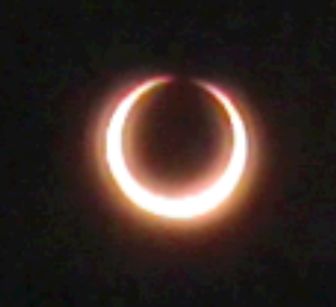
I wasn’t sure where I was going to be at the annular eclipse until 30 minutes before annularity began.
And I had just driven about 170 miles. The sky was mostly clear, finally; the partially eclipsed Sun in front of me was still too bright to clearly see that it was eclipsed. I saw one group at the side of the road, and I just swung off 50 yards from them.
Eight years before, I didn’t even know there was going to be an annular eclipse here, although I had known about the 2024 total eclipse for probably two decades. Annular eclipses are central, but here, the Moon is too far away (about 6,000 miles too far.) If you have had a recent “Supermoon,” a term I don’t particularly like, a full Moon that is close to Earth, the New Moon will then be far from the Earth, and if it covers the Sun, it will do so incompletely.
The first annular eclipse I ever saw was 4 January 1992. Before I left for San Diego, I told someone at the astronomy club what I was doing, and he said, “Annular, big deal. And you will probably be clouded out.” We didn’t care. It was a weekend in San Diego, and we would either see the eclipse or not. We weren’t true eclipse chasers, then, because if we had been, I would have been all over every source of weather information for eclipse day that I could find.
We went to Mt. Cube, to get up high, because we were at the end of the track, so close to the end, that if we were at ground level, we would miss it. The Moon started covering the Sun and annularity occurred as the Sun set through a cloud bank over the ocean. The colors were fabulous, and the picture of this annularity is recognizable from all others. We were with a small group of maybe 10, and unlike now, where people dot the road looking at an eclipse, nobody else was out there viewing.
Thirty minutes later, it was pouring rain.
We saw another annular in 1994 from Bisbee, Arizona, and a third from Costa Rica in clouds, barely visible, in 2001. I did get clouded out (pouring rain) in Iceland in 2003, but we saw the annular in Spain in 2005. We were on the coast near Javea, and on eclipse day, there was thick fog. We drove inland 10 miles to see the eclipse in sunny skies, with one other group near us and near busy traffic without anybody else’s showing interest. This particular eclipse was destined to re-occur 18 years and 10 1/3 days later, and given time zones and leap years, that would be 14 October 2023, a third of the world west of Spain, like the US.
In the intervening time, I saw an annular from Kenya, about eight minutes’ duration, in 2010, the same family as the first one in 1992. We saw the repeat of the 1994 eclipse in 2012, only the former was in the early morning and the latter was in late afternoon, both in Arizona. The last we saw from a hotel parking lot in Page. It was a hot afternoon, and eleven of us had access to an air conditioned lobby, It certainly beat being among several thousand below us about 500 vertical feet and 5 miles distant, from the LA Astronomical Society over Horseshoe Bend of the Colorado River. We were joined by Sergey, whom I met at the Kenya eclipse, and my wife rescued a pair of Swiss women who accidentally locked themselves out of their room from their balcony. The eclipse went well, nobody came out from the meeting in the hotel conference room. After the eclipse, we packed up and drove back to the South Rim that evening, just beating the traffic from Horseshoe Bend, cars parked for a half mile on either side of the road to the overlook.

he annular would begin shortly after 8 and would be annular between 0916 and 0920 in Eugene.
I start looking at the weather models 16 days out, just to get an idea of what the pattern would look like. All I get then is an idea of rain or no rain, and the weather did not look completely rain free. About a week out, I use Spot Wx to start getting an idea of cloudiness. The site is superb with cloud percentages, and one can look easily at many locations. From 10 days out the models go to 3 1/2, then 2, then 1. It became clear the few days prior to the eclipse that we wouldn’t have clear skies. I started to investigate other portions of the eclipse track and found better conditions east of the Cascade crest.
Two days before, Club hikes to see the eclipse were canceled due to cloudiness predicted. I heard that Eugene would be clouded out. Maybe, but maybe not, so I posted the following for general information:
“Tomorrow’s annular eclipse has not yet been clouded out. It ain’t over until it is over and you didn’t see it. This will be my 28th central eclipse trip (total + annular), and I’ve been successful 24 times. Several were successful at the last minute, including a hole that opened up in rain clouds at totality in China in 2009. Unreal. Or the amazing total eclipse in 2010 where we could see the conical shadow from the end of the track in Patagonia, and 10 minutes after totality it snowed. Or Siberia, in 1997, when the cloudiness lifted just in time for first contact. Or the annular in ’92 in San Diego, where the beautiful eclipsed Sun set in clouds into the Pacific Ocean and an hour later it poured rain….
“I don’t like to tell people what they should do. I just tell them what I am going to do, and why, and being an old geezer, I’ve been around long enough to have gotten lucky. A lot. I saw this annular series 3 Oct 2005 from Valencia, Spain, where we had to travel inland quickly to escape the fog on the coast. 18 years and 11 days later, it is back, 1/3 of the way west around the world. Why that happens is as beautiful as the sight itself.
“Fortune favors boldness.
“Anyway, just some thoughts.”
The night before, I was using the HRRR model, which has mile resolution. I had hoped for clear skies over the Cascade passes, only an hour and a quarter from my house, but by early morning, the only clear skies predicted were in Klamath Falls, so I was on the road early. My wife opted to avoid 350 miles of driving and took her chances here.
We were both pleased with what we got. She saw annularity from the house; I saw it in clear skies.

 Boreal B[l]og
Leave a comment