The final year I guided at Rowe Sanctuary, I seemed to be the only one who hadn’t seen a Whooping Crane. Many had seen them on the river; others who came into the Visitor’s Center saw Whoopers in the nearby fields as they drove in.
One night, I operated the Crane Cam and was able to put the camera on three Whoopers in the river at dusk. That was nice, but it was virtual seeing; anybody in the world could have seen it, at least the 1973 who had logged on.
I was a little jealous, but I try to be realistic; rare sightings in nature are just that: rare. If one shows up often enough in the right place, success is more likely. I had never seen Whoopers closeup, and while I hoped I might, I wasn’t expecting to. Low expectations coupled with willingness to try are good approaches to viewing wildlife.
As I arrived at the Visitor’s Center one morning, another volunteer flagged me down in the parking lot. She was an expert birder, one who frequently had seen Whoopers, in part because she was often in the right place at the right time. Experts find a way to do that. She came to the driver’s window and whispered somewhat conspiratorially to me:
“Mike, a half mile east of the Lowell Bridge, on the river.” I didn’t have to ask what.
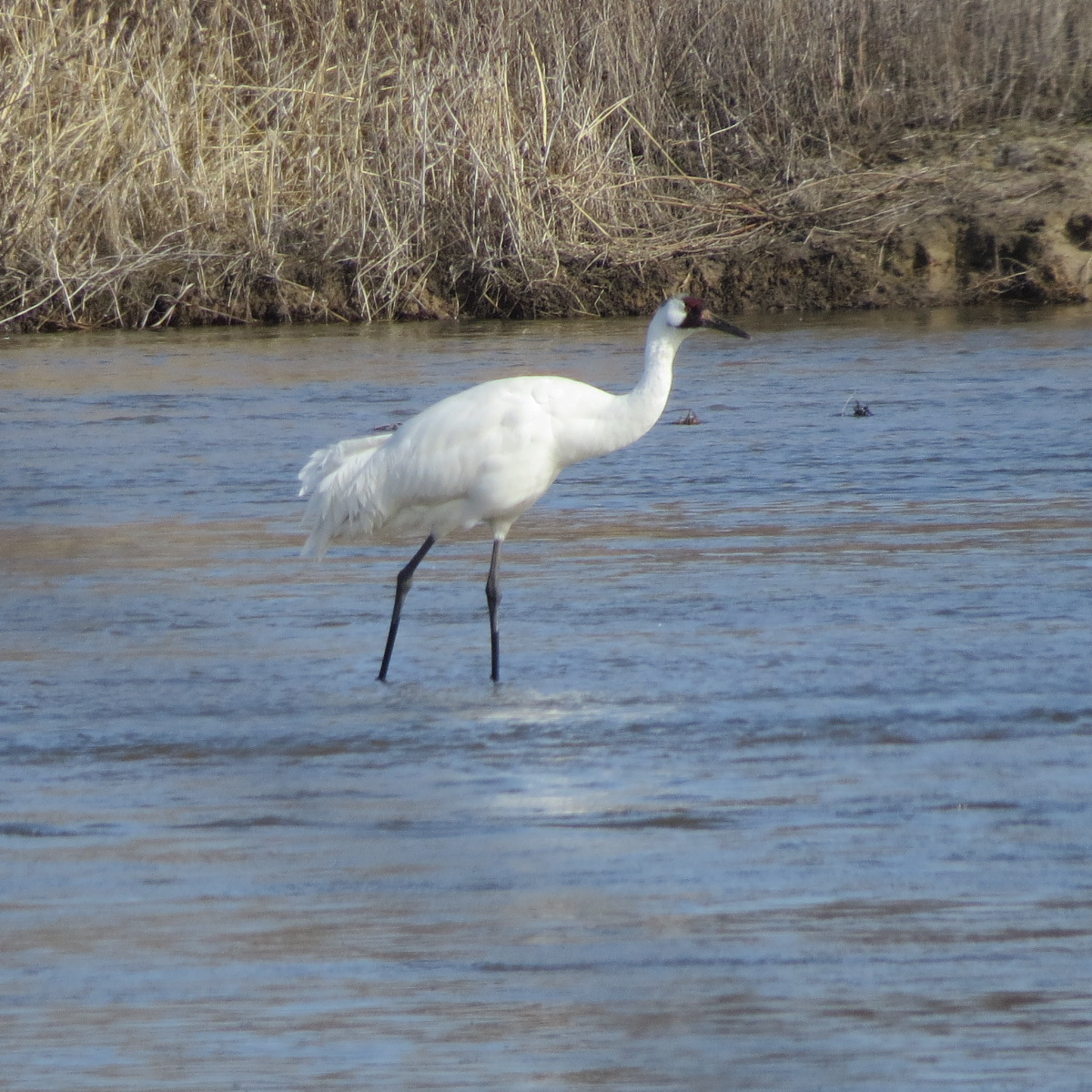
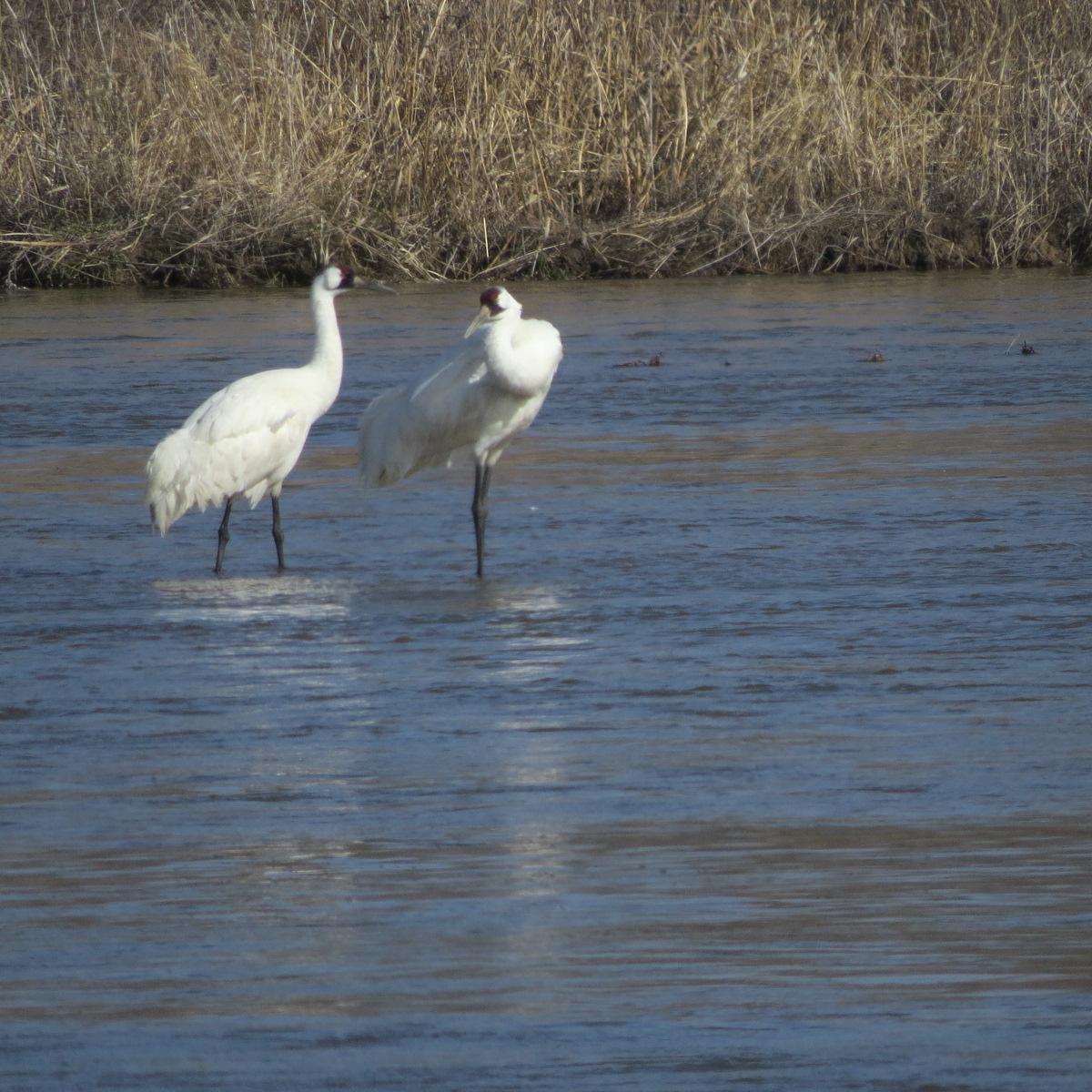
I did what one must do in those instances. Go. I drove forward, did a U turn, all the while computing where exactly I was going. Within five minutes, I had passed Lowell bridge and was on a dirt road heading east. I spotted two parked cars, a sign in Crane Country in spring that Whoopers are nearby. Four large white birds were in the middle of the river. The rules for viewing a crane from the road are simple: stay quiet, stay in the car, and don’t do anything stupid.
After years seeing tens of thousands of Lesser Sandhill cranes, I was struck by the far greater size of the Whoopers, with their striking white body, black legs and crown. I took some pictures, stayed quiet, stayed in the car, and did nothing stupid. I told myself this might never happen again, rolled up the window and quietly drove away.
I was at the right place at the right time by knowing the right person and having a bit of luck. Two minutes on either side, I might never had the experience.
The second to last day, I still looked for Whoopers from the viewing blinds. I didn’t expect to see any more, but I enjoyed observing the thousands of Sandhills, they and I waiting to see what the day and the river offered. I was viewing in perfect light; sunlight’s reflection off the cranes turned them into flying copper and the browns of the prairie grasses became pure gold. I watched the birds dancing on the river in front of me, upstream and downstream, bowing to and hopping over each other, circling, running towards and away from each other, individuals, pairs and groups dancing, when I suddenly saw, both out from the corner of my eyes and in front of me, the entire river rising and falling as one huge living wave of birds. The wave was remarkable, beautiful, unexpected, and brief, and then vanished. Two seconds.
It would be hours before I sorted out what happened. Frankly, the spiritual explanation of a “Gaia” river—a living river— seemed better at the time. The river rose and fell. I saw it happen, even if nobody else in the blind commented on it. Maybe I saw it because I am an expert in viewing cranes, and I was at the right place at the right time when the river rose and fell.
The late Paul Johnsgard, famous crane researcher and writer, wrote eloquently of a magical time when season (spring), river (Platte) and bird (Lesser Sandhill crane) came into conjunction. He was so right. I saw so many cranes dancing in so many places, in so many ways that at some point all the dancing became—if only for two seconds—a perfect wave. Experts are ready for the unexpected.
Two days later, I left the Platte, closing my tenth season, thrilled to have seen several Whooping cranes close up. It was a “finally” moment, which I never have again. But I had it once.
I expected the sighting east of Lowell Bridge would be the most vivid memory of my trip. But by being ready for the unexpected, my most memorable moment was two seconds the following morning when the living Platte danced before my eyes.


 Boreal B[l]og
Leave a comment