I dropped my pack by the sign at the bottom of Horsepasture Trail next to FS 1993, a narrow single track road that led one way 20-odd miles on occasional pavement and two other dirt roads back to main highway 126. The other way the road continued about two miles to where a landslide blocked it. The rest of the crew would join me in a few minutes, but we were ahead of schedule and nobody was in a hurry to get down. It felt good to have the pack off, the breeze cool my wet back after a day’s work clearing the logs off the trail to the summit.
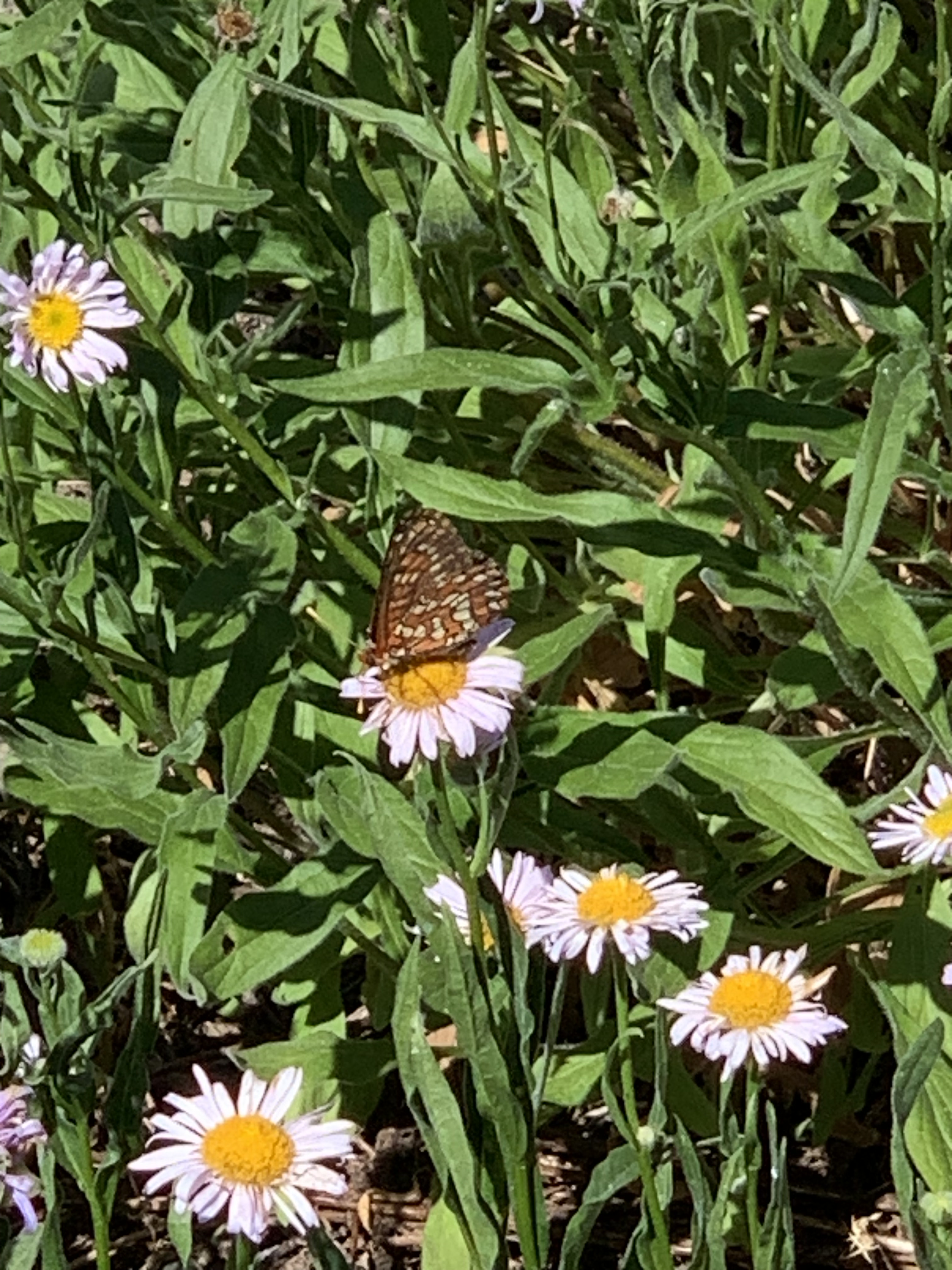
I walked over to a patch of Cascade Asters by the side of the road. They were filled with bees. That was good. While I am concerned about the yellow jackets later in the summer, I like seeing bees. We have wiped out many insects, and while few care for mosquitoes, we need Insecta in our lives. As I watched the bees, I put myself in let my thoughts wander mode.
These insects were living, not in designated wilderness, but where there were few visitors and the insects could live their lives—even if shortened by predators—without almost no human contact. Horsepasture trail joined Olallie Trail 100 yards in, to the right about 10 miles to Olallie Mountain, where I had worked the prior week; the other way about 6 miles to FS1993, near Horse Creek. Ironically, horses can’t come in here by trailer. I didn’t see Indian Paintbrush, Cascade or Mariposa Lilies down here like I did up top, but the asters were just fine.
A movement caught my eye, and a patterned black butterfly, a Variable Checkerspot, had landed on my thumb. It didn’t seem to mind what I was, just a landing or a resting place. It stayed there for the better part of a minute before flying to an Oxeye Daisy. I watched it flit from flower to flower. It didn’t appear to be in a hurry, either, like me. I can watch little things in nature—and some big ones, too—for an extended time. I once spent 15 minutes observing an ant carry a pine needle. That was in wilderness, and there wasn’t anybody else there that day, either. On a lazy summer’s day in the Boundary Waters, I have watched many an eagle soar out of sight among the clouds.
My animal sightings are often minor in the current age of seeking uniqueness. What isn’t minor about many of these sightings are the memories have stayed with me for years: watching a porcupine’s feeding by Jackson Lake one night in 1971; crows by a stream feeding their large, demanding young at Glacier Bay in 1988; watching a butterfly exit from a chrysalis seventy years ago in Crow Lake, Ontario; my first meteor sighting one night from one of the Finger Lakes; a beaver I snuck up to see while in a canoe on Kekakabic Lake. I then backed away and left it alone. During a “working” canoe trip to rate all 47 campsites on Lake Insula on categories from landing to latrines, my wife and I had a hermit thrush visit us in the middle of our campsite one afternoon. We stayed quiet until it left. Hermit thrushes are worth remembering, especially their song. I remember deep down on the Tonto Platform of the South Rim of the Canyon hearing a raven’s call echo off the curve of the Redwall Limestone known as The Abyss.
I’m analytical. I know that the deepest blue sky is about 95 degrees upward from a low sun. I enjoy seeking out that deepest blue, If I know where to look, I can spot Venus in daylight, a small golden dot. I follow the Moon through its phases and relative height above the horizon, as well as the angle the crescent makes with the horizon. They all change and are predictable. As for wind, in familiar country, I try to identify the tree by the sound the wind makes blowing through it. I also note wind direction, especially when it is strong from the south or southwest, harbinger of a storm.
The rest of the crew was starting to show up; the Variable Checkerspot had long since left. Time to leave this area of curious butterflies and a reminder of other special places.
See you on the trail.
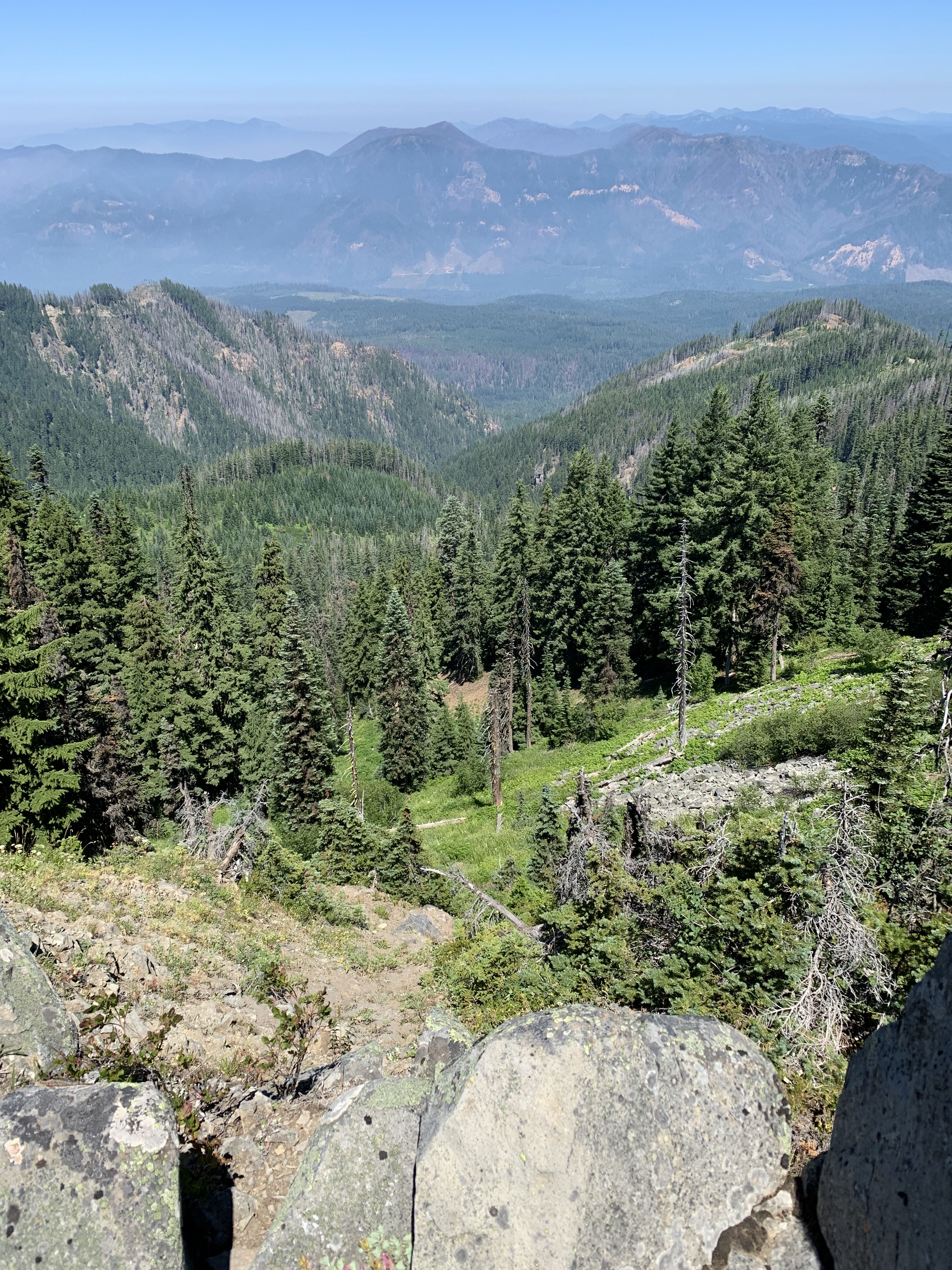
View from top of Horsepasture Mountain.
 Boreal B[l]og
Leave a comment