I left my campsite on Conmee Lake, deep in the Canadian Quetico, on a day threatening rain, a long paddle and some tough portages ahead of me. As I left the bay, I paddled by a tiny 18 inch tree growing out of a crack in the granite along the shore. Its few leaves absolutely loaded with color, as if to say, “I’m small, I don’t have great soil, but I am the most colorful spot on this shore.” It was.
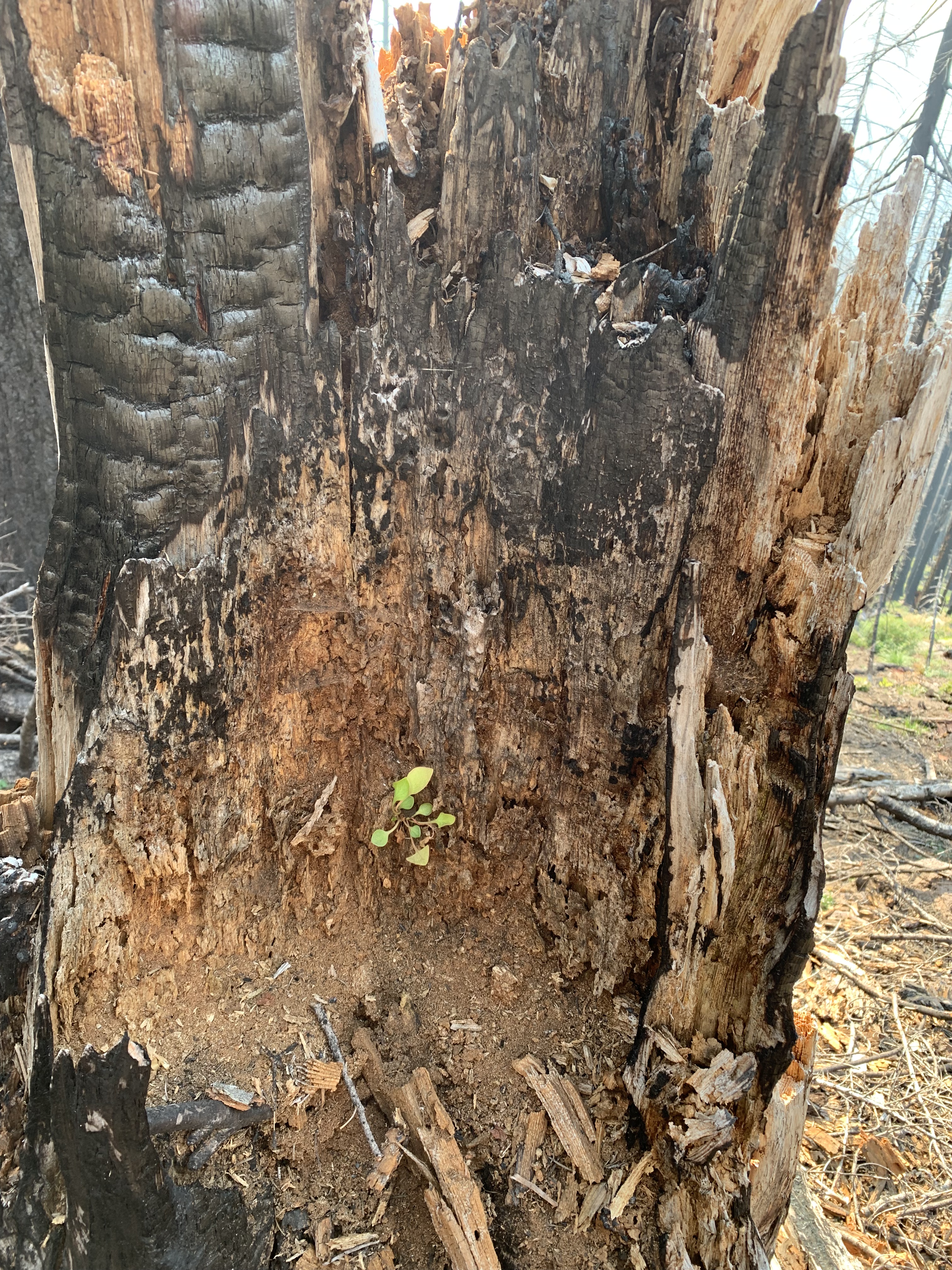
On Bunchgrass Trail this past fall, 2 years after the Cedar Creek fire, part of the in-progress-for-a-long-time Eugene to (Pacific) Crest Trail, I saw a tiny spot of green on a burned out stump several feet off the ground. I stopped and looked more closely. Yes, it was real. Just a few centimeters of plant, growing out of wood, eight small leaves. All the green I had previously seen on Bunchgrass was scattered plant life by the trail. Everything else was black, brown, gray or whitish gray, sterile.

Plant life on dead trees means bacteria are present to break down wood to recover nitrogen needed for amino acids and subsequent protein synthesis. Not everything was sterile here.
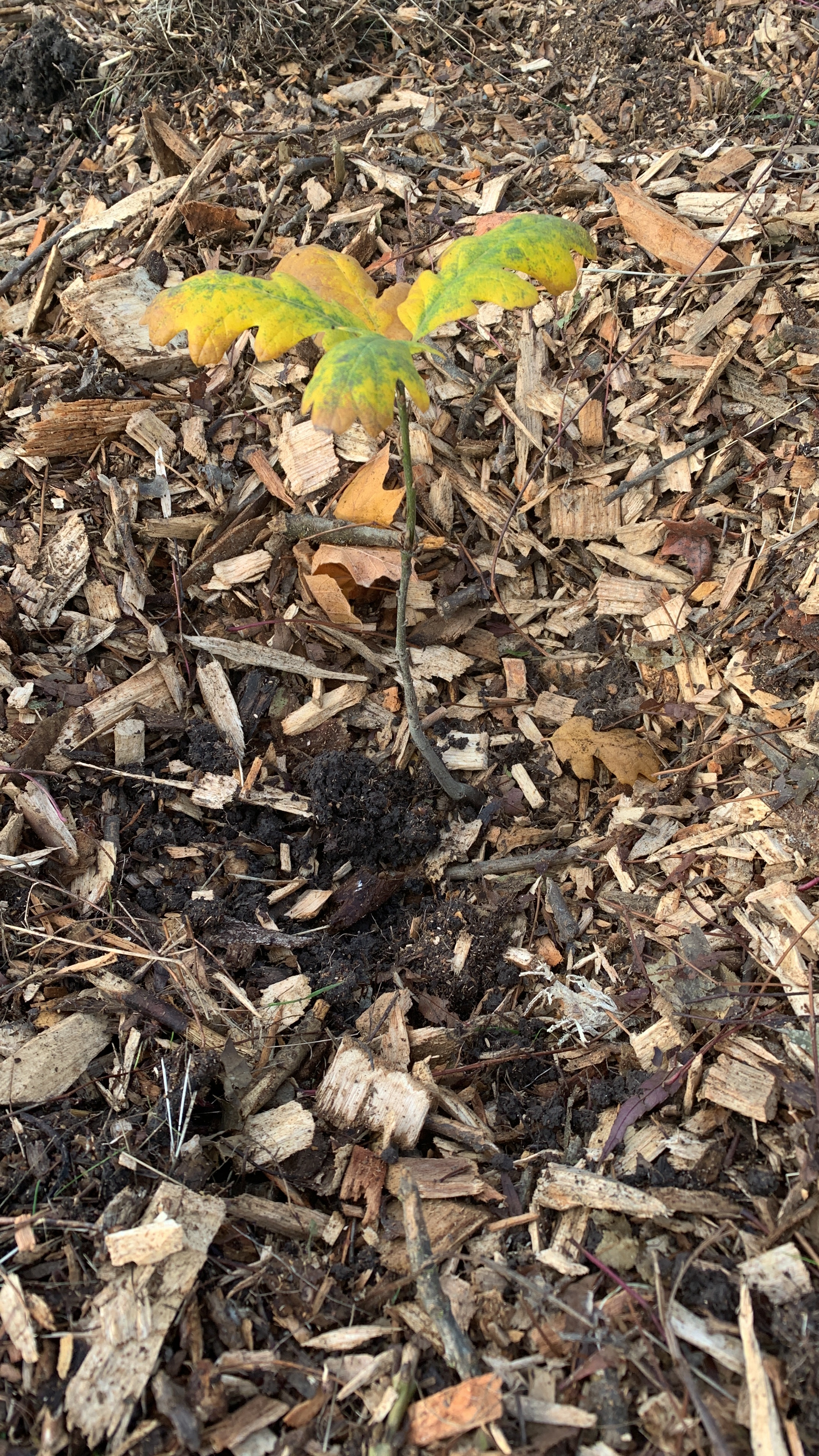
Two months later, I planted a white oak in Bethel Park. It had two leaves, each patchy green and yellow, but next year there will be several more. I thought about chlorophyll and took an intellectual adventure similar to the one I had last year when I studied tides, learning about the remarkable relationship among tides, gravity, and centripetal force, each inversely proportional to the radius cubed, squared, and first power, respectively.
Chlorophyll is life giving. It is comprised in part of four pyrrole rings, a porphyrin, containing carbon, hydrogen, oxygen, and nitrogen, with a magnesium atom present in the center, essential for photosynthesis. When chlorophyll degenerates in autumn, aromatic flavonoid and anthocyanin remain and we see their color.
Across the divide to animals, oxygen carrying is done by heme in vertebrates or hemocyanin in earlier phyla. Heme, part of the substance hemoglobin, is another such porphyrin complex, the complex itself chemically identical to chlorophyll, except iron, rather than magnesium, is the central metal. Iron carries oxygen, to a lesser extent carbon dioxide, and has great affinity for carbon monoxide, CO, which is why we have smoke alarms, since CO displaces oxygen in heme.
Hemocyanin has a different type of chemical ring, still 5 sided, with another nitrogen, and copper is a the central metal chelated here. When copper combines with oxygen, it turns blue, explaining the blue blood of arthropods and mollusks.
There is another metal: cobalt. When it is present in similar metalloporphyrin complexes, we have methyl cyanocobalamin, the synthetic version we call Vitamin B12, essential for our existence. Here are chemical rings chelated with four different metals. I knew about magnesium and iron; l didn’t know about copper and cobalt. In some bacteria nickel has been involved, zinc chelation is an organic photosensitizer, and metalloporphyrins are extensively studied.
Iron is fascinating stuff. The Sun will never make iron, ending up ultimately as carbon and oxygen white dwarf. Larger and hotter stars, however, fuse smaller elements all the way to nickel, which quickly degenerates to iron. Fusion ends here; iron is stable. Star size is a balance between heat expansion and gravitational contraction; when fusion stops, expansion stops, the star core collapses upon itself and explodes, a supernova, releasing energy that will fuse the other 66 natural elements. That’s where the iron in our blood came from. The Sun is not a first generation star; we are, as Carl Sagan said, made of starstuff.
The plant on Bunchgrass was a small speck of green, a magnesium electron transfer engine, made of star stuff, to make sugars and other carbon based compounds. There is a remarkable interconnected beauty of the universe and us.
And a small plant at five thousand feet.
See you on the trail.
 Boreal B[l]og
Leave a comment