The rocks seemed like they would never end. I was digging into the lighter brown mineral soil, small rocks kept appearing which we didn’t want on the trail.
The Crew was working in Cloverpatch, five on the third bridge, which now had stringers across Tire Creek, rushing after the recent rain, seven on the trail to the fourth and last bridge site. The stringers weren’t ready to walk across, so I waded through foot deep water quickly to the other side. My gaiters worked well; I had no sensation of wetness.
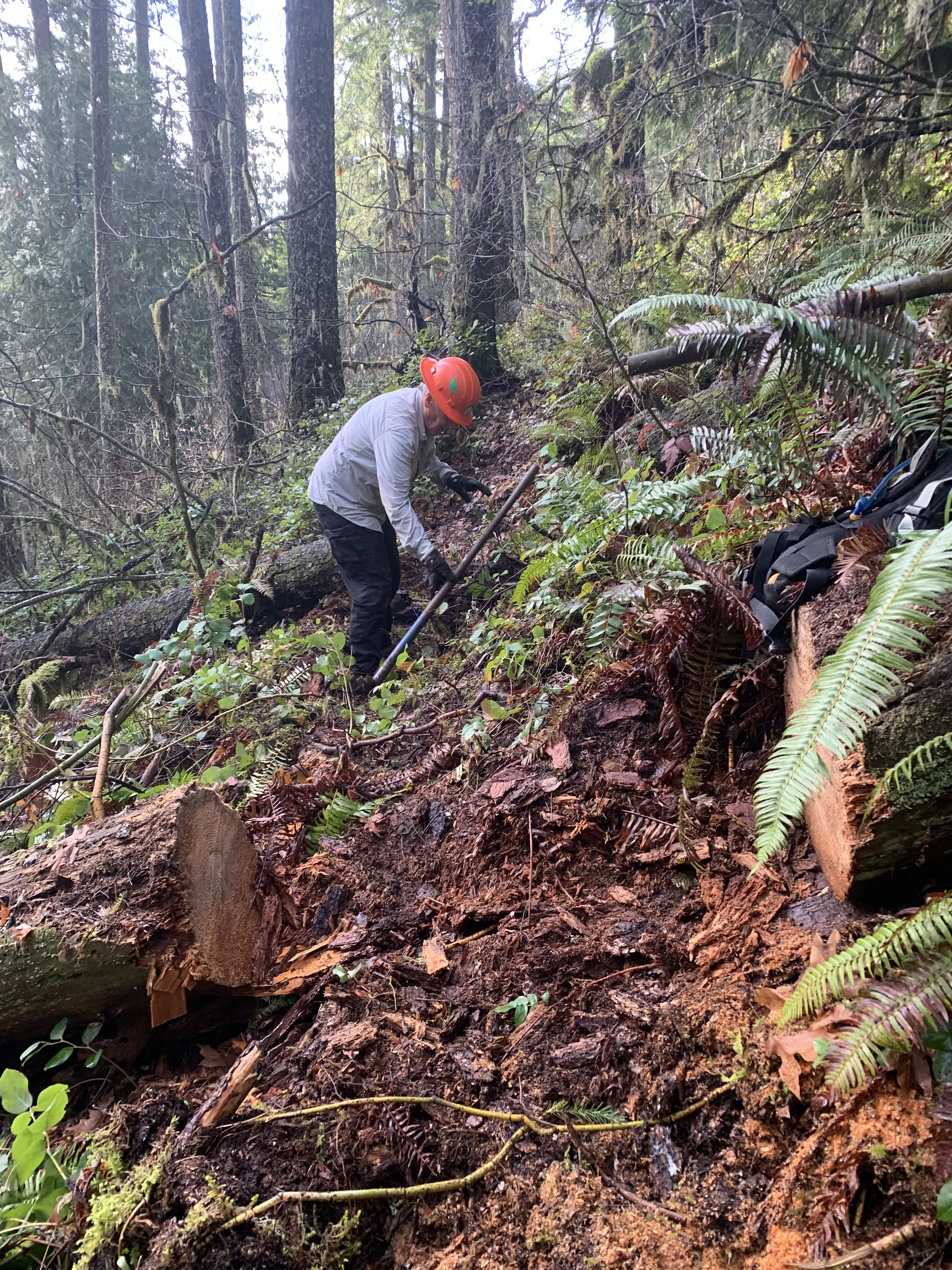
I took the group a quarter mile further to work on the trail that had been flagged to the last bridge, a half mile further. Flagging meant someone had bushwhacked and put small flags on metal rods in the ground, marking a proto-trail, eventually to become a mountain bike trail. To make the actual trail, we had to remove large brush to get access to the ground, then plants so that the tread would be a yard wide, cut out roots and branches with hand saws, loppers, or tread tools, then scrape away organic detritus to the mineral subsoil, pushing the former off the trail. Digging uncovered rocks, some we couldn’t remove, others could be after several minutes, but many smaller ones kept appearing. The week before, eight of us cleared a couple hundred yards. I doubted seven of us today would get nearly that far.
The trail went uphill and side hilled, sometimes constraining the width sub-optimally. We then dug into the hillside, encountering more rocks, more dirt, and more plants.
I had noted rotten logs in the trail under which I was able to work a tread tool to lift parts of them out. In the logs, I noted long stems of plant life, parallel to the grain. It was one of those new, odd things that I saw before moving on. I was bent over, and sometimes, to be easier on my back, I knelt on the trail to have better ability to use the Rinehart tool to move the organic duff and pick out rocks by hand.
But I kept seeing rotten logs and roots. Finally, taking a longer, closer look, I saw how the stems had split the log longitudinally with smaller roots intertwined, like capillaries, with the rotten, still wet, wood. Cellulose and lignin are the two most common organic compounds in wood. These are glucose polymers—chains of connected glucose molecules— containing carbon, hydrogen, and oxygen. The non-cellulose parts have proteins, built with amino acids, organic acids with an amine group at the alpha-carbon, the one that is not the acid (-COOH ) portion. Glycine, the simplest, is vinegar (CH3COOH) with a methyl hydrogen replaced by an amino (-NH2) group. Twenty different amino acids are found in our proteins, 9 essential or required in our diet. Cells in rotten wood contain potential nutrients: nucleic acids have nitrogen, sulfur, and phosphorus. Other minerals are magnesium, essential for chlorophyll, potassium, and calcium.
Capillary is both a noun and an adjective. Capillary action is the ability of water to rise in a narrow tube due to attraction between the water molecules and the sides of the tube. It is an important way to transport water upwards through the xylem along with transpiration pull from the leaves.
By kneeling on the ground and moving much of it, I learned about the two forms of capillary and how the minerals present were being used to form new organic compounds that will appear in many phyla in both plants and animals in the area.
See you on the trail. Unless you are working trail, please leave no trace.

 Boreal B[l]og
Leave a comment