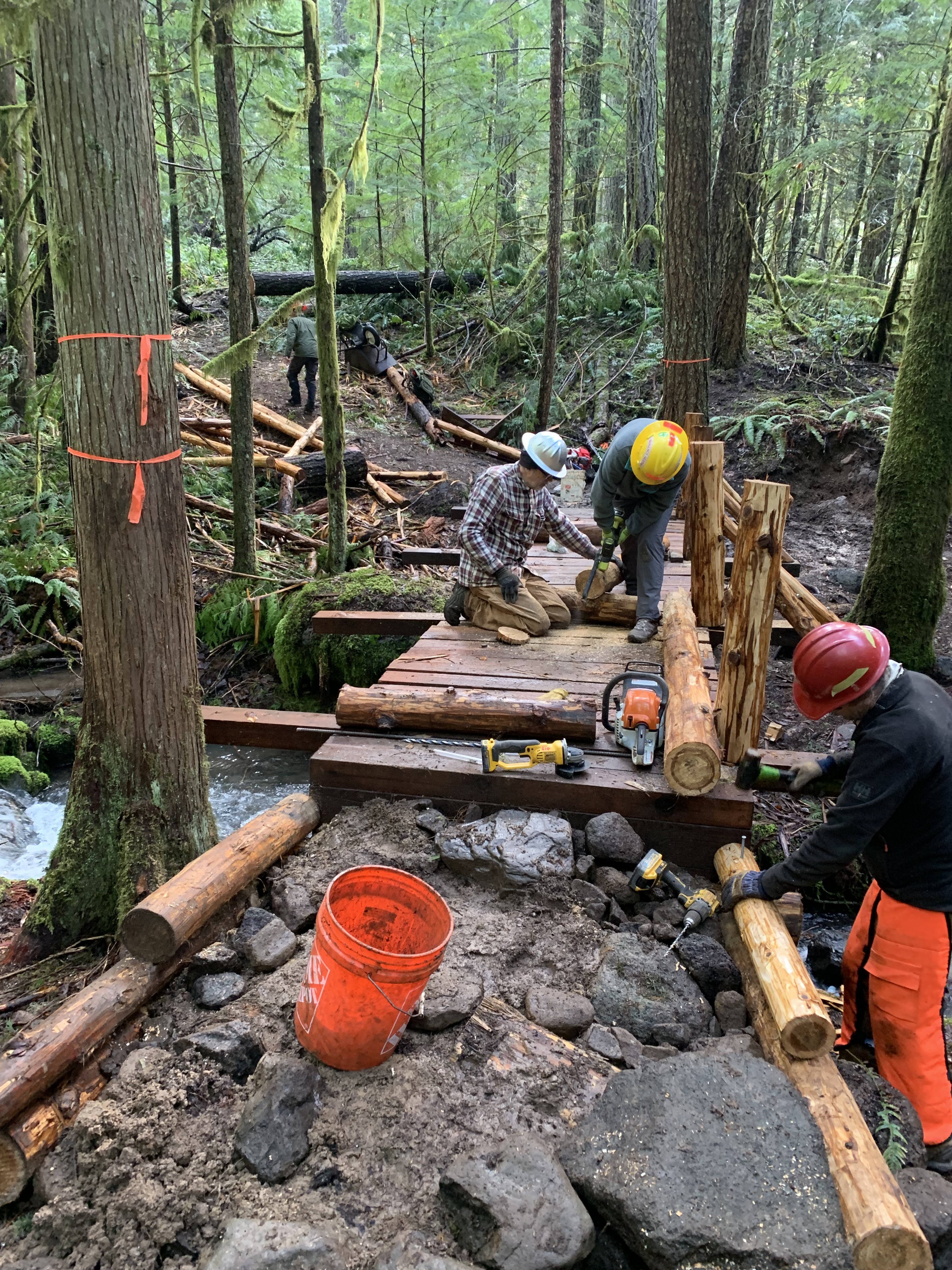
Amazingly, it wasn’t raining, despite the forecast. It sure was wet in the woods, though, and the two streams that we had put bridges across in the past 16 months were really flowing. The Crew was back at Cloverpatch working on the third bridge.
I had already done some work here, having carried in my share of tools, planks, and one memorable day figured out how to use a small log as a runner for a 1-2 ton stringer to get it to the bridge site. But the last few times out, I was either relegated to, or had the honor of, being the lead for the work party building the trail to the next and last bridge site, a half mile further. After three days with tread tools there we were now within about 50 feet of the end, maybe a bit more given some rerouting that I thought might be necessary.
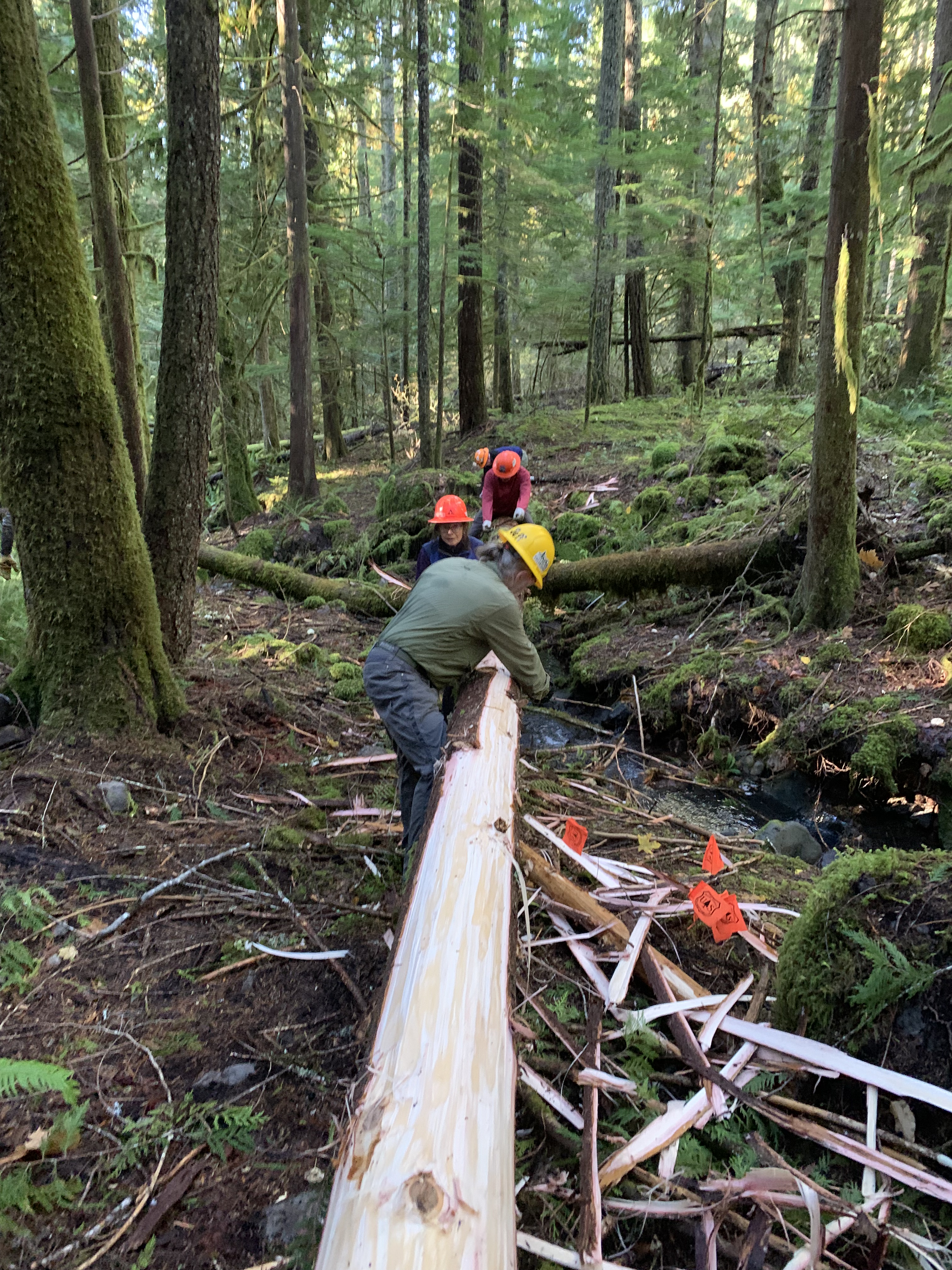
But on this wet day, I stayed with the rest of the eight person crew, hiking in, debarking cedar logs that would be used for stringers, posts, supports, and rails, a couple hundred linear feet required. Counting the posts, that comprised about 1000 square feet of bark that needing removal, although I was the only one crazy enough to calculate that.
Additionally, we had rock “cribs” needing filling so stringers and sills, the latter large diameter shorter length logs perpendicular to the crossing stringers, would rest minimizing wetness and rotting. We needed to make a ramp at each end for smooth travel at both ends of the 21 foot long bridge. This entailed more rocks, soil to fill in the spaces, and repeating until we had a smooth ramp.
I used a straight draw knife, sharp 10 inch blade, couple inches wide, beveled, handle at each end. Grabbing each handle, one straddled the log, leaned forward, put the blade under the bark, and pulled towards oneself, strips of bark peeling off. In the right season, strips could be several feet long, but this time of year two feet was good. We cut down to the cambium, worked our way down the log, and rotated it, continuing. I debarked a 12 and a 25 footer and then took a break collecting rocks, which were plentiful in the Tire Creek area. I had filled the lower two feet of the crib several weeks ago mostly by myself. Now, the rocks needed to go above the sills to support the ramp, to take up volume, each rock removing the need for the equivalent volume of mineral soil.
I was not the strongest. Jeff was carrying rocks I would roll, and in some instances he stopped to talk while carrying. Wow. My legs were good, so I could still do my part by carrying smaller rocks with more trips, taking time from that task to knock some rocks out of a root wad with a shovel. Before I knew it, time for lunch. I was beat. Rock work does that.
After eating, I rolled left and gradually stood, now needing to move rocks to the crib on the other side of the bridge. There were no rock shortages there, the distance shorter, but the weight the same. Most of the crew was about a decade younger than I, although Chris was only a year younger. He may be a little slower the past two years, but so am I; there is nothing wrong with his arm strength.
We didn’t finish, which would require more visits, and hiked out a mile and a half with plenty of uphill. For the first part, in addition to my pack, I carried only a light strap. Easy enough. I caught up with Hal, who had stopped, putting down 20 yards of coiled cable for a no longer needed come-a-long. I was polite, asking if he wanted to trade the cable for my light strap. I expected—and hoped—he would say he was fine.
“Would you? To the top of the next hill?” Crap. He’s serious.
I picked up the cable, coiled, 35 pounds plus. I let my right arm take the weight, and I started up the hill. My hiking speed dropped like a stone, and I went uphill about the same rate I could push one. But I was going to carry it up the hill, and once I got there, I wasn’t going to relinquish it. I would carry it to the trailhead.
I did make it. I finally felt useful; perhaps this will be another good year.
 Boreal B[l]og
Leave a comment