For the tenth time that day, we stop at a log to remove it from the trail. Each of us finds a spot to drop our pack, maybe before the log, because we want to get rid of the weight and bulk before clambering over the log, or perhaps after, so we don’t have to backtrack when we finish to get the pack. Placement sometimes requires later movement to prevent the cut log, a round, from running over it. Before dropping my pack, I need to put down what else I am carrying, usually an axe or a Pulaski, sometimes a large crosscut saw or a pry bar, then take off my gloves, unbuckle the hip belt and the chest strap, the latter often closer to my neck. Then I drop the pack directly through both arms or remove one arm strap and allow the pack to swing, whereupon I grab it, remove my other arm, then more gently lower the pack.
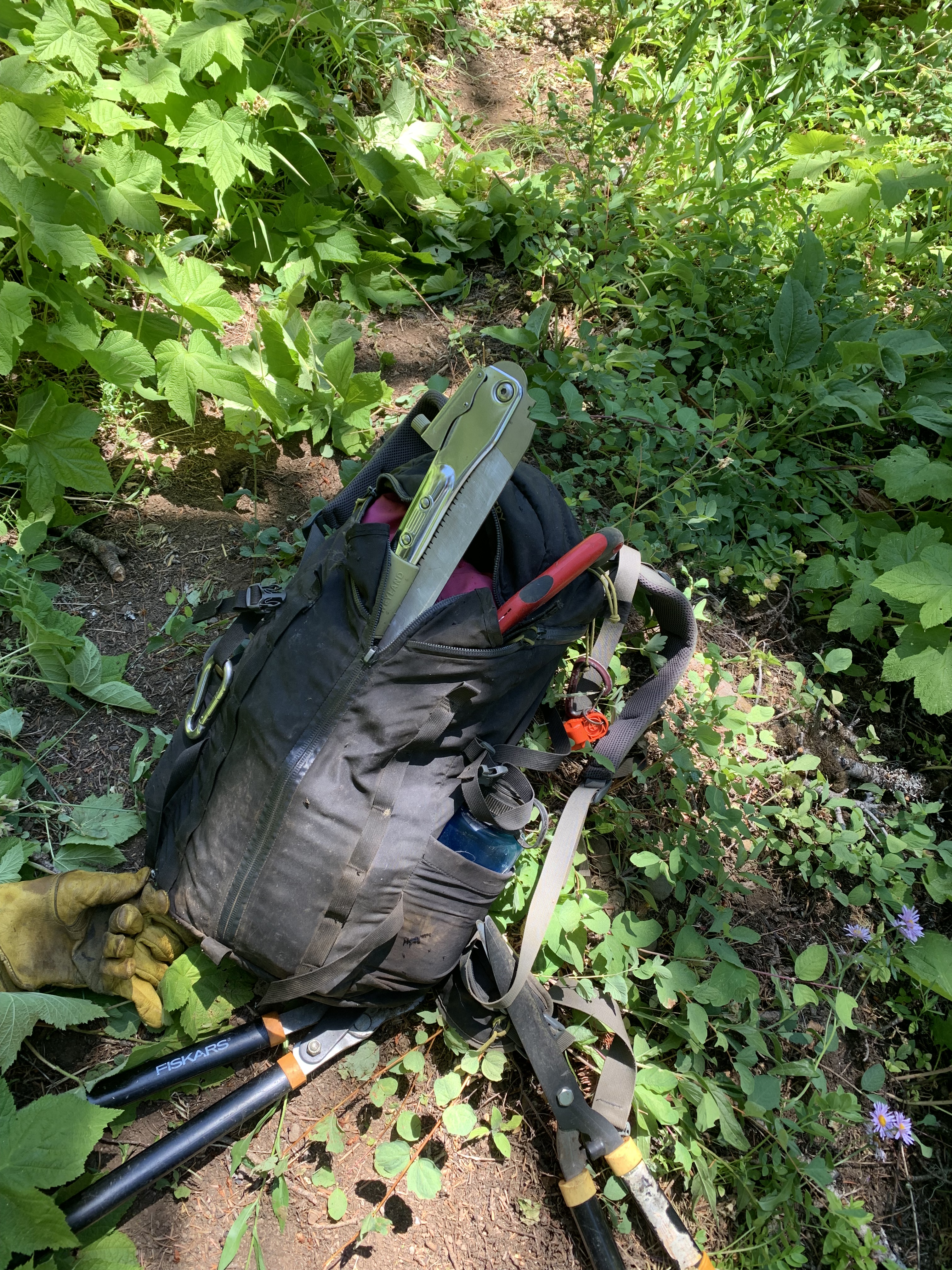
I have a Corona hand saw and a larger 500 mm KatanaBoy saw in the back of my pack that I want available, so I put my gloves back on and pull the two saws out. These, along with a Fiskars handsaw in my pocket, are used to trim branches or finish the cut, when the big saw is close to the ground and we don’t want its teeth to have contact, which will dull them. If I am carrying a crosscut saw, there are three velcro straps or buckles that have to be undone to free the saw from the blade guard. I try to do that with my gloves on, but sometimes I can’t.
I also carry three or four hard plastic wedges in my shirt and pants pocket for the cut. Last thing I want to do when cutting is stop, go to my pack or someone else’s and hunt for them. It’s more bulk to carry, but they are nice to have ready. Wedges keep the kerf—the cut—open and lessen saw binding.
After finishing the cut, which may take a few minutes or a few hours, we sheath the big saw, which on a good day can be done with gloves on and velcro’s behaving. On a bad day, the velcro has to be pried apart, the scabbard won’t line up properly, we put the saw on in the wrong direction, and the gloves have to come off again. Then I put my Katana in the pack, then the Corona, hopefully lining it up with its scabbard inside the pack, a 50-50 chance, which shouldn’t be if I could remember the whole day which way the scabbard curves, zip up the pack, pick it up with one strap and put it on. I now have to make a decision: if I think the next log is a minute or two away, I won’t bother with the hip and chest straps, and I keep the gloves off. Or, if I know from a scouting report the next log is some distance, or I guess right, I buckle up, but that’s a good day. I have to buckle the chest strap by feel, which may take one or many more attempts. If I decide to buckle up and the next log is around the corner, I have wasted energy and time. If I don’t buckle up and the next log is more than a couple hundred yards, I am going to have to stop, because carrying the pack unbuckled becomes uncomfortable. I usually keep my gloves on, because often there is something small that might need my pocket saw, unless I accidentally drop it or leave it somewhere. When one stops ten or more times a day, it is moving a lot of weight and taking a lot of decision making time that generates more fatigue. Other than that, logging out a trail work is just a day hike, with maybe 10-15 pounds extra gear, cutting a bunch of logs, moving the rounds off the trail by pushing with hands or feet, and going to the next one.
Maybe it’s a bit more than a day hike.

 Boreal B[l]og
Leave a comment