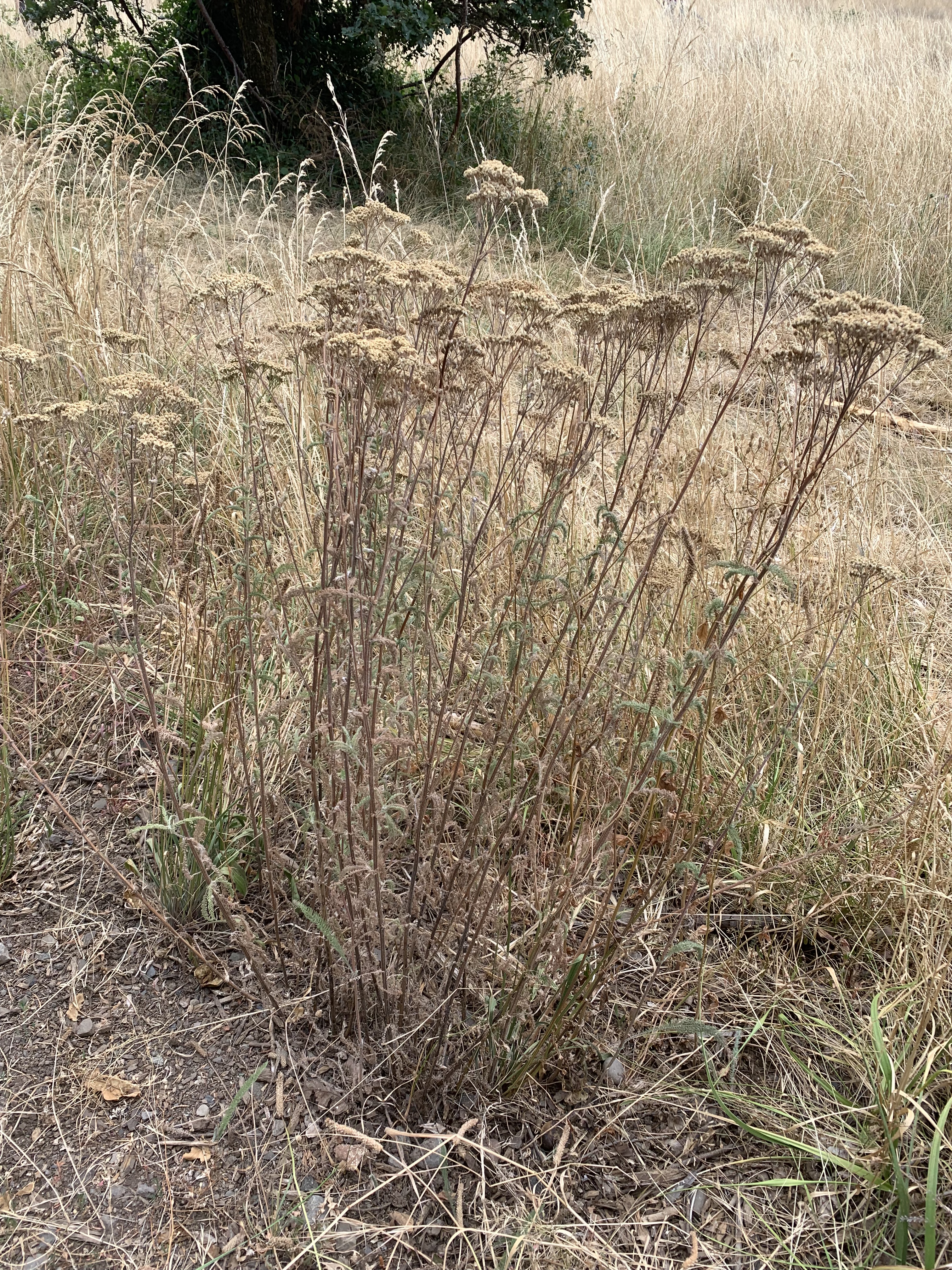
“Hey Mike,” Patrick called over, holding up a bunch of brittle brown stems. “This is yarrow. You can leave it.”
Blast it, I said to myself. I had looked at it, figured it was Queen Anne’s lace gone to seed and pulled it out. “You know, I wondered about that,” I said, “but it pulled out the way Queen Anne’s Lace did.”
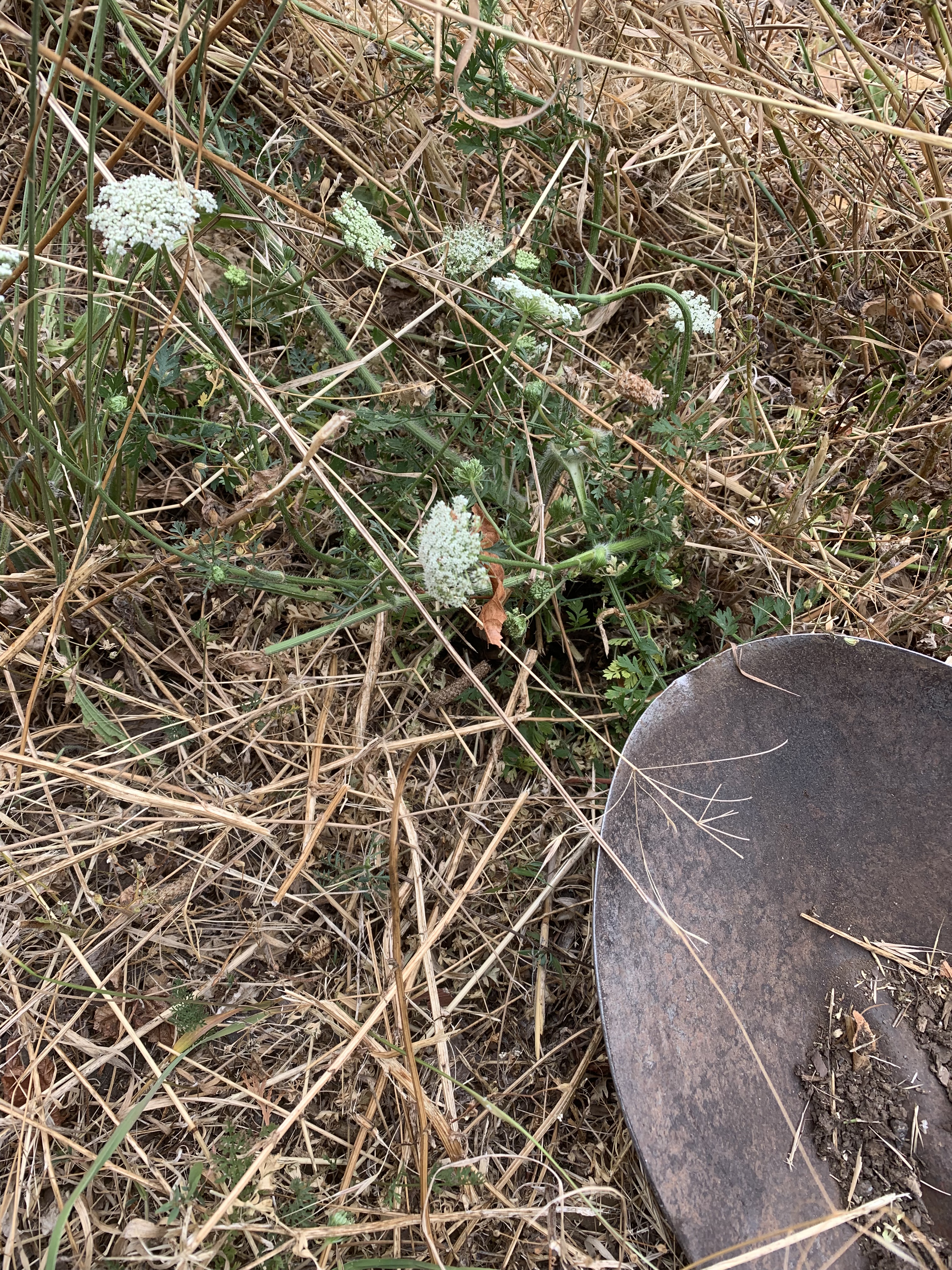
Chastened, I returned to work just below the gravel road at the Arboretum, in the brown grass, where real flowering Queen Anne’s lace needed removal. My job as one of several volunteers was to clear five or six meadows, each a few acres, of that, tansy ragwort, and Canada thistle. Queen Anne’s lace, 90% of what we were pulling out, is an invasive successful competitor, tansy ragwort is toxic to animals, and Canada thistle is also invasive. The first two are biennial; thistle perennial. We will need to do weeding next year in order to fully control the biennials.
I had just learned something about yarrow, because while I had seen plenty of the white blooms, I wasn’t familiar with yarrow that had gone to seed, a polite way to admit I had been around yarrow that had gone to seed but hadn’t noticed. The blooms had faded to brown, but the yarrow flower structures were still present. Had I looked at the flowers more carefully, I would have noticed the difference and besides, Queen Anne’s lace was still blooming. None appeared past the blooming stage. While true yarrow stems were the same size as Queen Anne’s lace and easy to remove, that was irrelevant.
We are pattern recognizers. It allows us to perform quickly and efficiently much of the time. But sometimes the familiar seen in unfamiliar surroundings can fool us. It reminded me of 24 years ago on a train trip back from a solar eclipse where that evening I saw an odd arc of stars just clearing the northern horizon over Zambia. It took me a while to realize it was the handle/spout of the Big Dipper, an asterism I knew well, the southern part of which was just visible from where I was at 16ºS., but had never seen in such circumstances. The stargazing I did south of the equator usually was focused on objects I couldn’t see from home. I stared at the handle for a long time.
I remember fields full of Queen Anne’s lace when I was a kid, but I didn’t see much of it afterwards. I was not consciously aware of its being called wild carrot because of its pale carrot-like tap root. I think I would have remembered. But perhaps not. As I worked, I developed a sense of what I had to dig up, how deep, how far around, what I could pull out just by hand, oddly using my non-dominant left hand as a decent lever that would either pull the plant out or not, whereas my dominant stronger right hand would often break the plant off above the ground and not be as helpful.
I noted the smallest Queen Anne’s lace flowers often bloomed from the same rosette of leaves. Once I discovered that relationship, I tried to remove the whole base along with its single large taproot, not each individual flower. Small free standing plants I could carefully remove with my “calibrated” left hand. Medium-sized plants I could comfortably pull out with either hand, and the larger ones I needed a shovel to clear out slightly more than 180 degrees around to pull them out. Six of us there cleared two acres, putting the removed plants in a large plastic bag, thicker than the one we used two weeks earlier, which ripped early and often, spilling seeds.
Back home the next day, Alton Baker Park was a sea of white Queen Anne’s lace. I looked at the flowers differently from the way I had before. I left these alone, more interested in picking blackberries from another invasive plant. I tried to visualize the number of tap roots out there. I like the smell, which reminds me of my childhood three thousand miles to the east.
Maybe see you on an Arboretum trail sometime.


 Boreal B[l]og
Leave a comment