My morning walk through Alton Baker Park was abbreviated because of foot issues, so I took a shorter route through a quiet neighborhood. I could do laps if I felt better than usual, but I missed walking further in wide open spaces I could see just a quarter mile away. I passed by a shaded curb at a corner, heading west….
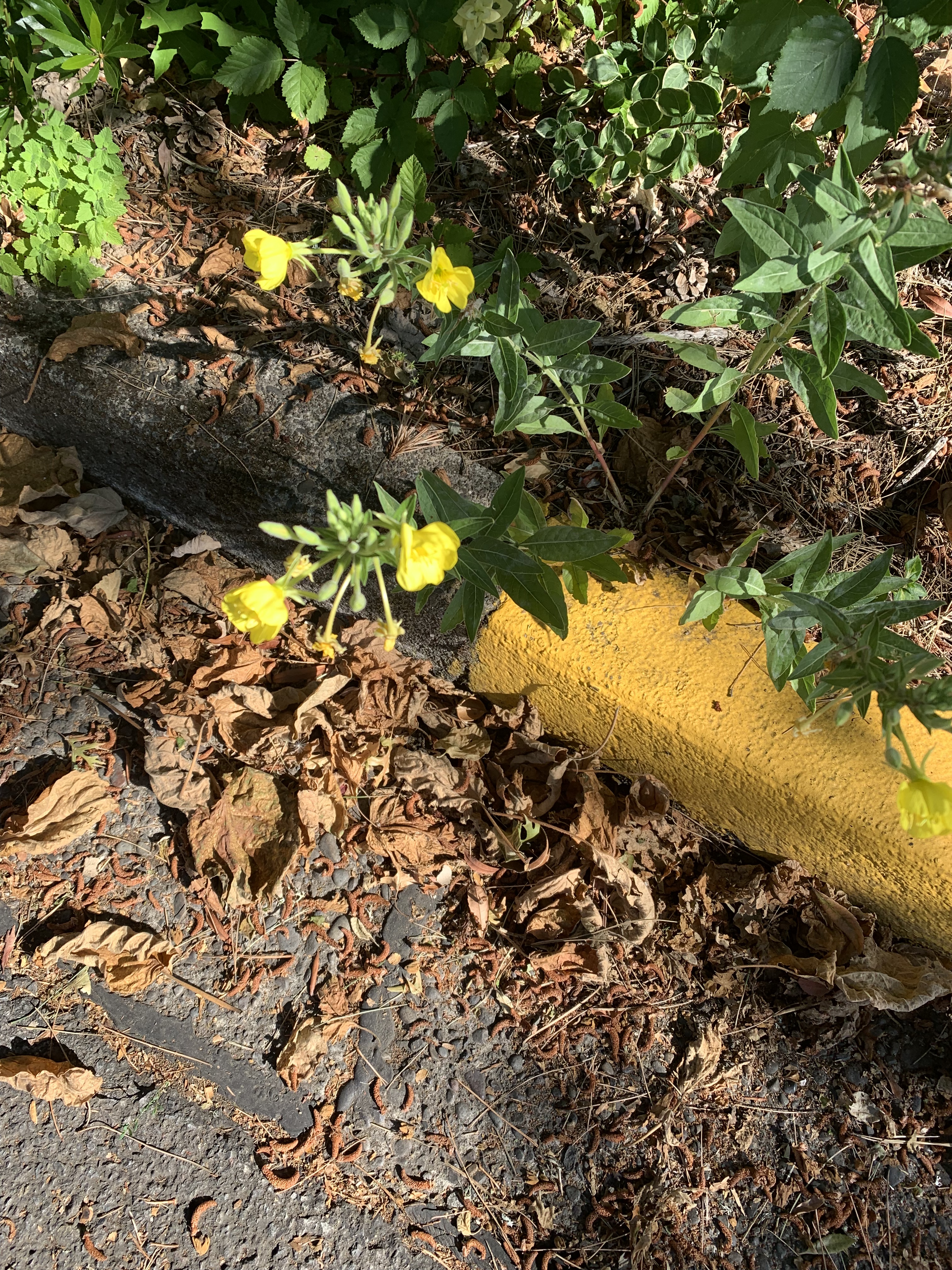
And stopped. I turned around. There was a yellow flower on a stalk, not a common mullein, because it had four petals; however, it was definitely, not a mustard. I smelled it but didn’t notice anything, although my nose was a little stuffy. I wasn’t totally sure what it was, but if I had to make a call, I would have said it was an evening primrose (Oenothera biennis.)
I hadn’t seen a primrose in years, and I don’t know what limbic system-visual cortex-association cortex process made me so sure I knew what the flower was. I sensed it, and after I went home and looked it up, turned out I was right. I returned to smell the primrose, this time finding the slightest hint of a lemony odor. A few days later, 100 yards away, along a path leading to the park, I saw a second plant. I had walked there numerous times, including recently. I had to have gone by the primrose but didn’t notice it. I hadn’t even sensed it. But rather than beating up on myself for my lack of noticing—after all, I think of many things on a walk—I eventually noticed. That’s better than never. It took me decades to learn when my wife asked me about a problem, she wasn’t necessarily telling me I must fix it. Sometimes, she only wanted me to listen. Imagine that. I eventually figured it out. Yes, I’m slow, but there are some who never figure it out. I was late arriving at the show, but at least I got there. Some never do.
There are several other lessons. Curiosity about the surrounding world enhances life, and it’s like reading, nature, languages, music, art and so much else. The younger you are when exposed, the better the development. Sometimes a minor observation doesn’t become important until much later, perhaps a connection occurs at 2 a.m., which it often does for me. It helps to believe a routine outdoor walk may turn up an interesting surprise or observation, without expecting such to occur.I spent time on Isle Royale one night looking across Feldmann Lake in vain for a split second wolf sighting. A few hours later, I had a wolf in my campsite for 5 minutes. A seemingly unimportant occurrence may become the beginning of an unexpected chain of events, when remarkable subconscious associations form. Eight green leaves on a dead, burned log eventually led to my writing about how chlorophyll and heme have a chemically identical key structure with only the central metal different (magnesium vs. iron). One can’t force this; while some days are—let’s face it— routine, seemingly empty of notable occurrences, it is possible any day can provide a not-yet-appreciated key observation that combines with a future event to produce something special. Experiences are not wasted.

In my walks, I have seen maybe 30-40 species of birds; I’m not a great birder. Still, some of the birds were a red bellied sapsucker, Pileated woodpecker, a heron’s trying unsuccessfully to swallow a fish, a rough legged hawk, and a turkey vulture on the ground a few feet away finishing off a squirrel carcass. I spent fifteen minutes one day watching a crow up in a tree drop nuts on a quiet street to break them.

During the pandemic, I took five mile walks, and in spring and early summer, routinely counted fifty species of wildflowers. One day, I saw a Fawn Lily growing under a bench right by the Willamette River. I had seen them only up on Spencer Butte. I do better with flowers than birds, maybe because as an amateur astronomer I like things that don’t disappear just as I get them focused on my retina.
À propos to disappearing birds: recently, I went to see the semiannual Vaux Swift migration. This is my fourth year and wish I had started sooner. For several evenings, across the street from Hayward Field, home of Track and Field championships, Agate Hall, an old building with a defunct chimney, is a migratory stop for swifts. Twice a year, fall and spring, people gather for a chimney vigil. There was no guarantee anything would happen, in which case it still would have been a pleasant evening with a crescent Moon very low in the sky, as autumn evening crescents are. But this night the birds came, swirled and called out for 15-30 minutes in a huge circle high in the sky. Then, like the bottom of a celestial funnel, entered the chimney, black drops rapidly flowing into a container. Some birds didn’t get it right or for some reason only a swift knows, and did a go around. Within several minutes, nearly all the swifts were in the chimney. Their disappearing into a true Airdnb (dinner and bed) was the why we were all there. There were probably one to two thousand, but I’ve been there when nearly nine thousand entered. The migration is easy to see, fascinating, and describes exactly what writer Sam Cook said: “You don’t go out looking for cool things to happen, but you go out knowing cool things could happen any time. You have to be there.”

Get out. See you out there.
Oh, Near the end a different bird landed on top of the chimney, and the swifts immediately stopped entering. A few seconds later, that bird, either predator or prey—I couldn’t tell which— suddenly disappeared. Everybody present let out a sound. The swifts resumed their checkin.
Cool things can happen at any time. I saw another primrose this morning.

 Boreal B[l]og
October 1, 2025 at 07:18 |
Keep looking…and writing about it!