It sure was a lot easier hiking on the trail connecting Bechtel Shelter with Abernethy Road in the Gold Lake Sno-Park than it was last spring. Then, I snowshoed on snow 6-7 feet deep interspersed with tree wells, where the depth dropped precipitously and conically more than half to the trunk. If I fell wrong, it would have been almost impossible to extricate myself. I didn’t see any tree markers for the trail and ended up bushwhacking out of there directly on the shortest line to get to the road. This late summer day, however, there was a well-defined trail, shorter than I remembered, maybe 200 yards angling from the road to the shelter. But there were still a paucity of trail markers.
Three of us were placing blue white reflective plastic diamond markers on trees in order to mark the trail for winter use. The idea was to be able to see the next diamond in either direction from anywhere on the trail. Additionally, we had a pole saw to cut away branches that might hit faces if there were 6 feet of snow on the ground. In a bag, I carried a hammer, aluminum nails and a stack of diamonds. The diamonds could be angled to show a change in the trail’s direction. Diamonds on trees degrade over time; others disappear. Trees fall. The person who would be in charge of the trail was learning from me how to mark it, and he did just fine. He would return this winter to move the diamonds upwards by standing on the snow by a marked tree, assuming there was not a significant tree well. If the diamond was well above the snow level, I told him to leave it alone. Many who maintain winter trails use a ladder in the summer to move diamonds, but I’m old, ladders are dangerous, especially in the woods, and with several feet of snow on the ground, I’ve been able to move the diamonds up the trees on trails I’ve worked.
I started to nail one diamond in when I again looked up little more carefully and there was already one there. One can tell my marked trails by periodic double diamonds, where either snow depth or carelessness on my part led to extra placement.
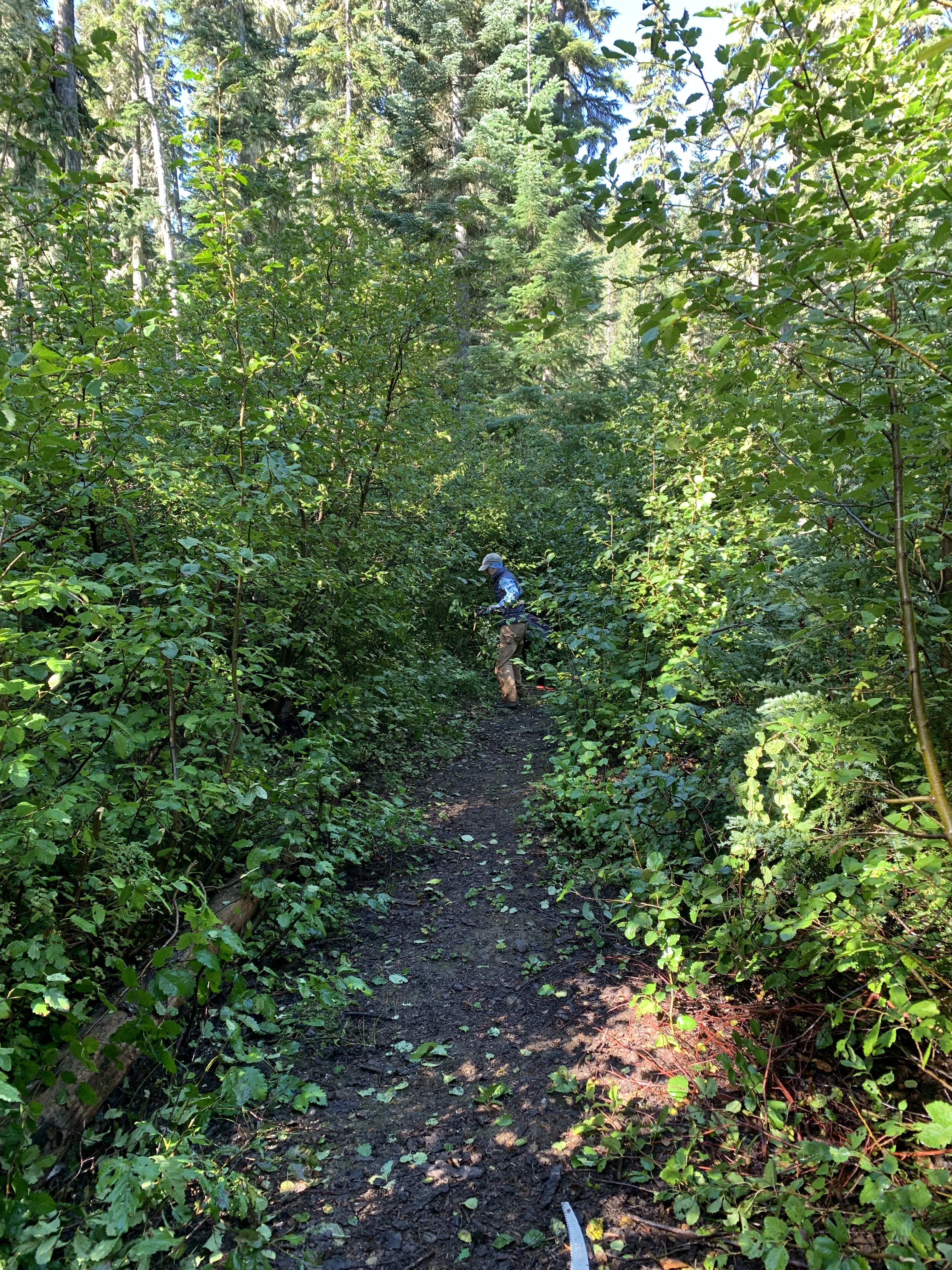
I have been to Bechtel Shelter many times, often going from there nearly a mile further to Midnight Lake in the Diamond Peak Wilderness. On a good day I’ve gone a mile and a half beyond to Arrowhead Lake. Everything looks different in winter. The bottom of the descent from the shelter in the other direction forks left to Marianne Way, a three-quarter of a mile loop returning uphill to the trail near the shelter. The right fork leads to Pengra Pass and then the parking lot. The right fork is easy to traverse in winter, but alder growth at the junction made it almost impassable in summer. Last year, two of us opened a still visible trail through the alders. Six months later, in snow, I could easily navigate through several scattered branches poking up, as if nothing were below. Now, we widened the trail to about 5 feet, crossing a small perennial stream, perfect for alders, along with direct sunlight, at least now. We cut several sub-inch diameter trunks that supported growth ten to twelve feet high. Clearing them took about an hour, for alders are brushy.
We backtracked, continuing on Marianne Way, where we needed to deal with a smaller patch of alders and then climbed, placing some diamonds, but generally the trail was in good shape. We looked for logs that would be a problem for winter users, removing a 5 inch diameter one 5 feet over the trail, a problem in winter, whereas one 2 feet over the trail would be snow covered.
Later on, we encountered a small log arcing over the trail. We spent more time than necessary cutting it, as I saw a chance to practice making efficient, safe cuts on smaller logs. The cutter started from the top, and after sawing perhaps a third of the way through, I had her start cutting from the bottom in two places parallel to each other. This would reduce the compression below so that the cut log would not suddenly open up on top and slab off, meaning much of the cut log would hang off the bottom when we were done. She finished the cut, and the log quietly dropped without slabbing. Learning a cutting technique on a small log makes it easier to do a larger one.
Near the end of Marianne Way, one of the others found a plastic bag full of nails. They had to have been mine from last winter. Nobody else had been out here checking the trail, and I had worked in that particular spot trying to place a diamond while standing in a tree well, not a good position. I couldn’t even remember whether I knew I was missing nails, but I could still use these.
Ten days later, across Highway 58, I used the nails on another of my trails, and failed to watch where I put the bag. I also managed to leave the same bag, with now only a few nails, on that trail. Maybe I should use a bright red pail to carry them. Next summer or fall, I hope to find it without fail and end this tale.
 Boreal B[l]og
Leave a comment