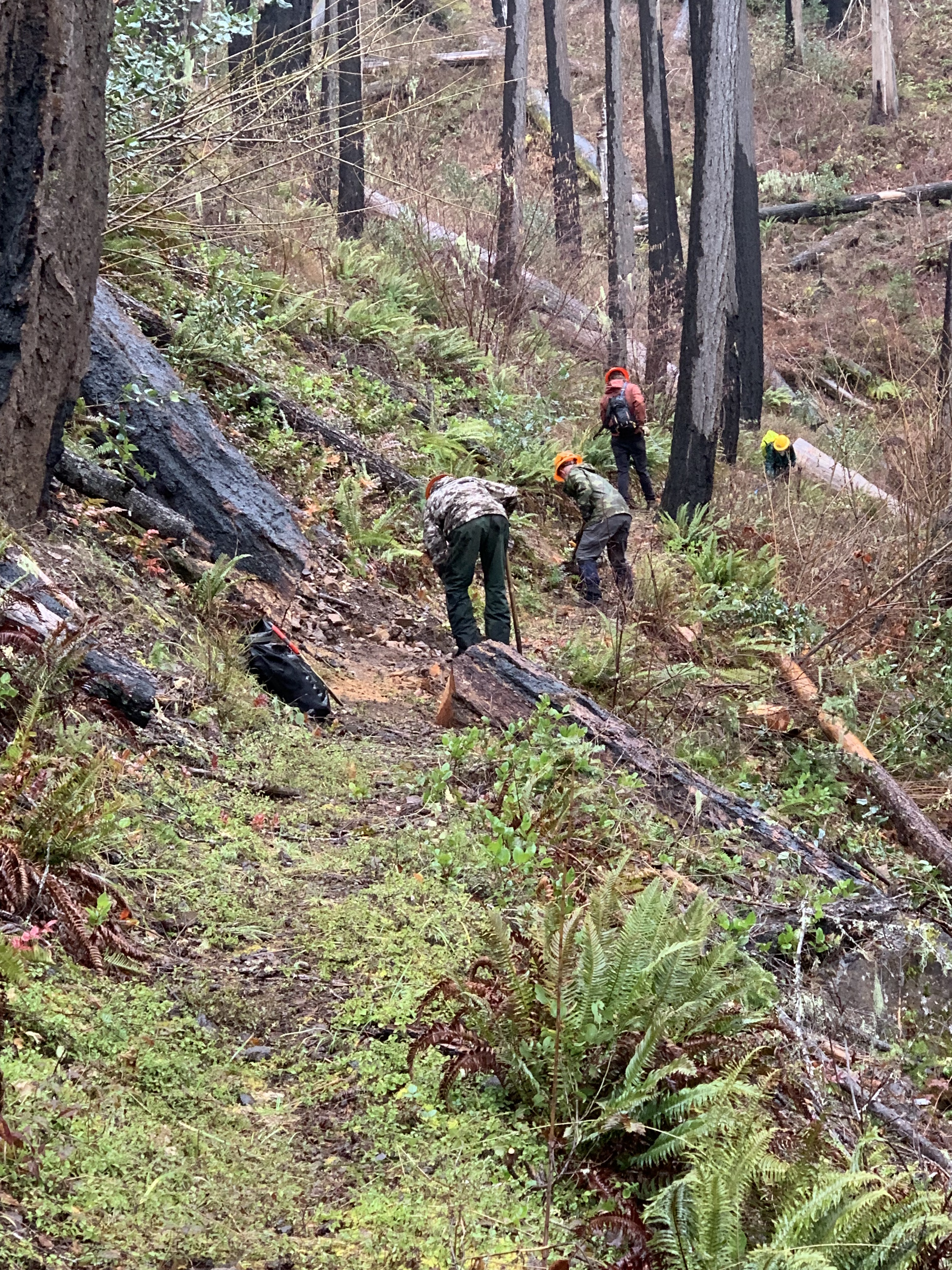
It was raining when we started work at about 8:15; ten minutes earlier, it had changed to snow here at Fall Creek, where six of us were restoring a trail.
I felt cold on the sides of both sides of my chest. Cold and wet give the same sensation because we don’t have wet sensing receptors, but we do have temperature receptors. The brain does some work to make us feel a wet sensation, although as a retired neurologist I am hard pressed to understand, let alone explain how that all works. In any case, the trickle movement of the cold suggested I was feeling real water, and I had been too cold to sweat.
Some of us were widening the trail, some throwing stuff off it, some making the trail more visible, others cutting out encroaching brush that would annoy hikers. Each of us was doing all of these at one time or another, and when I stopped digging and started removing salal, ceanothus, Oregon grape, and especially blackberry vines, I seemed to be using less energy than I did with my Travis tool cutting into the soft soil. Less energy use=more cold. My fingers were both cold and wet, and for some silly reason I was conserving my gloves for when I really needed them. Like right now.
Sig, crew leader, walked by me as we had a steady parade of forest leapfrogging, each of us briefly adopting a piece of unworked trail before reaching worked trail and then moving on. I told Sig I had about an hour left in me given the cold. My fingers had been cold the entire time, despite my constant use of them. Now my chest was cold, too. It’s difficult for me to be the first—or any—person to admit I will soon become unsuitable to do work, but given my age and medical condition, I felt right in speaking up, and I am doing so more often. I had an additional reason: I strongly believe that participants out here must speak up if they see themselves developing the inkling of a problem. That happened a month prior, and the way I handled that particular situation—where the individual, new to the crew, could physically continue to use a power brusher, she would suffer afterwards if she did— was perfect. I told her to listen to her body.
Sig said that he would plan for that quitting time to be within an hour and that we were well along on the trail, on whatever schedule he had. “But,” he continued, “please remember to tell me if I forget.” Good, well said. A crew leader does not wear a halo; they can forget.
I did more digging and warmed up; the rain/snow mix stopped, and in an hour I felt significantly better than I did earlier. We broke for lunch, and afterwards I did more digging and felt better enough that I spent significant time widening the trail in places where it was helpful but not essential. An hour after I wanted to stop, we were back at the vehicles, and I was the last one out of the woods. This has been the third time in three successive visits to Fall Creek where I have acted on my own to get what I wanted; twice breaking for lunch on my schedule, rather than going even five minutes into the afternoon.
Earlier that week, a friend told me she went on a hike with a few others. She was happy to hear one of the others calling it quits on more added distance when he had enough. “I knew you would have been proud of him for speaking up. I was trying to judge for myself if I wanted to call it. I was definitely getting mixed messages, but I was happy to be heading back when we did. We did just under 5 miles and there are other things I wanted to get back for.”
She continued. “Does it surprise you that people don’t let on that they’re tired and ready to quit? Jane was saying yesterday that there’s a kind of peer pressure to keep going and to not be the person to put the kibosh on the whole group and to look less than others or weak. I think it takes courage and clarity with oneself to be able to speak up in a group situation like that and take care of oneself…..it does take strength to take care of oneself in the midst of other folks plowing on to their detriment.…”
I return to “and to look less than others or weak.” I plied the trails with those words once and finally left the words thankfully behind. It wasn’t easy, and there were times I didn’t speak up when I should have, but I have become far better since.
I think it takes more gumption to admit one is not strong than it does to deliberately do things to show others you are. The next time at Fall Creek, the weather was completely opposite, 80 degrees and dry. I needed a break in the early afternoon because I was too hot. I took it and was checked by two others who saw me sitting on a nearby log. I was going to be fine, but I needed to stop THEN and had no qualms about doing it.
Shame it took me so long. All of us sooner or later get laid low by something. What is our legacy? Did it really matter whether we were first up the mountain or back to the vehicles, or who carried the most weight?
When I wrote about human factors involvement in the woods, the first page was devoted to an occurrence where I said “Enough!” to stop further work in the Mt. Washington wilderness at 4 pm, 2.3 miles from the trailhead. What were we thinking? Why were we still deciding whether or not to continue logging out at that hour? Why does it appear so many of our activities have become competitive? I got sucked into this a decade ago, finally took myself out of it. Working trail, I often witness an unsaid competition about who can carry more, hike faster, cut better, dig out more trail, all sorts of examples. Could we please stop and just work together?
 Boreal B[l]og
March 26, 2026 at 07:15 |
Dr. Smith!
Dr. Hunter has written Spy Sky for about as long as you. He wrote this for today.
TIM HUNTER
Special to the Arizona Daily Star
This is my 1,000th Sky Spy column. I want to thank the editors of Caliente, who have supported me for 19 years, starting with Inger Sandal in 2007. My current editor, Norma Coile, makes sure each column is up to the Arizona Daily Star’s standards and writes the headline for each. To celebrate, I am going to push my luck a bit and shamelessly promote my book, ‘The Sky at Night – Easy Enjoyment from your Backyard.’
The column was started in 1981 by Michael Smith, M.D., a highly respected neurologist and amateur astronomer. I don’t know if he came up with the name Sky Spy, but he wrote a splendid column for 19 years. I faithfully read it every week. After Mike, the column continued by one of the paper’s reporters, who did a very fine job with it for seven years until he left the Star. I then was lucky enough to pick up the column in February 2007.
Tonight, look at the bright gibbous (more than halflit) moon. At 8 p.m., it is nearly overhead. To the left (north) of the moon, only 3 degrees is Pollux, one of the twins in Gemini the Twins. The other twin. Castor, is 4 degrees above Pollux. As a bonus, bright Jupiter is in the middle of Gemini 8 degree above the moon.
How about that!
Steve
March 26, 2026 at 19:21 |
I will be …..well, surprised!! Thanks for the update!!!! Best wishes. Did you have a good trip to the Islands?