I should have looked at the Oakridge forecast rather than Eugene’s, I thought, as rain spotted the windshield and I discovered I needed a better rain top than the one I had, in order to stay warm and dry. Four of us in the vehicle were part of a 6 person crew to log out Pioneer Gulch trail, steep, gaining 1100 feet in just over a mile, which Camilla and I had scouted a week prior. We had a brief window this day to get in there to cut out trail blocking logs before a major snow storm arrived that evening.
After we got the gear sorted out at the trailhead, I went with Brian and Jean as one crew. Brian and I are both B-certified crosscut sawyers, but he is more experienced. Jean was going for her B cert next month. I wasn’t worried. She’s competent and will get it. Hiking in to the first log, two-tenths of a mile, I was concerned how I would hike with the rest of the crew. I am slower after my radiation treatments and didn’t want to hold anybody up. While I couldn’t stay with Jean or Brian, whom I knew I couldn’t, I did maintain some distance from Hal. I needed to know I could do that, even having hiked significantly the prior two days. I hadn’t been sure my hiking speed is adequate despite no testosterone; I won’t hold people up. If I can’t hike with the rest of the crew without significant delays, I will stop going out.
At the first log, Jean did the explaining, Brian critiqued her, and while I was odd person out, I did have a function being at the other end of the saw, until my arms got tired. When Brian offered help. I took it. I didn’t used to, but my endurance is less than it once was.
Note: I could have done more, but I had no reason to do so. It goes against the competitive, macho, man culture.
I found myself in a conundrum. On the one hand, I was glad seeing Jean’s getting instruction before her certification day. On the other hand, I never had such instruction in the 3 years before I obtained my certification to the A and then B level, other than the day long course before certification at the A level. None. I learned by being told I was “pulling” the saw, often without saying left, right, up, or down, and never by being told what I should be doing so I would not get this criticism. When Jean joined the crew, she immediately was taken under the wing of one of the experienced sawyers. When I joined, there was no such offer. When two young women worked with the crew on Hand Lake Trail a few years back, a couple of crew members were eager to help them. I watched an unusual scene: someone being taught how to saw. I never had that experience.
It wasn’t that I never had good feedback: on my 47th outing with the Crew (now over 400), an experienced crosscut sawyer was on the other side of the log in the Waldo Lake Wilderness. We were underbucking, cutting from below, and the sawyer said I was one of three people with whom he would be willing to underbuck. Three people. He had decades of experience. Later, he asked me to evaluate a log, which is where I learned the important “when you make the first cut, see if you can envision what is going to happen to where you make the second cut.” I didn’t evaluate a log again by myself for at least 2 years after and never received that sort of compliment again.
I was surprised by my sudden vocalization of both disappointment and anger in the lack of teaching me how to use a saw. My words were heard by the others, with some surprise by me that I felt that way. After that; I remained quiet. For me, it was a major loss of potential that I never became and never will become the sawyer I hoped to be. I was the wrong gender. Knowledge should not be segregated by sex. Some men aren’t familiar with tools or saws; many women are.
We need to teach those who need knowledge regardless of gender. When I joined the crew, nobody took me under his wing; I had no mentor, wasn’t invited to become even A certified until after three summers of log outs, and even then in my class was a person who had never touched a crosscut saw before; both of us got the same certification. It seems to me that men are assumed to know about tools, machines, and power equipment. This is wrong. On the other hand, I have seen four women in my crew immediately helped with their saw skills when they were on the crew, even though some had more experience with equipment and machinery than I had. This is sexism. Ideally, we ought to pair each new person with a mentor. Practically, we need a way to teach sawing to new crew members equally to allow them to function. It is not being done, and it should be.
Many feel teaching is not difficult. Many would be wrong. Being experienced in the field does not necessarily make one a good teacher. Good teachers make a field come alive, make their students want to be like them, and are a joy to listen to. They are uncommon. I’m a natural teacher. A while back, when a young woman at the drug store couldn’t make change properly, I patiently explained the transaction to her two different ways. I did not berate her. She felt badly enough and apologized for her lack of math. I quietly told her not to worry about it. If she’s good, she will worry about it, and she will get better, but at least it was between me and her. Nobody else.
I am disappointed when a system appears discriminatory against men who don’t fit into the right mold. I don’t discriminate against those who can’t read a map, have poor trail memory, or can’t find their way to a trailhead. I assume everybody can do it, and if they can’t, I help them.
On the way back out, I carried a saw when the strap suddenly came apart where the hook held the saw. That happens. I stepped off the trail to fix it. Two others came by me. The first asked if he could carry the saw. I said I was OK. The second said the saw was a little strange to carry, and if I would take the pry bar, he would take the saw. I agreed.
In summary, I took relief during sawing; I gave up carrying a saw in exchange for an easier pry bar. I did something few guys I see do out in the woods, I asked for relief, and I accepted someone’s helping me by changing what I carried.
There may not be competition on the trail, but it feels like one. Men should keep going and not ask for help. Women should be helped. One man older than I wouldn’t give up a brusher he was carrying out of the woods. I was crew leader and asked if he wanted help. He refused. This sort of behavior should stop. It is symptomatic of why so many men function poorly in society today: deal with adversity quietly, don’t seek medical help, with consequences, must be a “man,” don’t let down one’s guard with weaknesses, hide emotions. And in the woods, be in charge, be in control, don’t be the first person to say “Enough!” On a job, you are the one who has to do it, don’t take help, show how good you are every chance you get. Life is a competition that one has to either win or at least not lose.
I decided to leave that game some time ago. I am a lot happier, and I think I will be a lot healthier, too. Whether I can change others remains to be seen, but I am going to try; too much is riding to stay silent on this matter.

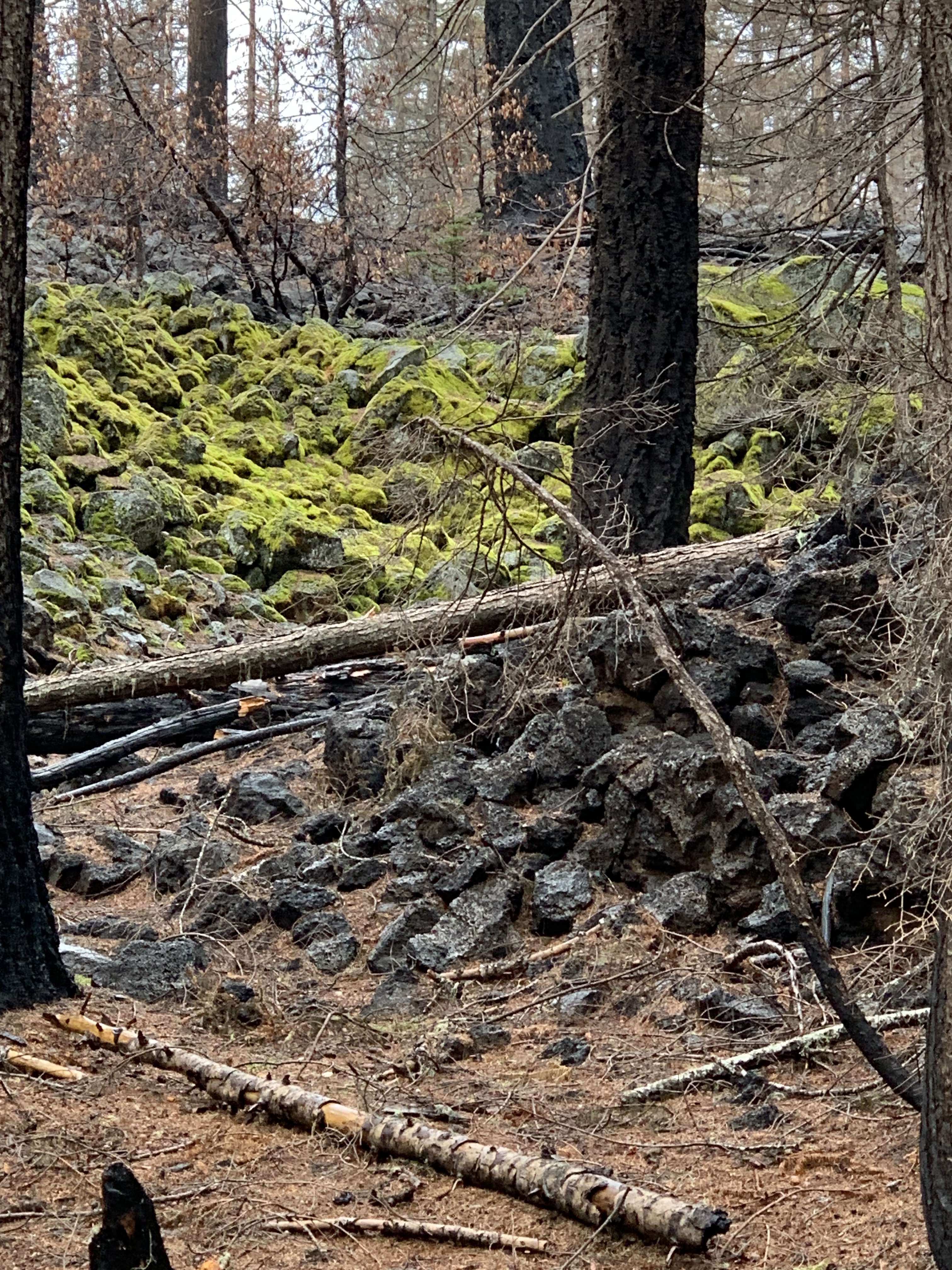
Some green in the black zone, Pioneer Gulch Trail
 Boreal B[l]og
Leave a comment