Archive for April, 2012

BWCA, 2012. TRIP 60. SOLO TRIP 20.

April 29, 2012

I needed to get my head on straight.  Really.  I am one of those who needs to get into the woods, the wilderness, or take a long hike periodically.  How long I can go in between varies.  But I know all the signs.  I get angry easily, I am short-tempered, I get upset at minor issues, and there is a part of me that says “get away from all of this.”

In 2006, we established a scholarship in our name at Vermilion Community College, a 2 year school in Ely, MN, on the Iron Range, at the end of the road to the Boundary Waters.  VCC students live on the edge of the wilderness….and poverty.  I was at the age where leaving a legacy–the woodpile a little fuller than I found it–mattered, and the scholarship was awarded at the annual VCC scholarship banquet, held in Ely.  I have attended 5 of the last 7 banquets.

In 2009, I partnered with the Friends of the Boundary Waters , one of those small organizations that has a few dedicated staff and leverages a lot of volunteers, to create a second scholarship.  I offered to pay for the scholarship myself; the Friends matched it, and this year, with a new employee in the Northland, he would present it, and I no longer would, which suited me fine.  The Friends kept a tall cellphone tower away from Ely, so it would not be visible from the wilderness.  Unless you have spent time in wilderness, it is difficult to explain how sounds and sights from civilization can degrade the experience.  A cell tower would degrade the wilderness, where cell phones read “No Service,” and one is on his own.

Worse, PolyMet is trying to build a Molybdenum mine in the area, which is of great concern to the water supply, due to the toxicity of the element.  It is jobs vs. wilderness, except the wilderness gives jobs.  The outfitter got money from me, and so did restaurants and motels I used, before I went into the woods.  We are going to risk the cleanest water in the US for mining something that is safe until it suddenly isn’t?  (Prince William Sound, 1989, Chernobyl, 1986, Fukishima, 2011, Challenger, 1986).

The third scholarship was the Brekke/Langhorst scholarship, named for two brave young men, cousins from Moose Lake, Minnesota, who died in Iraq…or as a result of Iraq.  One died 7 April 2004, which was almost certainly in Fallujah.  The other died from complications of PTSD, which should have been anticipated before we went to war, which was unnecessary and probably illegal.  But that is another story.  Young men are often the pawns of old white men, most of whom have never spent a day in uniform or served in harm’s way.  As a veteran, I wanted to contribute to a scholarship for veterans, and the family honored me by allowing me to do so.  No family member has presented the scholarship; I and a few others have.  This is a very deep honor for me.

So, I had plenty of reason to go to Minnesota in late April.  In 2010, I took a short trip, stayed about 3 hours from Ely, and in the space of one day drove to Ely, rented a canoe, did an eleven mile day trip in to Pipestone Bay, came out, presented the scholarships (there are about 50, now), and drove 3 hours back to my hotel.  That was a bit much.

In 2011, I wanted to go into Basswood Lake, and the ice went out the day before I arrived.  However, the weather was not at all cooperative, with high winds, big waves, and frigid water.  Not being in paddling shape, I thought in unwise to go into the woods, and camped at Fall Lake Campground, where I was alone, did some day hikes in snow, saw a Pileated Woodpecker, among other birds, and enjoyed myself.

This year, I decided to go in overnight and look at the results of part of the Pagami Creek Fire.  My wife persuaded me to spend two nights, in case of inclement weather, which turned out to be a wise idea.

I flew to Minneapolis, did the usual 4 1/2 hour drive up north, and got settled in Ely for the night.  The next day, I got the rest of the equipment I needed, put it on the car, and drove out to the Lake One landing.

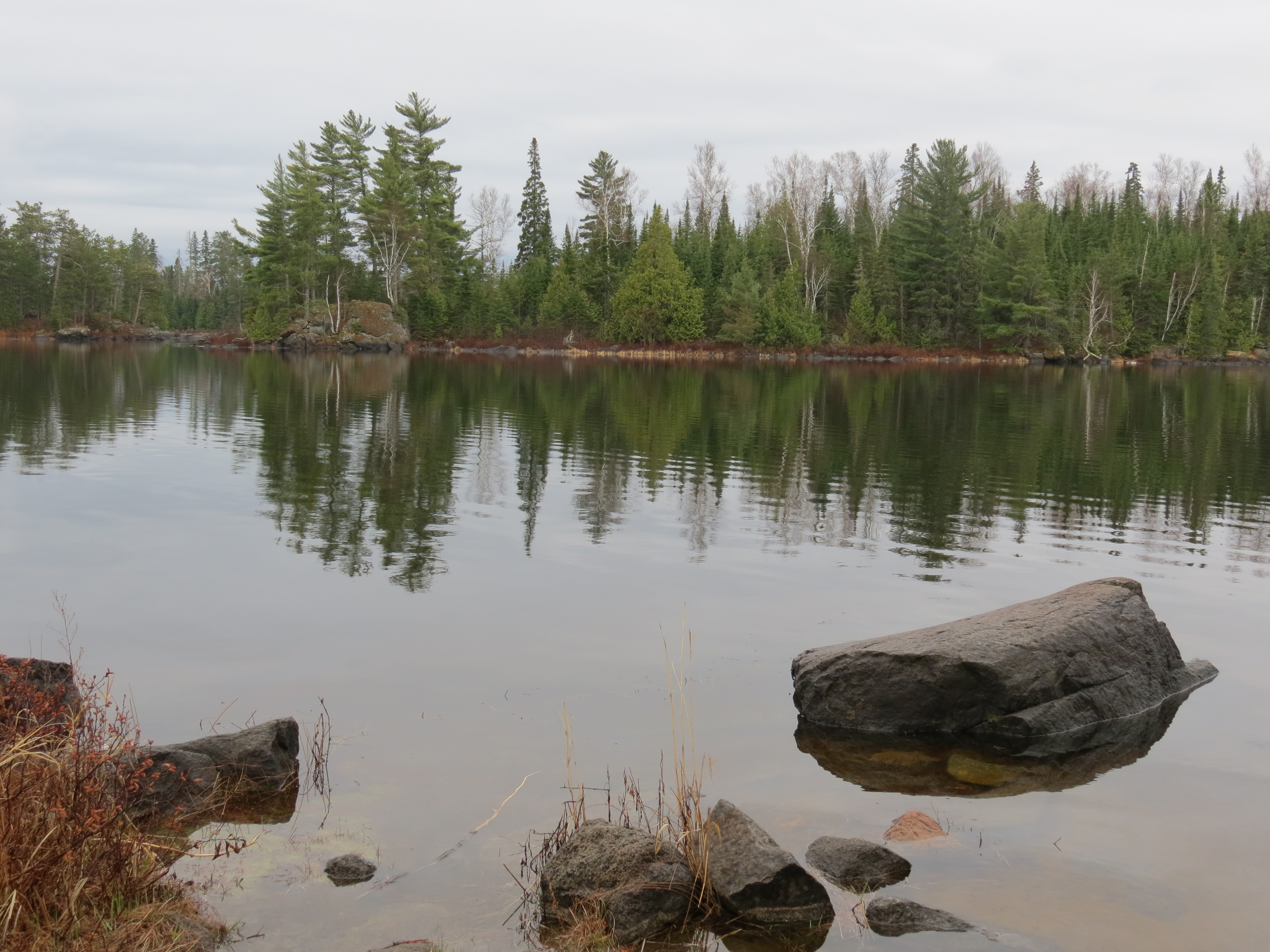
I got on the water on a bright 60 ish day (16 C), and in an hour found a decent campsite about 3 miles  (5 km) in  .  I was going to rest that day, but the forecast was good for that day and not so good for the next day, so I had lunch, hopped in the canoe, and portaged twice into Lake Two.  I expected a wasteland, but it was a mile before I saw any sign of fire.  But there were signs.  The campsites at the west end had some burned areas, and the beautiful white pines on the west end of the channel into Lake Three were no more, as that area had been subject to a back burn.
Channel between Lakes Two and Three, with tall burned white pine.

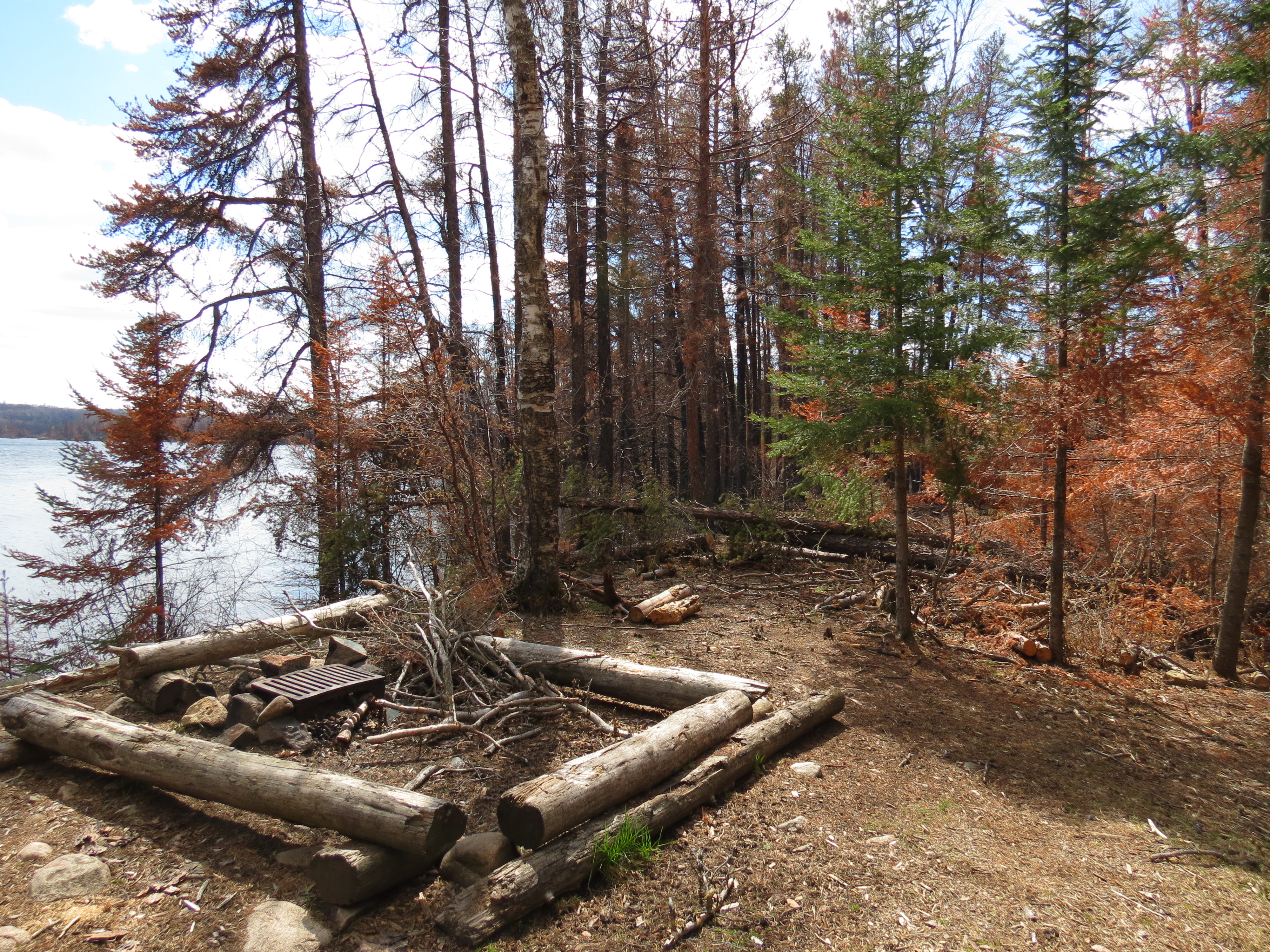
I paddled into Lake Three and was pleasantly surprised again not to see a wasteland but a significant part of the forest was burned.  There were mosaics of green amid blackened trunks.  The water was more turbid than usual, especially by the campsites, but also along the shore in general.  It will take some time for this to clear.  Some of the islands were scorched, others were completely untouched.  The south end was heavily burned, although campsites survived fairly well, in large part because most of the fuel in this area has been picked over by campers for their evening fires.

The wind was a little worse than I liked, and although a 2 foot chop is not difficult to handle, I needed to realize I had about 5 hours to explore, including time to get back to my campsite.  Wind, muck , and rapids are three things that can stop a solo canoeist, so I turned back to the north end and started to head back, stopping at one campsite that bordered the fire area.  The wind abated, so I took an open channel at the north end of the lake, which I had never before seen open, and went into the northeast bay.  The one campsite the late Mike Manlove and I had stayed at in 1993 was in the middle of a heavily burned area, and the north shore was fairly heavily involved.

Northeast Bay of Lake Three, heavily burned.

I had told everybody I would not go into Lake Four, and I believe firmly in never deviating from one’s itinerary, when one is solo. A lot of bad things can happen in the woods, and solo, what may be minor can become life threatening.  I looked around, took some pictures, and then headed back to the campsite on Lake One, the whole 13 miles (22 km)  or so taking me a little over 4 hours.

I had nothing to do when I returned so lay in the tent, not sleeping, but actually encountering a few mosquitoes, at least five weeks earlier than I am used to.  After dinner, the lowering clouds suggested that the next day might not be so nice, and I was really glad I got into the burn area when I did.

Indeed, I was awakened to the sound of rain, and I awoke under darker skies although no rain.  It was noticeably cooler, too.  I hung around the campsite for a while and then paddled about 1 1/2 miles down to Pagami Creek, far back in the depths was where the fire started.  I took a look at the western sky, and while the barometer had not changed, I did not think going further was a wise idea.  I turned around and paddled back to camp, arriving about 10 minutes before the first onset of rain.  It rained off and on through dinner.

I was really, really glad I hadn’t gone into Lake Three that day–wind, rain and cold weather would have made the trip a bad idea.  I have long learned never to squander good weather in the woods, be it 5 minutes or 5 hours.

I spent the evening looking along the shoreline for anything I could find.  Such scanning has found moose, beaver, otter and other animals.  This time, it was a raven and two crows who provided the entertainment.  The raven flew across the lake and landed in a jack pine across the small channel.  Two crows were beside themselves and called at him, each other, and probably to the general universe.  Periodically, the raven called, too.  I videoed the event, catching the raven flying off, still harassed.  Random scanning is often interesting.

The next morning, the tent was hard, as like a rock, and I went outside to see ice on the tent and snow on the ground!

Spider Web with frost

The stove was out of fuel, and while I had another cannister, it was cold, I was coming out of the woods anyway, and I had enough to eat.  I broke camp, got in the canoe, and paddled back to the landing.  The hardest thing I had to do was horse the canoe up on the car and tie it down.

I got my head back on straight.  I was out 2 days, and it felt like a week.  I saw the burned area, and next year, I have to go back one more time to Lake Insula, as sad as seeing the south shore will be for me.  I haven’t given the lake a proper good by, and who knows?  Maybe we can do our September trips there again, if I find the area isn’t too depressing.  One thing is clear–I need to tie the scholarship banquet in with a camping trip.

The banquet went well.  I met Ian Kimmer, the Friends’ person in the North Country, who presented the Friends scholarship.  I presented my two, stayed for the whole banquet, then headed south.  We’ll be back in September, headed out Fall Lake into Jackfish Bay on Basswood.  It will be a good trip.  All BW trips are.

Burned area.

Canoe with snow on it.
DEATH IN THE YOUNG….AND SUICIDE, NOT BY COP, BUT BY POVERTY.

April 22, 2012

A while back, my wife got a call from an ultrasound tech, who was shaking, she was so upset.  A young individual, in their 20s, who recently had an uncomplicated appendectomy, had presented with abdominal pain.  There was gas in the liver and no portal vein was visible on the ultrasound.

CT was not performed with contrast, due to the elevated creatinine.  But another “old fashioned study,” a contrast BE, had shown, on separate days, nearly no movement of contrast except through a tiny lumen, suggestive of an intussusception.  I was interested in the fact that high tech studies, with high costs and high radiation doses, didn’t make the diagnosis in this woman, but controlling imaging studies and radiation in medicine appears to be another issue where I speak out alone.

The young person died.  Yes, people die here in Arizona from appendicitis and uncomplicated appendectomies.  I appear to speak out alone when I ask why we aren’t learning from these cases.  We should drive the mortality rate from appendicitis to zero.

This person did not live in Saddlebrooke, Cobblestone, one of the country clubs, and have a seven figure income or an eight figure net worth.  I am not sure who is going to pay for the costs of care, which were limited by the early death.  But how do the young and uninsured, who have appendectomies, or even mesenteric adenitis, pay for the costs of an ED visit with a CT scan?  Many are young, gorgeous, and broke, to quote Suze Orman.

I will ask my colleagues again where the money is coming from to pay for care for all Americans, since the young, who think they will live forever, won’t, and they can have catastrophic medical issues, including bad motor vehicle accidents.  We have pretty much tried to say vaccines are bad, radiation good, evolution didn’t happen, the Earth is a few thousand years old.  I am waiting for the concept that young people don’t get sick and the rest of us don’t really die.  I once reviewed a paper for a right-wing medical journal (volunteer, of course), that purported the FDA killed 10,000 people a year by not allowing drugs on the market.  The statistics in the paper were awful.  And I still remember thalidomide.

As a matter of fact, I wonder what will happen if we do away with social security and Medicare.  My wife and I will survive, so long as we don’t have a catastrophic illness, but when insurance companies will have premiums high enough to cover their overhead (read: eight figure salaries), we may become old, not so gorgeous, miserably ill, and broke.

Most people who live to ninety have some degree of dementia.  It is a fallacy to think we will live to a ripe old age, and then, just before bad things happen, quietly die in our sleep.  Visit a few nursing homes if you wish.  Heck, there is a life at any cost group that will keep me alive even if my wife doesn’t want me to suffer.  Or keep her alive, when I don’t want her to suffer.

The facts are these:  most women over 85 are widowed, and a lot fewer men.  Let’s look at the women.  Most are not living at La Paloma having nice dinners with their friends at 85.  Most are trying to get by, not clear what the bills mean, are subject to scams, can’t get around well, and fear for their safety.  Maybe they have children, maybe they don’t.  The children have lives of their own.  Come on, we all know the picture here.

Suicide by poverty will join suicide by cop as the new America.  We aren’t as fortunate as the African Dik-dik, who dies, when his/her mate dies.  Some of us just keep on going.  That’s fine, until we need to stop keeping on going.  I know what that is for me, and I have it in my living will, so clear that even somebody who lives in Arizona can understand it.

But I have left my point:  how do we figure out a way to care for people who have catastrophic needs at any age?  Is spending $400 billion a year on war (defense is such a nicer word, but it was once–and still should be–the Department of War) really appropriate?  After 9/11, I said that we needed covert operations, which would be far more effective, to deal with terrorism.  Two wars and a decade later, a small, brave group of men killed Osama bin Laden.  He could have been dispatched without the money and lives lost in either war.

In these pages, I have offered a host of solutions, not one of which has been adopted.  That is unfortunate, not because I didn’t get the credit, but because those who were in power have not solved the problem.  We can and will, as soon as we say, “We can care for everybody in America appropriately, and we can pay for it.”

Then it will fall upon us to figure out a way to do it.  Once we make up our mind it will happen, we will find a solution.  Heck, I might even come out of retirement to offer a few thoughts of my own.  Ten, twenty, and thirty years ago, they were ignored.  Maybe now they won’t be.

SEEKING FIRST TO UNDERSTAND, THEN, AND ONLY THEN TO BE UNDERSTOOD

April 22, 2012

Many years ago, as a hospital medical director, I attended a meeting we had with one of our payers.   I remained quiet throughout most of the meeting, and when the time was right, I spoke.  I process slowly, but I process well.

When I spoke, the mood in the room was tense.  I summarized the payer’s points, asking whether I was correct.  I wasn’t, so I continued summarizing until they agreed that I had understood them.  The tension went out of the room like air out of a balloon.  I don’t remember who “won,” but I learned something that day.

During my tenure as medical director, I received many complaints about the hospital and doctors, and I handled them the same way.  Rather than defending, I summarized the complainant’s points, discovering that I could hear tension go out of a telephone conversation, too.  People were amazed that somebody was listening to them.  Sometimes, that’s all people want.  Try it with your spouse some time.


I was asked to debate climate change.  I try to do things that will make a difference, and my debating climate change is not going to change policy.  Debating requires good public speaking skills, which I have, but only when I teach.  I doubt I will teach anybody anything in a debate.  Debating also requires fast processing skills, which I do not have.  That is why I am a writer.

Debates also have other problems, too.  They have winners and losers, and winning and losing have become toxic.  The desire to win has overshadowed the desire to look for new solutions.  Steve Jobs was deeply flawed, but he had the ability to move people to find solutions to problems that they thought impossible to solve.  We need that sort of approach in medicine.  Debates don’t offer it.

In medicine, we would have done well to have first studied the efficacy of  CABG, CEA, angioplasty, stents and EC-IC bypass.  Had we, millions of people would have been helped or not harmed.  Of the five, only EC-IC bypass was properly studied, and we found it didn’t help.  The scientific method is more helpful than the often screaming debates I heard, sometimes directed at me in the case of CEA.

In the past 15 years, national discourse on many topics, at one time bipartisan, disappeared. There are several reasons, but it is a fact that many issues that are scientifically based, and should be treated that way, have become politicized. Such polarization is toxic, and it can be transmitted.  I caught it.

The idea of seek first to understand, then to be understood, Covey’s Fifth Step, is one of the most powerful.  It goes with “if you want to influence people, you must first allow yourself to be influenced.”

I’ve also been guilty of misuse of the language, using such words as “most”, rather than “many”; adjectives and adverbs I chose might have been better.  Words matter.  I am deeply concerned about Internet anonymity and the loss of critical thinking skills; lessening of emphasis on science and math education might be the cause.  Apple outsourced to China in part because we didn’t have the engineers here.  We have far too much name calling, prejudice–not just in the racial or religious sense–but politically.  For those like me, who process very slowly, this fast-paced prejudice puts me at an disadvantage, for if I process, often the conversation is over without my participation, and if I don’t process, I risk saying something I later regret.

I’m often glad I’m pushing 65.  It isn’t always fun, and with each passing year, like the great tight end Jerry Rice, I have to work harder and harder to do the things I have done all my life, knowing at some point, I will have to hang those things up.

But I am glad I won’t be alive in a world that will be people rich and resource poor.  Wilderness will disappear.  Quiet is disappearing, too, along with our great heritage of dark skies.  I do not want to live in a crowded world, where I can no longer find solitude in the wilderness and feel more comfortable there than with a lot of people.  The first thing I notice in Europe and Asia is the pushing and shoving.   The second thing I notice is the smoking.  The third thing is the relative lack of obesity, the fourth the number of solar panels in a latitude 20 degrees further north than the one I live in.  Europe has wonderful public transportation, polyglots, downtowns that work, and good use of the available space, which is not a lot.

There are many softer words in our language; we would do well to use them more often, in hope that maybe others will catch on.  We need to discuss medical care in this society, not debate it.  I don’t know what the right system will be, but many of us think it needs to be changed.  The irony is that not all of us are doctors or payers, but all of us are patients at one time or another.  That gives us something in common.  How should patients be treated?  How do we pay for it?  How do we do what is necessary and avoid what is not?  How do we die, when it is time?  When and how do we deny care, because we simply can’t afford it?

It is easy to criticize.  It is far more difficult, but far more rewarding, to first ask “Let me see if I can summarize what you said, for it is very important I do so correctly.  Please correct me if I make any mistakes.”

I hope I am not mistaken when I say that hopefully we still have time.  But not much.

ROWE SANCTUARY, 2012

April 12, 2012

This was my fourth year volunteering at Rowe, and the crane viewing was the best I’ve seen.  I flew into Kearney and was picked up by Margery Nicolson herself, the widow of the man for whom the center is named for, Iain Nicolson.

I hit the ground running.  Three hours after arrival, I was guiding a group to Stevie’s Blind, the first of the 19 consecutive tours I would guide.  We were busy; for the first time, I experienced all 5 blinds being open simultaneously.  I was in Jamalee 7 times, Stevie 5, East 3, Tower 2, and North 2.  All the trips were good for crane viewing.  I got to see cranes in the fog one morning, which was very special, as the birds appeared like ghosts in fog as the light slowly increased.  A few took off, but it was special, and there were remarkably few birds we saw, although we heard thousands more!!

Crane taking off in fog.

As a guide, I speak with my co-guide before we go to the blinds.  In the evening, we have a lot of time, because we usually arrive at the viewing blinds 30-45 minutes before the cranes land.  I try to show my enthusiasm at the beginning, then mention why the cranes come to the Platte every year.  Then, I go through crane viewing etiquette.  We have to be silent, nothing can protrude through the plane of the outside wall, and if anybody needs to use the Portapotty, they have to ask permission, so we can open the blind door quietly.

We return in the evening as a group.  Once people are in the blind, they must stay there unless there is a medical emergency.  Those take priority.  Personal inconvenience does not take priority over crane inconvenience.  Those who are hungry, cold, bored, or otherwise not interested, thankfully a very small number, have to live with being on a tour for two hours.

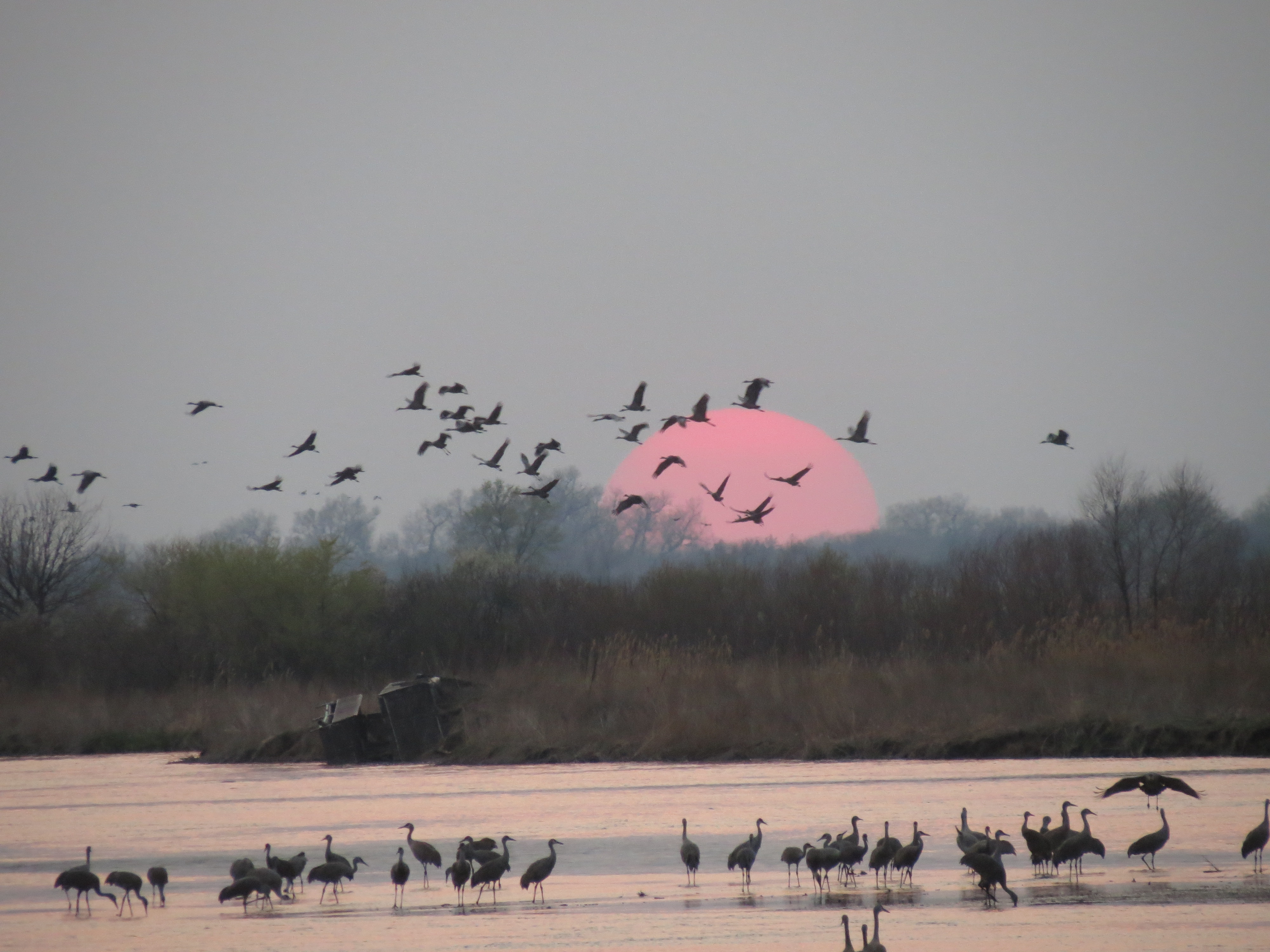
Photography is a big issue and at times a problem.  All flashes must be turned off and even taped, if there is any question.  The automatic focuser must be taped, so no light can show.  This does not affect the photography.  I ask for automatic rapid fire photography to be shut off, and only manual shutters to be used.  I have had photographers brag about 8 GB of photos taken, and one person told me that he had taken 3000 pictures during one blind session, averaging 40 a minute.  I have to wonder how many of these pictures are ever looked at over and over again, and how many pictures one needs of a Sandhill Crane, if that individual is an amateur.  I find the sunsets striking, and the great flocks of birds flying at sunset are wonderful to see.

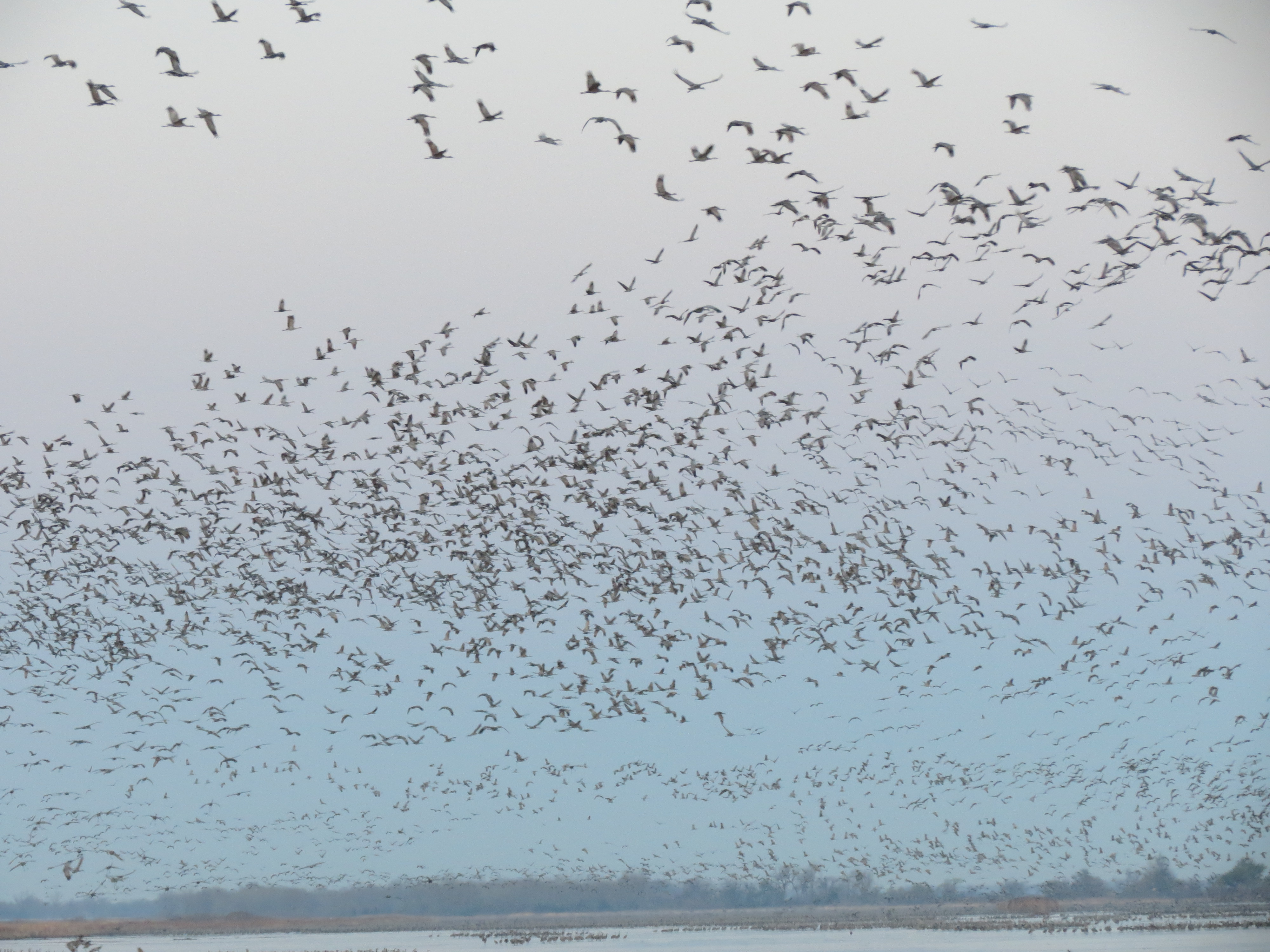
On the river and a large group overhead.

The problem with photographers can be severe at times.  In 2011, one man had his camera lens protrude about 15 cm (6 inches) outside the blind window.  I told him 3 times to bring it inside, and he got upset each time.  The third time, he was visibly shaking with anger, and his wife had to calm him down.  I have the right to make him sit down and take no more pictures.  That is a personal inconvenience, not a medical emergency.  If we spook the cranes at night, they may hit nearby power lines and die.  That must never happen on my watch.

I have had people get angry with me for taping their camera, when they think all is fine.  I ask them to point the camera at me and shoot a picture of my ugly face.  If I see any light, I make them tape the camera shut.  I have that duty.  We put post-it notes over the LED screens, to decrease reflection off the face.  The problem we are dealing with more and more is the sound from cameras, which clearly detracts from the experience of hearing the sound, at least until it gets too dark.  There are three, two-person individual photography blinds at Rowe, but they are booked in advance, and the waiting list for cancellations is equally heavily booked.  We don’t have a solution to this problem yet.  Cell phones must be turned off as well.

If we have time in the evening, once we arrive in the blinds, I can talk about crane facts.  In general, however, more and more I allow people just to look and experience the phenomenon for themselves.  The good guides I trained with did that, and I try to emulate them.

Mornings are more difficult, because we need to get to the blinds early, before it gets light.  Therefore, about the only things we can say are welcome, this is a wonderful experience, few know about it, and these are the rules.

Large flock of cranes. The true words for plural are sedge, siege, or herd. But we use flock.

In the blinds, if people have questions, they ask me, and I will spend as much time as I can with them, so long as they are interested.

In the evening, we must leave as a group, because the cranes are on the river.  In the mornings, we leave at 0830, but often, I or my co-guide will stay until 0900, for those who wish to view longer.  After that time, there may only be two or three people, and so long as they are quiet, most of the birds are off the river, and it is not a problem for them to leave alone.

I have other pictures, the best I shot, at the following link.

Cranes over setting Sun.

I love the guiding, for I get to teach and watch cranes, and there isn’t much better in my life in Nebraska than those two things!!

MUST WE DEBATE EVERYTHING?

April 4, 2012

1983:  I am in court testifying that a woman post cardiac arrest is irreversibly brain damaged.  Her husband wants to discontinue support; her sisters sued to keep her on the ventilator.  Nothing I said in the hospital had changed the sisters’ mind.  I knew the science and the outcomes of persistent vegetative states after cardiac arrest, and I agreed with the husband.  Eventually, he prevailed.

February 1988:  I show a nurse the conjunction of Saturn and Uranus in the morning sky.  She said they were in Capricorn (the proper name is Capricornus), but the two planets were visibly in Sagittarius.  I argued with her for 5 minutes before realizing nothing I said would change her mind.  Their next conjunction is in 2032.

Later, a man got a great deal of publicity for supposedly having discovered a new planet near Neptune.  I got a call at home from the man, who told me the planet was moving rapidly.  I stated that at Neptune’s distance from the Sun, the planet would move about a finger breadth at arm’s length every year among the stars.  No matter.  The man was convinced.  Nothing I could say would change his mind.

A physical therapist took me to lunch and told me that manipulation of the bones in the skull got rid of headaches.  I told him that skull bones were fused in adults.  No matter.  “It works!” he said; nothing I could say would convince him otherwise.

1984-1994: I said that the science underlying asymptomatic carotid artery stenosis meant that operations should be done only if the surgeon had a complication rate of less than 0.5%.  No matter.  Many were done at the hospitals I practiced; the major complication rate was 14%.  I got screamed at and threatened a few times, for intimidation, repetition, and reputation often trump facts.  I did not prevail.

2005:  Terri Schiavo.  Senator Frist, a physician, said she had cognition, despite clear evidence she was vegetative (smiling is part of the vegetative state).  Congress intervened briefly, an example of government’s dictating medical care if ever there was one.  Fortunately, science (amicus curiae brief by the American Academy of Neurology) and the court prevailed; indeed, the 600 gm brain with large ex vacuo hydrocephalus at autopsy confirmed what we neurologists knew.

March 2012:  I am in Tower Blind at Nebraska’s Rowe Sanctuary, guiding people to a suitable place to see the Lesser Sandhill Crane migration, one of Jane Goodall’s top 10 sights in nature and one of my top three.  As we waited for the cranes to land, my co-guide, an elderly woman, told me how she saw an egg stand upright on the recent equinox.  I said that can happen any day of the year.  The equinox is an instantaneous point in time, like the tangent to a function, with no influence on egg behavior.  No matter.  She was convinced.  Nothing I could say would change her mind.

More people believe in astrology than know why we have seasons.  Many believe we didn’t land on the Moon, that strange lights in the sky are aliens, who may abduct us.  A woman doing the luge at the Olympics held her neck in a certain way to “increase vertebral artery blood flow to the brain”; holding her breath would have been better.  Each of us has heard some remarkably odd ideas from people, totally convinced, totally wrong, about how the body functions.  Laetrile and colonic cleansing come to mind.

Our Sun is at least a second generation star, for elements heavier than iron must form in supernovae.  I believe in evolution and that vaccines are several orders of magnitude more helpful than harmful. I wish in the above instances I asked a simple question:  “Is there anything that you could learn that would convince you that you are incorrect?”  If the answer is “nothing”, then I am wasting my time.

We should change our beliefs when sound science shows that our beliefs are wrong.  When I learned that anticoagulation did not help vertebrobasilar insufficiency, I stopped using it.  When physicians at the University of Western Ontario discovered EC-IC bypass didn’t improve outcomes, they discontinued the operation.  They discharged four patients that very day.  There are many issues in medicine that we should study, in order to do the best for our patients; after all, each of us will be a patient.   We should discuss, not debate, the way we need to change American medicine, because I believe few are happy with the current situation.  We need to listen to and understand other points of view.  We must be willing to try new approaches, in order to learn from and modify them.  We need leaders able to convince people they can do great things that they never thought possible.  We need to use the best science available, even if it shows that our beliefs are wrong.

Children are born curious; alas, too many have it drummed out of them.  Perhaps if more were curious, we would look for answers, discover what we thought was true wasn’t.  That to me is moving forward.  Could I be wrong on climate change?  Yes. I don’t think I am, but yes, sound science could change my mind.  But I would rather discuss how we are going to fix medicine, locally and nationally.  My error reporting system has languished, unused, for 11 years.

I hope I am wrong about human-caused climate change; if I am, I will admit it.  Promise.