Posts Tagged ‘nature’

MATH LESSON AT TIRE CREEK

April 6, 2026

My arms were aching, and it wasn’t even 11 am. We had hiked in a mile and a quarter to the second bridge site at Cloverpatch, shedding a few of the group to help Brian log out a 21 inch log that barely missed our first bridge. He planned to cut out several other annoyance logs on the three quarter mile trail between the first bridge site and the second. 

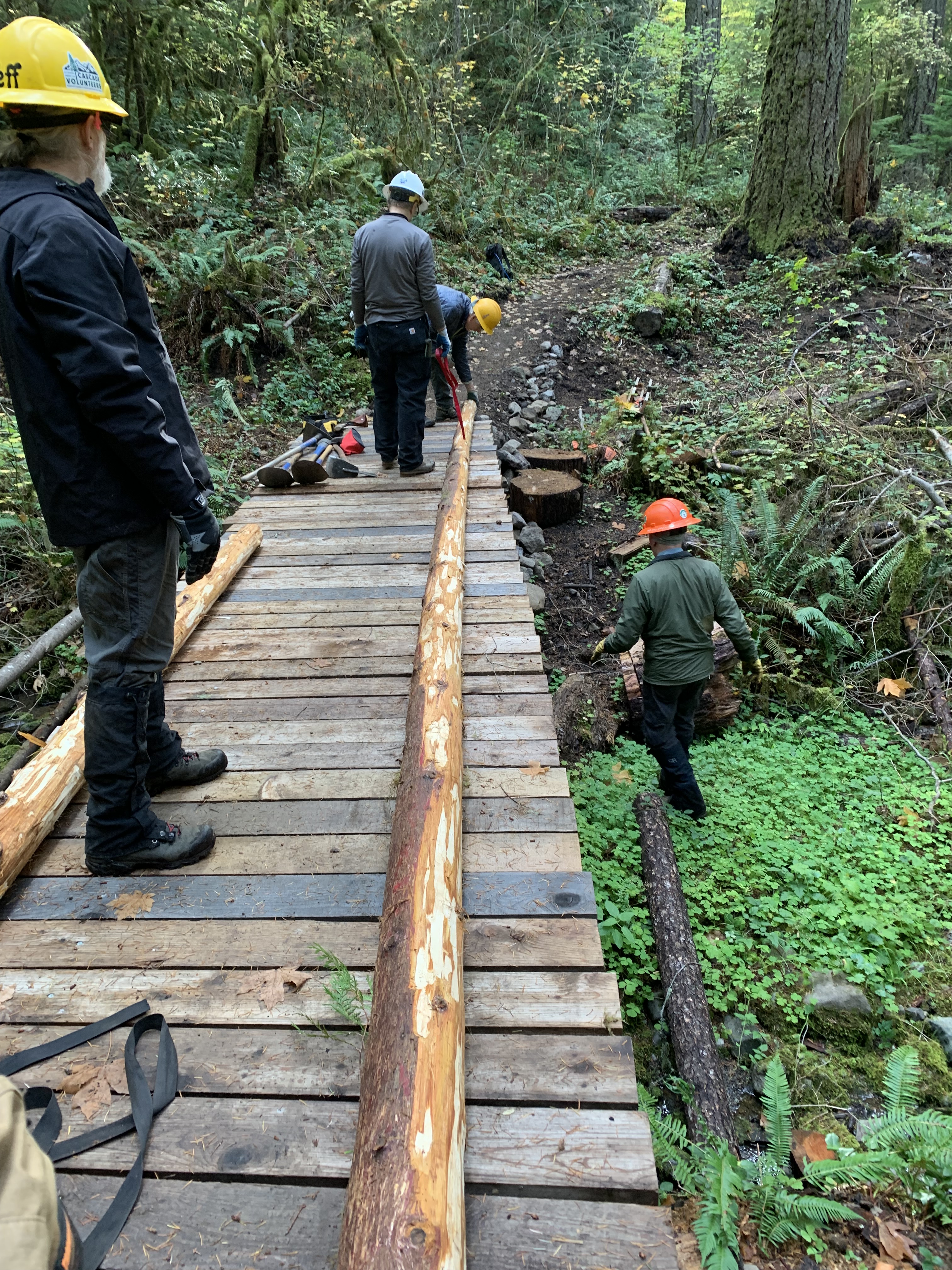
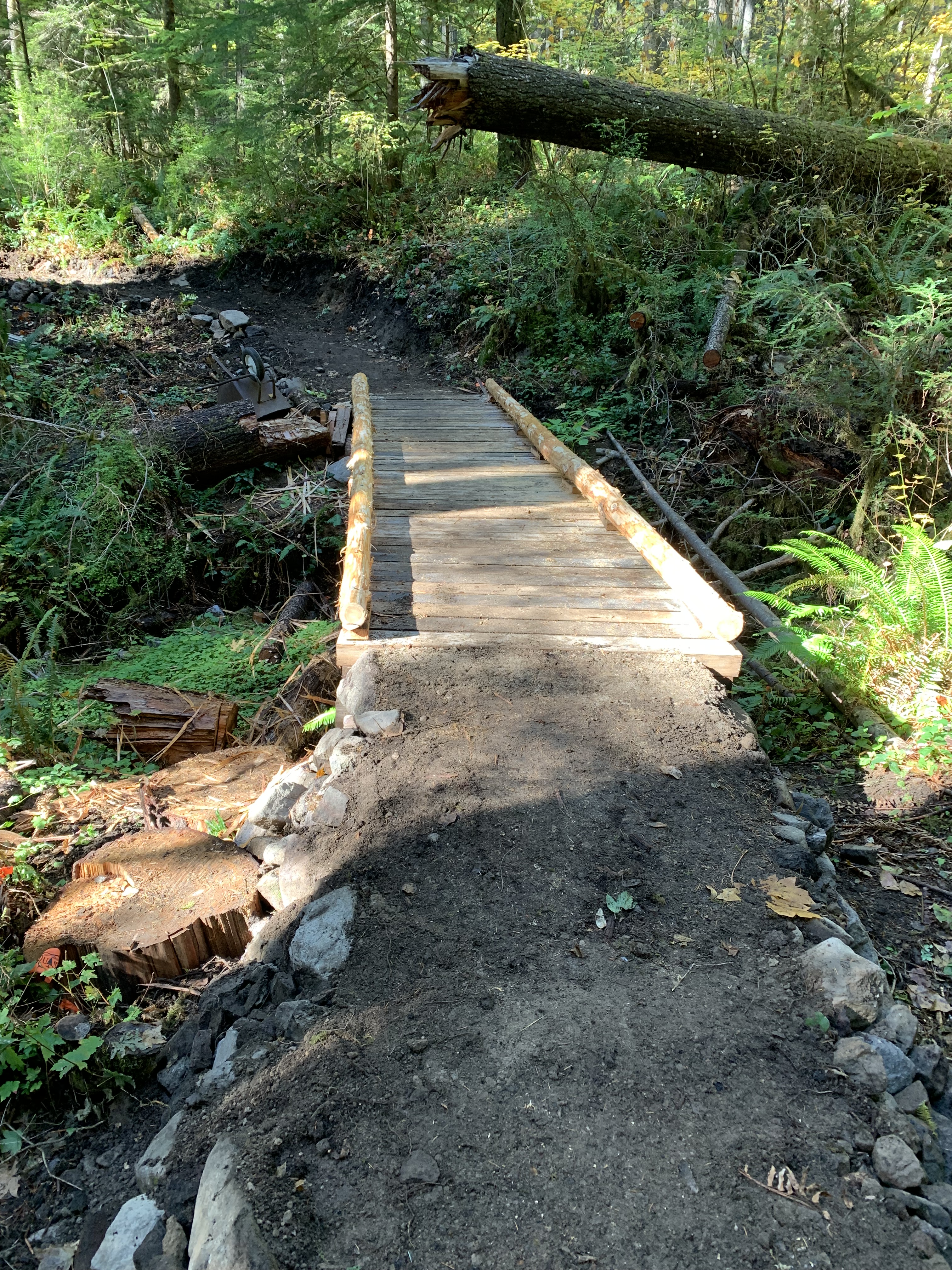
The rest of us planned to finish the second bridge by widening the eastern ramp and more importantly, fetching 50 feet of downed Western Red cedar from across Tire Creek, another third of a mile. Sig had cut three logs, they were mostly debarked, and they would become the base rails, the final step in bridge completion.

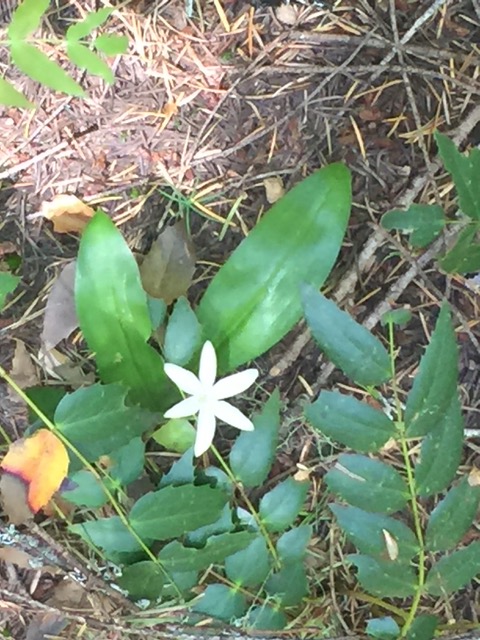
I lifted the end of a 25 foot log, 5-6.5 inches in diameter, a bit less at one end, as cedar tapers. This was heavy, and we needed to first get it across the creek, then move it uphill on a narrow trail and then more than a quarter mile back to the second bridge.

Jeff and I picked up the shortest log, 9 feet, put it on our shoulders and hiked back to the first bridge. My acromion, part of the scapula that is the point of the shoulder, protested, but 9 log feet had been transferred.

Eighteen per cent.

Getting the larger logs across the creek was an effort, with many ways to fall and fail.  When we had six people, we used straps and brute force, and with multiple stops, got the log across the creek and part way up the hill on the other side. I was asked to video, which was great, because I then didn’t have to help for thirty feet. I should have videoed the whole process.

I had been computing in my head 6 inches in diameter, 3 inches radius, quarter foot, area 1/16 square foot, times pi, or about 0.2 sq ft. multiply by 25 feet to get about 5 cubic feet of wood.  Now, Western Red cedar weighs 28 pounds per cubic foot dry, but this wood was cut 9 days ago and is green. How much?  Well, figure maybe 50% more, although one can find even higher numbers.  So the weight is probably 40-45 pounds per cubic foot, and we were carrying somewhere around 200 pounds. Two hundred solid, long, not bendable, heavy pounds. While we had six of us, at least two or more of us at any given time were not doing as much when the trail turned or there was an unfortunate rock or tree in our way. Six of us somehow got the log back over to the destination bridge with multiple stops. I felt sorry for Doug, who had the heavy end.

The third log remained. When I went back over, I noted one end was too narrow for what we needed.  Someone said we needed only 14 feet? That didn’t seem right, so I checked if we still needed 50 feet total. Yes.

OK. Jeff and I hauled 9 feet, and all of us hauled another 25. That’s 34. We need 16 feet to finish. There was a pause, then agreement. Think twice, measure twice, speaking of which, we had 25 feet of tape measure that wouldn’t roll back up. That’s a 300 inch metal mess spread across the trail.

We cut the log on the narrow end to 16 feet; the same six of us hauled it over, far easier with a third less weight. We placed it on the bridge, let Chris finish debarking; Sig and Steve would put it into place with spacers and lag bolts, we widened the on ramp, and the second bridge was finished! 

Two more to go. See you on the trail.

Oh, forgot to mention. On the way home, we got stopped for a train, then 5 minutes after moving again got stopped because of a police action in Westfir. We turned around and came home via the North Shore Road.

by Mike Smith

Willamette NF 2024
WHITE FLOWERS AND UNDERBUCKING

June 8, 2025

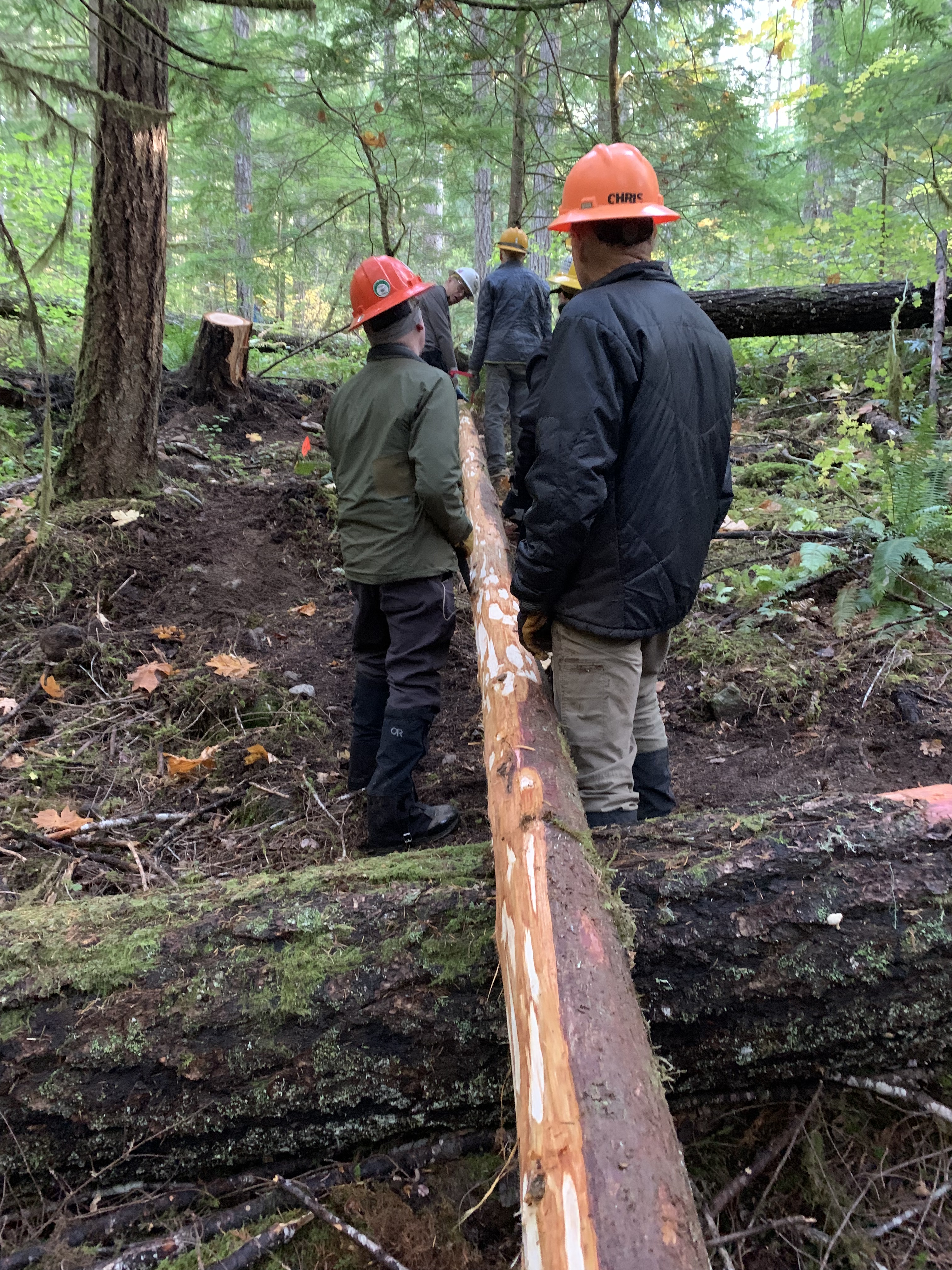
I love queen cup flowers. Six separate white petals, not tall, they bloom in the sixth month of the year, following the five petal Oregon anemones, which bloom in the fifth month of the year. I noted them along with a few five petal wild blackberry flowers on the half mile Frissell Crossing Trail from the South Fork Trail in the Three Sisters Wilderness to the campground, effectively unusable because of blowdowns. At least 20 logs were over, on, and blocking the trail.

The Crew had split into two groups this Saturday, an unusual day to be out, but we had several interested who could come out only weekends. I came along fully expecting to clear brush at the far end of the wilderness trail, but I was assigned to a group cutting out logs outside of the wilderness. That was fine by me. My foot bothered me a bit, and I wouldn’t be hiking as far.

The first log was a teaching moment for another Mike, retired Forest Service, a crosscut saw expert with a wealth of information. He sharpens saws, a job that he says takes about ten years before a person does it properly. The classic saws we use are about a century old, with as many teeth as years, along with terms like rakers, gullets, guards, and made of high carbon steel, not requiring sharpening often but very brittle. The saw teeth should never touch dirt, and woe unto anybody who lets that happen. The handles may be removed or rotated 90 degrees. Once while bucking in a different crew where nobody knew me, I fastened a saw handle about as quickly as possible with gloves on. That doesn’t usually happen, and it meant something that day to have someone see it.

We soon had a couple pair of logs that had to be dealt with, plenty of work for everybody. I had done one logout earlier this year, so my arms were ready for another day’s handling of a saw. Along the trail the trilliums were now gone at our elevation about 3000 feet. It was about 60, comfortable, some stream noise in the distance from the South Fork of the McKenzie River and no bugs. Good day to be out.

I misjudged what one log was going to do and didn’t recognize a couple of things we could do on one that the other Mike pointed out. I wasn’t feeling good about myself thinking after more than 7 years out here and 120 plus days logging out, I wasn’t progressing, just getting old.

After lunch, we worked on a series of three logs that required six cuts, opening another section of trail. We encountered the last log about 12 inches in diameter, high over the trail, caught in the V of two trees on one side. My turn to say what to do. Nobody else was talking. 

I have visualized this sort of problem at night and tried to figure out how to deal with it.

I said we should go to the far end away from the V where the log was closer to the ground and cut it there. It had bottom bind, meaning it was bowed upward; a cut will have tend to have the log go upward and maybe come apart (like explode), with a great deal of force. Such logs are under a lot of tension on top with compression below. We started with a top cut, a small mistake but maybe not having been seen by others. The log started talking to us by cracking, and I told my partner to stop sawing and to move the saw underneath to underbuck, cutting from below. I like to do this anyway, but I should have done this right away.  If we cut into compression, the tendency of the log to explode when the tension is cut will be minimized so it won’t slab off, carry the saw into the air, or throw a Pulaski 30 feet, all of which I’ve seen. Earlier that day, I had underbucked  twice with the right offset so when the cut round fell, the saw stayed in the fixed part, completely protected.  That’s pretty cool if one is interested in this sort of stuff.

We underbucked maybe an inch into the log and then went back to the top. There was more noise, and I had us again underbuck about three inches away from the first time. We returned to the top and this time cut all the way through. The log dropped.

Perfectly. It didn’t slab, and it was now just below waist height. Wonderful. The V it had been hanging in was pulled apart just enough to keep the log off the ground. We cut through it and were done.

On the way back, I thought I saw a trillium, but the three sepals were white along with the rest of the flower. Trilliums have green sepals. When we got back to the vehicles, there was a whole group of these flowers growing nearby, and I took a closer look. They were Oregon Iris. It can be—and here it was—white.

Queen’s cup

Oregon anemone