Archive for August, 2012

THE EPI-PEN CARTRIDGE

August 17, 2012

In 2009, I hiked part way up a mountain along the Aichilik River, at the northern end of the Brooks Range in Alaska’s Arctic National Wildlife Refuge. I sat on a flat rock and wondered who had sat on that rock.  It was a place where conceivably nobody had, for a century or a millennium–or ever.  Two years prior, I went into the Arrigetch Peaks in Gates of the Arctic National Park; our trip of seven was the only trip to go in all year, and the Arrigetch are well-known.  Maybe 80 people backpack ANWR every year, a place the size of South Carolina.  I’m blessed; I’ve done it twice.

The Maidens, Arrigetch Peaks, 2007
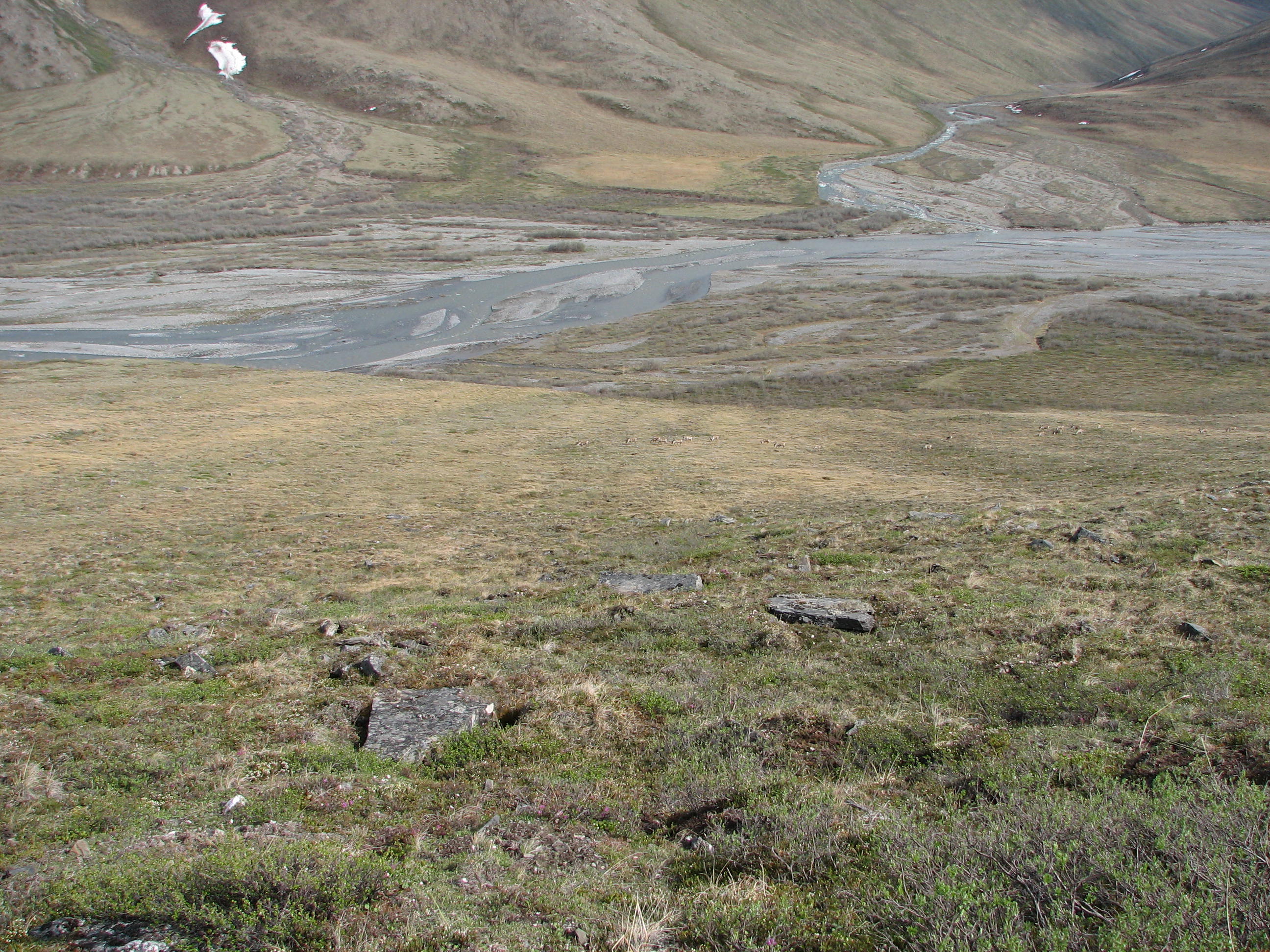
My rock, with the Aichilik River below.

In the Lower 49, the least visited National Park had 19,000 visitors annually.  No place is more than 20 miles (30 km) from a road.  I have taken 60 multi-day canoe trips into the Boundary Waters, often five or six days between sightings of people.  But every place one camps, there is a little trash.  You know you are one of many who has been there, even though the numbers of people who get into the backcountry are relatively small.

Few ever camp in the Brooks Range, where you are 200 miles (300 km) from a road.  Alaska has wilderness like nowhere else on the continent.  There are thousands of valleys in the Brooks Range which may go years in between human visits. This is a different league from the “Lower”.  I am blessed.

The following year, I hiked 32 miles along the upper reaches of Alaska’s Noatak River, one of the remotest rivers in North America, which starts high in the Brooks Range off Mt. Igepak and ends far to the west in Kotzebue Sound.

Perhaps 10 people a year go to the Noatak to raft it or to hunt in the nearby mountains.  Ten.  Few hike it.   As I walked, we encountered a few rusty cans, evidence of miners who worked in this region a half century ago.  Then I saw an empty Epi-Pen cartridge.  That piece of modern day litter made the area a little less remote, a little less wild for me.  I know others have walked here; I wanted to believe that I was one of the few who ever would see this place.  Seeing modern day trash badly affected that image.
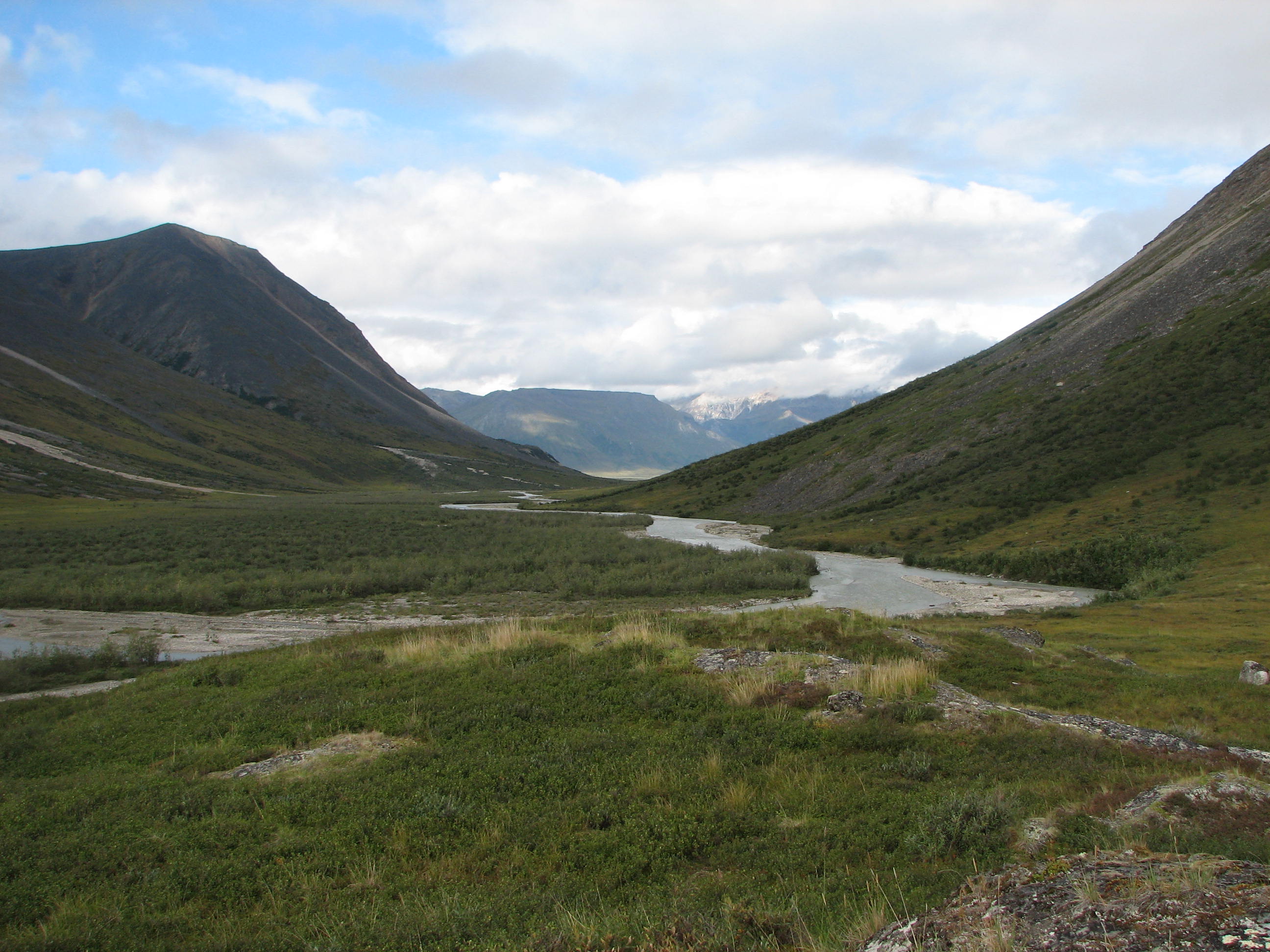
The upper Noatak River.

Wilderness is not just acres of undeveloped land, because a forest with no houses along a highway is only a forest, not wilderness.  Wilderness is an extensive roadless area, an ecosystem, where people seldom go, and if they do, they don’t stay long.  The go to test themselves, to think, to get away from other people, to be alone, to hear nothing but natural sounds, or nothing at all.  Sig Olson was the first American author who really understood the concept, when he wrote “Why Wilderness?” in 1938.  He wrote of those who wanted hunger and thirst and the fierce satisfaction that comes only from hardship.  He wrote of those who wanted to be in the “back of beyond,” where roads, and towns and steel ended, for only there would they find release.  When I first read those words, I realized I was not alone.

That is why even a few acres of ANWR devoted to oil exploration is something I don’t want to occur, even when I use plenty of oil in my life, to get to places like ANWR. Perhaps that is hypocrisy, although I use those resources also to relate how special these places are to people who will likely never see them. Additionally, I have  spawned no children, which is as green as it gets.  I believe our society, with as many intelligent people as we have, should not be drilling for oil in ANWR.  We can find other sources of energy, and we can conserve better, too.

I know that a few acres in ANWR compared to 19 million that comprise the Refuge seem small.  Those few acres are like a Epi-Pen cartridge on the Noatak, or aluminum foil in the Alatna.  There will be roads, unnatural noise, development, more aircraft, risk of spills that will destroy the most wildlife (which is along the coast).  It will change the character of the wilderness and degrade it, for instead of being 100 or more miles from Arctic Village, a tiny town served by aircraft and with no roads out, one will be 50 miles or less from oil development in most parts of the Refuge.

A large portion of Arctic Village

Does 50 miles matter?  Yes, even more than an Epi-Pen cartridge.  If you think that is crazy, I accept that.  But then you don’t understand wilderness, either.

Leave ANWR alone, for future generations, as one place where we have not despoiled.  Let those whose lives have yet to begin see the mountains and valleys, grizzlies roll on aufeis, Dall sheep 10 meters above you, caribou walk 3 feet by you, fight the bugs, eat the berries, climb passes that maybe only a few people ever had, and watch the Sun circle the sky every day in June, as I have.

Grizzly rolling on aufeis, Drain Creek (Kongakut Drainage), 2009.

Caribou 3 feet from you, Aichilik River.

There need to be wild places in America where one can’t easily reach.  We don’t build chair lifts in the Grand Canyon, so people can go up or down.  Let’s leave it like that.  Those who can’t–or won’t–hike it can still see the beauty.  Those who can hike it, who are willing to carry what they need and work hard doing so, will see more.  That is how it should be.  I need to know there are still places out there where I can go to escape my own species, my detractors, my society, and find peace.

Unless you have experienced the wilderness on its own terms, know you are not in control of a situation, have met a bear or wolf face to face, dealt with a powerful thunderstorm solo, 3 days travel from town, forded a dangerous river, know the capsizing meant death, had to make do without something you really needed, you can’t understand the need for wild country as part of America’s heritage.  If you can understand how an Epi-Pen cartridge changed the Noatak Valley for me, perhaps you can understand why I want no development.  Leave no trace of your presence in the woods, and let’s leave no further traces of our presence in the Brooks Range.

Top of an unknown pass. Who has climbed it? Bathtub Ridge in distance.
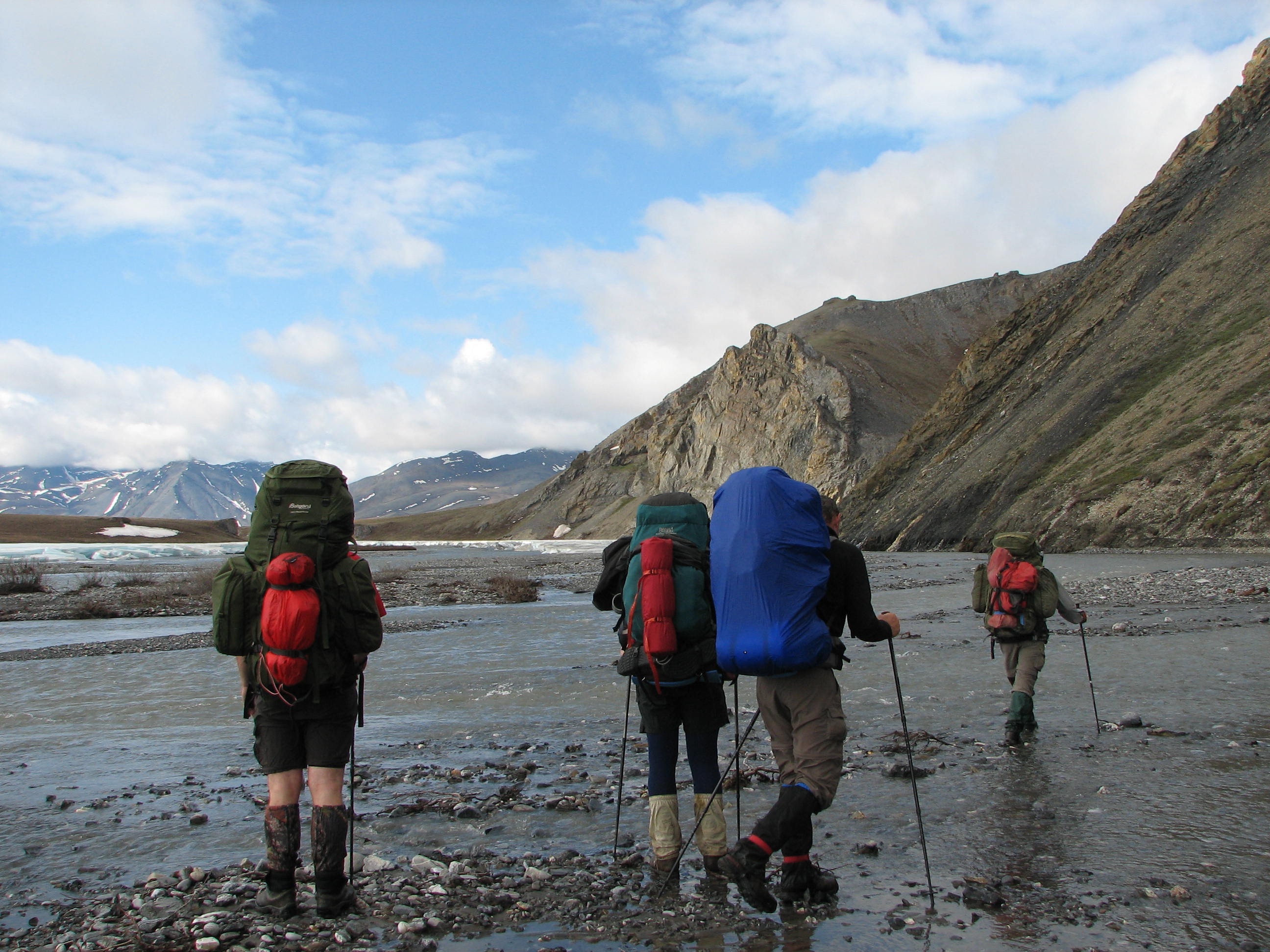
Beginning a ford where the Aichilik is not so dangerous.

Face to face with a 2 year-old male Griz.

SWIFT BOATING VACCINATION

August 13, 2012

On a science podcast I listened to a few months ago, the moderator interviewed an actress from a well-known television series.  She had a Ph.D. in physics from UCLA.  The moderator himself was on the show one time, and that may have colored his viewpoint of what happened in the interview.

The woman had not vaccinated her children, saying,  “There are a third more vaccines now than there were when I was growing up, and I thought that was too many.”

She thought that was too many?  Based on what science?  Her statement appalled me, and I was equally appalled when the moderator did not call her out on her actions.  So what if there are a third more vaccines?  I haven’t seen a measles case in years.  A measles cluster involving about 7 people occurred here a few years back, and it made the newspaper.  Fifty years ago, only 7 cases of measles in a neighborhood  would have made the newspapers as real news.  Measles kills and is extremely contagious:  1 in 1000 die from measles encephalitis.  It is a nasty, nasty disease.  Does this mother want to spin the roulette wheel on her children?

Or rubella, the disease we kids loved to have, because we felt fine but had to stay home from school.  Unfortunately, pregnant women may catch rubella–and may not know it–until too late.  Does she want her daughter to have a child with congenital rubella syndrome, like a cousin in my distant family?   He is deaf, retarded and partially blind, and he lives with his mother.  What happens to him when she dies?  What happened to his life, and what happened to his mother’s life?

What about polio, where most cases are asymptomatic?  Perhaps if her children never leave the US, they will be fine.  What if they go to Bangladesh, Paraguay, Uganda, or even Mexico?  Does she want to take the chance they will get polio that is not asymptomatic?  Perhaps they will not be allowed in, because some third world countries actually believe that vaccination is important, even if some in a First World country don’t.

Mumps orchitis (testicular inflammation and a chance of sterility), pertussis, and H. influenzae meningitis are not benign diseases. This is the worst year for pertussis in decades.  What is this woman thinking?  Does she believe these diseases no longer exist because a higher power took them off the Earth?  Does she not know the Salk Trial was stopped early, because the vaccine worked so effectively?  I was part of that.  I was in the first cohort who got the Sabin vaccine.

When I was a medical student, forty years ago, we wrote “UCD” in a patient’s history, meaning “usual childhood diseases.”  I have no idea what they are now.  If we did as a country what we should do, and mandate vaccination for those who clearly have no contraindication, we would not have many “UCD” at all.  In Arizona, half of all children in charter schools are not vaccinated; 15% in public schools are not.  It’s bad enough we are destroying public education in this country; now the kids are going to be at higher risk for bad diseases, too, in addition to no solid proof in Arizona that charter schools deliver a better education.

Regrettably, all it takes is for a few vociferous people who will not believe sound science to convince many that white is black, and black is dangerous.  There are many people convinced vaccines cause autism and vaccines are bad, when good science has not shown that.  There are many who don’t believe we landed on the Moon, that astrology is meaningful, who can’t find Polaris, don’t know why we have seasons, don’t know metric or English measurements, think 9/11 was a US government plot, and the Marfa Lights are UFOs. Even more believe that the climate is not changing, and that we can continue to grow economies infinitely using finite natural resources.  The latter beliefs are unfortunate; not vaccinating when there are no contraindications is child endangerment.

Before 2004, not many people had heard of Swift Boats.  Today, the term is an English verb: “To Swift Boat somebody”.  You take a fact, say it isn’t or discount its worth, repeat the lie over and over again, and you can get a lot of people to believe it.  Swift boat ads helped defeat a decorated combat veteran by turning his Vietnam service against him. We have Swift Boated vaccines, and at some point we will pay the piper.

I wish I could have had the measles vaccine in 1956.  I did get the mumps and shingles (zoster) vaccines.   The zoster vaccine decreases the risk of neuralgia by half and cost me $200. I thought that was a good bargain, since post-herpetic neuralgia is a miserable, poorly treatable disease.

For most of history, disease, not hostile action, was the biggest cause of battlefield casualties during war.  Small wonder that the military believes in vaccinations.  It would be nice if the rest of the country did.

GATES OF THE ARCTIC, 2012, DALTON HIGHWAY TO SUMMIT LAKE

August 7, 2012

I’ve been fortunate enough to have had six extended backpack trips to Alaska, two on the Chilkoot Trail, two in the Gates (Arrigetch and Noatak River), and two in ANWR (Kongakut and Aichilik Drainages).  I had missed seeing the actual Gates of the Arctic, the mountains that Bob Marshall called the Gates–Boreal and Frigid Crags.  I wouldn’t see them by foot, but I could see the area near them by foot and see the Gates by air.  It wasn’t quite what I wanted, but it was as good as I was going to get, and I jumped at the opportunity.

Like a lot of things in life, how this happened was by chance.  I knew ABEC, my past outfitters, had “hung it up,” so I tried other groups, but the cost was very, very high, mostly because of air travel.  I wrote Dave Hamilton, one of the past owners of ABEC, and wished him well.  He wrote me back and said, “Don’t plan anything yet.  I’ll talk to Aaron (his son)”

Aaron and Dave guided the Aichilik trip, and Aaron is both good and strong.  He now works for Alyeska, and he had time for a trip in the summer.  We could cut costs if we drove the Haul Road just south of Atigan Pass and hiked in, flying out.  Aaron thought he could get somebody to drive his truck back home, and it was my job to pay for the flights necessary to get us from the middle of the Gates back to Bettles and then to Fairbanks.  With remarkably little, but effective communication, we set up the trip, and I shaved a day off the front end by flying to Fairbanks in a day and spending overnight only before pickup at the motel the next day.

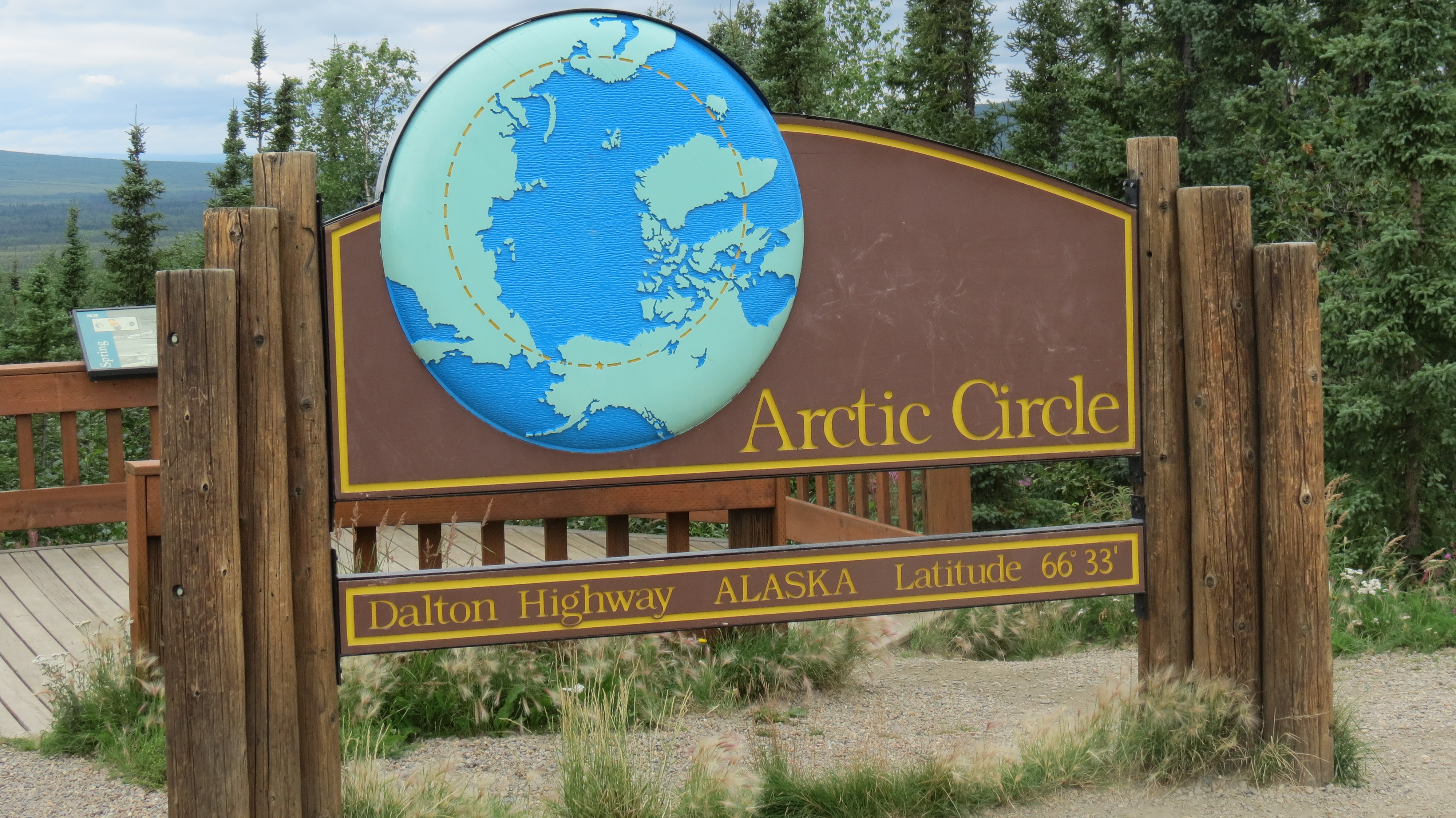
I was picked up by Aaron and his father-in-law, and we drove up the Dalton, stopping at the Yukon River Crossing for lunch,  and  the  Arctic  Circle.

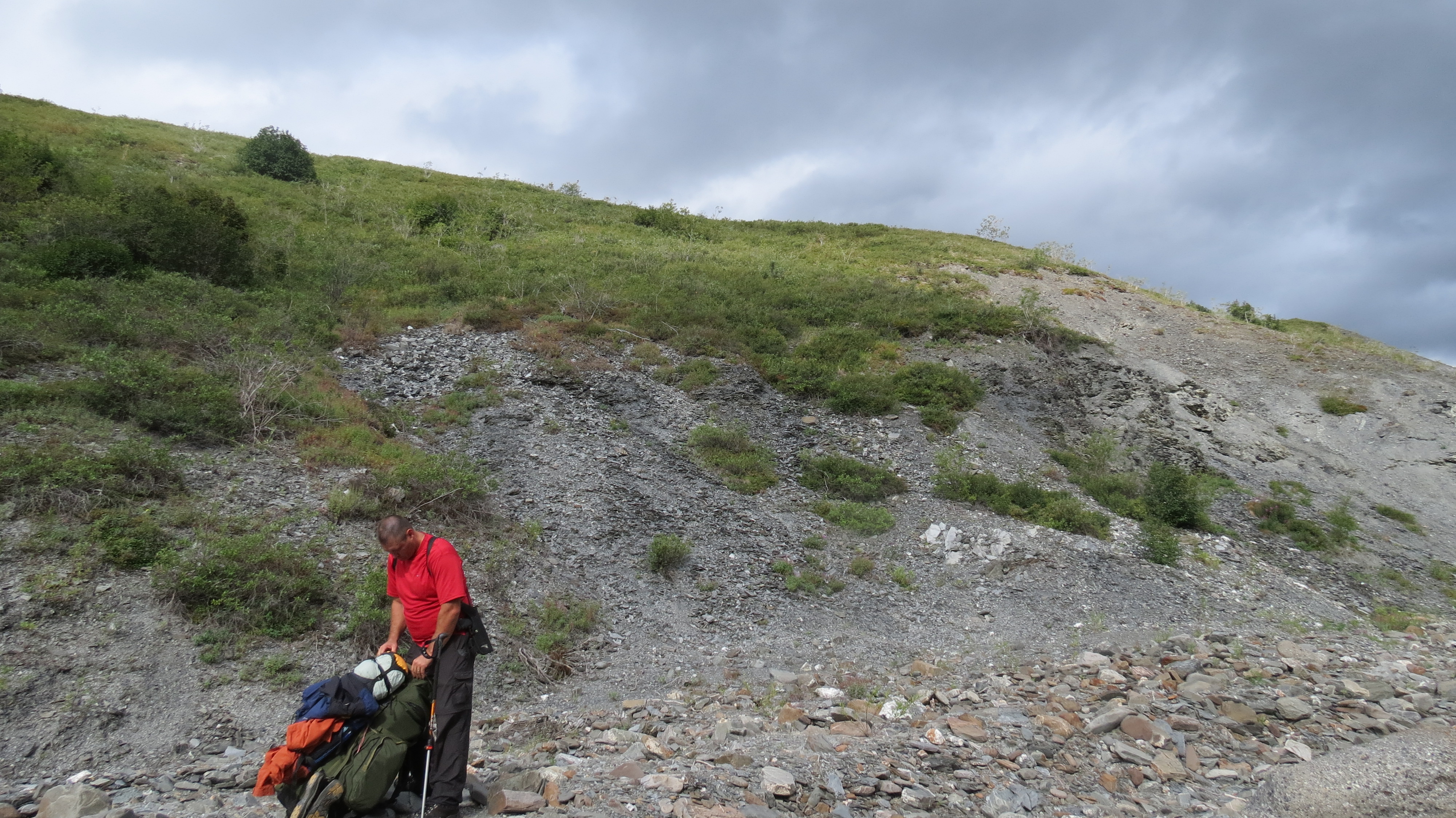
We drove up Atigun Pass  in fog, then came back to “Plan A,” camp along the Dietrich River, hike upstream about a mile, then hike over a pass about 1200 feet high down into the Kuyuktuvuk Drainage.  This would be preferable to a 4-5 mile hike through brush on the latter drainage, although it would entail a lot of climbing.    Aaron at base of climb. This was only about 1/5th of the entire hill.

We decided to do it and sent the truck back down the Dalton, camping on a sandbar in the middle of the river.

The next day, sunny, we hiked through some brush, through the river, and reached the climb.    It first looked easy–steep, but only about 200 feet vertical.  Unfortunately, that was the first of several false summits.  We would climb 1000 feet altogether, and while the grade lessened, it was steep the whole  way.  Aaron was carrying 93 pounds, I was carrying about 70.  We camped about 2/3 s of the way up to the top, where there was some running water.  We had a great view of the road, and a shorter 400 feet vertical to cross the pass.   

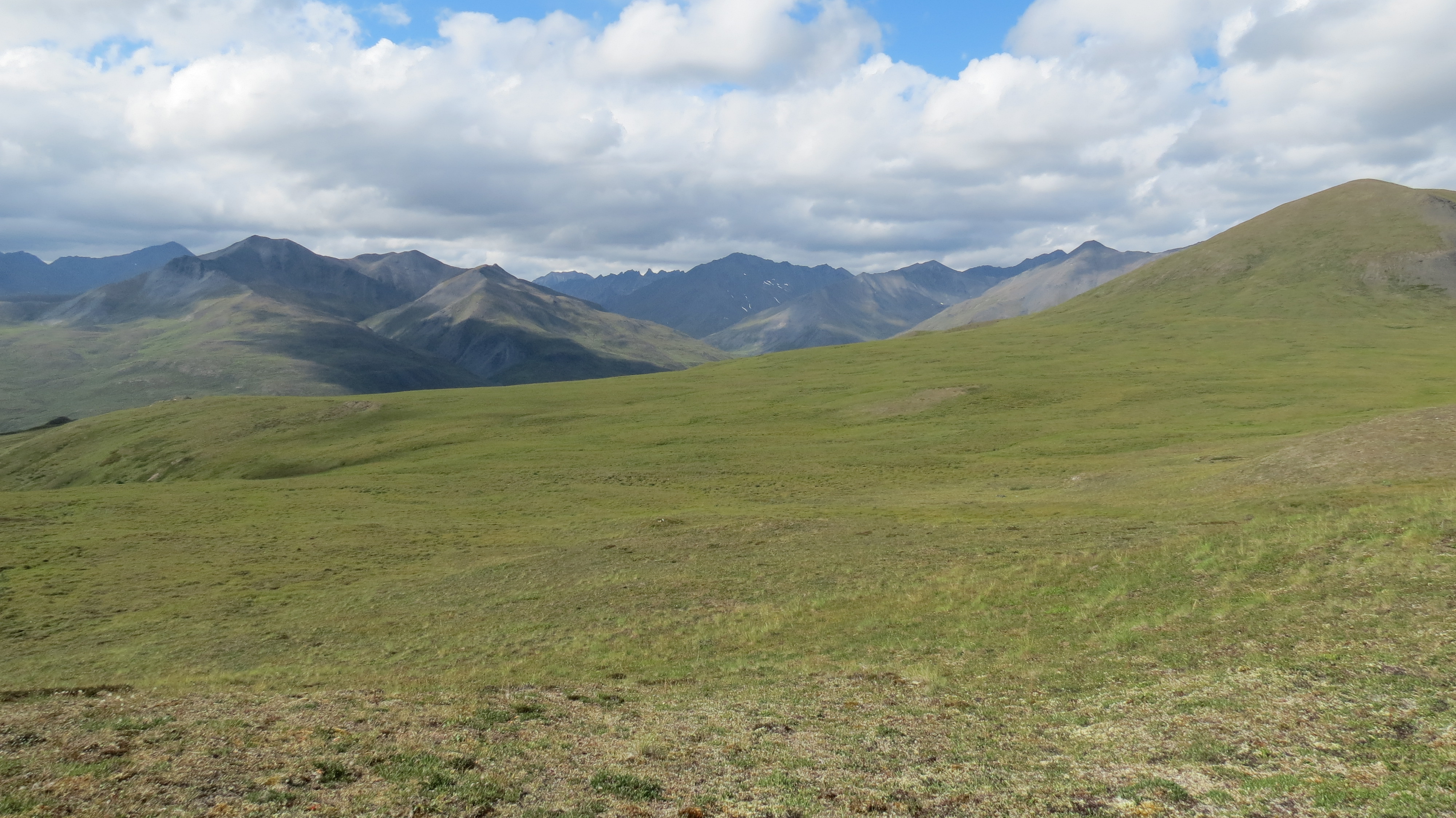
The next morning, we waited for the fog to burn off, which it did, and set off, over the pass down the other side into a large meadow and truly in the Gates.  We hiked downhill about a mile and a half to the river, where I crossed a moraine briefly hyperextending my knee.  While it did not appear to be a problem, I did notice some posterior pain.  We had lunch, I noted no stiffness, and we continued upstream, finding a camp on a bluff above the river.

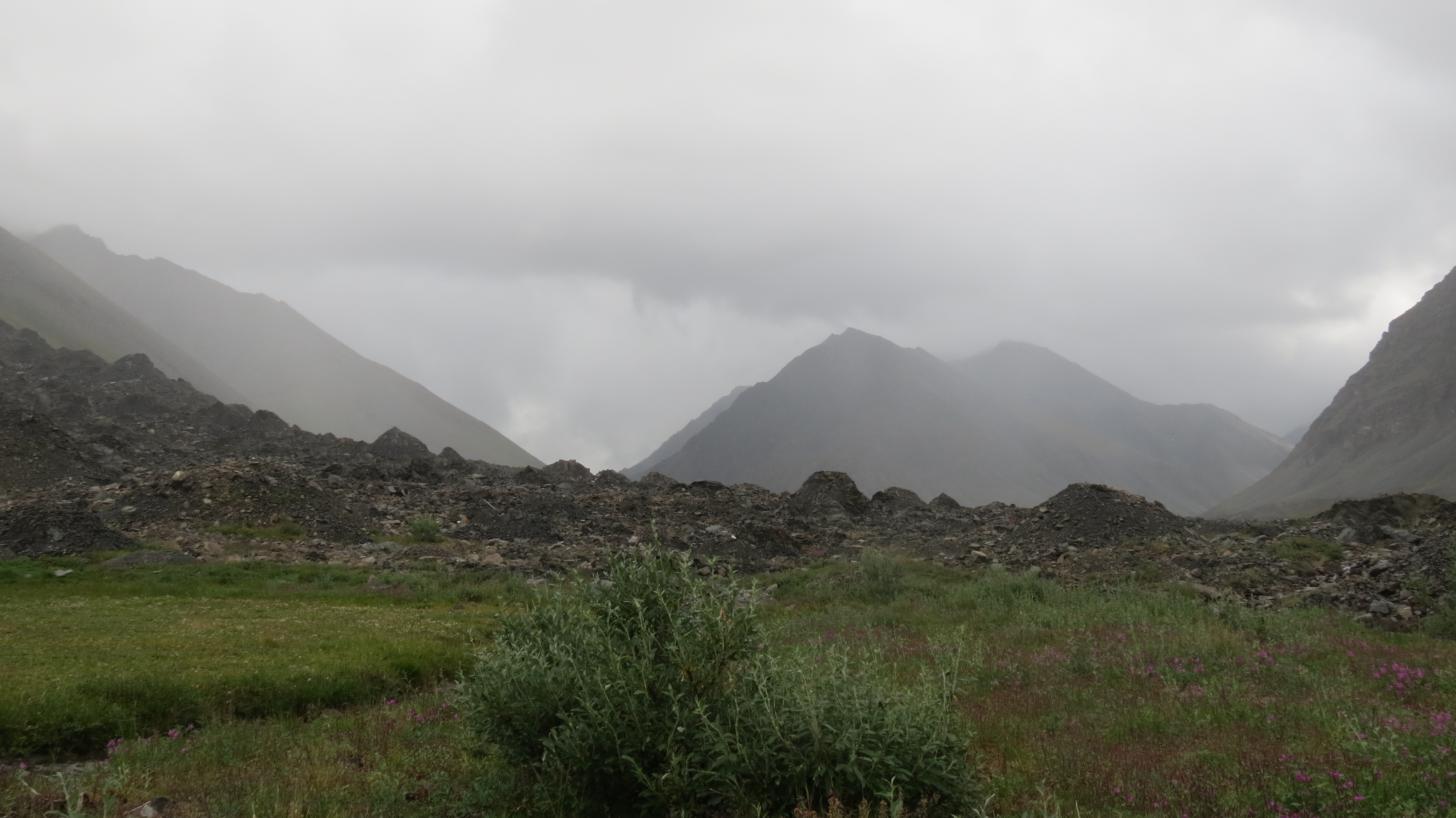
The next morning, with no more stiffness, except with full flexion, we continued upstream, the weather deteriorating.  We crossed Oolah Pass, a 1000 foot climb, and saw Oolah Lake, a small pond, at the summit.  By now, we had rain and wind, the latter behind us, and we headed downstream, through several rock fields.  In retrospect, we should have stayed on the other side, and high, but we stayed low, along the river, and went through some ballet-type maneuvers to get through the rocks,  Quite wet, we set up camp on a bluff, where running water was available, away from the river, well below us.

That night, it rained, and I got about as wet as I ever have in my tent.  What I thought was poor waterproofing was instead the wind blowing the rain under the fly and through the vents.  I rocked down the fly and sponged out the tent, realizing that having a tent sponge was a very useful item.  We were visited by a solo hiker going the other direction.

The weather no worse (and no better) the next day, we kept going, downstream and then joining the Itkillik River, crossing a giant moraine and walking through the river, tussocks, and general Alaska hiking.  We saw a bear eating blueberries, and stayed well below him, getting pictures from a distance.  I found that 35 x has some advantages. My leg was fine, and we planned on camping near the last turn that would lead a few miles to Summit Lake.  I was ready to set down, when Aaron suggested a small hill about a quarter mile inland.  Unfortunately, the hill was covered with Arctic Ground Squirrel holes, usually meaning trouble.  He then pointed to a large hill at the corner, asking “Do you have that in you?”  After a whole day, I thought I did, and climbed a few hundred feet in a half mile.  Neither of us was fast, but while windy, the campsite was better.

From this time on, the wind was in our faces and in our lives.  We were well above the river and thought we could stay high and avoid a lot of the muck.  That did not work, although we did have 1-2 miles of river that had easy walking, before the vegetation a half mile on either side was swampy. We bit the bullet, crossed the swamp, and climbed a couple of hundred feet.  As we crested the hill, I thought if Summit Lake was way in the distance, I would be really discouraged.

It was right in front of us. NPS was camped at the best spot, but we camped across from them and had 2 days of high winds, rock down the fly, and try to stay warm.  We did, although the wind was strong.  We saw several Dall sheep across the swamp high up on a mountain.  Neither of us was eager to do a day hike, given the near constant rain.  One morning, it was calm, the tent stopped flapping, and I went outside to find us enveloped in thick fog.  When I heard tent flapping a few hours later, I opened the tent door, and there was no more fog.

After two nights, we were talking after dinner on the third night, and I was just about ready to get undressed to get into the sleeping bag.  Aaron called his wife on the Sat Phone, and she said, “Have you heard?  A plane is coming for you tonight.”  Well, no, we hadn’t heard, since Sat Phones are turned off and the battery removed when not in use to save power.  We quickly packed up and were almost ready when Tyler, Chief Pilot at Bettles Air, landed a Beaver on the lake, telling us that the weather was going to deteriorate for several days and this was our “window” for departure.  Within an hour, we went from getting ready for bed to being high over the Koyukuk, headed through the Gates of the Arctic, which I finally saw, back to Bettles, and another wait before we could get back to Anchorage.

My knee did fine, but my leg developed soreness and swelling.  My best guess is that I tore something posteriorly in the joint, perhaps a tendon, and have some blood dissecting in the muscle.  What concerns me is a deep venous thrombosis as well, so ending the trip when we did  gave me a chance to come home early.

Was this my last backpack trip to Alaska?  I don’t know.  A 71 year-old did the Arrigetch, but on the other hand there are no major trips I can see myself easily doing in the Gates that I want to.  There are places to go, passes to climb, but they are difficult, and some end up at Summit Lake, which I don’t think I want to see.  ANWR?  There is the Colleen, the Leffingwell Fork of the Aichilik, and the Sheenjek Drainage, the latter I have spent a night at.  It is two flights to ANWR, one to Arctic Village, and a second into the Refuge itself.  I’m not sure, but I don’t have to decide tonight….at the Anchorage Airport, waiting for a flight south.  I’ll have to see what happens as I age a bit more.  I think both Aaron and I think we needed to get into better shape, even though I was carrying 65 pounds every other day 2 miles for several weeks.  I needed to carry more….and further.

Or eat a lot less.

Pictures.