Archive for May, 2014

WHERE’S THE BEEF?

May 30, 2014

Twenty years ago, medical director of a hospital, I took a call from a woman who wanted to know how many Abdominal Aortic Aneurysms (AAA) her husband’s surgeon had repaired the prior year at our facility.  She asked a good question, because the surgery is difficult, fraught with risk, even when done electively, which in this instance it would be.  Too often, it is done after the aorta ruptures.  My cousin’s husband died of a ruptured AAA; I have dealt with the issue emergently, and it is difficult to control the bleeding while simultaneously repairing the vessel.

I didn’t know the answer.  Therefore, I had no idea her husband’s chances of survival, how long he would likely be hospitalized, or his condition six months later.  We didn’t track that.  It took me four years to get the hospital to track outcomes from cardiac surgery, after I exploded one night in the ICU saying that I had been consulted 26 times in 270 open heart cases in one year.  Consulting a neurologist after a heart case usually doesn’t bode well.

I mention this, because AAA is one of the outcome measurements Leapfrog uses in determining how well a hospital performs.  So is Aortic Valvular Replacement.  The Tucson hospitals that used Leapfrog scored no better than “C”; one scored “D”.  Some of these hospitals had marketed themselves as being “one of America’s top 100 hospitals.”  It seemed that they were not quite as good as they thought they were.

Leapfrog tracked drug errors, too, and no hospital in Tucson scored better than “C”.  On 2 May 2002, I met with administrators at University Hospital in Tucson to outline my reporting program to reduce medical errors.  A year earlier, I had met with their cardiac surgery program to help track outcomes better.  I can’t believe I was so naive to think that I, who had practiced, been an administrator, had a Master’s in statistics, and 2 months earlier had written an op-ed on an error reporting system we needed in medicine would take on Big Hospitals.  Capitals mine.

Both groups wanted to know, in an unfriendly tone, who I was.  Being from the same city was a minus; had I been from outside, I might have had more credibility.  It would have helped if I were good-looking, exuded charisma, and showed glossy paper with colorful bar graphs, rather than having sound ideas and a quiet demeanor.

Needless to say, the cardiac surgery program wasn’t interested, and I was assured, that second of May, that University Hospital had “one of the best safety records in the country.”  They gave me no data.  They wanted to know what software I would use. I didn’t need software; I needed reports of errors in order to understand them better.  Unfortunately, computers and charisma mattered more to them.

Leapfrog was initiated by a group who had the smarts, the looks, the networking ability, and the leadership skills I lacked.  My ideas were ahead of theirs.  In 1974, I was counting outcomes in medicine when I was an intern.  I was selecting my surgeon to do carotid surgery in the mid-1980s, based upon his outcomes.  I raised concerns about our cardiac surgery program in 1990.  I wasn’t surprised that hospitals were graded “C.”

Every member of my immediate, now small family, has suffered from a medical error.  People make mistakes.  I accept that.  People should learn from them, too, which they often don’t.  For years, we had lousy data and lousy tracking systems.  No, we had no data and no tracking systems.  We hadn’t a clue, and we let Big Medicine, called the Joint Commission, dictate what hospital quality was.  I met with the Joint Commission, too, on 14 August 2001, in Chicago, at my expense.  They were quite interested, so they said, but I never heard again from them.  No e-mails, no calls, no response to my written requests, nothing.

It takes 30 seconds to compose and send an e-mail saying one is not interested.  They weren’t  too busy.  They were rude, arrogant, and wrong, as wrong as Condoleezza Rice had been 8 days earlier and the Bush administration would be four weeks later.  The only difference is a lot more people die from medical errors every year than died on 9/11.  We just don’t know how many.  Our estimates are bad, and the margin of error of those estimates is seldom given.  That violates a basic rule of statistics.

We should be tracking outcomes of common procedures in medicine.  When I broke my hip in an accident, the surgeon had no idea I had done well until I wrote him.  I fractured my fifth metacarpal, had a cast for four weeks, and told that alcoholics often took off their casts with no sequelae.  When I was told I needed two additional weeks of the cast (which did not change the angulation of my metacarpal), the comment my father made was “that is what your doctor learned to do where he trained.”

“Why?” I asked, “don’t we know whether somebody with a broken metacarpal even needs a cast?  Why don’t we know the optimal time? Do metacarpals heal depending upon geography?”  This is not a rare injury.  If we don’t need a cast, wouldn’t that save money and time?  How many other conditions don’t we know the results?  Perhaps some shouldn’t do certain procedures, like colonoscopy, lumbar punctures, bronchoscopy or angioplasty.  How many of these have you done, doctor?  And what happened to the patients?

We physicians like to say we are scientifically trained, and non-physicians don’t have data to show they make a difference.  Where are the numbers?  What should they be?  And what are we doing to achieve those numbers?   Too many ideologues argue using rhetorical questions, which I find annoying.  A statistician’s job is to ask questions.  Ours are good questions, answered with data, uncertainty and appropriate inferences.

We don’t need high speed computers to measure outcomes.  Pen and paper work just fine, with a lot of curiosity, and an open mind.


TIME TO LEARN FROM THEIR SILENCE

May 23, 2014

I hiked the other day with a group, including a man who had driven to the trailhead with a “Disabled Veteran” license plate on his vehicle.  He was the lead hiker and set a good pace. He was probably my age, give or take a few years, and we started talking, since this was an aerobic hike—fast, but not so fast that we couldn’t talk.

When I mentioned I was a retired physician, he said a corpsman saved his life.  I didn’t have to ask where.  I knew it was Vietnam.  Corpsman=military=my age=Vietnam.  He didn’t say what happened, only that he ended up in Yokosuka, Japan, for 5 weeks before being sent back home.  He is a Marine (note the tense, for Marines consider themselves for the rest of their lives as a Marine), and we talked about ships, sailors, and generalities.

We did not talk about what happened to him.  He mentioned Hue (“Way” is the pronunciation, for this household word in 1968), and I was polite enough not to inquire further.  I had a pretty good idea what happened to the Marines in Hue, and it was ugly, awful, and part of the devastation we inflicted on many of our countrymen and their families plus another country and their people that year.

This man lived; 58,000 Americans died, as well as least three million Vietnamese, probably a lot more. Cambodia and Laos were subsequently sources of many more deaths.  This man wasn’t killed but wounded, and when one starts tallying the wounded, we are in eight figure range—more than ten million.  Americans never trusted the government quite the same again after Vietnam.

The man didn’t talk about the war, and neither did my late brother, who served in Da Nang.  When we start talking about the numbers of people who were indirectly affected by the war, the number is immense.

Only non-combatants like me, who served on a ship that was near Vietnam, but 6 months after “Frequent Wind,” the exodus, talk about our military service.  The guys who were the grunts, the hiker with me called himself one, remain silent.  Almost all of them do.  They don’t brag about their service, and even John Kerry didn’t throw his military record into Bush’s face in 2004, only his medals, about 30 years earlier.  A lot of men who fought in World War II remained silent for years…or forever.  The Republicans at the 2004 convention who wore bandaids, deriding Kerry’s service, were among the most shameful behavior I have ever seen.

This silence should tell everybody how bad war is.  It is so bad that people who have witnessed the tragedies stay silent.  Such is likely is a protective mechanism, but may come with a cost, perhaps PTSD.  The man was a good hiker, and we got up to the top of Spencer Butte and down in about 3 hours, a decent time, although he could have pushed the pace had he wanted.  Four days prior, he and I were part of a group that hiked up Rooster Rock, north of Eugene, 2300 feet vertical, and he was good.  He didn’t mention his military service that day.  It took a second hike with me to mention what he did.

Perhaps the men who start or continue these wars, many of whom have never served in the uniform of this country abroad might think a bit more about the cost.  No, I am not talking about the kept off budget “Emergency Authorizations” during the Bush administration, which were barely challenged by any American, let alone in Congress.  That’s just money; when Republicans spent it, we were patriotic, when the Democrats did it, there was howling about budget deficits.

No, I am talking about the cost to a CIB (combat infantry badge) veteran, disabled, who doesn’t talk about it, and the men who died and will never talk again.  What did they see that kept them silent?  What did they see that their families didn’t even know?  What is this cost?  Well, of course, there is life insurance, but that is a monetary cost.  I’m talking about other costs, something Wall Street, bankers, a good share of politicians, and too many Americans don’t think of and never will, unless it affects them.  To them, unless there is a dollar cost, they aren’t interested.  Health insurance costs money, so many don’t like the country’s spending money on it.  The fact that people feel relieved to have such insurance, and that is a fact, is unknown to them.  Wilderness is board feet of timber, cubic feet of water, a place where they should be able to mine.  The value of what I see, feel, and do in wilderness has no monetary value, so these people ignore it.

Wars are at times necessary, but in my lifetime, Vietnam, Iraq, and Afghanistan were all unnecessary, fought under false pretenses, and run by old men. When I hear jingoistic phrases and see flag waving that make war romantic and patriotic, I wonder why almost nobody asks, “Why do veterans not talk about what they saw?”  I am profoundly saddened, puzzled, angry when people discover that war does bad things to people that we try to sanitize, so the public won’t be offended.  Why were only 16% of us against invading Iraq?  I saw what was going to happen, wasn’t it obvious?  It was to me.

I wonder why we still hear men push to go to war with Syria, Iran, and Russia.  I wonder, of course, where the money is going to come from, since the Republican-led Congress, and that includes the Senate, since they are running that for all practical purposes, wants to cut spending.  I wonder why we act surprised when the VA isn’t helping veterans.  This happens with every war.  That costs money we don’t have.  Why didn’t these guys die or go elsewhere?  A significant number are homeless.  They served, then were thrown away, like old furniture.

When we go to war, we are going to change the lives of every individual who serves in harm’s way.  People will die, families will change, and money will be spent.  The first two have incalculable cost.  The third we try to ignore.  If we go to war, we need to have a national discussion on this, without Fox News, Karl Rove and jingoistic “leaders” calling the shots.  We need to discuss what exactly what it is that makes this particular war so necessary., because thought and negotiation must be expended, before lives and treasure.  Lives are treasure that we cannot put a dollar value on, regardless of what the actuaries and the lawyers say.

Nothing short of the survival of the country should be a cause for war.


SITKA SPRUCES

May 15, 2014

It’s only a few hundred yards.  The air feels the same, the elevation barely changes, and the ground feels the same.  To any human hiking west, towards the ocean, the woods and the trees are the same.

But they aren’t.

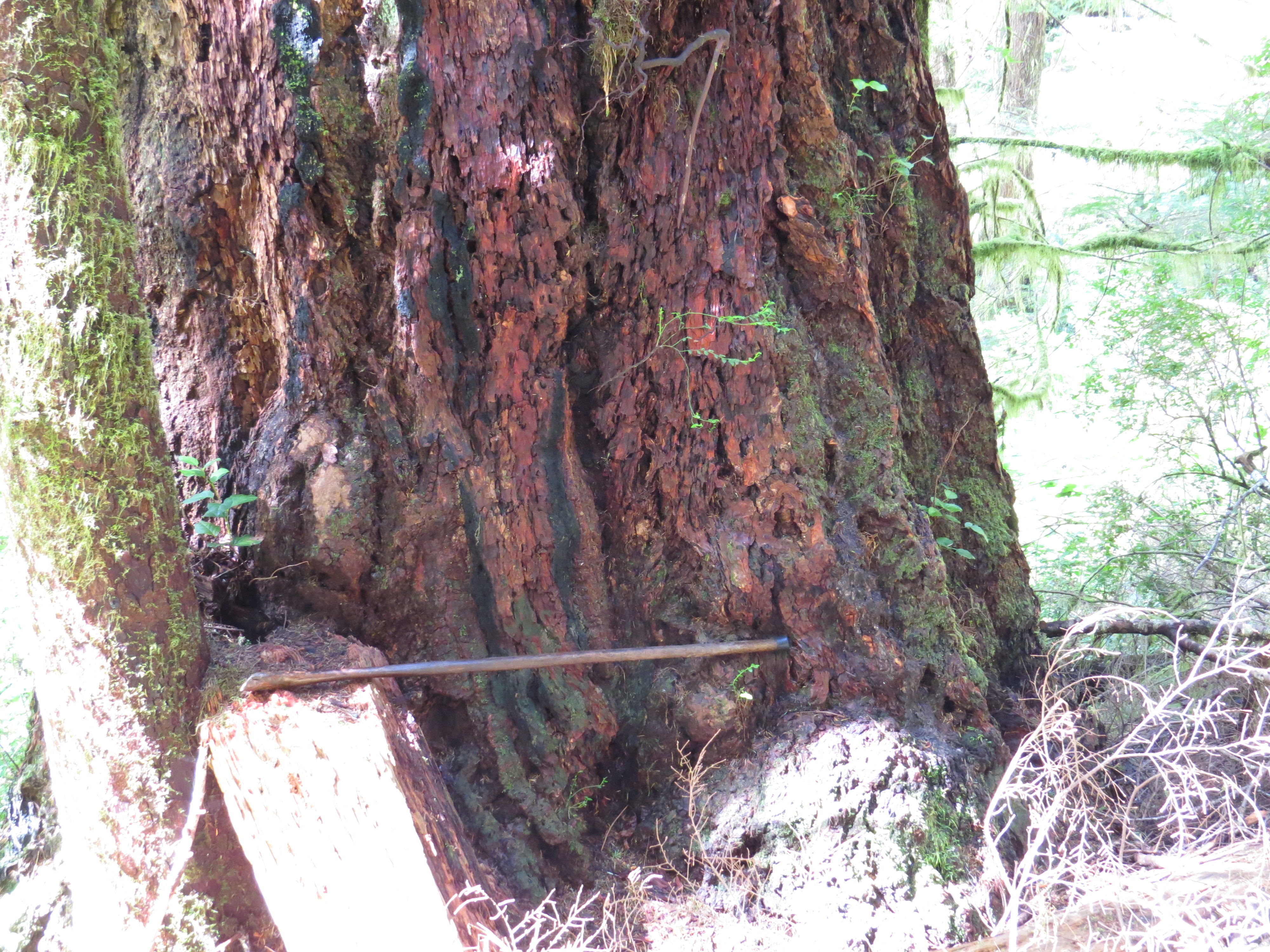
In this short distance, giant Douglas Firs in the old growth Siuslaw National Forest give way to Sitka Spruce, equally large, so much so that not far north of me is one 550 years old, 15 meters, (50 ft) in diameter, and nearly 50 meters (160 ft) in circumference, 70 meters (230 ft) tall.  A kilometer further inland—maybe only a few hundred meters—there are no Sitkas.

By "Big Tree," 550 years old.  The cave underneath once had a log from a fallen tree, that helped this tree grow.  It was called a "nurse log."

By “Big Tree,” 550 years old. The cave underneath once had a log from a fallen tree, that helped this tree grow. It was called a “nurse log.”

In this transitional zone, there are slight changes in the atmosphere and the soil sufficient to change the climate of the forest enough, allowing one type of tree to thrive and to displace another.  I don’t notice it, but the trees do.  Like the Redwoods south of here in northern California, Sitka Spruce can live only a few miles from the coast.  Any further inland, and the air, the soil, everything changes so that these trees can’t survive, but others can.

It’s a lesson we need to learn.  We are more like these trees than we think.


Douglas Fir, with 1.3 meter (4 foot) walking stick for comparison.

Douglas Fir, with 1.3 meter (4 foot) walking stick for comparison.

IMG_0585

Indeed, when one looks at what the human body can tolerate, our cells, too, live in a microclimate that is just right.  Drop the partial pressure of oxygen in the air suddenly by a third, and we die. Change the sodium concentration in our blood 15%, and we are in trouble.  Change the potassium 30%, we die.  Change the calcium 10%, and we can’t think clearly.  Put 50 cc blood suddenly in our head, outside the dura mater, and we die.  Put a few cc in the medulla, and we die.  Change our body temperature 4 C in either direction, and we die.

We are like Sitka Spruce.  Given the ideal climate, we thrive.  Change that climate too much, and we can’t.

Let’s think about the planet as a whole.  We are dependent not only upon the lower portion of the atmosphere but upon the upper portion of the soil, plant life, and pollinators, most of which we call bees.  I wonder if that is taught in Common Core.  It should be.  We think trees are immobile.  So are we, when we consider our habitable zone not the distance from the ocean, but the Earth itself.  If the planet is destroyed, I am as immobile as a Sitka Spruce.

Change the acidity of the ocean 25%, warm it just 1 C. (1.8 F.), and coral bleaches and dies.  Oh, that has already happened.  The ocean’s pH has fallen by 0.1 unit.  To most, this is meaningless, but do the math, yes, the nerdy math, by taking the negative log [H+], and you will understand I am right.  Increase the average monthly temperature 1 C., only one-third a per cent, and we call it warm.  Is every day 1 C. warmer?  No.  Some days might be even cooler, maybe 5 C.  Increase the change to plus 2 C. and we call it a hot month.  Change it 3 C., and we have record warmth.  One per cent increase in temperature is record warmth.  In Tucson, the annual change since 1980 has been about 1.5 C (2.7 F). I noticed it 25 years ago. People like warm winters, even when it is 90 in February and winter rainfall is a third of what it once was.  I am not a Sitka Spruce.  I moved. The desert plants cannot move.  If they can adapt, they stay; if not, they die.  We’ve seen a lot of death in the Sonoran Desert.

Decrease rain 10%, and it’s a dry year.  Decrease it 20%, and we are in drought.    Decrease it 30%, which has happened in Tucson for the last decade, and you have…..silence.  Nature doesn’t say right or wrong, only allows organisms adaptable to local conditions.  Change the conditions, change the organisms.  The desert is still there but is no longer the same.

Our habitat is a small planet in a perfect orbit around the right star.  We thrive.  Or we used to, before several things happened.  We became too plentiful, and our resource use is unsustainable.  When there are too many people, governing becomes more difficult and less gets done.   We aren’t acting.  The Western Antarctic Ice Sheet is going to melt, and sea rise will eventually increase 3 meters, or 10 feet.  There goes Pacific Islands, Bangladesh….and Florida.

The Chambers of Commerce are going to have a hard time with the last.

Nature isn’t out to kill us.  Nature, biology, physics, and chemistry have no conscience.  They are.  Change the habitat, and Sitka Spruces—or humans—will disappear. The oceans are rising; there is absolutely no doubt about that:  the two causes are glacial melt and expansion of warm water.  No political rhetoric will change that fact, nor will any change the fact that increasing carbon dioxide will acidify the oceans.  It already has.  The Earth will stay in heat balance, regardless what happens in Brussels, Washington, Moscow, or Beijing.  If there is more heat, it will be balanced by storms, for a hurricane is a heat exchanger.  The Tea Party may say it isn’t happening, but they have no evidence.  Nature doesn’t hear “hoax;” changes have consequences.  We know some; we don’t know all.

Sitka Spruces use soil and air.  Eventually, they succumb, to root rot, to wind, and perhaps to excessive rain on certain slopes. They give back during their life, sequestering carbon and producing oxygen.  When they die and fall to the forest floor, they are recycled into new trees.  For thousands of years, they have born, lived, and died, in tune with their environment.  Walk among these giant trees, and you see all parts of the life cycle.  It is a cathedral of life, for from a dead tree springs new life.

It is the way of the world that was set into motion.  It is fair to argue what set the world into motion.  I happen to believe in The Big Bang and evolution.  To me, the evidence is compelling.

It is neither fair nor right to argue that changing the conditions of the world will not affect what life forms will exist.  It will; it has. Denial is short-sighted, stupid, and sad, not just what we have done, but that we never tried to fix it.  We didn’t try and fail.  We didn’t even try.

Nature, however, will not judge.  There will be only consequences.  They are already here.


IMG_0700

Nurse log that actually never died. Not only do the trees (the 3 on the right, although the center is did) get their nutrients from the downed tree, they were original branches. I have never seen this before.

Douglas Fir on the right; The Sisters in the distance.  Oregon Coastal Range, but 30 straight line miles (50 km) from the ocean.

Douglas Fir on the right; The Sisters in the distance. Oregon Coastal Range, but 30 straight line miles (50 km) from the ocean.

IMG_0618

Another example of the size of a Douglas Fir. Notice the deep grooves in the bark. This tree probably germinated during the reign of Queen Elizabeth of England–the first one (1558-1603).

HOW ABOUT MISTER SMITH, OR EVEN SIR?

May 12, 2014

“Dr. Smith, lay to the bridge.”

John, my hall mate back aft on the O3 level, cringed, and then let loose with a few epithets.  He and I had the two aft staterooms separated from the rest of “Officer’s Country” by a door.  It was colder there when it was cold, like off Korea in March, and it was hotter there when it was hot, like in the Philippines in June.  But we were mostly left alone, had an exit door aft, with a good view of the ship’s wake, when we weren’t working.

The numbering system for decks started with the Main Deck, then 2,3,4 going below or down.  Going topside or up, it was O1, O2, O3, to the uppermost deck, our bridge on the O4 level.

John cringed, because “lay to the xxx,” was used only to call enlisted personnel. “Your presence is requested to xxx”  was for officers.  Put succinctly, it was a breach of etiquette. The Navy was polite.  As coarse as the day-to-day language was, contributing to my current curse word vocabulary well into three figures, there was politeness.  I had to salute senior officers once a day on board, but only if I were covered, or wore a hat.  At sea, hats were not required, although most of us wore ball caps.  Navy men never salute uncovered.  Covers were not allowed in sick bay; they were required on the bridge.  In port, in uniform, one was always covered outside.  I learned these rules fast; I had to.

Coming aboard, one saluted twice, once aft, where the colors (flag) flew, and once to the officer of the deck, concomitantly saying, “request permission to come aboard.”  The procedure was reversed when one disembarked.  One needed an ID ready, too.  Ashore, one saluted any senior officer, holding it until the salute was returned. We called senior officers “Sir,” but on board, the executive officer was “XO,” the Captain was “Captain,” or plain “Cap’n”.  He didn’t mind.  When the Captain appeared, the first person spotting him said, “Attention on deck,” and we all jumped up.  The Captain would say “at ease,” and we would sit down.  This was formal stuff.  When the XO appeared in Sick Bay, I stood up.  It showed respect.

In correspondence with junior officers or enlisted men, we wrote, “Your attention is directed to xxx.”  To senior officers, we wrote, “Your attention is invited to xxx.” To this day, I take that and three other things with me from the Navy: short hair, my shirt buttons lined up with my pants zipper, and use of the word “Sir.”

I mention all of this, because the other day at the local pharmacy, where I get my medications, I stood inside the privacy line, painted on the floor.  Privacy is a big deal these days, except everybody knows everything about me, so I don’t really believe in it.  I may not see a prescription, but even with bad ears I hear what people are getting.  In any case, I was chided with a “Get back behind the privacy line.”

Gee, sorry that I am old, new in town, and honestly didn’t see the line, since the letters were faded.  I got half my medicines, since one was still not ready, five days after I dropped off the prescription, another problem with today’s “just in time inventory.”   I decided to return the next day.  As I left, I heard , “Thank you, Michael,” and cringed.

I don’t like strangers, especially the young, calling me by my first name, and I don’t like it when people on the phone with whom I speak ask me how I want to be called.  You call people Mr., Mrs., Dr., or Ms.  It is default.  You don’t ask, you do it, and you ought to know that.  I still call the former head of neurology where I trained “Doctor.”  He is in his 80s, and he has always been “Doctor” to me.  The past Executive Director of the Medical Society always called me “Doctor,” although we spoke on a lot of issues as friends.  It’s a sign of respect.

I don’t push the issue, but maybe it’s time to.  If you are too polite, you will be given an honor (yes, it is) to call someone people by his or her first name.  One should not put people in an uncomfortable position of asking how they want to be called, which happened with me with AARP.  How about “Mr. Smith”?  It is always in style, never wrong.

Thirty years ago, I flew over to San Diego to attend my Chief’s retirement.  I stayed in my stateroom one last time. I could have called both the Captain and the XO by their first names, for I was a civilian.  I could have called my chief by his first name, too.  But I didn’t.  I never had.  These people were “Captain,” “XO”, and “Chief”.  They were, and they always would be.

I discovered in civilian life that “Sir” is a powerful word showing respect for the office or age, but properly pronounced may be used to show distaste for the individual or task.  I learned the last to more than one lawyer’s chagrin, when he thought he was dealing with an arrogant doctor: my use of “Sir” with the appropriate tone was devastating.

“Sir, could you please step behind the privacy line?  Thank you.”

“Thank you, Mr. Smith. Good-by.”

“Mr. Smith, may I outline the benefits of our program?”

Notice the “Sir,” “please”, “Thank you,” “Mr.” and “may I”. These seven words exude politeness.

Many gun owners have told me that gun ownership will create a polite society.  I disagree.  I didn’t think the 19th century was so polite, the 20th or especially this one, while gun ownership has increased rapidly.  People must be scared of something.  Congress won’t even fund the CDC to find out why.  If we had 25,000 people dying from a new virus every year, you bet the CDC would get money.

Ironically, one of the most polite places where I worked was one where rifles were locked up, we enforced the Uniform Code of Military Justice with Captain’s Mast (non-judicial) more than courts martial, and fights were almost always with fists, even in liberty ports.   I treated a lot of STDs; I honestly can’t remember treating even a knife wound.

But please, dear reader, bear with me, for my memory is no longer good.  I might be mistaken.  But not about gun violence.


THE NEW WORLD

May 8, 2014

“640 K of memory ought to be enough for anybody.”  Bill Gates (1990).

“I’m 55, I don’t need to learn about computers.  I’m too old.”  A friend, 2001

I remember Blockbuster, the blue and yellow signs, shopping for videos along the many aisles, the late fees we tried to avoid, the drop boxes. Blockbuster was sold to Viacom in 1994 for $8.3 billion.  It was auctioned off not long ago for $254 million, a 97% decrease, and the last of its several thousand stores disappeared before this year.  In the space of a quarter century, Blockbuster went from nothing to huge, to nothing.  The building we went to for videos now houses “Beyond Bread,” a thriving, great restaurant.

Blockbuster had a good business plan, and only one thing went wrong:  the world changed.  It became possible to get videos streamed over the Internet.  I watched probably my 2000th video in German today, for free.  I can watch them in other languages, too, if I choose to.  I haven’t used Netflix, although I could. Those who plan for the world’s changing will survive.  They may not get super wealthy, unless they guess right, but to do well one needs only to see the changes and learn to adapt to them, not deny their occurrence.

The Haunted Bookshop was a lovely place in Tucson, with old and new books, a store where one could pick up a good hardcover, find a comfortable chair, read a few pages, and perhaps buy it.  It has been gone for decades.  Checkout, however, was slow, because the clerk  painstakingly wrote down the book’s name and the price.  Big chains, like Barnes and Noble and Borders, appeared, with tens of thousands of books; The Haunted Bookshop didn’t have a prayer.  Then came the Kindle, which my 86 year-old neighbor uses every day.  She doesn’t have to go to a bookstore.  Borders, which began in 1971, had its last profit in 2006.  It is long gone.  Barnes and Noble countered with the Nook, but Amazon had the books and soon had almost everything else people wanted.

Last week, I literally ran to the local REI to buy a micro SD chip with topos for Oregon and Washington.  REI was out of them.  No surprise, many stores have slashed inventory so much that they are often out of stock of the item you want, promising to have it to you in “x business days.” I find that annoying.

I walked out of REI, leaned against its wall and with my smartphone ordered the microchip from Amazon in about 2 minutes, $15 less, sent to my house.  That’s how good Amazon is.  If I want something, I often look there first.  The prices are good, I can get used books for a lot less, which is often all I need, and my information is saved, so it is easy to check out.  I want to shop and buy locally, but if retailers are going to continue to use the B-school model of “just in time inventory,” which isn’t just in time, I will take my business elsewhere.  I, like many, can be an impulse buyer.  If I can’t find it quickly, I order it. Now, had REI had a different B-school approach, and ordered it overnight from Amazon, at higher cost to them, but not me, they would have gotten my purchase.  Nobody tracked my disappointment, nobody learned, and that is a non-survivable model in the new world.  Count on it.

The topos  I got were for my Garmin GPS, a much nicer model than I had planned on,   I bought that online through Cabela’s, because all I had to do for a 60% discount was show up at the store 5 days later, when it arrived.  It takes me 35 minutes to walk to Cabela’s.

There is a lot of resistance to solar from some utility companies, blocking it wherever possible.  The oil industry wants to do the same.  I don’t know whether solar will be the new energy or something else.  I can tell you this:  the world will change, and what energy we will use will change.  I’m not sure how much, only that it will.  Movement by horse was once a given.  Building better buggies was a huge industry.  Then came the automobile.  One would have to be foolish to think the automobile and gasoline will stay forever.

Last night, a man told me that tidal power was impossible to generate in Oregon, because of the coastal geography and the storms.  I simply replied, “Perhaps not yet, but I wouldn’t count it out.”  He countered by saying it would be prohibitively expensive.  I’d be cautious about making those statements in the new world.  For a few dollars, I can buy an 8 x10 mm piece of plastic that holds 8 GB of data, including every 1:24,000 topo map in Oregon and Washington.  For a few hundred, we used to buy encyclopedias, which I haven’t seen in years.

While we have far more instantaneous information at our fingertips, we don’t have the ability to separate the wheat from the chaff, truth from conspiracy fiction. The new world will need critical thinkers and those who can teach the difference.

It is not yet clear to me whether online education will work.  Through my work with one university, that had some class time, degrees were obtained with a lot less work and a lot less knowledge.  I was motivated, I was smart, but I don’t think I could learned as well with home schooling or over the Internet.  I needed somebody, a guide—a great teacher once told me—to personally explain things, give me assignments, so I could figure out the answer for myself.

Who will have trouble in the new world?  Those who refuse to adapt to the changes, want to turn back the clock to “the good old days,” which weren’t so good.  Back then, we lynched African-Americans, did nothing about child abuse (“blood was thicker than water” approach) thought getting drunk and smoking were cool and chic, woman and blacks need not apply, cars broke down, planes crashed monthly,  In medicine, “The doctor” could do no wrong, except when he (and it was he) did, it was covered up. I remember those days.

Those who want to turn back the clock would force raped women to carry babies, have unwanted, malnourished, unvaccinated, children, teach them that the Bible (substitute any other Holy Book), is the only truth, when I need just one counterexample, and there are many, called contradictions. The clock cannot be turned back.  The world is changing, and its climate is, too.  What is scary to me is not the change, or even the fact that some don’t want the change and won’t believe in it.

No, what scares me is that those people have become so popular and are damn close to running the show.  The world they want to bring back will fail, and it will take humanity with it.

ITALICS MINE

May 6, 2014

April 15, 1994, was a memorable day:  The executives of tobacco companies stood before a congressional hearing, under oath (Italics mine), and said these words, among others:

“Cigarettes may cause lung cancer, heart disease and other health problems, but the evidence is not conclusive.”

At one point during the hearing, Rep. (now Sen.) Wyden presented data from medical groups and a 1989 Surgeon General’s report on the health consequences of smoking, asking each executive if he believed that cigarettes were addictive. Each answered no.  I saw that on TV. (Italics mine.)

“What the anti-tobacco industry wants is prohibition,” said one. “We hear about the addiction and the threat. If cigarettes are too dangerous to be sold, then ban them. Some smokers will obey the law, but many will not. People will be selling cigarettes out of the trunks of cars, cigarettes made by who knows who, made of who knows what.”

I know what: carcinogenic and addictive substances, same as now.

Despite earlier denials, a Philip Morris study that suggested that animals could become addicted to nicotine was suppressed in 1983 and 1985.

Wow, if cigarettes are banned, only outlaws will have cigarettes, and as bad as firearm lack of regulation in our society is, the magnitude of deaths is at least 20-fold more in the case of cigarettes. (Italics mine.)

The executives stated that tobacco companies could control the amount of nicotine in cigarettes, using these blends for flavor.

Or to addict people.  Turns out smoking is not a character flaw, but is an addiction, like high fructose corn syrup, but the latter is for another time.

Pressed by the subcommittee’s chairman, Mr. Waxman, and Representatives Wyden and Synar, (all Democrats), the companies agreed to supply many private company papers, including all the research done by the Philip Morris researcher whose scientific paper on addiction was blocked from publication by company executives.  (Italics mine.)

When one executive said that all products, from cola to Twinkies, had risks associated with them, Mr. Waxman replied, Yes, but the difference between cigarettes and Twinkies is death.”

“How many smokers die each year from cancer?” Mr. Waxman then asked.

“I do not know how many,” was the reply, adding that estimates of death are “generated by computers and are only statistical.”

If computers are banned, then we won’t die, I guess.  (Italics mine.)

Mr. Waxman asked, “Does smoking cause heart disease?”

“It may,” Mr. Johnston said.

“Does it cause lung cancer?”

“It may.”

“Emphysema?

“It may.”

Could the world be flat?

It may.  (Italics mine).

The term “only statistical” underpins science. We stopped the study on the effectiveness of polio vaccination because of statistics proving the vaccine was effective.  I am polio-free today because of that.  I received the Salk vaccine when it was first available; I was in the first cohort who received the Sabin vaccine.  We have confidence intervals stating with high (not complete) confidence that global climate change is occurring.  I have never seen one CI saying that it isn’t.  (Italics mine.)

We didn’t regulate tobacco enough, allowing “market forces” and “getting government out of business” to handle such issues.  The result has been as many deaths from tobacco-related illnesses every year (Italics mine) as the number of Americans who died in World War II.  Stalin said that “One death is a tragedy, one million a statistic.”  Yes, it is a tragedy when it involves a death at 40, or 53, my father-in-law, or my brother.  This should be a national outrage.  Wow, I can make a case for anti-government being in line of Stalinist thinking.  (Italics mine, but reasoning probably faulty.)

The incredibly rich tobacco company executives lied in front of Congress, suppressing evidence that went back decades.

That, Mr. Boehner, and Mr. Cantor, and Mr. Joe Tea Party, is why we need federal regulation.  Without it, people DIE.  (Italics mine.)

We regulate, because left to their own devices, people make a mess of the world.  We learn that early in school when “today, on your break, you will stay quietly in your seats, because a few people abused the privilege by jumping on their desks and screaming.”  You can use whatever you want for what you couldn’t do, but the first seven words in the subordinate clause stay the same throughout our lives. (Italics mine.)

I unsuccessfully tried to regulate medicine.  With no regulations, doctors did piecework and expected to be paid for it.  I remember a few of these doctors.  Those were the “golden days” of medicine, when “Doctor” was “God,” surgeons threw instruments, people cowered, nurses and medical students abused.  I was verbally abused to the point of tears by many doctors and had a retractor slammed on my thumb once.  “The Giants” made mistakes, because they were human.  Their mistakes were covered up, not investigated so we could learn from them. because to rat on a colleague would result in ostracism and no referrals.

My colleagues operated on carotid arteries, with frighteningly bad results, worse than the natural history of the untreated disease.  I counted these and presented the statistics.  I was screamed at and told I had no business to interfere. I was unpopular; however, I did notice that 12 physicians who became my patients never referred their patients to me.  (Italics mine.)  I thought that interesting. We allowed rods and fusion for low back pain, without adequate evidence that they did any good, which with few clear exceptions, they didn’t.

We failed to do what was proven effective to decrease post-operative infections:  inject a specific antibiotic for clean case infections 30-120 minutes before incision.  Easy, right?  In my hospital, we did it 25% of the time, and physicians refused to change.  We couldn’t even mandate the right antibiotic, promoting resistance to stronger antibiotics that some surgeons insisted upon using.  (Italics mine.)

After many years, we finally mandated that only pulmonary physicians, not general internists, could manage ventilators, because the former had better results.  That was strongly resisted, but it was one powerful group against another, not a dweeby neurologist (Italics and individual mine.) trying to change the profession through data and outcomes.

Politically powerful physicians who brought money into the hospital had special treatment.  Facts, outcomes, right or wrong were too often subsidiary.  It had to do with money. (Italics mine.)

My point is simple:.  Every law, every regulation, came because of a reason.  Maybe the law could have been better written, but the fact that there is a law speaks to a reason.  Some person said, “There ought to be a law against…..”

Don’t like regulations?  Neither do I.  Then self-regulated your group, your peers, your city, your country.  Want government out of your life?  Then figure out how 310 million people can each do what he or she wants without upsetting somebody else.  (Italics mine.) Hear that, Mr. Boehner and Mr. Cantor?

I don’t miss second hand smoke.  Nor does my body.  

(Italics mine.)