Archive for March, 2015

WHO NAMED THE STARS?

March 28, 2015

I had just finished the last of six shows in the planetarium my first day as a volunteer at the Science Factory, a hands on museum for children, right down MLK from my house.  I had given six shows, three each of a different topic.  While the shows and my explanations had been good, I realized how much I had to learn as a volunteer, and I was tired.  As the last family left the dome, their 4 year-old daughter looked at me and made my day:

“Who named the stars?”

My fatigue vanished.  A 4 year-old had just asked me a question.    She didn’t just ask me a question, she asked a dynamite one.

That in itself is not surprising, because children are naturally curious, until they keep hearing, “Be polite, don’t bother the man,” or “don’t know, go away.”  She asked, because she wanted to know, and it’s a cinch her parents didn’t know.  I think I understood why the Science Factory wanted planetarium volunteers who knew amateur astronomy.  So, who named the stars?

I bent down to her level, and said, “What a great question that is!!”  Then I answered it:  “The ancient Arabs, Greeks and Persians named the stars.”  I didn’t get into the reasons they did: these people were desert dwellers, had no electricity, and light pollution occurred only with the Moon or a campfire.  The nights were dark.  Small wonder that they knew the sky well.  The ancient Jews knew the Moon’s irregular phase cycle to within 2 minutes.  The Saros cycle for eclipses, a repeat of a similar eclipse every 18 years and 10 or 11 1/3 days, was known 3000 years ago.

“Mommy, I want to come back here in summer and learn more names of the stars.”  I hope I am doing planetarium shows that day.

I looked in the main room and saw an 18-month old girl trying to reach a door handle. She didn’t know what it was, but she saw it, and she wanted to figure it out.  Kids run wild in that room.  That is why the museum works.  Kids need to look at how things recycle, how gravity works, how colors mix, where the lizard is in the terrarium, how we can make optical illusions, and what orbital velocity requires.

When I ask at the outset of a talk whether anybody has questions, they are invariably from children.  The questions are good.  When I was a docent at Kitt Peak in 1986, a junior high school student asked me what a parsec was.  Impressive.  It is the distance of a star from us with parallax of a star one arc second.  In other words, a star viewed six months apart in the Earth’s orbit appears to have moved, just like your thumb appears to jump when you close first one eye and then the other. The closest other star to the Sun is  1.3 parsecs.  Great question.
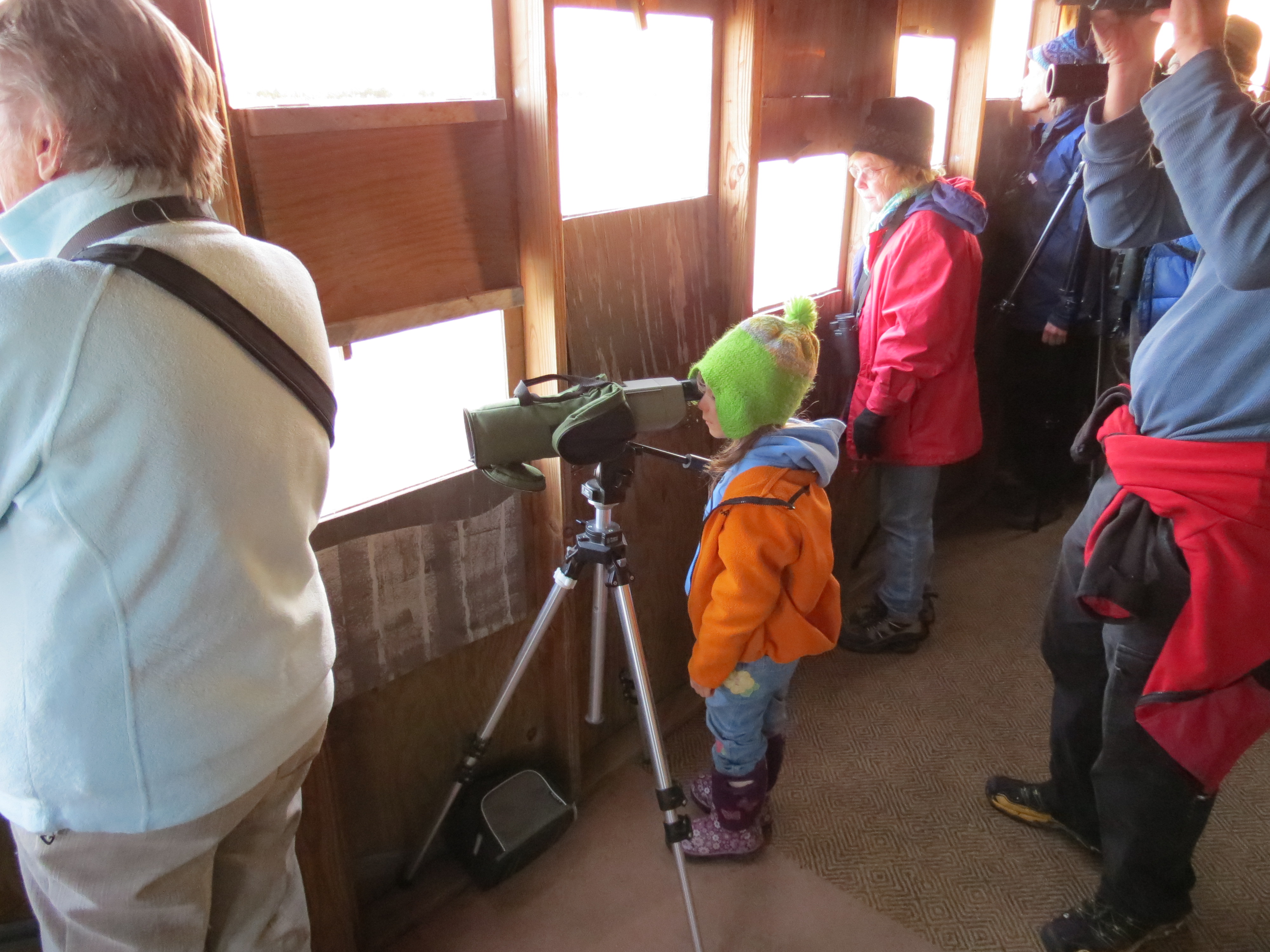
Young viewer of the Sandhill Crane migration, Kearney, Nebraska, 2012. Two great sights: the migration, and seeing a young person enthralled with nature.

Young viewer of the Sandhill Crane migration, Kearney, Nebraska, 2012.
Two great sights: the migration, and seeing a young person enthralled with nature.

I was lucky.  My curiosity was fostered by my parents.  I listened to my brother ask so many questions at the dinner table that finally my father told him to ask only three.  Great idea.  Small wonder my brother became a superb grant writer.  He learned to ask good questions; because grants are difficult to obtain, the better the question, the more likelihood of success.

I wasn’t as good as my brother, but I grew up curious. In kindergarten, I asked the teacher, “What does ‘Proceed with Caution’ mean?”  When children weren’t able to read, she was impressed I could.  I still remember her name, I still have her report cards from 1954, and I was once chided by her: “Mr. Smith, we do not say goddamn in my kindergarten.”

Precocity with some words is not always valued.

Often, I don’t answer the questions but let the children find out by watching the show or doing an experiment.  I’ve shown more than one child the Sun through a solar filter, and hear them say, “It looks like the Moon.”  Yep, it does.  That’s why we can have solar eclipses.  I showed one girl Jupiter one night, and she asked about the dots near it.  She had just discovered the Galilean Moons, as surely as Galileo had.

The following day, I spoke about solar eclipses to OLLI, the Osher Lifelong Learning Institute.  This was a tough audience of retirees. I figured I would get a couple of questions I didn’t know the answer, and I did.  I also got mildly chastised by a man who did not understand the concept of protecting the eyes from sunlight during the partial phases of eclipses.  To me, the concept is easy.  He didn’t understand it until after I explained in great detail how the Sun’s rays damage the retina.  He finally said, “OK, why didn’t you say that?”  That’s a tough group.

I also learned I didn’t explain the concept of eclipse families well, because several asked me at the break.  I had the ephemeris and showed them the eclipses of 1997, 2015, and 2033.  Then I showed them 1991, 2009, and 2027.  They understood.  Sure, there were one or two asleep while I talked, and a few looked bored, but that happens.  When I took some out to view the Sun through filters, they were thrilled.  Without my speaking, they saw a large sunspot and noted the Sun was the same apparent size as the Moon.

I was concerned that I had gone through the material too quickly, but this group of adults has been lifelong learners for a reason, and that reason is curiosity.  They were curious as kids, and they never stopped being kids.  I opened the floor to questions, and I no longer had to worry about finishing too early.  Great questions, too.

The interesting thing about adults in these situations is that some drop the fears they have about asking questions, the embarrassment, the feeling they are being impolite, and revert to being a kid, asking questions when they don’t know.  I love teaching in that situation.  Some of the questions make me think, so I learn, too.  I watch their eyes shine in a way that perhaps they haven’t shined for years, because for too long they felt it was impolite to question or were afraid it was dumb.   Some took it to the next level by asking followup questions.  Kids, of course, are naturals at doing this.

The little girl got me thinking—I used to know the names of over 100 stars.  I just went through the sky with my eyes closed and can still do 60.  I’ve got work to do.  That girl may be back, and I sure don’t want to disappoint her.  If I can get everything in the Big Dipper and Pegasus-Andromeda right, the southern stars in Canis Major, and a few others, I’ll be ready.

There is only one dumb question, asking one that was just answered when you weren’t listening.
MOSTLY BY CHANCE

March 22, 2015

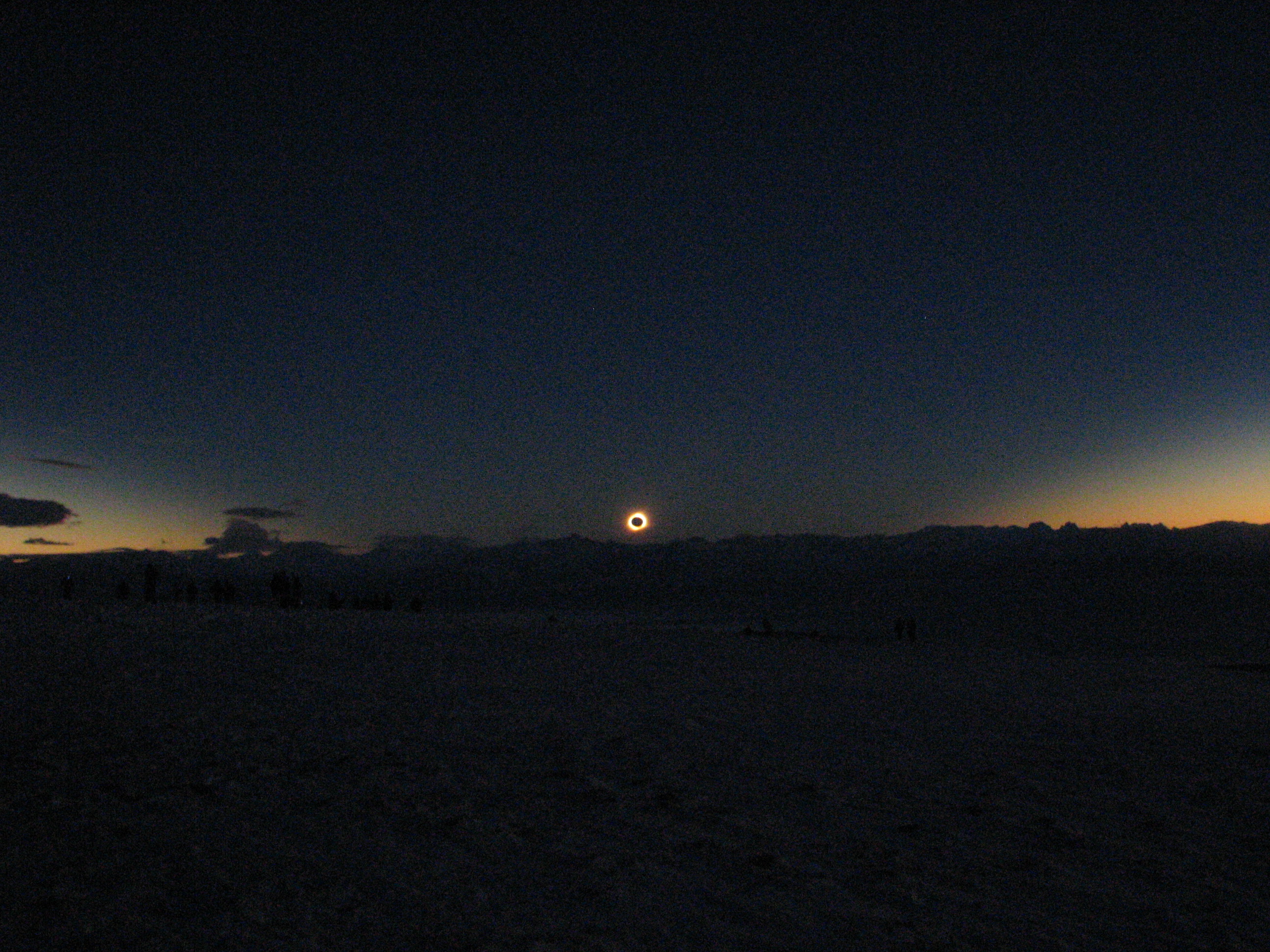
I hadn’t seen Christiaan since the 2010 eclipse, when a few of us got really, really lucky in Patagonia, Argentina.  We had a tour that had chartered a flight to see the eclipse, since July is winter in the Southern Hemisphere, and it is almost always cloudy at 50 degrees south latitude.  The flight was cancelled, ostensibly for “maintenance issues,” which none of us believed, and we thought we would never successfully see the eclipse from the ground.  Instead, we saw the most spectacular total eclipse I have seen, and I’ve seen fifteen.

IMG_2627

Christiaan, along with some others on the trip, befriended me on Facebook.  Like most of my Facebook friends, I didn’t expect to ever meet him, except that he does chase eclipses.  He lives in Amsterdam, and while we were in Germany, before the 2015 eclipse flight, he happened to message me on Facebook, asking whether we were staying at the Sheraton by the Düsseldorf airport.  I was, and he gave me his room number.

Things are things, people are busy, and he was on the other of the two eclipse flights.  I decided I really should call him after the eclipse, our last night there.  I’m not the greatest people person, but I called, and we talked for a while.  It wasn’t clear to me whether he wanted to continue the conversation. In the US, I have long been known when people didn’t want to talk to me.  In Europe, the culture is different.  In any case, I ended the conversation, since his eclipse group was having dinner together, and my wife and I planned to take the train into Düsseldorf and eat at a restaurant we liked when we had arrived ten days earlier.

Later, we decided instead to eat at the airport, a short walk, where we knew a good restaurant.  Mostly by chance, I thought since we would go by the bar in the hotel, on the spur of the moment gave Christiaan a call, asking him if he had a chance to stop by and say hi.  I wasn’t sure it was the right thing to do, but it seemed like a good opportunity to at least try. The worst that could happen was we wouldn’t meet.  Ten minutes after we arrived, I saw a tall young man and a young woman appear, guessing correctly, as it turned out it might be Christiaan and his girlfriend.  We had a delightful visit, despite being from different parts of the world, different cultures, and different generations.  We are fellow eclipse chasers.  It would have been easy not to have gone to the effort to call, but I’m glad I did.  I may or may not see Christiaan on another eclipse trip; it is highly unlikely I will see him in Europe again.  But I saw him.  That mattered.

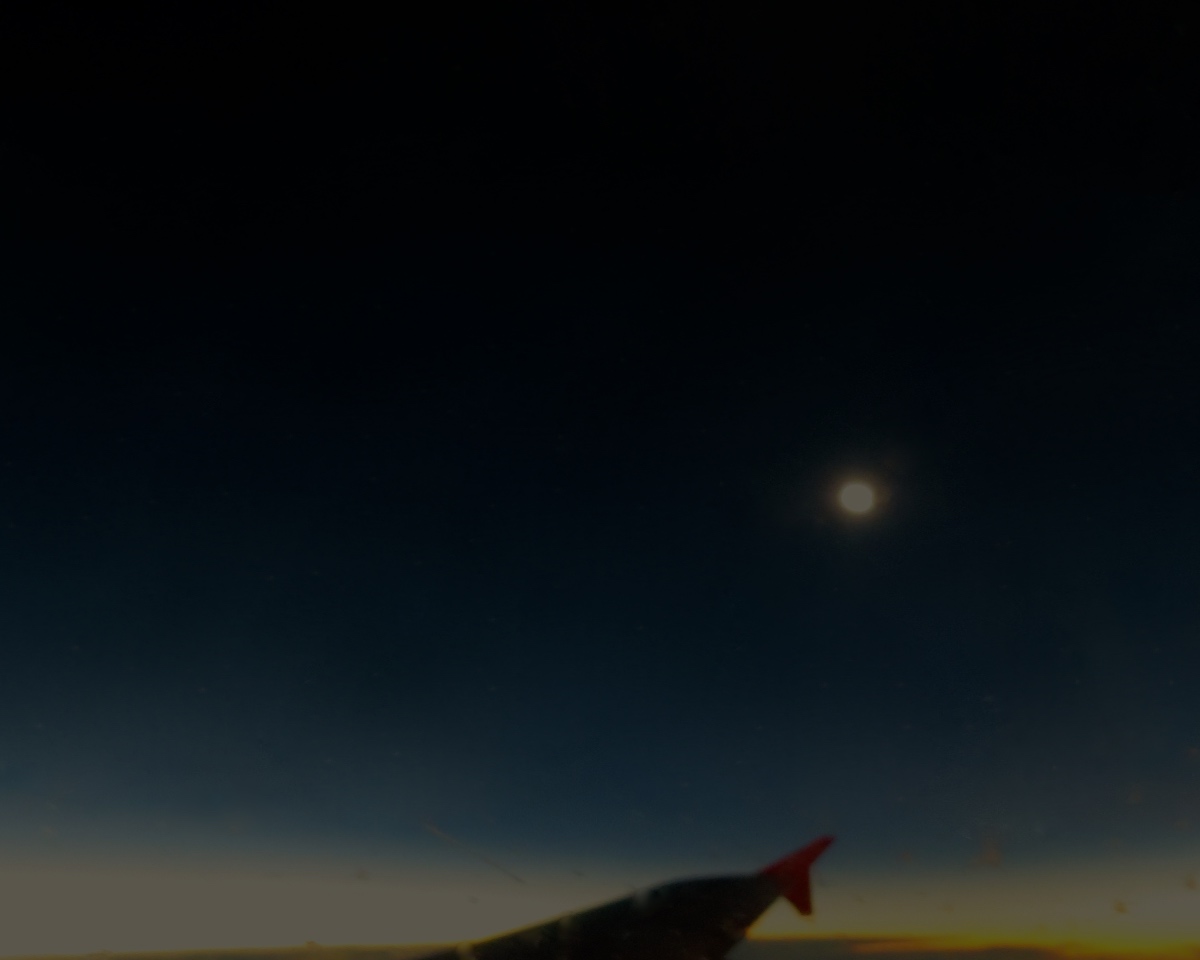
TOTAL SOLAR ECLIPSE, 20 MARCH 2015, OVER THE NORTH ATLANTIC.  SAROS 120.

TOTAL SOLAR ECLIPSE, 20 MARCH 2015, OVER THE NORTH ATLANTIC. SAROS 120.

Quite by accident, later that evening, after dinner, I decided to go and use the free wifi the hotel had only in the lobby.  I had posted something on Facebook in German, only to discover a grammar mistake.  I decided I would take the post down altogether.  I should do that more on Facebook.

While at the computer, I heard a conversation about two people, one of whom I know.  His first name is uncommon; I don’t often refer to people by their full names in this blog, so I will call him Stanley.  The man talking was an editor of an astronomy magazine, with whom I have been on at least two eclipse trips and may see in Indonesia for the 2016 eclipse.  He said that Stanley, now in a wheelchair, could be photoshopped into a group picture the other eclipse flight had taken.

Stanley is not a close friend but a man whom I greatly respect.  He lives in Tucson and has chased eclipses at least ten years before I started in 1991.  In 1984, he spoke at the Tucson Amateur Astronomy Association (TAAA) about the 99+% annular eclipse on the East Coast.  He said it had really been worth seeing.  I hadn’t.  He talked about the earlier Java total eclipse, then showed a map of total eclipses that would take place between then and 2002.  “That’s my vacation schedule,” he said, and everybody laughed.  He wasn’t kidding.

Stanley went to eclipses to possibly miss them, standing near the predicted edge to see if he saw it or didn’t.  That is a scientist.  I want to see every second of totality.  In 1987, I was with him at Tucson Mall, when the TAAA had a booth during a fair.  He showed a video of the annular eclipse in China, back when travel to China or videos were both uncommon.  He once climbed one of the Aleutians in pouring rain to try to see totality.  He failed but was philosophical about it.

Stanley is quiet.  For years, I went to a Christmas party given by a fellow amateur who is the opposite.  As I did less astronomical observation, I knew fewer and fewer people.  Stanley always came, and I knew I could talk to him about eclipses as common ground. He had been to St. Helena twice, a remote island group well off southern Africa. I once asked him how many eclipse trips he had been on.  He told me 38, and that was a while back.  Stanley never bragged.  The last time I saw him, he was 79 and looked great.

I don’t know why he is in a wheelchair.  Had I been a different person, I might have walked over and asked the editor about Stanley.  It didn’t seem appropriate.   Stanley might not have known me well; I am not a fixture in the eclipse community.  he is.

The individual hosting the Christmas parties once told me, that my eclipse chasing wasn’t “real astronomy.”  I didn’t argue, for he was one with whom one just never argued.  I think looking up at the night sky is astronomy, and seeing the Sun disappear in daylight qualifies as well.  I’ve published three articles about how astronomy has affected my life, one in Astronomy; two were in Sky and Telescope.

Perhaps I’m not a real astronomer.  But I’ve traveled all over the world chasing the Moon’s shadow.  Stanley is one of my heroes, a good man.  I’m sorry he is in a wheelchair and hope that in his early 80s now, it is temporary.  The odds don’t favor that. Nevertheless, he saw the 2015 eclipse.  I hoped he loved it.  I hope others got to hear some of his wisdom that he imparted to me.  I’m a better person for knowing him.

I’m glad that night I went to the hotel lobby twice.

Mostly by chance.

THE DOGS OF WAR

March 21, 2015

I needed to see Dresden.  The Stammtisch group I attend Tuesday nights in Eugene recommended I see it, for it is a beautiful rebuilt city.  The beauty wasn’t the primary reason I went there, however, although I was not disappointed.  The fact the city was rebuilt after the February 1945 firebombing did interest me.  I expected to see a lot of memorials in the city.

The only memorial I saw was outside of Frauen Kirche, on a piece of rubble.  There was a plaque with a comment by a man who had walked through the “dead city” on 15 February 1944, witnessing the final collapse of the dome.  Those monuments is where I remove my hat, as I did when I went into the rebuilt Frauen Kirche.  I am not religious, but I lit a candle and wrote in the guest book “Gedenke für die Opfern Februar 1945.”  Dresden didn’t need to be bombed.  I say that, not in hindsight, but because even before and during the raids, many Allies questioned the need to bomb it.  Much industry was outside the city, a cultural center, and many fleeing the Soviet Army passed through Dresden.

IMG_5094

I walked throughout the new and old cities, and when my wife and I went to dinner the last night, I again looked up in the sky, as I had many times, and wondered what it must have been like the night of 13 February 1945, when there were so many bombers that when they were first spotted, it was described as a giant dog was about to swallow the city.

It was worse than being swallowed.  The city was burned to the ground.

We walked through a square and stopped by a raised area, which had an opening for underground parking. I almost missed it.  I saw writing on the concrete that was part of the barrier.  This didn’t appear to be a monument.  But I was certain I saw some writing.  I was correct. I then read what was on it.  Translated, the last sentence was poignant:  “War went out from Germany to the rest of the world and came back to our city.”

Here, 6685 bodies were cremated.  Most of them had already been burned in the firestorm, so this was really a second, final cremation.  The dogs of war had been let loose in the world, and war had returned with a vengeance.  The people did not blame the Allies for bombing Dresden.  The statement simply stated that war had begun here, had spread from here, and had come back here in spades.  I needed to read that.  It mattered that there was an acknowledgment of war.  It mattered that the people actually wrote it on a monument, not without controversy, for there was some, but they did write it.  Indeed, it matters as much as the fact that there was a resistance museum, for it is clear that people did protest what was happening.  They were shouted down, attacked, deported and murdered.  The lucky ones fled.

I thought it ironic that a right-wing group had held a rally here the night before, including an American flag with “US go home” painted on it.  Dresden had been shut down by demonstrations earlier in that month, and more were planned.  The right wing wants its way; most of us do.  The difference is I’m willing to look for solutions, willing to give, but not willing to always give in.  The right wing I know has to have everything their way.  The right wing in Germany forced their way in the 1930s, and almost brought down civilization.  The right wing in the US had incredibly gone around the President’s back and told Iran that any deal negotiated by the US would be null and void after the next election.  Had Congress done that to the prior president, they would have been labelled traitors.

Additionally, inviting the Israeli prime minister to speak in front of Congress, and is coming, was a massive breach of protocol, torpedoes hopes of negotiation of Iran, frankly boorish, and incredibly stupid, since the senator who wrote this letter was later quoted as saying the Iranians were “in control of Tehran,” as if the capital of the country were somewhere else.  I may not be a US Senator, but I know what and where Tehran is.  I correspond with several people who live there or who have escaped from there to other countries.

I find it astounding that a country where balancing the budget is given so much press and so little effort to do what could easily—yes, easily be done—is actually considering unleashing the dogs of war on a country three times the population and area of Iraq.  We were told that war with Iraq would cost $1.7 billion and be paid for by oil revenues.  To date, the cost has been one thousand times that.  Yes, one thousand.  Several thousand Americans have died, uncountable Iraqis, and tens of thousands of American soldiers maimed for life.  The numbers of Iraqis are again uncountable.

I don’t think we can prevent Iran from obtaining a nuclear weapon, and even if we could, the fact that nuclear material has been smuggled out of former Soviet republics, that Pakistan, India, China, Israel and North Korea are among those countries with nuclear weapons, to loose the dogs of war on Iran is beyond my comprehension.

Elections matter.  Too many Americans sat out the last one because Mr. Obama hadn’t fixed everything that the recession and two wars he inherited had caused.  Further, Mr. Obama is faced with a rapidly changing world that America no longer can control with troops, CTF (that would be carrier task forces), or bombing.  Further, he is being asked to cut spending, taxes, and destroy the environment in the name of jobs, which need to be different from ones we have had before, because the world is changing rapidly.

It’s difficult to walk out of the Jewish Museum in Berlin without realizing that the world has been at war a good deal of its history with a few relatively short periods of peace.  Peace in our time will sooner or later devolve into war.  At least two thousand years of history support this contention.

Unleashing the dogs of war immolated Dresden.  It did the same to Tokyo, where fire killed more people than Hiroshima.  The dogs of war, once unleashed, are not controllable.  One might be extremely cautious before letting them loose.

One might even visit Dresden.

IT HAPPENED; THEREFORE, IT CAN HAPPEN AGAIN

March 19, 2015

In Berlin’s German Resistance Museum, there is a picture of Dr. Magnus Hirschfeld, one of many intellectuals persecuted by the Nazis in the early 1930s.  Dr. Hirschfeld had done much research about homosexuality, concluding such was a variant of human sexuality.  Note the word “variant.”  It means different, like red hair is a variant of human hair color.  Or skin color.  Or ability to do different things. Said another way, some people’s brains are wired differently when it comes to sexuality.  They just are.  I am straight, but I didn’t choose it.  I just was.  It is sort of like how I deal with math.  I am good at it.  I just am.

The rise of Nazism was due to many factors,  the upshot’s being that a group of thugs took over one of the premier civilizations of the world, blaming certain groups, instilling fear, the need for law and order, and of course creating jobs.  My late father-in-law, a physician, had to learn German in medical school, because the important scientific literature was written in German. His son-in-law, also a physician, sees disturbing parallels between 1930s Germany and the current US Congress, especially when it comes to instilling fear, racism, sexism and being boorish.

Dr. Hirschfeld was heir to the scientific tradition of Germany.  What he had discovered was astounding, given it was 80 years ago.  Unfortunately, on 10 May 1933, twenty-five thousand books were burned in Berlin, right across from the university.  These were not just novels, they were classics, books about many different subjects, and …  Dr. Hirschfeld’s work.  Before a book was thrown into the fire, the author and the title were screamed aloud.  I say screamed, because I believe with a fire and a mob, one would have to scream.  But I could be wrong.

MONUMENT TO WHERE THE BOOKS WERE BURNEDEMPTY SHELVES SEEN BELOW DEMARCATING WHERE BOOKS WERE BURNED

Dr. Hirschfeld could have been wrong, too.  I suspect, however, he would have been the first to admit it, had someone discovered compelling evidence to dispute his findings.  Good scientists use terms like “margin of error,” “confidence intervals,” and “uncertainty,” which many lay people take to mean that scientists don’t know what they are talking about.  In fact, the absence of those terms from scientific discussion is a statement of ignorance.  If we taught basic statistics well, we might be able to have a citizenry who understood how we can make inferences about quantities that may never be exactly known, such as the state of the Earth’s atmosphere, and draw conclusions about our climate, to name one.

The SA did not know much about science, either, and felt intellectuals, the Jews, gypsies, and infirm did not belong in their society.  That is why they burned books.  They burned truth, they burned what might not have been truth, but an attempt to find it.  They burned the creations of human beings.  I might not agree with such creations, like those that Glenn, Rush, Ted Cruz, James Inhofe, and Pat Robertson; indeed, I think most of what they write are outright lies.  But I wouldn’t burn their books.  I don’t buy them, I hope others don’t, and that the paper is eventually recycled into something better.  Indeed, in a capitalist society, we would call that the “market forces.”

Robertson himself recently likened being gay, or homosexual, as Dr. Hirshfeld would have stated, to being a drug abuser.  Robertson is wrong.  He needs to retire, disappear from public view, and the media ought to stop covering what he says. His time is over, not because he is old, but because he is rigid, wrong, won’t consider other ideas, and spews venom.  He has no proof that homosexuality is a choice.  Jimmy Carter is 6 years older and still writes thoughtful books.

Dr. Hirschfeld died two years later in Nice, in exile.  At least he got out of Germany before the War, when he otherwise would have ended up in one of the concentration camps and have been murdered.

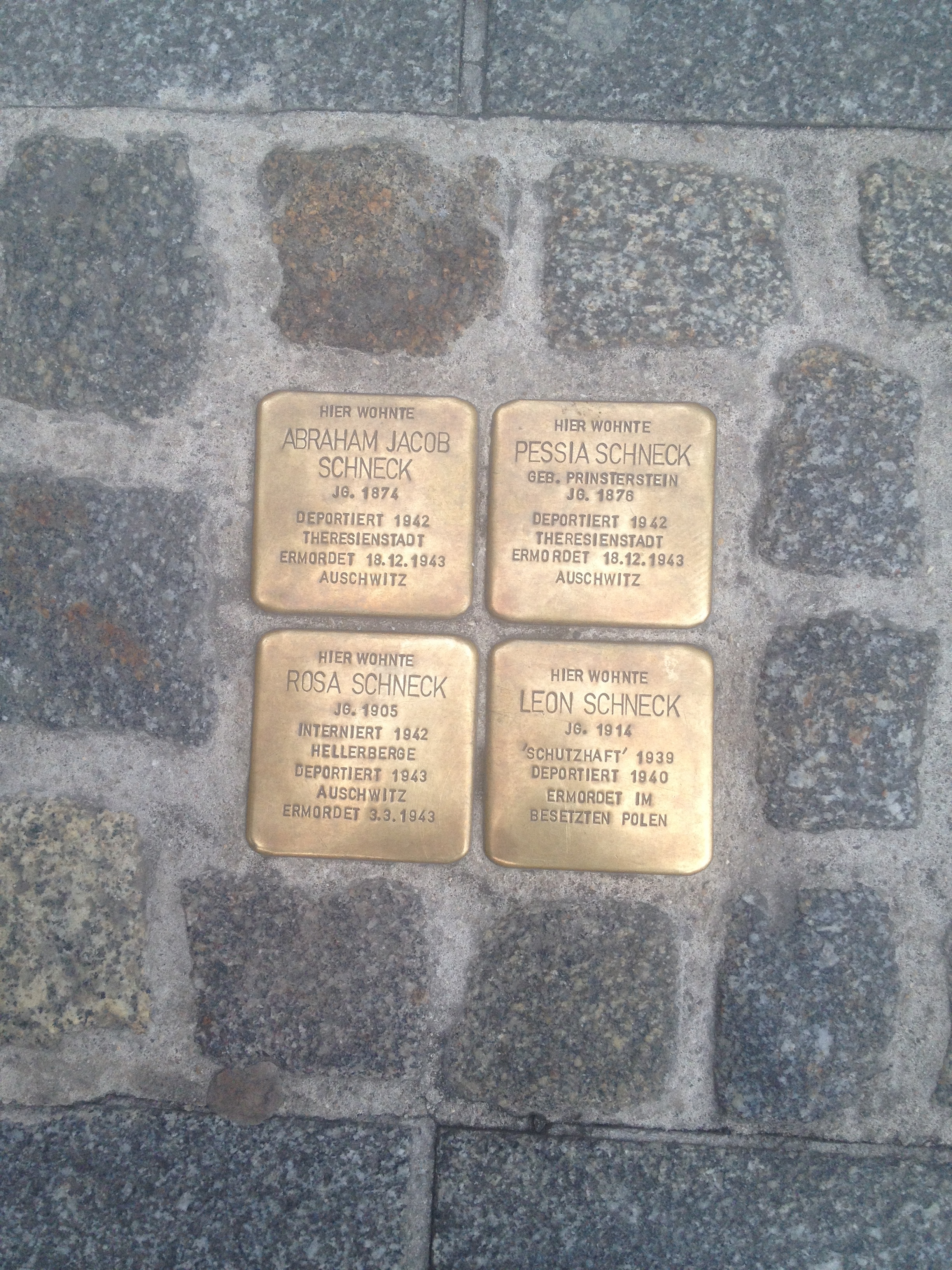
Notice the word “murdered.”  The German Resistance, Holocaust, and Jewish Museums use the word “ermordert,” rather than “gassed,” “shot,” “starved to death,” “jumped off a cliff without a parachute,” or “died from tuberculosis/typhus.”  They don’t mince words.  Those who died were murdered.  They were forcibly deported, after losing their livelihood, their possessions, their families, their health, and finally their lives.  Walk the streets of Berlin or Dresden, and occasionally you see a “Stolperstein,” a small sidewalk marker, where somebody or several somebodies once lived.  These people were deported to a concentration camp and then murdered a year, two years later.  Don’t believe me?  Here are four.  Two were my age.

STOLPERSTEIN

So was lost the truth, the potential, and in Dr. Hirschfeld’s case, work that was a minimum of 80 years ahead of his time.  The clock is still running, however, for even today, a majority of those in Congress feel homosexuality is sinful, that love between two people of the same sex is wrong, can be changed, and is a choice.  As recently as 1970, the American Psychiatric Association considered homosexuality a disease.

Dr. Hirschfeld was a great man who never lived to see the fruits of his labors.  Had the Nazis not intervened, who knows how the idea of homosexuality would have interpreted in the civilized world.  Perhaps nothing would have changed; somehow, I think it might have been a lot better for both gays and straights.

Maybe. Maybe not. Jews have been persecuted on and off for their entire history.  What I do know is that I learned something the day I stood over the spot where the books were burned, and two days later, when I toured the Resistance Museum and read about Dr. Hirschfeld.  From this great man, I learned a better term than “homosexuality” or “gay”.  I learned “variability of human sexuality.” I also learned that we often don’t live to discover whether we were right.  It’s OK.  We tried, and we honestly tried to advance human knowledge.  That is enough.

What isn’t enough is we can’t rid ourselves of the enemies of truth.  They wrap themselves in the Flag, a Holy Book, their interpretation of religion, and their ideology.  They bully others by loudness, by threats, by carrying out threats, and by joining with likeminded others.  They have always been out there, and they always will be.

By the way, if you think human sexuality doesn’t vary, read Dan Savage’s column sometime.  In the Eugene Weekly it is called “Savage Love.”  As ex-Navy guy, I thought I had heard of everything to do with human sexuality.

Oh, how wrong I was.

“It happened, therefore it can happen again. That is the core of what we are trying to say.” (Primo Levi)

PASSING IN A SCHOOL ZONE

March 10, 2015

The sign said “20 mph between 7 and 5 on school days.”  Oregon has two types of 20 mph school zones: that and “20 mph when children are present.”  I was doing 20, when a guy behind me pulled into the center turn lane, accelerated, passed, pulled in, driving far more than the 35 mph speed limit after the zone.

I caught him at the next light.  So, to save a few seconds, the guy broke a few laws, wasted gas and brakes.  For nothing.

**********************************

“Why didn’t you call a neurosurgeon?” The plaintiff’s lawyer asked me in a deposition, back in 1978.

“I and my attending did, Sir,” I replied.

“Why didn’t you hurry and do it sooner?  The patient might not have been paralyzed.”

“He already was when I first saw him, Sir.”

The patient, with ankylosing spondylitis (AK), a bad disease that fuses bones of the spine, had fallen and had cracked his spine.  Unfortunately, an orthopedist tried to move the neck, producing spinal cord injury and partial paralysis.  I resented being blamed for the catastrophic outcome, and it would be the first of a long number of bad encounters I had with the legal profession.

Technology now allows non-radiologists to view many images before the radiologist.  This increase in speed of transmitting information occasionally comes with a cost.  Recently, an individual with AK and a neck injury was felt to have a normal C-spine X-Ray, according to a physician’s reading in a trauma center. The reading was wrong but fortunately did not cause a similar catastrophe.  Radiologists should read these images before anybody moves the spine of a patient with AK.  I’d make it mandatory.  It doesn’t guarantee a good outcome, but it improves the probability of such.

*************************************

A Chance Fracture has nothing to do with luck.  Or maybe it does.  Formerly called seatbelt fractures, before shoulder harnesses, they occur with violent forward flexion of the thoracolumbar spine.  The anterior or front part of the vertebra flexes and compresses, the posterior elements fracture.  It is highly unstable, and the proximity of the fracture to the nerves in the spinal canal means paraplegia may occur.

A patient was seen after an automobile accident, and a physician noted free air under the diaphragm on one image.  This means a perforated viscus, usually the bowel.  The patient was quickly taken to the operating room, for speed matters, and the “bowel was run,” meaning that all of it was checked.  The radiologist, in the meantime, looked at the images, noting no free air but saying there was an Chance fracture.

Oops.  In 100 yards, the speed limit will be 35. Did you have to pass?

The patient now has an abdominal scar, is at increased chance for adhesions and a bowel obstruction as a result, and was fortunate not to be paralyzed after having been moved.  Waiting a few minutes for the radiologist’s reading would have avoided an operation.  Free air requires immediate attention, but surgery may be delayed until the diagnosis is clear.

*****************************************

A third patient had a dislocation of the hip, a bad injury, and was taken to the OR before the radiologist reported a clot in the iliac vein.  Such clots are a risk for pulmonary emboli and complicate surgery, something the surgeon must know pre-operatively.  There was time to think; fifteen minutes wouldn’t adversely have affected the outcome.   Like the guy passing me, hurrying may save time, waste time, or cause a bad accident.

I don’t practice any more.  I wasn’t a trauma doctor, but as a neurologist I saw plenty of trauma long before we had Level 1 centers.  I am out of date.  But I know the ABCs, airway, breathing and circulation, which were and are essential to deal with immediate survival.  Here, seconds and minutes count.  Otherwise, I palpated the entire patient, looking for injuries that weren’t obvious, but might become significant problems.   It’s easy to see an obviously fractured femur and immediately want to fix it.  A wise radiologist said, “The first thing you must do in an emergency is take your own pulse.”  By that, he meant to stop and think for a few seconds.  If you don’t have a few seconds, it’s probably too late.

Time.  It is about time.  Knowing how much time one has matters.  Knowing how much time one has to think matters more.  Time.  Is it worth doing 45 in a 35 zone?

Technology has revolutionized medicine.  Improved communication would as well, if we actually did it.  If several people with significant injuries arrive at a trauma center, they must be triaged.  Some need help more quickly than others.  For some, it is sadly too late.  Many may require the same test; the order in which they get it must be established.  Communication means telling the radiologist the history of the patient, what the clinical concerns are.  It improves the reading of the image.

Ask a radiologist sometime how good clinical histories are.

Today, we do whole body scans.  These take time to perform, valuable time. Taking extra minutes to scan the entire body may delay doing an important test on a second patient. These scans deliver much ionizing radiation and are expensive.  Neither of the latter two is an immediate concern, but they are issues.  Radiologists read hundreds of images quickly, and that requires…..time.  Anything that limits the number of scans is good.  Clinical evaluation does just that.  Patients with free air under the diaphragm likely have a rigid abdomen.  Chance fractures produce severe back pain.  This information helps the radiologist immensely.

When I was responsible for caring for many sick patients, I triaged them, trying to make best use of time, an important commodity in my life.  I needed time to eat, sleep, think, see patients, and summarize my thoughts.  I had only so much of time, and only I could prioritize it….until the day came when I realized I could no longer fit what was expected into what time I had.  Hurry is both dangerous and stressful.  Kids suddenly jump out into the street.

Television makes it appear that speed saves save thousands of lives, that everything must be done in a hurry, and that death is prevented with seconds to spare.  That simply isn’t true.  Time is important, because waiting can be deadly.  But there must be time to think, to reason, and to plan approaches, too.  Or people will die.  We all make mistakes.  We can prevent many with better standardization, lessening fatigue, fewer interruptions, ordering only what needs to be ordered, giving information to radiologists, allowing them time to read images before people are rushed to surgery.

Once one is beyond the ABCs of resuscitation, there is time to think and plan care.  That time must be used.

The next light will likely be red, anyway.

MACK AND JACK

March 4, 2015

Former Arizona Sheriff Richard Mack is asking strangers online to pay medical bills he and his wife have incurred.  The Constitutional Sheriffs and Peace Officers Association, which Mack founded, is paying some of them.  Mack is LDS;  I was surprised that the Church wasn’t passing the hat.

I actually wish Mr. Mack good health, hoping he gets coverage under the Affordable Care Act, which he was ardently against.  I guess that makes me a liberal, whom Mr. Mack detests, because I think part of my job as a citizen is to help other citizens.  If my taxes support people on Medicare, for which Mr. Mack will be eligible in two years, assuming the program isn’t gutted by his fellow Libertarians and Republicans, then so be it.  Medicare is a good program.  It helps the elderly.  Some in Congress think that is a free ride.  Well, all Americans get a free ride, be they Ted Cruz, Mitch McConnell, or Mike Smith.  My college education was subsidized, I get more from SSI than I paid in, and I can access for free things the government requires be open source.  Oh, I had to give a couple of years of my life to the military, but that is national service and something people used to do.  Ted and Mitch did not serve. Besides, I got paid for it.  The idea that successful folks are self-made, without help, guys like Jack Welch for example, is pure baloney.  We all benefit from being Americans and from what our government does.  Research that improves medical care is tax supported, roads, infrastructure, the National Weather Service and Hurricane Center, the Coast Guard, plows during snowstorms, FEMA, all benefit us.

Passing the hat was once helpful when medicine couldn’t do much, or if somebody’s barn burned down.  It doesn’t cut it today, when a house is lost, a child has leukemia, or if you are 62, like Mr. Mack, and have had a heart attack.  After passing the hat a few times, there isn’t much money; people can’t chip in that every time there is another needy soul.  That is sort of why we have the Affordable Care Act, which covers people for whom the hat isn’t large enough to hold say $10,000, which isn’t much for a hospital stay.  Most of us don’t have that kind of money lying around.  Jack Welch does.  He got about $400 million when he retired from GE, after cutting 100K jobs and research.  He’s on his third wife, by the way, but at 79, his time has passed.  He won’t be around to see what his denial of climate change has done.

Back to Mack.  He supported Cliven Bundy, the rancher who refused to pay for grazing his cattle on public (that’s my and your) land at $1.35 per animal per month eating an average of 780 pounds of foliage, and got away with it, because to have thrown him off would have been akin to the attack at Waco in 1993.  Mack got the Supreme Court to weaken the Brady Gun Bill, and he ran for a Congressional seat, getting 11,000 votes in the primary.  That’s about 10,950 more votes than I would have gotten had I run in a primary in Arizona.  I got 50 votes in the last election I ran for, Secretary of the Arizona Medical Association, which I lost.  I wasn’t too popular in the medical community.  I told the truth.

I wish Mr. Mack good health, because ill health sucks.  I haven’t had a heart attack, but I have been very ill, and it isn’t fun.  Mack doesn’t deserve it.  Nobody does.  He deserves to have insurance, and when I supported the ACA, I hoped that all uninsured would be covered.  Many of those I may not have liked, but they deserved coverage.  Frankly, single payer, like Medicare, would have been simpler, but it was never put on the table, which to this liberal is unfathomable.

Some would say that wishing good health on somebody who supports views you detest is Christian.  Or LDS.  Well, I’m neither, and I can’t stand the latter, which has probably made a bigger mess of Arizona than other single group I can name, since their influence has packed the legislature and certainly helped Jeff Flake, a nondescript House member, win a Senate seat over Richard Carmona, a Vietnam Veteran and former Surgeon General.

My feeling about Mack is not dissimilar to that towards a woman who posted on Facebook “we ought to use the guns we have to shoot liberals.”  I pointed out that I was a liberal, a veteran, probably paid more taxes than she and her husband made, and volunteered in my community.  She apologized, one of the few I have ever received in my life, saying she and her husband had fallen on hard times when he lost his job and got sick.  The only thing they really wanted, aside from being out of debt, was to be able to hunt deer for meat they needed, without people’s deliberately scaring off the deer. I felt a little badly being right with my financial assessment. It was a cheap shot.

I’ve been a Life Member of the Sierra Club since 1983, but I wished her well, both with hunting and with her husband’s problems. I don’t believe in hunting, but hunting for food, when one needs to eat, and has no other choice, is not a sin.  They’ve been dealt bad cards, and while we can’t help everybody live great lives, we ought to help people get off the floor.  That’s what this liberal believes.

Many things I support help people, and my liking them is not a precondition.  It is not my place to judge whether only nice people get help; every citizen deserves to have affordable medical care and education.  They don’t deserve a free ride through life, but education is essential to our success as a country, and medical care costs are one of the biggest reasons people become bankrupt.

Don’t get me wrong.  I worked hard to get what I got.  In high school, I studied when other kids partied.  Did the same in college.  Worked damn hard in medical school and post-graduate, often being on call every other night. Served two years in the Navy on a ship, so I started my medical practice when I was 31, after many had been making good money for a decade.  I didn’t go abroad in high school or college.  Would have been drafted.  I’ve done a lot in my life, I worked hard to get it, but I got a huge amount of help along the way, without which I wouldn’t have gone anywhere.  I’m grateful.

It’s time to give back.  Way past time, so others may get the same shot at success I’ve had.  But I won’t donate to Mr. Mack.  He deserves medical insurance, and I’ll vote for that.

Maybe Jack Welch will help out.  Or his second wife.

She had a good pre-nup.  Does my heart good.

“IF I AM STILL AROUND”

March 2, 2015

I just know the man was younger than I.

And early last summer, he was healthy, or at least so he thought.

Today, I read his obituary in the paper.  He had been diagnosed with “brain cancer” (a glioblastoma, likely) six months earlier.

It gave me a moderate jolt.  These sorts of things do.

There is death, and there is death.  For those who are demented, death is a release for them and their families.  It is sad, but it is a release.  Society often doesn’t allow us to say that, but many of us think it.  When my mother-in-law died at 94, one niece cried for hours.  My wife and I just said, “It’s finally over.”  My mother-in-law had been widowed twenty years earlier, was never the same, moved out of her house to assisted living 8 years later, had become slowly demented and had been ready for death for years.

I have seen too many who did everything they could to forestall death, when it was not only going to be the outcome, it needed to be the outcome.  I wasn’t popular, but I had the respect of nurses who dealt with these issues first hand.  When I practiced, I once had eight dying patients simultaneously in an ICU.  I had to deal with eight families, each of whom had members who were dealing with a family death for the first time.  I don’t remember what I got paid for it; suffice it to say that my total bills for the entire 8 were less than an average inpatient surgery at the time.  Surgery takes skill; dealing with death?  Well, that is another story.  That’s just talking to patients or families, not taking a knife and curing them.  Talk is cheap, and talking about death isn’t paid for at all.  Remember Death Panels?  That was just paying for the discussion with people about how they wanted to die.  You’d think from the uproar that elderly people had never thought about the concept before.  I submit talking about death is far more important ultimately than a good deal of procedures Medicare does pay for.  Perhaps if it were reimbursed better, the discussions would be better, but I am out of date.

Here in Oregon, people who are competent and terminal can choose the time of their death, not passing, for passing is a euphemism that makes us think that the non-existence of a former sentient being is something other than non-existence.  About seventy-five people choose that option here every year, not many.  These individuals know full well what they are doing.  They know they are dying soon, and they don’t wish to go through the indignity, often painful, to reach the end result—death.  Some use “assisted suicide” to describe this law, but suicide has a different connotation in our language, and “planned death” is a better term.  The individual is dying soon from a disease, not a medication, and they don’t wish to go through the whole disease process to the bitter end.  There are strict controls, and people die when they are ready, having had for some time the knowledge that they could choose or not to choose to use the drugs that would allow them to die.  A third never use the drugs.

A death from a bad disease in a younger person is a particularly bad tragedy, even if it is were not preventable.  It is a message to those of us who hear about it to be sure we are doing what we want with our lives.  It is a message to end estrangements, if possible, to fight only those battles that are meaningful, to leave behind something good, to live and to be able to say to yourself or even aloud, “I am alive!!!!”

I don’t live in a perpetual state of angst about death, but I find myself discussing events in the next 1-2 decades with the caveat, “If I am still around.”  Mind you, accidents, which can occur at any age, can cause sudden, unexpected deaths.  In one’s 60s, however, there are a lot more things that can kill.  Pneumonia is suddenly not just a minor inconvenience; it is life-threatening.  One nurse told me a two years ago that a cardio-thoracic surgeon we both knew developed leukemia at age 60 and was dead 6 weeks later.  I probably had my mouth open for a couple of minutes.  Suddenly, the problems of the world don’t seem so pressing.  Indeed, Oliver Sacks, who recently admitted he has cancer metastatic to the liver, has stated just that.  He no longer watches the news.  I can’t say I blame him.  I don’t watch it much, either.  I try to deal with the things I can control, not worrying about the many over which I can’t control.  I wish I could stop worrying about the weather and climate change.  I can’t change it, but it still hurts to see it happening.

That means I support the Humane Society, but I turn off commercials and don’t look at posts that show animal abuse.  I simply do not have the time, resources or energy to deal with every needy individual in the world.  Further, the sheer volume of these requests overwhelms me and shuts me down.  I feel like a failure that I can’t fix the world. I am not going to try, and if that makes me a bad person, so be it.  I try to choose my battles, decide where my money, time, effort should go, and am glad I am in a position to do all of these.  I have my own list of things to do; another list, much shorter, are those few things I have done in life that I believe have defined me as a person who existed and which have mattered the most.  The first list is written down, not ordered.  I discuss it should people ask and make it a point to do the things on it when I can.  The second is far more private, and it is very much ordered.  I am deeply clear what those items are.  Others may have seen me as a different person, but this list describes how I see myself.

I don’t know how much time I have.  I just know that every year needs to count for something, and something on one of those two lists needs to be part of every year.