Archive for April, 2015

OPTING OUT…OF MATH

April 27, 2015

Lately, there has been a lot of press, fanfare and pride in having one’s child opt out of testing for Common Core.  I am not a fan of standardized tests, but I took them every year in elementary and high school.  Perhaps the stakes weren’t high then, or maybe I did well enough on them so it didn’t matter.  My teachers didn’t teach to a test.  They taught material, and we were supposed to learn it.

I have taken more than one proud teacher to task for bragging about how many kids aren’t going to take the test.  “What,” I ask, “do you plan to put into place to know that a student is competent to advance to the next grade?”  At this point, I usually hear complaints about how teachers aren’t listened to, rather than specifics about how to make something better.  It’s easy to complain about something; it is a lot more difficult to put oneself on the line and offer something different.

At Lane Community College, where I am a volunteer math tutor, a recent editorial in the school newspaper suggested the school get rid of any math requirement, with the headline “Math-free degrees make sense.”  Some quotations:

  • “Many of those careers don’t require people with math skills.”
  • “For some college programs, not all, math is completely unnecessary.”
  • “However, for some students, any math is a hindrance to getting a degree.”
  • “When students have to subjects they are not suited to, rather than attending classes of…relevance…they become stressed and tired.”
  • “Granted, those going onto (sic) four year colleges would still have to study math.”
  • “What matters to employers is that job applicants have the necessary knowledge and skills to get the job done.”
  • “Choosing between a job candidate who had to study math…and one who didn’t…employers simply wouldn’t care.”
  • “These days (sic) technology handles all the math most people will ever need.”
  • “I’m not saying no to math in education altogether.  I’m saying it’s the responsibility of earlier education.   Remedial math should be the choice of the individual, not a community college mandate.”
  • “A more practical…alternative would be where students learn…how compound interest works, how monthly payments enslave people…”

My first reading of the article was that is was sarcasm, but I soon realized it was not.  The editor-in-chief of the paper has her picture present, and she looks like she is within a decade of my age.  I had a choice between a 250 word letter to the editor or a 600 word opinion piece.  I chose the latter.  I will expand upon it a little more.

It’s unfortunate that the Suze Orman Show is now gone, for Ms. Orman embodied the importance of math in finance and in life.  Those who sought help from her did not fully understand its importance, as the “Can I Afford It?” and “How am I Doing?” segments showed.  

My student who wanted to be a stockbroker couldn’t understand why he was learning logs, until I showed him how to determine the doubling time of money with 5 calculator strokes (72 divided by the interest rate in per cent is number of years), proving it in two lines (proof below).  He was amazed.  Another was thrilled to discover that by knowing the volume of a cylinder, he could determine cubic inch displacement of an engine.  I have never forgotten the look on his face, when he realized his knowledge.  Math is important, can easily be made relevant, and—yes—even fun.   Having my advisor in graduate school look at a proof of the first and second moments of a previously unknown hypergeometric function, say “Good job,” was one of my highlights of two difficult years away from home.

I grew up in an era where people did the same job their entire life.  The world is rapidly changing; multiple careers during one’s lifetime are now the norm.  At 66, I have had three.  We can’t imagine what jobs will be needed 10 years from now, let alone 50.  The winners in this new world will be those who can adapt; math is the single most valuable subject I know that increases one’s adaptability.  I taught adults in their 30s who discovered that they were wrong, when they thought in high school they knew their career path. Suddenly, they needed an MBA to advance in their company.   When faced with linear regression in a business model, knowing the slope of a line becomes relevant, as does probability, difference between a mean and a median, servicing debt, survey design, and measuring quality, to name only a few.  Without math, the glass ceiling becomes cement. 

I have heard students complain, like Ms. S., that they wouldn’t use math they were learning.  I could easily fill this paper with counterexamples, and my primary career was a neurologist.  I didn’t start my third career, statistics, until I was 49, and I had to review calculus taken 32 years earlier in order to get accepted.  Math, like learning music, chemistry, or Spanish, takes work and practice.  If Ms. S. thinks that math is stressful and makes people tired, I can assure her that I survived the stress and fatigue of reviewing calculus on my own and two years of graduate school, 300 miles commuting each way.  I didn’t remember calculus, but once I began to review it, I discovered something important: “If one learns a subject well, and doesn’t use it, he will forget it.  BUT, once he sees the subject again, it is relearned quickly.”

I have long thought we need a parallel educational pathway where math requirements vary for students.  I agree that a community college should not be a high school finishing institution, but until elementary and high schools teach students how to add and subtract, learn the multiplication tables, know when a calculator result doesn’t make sense, allowing remedial math to be the choice of a Lane student is saying math doesn’t matter at all, countering Ms. S.’s claim.  Offering math-free diplomas to increase graduation numbers is an astoundingly bad idea.  Our society needs proof of agreed-upon minimum math competence before a student  graduates from high school. Until then, Lane students must deal with the “stress” of learning math.  Life is tough. In the meantime, I hope Ms. S. understands that teaching compound interest to become financially literate requires algebra: Stating I=prt doesn’t allow one to understand continuous compounding any more than showing me middle C on a keyboard and thinking I can find D major.  For those who think math is worthless, I’m at Lane twice weekly by choice, to help students learn math.  To me, those 8 hours are almost a sacred calling.  Yes, sacred, not scared.

[A piece of wood was 40 cm long and cut into 3 pieces.  The lengths in cm are:

2x-5 

x+7

x+6   Add:

4x+8  = 40

4x=32

x=8; pieces are 11, 15, and 14.  Even if you didn’t know this, x+7 is larger than x+6.  One piece has to be at least 14 cm, so x has to be 7 or greater.  Put in some numbers.

What is the length of the longest piece?  15 cm.  7% of American 8th graders got it right; 53% of Singaporean.]

********************************************************************

Compound interest that can be taught for financial literacy (not difficult, but if you haven’t had algebra?):

Continuously compounded (the easiest):

P=Po exp^(rt) ; P= principal  Po=starting principal, exp= e (2.71828); r=rate, t=time. Don’t worry about e; ln takes it away just like division takes away multiplication, subtraction takes away addition.  Can you imagine doing that without knowing algebra?  Yes, e=[1+(1/n)]^n, as n gets large or ∑[1+(1/n!)] summing from 1 to infinity, but without algebra?

2P=Po e^rt; P=2Po, because money has doubled, (2Po/Po)=e^rt; ln2=rt

ln2/r= t; 0.693/r = t   69.3/r (%)  =t   round to 72/r=t, because 72 is divisible by many numbers.  That is 6 lines, but 8 small equations fit in 2 lines.

DEATH AND LIFE

April 24, 2015

A few nights ago, or in the morning, whatever one calls 2 a.m., a young man and woman, both in their 20s, died when their car struck a tree, right down the road from where we live, where the speed limit is 40, and the road curves, but easily taken at 40.  Today, there is a memorial on the sidewalk, tree, and a few people are present.  The news reported, “speed has not been ruled out as a factor.”

Like so many accidents, the final results of the investigation are either never published or are so hidden in the newspaper that one often never learns the cause.  When I walked back home from a hands on children’s museum last Sunday, after showing sunspots to kids and adults, I was in sight of the tree that would be struck. The two victims were then alive and vibrant, full of life, full of promise, four decades of life ahead before they reached my age.  Now they are corpses, a dreadful word, but the truth.

For the truth is dreadful.  They are dead.

Not only are they dead, there is a high likelihood they didn’t have to die.  Driving the speed limit in a modern car, wearing seat belts and with air bags, one is likely to leave the road only by being distracted or intoxicated, both of which may well have been factors.  The kinetic energy at 40 mph is 45% that at 60 mph, for kinetic energy of a moving object increases with the square of the velocity, and the extra 55% may be enough to convert an accident with injuries into one with fatalities. Being belted in and having airbags doesn’t prevent death from a crash, but it greatly decreases the probability.

Too many don’t understand this concept.  To them, one counterexample invalidates a whole theory.  “She did everything right and died from xxx, so it didn’t matter.”  That might have been said about the woman, 60, who died from ovarian cancer, or a 52 year-old colleague who died from an astrocytoma, a colleague’s wife who died at 49 from a ruptured aneurysm, or the obituary today of a 35 year-old, killed by a drunk driver.  “Everything right” that we know of often doesn’t work.  Sometimes, it is as simple and as awful as being in the wrong place at the wrong time, like being a 9 year-old girl at a Tucson Safeway on 8 January 2011.

Other times, it is just bad luck.  I never knew Mark Edelson, photo editor of the Palm Beach Times, named Newspaper Picture Editor of the Year nine times.  He recently died of lymphoma, only 64.  Reading that, I realized how lucky I am, how little I have to complain about, and how much more I must do with my life.

Doing everything right can greatly decrease death from lung, skin, cervical, colon, breast, hematopoietic, and other cancers, allowing people with these and other conditions to live far longer than they used to.  Acute lymphoblastic leukemia was a death sentence 40 years ago;  it is curable in 85% today.

Last week’s Stammtisch, a gathering of German speakers (or wannabes like me) was the only group in the pizza parlor.  For once, it was quiet, so I could understand people, which with my hearing is difficult enough in English, let alone in German.  I listened to a young man in his twenties, from the Portland area, living here, speaking German fluently.  He had studied it three years in high school, more it in college, and spent a year in country.  That’s how to learn a language.  Start young, study hard, and live in country for a year.

Peter, several years my senior, from Alsace, fluent in English, French, and German, sat next to me.  Peter served in the military in Europe, helping MPs get American soldiers out of trouble.  Speaking three key languages fluently allowed Peter to serve his country well.  He corrects my German gently.  Peter nudged me, nodded towards the young man, and said in German, “He has his whole life before him.”  I agreed.

“But I wouldn’t trade with him,” Peter quickly added.  I also agreed.  Yes, to be young, multilingual, good looking, healthy, with your adult life and the world before you, is great.

Unless you drive too fast at night, leave the road and hit a tree.  Or have really bad luck.

If possible, I would do over much in my life.  But I can’t change the past, only apologize, make amends, and then move forward, dealing with current circumstances.  I grew up in a wonderful time, being white, male, straight and middle class.  I had good parents, who taught me to be curious, to read, to love animals, and to treat the outdoors as a place to enjoy and to take care of.  We got dirty, bored, made up our own games, and enforced our rules.

I had pressure in school, but I never slept fewer than six or seven hours at night.  I read recently that some are taking a new stimulant allowing them to work longer in order to advance.  “Sleep is an option,” said one.  Wow.  I had summer jobs, and huge student loans were unknown.  I was a partner in a medical practice;  I now know highly qualified physicians who are looking for work, not even partner track, just work.  I never had that problem.

There were good times for the right people, but hardly idyllic.  “Negroes” were discriminated against, lynched, and we equated homosexuality with pedophilia.  Interracial marriages were illegal, and gay meant happy.  Smoking was considered cool, plane crashes were common, kids died from polio or measles, rape was considered a woman’s fault, wages for men were higher, “because he had a family,” doctors were God, and we dealt with cans in the wilderness by throwing them on the ground or sinking them in the lake.  The “good old days” were hardly that.  By the way, rape is still considered a woman’s fault in many places, gender wage equality isn’t, and racism is still prevalent.

I would not want to be in my 20s in this competitive world.  I am content with my age, hopefully wiser.  It is my world, too, one where I want to give back: volunteering tutoring math, learning a language or two, showing kids the night sky, leading hikes deep into the wilderness, seeing special places, volunteering at the crane migration every year, and living in my mid-60s.  No, the 60s are not problem-free.  Not at all.  Then again, in the obituaries virtually every day, I read about those who didn’t get to their 60s, 50s, 40s, or 30s.

Mark Edelson didn’t get to Medicare age.  What a loss.  When good people die, the rest of us have to make up for their loss.

Time for me to get back to work, and be glad I am alive to do so.

DESIGNATED GUN HOLDER

April 20, 2015

In 2009, when Arizona allowed guns in places that served alcohol (read: bars), the owner of the gun was not allowed to drink alcohol.  This is “people will do the right thing” mentality, and if you believe people do that, you haven’t been on an aircraft lately, driven on an Interstate, picked up roadside litter, or heard of Curry Todd.

Mr. Todd is a Tennessee legislator who was arrested for DUI and carrying a firearm.  Todd claimed it was the prescription medicine that caused him to weave in and out of traffic, but the law reads “alcohol,” he had been drinking and taking medication, and was jailed for 48 hours.  Todd repeatedly argued during a debate about the law that gun owners were responsible and would not drink while carrying a firearm.  If gun owners are so responsible, why was Todd irresponsible?  Why do 600 people die each year (50 shot by a child less than 6) unintentionally?  Why are there more deaths due to firearms in states where there are more firearms?

Some gun owners are responsible; many are not.  Indeed, 22 million Americans are estimated to have anger issues and access to guns.  They don’t just get pissed off occasionally, like I do, but get skunk anger, red hot road rage sort of stuff.  One doesn’t have to drink in a bar to see people who have clearly imbibed too much.  Really, now.  Does anybody honestly believe we will have a “designated gun owner” who doesn’t drink?  Curry Todd didn’t.  He was an irresponsible gun owner that night.

Let’s look at the “people will do the right thing” mentality.

At Rowe Sanctuary in Nebraska, 600,000 Lesser Sandhill Cranes, 90% of the world’s population, migrate through every spring, the greatest migration in the contiguous states, and the largest crane migration in the world.  Cranes are extensively hunted, Nebraska’s being the only state/province where they are not, so they are wary of humans.  The only way to see these birds close up is to be in a viewing blind where one is hidden.  Stand outside, and the birds will not land near you.  Try to approach the birds on foot (illegal in Nebraska; it is harassment), and they will move away.  That doesn’t stop people’s trying to do it.  A couple did it once and ruined one of my blind tours in 2004 over in Grand Island.  The birds left.

The migration is viewed by 20,000 people at Rowe annually; I have been in the viewing blinds 110 times watching, wondering, learning, simply in awe of these birds, which may live to be 35 in the wild, are usually monogamous, and may migrate 14,000 miles roundtrip (24,000 km) each year, to nest.

A lot of people capture this migration using cameras.  In the old days, there was limited time people could shoot a picture using a roll of film.  Digital cameras were a game changer.  At Rowe, we do not allow flashes, we tape over the automatic focuser light, and we do not allow LCD screens to be illuminated after dark.  These regulations occurred because flashes may spook the birds into the air at night, where they may collide with power lines and die.  Flashes don’t work at photographic infinite distance.  Automatic focusers may be seen a mile away.  LCD screens reflect off the face and are visible out on the river.

Before these regulations, we had banned automatic firing of the shutter, because the migration is an auditory and visual experience.  Even a rapid use of a manual shutter detracts from the experience.  We don’t allow lenses or any object to be outside the plane of the outer wall, because the birds will likely perceive the object as a rifle.  Tripods are not allowed in the corner of a blind, because they take up space for three or four windows.  In a dark viewing blind, more than one person has tripped over a tripod, sometimes the owner, who has also been known to drop lenses.  As a guide, I have seen every camera violation there is.  Some people become irate when I ask them to move the lens inside the blind.  Glad one didn’t have a gun.

Photography has become an issue among the volunteer guides.  Some think we ought to ban it outright, the way some museums do.  I don’t have a problem with photography, so long as the birds’ safety is not compromised. I like to take pictures, but I don’t need the perfect picture:  I want to show pictures to people so that they may understand the beauty that is in this world, seek out this beauty, and work to keep these special places…..special.

What would happen if Rowe Sanctuary had no regulations?  Nobody would be viewing the cranes, because people would be walking up and down the river.  People would pitch tents, promise to be quiet, wouldn’t be, leaving human waste and a mess, because people do those things.  People can’t be trusted not to throw trash into a composting toilet at a trailhead on Oregon Route 58 by Mt. Hardesty, despite a sign in the restroom telling them not to do it.  Go see, if you don’t believe me.  How difficult would it have been to have taken the trash back home?

Without regulations, we would have blinds full of tripods, large equipment, flashes, automatic focusing lights, automatic shutter speed, 8000 pictures in one two hour session (yes, a man once bragged to me that he had done that) the birds would be spooked, and the blinds become worthless.  But hey, got to have that one good picture that one can sell, put on Facebook, put it on one’s Web page, be a famous person.

Fact is that photographers failed to regulate themselves, so we regulate them to protect the migration.  We have rules about noise, how many may go to a blind, how they must enter, leave, and conduct themselves.  Left alone, people don’t do the right thing.  Remember Curry Todd.

If people did the right thing, we wouldn’t need speed limits.  We wouldn’t have litter along roads, we wouldn’t have signs shot at, we wouldn’t have scams, NINJA mortgages, the SEC, insider trading, derivatives that nobody understood, worthless supplements declared off limits for FDA regulation, thanks to conservative Orrin Hatch of Utah, need to regulate lasers shot into the air which blind pilots, or drones over important air space.

I don’t want a nanny state, a government that takes over every stage of a person’s life.  When people effectively self-regulate, we won’t need laws.  If people just voted right, we wouldn’t elect people like Curry Todd, who is still serving.

Unopposed.  I’m speechless.

YOU SHOULD HAVE SEEN

April 14, 2015

In the video that every visitor to Rowe Sanctuary must see, before they go to the viewing blinds, Bill Taddicken, the Executive Director, calls “You Should Have Seen” the four saddest words in the language.

It’s interesting, because the first two, “You should,” bother me enough that I almost never use them to others.  “Should” connotes advice, and many don’t like it.  Me, too.  I actually try to follow some advice I’m given, but there is not enough time in my life to do everything “should” expects from me.

But Bill’s four words are powerful.  You Should Have Seen.  I capitalize them, in order to emphasize that rather than annoyance, failure on my part, or unwanted advice, YOU SHOULD HAVE SEEN is a statement of what a situation was once like, before it changed for the worse and the opportunity was never again available.

Bill uses two examples:  YOU SHOULD HAVE SEEN THE BUFFALO MIGRATION, not stating the obvious, that we nearly exterminated this magnificent creature, a hundred million animals, in the 19th century by shooting them from trains, for sport, and letting the animals die a horrible death and rot on the prairie.  This is a sad commentary on America.  Bill doesn’t say that.  I do.  I would have loved to have seen the buffalo migration, to have studied it, to have learned from it.

YOU SHOULD HAVE SEEN THE PASSENGER PIGEONS, before stating they went extinct in 1914, the year my father was born.  This beautiful bird used to fly in dark clouds that blackened the sky, extending for miles.  I can only imagine the view.  I am angry my forebears exterminated this bird, and I never got to see it.  I can understand how the next generation is angry with mine, for the species we have allowed to become extinct.

Bill doesn’t want his daughter to have to tell her children, YOU SHOULD HAVE SEEN THE SANDHILL CRANE MIGRATION, because in the name of jobs, crops, recreation, sending water elsewhere, we took away the habitat the cranes needed along the Central Flyway of the US, where the cranes migrated for ten thousand years, after the last glaciation.  Bill is fighting for the River, the Flyway, the Bird, and the Migration, one of two great ones here; the other, the Porcupine Caribou, is much more difficult to see.  The Sandhill Crane migration can be seen six miles from Interstate 80 in Nebraska.  For $25, one can spend 2 hours in a viewing blind and see something that Jane Goodall calls one of the great ten sights in Nature.

Right in the middle of the USA.

People get transformed by the cranes.  Some cry.  Couples hold hands.  Some kiss, in a way they may not have for a long time.  Some stare, eyes fixed on the scene in front of them, people whom I watch, but leave alone, for the people are spellbound.  For them, this is not just a bunch of birds, it has become what some call a sacred place.

I’m not advising anybody to see the cranes.  I was often asked in Arizona, where some cranes winter, why I just didn’t go there to see them.  I replied that I’ve seen them in Nebraska.  I’ve seen the full migration first hand.  I once took videos.  Got one when it was becoming really dark, cranes flying in circles coming towards me in the viewing blind, where I was alone.  The sound was so loud, the birds so close, that I said, easily heard on the video, “I have never seen anything like this in my whole life.”

You should have seen my face.

Took another video of a pair of cranes courting, in the Platte River.  Each put a bill into the river, and they both pivoted around their bills and around each other.  Wow.  You should have seen it.

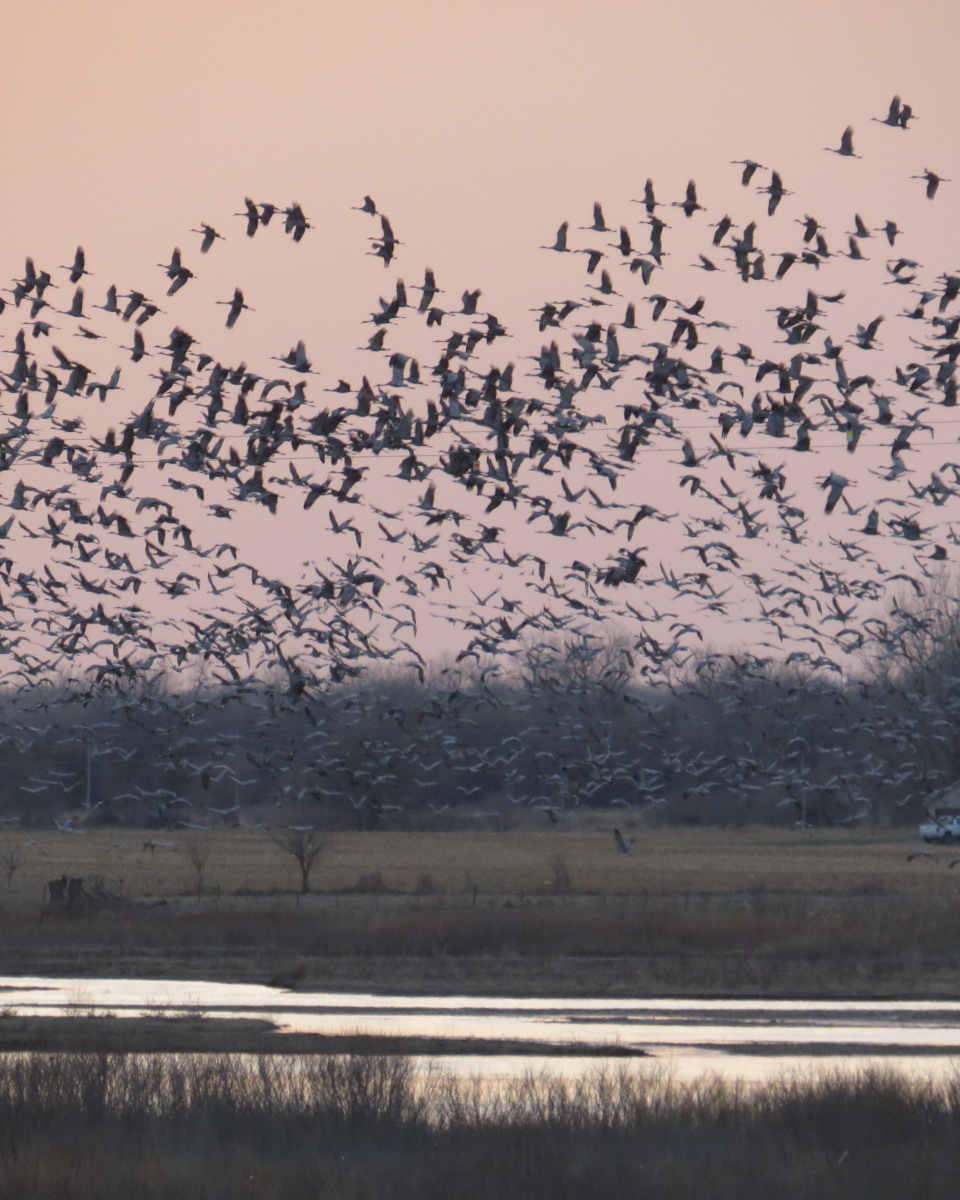
Sandhill cranes, Nebraska, 2010

Sandhill cranes, Nebraska, 2010

IMG_2408

Sandhill Cranes, 2015, Nebraska

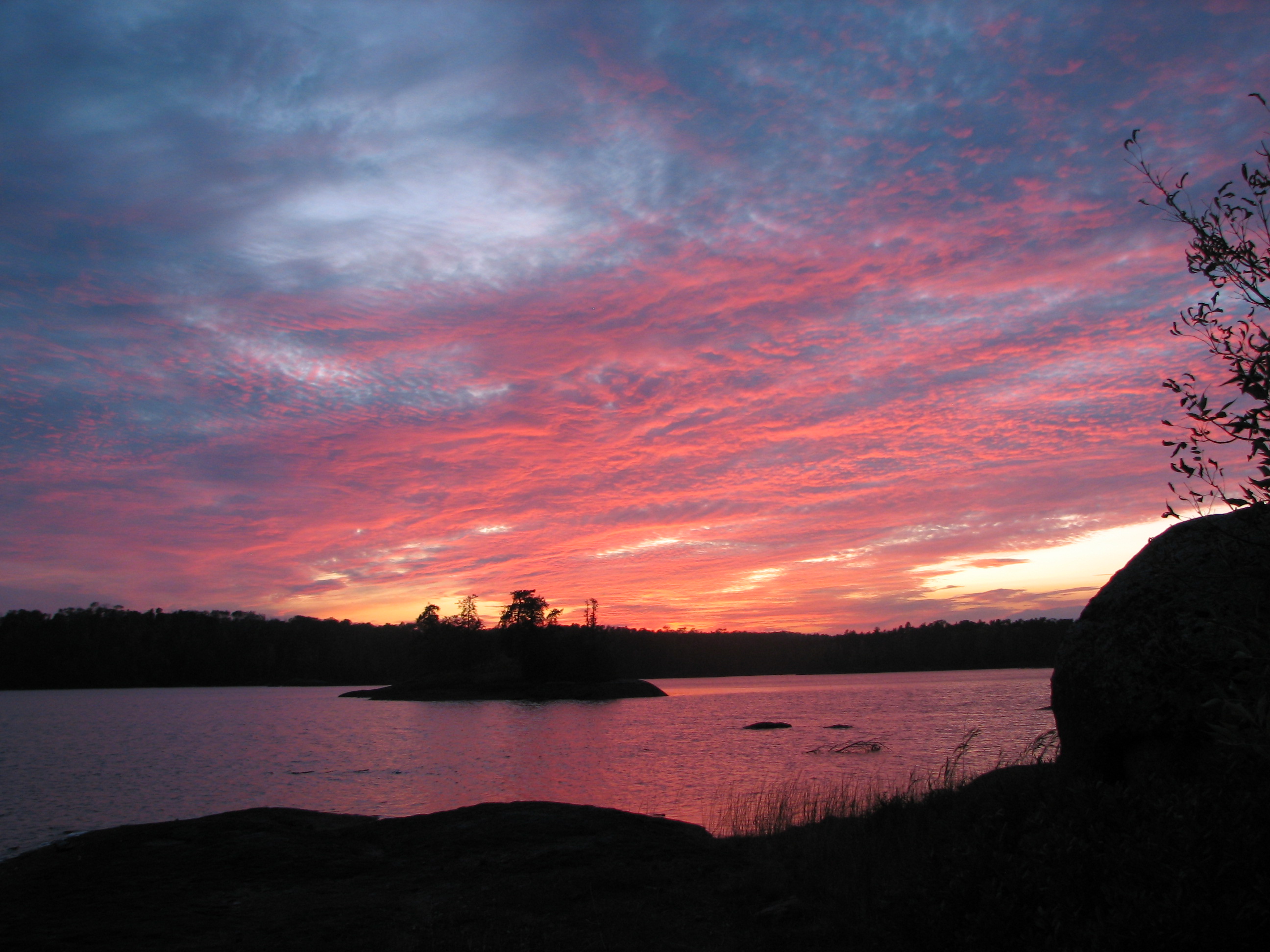
You should have seen the Boundary Waters, before the water became undrinkable in 2020 and the loons disappeared because a sulfide mine brought JOBS to the region.  The mine failed, the company went bankrupt and couldn’t clean up the water.  They were sorry.  Couldn’t find a politician that year in the state who claimed they supported the mine.  Sure could in 2010.

Lake Insula sunset, 2009.

Lake Insula sunset, 2009.

You should have seen the corn yields in Nebraska before the Ogallala Aquifer was polluted by oil in 2023 and corn ceased to be a crop.  Keystone thought the leak was “An Act of God.”  They are now bankrupt and express “regret”.  None of the 62 senators who originally voted for Keystone will comment on the Ogallala.  Nebraska voted Democratic in the 2024 election, but the outmigration allowed them only 3 electoral votes.

You should have seen the Grand Canyon, before the Republican Senate decided that the states should own all the federal land, and privatization allowed mining. I remember back in ‘85 when my wife and I were camped out on the Tonto Platform below the Abyss, hearing the flap of a Raven’s wings echoing off the Redwall.  You should have heard it.  You should have seen it.

The Abyss, Grand Canyon, 2012.  Tonto Platform is to the right.

The Abyss, Grand Canyon, 2012. Tonto Platform is to the right.

You should have seen the Aral Sea, before it disappeared in the latter part of the 20th century.  Nobody seemed to care.

You should have seen the Brooks Range of Alaska, when one could be 300 miles from the nearest town, days from civilization, before the road that paralleled it was built in 2025, so that Native Americans could drive to Fairbanks to shop.  The Natives seldom used the road, but miners and hunters have, and now the natives are destitute.  You should have seen the bears I saw on the Noatak in 2010, the sow with 2 cubs and a second year male, marching through our camp one night like we weren’t even there.  They had likely never seen humans.

IMG_2890

Grizzly Cubs, Noatak River, 2010

You should have seen Churchill, Manitoba in the autumn, before climate change that we were told wasn’t took away all the pack ice and the animals are now only found in zoos.  Past president Ted Cruz still claims that “he wasn’t a scientist,” and that he was using the best available evidence when he denied global warming was occurring.  You should have seen me nose to nose with a polar bear in 1992, 15 inches separating us.

You should have seen the Whooping Crane before they finally went extinct in 2060.  I saw nearly ten in my lifetime.

You should have seen the Harris Sparrow in central Nebraska.  They became extinct ten years later. I saw them.

We still have time.  But not much.  You should have seen how Americans came together and fixed the environment in the 21st century.  That’s what I want to hear before I die.

THEY’LL GO ELSEWHERE

April 10, 2015

I was speaking with an intelligent woman staff member at Rowe Sanctuary about the work they are doing, protecting a key part of the Sandhill Crane migration, the stopover on the Platte River the cranes take every six weeks from late February to mid-April.  The cranes are on their way north from the southern US and northern Mexico, and they refuel, rest, court, and spend 2-4 weeks in south central Nebraska, on the Great Bend of the Platte River.  They’ve been doing this migration for 9000 years, since the end of the last glaciation.

This habitat is critical.  There is waste corn in the fields, although before corn, the cranes came to wetlands here, where there were crustaceans and other invertebrates, rodents and other animals they could eat.  They would fly to the shallow Platte, full of sandbars, for safety at night, for cranes have a vestigial hind foot and cannot perch in trees away from predators.  The water makes it difficult for predators to approach without splashing announcing their presence.  Cranes live in three dimensions: ground, river, and sky.

Their habitat once spanned 200 miles of river, and cranes could be found anywhere there each spring.  But dams were built and irrigation began, channeling the river.  Invasive plants arrived, along with water guzzling cottonwoods, producing shade, but also allowing brush to fill in the river, making it less safe for cranes.  In 1975, a water diversion project planned would have completely dried up the river and the habitat.  It failed, but today, the habitat for the cranes in March is perhaps 50 miles of river, and only a few miles is totally protected.  The rest of it is hit or miss for the birds.  They may find a safe place, they may not.  We estimate 90% of their total habitat has been lost.

I’m pessimistic what the a warming climate and uncontrollable population will do to the migration.  In the name of jobs, because we aren’t going to decrease our population voluntarily in my lifetime, we will require more food, more fresh water, more living space, and put more demands upon all our resources.  Fresh water is the oil of the 21st century, and the Platte is a huge supplier of fresh water to the central US.  Underneath the river and well away from it lies the billion acre feet of the Ogallala Aquifer, fresh water that can be accessed underground.  The aquifer is a national treasure, yet we are risking the Ogallala in the name of building a pipeline to ship dirty, carbon intensive oil abroad, in order to make more carbon released in burning it.  Oil vs. water.

What if water in the Platte goes for other uses, in the name of jobs?  Well, I have been told, the cranes will have to adapt.  “They’ll go elsewhere.”  Really?  Where?  They’ve been coming here, longer than human recorded history.  They can’t adapt to “going elsewhere.”  They are cranes, not technologically advanced individuals capable of altering the environment.

“The climate has always changed.”  Indeed, it has.  And species come and go, but they have come and gone over thousands of years.  We are changing the environment in a matter of a few generations, not over thousands of years, which animals require to adapt.

“They will be fine.”  Really?  That is rationalization, wishful thinking.  No, the birds won’t be fine.  They will go extinct.  And then what?  For the cranes to “go elsewhere” is like my telling humanity right now that we have a century to find “another planet,” because this one won’t be livable.  It can’t be done, and the cranes can’t find another river, another flyway.  There isn’t one.  And by the way, I am dead right.  We have a century.  No more.

I told the young woman that I had no children, no skin in this game, and once I was gone, it wouldn’t be my problem.  She disagreed, stating that my presence as a volunteer meant that I DID have skin in this game, that I felt it mattered to be here.  Yes, she was right.  It does matter to me.

She additionally mentioned how young people of today are angry at the world they are being left.  They should be.  I was left a world after two wars, with enough conflicts that during my young life. I served in the military, visiting countries abroad in uniform, not the way the young do today, traveling freely, learning other languages, being connected with people all over the world on social media.  I survived.

To the younger generation, I will do my best to contribute my skills to make the environment better.  They must do the rest.  They need to get out into this natural environment, not see it on Facebook, play video games on cruises through Kenai Fjords, not look at wild fruit as “yucky,” and not tweet, call, or instant message their parents or friends about their adventures in wild country.  When people see my pictures and ask where I got them on the Internet, I say, I took them.  I WAS THERE.

We are not as far removed from our ties to nature as many might believe.  A number of studies have stated how disconnection from nature makes us unhappier, not happier.  We have one advantage over cranes that can’t go elsewhere.  We alone can manipulate our environment.  We can deal with greenhouse gases, we can figure out ways to avoid or mitigate ocean rise and de-alkalinzation, continued loss of coral species, and an Anthropocene where Earth has far fewer species of animals.

We have reached a time where we can continue on our present path, and when a species can’t go elsewhere, it dies out.  One of those species will some day be us, should we continue.  We can assume we are above the rest of the biosphere and pretend the world isn’t changing.  Or, we can assume we alone can change our environment, need to and start acting.  We can keep denying, and nature will respond.  Biology will respond to changes in physics and chemistry, not to Jim Inhofe, Ted Cruz, and those of my detractors who have been wrong on the climate.  Not one of them, not one conservative think tank can change those laws, no matter how sharp a speaker looks, speak, or tries to debate what is no longer, and never was debatable.

I won’t be around to see much of this.  If the coming generations don’t channel their understandable anger into fixing things, fail to realize that in saving the environment and nature is not a matter of cutsy sayings or “like”s on Facebook, but science, understanding nature, getting out into nature, demanding, working to reverse the damage that has been done, they won’t be around, either.

It’s time to get connected.  With nature.  Without electronics.

DE-JADING MYSELF

April 8, 2015

It’s easy to become jaded when dealing with the public.  I became jaded in medicine, although to be fair to my patients, long hours, lack of sleep, frequent interruptions and hurry had a lot to do with my frame of mind.

I volunteer serving the public each spring when I go to Rowe Sanctuary in Nebraska to help visitors see the Sandhill Crane Migration, one of the great sights in nature.  I am one of maybe 120 volunteers, most of whom live in the surrounding area, but easily a dozen or more of us are from out of state.  They stay longer than I.  Many have no pets, no children, and can leave a house alone for a long period of time.  They come to Rowe for 2-3 weeks during the 5 week crane season and find their niche.  I come for 10 days at most, maybe less, depending upon other commitments, and I don’t fit easily into a niche.

IMG_2966

I’m not much of a birder, although I love Sandhill Cranes.  I don’t know Nebraska like many of the volunteers, who either live here or grew up here.  I can’t advise people about certain towns that I have never been to, wetlands that I haven’t visited, birding areas I may never see. I’m not good with my hands, so I help if I can, but construction projects around the place are better left to others more skilled.  I have learned to drive an ATV, so I deliver people who go overnight to photography blinds, with all their gear, and contribute a little.  While my trailer backing skills are not great, I can fill in and do the work.  I learned.

I can do menial but necessary things like clean toilets and mop floors.  I can sweep outside and pick up trash.  I drive vehicles into town for supplies.  I feel most at home, however, taking visitors to viewing blinds.  I become a different person when I teach, for I know cranes, I have been in each of the viewing blinds in all weather conditions, with many others or alone.  I’ve seen a lot, but I still learn something new every time I go in.

This past year, Rowe staff developed a video that they play at each tour’s onset, explaining the mission and the rules of the Sanctuary.  This is a good idea, which will get better with modification.  It is important to standardize the rules of the Sanctuary and to impart certain basic information.  The video, however, took away one of my few strengths, my standing in front of 30 people going to a viewing blind, where it might be cold, hot, wet or dry, and convey, with enthusiasm and clarity, that they were going to have a special time, because I knew I would.  I would tell them that the cranes are one of the top sites in nature for me.  I told them I would learn something new, because I learn something from every visit to the blinds, about people, birds, or myself.  I would then take them to the blinds, apologizing for my lack of enthusiasm.  They laughed.  I was in my element.  My tours went well, and I believe many visitors were happy.  At least I think they were.

Crane

Crane

Now, my connection is replaced by a video.  I’ve lost some of my only niche, connecting initially with the visitors.  Once in the blinds, I want to be quiet, unless there are questions.  People ought to experience the cranes on their own, not have a play by play.  I want to state my love for the Platte River, the need to conserve this area, the Central Flyway, and to support Rowe.  Last two years, I had staff from Audubon Nebraska on my tour and was told I asked for support in exactly the right way.  Of course I did.  I was teaching, I knew what I had to teach, and I understood the material completely.  It was like my teaching high school geometry or algebra, a piece of cake.

On my fourth trip in to the blinds this current season, now having been in one more than a hundred times, we had a good group on a sunny, warmish evening, including a young boy of 12. While waiting for the cranes to come in, we saw nine deer and several wild turkeys.  The boy was clearly interested in all and asked about the reflectors on power lines that spanned the Platte.  It was a good observation, and I told him so.  The reflectors have cut in half the number of cranes dying from power line collisions.  He was engaged in everything.  I told him I heard a pheasant near the east end of the blind, and while he might not see it, he might take a look.  He went.

About half way through the tour, the cranes began landing where sunlight was reflecting off the river.  I made a comment to everybody, “Cranes are now on the river,” a signal we now needed to be quiet.

“Did somebody text you and tell you?” a woman asked.

“No,” I replied, “I saw them.”

IMG_5294

The tour went well, the world on the Platte’s unfolding as it should. We saw thousands of cranes land, they moved downstream, walked and flew past the blind, bathing, dancing, drinking, preening, doing things cranes do. The sunset was lovely, the tricolor sky beautiful.  At 8:30, we began to leave.  I went by the young boy and his mother.  The boy looked at me with his brown eyes, saying:

“This has been the best day of my life.  This was the most beautiful thing I have ever seen. I am coming here every year for the rest of my life.

“How do I volunteer here?”

I was no longer jaded.  I had let the show of the cranes devolve into a show I was giving, taking people to the blinds.  I had made the mistake of thinking I mattered.  Well, I did matter, a little, but the cranes mattered.  The river mattered.  The flyway mattered.  Nature mattered.  My job was simply to take people to nature, to be on the flyway, be by the river and see the cranes.  By doing that job, and doing it well, I offered the possibility to people—this night, a 12 year-old boy—that an experience in life may be transformative, changing their world forever.  Life won’t be the same.

In short, it was about a young boy, a bird called a Sandhill crane, a migration, and a river.  Nothing else.  Nothing more.

Nothing more was completely enough.

IMG_2408

NIGHTSTANDS AND CLOSETS

April 3, 2015

About four years ago, I came within six inches of never being able to hike again.  I was at a holiday party given by an acquaintance who was a retired field grade officer in the Air Force.  We had a mutual interest in astronomy—he became an amateur-professional whereas I remained an amateur.  Indeed, he once told me that my eclipse chasing wasn’t really astronomy, so I stopped mentioning it to him.  Then again, back in late 1991, he said the annular eclipse of 4 January 1992, visible from San Diego, was “no big deal.”

Annular solar eclipse 4 January 1992.  It ended before it reached the coast, but from a 300 m high hill, we could see well out into the ocean.  Two hours later, it was pouring rain.

Annular solar eclipse 4 January 1992. It ended before it reached the coast, but from a 300 m high hill, we could see well out into the ocean. Two hours later, it was pouring rain.

Seeing the “ring of fire,” the Moon inside the Sun, set into the ocean, ranks as one of the best natural views I’ve ever seen.  He missed it.  My acquaintance had made some public statements that offended the fringe who believed in odd celestial occurrences.  For that, he told me at the party that he had received death threats.

“Want to see my weapon collection?” he asked.

I didn’t want to, since weapons bother me.  When my father died, we found a handgun in his nightstand and couldn’t get rid of it fast enough.  Fortunately, we knew a deputy sheriff.  My host showed me a laser guided gun on his nightstand, ready to fire in case anybody broke in and tried to kill him.  Wow.  I looked at the gun and saw instant death, oblivion, cessation of existence. Then he showed me his closet with as many weapons as clothes, several different kinds of firearms, any of which probably could have taken out the neighborhood, had he been crazy.  At that point, a samurai sword, unsheathed, dropped from a hanger on to the floor.

Six inches from my left foot.

This is a smart person, but where were the safety checks?  No, this wasn’t a gun, “only” a sword, that could also kill, and a lot faster, had it been grabbed, than a nearby firearm. Had it been a loaded gun and discharged, I could have died instantly.  I never went to another party there again.  It just freaked me out.

Gabby Giffords, who four years ago was shot in the left parietal lobe by a crazy gunman, 4 miles from where I lived, at a store where I almost went that day, was recently at the Capitol to support a bill expanding background checks before firearms are bought.  Such checks are espoused by an overwhelming majority of men, women, Republicans, Democrats, and firearm owners themselves.

The NRA wasted no time tweeting how Giffords’ own shooter passed a background check, omitting the fact that the individual complained about the difficulty he had.  The NRA proffered other examples where background checks were done and firearms were later used in homicides.  That’s like saying somebody in an accident wearing a seat belt died, so we shouldn’t wear seat belts.

We have gun shows where people purchase firearms with no background checks at all.  Video recordings are amazing.  They show things occurring that people still deny, be it buying a gun at a gun show and leaving, without any checks, to denying that one ever said Iraq clearly had weapons of mass destruction.

Will background checks prevent all murders?  Of course not.  Will they make them fewer?  I believe they will, a verifiable prediction.  If I am correct, would not the prevention of one murder be a good thing?  Exactly how are people’s rights to own a firearm infringed?  We don’t have unbridled freedom of speech; why should we have unbridled right to bear arms?

I made the mistake of reading some of the comments at the end of the article.  One guy basically swore at Ms. Giffords; another, while extolling her courage, wanted to make sure his right to protect his family was not infringed.

Does this man think his family is under siege by robbers just waiting to kill him?  Does he not know that the presence of a firearm in a house nearly doubles the likelihood of a mortality there?  It increases the likelihood of a suicide of a man living there thirty-fold.  Could a gun protect him?  Sure.  But a bigger problem is the number of deaths in this country from domestic violence.  Three women a day die here on average from domestic violence. Want to end it?  Make it a lot more difficult for stalkers and people within 2 years of a divorce to own firearms. Why two years?  Not sure, frankly.  It seems like two years is enough time to get over the fact that a relationship is over.  If I am wrong, that could be changed.

Exactly how many people need firearms to protect their families?  Truthfully, I DON’T KNOW.  One of the reasons I don’t is that we don’t have research on this and other issues dealing with gun violence, because the National Rifle (read: Gun) Association has prevailed upon Congress not to allow this to be done by the CDC.  If gun violence isn’t a disease that needs to be controlled, then I’m missing something.  Over ten thousand people a year in this country die from it, triple that if you count suicides; seven times that number are injured.  Had Ebola killed this many, we would have shut the country down.

I’m worried, too, not of being gunned down, but that my car will be vandalized if I put a sticker on it saying “Americans for Responsible Solutions.”  Sam Brownback has signed into law that allows Kansans to carry concealed firearms without a permit and without requiring a gun safety course.  There is a sense that Kansans will do the right thing, and they don’t need the government to tell them how much training or responsibility they need.  There won’t be a blood bath in the streets, they say, this isn’t the Wild West.  Perhaps they are right.  What if they aren’t?  Where is the evidence?  Who is counting?

Each day I read of people gunned down, of children taking guns, pulling the trigger, killing their mother, sibling, friend, or themselves.  I’m not scared I will encounter a situation like that; although it is certainly possible, it is improbable. As one who thinks firearms need to be better controlled, I am unpopular, at least among a vocal, scared, hateful group, not a majority, who nevertheless control the agenda for firearms.

Guns are too slow and too quick.  If you are a teacher with one in your desk drawer, and a mass shooting breaks out, you may well be gunned down before you get it.  If you have one available, and you shoot at what appears to be an attacker, but who isn’t, which almost happened that day in Tucson, then it’s too quick, too final.

After 9/11, we talked about arming pilots.  How does that sound now?

TOTAL SOLAR ECLIPSE TRIP OF 2015

April 2, 2015

I make it a point to know eclipse dates and locations well in advance.  We eclipse chasers do that sort of thing.  I knew about the eclipse in 2015 for at least a decade.  I knew it would likely require a plane to see it, since nearly the entire path was over the North Atlantic and high Arctic.  Only the Faeroe Islands and Svalbard were occupied land masses in the path.

With that in mind, we decided to book an eclipse flight out of Düsseldorf, with eclipse-reisen.de.  I went with them last year to Uganda.  They know me, and I can book the flight in German.  We decided to tie the tour into a visit to Germany and to see Berlin, which I, as a child of the Cold War, had always wanted to see.  We would also visit Dresden and then return to Düsseldorf, take a side visit to the Köln Church and then take the eclipse flight, before coming home.  Eclipse trips allow one to see well-known places or not so well-known, depending upon the eclipse location.

Eclipses of the Sun must occur at least twice a year.  If the alignment is right, and the Moon is close to us, we see a total eclipse.  If the Moon is further away, but the alignment is right, we see a ring eclipse, with the Moon “inside” the Sun.  With less than perfect alignment, we see a partial eclipse, like we did last October.

Take a flashlight, and turn it on in a dark room.  There is a bright cone of light in the center.  Outside of that, the cone of light is a little dimmer.  Eclipses are the same with darkness.  Be in the center of the shadow of the Moon, and it is dark.  Outside the shadow, it is lighter.   Without going into too many details, there are 40 eclipse families currently occurring every 18 years and 10 1/3 days.  The Saros cycle, the word coined by Edmund Halley, is a corruption of an ancient Babylonian word, which meant about 3600 years.  Ancient people understood the cycle.  About a third of the families generate partial eclipses, another third annular, or ring eclipses, where a small amount of sunlight is visible, and the final third total.  There are 13 total eclipses during this 18 year period.  Each family is born, lives, and dies, with about 70-80 cycles over 1200 to 1500 years. The cycles themselves are a combination of 223 synodic lunar cycles (the familiar “month”), lining up of the Earth-Moon-Sun, 242 cycles, and the Moon’s being close enough to the Earth to cover the Sun, 239 cycles.’

I’m trying not to give too many details, but sometimes my enthusiasm slips out.

It’s a shame that my enthusiasm wasn’t present earlier in my life.  On 20 July 1963, I canoed in Canada and missed a total eclipse, seeing 91% partial from Algonquin Park.  Nearly 7 years later, I missed totality again, by not going to Nova Scotia, saw a 94% partial eclipse.  Almost a decade later, I missed totality during the American-Canadian eclipse of 1979, skiing near Salt Lake City, seeing a 91% partial eclipse.  Perhaps had I been aware of the fact this was the last total eclipse to strike the contiguous states for 38 years, I might have been more eager to drive to Montana to see it.

This most recent eclipse is a member of the same family that last brought the umbra of the Moon’s shadow over on America.  Eighteen years and 10 or 11 1/3 days later (leap year, dateline and midnight considerations) this particular eclipse family repeated, same type of track, in this case the right side of a “U”, either north or south of the prior (this instance north), and 1/3 of the way west around the world.  The American-Canadian eclipse of 1979 became the Siberian eclipse of 1997, the North Atlantic eclipse of 2015, and will become the Siberia- Alaska eclipse in 2033, the last total eclipse of this family.  I did see the Siberia eclipse in 9 March 1997, along with about 60 others, and not too many other people.  The American eclipse on 21 August 2017 will be a repeat of the family I saw in Ontario in 1963.

All of Europe enjoyed some degree of partial eclipse, but partial eclipses are not total.  The concept was lost on me for many years, when I had said “I have seen an eclipse.”  I had, but not a total eclipse.  A woman in Hamburg, Germany, posted on Facebook why she saw a fat crescent and her friend in the Faeroes saw briefly (through clouds) totality.  For eclipses, 99% partial is not total and that 99.9% is also not total.  An individual understands this statement once totality has been seen.  Eclipses are nature’s way of telling us that time and place matter.  I’ve heard many say, “You can see it later,” when no, we can’t see it later.  We place ourselves on the track the day before if possible, and look for good viewing spots.  When the Moon’s shadow no longer covers us, we can’t chase it down again.

The advantage of seeing an eclipse by air is planes can fly above clouds, which cover much eclipse tracks, including the North Sea in March.  Additionally, planes may fly along the eclipse track at a quarter of the Moon’s shadow’s speed, allowing one to see a longer eclipse.

The disadvantage of seeing eclipses from the air are the lack of the ability to see the subtle changes as the Moon covers the Sun, the approach of the shadow, and the last part of the eclipse, although not many care to watch the last part of an eclipse.  My wife and I think it is our personal obligation to nature.

Another problem with seeing an eclipse from the air is that windows get frost.  I’ve seen three from the air, and only over very dry Antarctica, was the window completely frost-free.  In 2008, we had a great deal of ice, from too vigorous cleaning of the window by well-meaning individuals who left water in the window well.  At 11,000 meters elevation, it is cold, and water freezes to the window.  This time, we had smaller amounts, that while not affecting our visual viewing, did affect quality of pictures.  I was able to remove a lot of the artifact, but not all.  Finally, it is difficult for two people to look out an airplane window at the same time.

IMG_0675

The latter brings me to viewing an eclipse.  I try to take pictures and shoot video.  But equipment fails, falls out of focus, or is on a moving platform, such as a ship or a turbulent plane.  The most important thing for an eclipse viewer is to see it.  Each eclipse is a little different; each has the same pattern.  Each stays in my mind in some fashion.  I don’t know in what way it will, only that something will strike me as special.

I will always remember the diamond ring with this eclipse, the last bit of sunlight before totality.  As the Moon covers more of the Sun, making it a smaller crescent, eventually the edge of the Moon, not perfectly round, but containing mountains and valleys, allows sunlight to pass only through valleys between the mountains. These are called Bailey’s Beads.  Finally, one valley is left, allowing sunlight to pass through, showing a dark disk with brilliant light.  I will also remember the beautiful gossamer-thin corona, and the large prominence on the Sun, which normally I miss.  I saw Venus, by accident, because I don’t look for planets near the eclipsed Sun.  Venus was impossible to miss.

IMG_5137

Crescent Sun, just before the eclipse

IMG_5143

Another view of eclipsed Sun.

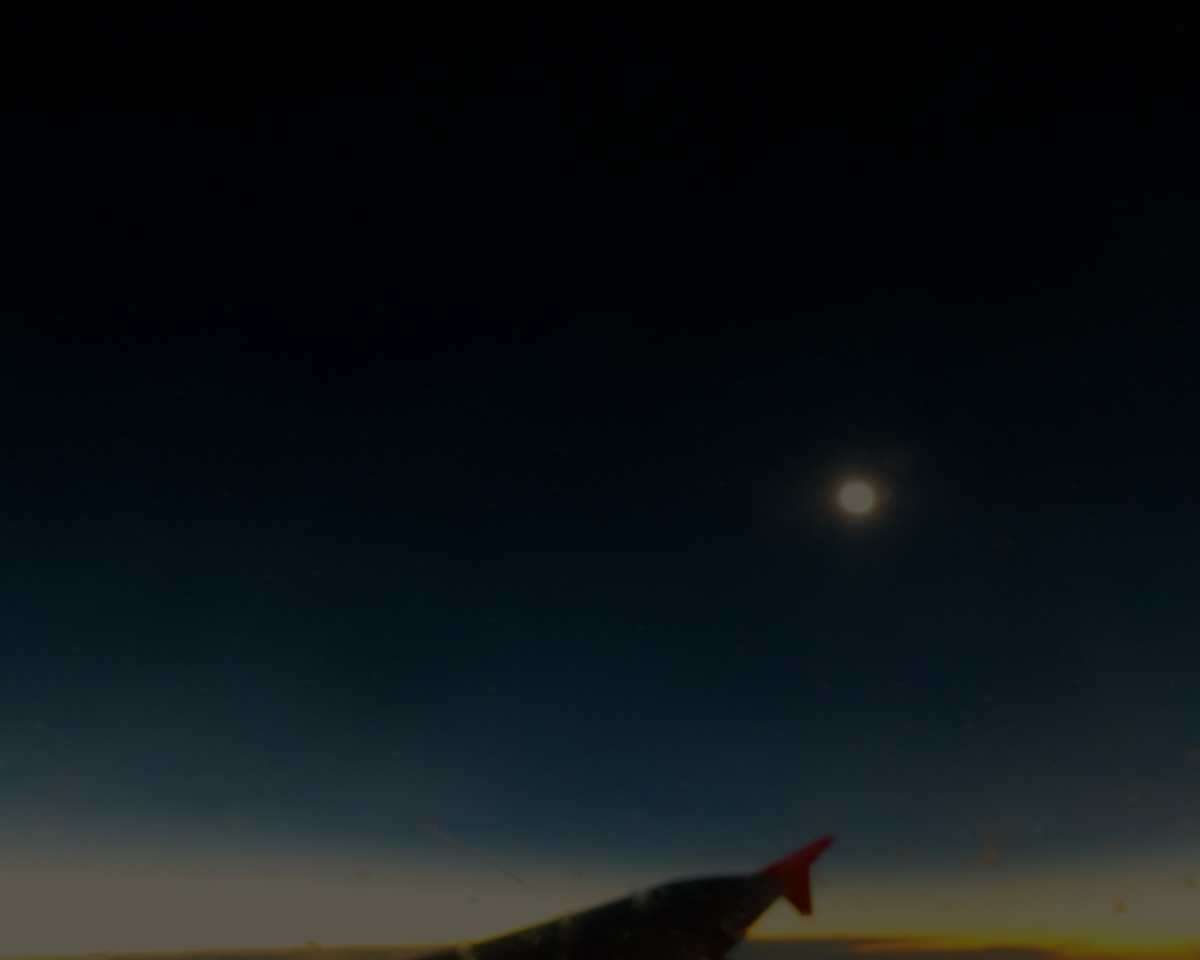
Eclipsed Sun with Moon's shadow overhead.

Eclipsed Sun with Moon’s shadow overhead.

Most eclipse chasers know how many they have seen.  A few of us know how many seconds we have been under the Moon’s shadow.  One thousand is a milestone.  An hour is a huge milestone.  Another milestone is seeing the same eclipse family twice, which means 18 years and 10 or 11 days later.  To me, one of the nicest milestones is seeing somebody I met on a prior one.   This trip, a German flight, was no exception.  There were several familiar faces, my roommate from the Uganda trip, and people I had seen in 2008 and 2010.  I have gone on several trips where I was certain I would never see anybody I had seen before, only to be pleasantly surprised.  After 24 eclipse trips, this sort of thing happens.  It is nice.

Oh, I am just shy of 45 minutes under the Moon’s shadow.