Archive for October, 2015

THE DEMENTORS IN OUR SYSTEMS

October 24, 2015

I don’t speak out much any more about quality of care in medicine, mostly because I am out of date.  But I am not out of data.

Last July, I had a sudden dysrhythmia.  I was minding my own business one evening, checking  a sunflower, when I stood up and started noticing my pulse pounding irregularly.  I had no pain, and at first I thought it was a bunch of PVCs, premature contractions, although they were a little different.  I was alone, didn’t want the animals to be uncared for if I were admitted, so I did the next best thing.  I went to bed.  I awoke at 1 am and felt fine.

I saw my PCP the next morning, who had had a cancellation, and my EKG looked fine.  She recommended a Holter Monitor, so I wore one for 48 hours, during which time I hiked and had no symptoms.  The monitor showed a few supraventricular rapid beats, nothing solid, but not normal, either, so I was told I would need to see a cardiologist, and a referral sent.

Ten days later, I had no appointment. On my own, I stopped all caffeine and chocolate, and the few funny sensations I had had vanished.  Unfortunately, so did my referral.  An email to the office went unanswered for a week, until my PCP replied, asking me what the cardiologist said.  Well, I wrote, maybe he or she had said something, but not to me, since I had no appointment.  She apologized and within a few days I had an appointment 5 weeks later, nearly 8 weeks after my event.

I saw patients as emergencies the same day who had a 10 year history of the same headache with several normal CT scans. I have a dysrhythmia as a 66 year-old and it takes 8 weeks to see a cardiologist?  It’s a different world today.

**********************************

Later, my wife needed a GI evaluation.  A referral was faxed to the specialist’s office, and we were to get called back.  The office of the referring physician was about 150 meters away, as the crow flies, from the office of the new physician.  Two weeks later, we had heard nothing.  My wife called, and nobody knew where the referral was.  This sounds familiar.

My wife and I are not mildly or moderately demented, we are educated, knowledgable about medicine, and can afford our care.  What happens if one is demented, uneducated, or unclear about the medical system?  Most people are unclear.  I certainly am, and I practiced medicine.  Perhaps these people think (1) nothing needs to be done, (2) the physician wants money up front and they hadn’t paid in advance, (3) somebody had changed their mind, or (4) they might not have assumed anything, just forgotten about the referral, since they didn’t have it on our mind and didn’t follow up.

Sort of like what happened to those who sent the referral.

A phone call was answered pleasantly, and my wife was told the referral would be faxed over to the other physician’s office that day, there would be “three business days” to set up a future appointment, and then she could have the procedure.  With all due respect to electricity, I can walk a referral over almost as fast and with complete certainty deliver it to the right person.  With all due respect to the fact my style of practice isn’t done today, “business days” is redundant.  Every day was a “business day” for me.  I told my wife that we were going to go to the physician’s office that day.  It was a 15 minute drive, and there is something about a face-to-face interaction that gets things done quickly.  It’s far more difficult to ignore a person, unlike a call, e-mail, SMS, or some other electronic medium of communication.

We bypassed everything possible and had the appointment 46 hours later, one business day, to those who count such things.

The same week, I discovered my monthly medications had no refills.  I sent an email through the online patient portal and waited a week to hear.  Nothing.  I called the pharmacy, and they had received nothing but would call the physician’s office.  I waited another week, now two weeks late in getting my medications, and called the pharmacy to see if my prescriptions were ready.  I heard a “prescription” (indefinite article, singular) was ready, and when I stopped by, indeed, one was.  The second one?  Nowhere to be found.  The pharmacy tech was pleasant enough, however, saying she would call it again to the doctor’s office. Before she called, I asked to see the dose, having changed it several months earlier. It was the original amount.

Fortunately, I had plenty of the medication at home, since the pharmacy had not changed the dose, despite my having asked them to do so.  Two days later, I got a call from the pharmacy, telling me that they had been unable to reach the physician’s office.  So much for pharmacies’ calling physicians successfully.  I called and talked to an answering machine.  I would have walked over, but I figured I had a week to burn.  I still haven’t received the drug.

None of these three issues was serious.  Sadly, none of them is rare, either.  These sorts of things on a daily basis are Dementors, for they suck the happiness out of people.  Time spent fixing these problems is time that can’t be spent doing something more important, like promptly scheduling a patient, rather than have them wait on hold, which we all do.

There needs to be a better way to track referrals.  I can log on to Amazon, UPS, or USPS and immediately know the status of a package that I ordered thousands of miles away, yet I can’t find out in my own small city whether my referral has been seen by the specialist or where my medications are.  What happens if somebody is elderly, infirm, doesn’t hear or see well, and needs specialty care?  We are up in arms about the Affordable Care Act, yet virtually everybody is silent about the many broken systems in medicine that affect everybody in the country who seeks care, which is about all of us.  Am I just incredibly unlucky?  I doubt it.

As for pharmacy issues, I find it ironic I am having the same problem that my op-ed in the local paper addressed: pharmacies must start using the state error reporting system.  Oregon is the only state that includes pharmacies, but the 721 last year reported exactly 20 errors.  I alone have had three, and there are nearly four million people in the state.  I don’t think I am incredibly unlucky. What happened after my op-ed?  Choices: (1) few read it, (2) pharmacies jumped on board and are reporting like mad, or (3) nobody really cares, because we have high quality care.  A=1; B=2,C=3, D=1,3.  You choose.

Every broken system has countable and uncountable costs.  The countable ones are hours spent doing things twice, looking for something, fixing what is wrong, and spending time apologizing.  The uncountable ones are Dementors: annoyance, unhappiness, feeling of powerlessness, the wondering why, after so many years of stating what we need to do in medicine, why it still hasn’t been done.

THE SEASONS OF OUR LIVES

October 21, 2015

The 2015 Canoe Trip has been like the last twenty or so.  We fly to Minnesota, drive 4 hours north to Ely, get the gear we rented, drive to the entry point, our jumping off point, and the next morning, regardless of the weather, enter the wilderness, for entry permits are day and place sensitive.

We are both old now, although we do note with some pleasure a few more folks like us on the water than in years past.  I think it’s because the gear is better, lighter, and more convenient than it once was, and a lot of our generation grew up in the outdoors.  I don’t do the long travel trips that I once lived to do.  Instead, we go in a dozen miles, find a site we like, usually one we have stayed at before, pitch the tent, and settle in.

Fall Lake from the Fall-Newton portage, BWCA, 2015

Fall Lake from the Fall-Newton portage, BWCA, 2015

I like base camping.  It’s nice to pitch the tent and not have to take it down the next day to do another dozen miles.  Yeah, we could do it, but we’d pay for it a lot more.  The site we have is really nice.  It’s not one people go to by choice, I suspect, because there are only two tent sites, neither of which is great.  The one we use has me slide slowly towards my feet during the night.  I can live with that.

Down a bay is an isthmus site where I stayed in 2013.  It’s pretty, being ten yards from water to water at its narrowest spot.  There are a lot of tent pads, a decent kitchen area, and great sunsets.  I liked it and thought in 2014, when my wife was again well, we’d stay there.  She had seen the site once before with me when we were exploring and in 2014 we fully expected to stay there.

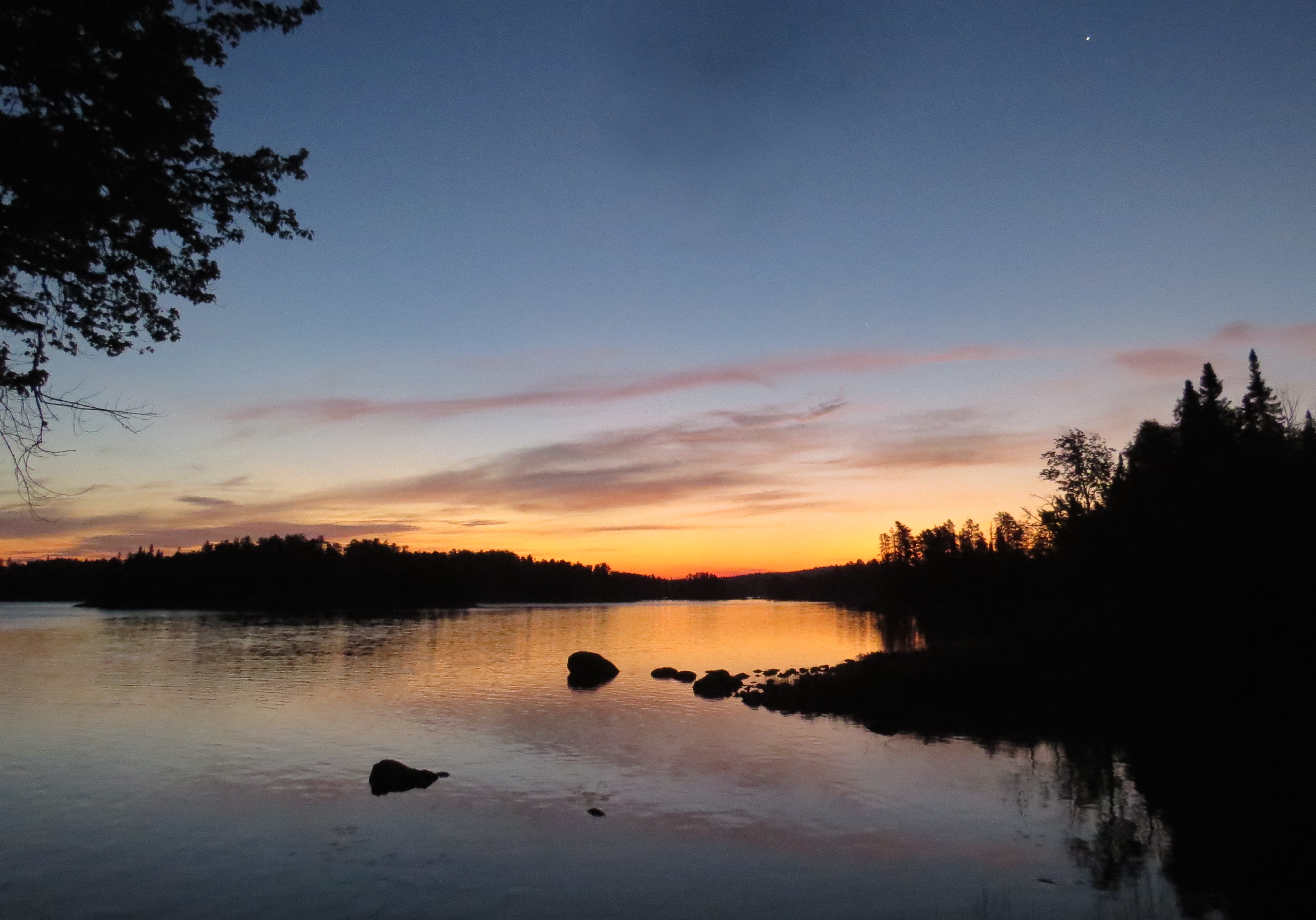
The isthmus campsite from our site on the point.  They get the sunset, we get the "Ross Light," a special light at sunset, coined by the great wilderness author Sig Olson.

The isthmus campsite from our site on the point. They get the sunset, we get the “Ross Light,” a special light at sunset, coined by the great wilderness author Sig Olson.

However, the site was taken. Bummer.  We paddled back out the bay, deciding to look at a site on the point.  It rises up some ledge rock from the lake, only 20-30 feet, but elevation matters in the Canoe Country.  We immediately noted the view down the lake a couple of miles to Canada and back to the isthmus site where we had just been.  Yeah, it’s work bringing the packs up, but we only have to do it once.  We get here in 4 1/2 hours and we often just sit for hours, watching the water and an occasional traveler.

Evening view down the lake

Evening view down the lake

We have learned that by sitting still, we see a lot more.  This is basic to observing nature, but in the past, I’ve been in a hurry to see what’s out there, not as conducive to seeing wildlife.  Last year, we were treated to a nightly show of beavers swimming into the small swampy inlet next to us.  This year, we had no beavers, although the beaver house was still nearby.

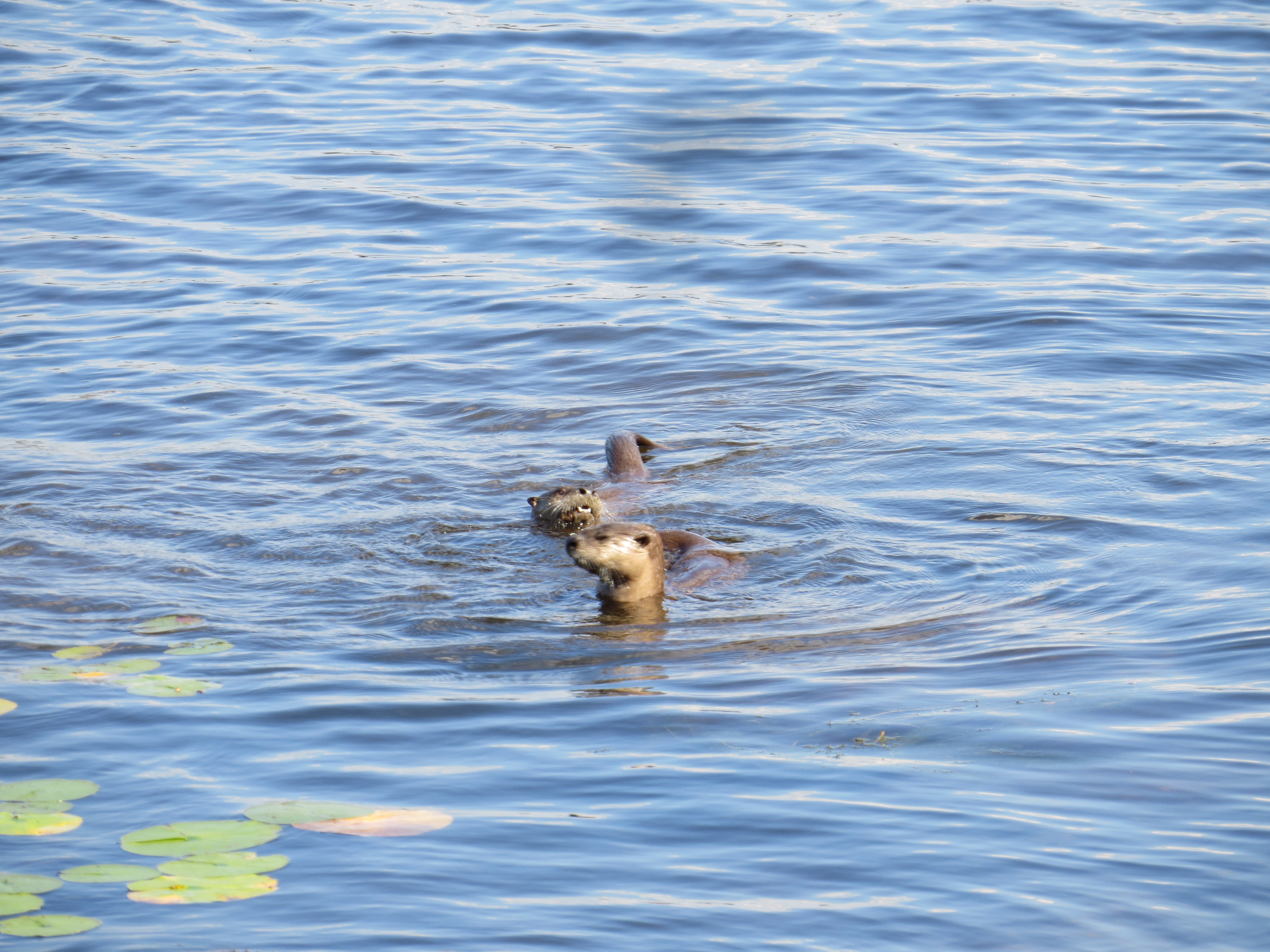
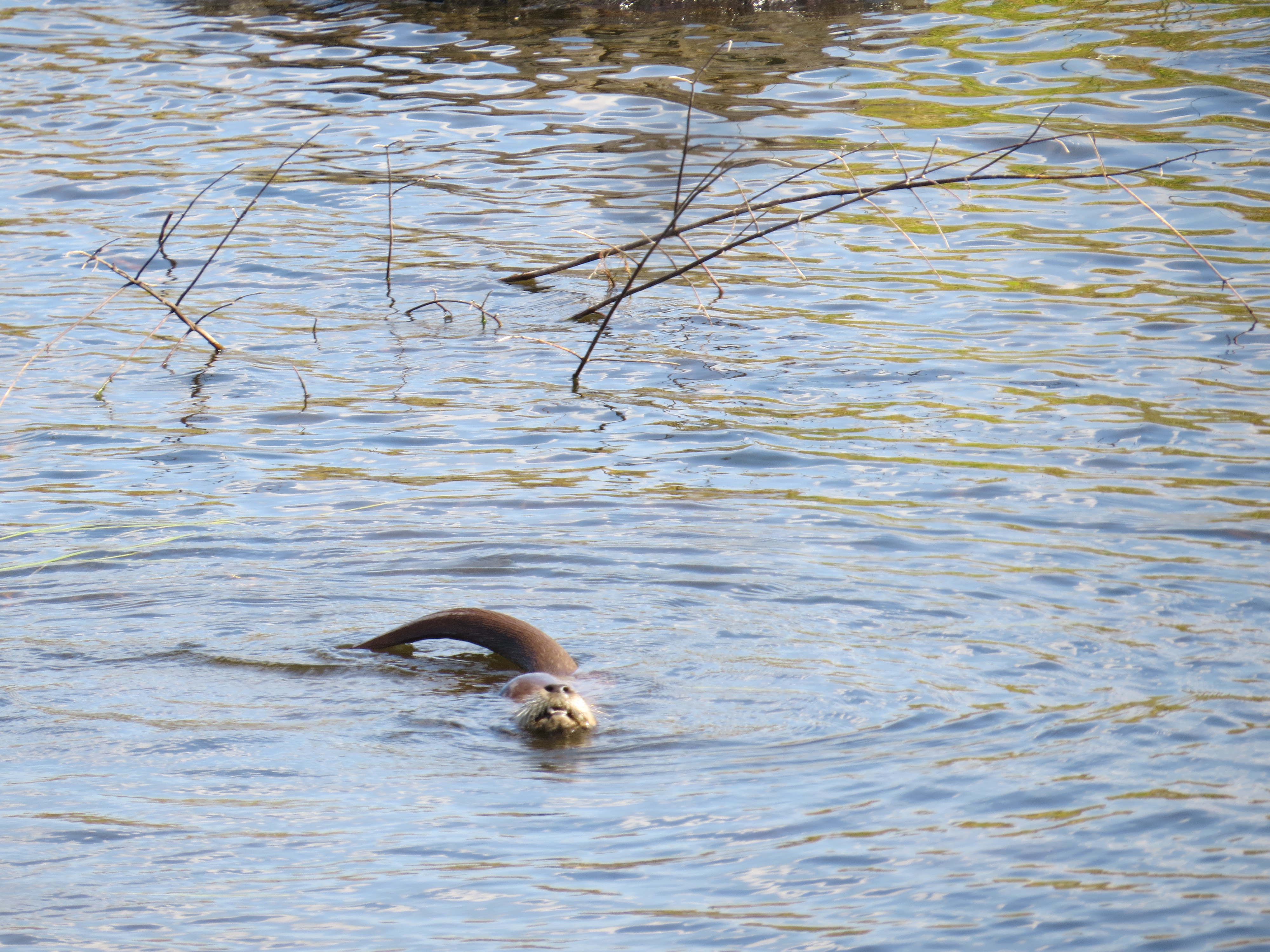
No matter, the weather was rainy for three straight days, so we got out for some short paddles and spent a lot of time in the tent, sleeping.  We sleep a lot out there.  The autumn colors were better last year; this year they are just beginning, although they were going to peak the week after we left. We get what we get.  The last full day out, we awoke to mist everywhere, threatening rain, figuring we’d take another day trip with the canoe.  The weather cleared, but then the wind came up, strong enough that we decided just to sit in camp the last day, reading, writing, looking down the long channel, or over to the isthmus.  We had a long paddle out the next day and wanted to save our arms.  At least that was our excuse.  Neither of us was looking at anything, just the trees that had changed color, the sky, the shadows, and the.….otters that suddenly appeared right off shore, three of them.  The day before, we watched one play with a stick on a rock face, before he ran down into the water.  We had missed the beaver show, but the otters played right below us, diving, allowing us to see them underwater, come up by a rock, by each other, and then disappear again.

IMG_6094 IMG_6097

Otter, Basswood Lake, BWCA, September 2015

Otter, Basswood Lake, BWCA, September 2015

By remaining silent, we saw a hermit thrush walk through camp, a Hairy Woodpecker and a Three-toed Woodpecker work on a dead birch tree near us.  Sometimes you see this stuff when you are traveling fast; the chances are greater you will if you sit still. I have long had the philosophy that wildlife viewings are a gift.  I never expect any, so if I see something, I feel blessed and grateful.  The otter viewing was the best I’ve seen, and I’ve seen a lot of otters.

We talked about what we would do when either of us or both of us can no longer do the work to get up here, or if the benefits don’t outweigh the effort, which can be considerable.  We can see those years in the future now.  It could be next year.  For my wife, 2013 was such a year.  On the other hand, we are able to do the work, and we hope maybe we’ve got a few more years out at this site until we need to move to a place that closer in, but still keeps us in the wilderness we’ve grown to love.  Eventually, we may have to stay in a cabin and canoe from there, not in the wilderness, but close to it.  That is how we hope our lives may play out.

There are many who say that age is just a number, but they are young and not wise in the ways of probability and genetics.  Things happen as we age.  The work necessary to get into this country requires strong enough arms to paddle long distances, often against headwinds, legs and body to carry packs and a canoe, decent balance to walk in camp, and ability to take care of oneself in the outdoors.  I’m relying heavily on experience these days.  On the trip in, the canoe went up on my head automatically, without my even thinking of it.   I can still move a canoe in any way I want it to go, I can read the sky and try to travel smart.  There are no guarantees, however.  I want to come out here as long and as I safely can.

I spend only a few nights every year up here.  They have now added up to more than three hundred in the border lakes country.  The special places I’ve seen are where I go in my mind when things are bad, life is difficult, and I need to mentally separate from the present.  Like the otter, I appear there, spend some time, then go, glad for what I experienced.

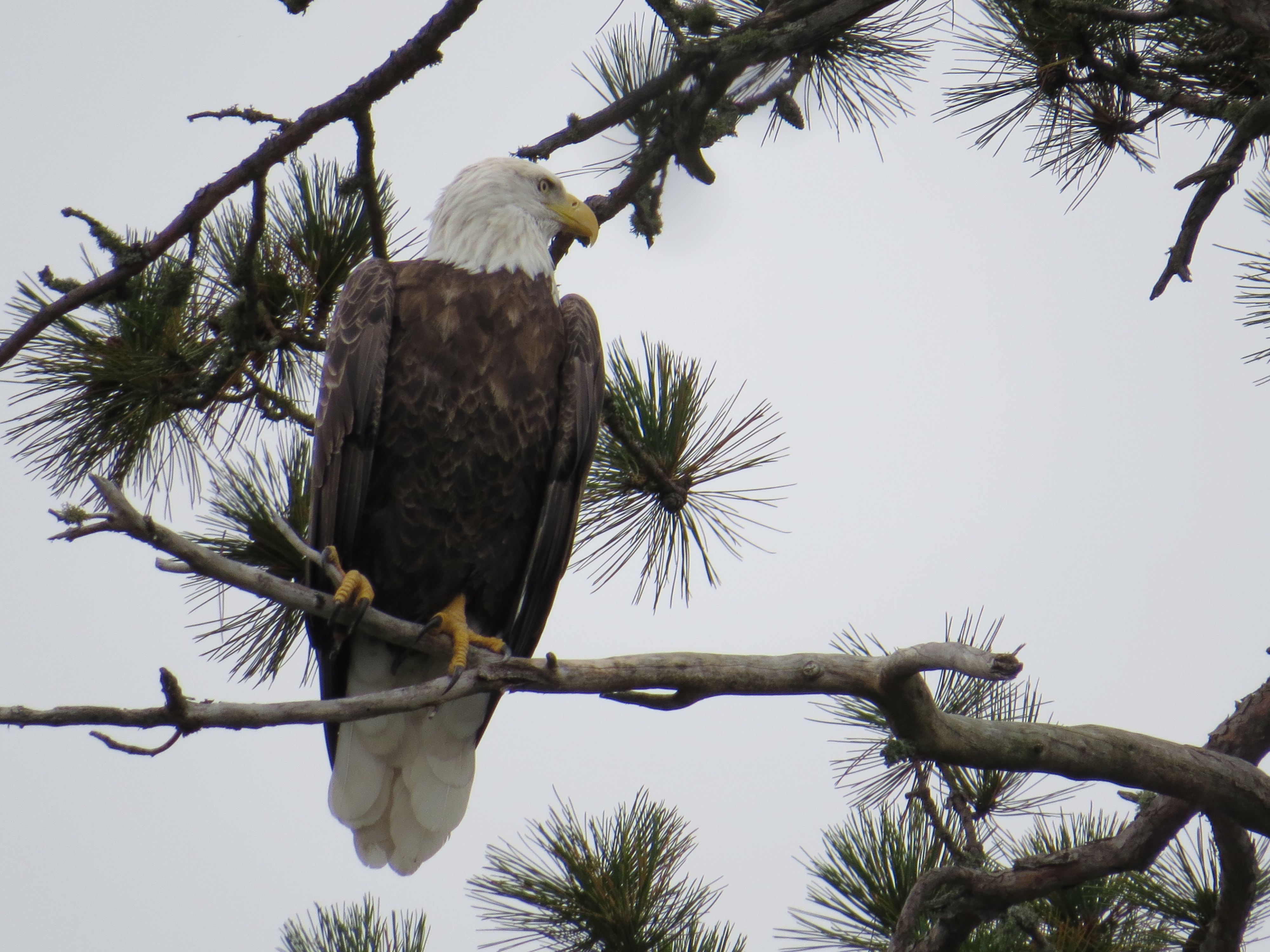
Eagle near the Canadian Border, BWCA

Eagle near the Canadian Border, BWCA

TWO MOOSE ON ISLE ROYALE

October 12, 2015

In Isle Royale National Park’s Visitor Center, on the largest island in Lake Superior, there are many moose skulls on the wall.  Such is not surprising; since 1997 a few hundred moose and a few dozen wolves have been completely isolated from the mainland.  It is one of the longest, most intensively studied predator-prey relationships in existence, but the wolves are dying off, a tragedy and a controversy as to whether new ones should be introduced, a raging controversy, both sides passionate about what to do.

Ironically, how we usually handle this and other hot button issues is summarized right on that wall.

Two skulls are very close together.  Indeed, it takes a little while to see that there are two, for there are so many antlers around them.  Then, it becomes strikingly clear what happened.  Two moose, probably in rut, fought over a female.  Their antlers locked, and they were unable to disengage.  Their destiny was not to win or lose.  No, their destiny was death together, fighting futilely to exhaustion and starvation, easy prey for wolves.

We might learn from that, if we weren’t so busy locking our own horns to realize we and those with whom we argue may both lose, prey for our common enemies.  Red-Blue, Conservative-Liberal, Pro Gun-Anti Gun, Republican-Democrat, one side-other side.  Take your pick, apparently, because there no longer seems to be much common ground, except there is, if we start looking.  If we choose to keep fighting, the wolves of the world will pick us off, because we will be too busy playing the futile game of trying to convince people who won’t be convinced, rather than finding a new solution, missing opportunity after opportunity.

That is why when Facebook put an ad on my site saying “Stand with Hillary and take on the NRA,” I didn’t add my name.  I will admit I have no love for the organization and am against their current agenda (which wasn’t always the way it is today).  But I know that without the NRA’s help, yes help, we aren’t going to solve the issue of mass shootings.

I’m going to assume that no decent American wants to hear about another mass killing.  It doesn’t matter whether the individual is an Oath Keeper or one who wants firearms banned.  No reasonable person wants the shootings to continue.  Simple solutions proffered by both sides won’t work, but we are a technologically developed country with many who are experts about firearms, their manufacture, use, safety and locking mechanisms, as well as tracking them. We have experts in firearm safety, human behavior, system and study design.  We need all of them.

It is not likely that we will be soon be able to determine which mentally ill person is a likely mass shooter. Maybe with better mental health care we would slightly alleviate the problem, but  many of those who harbor violent urges don’t seek help.  They don’t see a problem.  Additionally, we aren’t likely to pay for the cost of mental health care, even if we returned to institutionalization of the 1950s, which was a dictatorship over people.  Without doubt, it would solve a lot of problems: homelessness, some shootings, extra police work, and many emergency department visits, but at the cost of liberty to many.

Cars are dangerous, too.  Thrice as many die in the US every year from automobiles than from murders due to guns.  Notice my use of numbers.  These are facts.  If we allow research into gun violence to again be done, the way it once was, we would operate from facts, less from emotions and inaccurate numbers.

Guns are the major cause of suicide, and twice as many die from suicide by gun than murder.  Only the most callous would say that those who want to kill themselves should do so and be done with it.  These callous people are online, and we need the help of ISP and other computer experts to deal with the harmful byproduct of anonymity on the Internet. No reasonable gun advocate or anti-gun advocate wants to see firearms used to commit suicide.

We once had poorly engineered automobiles.  Indeed, Ralph Nader became famous with “Unsafe at any Speed.”  Improved engineering, better materials, seat belts, air bags, ABS, and side protection have cut the number of motor vehicle deaths 40%, despite a significant increase in the population (the number per 100,000 has fallen 60%).  We haven’t eliminated the problem.  One may wear a seat belt and die in a MVA, but the probability is less.  We don’t know who the 20,000 survivors are because of safer automobiles, but if we had 52,000 deaths a year, we would do something about licensing people, drunk driving, safer roads, and better auto engineering.  Oh, we did have that many deaths, and we did act.

So, this is where the firearm experts are needed.  Here is where the NRA is needed.  Here is where every responsible gun owner is needed.  We need ways to prevent people misusing firearms.  Yes, it is impossible to do it perfectly, but yes also, we can find a way to improve our current situation.  If we had 5,000 gun deaths from murders a year, it would still be too many, but it would be better than what we have now.  If we had 5,000 suicides a year from guns, it would still be too tragic, but it would be so much better.  If 30, rather than 60 children died from accidental GSWs, it would still be too many, but 30 fewer devastated families.

I’m weary of arguing.  It is not the time to “Take on the NRA.” Like the man with the wind and the Sun, if I blow harder, he will only pull his coat tighter.  No, it is time for the NRA and its membership to be invited to the table, to offer engineering and other solutions that have a chance of being tried and tested.  Who should own what?  How is ammunition regulated?  What should be written down, and what not?  How do we do background checks and maintain privacy?  What are ways to deal with this problem that we can a priori postulate what we think will happen and then count to see if it did happen?  Wouldn’t that be an improvement over what we aren’t doing today?

I want the mental health community to be at the same table to offer suggestions.  I want researchers to design studies showing how we might determine if a possible improvement works.  I want security experts and IT at the table, too.

Legislation may have to come from a Republican Congress.  Only a Republican in 1972 could go to China, and I think only a Republican Congress can write such legislation.  They need help from the Democrats, but at the same table, with the goal to decrease gun violence in this country and at the same time not limit responsible firearm ownership.  It is a tall order, given the money involved in making firearms and the emotions when somebody is gunned down.  However, given where we are today, we can’t do much worse.

Like the moose, we can lock antlers and hope to win, bloodied but victorious.  Or, we may end up together on the ground, helpless against our enemies.  We can use what’s in our skulls to solve the problem, with leadership and risk taking.  It’s our choice.

The two moose were programmed to fight.  They didn’t know one of the consequences.  What’s our excuse?

LEAVE NO TRACE JOURNEY

October 2, 2015

Leave No Trace (LNT) has been a part of backwoods, wilderness, outdoor travel for a few decades now, but until the first half of the 20th century, wilderness was the enemy, the “out there” that needed to be subdued by cutting trees, draining wetlands, building roads to lakes, later flying into them, making the outdoors accessible and safe for people.

About a century ago, outdoorsmen like Aldo Leopold, Wallace Stegner, Bob Marshall, and Sig Olson, among many others, challenged the notion of subduing wild lands, stating the opposite, that we need wilderness.  As a species, we are not far removed from wilderness, they wrote, and periodically need to get away to the “back of beyond,” far from steel, asphalt, cars and towns, where a person could be alone, on his or her own, and by being such, might reclaim some of the sanity, some of the humanness that had been lost.

In the early 1950s, I spent summers at a cabin by Ontario’s Crow Lake, a beautiful place with few people and motors.  We didn’t worry about trash.  We burned what we could and daily took the cans out to the center of the lake and sank them.  Everybody did it, but everybody back then was a small number.

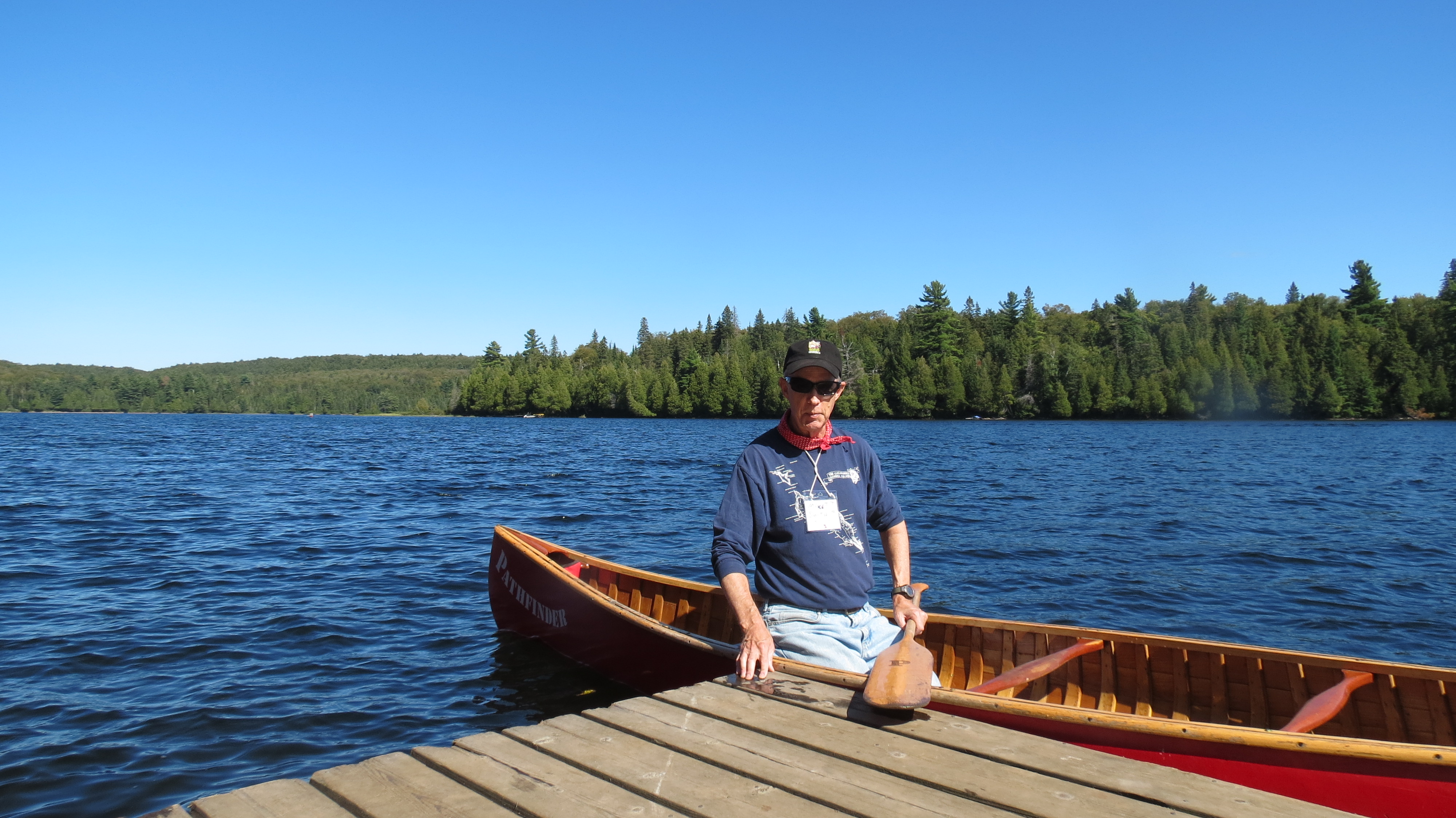
A decade later, as a camper and then member of the Camp Pathfinder canoe tripping staff, we traveled in wood and canvas canoes, with keels.  Pathfinder today, 102 years after its founding, still uses red Old Towns. Our heavy canvas tents leaked if one touched the inside of them when they were wet.  The mosquito netting had holes, and every night, campers were told to ‘hold their breath” as bug repellent was sprayed into the tent.  I have no idea what I inhaled.

Author at Camp Pathfinder 100th year reunion, 2013, back in a red canoe for the first time in 47 years.

Author at Camp Pathfinder 100th year reunion, 2013, back in a red canoe for the first time in 47 years.

Day trip to Little Island Lake, Pathfinder reunion.  I camped on this very site fifty years prior.

Day trip to Little Island Lake, Pathfinder reunion. I camped on this very site fifty years prior.

We cut down small trees, usually balsam firs, to use their trunks as tent stringers, to which we tied the front and the back of the tent.  We used the boughs as mattresses.  Our food was cooked over an open fire, requiring large amounts of wood, for there were no camp stoves.  An axe was a necessity; every campsite had a can pit, a considerable amount of rusted junk, which attracted bears.  We made our own fire pits and camped wherever we wished.  Meal time, we soaped the pots and pans to make removing the blackness easier, later cleaning our dishes in the lake, leaving many visible food particles.  We used sand to scrub, moss to remove grease, thinking ourselves woodsmen of the first order.  Maybe we should have known better, but nobody I knew did. Sunscreen was unknown and we had no water filters.  Small wonder we often became ill.

Having learned to camp this way, the idea of complete LNT has been slow for me to adopt and for many others my age, some of whom haven’t adopted it at all.  I began using camp stoves about 25 years ago, never did cut green trees for firewood, or strip birch bark from a live tree.  That part was easy.  I’m still able to camp where water is drinkable, but even in the Boundary Waters, I’ve become ill on two occasions.  I take water from the middle of the lake and usually boil it now.  I use a small saw to get wood, although I do have issues with the suggestion that wood be gathered more than 150 feet from the shoreline of a lake.  Better wood, not degraded, is present along the shore, and walking deep in the woods risks injury, getting lost and hurting plants.

I hadn’t made the final step until recently.  I stopped burning trash. In Alaska, people still do on trips, but it is illegal in Minnesota to do so, and burning plastics releases toxic gases.  Many food containers used have aluminum foil present, the bane of litter in the woods.  Contrary to many beliefs, aluminum foil does not melt, but it does fragment, so even burning the pouch and carefully collecting aluminum left some behind.  All trash was packed out, including dental floss, and when I brush my teeth, I spit into the fire pit, not spray it on leaves, many of which on campsites are white from others’ doing this.  Cleaning pots means getting the soap off, but away from the lake, scrubbing with scouring pads and not rinsing them in the lake.  It seems so tempting just to do it in the lake.  A little soap won’t hurt.  But yes, it will.

In 1992, when I volunteered for the Forest Service in the Boundary Waters (BW), I saw first hand how LNT was being implemented. The BW has designated campsites, where one must stay.  This concentrates the impact to a few places, rather than many.

We need to regulate, because people don’t self-regulate well enough:

  • We must enter on a specific date and place.  The length of time one may stay and exit may not be regulated.  We want to disperse people throughout the wilderness, not overwhelm designated campsites.
  • Campsites all have a fire grate, the only place a fire is allowed.  The fire must be out, dead out, tested by using one’s hands in the ashes, when one leaves the campsite, be it for good or for a day trip.  I’ve seen experienced people leave burning fires when they day tripped.
  • It is illegal to cut, deface a tree or pick flowers.  The days of tent stringers are long gone; new tents are easier to pitch and leakproof.  Despite Thermarests, people still cut pine boughs, but it is rare.  Still, many trees are defaced by having nails driven into them to hang packs off the ground or for clotheslines, neither of which is necessary.
  • Only 9 people and 4 watercraft may be at the same place at the same time.  This removes crowds.  On busy portages, crowding may be a problem, but with 250,000 visitors annually to the border lakes, rules are needed.
  • No cans or bottles are allowed in the BW except for medications, fuel, and toilet articles, one of the first rules and one of the best. Can pits are long gone.
  • The latrine at each campsite concentrates human waste in one area. Nothing should be thrown into it, although I’ve seen fish, books, clothing, fuel bottles, and liquor.  Latrines may last a few years before being re-dug.  I have dug sixteen in the rocky soil, a difficult, nasty job, especially removing the old one and covering the prior area.  The Appalachian Trail Conservancy must come to grips with human waste with hikers passing through, because many don’t bother to bury their waste,  More and more LNT is requiring packing out human waste  We did it on Grand Canyon raft trips 35 years ago. If I live long enough and remain healthy, I see a day when will routinely I pack out my waste.

I have found these changes to be difficult to adopt, but with time, they become easier.  The idea is to leave a site better than it was when one arrives.  For the current generation, this should all be easy.  For my generation, it has required a lot of changes. It isn’t 1950 any more, we aren’t making new wilderness, and many would like to destroy the little we have.

We need wilderness for our sanity.  Some of us have long known it.  Others have yet to learn.

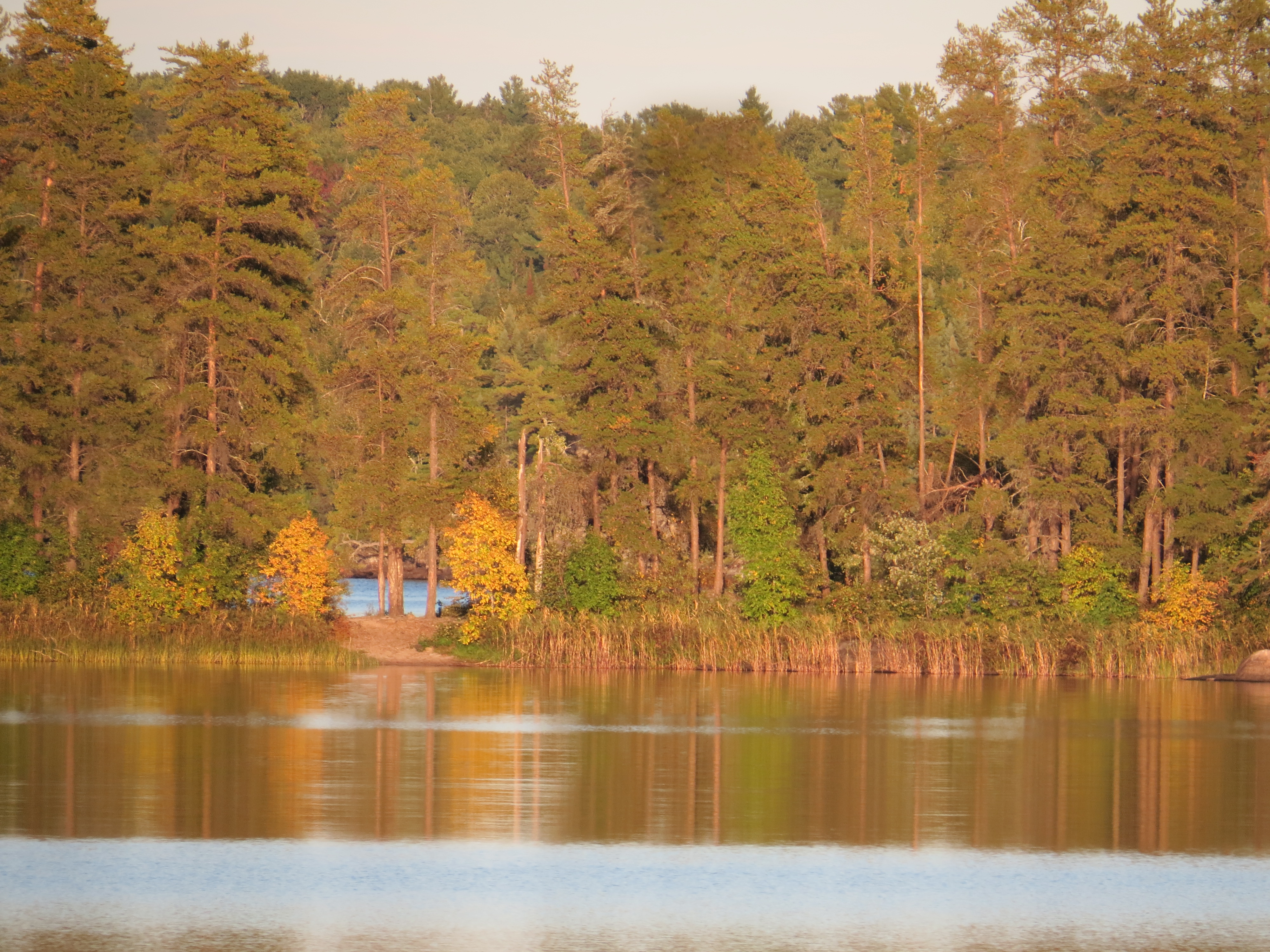
View from campsite in Boundary Waters, 2015.

View from campsite in Boundary Waters, 2015.