Archive for February, 2016

MY ANNUAL BILL TO BE AN AMERICAN

February 18, 2016

After the New Hampshire primary, a friend commented that she didn’t want her taxes to go to send other people’s children to college, a comment on Sen. Bernie Sanders’ plan for free college education.

I was surprised and a little disappointed to hear that.  Through grants, to name one example, government is involved in education.  My taxes go to many places that are irrelevant to me.  I have no children,  I don’t eat meat, and I’m not a woman.  Should I have the right not to be taxed for public education, grazing fees on my land, and Planned Parenthood?  Of course not.  Is my friend going to vote for the other side, who will defund  Planned Parenthood and require that all rape-caused pregnancy be carried to term?   I was against the Iraq War long before it started, but my taxes went for that debacle.  I will never drive on roads in Texas again, so why should my taxes go for that?

While we are at it, we could get rid of the phrase “hard earned dollars.”  Sometimes they are, sometimes not.  In any case, the phrase is worn out.

There are things that the federal government must do, because we as people living in towns, cities and states simply cannot do them ourselves with our own resources.  We can’t clean up after a devastating natural disaster without federal help.  Yet, more than 30 Senators voted against Hurricane Sandy aid, even though many were from states that FEMA has been to many times after devastating storms.  We can’t defend ourselves against major foreign powers, and we can’t pay for medical care for the elderly or infirm.  We can’t build a national system of roads, and we can’t have a national weather service, the NIH or the CDC without the federal government.  These and so many other programs are essential to our well-being.  Live in the South?  Maybe you are glad the National Hurricane Center exists.  Government shouldn’t do everything, but there are things government can do.  And should.

People ought to save for retirement.  I did.  Sure, there are many who buy toys or travel everywhere without putting anything away and then find themselves old with no money.  I am not sure what is going to happen to them, except they will have less—but not zero—money.  We ought to make it easier to save, and we have to an extent with IRAs.  We need to do more, however, because if a senior is destitute, somebody somehow has to care for them, unless we are a different country from the one I thought we were. I had good fortune and a good job.  In the 45 years of being between 20 and 65, had I developed a significant medical problem, and I hadn’t had insurance, I would have become bankrupt.  Many have.  It doesn’t matter whether or not a person was saving money or whether the problem was their fault.  They need a safety net.  We can argue about the size of the safety net or whether people like me should receive it, just because we reached a certain age.  That is fair.  But the fact our taxes go to pay for something somebody else gets doesn’t a priori make it wrong.  That’s what elections are about.  My taxes are payment for my annual bill of being an American, and frankly, it is a great bargain.

People ought to have a healthy lifestyle, too.  Why should I pay for smokers who develop emphysema or lung cancer?  Or those who eat the wrong diet and suffer the consequences?  Or motorcyclists who have accidents and weren’t wearing helmets?  The list is endless.  I could add to it the question “Why should I pay for future cases of Chronic Traumatic Encephalopathy caused by football, soccer, or hockey?”  Nobody forced those people to play the game.  Many made a lot of money.  Why, I could ask, don’t they fund themselves?

What we have accomplished with our collective will and our federal government is so pervasive in our lives we don’t recognize it but take it for granted.  It isn’t; it may be removed at any time.  When FEMA was decimated under Bush, we saw what happened to New Orleans.  Bush’s response to Katrina did as much to bring down his presidency as Iraq.  Had Social Security been privatized, the recession would have bankrupted millions of people who get by on something they were never intended to get by on.  I shudder to think what will happen if Medicare is taken away.  It can be.  All it needs is a president, a Congress, and a Supreme Court willing to do it, and if one thinks that is impossible, one is unaware of reality.  I am already preparing for 2017 and 2018, when the other side is in power and the safety nets are removed.  I am counting on voters finally waking up and showing up to vote in November 2018 to take back Congress and stop the madness.  Being American voters, I may be hoping for too much.

Every time we drive on a federal highway/Interstate, we are seeing what our taxes went for.  Every time we go into a national forest or a national park, we see it. The food labels for nutrition that are so helpful are a federal law.  We ought to have point-of-origin food labels and label GMOs. The medications we take are safer, due to the FDA.  If one flies, there is the FAA, NTSB, and the TSA.  Indeed, we now have the TSA, because prior to 2001, the airlines were responsible for security, and we saw what happened.  Pilots are trained to certain standards.  Flight attendants are, too, and everything that they say was legislated.

Regulations exist to ensure there is a certain baseline of information that is given to the public.  Regulations in food safety exist because without them, we have no guarantee that each food service facility will do the right thing.  Regulations exist, because every year we see what happens without proper regulation.

Here’s my plan for who pays for college:  I would bring back the Civilian Conservation Corps and the GI Bill, make young people serve their country and then give them the education they want.  College for young people is a better investment than the Iraq War was. My downpayment for being an American was serving my country.  The annual payment is called taxes.  I get a say in what happens.  That’s my social contract.

Let’s bring it back.  It will help bring us together.


THE HALLWAY

February 9, 2016

A good friend of mine is trying to decide a career path, and having grown up in a very different culture, has choices and restrictions very different from what mine were.  Nevertheless, without asking in advance, admittedly a bit rude, I offered some thoughts, my own story, hoping perhaps it might help.

I wasn’t happy in medicine.  Neurology would have been a great specialty for me fifty years prior—even 20 years—before imaging tests allowed most physicians to diagnose many conditions that hitherto had been the province of neurologists.  I was left with the complaints of headache, spine pain, limb pain, and dizziness, 45% of my new patients (I counted), where imaging tests were normal and my training to deal with these conditions practically non-existent.

Night call was dreadful.  I didn’t sleep well, even on quiet nights.  I hated weekends, especially when my partners decided (with my dissent being the only one) one person be on call the entire weekend.  I was the only one in my group who took off the following Monday afternoon, not the whole day, because it took me all morning to get everything cleaned up from the weekend. I was on call 582 nights during my time with the group, and I then wondered what was the toll was on me from lack of sleep—how many errors I made, how many times I was unnecessarily nasty, cruel, or mean.

I knew I had to do something different, so I decided to take a 6 month leave of absence, 6 months of retirement at age 43 to work as a volunteer for the Superior National Forest, being a wilderness ranger in the Boundary Waters Canoe Area Wilderness,** a million acres of lakes, rivers, and forest—no roads, no cabins, no powerboats.

That time was perhaps the most content I ever have been in my life.  I was in the woods 100 days that summer.  I learned the Boundary Waters like my neighborhood, traveling hundreds of miles through 300 different lakes.  I was strong and soloed 15 times, single carrying (canoe and pack) a mile without stopping.  I traveled 6 days solo without seeing another person.  Didn’t mind that, either.

But winter comes to the North Country and I had to return to my practice, never having had the epiphany one night by a campfire, when I would suddenly realize what I was going to do with my life.  That is what I thought would happen.  It didn’t.  Back in practice, I was calmer but I still was dissatisfied with my life.  Then, quite by chance, the medical director of the hospital resigned for another position out of state and I decided to apply for the job. I wasn’t sure how it was going to work, only that it was more to my liking than what I was doing.

I liked the job, learning a great deal about medical management.  I never would have dreamt during my training I would become an administrator.  Nor would I have predicted that hearing Brent James from Intermountain speak on medical quality would be life altering, and that I would not only take his 4 month long course in Salt Lake City, but I would ultimately leave medicine in all forms to pursue a Master’s in Statistics.  No, I never foresaw this.

Nor would I have guessed how I would have failed at being a medical statistician.  I had closed a door, one that paid well and gave me power and influence, but it locked behind me.  I couldn’t go back.  Instead of a bright world in front of me, it was as if I were in a hallway, with a lot of doors, all of them closed.  Only one was unlocked, and I entered a room, the door’s not locking behind me.

This imaginary room was like a classroom, as if I were back in school, doing two things I liked and was good at—teaching and math—and another that I liked but wasn’t good at—writing.  Somehow, I cobbled together a new life of writing about patient safety and medical errors for magazines, became a columnist for the medical society and Physician Executive magazine, and continued writing a weekly astronomy column for the newspaper as well.

Quite by chance, which became three words that would define my life, while looking through a drawer one day, I found “The List,” things I wanted to do in my life, ignored for two decades.  I started to dream, then I started to act.  I began in 2004 with seeing the Sandhill Crane migration, and then began the following year to see the national parks, beginning late 2005 with Guadalupe Mountains and Carlsbad Caverns.  It was as if I had opened an imaginary door and gone literally and figuratively outdoors, without the door’s locking behind me.  I had written down “See Alaska’s Arrigetch Peaks,” and I did in 2007.  That led to five more Alaska backpack trips to the Brooks Range.  I had learned that writing a column was like my life—I didn’t force things to happen, I recognized opportunities and tried to act upon them appropriately.

In 2010, cold weather in Nebraska and a delay in the arrival of the cranes led to my returning in late March, which was life changing, for instead of being at Rowe Sanctuary before the public arrived, I became a guide to the viewing blinds, going again this April for my seventh consecutive year. That July, I planned to see the total eclipse in Patagonia, but the flight-seeing plane we had booked to fly over the almost certain cloudy country was cancelled, meaning our chances of clear skies in the austral winter were about 5 per cent. I nearly missed making the plane to Buenos Aires, which I wouldn’t have minded missing, but found myself 2 days later in Patagonia under thick clouds the day prior to the eclipse.  Yet the next day, in a clear sky, I and a large tour of mostly Germans saw the most striking of the 15 total solar eclipses I have been fortunate enough to see.  The friendliness of the Germans I met led me to try to learn their language.  I won’t ever finish the job, although I watch far more German than American shows on TV.  There was no way I could have foreseen either of those two events that year.  Quite by chance.

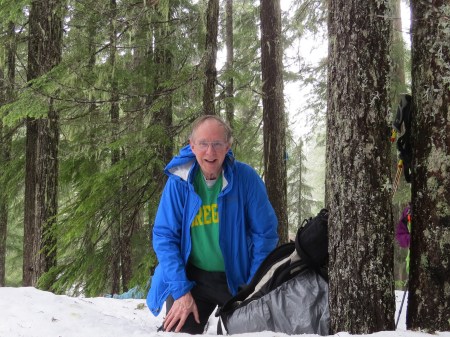
When we moved to Oregon, I knew that I would do something and was perhaps wise enough to know that I would do things that I could not possibly foresee, and other things would not work out as planned.  Leading hikes, tutoring math at the community college, and running planetarium shows could not have been predicted by me, but I do them.  Two weeks ago, I went snowshoeing for the first time in my life. (Salt Creek Falls, Oregon; February, 2016).

What I told my friend was not to force any decision about school.  Think about what you like, I wrote, and keep your eyes and ears open for opportunities.  Take some risks.  You might end up in a brand new world, or you might end up in a hallway with a lot of closed doors.  Try them all.  I bet at least one will be unlocked.

Quite by chance.

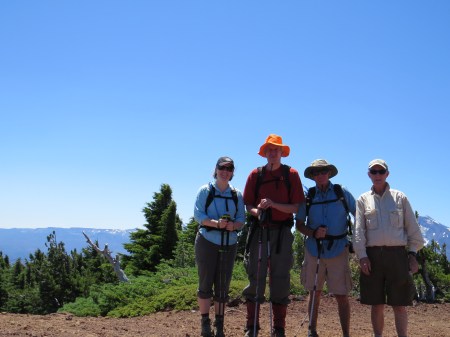
At right, trip leader to Black Crater, Oregon, 2015.

**”The examiner re-examines” and “Burnout or rejuvenation?” were my words, except for the title, that Steve Nash, former Executive Director of the Pima County Medical Society and now of the Tucson Medical Osteopathic Foundation.  I deeply appreciate his taking my words and adding his style to the medical society publication Sombrero.


CRESCENT MOUNTAIN

February 7, 2016

“We can’t go any further!!” one of the hikers in the lead group yelled to me, the leader, as I approached.  “There is too much snow.”

We were about 4 miles and 1800 feet up Crescent Mountain from the trailhead on a day that was alternating between rain and snow flurries.  My thirteenth time leading hikes for the Obsidians, and I had everything I could handle.

I hadn’t planned ever to lead hikes.  Indeed, I had heard of the Obsidians, a hiking club, only by chance, when on a visit to Eugene before we moved, the person showing us around mentioned the Obsidian Lodge, as we drove by a large building set in the woods in the South Hills.  After we moved, six weeks later I suddenly remembered the club, looked it up, wrote them about perhaps my joining, hoping, “we would be a good fit for each other.”

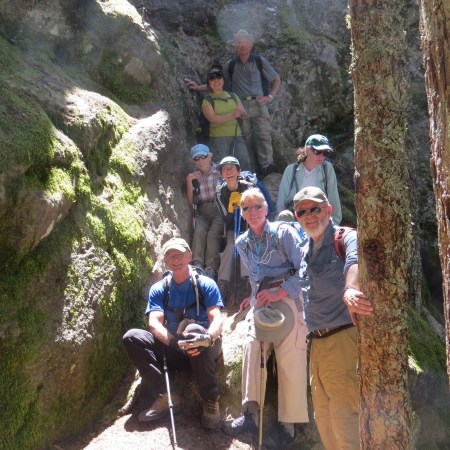
We were.  One has to do three hikes to become a member, and on my first, up Rooster Rock in the Menagerie Wilderness, I found I wasn’t left behind.  Indeed, on the steep upper part, climbing 750 feet in a half mile, there were two of us in front, and I kept up a conversation with the other ahead of me.  I belonged in this country.  (Picture of Obsidian Hiking Group, Rooster Rock, 2014).

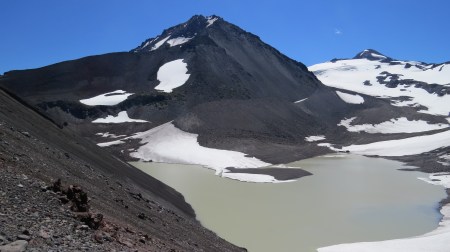
The leader on that hike, a dynamo, 73, kept telling me I should lead hikes.  I told her I couldn’t lead a hike without having done it first, so I spent much of the summer of 2014 doing hikes in the Cascades or on the Oregon Coast by myself.  I started with Eagle’s Rest, a 2000 foot climb, then did Hardesty, a 3500 foot climb over 4.5 miles.  I found a way to do Hardesty without backtracking, and did that 14.5 miler, with 5000 feet of climbing, twice.  I hiked Obsidian Loop, one of the classic Cascade hikes, on July 4, six feet of snow or more on the ground.  I later combined the loop with Opie Dilldock for a 19 miler.  I did Maxwell Butte, Iron Mountain, Castle Rock, and on a cold October day near season’s end, Browder Ridge, solo.  (Collier Cone, Opie Dilldock 19 miler, August 2014).

I started leading hikes in August, two months after I became a member.  I led Obsidian Loop twice, once in November, four days before the road closed for the winter.  That was a great hike, in fog and rain, not the usual way people see that country, which is usually in summer.

The non-winter of 2015 meant that hikes we normally did in June or July were able to be done in April.  Indeed, I led lower elevation Rooster Rock in mid-February, with trees in bloom.  Crescent Mountain was in April.  I had done it the prior June 29.

There had been some rain, but 12 of us showed up, the typical number that carpool, and we arrived at the trailhead high in the Cascades about 10.  The woods are dense here with Douglas Firs and sword ferns.  Early season hikes had a problem which I had not anticipated: several blowdowns, fallen trees, were blocking the trail.  While it didn’t snow much, there was rain and a lot of wind.  Saturated soils often cause trees to fall.

We started the hike by descending to Maude Creek, where we regrouped.  There had already  been three major blowdowns, and I led, finding the best way around them.  We regrouped at the creek, and I counted people, always counting, as I had on canoe trips nearly a half century earlier, when my campers went swimming.  I had to reach 12.  It wasn’t like there were other trails here, although that does occur on other hikes.  People can get hurt or have a medical emergency, and our median age on the hike was well over 60.

After the creek, I let people go at their own pace, staying in the middle of the group as we steadily climbed.  As we broke out into the first small meadow, there were several firs that had fallen together and required a few minutes to navigate through.  It was a mess.  (Upper Meadows of Crescent Mountain, looking at Browder Ridge to the south.)

This area was about the half way point of the climb, and I waited for everybody I could see, even backtracking to make sure whoever were 11 and 12 were OK.  They were, and I moved back through the group to the higher meadows, too soon for the wildflowers we had seen last June.  At the upper end of the meadow section, I heard the shout about the snow.  I looked and saw the six of my group clustered where the trail disappeared into the woods.  I knew the trail went up from there, and I found it easily, despite the snow.

Everybody followed, catching up when I looked for a way around a blowdown in the woods.  The snow was a lot deeper but still passable.  Nobody complained, and we climbed the last few hundred vertical feet to the summit.  This was the lunch spot , but I then went back down the trail, to find the last five. (View from summit of Crescent Mountain).

Three were about a quarter mile back, just past the blowdown, and they were doing fine.  The other two were another quarter mile back, and I wondered if I should turn them around.  I hated to do it, and we were fine on time, not as fast as I had wanted, but not in trouble either.  I can sense well time on the trail and thought if we didn’t stay too long on top, we would be down at a reasonable hour to get back to town.  (View towards Mt. Jefferson, hidden in the clouds).

The last two arrived at the summit and thankfully quickly ate their lunch.  A few who were cold asked if they could slowly start down.  I told them to go.  The view was beautiful in fog, with the trees below covered in recently fallen snow.  I pointed out Crescent Lake to the north, unfrozen, and Browder Ridge, below to the south.  We wouldn’t be seeing The Sisters, Mt. Washington, Three-fingered Jack, or Mt. Jefferson today.  I quickly ate, took a few pictures and was left with one other person.  She was having a little trouble with her gloves and told me to go, but I stayed and got her settled.  Gloves are important and if the hands are cold, other things might happen, like falling.  Once she was taken care of and started down, the count being correct, I left.  The hike down was uneventful.  The group walked about 11 miles; I might have done 13.

It was just a hike, nothing special, not a race, not a major climb, just a Sunday outing.  It was the day that truly I became a trip leader, realizing that it was far more than posting the hike online and showing up.  Leading is counting people, watching the clock, watching the sky, watching how people hike, looking at their body language, their expression, their gear, listening to their breathing.

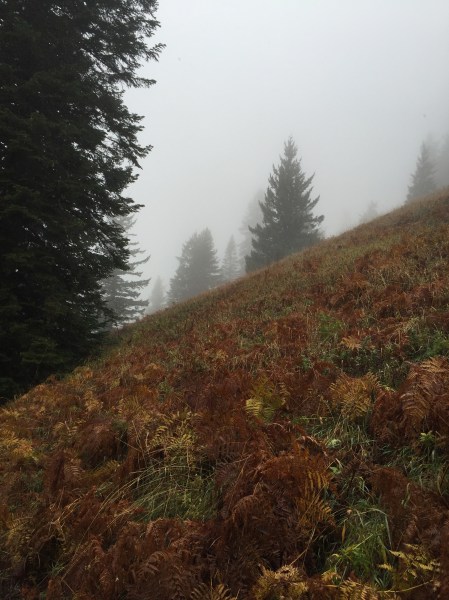
The Obsidians give patches for those who do 100,200,300, and 500 hikes.  They also give them for leading 25,50,75,and 100 hikes.  I’ve now taken more 120 hikes and led 34.  I led Crescent again later, in a cold autumn rain.  At the meadow, the cold wind’s howling and the 45 degree temperatures led me to call off trying to summit in fog.  We turned around and got back down wet, but warm.  (Upper Meadows in fog.  It was windy and intermittently snowing).

Knowing when to quit is perhaps the most important part of leading.

(Black Crater summit, August 2015)