Archive for April, 2016

THROWING OFF THE BOWLINES

April 26, 2016

“Twenty years from now, you will be more disappointed by the things you didn’t do than by the ones you did do. So throw off the bowlines. Sail away from the safe harbor. Catch the trade winds in your sails. Explore. Dream. Discover.”

Mark Twain

But be rational about it, remember to pay your debts, carry some form of health insurance, fund your retirement, and give back to society.

I admit it.  I’m jealous.  I’m jealous of the young guy with whom I hiked who had time and money to hike the three main N-S trails in the US: the Appalachian, Continental Divide, and the Pacific Crest Trails.  I’m jealous of those who have the time and money to travel the world, seeing places I will never see, doing things I will never do.  They have caught the trade winds in their sails, and they have explored, dreamed, and discovered.  I just wonder where they got the money and the time, how they are going to pay medical and other bills, how they are going to retire, and whether they are giving back to the world.  I never ask them, however, for it would be impolite. Besides, I might not like the answer.

Two years ago, I backpacked with a group in western Alaska.  One, 32, was a nurse who had been all over the world.  She made good money.  I made more at her age, but I back then didn’t feel then I could afford long trips.  Still, I knew almost nothing about her.  Another was a man who had a two month old back in England, and he was flying around the world alone, stopping at various interesting places.  After the backpacking trip, he was going to canoe in southeast Alaska. I needed to get home.

I didn’t ask where they got the time to throw off the bowlines.  I threw mine off for the first time in 1975 when the Navy ship I was on backed away from the mooring, turned the bow westward, and started steaming across the Pacific.  I saw a lot of things, mostly water, a young doctor—the only one on board—with a lot of responsibility and not nearly enough knowledge.  Back then, we had to serve in the military, and I was one of the fortunate ones who avoided combat duty.  But I still served, making good money, about $11,000 a year.  It wasn’t enough so I could bicycle the Silk Road, hike the Appalachian Trail, camp out on Easter Island, or take a year off to see Europe.  We had to serve, period.  Taking a year off cost money back then.  I think it still does.

Two decades later, a friend of mine was jealous of my traveling to South Africa for the 2001 eclipse.  I was 52, hardly young, and she and her daughter had not traveled much after they both had a month-long trip to Europe when her daughter was 21.  Why be jealous?  When I was 21, I was in college.  It would be eleven years before I saw Europe, and I was then in my first year of private practice.  First year.  At 32. I had debts to pay and a retirement to fund.  I couldn’t afford to stay long, and it would be a quarter century before I went back.

My generation didn’t have the chance to throw off the bow lines, except when the 1MC intercom on board blared, “Underway, Shift Colors.”

I didn’t have the opportunities that so many of the young today have, for I had to save enough, pay off debts, pay a mortgage and buy-in to the practice I had joined.  I was lucky.  I had no student loan debt, and the practice buy-in wasn’t onerous.  I was dealt different cards.

I was fortunate to live long enough to discover that I needed to get back into the outdoors more, so in addition to yearly trips to Zion NP to backpack, I started doing the same at the Grand Canyon.  In 1981, I took my first trip to the Boundary Waters in northern Minnesota, not returning for 5 years, but returning every year thereafter.

Most don’t get the breaks I did.  I took a leave of absence when I was 43 and volunteered for the Forest Service.  I didn’t go until I paid off the house, was debt free and had my retirement under control. After I returned, I slowly added each year to my portfolio of canoe trips in the US and Canada.  Along the way, I started chasing solar eclipses, the phenomenon’s dictating where I was going to visit.  I tried to see as many national parks as I could, one here, one there.  I discovered Alaska.

If you live long enough doing this, you see a lot of places in the world.  But you have to be fortunate.  You need a decent job—at least most of us—so you can have the money.  My philosophy is first things first:   We drove old cars, and our house, with all our cats, was not a place we invited people to visit.  We chose to have animals, but we chose not to have expensive toys.  Memories matter, so while I could have made more sooner,  I waited.  I wonder how many do that today.

Having voluntary military service helps.  Except not the country.  It is disturbing that a few serve multiple deployments and only one in eight of 25-34 year-old men is a veteran.  Half the men my age are.

As I entered into my 50s and 60s, I realized that my legacy to myself might be the places I had seen and camped, but my legacy to society was what I gave back.  Volunteering became important.  Still is.  I do have some skills that are useful at the Community College, so I help with math.  The hiking club needs leaders who organize hikes, the local planetarium occasionally needs somebody to do a show.

Explore.  Dream. Discover.  Yes, do all that, and do it when you can while you can, for there are no guarantees.  But remember that you also have to take care of yourself when you get old.  Many can’t.  I can afford to do this, and I can because I stayed in school a long time, worked long hours at a good job for which I was trained, and saved money.  I had the right genetics, too.  When I had time and sufficient money, I took it and used it.  I did what I could.

Every week, I update the calendar  with how many hours I volunteered.  I don’t know how much is enough, but I do what I think I can.  It’s my job to donate money, too, because I can, although I’d rather donate my time and my mind.  Few want the last.  Only the money, please.

If I live long enough and become crotchety enough, I may ask one of these younger folks how they got the money to travel and how they are going to fund their retirement.  But not now.  It would be impolite.

But I am quite curious.
HOLDING COURT

April 18, 2016

“Excuse me, but this is a library.  Could you please be a little quieter?”  My wife asked two couples who were talking rather loudly in the ship’s library, where the rest of us were reading.  We were close and had looked over twice.  Another lady had looked over, too.  We were on a cruise to see the 2016 eclipse, lucky to go there, but our room number was a lot lower than theirs, I would bet money.  The first deck was for those who paid a lot less for the cruise.

Not only were they loud, the men were bragging.  They were talking about their season tickets to Ohio State football games, being on the Board of something or other, how they had taken “hundreds of cruises,” and all the places they had traveled.  They had seen stuff I never had or will, and I’ve been to fifty different countries. I had seen a few more total solar eclipses than they had, not that I was going comment.

I am not an OSU fan, something that isn’t rational, so hearing the specifics of a loud conversation about the Buckeyes added to the unpleasantness.

The quieter of the two couples were standing, the loudmouth, probably our age, was sitting, leaning back in a chair, as if he were holding court.  My wife and I decided to move, and I left first. I’m not confrontational.  The few times I have been have not turned out well, for I have a very nasty sarcastic streak, which makes me feel badly later, when I have a clearer mind.  If it is easier for me to disengage, I will.  As I left, I turned around to see my wife saying something to the foursome.  She then joined me. My wife isn’t afraid to call people out on boorish behavior and does it well.  Maybe as a woman, she has an advantage, maybe not.  I am afraid I probably will be slugged. Or shot.  This is America, after all, although we had all gone through a metal detector to come aboard ship.  I felt safe from that.

The comment from the guy holding court to her was, “What, did we wake you up?”

That was completely uncalled for.  It was not true; it was rude, boorish, and frankly shocking that a person called out on loud speech in a library, one who has taken so many cruises, obviously rich and powerful, for he was a member of so many boards, would say such a thing.  I’ve served on only two boards my whole life—the local and state medical society ones—and have never once been asked or considered to be put on the board of anything else.  Maybe it is because I’m not a high-powered loud opinionated person.  Or maybe because my knowledge, wisdom, ability to listen, and to stay quiet long enough to put things together at the end of a meeting is not welcome.  I’m an introvert and a slow processor; the loudmouth idea generators, who don’t have time to allow those of us who are system builders to make ideas reality, sit on the boards in the world I live in.  Maybe it is a reason why the world is such a mess.  I often wonder how much potential is lost; that is definitely one reason why the world is such a mess.

Boorishness is in these days.  Donald Trump brought it back and has been very successful with it, at least with a disturbingly large segment of the American electorate.  Worse, apparently it is stressing out teachers and children, too.  Some teachers are not discussing the upcoming election.  Others have abandoned neutrality for the first time.  Anti-bullying work in schools is being stressed to the limit—and failing.  “I want to kill Muslims,” was said by a fifth grader.  “You are going to be sent back to Mexico,” was said to another.  Currently, I’m being flooded by requests for money from organizations to help stop Trump, when frankly, I think that is the Republican Party’s problem now, not mine.  Stopping Trump in favor of Cruz and avoiding a convention floor fight does not do my side any good.  I’m less worried about Trump than I am that Sanders’ supporters won’t support Clinton, should she get the nomination.  I would have thought what happened in 2000 would have been remembered, but our collective memory is short in this country.

I have been called out on my talking too loudly, the last time being when I came out of the woods after a winter camping trip and was having breakfast at The Front Porch, in Ely, Minnesota.  Fresh from camping in snow at 14F (-10 C), I was now warm and eating, and I called home from my corner table to tell my wife how interesting it was to be in the Minnesota woods in winter with nobody else around.  When one comes out of the woods after a solo trip, there is a natural tendency to speak loudly.   After a few minutes, a man sitting near me, who was in a conversation with three to four other people, came over and asked if I could be quieter.  Not a little quieter.  Quieter.

I was deeply embarrassed.  I apologized to him and went outside to continue the conversation.  When I returned, I didn’t say anything to him—or to anybody.  I remained silent.

Look, people make inadvertent errors or do things that they shouldn’t.  Speaking loudly in a quiet room is not unheard of.  We shouldn’t do it, but a lot of us forget.  I did.  The appropriate way to handle it was the way the man did to me and they way I responded.  Blaming the other person is narcissistic.  That’s the narcissistic way, the “I am too important to be bothered with such stuff” way, the “I can’t possibly be wrong” way.  I apologized and left the room to talk.

After we left the foursome, the other couple also left, with what my wife described as “relief” on their faces, as they exited a conversation that had gone on too long for them.  We ran into the guy holding court and his wife as they were walking the opposite direction, away from the library.  I looked through him, treating him as a non-existent being.

We were in the Java Sea, not Columbus.

DRUNK WITHOUT ALCOHOL: SLEEP DEPRIVATION

April 14, 2016

After the second long flight on the trip, from Tokyo to Singapore, we arrived in the Lion City about 1 a.m.  Fortunately, we had booked a hotel at the airport, and all we had to do was find it.

Biologically, it was about 10 a.m. the next day for me, and I had not slept well on the plane.  I seldom do.  Usually, my head flops over and wakes me up, and I couldn’t find a way to rest it elsewhere that worked.  Yet, I felt surprisingly sharp, as we walked through the terminal.  The terminal wasn’t quiet; indeed, the world isn’t quiet, even when it ought to be.

I wasn’t sharp,  although I didn’t realize it.  I had trouble finding the right tram, and the “T2” sign didn’t click with me as meaning “Terminal 2.”  I thought it meant “Tram 2.”  Nevertheless, we got to the hotel and slept a little.

The next morning, I realized how much clearer I was after even 5 hours of sleep.  There was so much I had missed in the airport the prior night.  I didn’t realize the shortness of the tram and the various shops present.  It wasn’t like I was totally stupid the night before, but I thought I had been functioning well, and instead I had acted like I was mildly drunk.

Exactly.

Being sleep deprived for 24 hours is akin to being drunk.

When I learned German online, I was often teaching English to people all over the world.  I was amazed at the hours when they were awake.  No, not the hours in my time zone, but hours in theirs.  People were up at 2,3 or 4 a.m.  I can’t fathom this.  I have often wondered if the one of the big problems in the world is that a good share of humanity is functioning half or fully drunk because they aren’t sleeping enough.  It sure would explain a lot of the world’s problems.

If I am separated from the felines who live with me, like when I take a canoe trip, I find I sleep even more than the 7 hours I usually get, although eventually I return to that number.

I knew sleep deprivation was bad when I was a physician.  I felt awful, the telephone’s ringing jarred me, I occasionally dozed, and I often sat writing a note on a patient, only to realize I was staring at the paper and nothing was appearing on it.  Had I been drinking and practicing medicine, I would have been thrown off the hospital staff.  Instead, they tolerated me for years functioning at a sub-optimal level, called “not enough sleep,” and actually expected it.  My partners did, my colleagues did, my teachers did, for the “giants” of medicine, those who in my view made the mess American medicine is, were purportedly able to function without eating, sleeping, or vacations.  They were held up as paragons of medical virtue.

The only bad evaluation I received as a medical student was when I gave the wrong order at midnight and fell back asleep.  The next day, the patient needed a ventilator.  I felt badly, for good doctors give the right order any time day or night.  I obviously was not good.

Eventually, medical programs recognized the need for doctors in training to get enough sleep.  Pilots have known about sleep deprivation for a lot longer.  The airline disasters in the Marianas and Colombia were in large part due to pilot fatigue.  Pilots take brief naps on long haul flights, for a nap has been shown to improve performance.  I wonder sometimes how many errors I made because I was too tired.  We all gave orders over the phone at night and had in the future to sign off our phone orders.  There were always orders I gave at say 3:27 a.m. that I had no recollection of  giving.  No recollection.  That’s scary.

More than one has teased me for the brief 10 minute afternoon nap I often take and have taken for years.  Because I have animals, I am up at 5.  I am in bed by 9, when most I know go to bed a lot later.  Indeed, I often wonder if they go to bed at all.  There appears to be a gap between 2 and 5 in the afternoon on the US West Coast, when the rest of the world is quieter.  Three hours.  Then in the evening the messages start, and when I awaken at 5, there are often messages sent to me at 1,2,3 a.m. as if I were awake at those hours.

Nope.  I’m not.  I can’t function awake at 24 hours.  Nobody can.  Oh, people can be awake that long, but they are kidding themselves if they think they can function.  They are missing things in life, because we just aren’t able to function normally.

GOOSEBUMPS

April 8, 2016

It’s not every day I get interviewed for Nebraska Life magazine.  Or give the interviewer goosebumps.  Like everything else that had happened in the prior two days, it was a matter of chance.

It was chance that as a Rowe Sanctuary volunteer doing daily cleaning, I decided to take a sweeper over to the viewing blinds, which get sand and small gravel tracked in.  It was chance that led me to stop for a few minutes, delaying my return, because I saw a flicker come out of a cavity nest in a dead cottonwood.  When one is volunteering at a bird sanctuary, things like a flicker’s leaving a nest are important matters.

The delay held me long enough on the trail that I encountered Alan, a little younger than I.  He saw my name tag, recognized me, and introduced himself.  I was a little embarrassed I hadn’t recognized him.  I’m the same way with birds—good auditory memory, terrible visual.  We knew each other from past years, since he also volunteers at Rowe; judging by his shirt, he worked for Nebraska Life magazine as an assistant editor.  I told Alan that I was once an assistant guide with him, and I emulated many of his traits.  Alan smiled, then asked if he could interview me for a story.  Why not?

We talked about why I came to Rowe and what the cranes meant to me.  He then suggested that we go into Jamalee Blind to shoot some pictures of me, while I swept the carpet.  Why not?  And I told him about the story that happened two nights prior, in East Blind.

I didn’t go into all the details, such as my 11 hour trip from Eugene to Kearney, leaving me frazzled when I arrived.  I probably should have gone to bed early and not bothered the public with my mood.  Instead, I went to the viewing blind that evening with Jane, an experienced volunteer ten years my senior.   It is always good to see Jane each year and even better to go out into the blind with her. She’s a solid Nebraskan who knows what’s she’s doing, telling me that while she wanted to talk to the thirty-two visitors first, she thought I should say more, because she learned from me every time I spoke.  I could say the same thing about her.

At that time of day, I wasn’t sure I was capable of meeting her expectations, but said nothing.  We had a good group who asked great questions, and the cranes put on a nice show, flying over several times, as they do in early evening, before they landed on the river.  It was still early, and I quietly strolled back and forth in the blind, making sure people were properly situated.  And then came the the story I related to Alan:

As I reached one end of the blind, a woman asked me, “You said that seeing the cranes were one of your top three sights in nature.  What were the other two?”

I stopped and looked at her: “A total solar eclipse and seeing a wolf in the wild on Isle Royale.”

From behind, I heard, “Did you know there are only two wolves left on Isle Royale?”  I turned around, seeing a tall man with a kind, somewhat concerned face.

“Yes,” I replied.  “I don’t know what is going to happen next.”

“I’m involved in some of that for an environmental group in Minnesota.”

That was interesting.  I told him I was a member of the Friends of the Boundary Waters, a small organization in Minneapolis that leverages a few paid staff members and several thousand members to accomplish good things.

“I was their first liaison to the northern communities.”  That stopped me cold.

“We know each other,” I said, with a little more excitement. “What’s your name?”

“Ian.”

“Mike Smith.”

Ian paused, his eyes briefly questioning, then I saw the sudden change of recognition in his face as he realized who I was and that we indeed had met each other in person in northern Minnesota four years earlier at an annual scholarship banquet for Vermilion Community College.  In 2008, I established a scholarship at Vermilion, splitting the funding with the Friends.  Four years later, the Friends established a liaison for the northern Minnesota communities, Ely especially, and Ian was the person “on the ground.”  We jointly presented the scholarship for two years. We shook each other’s hands, talked for a few minutes, and then it was time for him to look for cranes and for me to walk back down the blind.  As I left, he shook his head in disbelief. I suspect I did the same thing.

Viewing wildlife is a matter of being in the right place at the right time, having all senses open, and being ready for the unexpected.  It’s all about recognizing opportunities when they occur.

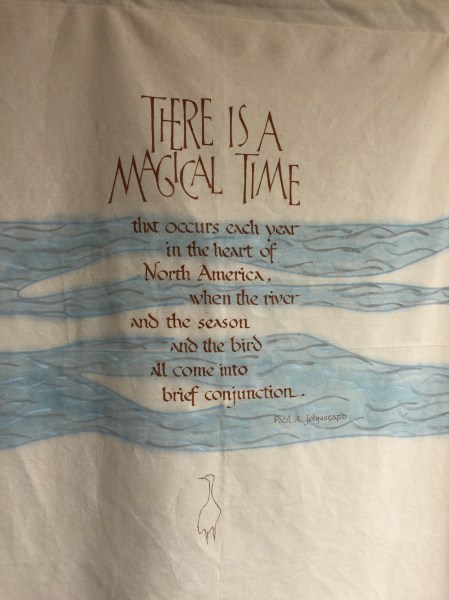
I hadn’t ever imagined I would encounter somebody in a viewing blind whom I knew from somewhere else.  Paul Johnsgard, one of the leading writers about cranes, speaks of the conjunction of spring, a river, and a special bird.  Ian and I had supported a special wilderness 1000 miles away.  By chance, we arrived in the same viewing blind at the same time in another special place.  Several unlikely utterances had to occur for each of us to discover the other’s presence.

Underneath my jacket, not visible, was my shirt, which was “Isle Royale National Park.”  I had never worn that shirt before.  Of all the shirts I could have worn, I chose that one.

I had had a long, unpleasant day.  But again, being among the Sandhill Cranes was magic.  My telling the story gave Alan goosebumps.  I saw them myself.

There was more than one conjunction that night on the Platte.

IMG_3137.jpg

IMG_6532.JPG

TEASING

April 1, 2016

One Saturday night early in my internship, I was called to the cardiology floor to evaluate a patient with a fast pulse.  I walked into the room, today still able to remember what room and which bed he was in.  The man’s heart rate was about 150, and while he was tolerating it, he needed to have something done.  I hooked up an EKG, both confirming the rapid pulse rate and the diagnosis, atrial flutter, with 2:1 block, so the atrial rate was 300 contractions a minute and half of them were getting through to the ventricles.  Back then, before the anti-arrhythmic drugs we have today, massaging the carotid artery was one way to stimulate vagal tone and slow the heart rate.  Thinking I could see the EKG well, I started massaging the patient’s right carotid artery.

I can still see the patient as he had a seizure about twenty seconds later.  I took my finger off the carotid and he quickly woke up.  I looked more closely at what I thought I had been watching.  The vagal tone I stimulated was so strong that I blocked all atrial conduction, no longer 2:1 but rather 300:0, so that not one beat passed through the atrioventricular node to the ventricle.  I had put him into cardiac arrest.  Great job, Doc.  No pumping, no blood.  No blood, no brain function.  When the brain suddenly gets no blood, one of two things may happen: coma, which is the most common, or a sudden burst of electrical activity, a seizure. I once seized when I fainted.  A lot of “near death” experiences may be due to excessive brain stimulation due to severe hypoxia.

The attending showed up an hour later, looked at the patient, then the EKG, and finally me.  He held up the EKG, looked down his glasses, and quietly said, in a British accent,  “Are you the author of this?”  I was embarrassed beyond belief.  The patient was moved to ICU and fortunately made an uneventful recovery.

My misadventure with a patient’s neck was the butt of many jokes for the rest of my internship. For days afterward, every one of my fellow interns, when they saw me, would rub the side of their neck. Even today, I would be willing to bet money if one of the interns I knew saw me, the first thing he would do is put his hand on the right side of his neck and act like he was rubbing it.  He did that every time he saw me for the rest of the year.

The first few times it was tolerable.  Then, it became annoying and finally hurtful.  I admit it.  I screwed up.  Do I have to be reminded of it every time you see me?  What do you want?  Should I admit to being the worst doctor in existence?  Would that help?  Should I quit? Would that help?  Why are you doing this to me?  Have you never made a mistake?

Later, in practice, I saw a psych patient whom I was convinced didn’t have anything neurological going on.  A nurse disagreed, and she was proven right; the CT scan I ordered showed a large, benign brain tumor, which had caused the person’s problems.  I might add while this is always a consideration, I only saw twice a benign tumor causing psychosis in all the years I practiced.  Oh, I diagnosed the other tumor.  For years afterward, the nurse reminded me of my mistake.  Stuff like that hurts.  It starts to eat away at a person.  OK, I missed a tumor.  I am a bad person, a bad diagnostician, a bad doctor, and on and on up the ladder of inference.  Do you continue to  have to remind me?  Does anybody remind me, I wondered back then, about the diagnoses I did make correctly, the patients I did help, the times I was right and others were wrong?  What about the case of Wilson’s Disease that I diagnosed on the first visit in the office?

Teasing is toxic.  Maybe in small doses, it is fine, but only in small doses.  Let the individual poke fun at himself or herself.  And perhaps that is why I behaved the way I did last February 2, when the hike leader gave me a stuffed toy of a groundhog and told me quietly to start hiking before everybody else and put the groundhog on the trail somewhere where it could be seen.  About fifteen minutes up the trail, I stopped and placed the groundhog on the edge in the sun, because frankly I wanted six more weeks of winter.  I like rain; I haven’t seen enough of it in decades.

I waited, and when the first group of hikers arrived, one looked at the groundhog and pulled out his camera.  He was dead serious.  “Wow, a groundhog is up here!”

I thought he was kidding.  He had to be.  But the furry thing did look kind of real.  I quietly walked over and put my hand down on the stuffed animal.

“Oh my God,” the hiker said. “I fell for that.  I can’t believe it!!”  I didn’t say anything.

And I haven’t since.  The individual has mentioned the groundhog event to several people, but I have stayed quiet.  Sure, I could have teased him about it, but a long time ago, I learned what I should have known all along:  a good deal of teasing is toxic.  It hurts, and it isn’t appreciated, no matter what people say.  “Can’t you take a little teasing?” I heard as a kid.  I should have replied, “Can’t you take a little poison?”