Archive for September, 2016

SECOND CHOICE

September 26, 2016

“Is the site open?” I asked.

“I can’t tell from here,” said my wife in the bow of the canoe, as we entered a small bay with a low isthmus separating it from another part of Basswood Lake, forty-five square miles that  straddles the border between the US and Canada.  I looked with binoculars and couldn’t be sure whether I was seeing a rock or some part of a person’s camp.

We paddled a little further until we found to our dismay that the object was a tarp.  Site taken.  Damn.  We had walked on that site in 2012, and I had camped there solo a year later.  Not this year.  We turned back to another site that we had passed, second choice, at the mouth of the bay and still out of the motorized zone, for while we were in wilderness, concessions were made in 1964, one of them allowing parts of Basswood Lake, a national treasure, to allow small motors.

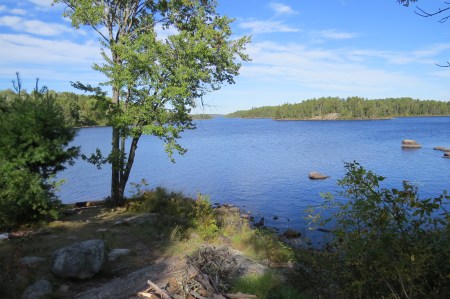
We landed on Second Choice, walking up from the narrow beach landing on ledge rock to the fire grate, part of every Boundary Waters (BW) campsite.  When we turned around, we had a splendid northeast view down a channel to Canada, two miles distant.  A little elevation makes a significant difference in what one can see in the BW.
IMG_7857.JPG

View from the top of the ledge rock.  Canada in the distance.

That first year on the site, we stayed five nights, with a nightly parade of three beavers, two adults and a young, swim by getting food, branches from trees they fell in the adjacent swampy area.  We heard and saw one tree fall. We saw the northern lights twice, heard wolves, and had a moose visit.  Second Choice?  This place was a gem, and with two small tent sites, it probably didn’t get much use.

IMG_4635.JPG

Beaver with stick, 2014

IMG_4667.JPG

Moose, 2014

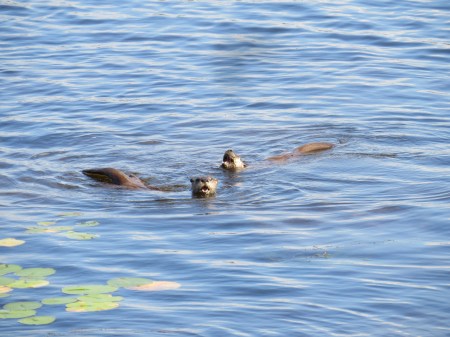
We returned in 2015, but while the beavers were gone, we saw three otters playing. Every sunset, we marveled at the lovely way the light appeared on the isthmus site and the rock face across the bay.  We returned again this year, where we didn’t day trip much because of wind, so I sat and read, looking at Canada in the distance, realizing that Tru- as a leader really meant Trudeau, and seeing things I had never noticed before, because I had more time to look.
IMG_6093.JPG

Otters at play, 2015

IMG_6066.JPG

Sunset on the isthmus site

I saw a chipmunk, an occasional pest, climb up on a wild rose bush and eat rose hips.  I didn’t know they ate them.  A flock of eight common mergansers swam by, not uncommon for the BW, and we saw them again nearby on a day trip.  This was clearly their territory.  An otter walked on the shore one afternoon, swam across the swamp, and disappeared among the rocks.  Many times, a raven announced itself by the WHAP, WHAP of its wings over us.  I watched an altercation between a Broad-winged hawk and a raven.  Twice, looking high in the sky, we saw an eagle soar, easily 1000 meters up, a dark spot against a white cumulus cloud.  These things you don’t see on high mileage trips.  They matter to me now.

IMG_7869.JPG

Chipmunk eating rose hips

IMG_7932.JPG

Mergansers

There was more.  For the first time in my wonderful outdoor career, heavy dew and morning fog did NOT presage a wholly sunny day.  It rained that morning, only later becoming sunny.  I had never seen that before.  I had thought the channel led north, until one night, I saw the North Star 45 degrees to the west of the channel.  It led northeast. The North Star doesn’t lie.

I found myself studying little things: the waning gibbous Moon each day, a long curvilinear cloud one evening, and its stunning reflection, which appeared like disturbed water in a calm lake.  We twice found a rock where turtles hang out, and noted the one’s shedding part of its carapace.  We know all the campsites up the lake towards Canada.  They are nice, but they aren’t Second Choice.  We may be the last on the site this year, for all we know.

One morning, we heard Basswood Falls, a mile or two distant across forest in a straight line, considerably further by canoe.  We had never heard the falls before on our prior two visits, but on a quiet, calm morning, they were unmistakeable.  I saw orange hawkweed, one of my favorite flowers from my boyhood, right next to our tent. It has the most wonderful smell.

IMG_7908.JPG

Orange Hawkweed

Second Choice has become for us one of our most special places we can go.  My wife has reluctantly said good-by to the area.  If she doesn’t return, I may go by there, but I don’t know if I will go on the site.  Not alone.  It’s hard to say why.  Only that I don’t think it is a place for me alone.  Once, when severe illness visited us, I paddled into the bay alone and stayed on the isthmus site.  I can stay there again, if it is open.  If not, there are other sites.

Every year, it gets more difficult to canoe.  I threw my back out the day we left, and my dominant elbow was inflamed.  Somehow, I was able to paddle and carry, and we paddled to the site in just over 4 hours, due to a tail wind that we had not planned on.  We don’t assume good weather for our trips.  That’s a recipe for trouble.  Because of a falling barometer, we decided we would spend four nights there, not five, and come out most of the way to a busier lake near the entry, avoiding heavy rain, thunderstorms, and strength sapping headwinds.

On clear nights, the Milky Way is bright, brighter than nearly any American can see on a given night.  We told time by the moonrise, for this trip coincided with the latter part of the Harvest Moon.  As I type this, I just heard the crash of a tree fall across the bay. Yes, if a tree falls in a forest it makes a sound.

Second Choice taught us that sometimes less visited sites have value.  In such places, I can learn a little about the neighborhood, see things that I have seen before, learn something new, so long as I sit quietly for a few days, foregoing the high miles that once appealed to me, back when I once wanted to know what was out there in the Quetico-Superior.

Second choice sites do that.  I may not physically return, but I will often go there in my mind.

IMG_4610.JPG

Sunrise

IMG_6106.JPG

Sunrise

IMG_7911.JPG

Evening sky

FROM OUT OF THE BLUE

September 19, 2016

I got an email from a former colleague, a physician trained in geriactics who once practiced in the office next door to mine.  We were good friends, and I often went to his office for a few minutes each day in order to pet his Portuguese Water Dogs, which he often brought to work.  It was a good way to relax.  If he sent me a patient, I would talk to him person to person about what I found.  But this was a quarter century ago.

He is older than I and retired, not long after I went into administration, and took up farming in another state, where he was successful.  We were part of his Christmas card list and heard each year about the family and the dogs.  He had several health issues, but he was tough and got through each one.

About a decade ago, although I can’t be sure these days, because the years go by so fast, his Christmas cards developed a significant religious tone and he mentioned his involvement with several well known evangelists.  I just wished him well, although the change didn’t resonate with me.

Then, about five years ago, not at Christmas, he sent out a e-mail to his address book complaining about the New World Order, how the UN would be stationing troops here, guns would be confiscated, and we would lose our freedoms.  I don’t know much about this stuff, but to be honest, I thought it might be better than the Project for the New American Century, which did exist and was behind the Iraq and Afghanistan wars.  I wondered if my friend, or really ex-friend now, might be becoming demented.  That’s tough to diagnose, so I said nothing and heard nothing more.  I now wish most people well, even my so-called detractors, so long as they don’t interfere with my attempts to quietly lead my life. I must be mellowing.

Today, out of the blue, after at least a 3 year hiatus, I heard from him.

He isn’t demented, which was the good news.  The first “How are you?” was, unfortunately, followed by a video clip of Hillary Clinton’s supposed Parkinsonian symptoms that he wanted me to view, along with several other attachments, all on YouTube.

I’ve heard these allegations before.  I didn’t notice anything obvious about her at the Convention, but I didn’t look carefully.  Bill looked like he lost a lot of weight, maybe too much.  I do know Mr. Trump is 70 and has been overweight for years.  That is a significant concern to me.  My board certification is from the American Board of Psychiatry and Neurology, so I can say with some confidence Mr. Trump meets the criteria for narcissistic personality disorder, and the press has often given him a free pass on that and virtually everything he has said, the free advertising likely to elect him president, in what is becoming the highest stakes reality TV ever, given the country’s infatuation with media celebrities.  Ms. Clinton has been a public servant for 35 years, long enough to make mistakes, long before the millenials, who are “cool to her,” were born.  Trump’s failed business ventures, failure to release his tax returns, his boorishness, racism, xenophobia, bullying, and litigation don’t appear to bother much of the electorate, including his ridiculing those with disabilities (a reporter), injuries (Harry Reid), nervousness (the woman in Flint), or his suggesting violence (that the Secret Service not guard Ms. Clinton).

I do not like it when my detractors want me to read a series of articles or look at videos with the idea that I must be changed to their way of thinking, because for years, I read their articles, the ad hominem attacks, the statistics that were clearly in error, the bias, the grammatical mistakes, the inflammatory language, and I was not convinced.

I will not reply. Silence is best.  He will not know whether I received it or what I think. I will not look at the video.  I have no way of knowing how it was edited, whether the purported “freezing” is like “Hitler’s jig” when France fell.  I have no way of knowing if her silent speech was in a focus group and dubbed in to another speech.  And if I say she doesn’t have clinical Parkinson’s, a view which her facial expression on a post today would support, somebody will come back and say I haven’t practiced in years, which is true.  Anything short of agreeing with him will likely lead to an argument I want no part of.

I’ve seen thousands with Parkinson’s, was involved in a clinical trial of bromocriptine; many patients functioned well mentally and physically.  One can outwork me at Rowe Sanctuary in Nebraska every spring and at age 70 taught me the definition of an acre (it’s 10 chains squared, and a chain is 22 yards.)

Bet Mr. Trump doesn’t know that.  Mr. Cruz said we had billions and billions and billions of acres owned by the federal government.  The country outside of Alaska has 1.9 billion acres total, and non-public land in Texas alone has about 161 million of it. A great majority of the land east of the Mississippi is not public.  Candidates for public office ought to be required to say what a billion or a trillion is operationally, before they can run for office. I bet many wouldn’t be able.

As for presidents with disabilities, FDR ran the country for 12 years, during the Depression and  WWII, in a wheelchair. John Kennedy had Addison’s Disease. Johnson had severe enough heart disease to require a defibrillator nearby.  Carter almost collapsed on a run in Catoctin.  Ford tripped coming down Air Force One and became the butt of many jokes. Reagan was shot and had Alzheimer’s for a significant part of his last term.  The first Bush vomited on the Japanese prime minister and fainted at a state function. His son was an alcoholic.

The sudden claim of Parkinson’s for Hillary Clinton is odd, since the supposed symptoms quoted are usually seen late, and she has been in the public eye for years.

I was disappointed, but not surprised, when after a venous thrombosis in her skull four years ago gave her diplopia (double vision), it was treated by the Congressional Republicans as a minor headache, a skimpy excuse keeping her from testifying before Congress on one of their many Benghazi investigations.  She is subject to a double standard.  When Ms. Clinton had a rather common illness—I’ve had pneumonia and hallucinated, but I returned to practice medicine three days later—it was blown out of proportion. When it comes to Parkinson’s, I’m sure there are some neurologists who without an exam, but with bias, repetition, and intimidation, will claim that she does. And so what? Parkinson’s has treatments.  Narcissism?

Both presidential candidates are at an age where bad things happen to people.  I am at that age, too. Being old means that the vice presidential choice matters.  One thing scares me more than Mr. Trump, and that is having him incapacitated.  Trump at least isn’t a social conservative. Governor Pence would send us back to the 19th century in our treatment of women.

I don’t need “re-education.”  I can teach math, statistics, neuroanatomy, guide people on hikes, show them the night sky, and teach them what happened when the most civilized society in the world became fascist.

MITCH

September 14, 2016

Six months ago, Mitch joined our Wednesday hikes up Spencer Butte here in Eugene.  We meet early, pay a dollar that goes to the Club, have one of us lead the hike, and take the 3.1 mile route 1500 vertical feet to the top.  It’s a “conditioning hike,” meaning people can go at their own speed, whatever suits them.  I like to go fast, as if I were hiking alone.  I’m told I’m fast, but I can think of at least 4 people in the group who are faster.  I do OK.  I’m not young, but the four who are faster aren’t young, either.

Mitch was in the back of the group the first day. He was overweight, and just making it to the top was an event for him.  He was pleased and so were we.  Several in the group use the hiking time to socialize on the way up, and nobody is racing.  I’ve done it in 53 minutes, alone, just to see what I could do.  The top part now has steps in places, which make it safer, but it’s an average 20% grade, and it is a real cardiac workout to do it.  My pulse tops out at 160, and I can take it just fine by listening to the pounding in my chest.

With time, Mitch began to hike better, both in appearance and on the trail.  He was 50, diabetic, and his doctor told him he needed to exercise.  Mitch took him up on it. He wanted to do some out of town hikes, which the Club offers every weekend and almost every day in the summer.  Somebody has to organize one and lead it.  We meet at a place arranged by the leader, everybody pays a dollar, five for non-members, we carpool to the trailhead and hike at whatever pace the leader has decided.

I’ve led about 70 hikes now, both in town and all over the west Cascades.  My longest hike led is 17 miles; I’ve been over 20 miles twice. I did a 22 miler in 7 hours.  I hike a trail before I will lead a hike on it.  That requires I “scout” hikes, sometimes even hikes I’ve done, because there may be snow on the trail, or blowdowns of trees, and I need to know if the hike is even feasible.  The Club gives credit for being on a hike, leading a hike, but not scouting one.  On early season hikes, I am also a volunteer, reporting and photographing blowdowns to the Forest Service and High Cascade Volunteers, the Scorpion Crew, so they can later prioritize resources to clear the trail.  I may join one of their work crews some day.

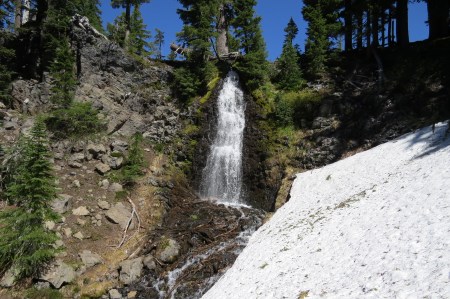
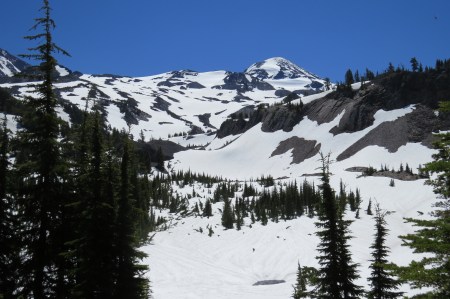
Anyway, Mitch asked me in June if he thought he could be able to do my Obsidian Loop hike on July first, a classic, requiring a permit, that goes through the Obsidian Limited Entry Area up near McKenzie Pass.  It’s a great hike with closeup views to North and Middle Sister, has a beautiful waterfall, and a couple of miles on the Pacific Crest Trail.  By then, I thought he could.  The hike is difficult, with 12 miles and 2000 feet vertical climb, but half the climb is spread out over the first 3 miles.  I had scouted the hike 5 days prior, concerned about snow, finding a lot of it, off trail a lot depending entirely upon GPS and trail memory, making it difficult to complete the loop, so I was fairly certain we would have to do an out and back hike, not completing the loop.

IMG_7271.JPG

Obsidian Falls on the scouting hike.  The trail is under about 5 feet of snow to the right.

IMG_7279.JPG

Middle Sister from Obsidian Loop Trail.

Mitch thanked me profusely the day of the trip for scouting the Obsidian Loop Hike.  That was a pleasant surprise.  Usually nobody does that, nor do I expect it. I appreciated that somebody acknowledged that on my own, I had driven a total of 4 hours and hiked another 4 in snow, alone, rather difficult conditions, to see if a trail was passable.

On the day we all went, there was less snow on the path through the woods to the loop.  That was a good sign.  Other areas had less snow as well. I made the decision to go around Obsidian Falls, because of significantly less snow than had been present just five days earlier.  On the way down, however, I had to again use the GPS to try to find the track I had taken earlier, and we ended up glissading on hills where there was no clear way to get to the trail, which was buried under snow anyway.  One of the guys told me at the end, “Now, that was a HIKE.”  Another said it was one of the most beautiful hikes he had ever taken.  Mitch thanked me yet again for the work I did.  He had no problems with the difficulty.

IMG_3789.jpg

Hill we glissaded down, not far from the trail.

IMG_3787.JPG

High Country Lake.


Mitch started adding more on the Spencer Butte hike. There is a back way up to the top, longer, steeper, that he wanted to do.  He did it.  I led a 17 miler that involved climbing two cones, Collier, which is a long climb, and Four in One, shorter, where four vents came out of one cone. In addition to the 17 miles, the hike involved net 2700 feet of vertical climbing.  It’s the most difficult hike I’ve led.  Mitch did just fine.  I knew he would.

IMG_7814.JPG

View from atop Collier Cone, with Belknap, Washington, Three-fingered Jack and Mt. Jefferson (the largest) in the distance.

IMG_7834.JPG

View of Collier Cone from Four in One Cone

IMG_7828.JPG

Four in One Cone from the base

I had led three hikes in five days when I led a fourth two days later, up Spencer Butte.  The prior three hikes had all been difficult, but I felt I was rested.  In other words, I had no excuses.  Mitch and another man were with me on the first mile up to Fox Hollow.  There, we cross the road and continue on the trail upward.  I led to Fox Hollow; Mitch passed me on the road, and I said, “Go ahead and I’ll see you at the top.”

Mitch replied that I’d probably catch up to him.  When I hear that, I know I won’t.  And I didn’t.  He got up to the top, mostly still in sight, but at least a minute ahead of me.  He’s faster and stronger, no doubt about it.  Yes, I’ve got 17 more years of age on him, but he’s lost 40 pounds and is only going to get stronger.

Three days later, I led a hike that did the whole Ridgeline Trail in Eugene, out and back.  Mitch hiked it and asked if he could detour and climb Spencer Butte as well.  That added 3 miles and another 1000 feet to an already difficult hike.  I told him to go ahead. I didn’t find myself jealous at all.  The last time I did the hike, he started off fast, and I couldn’t have caught him if I had wanted to.  Mitch earned it.  He’s strong, and he’s good.  I am glad I had a part in it, encouraging him to do difficult hikes that I led in the Cascades.  I had faith in him, but more importantly he had faith in himself.

It’s great to see.  Even from well in the back.

PLANETARY CONJUNCTION

September 7, 2016

I went out recently to see the close conjunction of Venus and Jupiter.  I could have done without the hype: that it was the closest they would be for many years.  Indeed, the hype ignored the fact that for a few days prior and afterwards, the two would be almost as close in the sky as they were that night.  It would have been better to have said that Venus and Jupiter would be close together all week, changing a little each night relative to one another, and that Saturday would be the night they were closest.  That gets people looking up and noticing that planets move from night to night.  The very name comes from the Greek “asters planetai,” wandering stars.

One lady in particular was almost adamant about seeing the conjunction, as if she might never get another chance.  I didn’t tell her that the next night it would be almost as good.  I like to teach, so I explained that conjunctions often occur in 10 and 14 month intervals, although there is a better 3.3 year interval. I didn’t have the ephemeris at my fingertips, but this was the 28th conjunction between the two since the beginning of 1991.  They aren’t exactly rare; they are beautiful.  Her expression didn’t change.

She then told me how Mars was as “big as a basketball” when it rose, last year, closer than it had ever been for “thousands and thousands of years.”  That simply wasn’t true, but I quietly replied no, Mars was bright, but it was still far away and about as bright as Jupiter was that night.  I didn’t have at my fingertips the fact that in 1924 Mars was only about 12,000 miles further away than it was in 2003, which was when it was closest.  Perhaps, I thought, she was thinking of the reddish eclipsed Moon a year ago.

She wasn’t having it.  Somewhere, she heard it was Mars, and she wasn’t wrong.  Shortly thereafter, she left.

This “knowing” of something that is blatantly false has come to the fore this year.  American immigration peaked in 2007, not continually rising.  All nine categories of major crime have fallen dramatically in the past 20 years. We aren’t having a massive crime wave.  The Earth’s temperature is rising slowly but definitively, the oceans are slowly rising, and California is in its fifth year of drought.  I don’t like any of the last three.  I wish they weren’t occurring, but they are, and I need to face reality.  As a country, we aren’t.

I was disappointed on several fronts astronomically.  How in the world does somebody think that Mars can suddenly appear in our sky looking the size of the full Moon?  Then I remembered for years after the August 27, 2003 closest approach, I would get emails from people—smart people— saying that on August 27 that particular year, Mars would be closer to the Earth than it had been for thousands of years.  That was wrong.  So was the picture of the huge Moon blotting out the Sun, posted by somebody who said that is what an eclipse at the North Pole looks like. Nope, that’s wrong, too.  As was the photoshopped large Moon rising over Houston, where somebody commented, “I didn’t realize it was so big.”  The Moon appears smaller on the horizon that it does overhead, when it is 4,000 miles closer, because we aren’t looking across the Earth’s radius.  We can’t perceive a change in the lunar size of 1.7%, but it isn’t larger on the horizon.

While I’m at it, the idea of Supermoons, full Moons at perigee, or close to Earth, can’t be perceived with the eye.  Indeed, Project ASTRO personnel once laid out on a desk twelve phases of the Moon and asked us trainees to order them.  When I got done ordering them, I pointed out the change in the Moon’s size during the cycle.  The teachers had never noticed this simple and important finding before, and they were teaching astronomy for schools.  If they weren’t aware of the change in the Moon’s apparent size photographically during every cycle, it is unlikely that anybody will be aware with the eye.

I don’t like hearing  “rare, once in a lifetime sightings,” that next year will be followed by another similar rare, once in a lifetime sighting.  Venus-Jupiter conjunctions shouldn’t be hyped; viewing the night sky, as well as the day sky, should be.  People need to get out and look up, safely of course.  It beats looking down at the cellphone. Venus-Jupiter conjunctions are not rare, but you don’t see them often.  Look for them.  Mars becomes bright every other year, and that’s worth noting.  Venus and the crescent Moon pair often, and particularly close pairings are spectacular.  Indeed, the idea of educating people about astronomical events is important, given that many Americans do not know what a year means, how to find the North Star, three ways to distinguish a planet from a star (motion over several nights, shines with a steady light, usually brighter than surrounding stars), or how to see the Milky Way.  Hint: go outside in summer or winter, far from city lights, and look overhead.

I have been disappointed in my occasional attempts to get people interested in what is up in the night—or even day—sky.  Last May, I had my telescope out near Autzen Stadium to show people the uncommon transit of Mercury, where it crosses the Sun’s disk, viewed from Earth.  There was moderate foot traffic, but only 7 people came by and looked during the 4 hours I was there.  One woman spent time talking about her special breed of dogs but made no move to see something that happens 13 times a century.  The transit of Venus was even more rare, occurring twice 8 years apart, about every 120 years.  One of the people to whom I showed the latter commented that it wasn’t very spectacular.  No, it is not, but he got to see something nobody else alive today will see again. And he liked the buttons I was handing out, commemorating it.

Recently, I wrote, on short notice, an opinion piece for the local paper about the need to prepare for the large influx of people coming to Oregon for the total solar eclipse in 2017.  Perhaps there isn’t much interest in Oregon, but there is worldwide.  The article gave me a chance to talk about planning ahead, how to protect one’s eyes from blindness and one’s brain from falsehoods that will be spewed when the eclipse comes.  I hope the article will be helpful.  There were four comments about it in the newspaper; four people told me they read it.

I do what I can and hope that somewhere, sometime, it will make a difference.

THEY WAY WE WERE

September 4, 2016

“You will wear this monitor for 30 days, and if you feel anything strange, push this button.”

Thirty days? I thought. After my first episode of palpitations, a 48 hour Holter had been non-diagnostic. A second episode a few months later lasted long enough to obtain an EKG during it and show I was in atrial fibrillation.  A mid-level provider reassured me this was not serious.  As a neurologist, however, I knew full well (and I knew it before the mid-level was born) that atrial fibrillation is a strong risk factor for stroke.  It wasn’t his heart; it was mine. I didn’t see the cardiologist that day, but I did get an appointment for a week later, with one who had seen me before.  I’m an established patient—a week is a bit long to wait but acceptable.

My first appointment had been well after my first episode.  A then-66 year-old with palpitations ought to be seen quickly, I thought, but It took two weeks to get a Holter monitor and another month to be seen, in part because the referral got lost, and I had to call to find out what was going on.  I do wonder what happens to the elderly who aren’t physicians and might not be thinking clearly.  Would they ever call?  Would anybody notice there was no appointment? We don’t discuss bad system problems when we discuss health care reform.  We assume access and dealing with cost is the problem; quality is supposedly a given.

It isn’t.

After my diagnosis was confirmed, the cardiologist told me all the probabilities, gave me a medication if I needed it, and said he didn’t need to see me for a year.  OK, I had better than 95% chance (but not better than 97% chance) of doing well.

Twenty days later, I had another episode after a hike, and while I was fine while walking, I was light-headed in the car, so somebody drove me home.  I wrote the cardiologist, because we now have e-mail communication.  I was called two days later, not from him but from the appointment scheduler, telling me to come in for a monitor. That sounded odd, because I knew what I had.  Shortly after, I was discussing a month-long monitor, which had never been mentioned at either of my first two appointments.  Worse, it was the wrong kind of monitor for my condition, and that bothered me.  The tech was savvy enough to say I could decline the monitor, and she was right.  Patients can refuse tests.  I could not understand that if my appointment were a year away, why did I suddenly need another test?

The problem was that the cardiologist neither called me nor spoke to me.  It appears today that doctors are so busy that patient inquiries are handled by middlemen and middlewomen.  That’s a recipe for miscommunication.  I think, but don’t know for sure, the cardiologist received a message that I was desperate to know what was going on, which I wasn’t.  I was just informing him.

My wife gets after me every time I complain that “medicine isn’t the way it was when I practiced it.”  Well, it isn’t.  I spent an hour or two a day in practice on the telephone with patients, and these calls were never billed.  They were part of giving care. The patients didn’t want to talk to a nurse; they wanted to talk to me. They called about test results, and if I had my staff tell them their test was normal, they still wanted to speak to me.  I answered every call the day it was received.  I didn’t blow them off.

This is lost, now.  Thirty weeks later, I had my fourth episode, followed by my fifth 4 weeks later, both after hikes, both spontaneously converting in 2-3 hours.  I e-mailed the cardiologist asking whether I should take the pill or just ride the episode out.  I said the problem wasn’t urgent, but the longer the e-mail sits (3 business days is the reply time they say, but it has now been 9), the more likely it is to be forgotten.  Why can’t somebody pick up a phone and call me?  Or, since we have technology, answer a simple e-mail?  We’re talking 30 seconds.

My wife has the same issue.  She needed a GI evaluation, and the referral wasn’t successfully  transmitted across a street.  It was finally hand carried, which I would have done the first time. I used to walk 150 yards to an imaging center to look at my patients’ head scans with a radiologist.  It took fewer than 10 minutes, during which I got a great reading, the radiologist loved having clinical information, and I could tell the patient what was occurring, not having them go home to wait 1-2 weeks (or longer) for a report.  This is what medicine should be doing. Today, I could pull the scan up in the office and view it myself.  I probably could talk to the radiologist at the same time.

My wife had a later reason to call GI and was told she couldn’t see the doctor for five months. She’s an established patient, and five months is unacceptable. She got to talk to a PA who had a 2 month appointment wait.  I can’t count how many “Headache, emergency, see today” patients I had to work in to my daily schedule, and they were nearly all tension headaches. Same day service by a specialist.  Even a walk-in one day who was a Canadian winter visitor. I discounted the charge on the Canadian, because the problem was simple.  Who does that?

My wife got three pages of information what to try.  This involved the PA’s talking to the physician and deciding what she had on the basis of second hand communication.  Doctor Radio on Sirius XM has better.  I am convinced that a good GI physician could deal with her problem in 10-15 minutes.  Talking to a physician appears to be closely regulated. If this improves medical care and flow of patients, fine.  I’d like to see the data, however.

Fortunately, we still know a physician in Tucson, where my wife frequently goes, who does answer calls.  Semi-retired, he is as wise as they come.  He’s the kind of doctor I wish I could have been.  He’s old style when it comes to seeing people but adept at using technology, so that I could have pictures of my colonic polyps that he removed. When I needed to see him for something else, he sat down in the office and gave me the sense he was there as long as I wanted. He’s great.

If we’re too busy to do it right, then we are too busy.  I was too busy, and my only solution was to leave.  I think medicine lost something, although some might disagree.  Technology is essential in medicine, but the human voice, the human touch, the human approach is also essential.  I can’t put a price tag on it.

Robots are great in the OR.  I hope they never end up in the office.