Archive for July, 2017

GETTING THE MOST OUT OF THE TOTAL SOLAR ECLIPSE: FIRST TIME VIEWERS

July 28, 2017


EQUIPMENT:

  • Solar filters of some sort, which may include eclipse glasses, a #14 welding filter, mirror covered in paper with a dime-sized hole to reflect sunlight on to the wall.  Please don’t use sunglasses, X-Ray film, black and white film, or smoked glass.  None of it is safe.
  • Sunscreen:  remember, 99% of the event will be spent in sunlight.
  • Binoculars, only to be used during totality, and absolutely MUST not be used for any other part of the eclipse unless they have adequate solar filters. This includes ALL binoculars, even 8 x 20.  Binoculars are more dangerous if one so much as glances at the Sun, for they concentrate sunlight.
  • White sheet to put on the ground to look for shadow bands near totality.  Don’t get too hung up on having one.
  • A colander or something with many small holes.  A hat with a mesh is fine.
  • Thermometer to watch temperature changes is useful.
  • A video camera that about 5 minutes prior to totality you can set pointing to the west, where the shadow will come from, and start it and not worry about until about 3 or 4 minutes after totality.  That way, you can film the darkness without taking precious time away from totality.

CONTACTS

  • First:  Moon just touches Sun and you won’t see any of the Sun eclipsed for a few minutes.
  • Second: beginning of totality
  • Third: end of totality
  • Fourth: Moon just touches Sun and eclipse is over.

Between First and Second Contacts:

  • Watch the Moon slowly cover the Sun.
  • Notice that the temperature starts to fall before you notice any change in light.
  • When the Sun is about half covered, notice the slight “yellowish” cast of the light.  It’s different.
  • After the Sun is more than half covered, use a colander or hat to cast crescents on a surface, as each hole becomes a pinhole camera.  Check to make sure you are positioned where you want to be for totality.
  • IMG_2880.jpg

    Crescents made by the mesh of a deck chair, 9 March 2016 eclipse in Makassar Strait.

  • Periodically look to the western sky, because from there is where the Moon’s shadow is coming.  You are looking for some darkening.  You won’t see anything until a few minutes before totality.
  • Notice Venus to the right or west of the Sun.  It will become very easy to see.
  • Look to see if any animal nocturnal behavior is occurring, such as birds coming to roost or cattle acting like it is evening.

Last 5-10 minutes before totality—things start happening fast:

  • Sun shrinks to a crescent, and the crescent starts breaking apart into fragments to eventually become a single point of light, the Diamond Ring.  This is where you may remove all filters, because the light quickly fades.
  • A minute or two before totality, look at your shadow to see every individual hair.
  • As totality approaches, steal quick looks at the west, as the shadow approaches as a giant black curtain. Watching the shadow is good, but the Diamond Ring is something you want to see for sure.  I can look quickly at both, but I’ve had a lot more practice.  See the Diamond Ring.
  • Don’t forget to look at the ground or a wall for shadow bands.  If you don’t see anything don’t keep trying.  There is too much else to look at.

TOTALITY  (Take the eclipse glasses off, if you didn’t do it at the Diamond Ring)

IMG_2881.jpg

9 March 2016 Total solar eclipse over the Makassar Strait, Indonesia.

  • I begin by staring at the eclipse for 15-20 seconds, to fix it in my mind, for no second spent looking at the eclipse is wasted. I start talking aloud about the corona, how many solar diameters out from the Sun it is and where. I look at how dark it is and comment compared to twilight.  If you do nothing more than look at the eclipsed Sun, you will have done well.
  • What the Moon covers last is the lavender chromosphere, the inner atmosphere of the Sun.  I look for it, because it’s there and the color is beautiful.
  • Look for prominences on the surface of the Sun.  They will be small red dots on the edge of the Sun that get covered by the Moon on one side and exposed more on the other.
  • I do a 360 degree turn looking at the horizon all around me, to see reds everywhere.
  • I look for planets.  Venus has been seen; Mercury will be to the left and below the Sun; Mars on the opposite side. The star Regulus will be to the left of or east of the Sun. I want to see Regulus, but if time is passing quickly. I won’t look for other bright stars other than maybe steal a quick peek at the zenith.
  • I look at the eclipsed Sun and see if the prominences have changed.  The Moon is moving, so there will be a change.

Near the end of totality, get ready for the Diamond Ring.  There will be a slight increase in light and then suddenly there will be brightness, as the Sun is no longer completely covered.  See it, and before you put eclipse glasses on, while others are celebrating the end of the eclipse, watch the Moon’s shadow as a huge black cloud move off to the east.  Virtually nobody discusses this great phenomenon, and there are only about two or three seconds to see it.

IMGA0014.JPG

Libyan eclipse of 29 March 2006, after Third Contact.


Between Third and Fourth Contacts

Look for shadow bands again, notice the crescents on the ground and on you.  Watch everything happen in reverse as the Moon slowly uncovers the Sun.  The lighting changes, the temperature rises, animals revert to normal behavior, and soon it is difficult to know that anything happened.

I consider it honoring the event by staying until Fourth Contact, when the eclipse is over.

IMG_6350.JPG

And for us it is never completely over until we see the Moon as a crescent in the evening sky.  Notice that this is south of the equator and not the view that will be seen the evening of August 22 or more like August 23, since summertime evening crescents are difficult to see until 2 or more days after new.

NATURAL WEB OF LIFE

July 18, 2017

I went to the Oregon Coast recently on a backpacking trip with six other club members.  The coast is pleasant in summer with cool nights and days, an evening campfire welcome, and one sleeps comfortably, without the bugs at the higher elevations, where there might not be any wind and may be a good deal hotter.

The youngest on the trip was 50, the oldest 72.  We share a love of the woods and backpacking, but we had very different personalities.  One disappeared for most of the trip, hiking early and alone.  We saw him the second day out, hiking back from a place where we were going to.  That afternoon he disappeared into the woods reading, and he was gone the next morning when I got up.  I am a morning person, but other than that one individual, the rest were not, so I did some early morning solo walking on the beach, but I stayed in camp when the others were there, and during a lot of the campfire time, listened.

IMG_8741.JPG

My tracks on the beach north of Blacklock Point.

It’s good to listen long and hard to others.  I ought to do more of it.  I forget people’s names, or how to pronounce some of them, so if I listen long enough, I often avoid the embarrassment of asking someone’s name, which I should have learned but didn’t, or how they say it.  If I am especially lucky, I learn how to pronounce some of the natural landmarks from long time residents, so I don’t mangle the pronunciation myself.  While others are talking, I learn about ages, past jobs, families, marriages, divorces, kids, philosophy, and a whole host of things I would never ask, because I generally don’t like to ask people about personal matters.  Listening is great: people like someone with whom they can talk, and I get a lot of free information.  I just have to keep my own mouth shut, and that often isn’t easy.

I also learn how organized people are by how they deal with campfires.  Some like to have every piece of wood in the right place, and are constantly in motion making sure such happens.  Others just let the fire burn where it burns and don’t involve themselves in it at all.  I’m in the middle, tossing an occasional pine cone in, trying to get it to one exact spot.  I need a lot of pine cones.

The woods itself teaches me much every time I go into it.  Too many in the club think all I do is hike as fast as I can without seeing anything.  I don’t try to convince them otherwise; I won’t. I’m too old to make the effort, and I’ve long known that the only person I can likely change is myself, and that hasn’t been easy. Lately, I have been interested in wildflowers, and I get to see some that I can take a picture of and look them up back home.  I watch the Moon in daytime, when it is visible.  I look at its angle with the horizon, the phase, and notice how dim it gets near the horizon, eastern horizon if it is rising before full, western if it is setting after full.

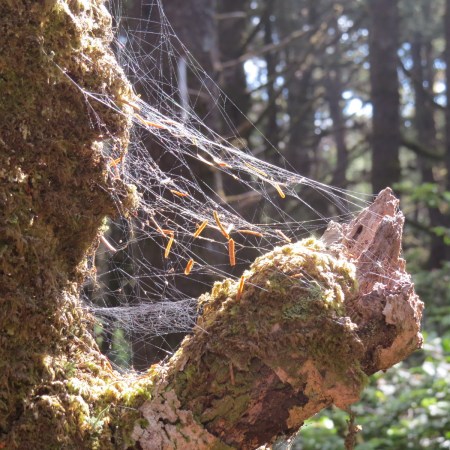
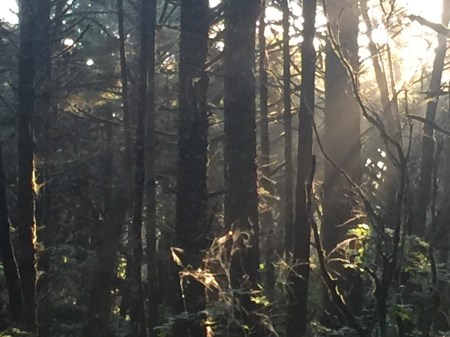
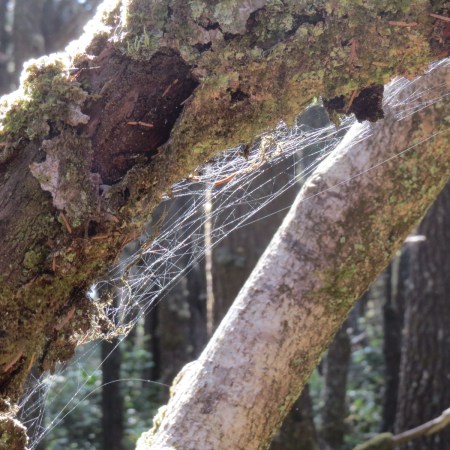
What surprised me the most this particular trip were the spider webs.  Yes, spider webs.  It was quite by accident I even noticed them.  I was making a simple breakfast and happened to look up to the east, where the morning sun sent its beams through a the forest of red pines and Sitka spruce.  That was worthy of a picture, but instead of pulling out the camera, I kept looking. What really struck me were the number of webs, complete ones,  ones with just one strand, a strand 25 feet up in the air, several at near ground level.  I realized how many I destroy when I walk through the woods.  I understand how dangerous these webs are for small flying insects.  Mind you, there have always been spider webs in the woods, and I have long noted the beautiful ones with dew on them, but I never had fully appreciated the sheer number of spiders in the woods.  At 68, that is shameful.  On the other hand, at least it wasn’t when I was 69, 79, or never.  Kind of makes me wonder briefly what else I am missing.  I’m sure someone in the club will tell me.

On the other hand, I bet they don’t know what the phase of the Moon is and why it is angled the way it is to the horizon, either.  Maybe some night I will explain it to them, by a campfire.

IMG_8757.JPG

IMG_8758.JPG

IMG_6920.JPG

IMG_8720.JPG

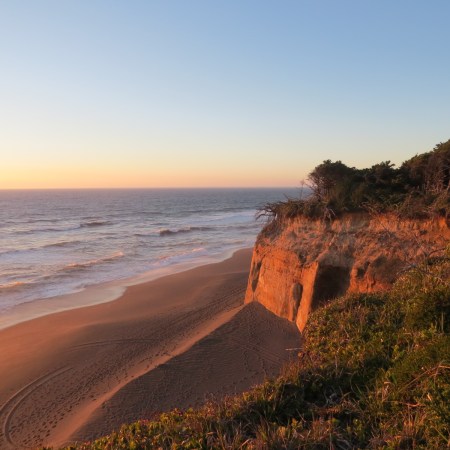
“Ross Light”, the special light, at sunset. It is the name Sig Olson, the great 20th century wilderness writer, gave to that time when photography was the best.

IMG_8777.JPG

Looking south from Blacklock Point, Oregon Coast. At the far right center is the Cape Blanco Lighthouse.

IMG_8766.JPG

Wildflowers, Blacklock Point, Oregon Coast.

TOO MUCH SUN, NOT ENOUGH BRIGHT PEOPLE

July 4, 2017

About a month ago, I felt some scaling on my cheek, saw abnormal skin, and realized it was time to see the dermatologist long before my annual appointment.  Here in Oregon, I get annual appointments; in Arizona, I was seen every six months, which I needed, because I had lived there for decades, the sun angle is higher and there is more sun exposure in general.  Arizona is a hotbed of skin disease.  Worse, I grew up spending a lot of time outdoors, where my parents told me to go outside and play in the sun (along Route 20, I think the pediatrician told them).  Vitamin D was good: we all heard that. I developed many actinic keratoses as a result of all that “good” sun. The four basal cell carcinomas I had were more dangerous, but at least somebody found them in time and cured them with chemotherapy ointment.

Skin cancer is not a big deal if one has periodic checks and gets treated early.  That costs money, requiring insurance and access to dermatologists.  Unfortunately, in the scheme of needed body care, dermatology and dental are not high priorities. If one doesn’t have insurance or access—either one—there is a risk that a melanoma will be missed until it presents with a seizure perhaps, meaning it has metastasized to the brain, or a basal cell cancer presents by eroding deep into skin and bone, treatable only by extensive disfiguring surgery.  The father of a friend of mine died after surgery to try to clear a basal cell cancer that had eroded through his face. My actinic keratosis was treated in twenty seconds of liquid nitrogen therapy.  The blister on my face will be healed in a week.  I won’t discuss dental care other than it is necessary for good health as well as creating a good impression.  Americans are very teeth conscious.

Strep throats are nasty but are easily cured.  Left untreated, because someone cannot afford a doctor’s visit, they will still get better.  Unfortunately, untreated strep throats may have complications as peritonsillar abscess, mastoiditis, retropharyngeal abscess, rheumatic fever with subsequent scarring of the heart valves, and acute glomerulonephritis with kidney failure.  A big reason why I never saw mastoiditis when I practiced medicine was that American children get early treatment for strep.  Take away access to treatment and these diseases will return.  Syphilis has returned to Eugene.  Go to the Third World and you will see people with diseases we Americans never get (polio, tetanus, congenital rubella) and trauma that our “restrictive” safety regulations prevent.  No, we aren’t perfect; every fourth of July, 11 Americans die from mishandled fireworks.  A kid out here blew off his hand last week: “I thought I would have at least two to three seconds.”  He might have had that; people aren’t good judges of time. He now is young with one hand.

We need to ensure people at both ends of the age spectrum have access to affordable, good quality medical care, and then work on those in between.  I had thought we were making progress towards the first until these past few months, when there is now a real possibility we will go backward at least with children on Medicaid.  I would be very naive were I to think Medicare is immune from the chopping block in some form, either.  There are far too many who don’t think they should be taxed to pay for someone else’s medical care, even as these same people are medical care consumers.

I would hope that out of the shooting of Mr. Scalise, there might be an awakening in some circles that each one of us is one bullet away from an unexpected, unforeseen medical catastrophe.  A psychologist I know would have called this being hit with a two by four on the side of the head moment.  I would expand the list from a bullet to one malignant cell, one blood clot, one ruptured vessel in the brainstem, one bacterium, one virus, and one drunk driver.  While some of those have risk factors, virtually none is predictable.  We can screen for cancers, and we can eat right, and that will help, but I, like all doctors and nurses, have seen my share of horror stories: the 29 year-old with aggressive colon cancer, the 24 year-old runner who died after uncomplicated surgery for appendicitis, the 41 year-old man who died from a preventable heart attack, because he couldn’t afford to be screened, a 17 year-old high school student in my class, beautiful, smart, who died after routine thyroid surgery.  Bad stuff can happen to anybody, and not being able to get or to afford care makes a bad situation far worse.

Catastrophes aside, day to day preventive health care gives peace of mind if something isn’t found, and while peace of mind doesn’t have a dollar sign, it has worth: perhaps the pursuit of happiness that is discussed every July fourth.  If something is found early, like a melanoma, an unsuspected heart problem, a small malignancy in the colon, cervix, or prostate, it can be dealt with far more easily, successfully, and yes, cheaply, than waiting until the individual has Stage IV disease and is “found down” or struggles into an emergency department with extensive disease, a bad prognosis, and yes, very expensive, too.

I’m concerned about the 40% of our children covered by Medicaid.  The proportion is not surprisingly higher in the poor, especially in people of color.  A disturbingly large number of children have episodic Medicaid coverage, which is not good for those with chronic diseases, like asthma, who need regular monitoring.  I’m concerned about vaccination status, lead poisoning, and proper nutrition.  If we miss the timeline on these, these children will never catch up and be doomed to a second or lower tier existences.  If we have too many children in this country, which I think we do, then we need more available birth control, not defund Planned Parenthood or take away medical coverage.  What gives?  Let me say it right out:  Paul Ryan is a devout Catholic, and he is going to push the Church’s rules (hopefully not pedophilia, although that is a cheap shot, I admit) down our throats.  Let me keep going.  The Affordable Care Act was signed by a black (half black) president, and that is just too much to tolerate.  In one of my lesser moments in life, my father once accused me of being incredibly irrational.  Yes, I was.  And I learned from it.  (So was my father irrational when it came to the Catastrophic Care Act, which taxed the elderly.)  It’s one thing when I’m irrational.  I hurt the people around me, a very small number.  The Republicans in power are hurting a third of a billion (not counting the rest of the world), because they couldn’t stand a black president and any of his legacy.

What are they thinking?  Do they want more poor people who need more medical care?  Because that is where we are going.  Or do they honestly want to see people die because they aren’t pure in some form?  What is it that they want?  Is it government out of our lives altogether?  Why, when a majority of Americans want Medicare to be left alone, should it be changed?  Why, when a majority of Americans want background checks for firearms, should they not be allowed?  Keeping Medicare is not irrational; wanting background criminal checks before one purchases a weapon is not irrational.

Not making needed preventable and other medical care affordable to every man, woman, and child in this country is irrational.  Not only is it morally right, it will save money in the long run.  Want to save more?  Fund Planned Parenthood and increase family planning.  Wanted children are healthier and will be more productive citizens. It’s necessary, it’s fair.

It’s rational.