Archive for September, 2017

A PLACE EVEN BETTER

September 26, 2017

I really wanted that isthmus site on Basswood Lake, an international treasure where the Canada-US border runs for 14 miles through the middle of it.  Basswood was part of the main fur trade route two hundred fifty years ago.  Spanning the border from Prairie Portage to Basswood River, its 45 square miles and 14 named bays makes it “big water” in the Boundary Waters Canoe Area.  The lake is so special that when the BWCA became one of the first wilderness designates after the Wilderness Act of 1964, there was a compromise made on the American side, allowing 25 hp motors on a large portion of it as part of the deal.

Basswood has over 150 designated campsites on both sides of the border.  When my wife and I were looking for base camps for our annual trip, we spent two autumn trips in the motorized zone, finally taking a long day trip outside the zone to find a beautiful isthmus site, a narrow strip of land between two quiet bays.  We planned to stay there in 2013, but severe illness prevented my wife from canoeing that year, so I went solo with her blessing and stayed on the site, enjoying 5 days of sunrises, sunsets and profound quiet.  When I returned with my wife in 2014, we paddled out of the motor zone, turned the corner around a wooded, rocky point, and the isthmus looked open, at least with binoculars, from a half mile.

As we got closer, however, we saw a tarp flapping in the wind, and our dreams of camping there were dashed.  Somebody else was on the site.  We turned around, went back to a site that we had just passed, and pulled in.  We had also scouted this particular site two years earlier. Neither of us thought too much of it, but we decided to take another look.

We were glad we did.

I now have the site labelled on my GPS as “Hidden Gem.”  During our five night stay in 2014, we were treated to incredibly dark skies, northern lights, wonderful sunrises, a moose, beaver swimming off the campsite every night, and wolves howling.  We would have missed almost all of that from the isthmus site.  We returned to the same site the following two years, no longer caring whether the isthmus site was open.  The beaver were no longer there, and no moose came, but the views were those that I still think of when I need to go deep into myself to get away from the world.
IMG_4563.JPG

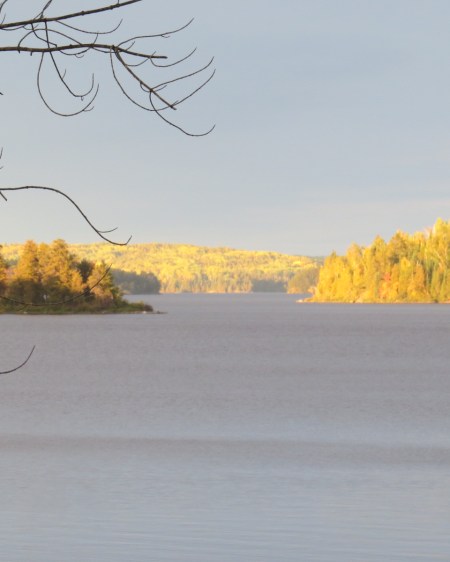
View to the north and Canada from the site.

IMG_4667.JPG

Moose, from the “Hidden Gem” site, 2014

This past year, when I took a friend of mine into the area, I hoped again for the isthmus site.  It had a small beach, and he liked to swim.  We left the motor zone, turned the corner, paddled by “Hidden Gem,” where I would not stay at without my wife’s being along, and the isthmus site looked open.  I was pleased, as we paddled right up to the landing and got out, walking up from the beach a few feet to the site.  I turned and looked to my right, at the kitchen area.
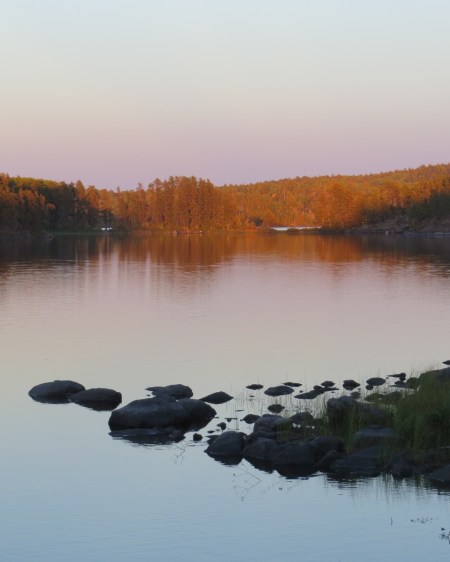
IMG_4528.JPG

The isthmus site from “Hidden Gem”

Hidden in the trees was a tent.

Oh well, I thought, we wouldn’t stay there, but there was another site down in a bay about a half mile away.  I didn’t remember the site as being too nice, with a lot of blowdown trees and not much room, but that had been three years ago.  Besides, I reasoned, I once thought “Hidden Gem” wasn’t all that great the first time I saw it, either.  We paddled along the shore of a quiet, moderate sized bay with a high cliff on the west side and two nearly bare, small islands out in the middle, rocky but interesting.  The whole place was quiet, except for a couple of nearby ravens.

We landed and walked uphill on the rocky path.  The site wasn’t large but it did have enough space for two tents.  The views were great to the north where we could see Canada. Nobody was on the lake, and I doubted we would see anyone, for we were well off the travel routes.  Most importantly, my companion said he liked it.  I did, too.  We had room, quiet, and we later explored the two islands, climbed the cliff, and in the evening had a visit from migrating geese, which landed by the islands, staying the night.  In all my years in the Boundary Waters, I had seen a lot of geese flying overhead; I never had camped with them nearby.

IMG_8992.JPG

“Hidden Bay” campsite as viewed from the cliff

We didn’t have wildlife, other than a couple of chipmunks, which were more interested in the plants than in us, but we had clear skies one night, with some of the best dark skies in the Lower 49.  We paddled the next morning to the outlet of Basswood, where the rapids began, the international border’s being in the middle of the rushing water.  We walked on the portage a short distance to places where one could be near the roaring rapids that continued for several miles to the west, ending at Crooked Lake. Other than a pair of eagles, we had the place to ourselves.

IMG_9017.JPG

Beginning of Upper Basswood Falls; Canada across the water
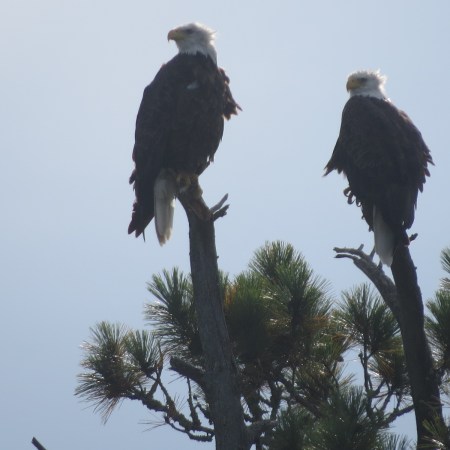
IMG_9012.JPG

Eagle pair

I no longer go to the Boundary Waters to cover miles and quench my desire to see new country.  I have done it, enjoyed it, happy that I was so fortunate to do so. These days, a base camp in a nice place is enough.  I can get in there in a few hours, if the weather is cooperative, I have a quiet place to stay, hardly see anybody,  and I can get back out easily.  Hidden Gem is still there, should my wife be able to travel with me again.  So is the isthmus.  It’s a nice place.

I’m lucky.  I can pick among several beautiful campsites on a lake whereI have spent more than fifty-five nights on twenty-three different campsites.  I didn’t look all of these numbers up on a map; I have them all in my memory, the year I was on them, and in some instances the actual date.

I sometimes think how interesting it might be to have spent a night on every one of the 107 campsites on the US side, and the half again as many on the Canadian side.  Realistically, however, I would never do that.  Getting to know a place well means more to me these days, second only to having the ability to get there.

Isthmus, Hidden Gem, and now Hidden Bay.  Nice places.

Basswood Lake: an international treasure.
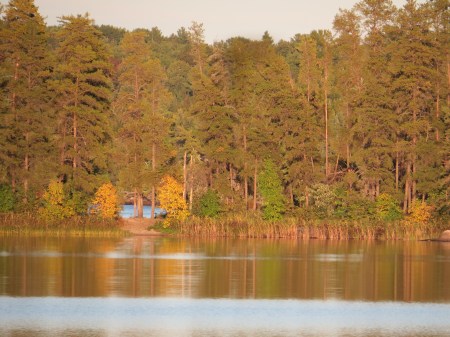
IMG_6070.JPG

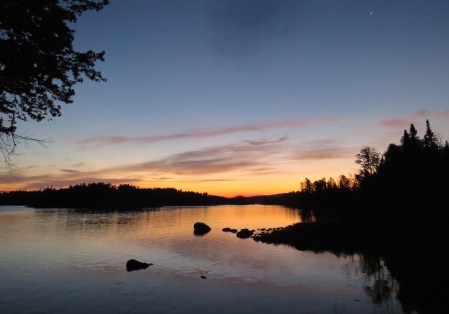
Closeup of isthmus site at sunset

IMG_6106.JPG

Sunrise from “Hidden Gem”

IMG_4621.JPG

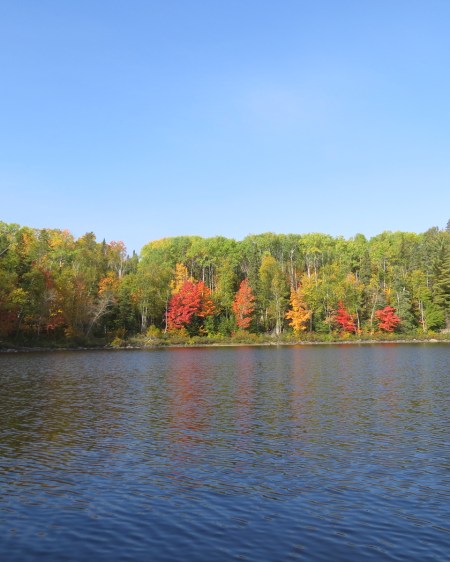
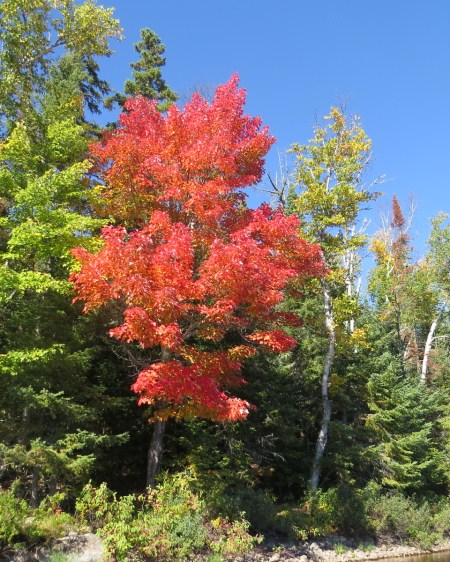
Fall colors, September 2014.

IMG_4636.JPG

Beaver, 2014

IMG_4509.JPG

CLIMATE CREEP

September 10, 2017

The other morning, after the Eagle Creek Fire had burned through much of the Columbia Gorge on the Oregon side, putting eastern Portland in jeopardy, the morning paper had several interesting comments in one article:

  • “… the smoke output in the western part of the state is massive.”
  • “The number of active fires in so many parts of this state is pretty unusual.”
  • “It’s kind of unusual to have this high-pressure system this late in the summer.”
  • “Such high pressure systems occur a few times each summer in Oregon, but they typically don’t last this long.”
  • “It just so happens that we have this pattern and we also have all these forest fires going.”
  • “The marine air (has)…been having trouble kicking in.”
  • “I’ve been here 30 years and never once has there been a fire anywhere near here.”

From some of the people I know:

  • “I’ve NEVER seen the smoke so bad.”
  • “We’ve never had fires around us like this.”
  • “We always got some rain during the summer but not this year.”

The natural events that produced these are what I call “climate creep,” and the statements I call  “climate speak.” Here are some others: “It never used to be like this,” “we’ve never seen anything like this before,” “it’s coming a lot sooner now (spring) or a lot later now (winter),” “I don’t know what to expect any more.”  It’s not that every day is hotter than last year. They aren’t.  It’s not even the years are progressively hotter, although they are always above the defined average. It’s a sense that the climate in which we grew up has changed is no longer as predictable as it once was.

I think climate creep is why we are seeing so many significant events, yet almost all of them can be considered “normal,” inasmuch as they have occurred before.  Fact: for ten years in a row, extreme weather has cost the country more than $10 billion annually. This cost has been a significant increase since 2005.  Both hurricanes Harvey and Irma are in of themselves not unheard of.  We’ve seen stronger hurricanes.  Two in two weeks seems odd, although that can be explained, too.  Three five hundred year floods in Houston in three years seems a lot more than “odd.”  A lot of the impact is because of how cities are built, and Houston was not built to handle large amounts of rain.  “Anomalously” strong high or low pressure systems are not uncommon. We now have more people affected by extreme events, no longer a few thousand, which I call a 3rd magnitude event, or even ten thousand, a 4th magnitude event.

Climate creep is our becoming so used to warm weather that normal temperatures—or what used to be normal temperatures—now seem cold.  It is becoming so used to dry weather—at least where I have lived the past twenty-five years— that normal rainfall or snowfall has become “really wet,” when in fact our “wet rainy season” last year was still a little drier than normal, whatever normal is.  Those last three words are climate speak.

Climate creep is made easier to accept in that we are brought up to believe that sunny days are fair and rainy days foul.  Deteriorating weather is used by meteorologists to mean rain; improving weather sunshine.  A few degrees of warming are more likely to be tolerated and enjoyed than the same amount of cooling.  During Oregon’s extremely warm winter of 2014-2015, I was asked by a friend how I liked the “spectacular weather.”  I didn’t.  During the following summer of dust and fire, which I knew was coming, I liked it a lot less.  In the current season of multiple fires, a TV meteorologist referred to a prediction of little rain on the weekend as “hopefully, it won’t affect the football game”.

Climate change isn’t exactly linear. It creeps, slowly.  We aren’t going to wake up one day to discover it is hot.  I think while possible that a large non-linear change may occur, I’m betting the changes will continue to be subtle, and we are good at adapting to subtle changes in our life, be it smog, traffic, weighing a few more pounds, or temperatures that aren’t what they used to be.

Climate creep is periodically punctuated by 5th or 6th magnitude climate events, affecting 100,000 and a million respectively. The unprecedented smoke here was a 5th magnitude event,  Hurricane Harvey 6th magnitude, Hurricane Irma and California’s mega-drought, in some places worse than in the past 800 years, 7th magnitude, affecting more than ten million people. None of these proves climate change, but I think we will look back in 10-20 years upon these events and realize the concatenation of all were the vanguard of what was coming. The 9.8 magnitude event, affecting everybody, may not be a storm. It may simply be called 2050. Or 2080.

Climate creep is increased variability in the climate system.  An average may or may not change, but the values are more extreme on either side.  A place can flood, later dry out and have extreme wildfires.  The average is normal, but the variability is more extreme than it once was.  It should be noted that when physical systems fail to operate well, one of the first signs is often increased variability without a change in the mean.  We are seeing more 6th and 7th magnitude climate events.  It’s also the fact that annual global temperatures are not falling, and in my life I hear more and more climate speak:  “we used to get more rain,” “we always used to say summer started after the Fourth of July,” “I’ve never seen so much smoke,” “We’ve never seen so many fires at once.”

I think it only fair I make verifiable predictions: (1) Global temperatures will continue to trend upwards, and locally I will never again experience a year with below normal temperatures. (2) The cost of severe weather in the US will continue to exceed $10 billion every year. (3) The number of discrete annual billion dollar events will be at least 6 (the long term average is 5.5, in the past five years 10.2, and 9 so far in 2017).  (4) Ocean rise will continue unabated or increase.

I hope I’m wrong.  In the meantime, I hope we begin addressing issues where people are allowed to live and be allowed to rebuild with taxpayer money, especially on the coast, floodplains, and urban-wildland interfaces. I ask how we will tolerate, safely, “climate creep”: the high magnitude climate events of heat, cold, water, wind, and fire.

TONS OF RAIN AND A TINY CHANGE OF pH

September 5, 2017

“Tons of rain” was the grossest underestimate I heard of the amount of water accumulating during Hurricane Harvey.  A ton of rain is not very much, roughly about 0.02 inches on a moderate sized roof of one house.

What about 11 trillion gallons of water?  The media used the number to say how much water fell on southeast Texas.  The problem is first, too many don’t know how big a trillion is and second, a trillion is not a term often used with water.

A trillion, 1,000,000,000,000, 1 x 10 ^12, is a term used to describe both the national debt and the Gross National Product.  It is roughly the number of days the Earth has existed.  It is about the number of seconds in 31,700 years.

The term we use to describe a lot of water here is an acre-foot (1 acre covered with one foot of water), and while perhaps archaic, it is useful.  An acre-foot of water is roughly 326,000 gallons, what an average family of 4 uses in a year.  Lake Shasta, the largest reservoir in California, has a capacity of 4.5 million acre feet.  Eight Shastas would have flooded Houston, or 11 trillion gallons of water would cover all of New York State a foot deep.  If the catchment area described were 10,000 sq miles, it would have covered it to a depth of 5 feet, basically what people needed to know and could see from the pictures.

*************************

Per cent is a useful term, but often misleading.  I inadvertently misled people before the recent eclipse.  What I should have said in the talks I gave prior to the event was that there were two kinds of eclipses (there are more, but I will keep things simpler), partial and total.  They are very different experiences.  Had I said that, mentioning that where I lived was in the partial zone, I might have persuaded more people to go to see totality.

Instead, I and many others said the eclipse would be 99.4% (or 99%) and most people figured, reasonably enough, that they would see almost the full event from their house.  I have since had several people tell me that they wish they had gone to totality.  One poignant comment was that 0.6% made all the difference in the world, since it was still sunlight and not totality.  If the eclipse isn’t total, it is partial.  It may be a little darker, a little more of the Sun will be covered if it is a deeper partial, but it is not total.  Next time, if there is a next time for me, I won’t make that mistake.

Per cent shouldn’t be used when counts are a better measure.  I have said in 2001 that the per cent of domestic flights not hijacked was 99.999996%.  Counts matter, especially when the counts should be zero.  When I was medical director of a hospital, we had a surgeon operate on the wrong side of the head.  Actually, we had three wrong side cases that I knew about—one was the wrong knee, and the other was the wrong side of the colon.  With the craniotomy, the OR head said that 99.9% of the time they did it right.  No, I retorted, we did 99.99% of them right, and that wasn’t the issue. There should be zero wrong side cases;  99.9% of landings done right means a plane crash every other day at O’Hare.

*************************

Not every measurement is interval or ratio, meaning that the difference between 10 and 20 is not the same as the distance between 20 and 30.  Most of us realize that with temperature, that 110 is not twice as hot as 55.  That is because the Fahrenheit scale has an artificial zero that is 459 Fahrenheit degrees above absolute zero.  Therefore 55 degrees is 514 above absolute zero and 110 is 569 above absolute zero, a difference of 10.7%.  With Celsius, these numbers would be 273 above absolute zero, 13 and 43, respectively, making the temperatures 287 and 316, or 10.1%, really the same, given the rounding in the conversion from one to the other.  It’s important to recognize what is ratio data, meaning that multiples make sense, and what isn’t.  Money is ratio data, as are height and weight.  Others are ratio data, but they are used in ways where one has to be careful.  Height is ratio data, but the Body Mass index is a function (depends upon) the square of the height, or the height multiplied by itself.

This concept of squaring something is important in many areas, such as the energy of a moving body, which is proportional to or depends upon the square of the velocity.  With hurricanes, velocity of winds increasing from 100 mph to 120 mph, 20%, is a 44% increase in energy, (120/100)(120/100).   A car moving at 60 mph has four times the kinetic energy it had at 30 mph.

Cubing something is to the third power or multiplying it by itself 3 times.  While 1 yard is 3 feet, 1 cubic yard is 3*3*3 or 27 cubic feet.  A meter is almost 10% longer than a yard (9.4%), and a cubic meter is 31% more than a cubic yard.  Gravitational attraction is inversely proportional to the square of the distance between objects; tides are inversely proportional to the cube of the distance between objects, which is why the Moon, so much less massive than the Sun, is responsible for 45% of the tidal pull on the Earth.

Fourth power?  Yes.  The radiation from a star can be considered to be equal to the fourth power of the temperature, useful for determining the temperature of distant stars.  And closer to home, the damage large vehicles cause to roads is roughly equivalent to the fourth power of the load equivalent factor, having to do with axle number and weight.

Other relationships?  Yes, too.  the acidity of a liquid is the negative log of its hydrogen ion concentration (pH), which is a nice way to call 0.0000001 moles/liter of hydrogen ion a pH of 7.  Therefore, what seems like a minor fall in the ocean pH from 8.2 to 8.1 represents a 26% increase in acidity.

It’s not always the magnitude of a number that matters—99.99% is not always good, and a pH’s falling from 8.2 to 8.1 will see the end of most coral reefs on Earth.