Archive for April, 2024

NEW GENERATION

April 30, 2024

Six of us started up the Larison Rock trail outside of Oakridge. There were supposed to be seven, but one person who thought he knew where the trailhead was, did not. There are two of them, one at 1200 feet (350 m)elevation, across the river from Oakridge; the other was a longer drive around the mountain and at about 2800 feet (850 m). We hoped he would find the right place and catch up.

I was last and figured I would catch the others fairly soon. Two looked like they were in their fifties, one maybe forties, and the other 67. The trail goes uphill 1500’ (450 m) in the first two miles (1.3 km0, steep, but steady and good tread. It doesn’t waste one’s time gaining altitude—my kind of climb.

I started to catch up to the first person as he adjusted his poles, thinking that I hoped he would be faster. His poles adjusted, he moved on ahead, and for the next mile, I was still in the back, not gaining any ground on him at all. That’s unusual. I’ve had some knee and Achilles tendon issues, for which I walk carefully on steep grades, but I wasn’t hurting, and I was climbing well. At least I thought I was.

I passed two of the group who had removed layers, and about a quarter mile later, I did the same, making a quick change and moving on ahead. The three in front of me were out of sight and stayed that way to the rest stop where I wanted to regroup. The two behind me arrived not long after I did. I had a drink and something to eat, and the first four were off going up the trail to the upper road, where we would stop again. I was going to go last, but the guy who adjusted his poles at the bottom was still working on his pack, so I decided I would go on ahead. 

After maybe a half mile (800 m), a little more, I encountered a pair of mountain bikers coming the other way, went around them, and then heard footsteps behind me. I realized the last person was right behind me, so I pulled over to let him go by. He moved ahead about a hundred yards before I lost visual contact. I finally caught up with him and others at the upper trailhead. These guys were fast.

The year prior, when we went the last part to the top, which switchbacks steadily, I had someone behind me, and I just kept my pace the same to the top. I climb at nearly my flat ground cruising pace. This day was different. The group took off, and while I climbed at a decent pace, I was the last one to Larison Rock itself, where we had lunch. I wasn’t breathless, I wasn’t sore, I was fine. I was also dead last.

I had not “led” the hike at all; in 8 years of leading this hike, that had never happened before.

While we ate lunch, the missing person showed up. He had driven to the upper trailhead, turned around when he realized there was another trailhead down below, and had come up the same trail as we, quickly. He was more than a half hour behind me at the start, and I had only been on top twenty minutes.

I’m not as fast as I once was. Doing trail work, I am used to carrying more and hiking less. But there is no need to make excuses. Things are what they are. I am observing a generational change, this time from the other end. I’m fine with that.  I don’t need to train with longer hikes—like doing Hardesty weekly—to see if I could improve. I can enjoy what I still do, and do well, sparing myself Hardesty’s 3300 foot (1000 m) vertical climb. That sounds a lot better.

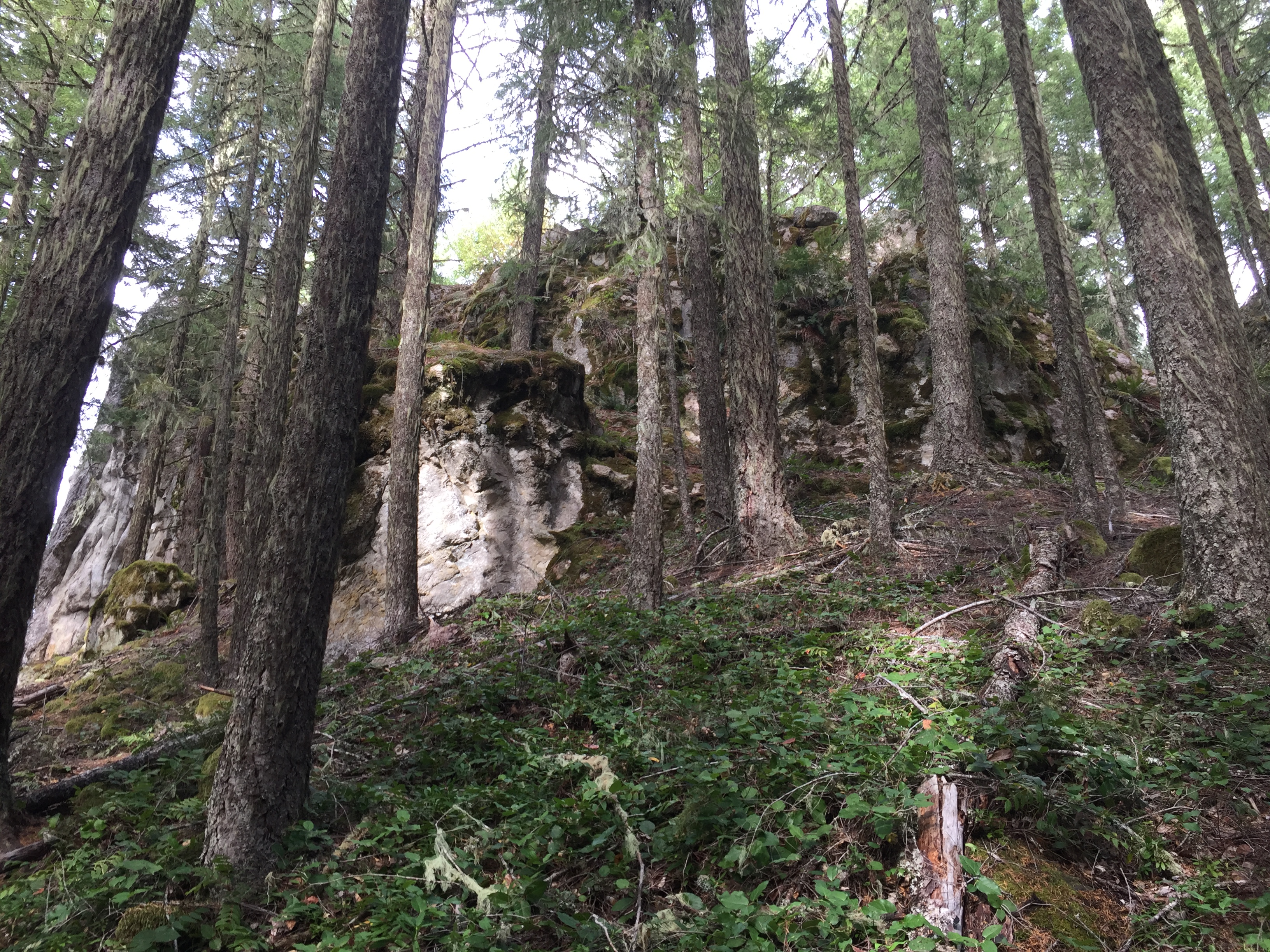
View from Larison Rock

Larison Rock from below

 IT WAS NOT JUST TOTALITY, IT WAS THE PEOPLE THERE

April 11, 2024

Six days before the total solar eclipse, a NWS forecaster at Dallas-Ft. Worth, also an eclipse chaser, wrote in the weather discussion, “this is a soul crushing forecast.” He was right. Weather models predicted cloudy skies over much of Texas in the eclipse path, all of it that I could drive to from my hotel in San Antonio. One recent change in the forecast was for severe storms to cross Texas not long after the eclipse. Great, I thought, if I get clouded out, I now have an additional chance of being a storm casualty on the drive back.

This being my 29th eclipse trip, 18 total, 7 annular (ring) seen, I remembered two aphorisms:

“It ain’t over until it is over and you didn’t see it.” Last minute luck in seeing totality has occurred on more than one occasion. In 2009, a hole opened in the rainy sky in China at totality and we saw the corona.                                                           

“If I don’t go and people see it, I will never forgive myself.” I had a storm delay on my way to the 2010 eclipse in Patagonia, with a miserable weather forecast there, too. Had I missed my international connection I might have gone home. I made the connection, the weather improved, and I saw the conical shape of the Moon’s shadow the eclipsed Sun inside the shadow, and the shadow’s lifting off the Earth above me, minutes before sunset. Ten minutes later, it started snowing. 

I spent a full day in San Antonio the day before the eclipse checking the Canadian and US weather models, and when it was less than a day away, the HRRR (high resolution rapid refresh) and RAP (rapid refresh) models, which are high resolution out to 18 and 21 hours respectively, looking at everything in the eclipse track from about 50 miles south of Dallas down to the Rio Grande. I decided to go north, because the fewest clouds were predicted, no low or middle but cirrus clouds 2000 m thick were predicted. That’s a thick cloud, but between 1 pm and 2 pm the RAP showed some thinning north of Lampasas, and Evant was at a crossroads, 29 miles north of the former.

So here I was, driving into Evant, Texas, a tiny town with a few hundred people.  I saw some eclipse setups in a small park and looked for any other possible viewing spot in the northern outskirts, didn’t find any, and turned around. 

The small park had enough room, so I pulled in and parked, 3 hours prior to totality.  My minimal eclipse viewing set up was binoculars with solar filters, goggles with a welding filter, and a camera. I noted small groups of people, several small telescopes, and smoke from a grill where one was setting up a barbecue. The sky looked promising, and I was amazed.

I’m an introvert, but if I start to teach something, I change. With eclipses, I am totally, literally and figuratively, in my element. I wore my Indonesian eclipse T-shirt from 2016 that lends me some credibility and is a good conversation starter.  I walked with my binoculars across the street near a church where I asked a woman if she wanted to look at the Sun. Most never see the solar disk, which to our eye is the size of the Moon, which is why we were all where we were, and there was a sunspot visible, too. I returned to the square and started showing the Sun to others, including a couple, helping the woman with the viewing.  A man came by wearing a 2017/2024 T-shirt and we chatted. He was from Austin, it was his tenth eclipse, and we exchanged stories from past ones. As he left, he patted me on the shoulder and thanked me for showing the Sun to the woman who had just left.

Two hours prior to totality, others stopped by to talk and to ask questions. There were many first timers, families, couples, a pair of guys my age, who had road tripped from Minnesota. They had gone to college together but had not seen each other until recently. There was a group of about a dozen Brazilians; how they ended up in Evant, of all places, I never knew, but then again, I wasn’t expecting to be there either. I showed them my red rental car parked under a tree, dozens of crescents on it, because the leaves above acted as pinhole cameras. We were no longer strangers but a group sharing a remarkable day.

One family had a young man who wanted me to talk about eclipses, and so I did. He was so interested I gave him the “nerd talk,” about how the three major cycles of the Moon, the synodic, anomalistic (perigee to perigee), and draconic (node to node, or crossing the plane of the Earth’s orbit going north for example, to doing again) all come into exceptionally close alignment (5 hours) with 223 cycles of the first, 239 cycles of the second, and 242 cycles of the third. The alignment is every 18 years 10-11 1/3 days (depending upon leap years and time zones). Each member has a path similar to the previous and shifts a third of the way around the world to the west. I saw this same family in Libya 29 March 2006, and three cycles prior to this was the 7 March 1970 eclipse that went up the Eastern Seaboard, where I was outside the path of totality (and regret it every time I hear Carly Simon song, “You’re so Vain”). He was fascinated.

As totality approached, I kept waiting for the proverbial shoe to drop, or realistically, for clouds to appear, for the models had shown a huge difference in cloudiness between 1 and 2 p.m., and the eclipse occurred about 1:35. But cloudiness would not be a problem.  We would see this. The young man had earlier asked me what he would see at totality. I had replied simply, “I’m not going to tell you. I want you to find out for yourself.” He did, after 4 minutes and 8 seconds.  

Ten minutes later, it was cloudy. 

I went to Texas knowing a soul crushing forecast and yet saw the eclipse under excellent conditions. But what will stay with me even more than the beauty of the eclipse was the enjoyment I had with many others, explaining to them why this old man has made 29 sometimes odd journeys for a few special seconds, not guaranteed. I am 75 and felt that day like a wise elder, sharing knowledge accumulated over decades of experience. I felt wanted and useful. As I helped make the event more special for those around me, I made the event more special for me, too.  This was a great eclipse, and it was due to the people I was with.

As I started to drive away, the young woman, who had just asked me if she were now an eclipse chaser (yes, ending up in Evant, Texas, qualified) and had asked when the next one is (12 August 2026), called out:

“We love you!”