Archive for December, 2024

A SECOND PAIR OF EYES

December 30, 2024

“Glad to get that off my shoulder,” I said to the trail, the nearby trees, and a woodpecker I could hear but not see.  I put Brad’s chain saw down on the ground by the junction of the Betty Lake Trail and its north spur to the lake. Lunch time.

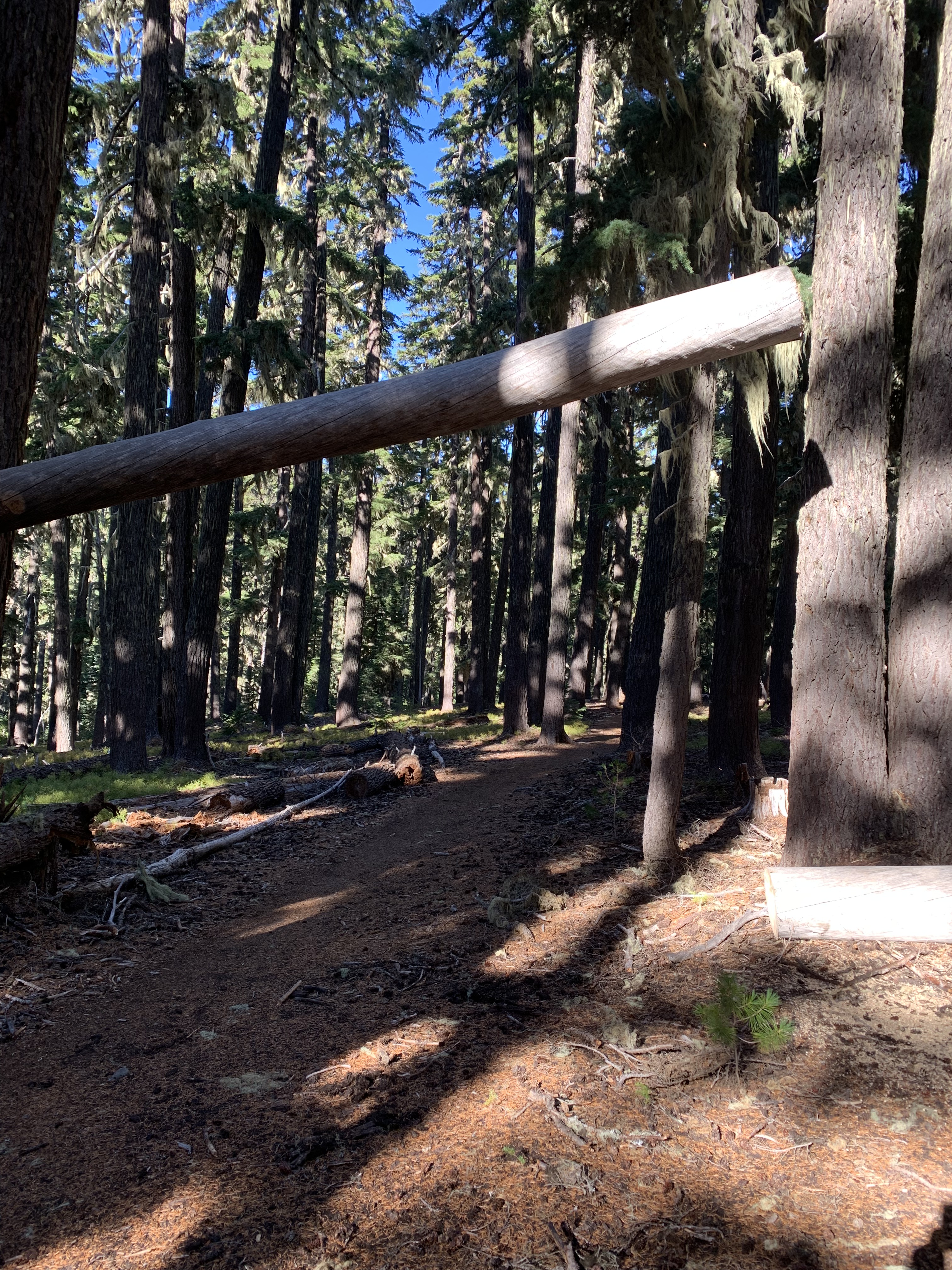
An hour earlier, Brad and I were a mile further west at the fourth of six logs we had to remove on the Betty Lake Trail, an all season path near Waldo Lake, joining Waldo Lake Road to the 20 mile Jim Weaver Trail that circles the lake. Our first log was head high over the trail and held in a notch of a pair of trees. When the log was cut, it went up like a teeter-totter. You find entertainment where you can when working trail. The current log was 20-22 inches diameter, a straightforward cut. Standing on the opposite side of the log, I noted a rock right about where Brad’s cut was headed. As the cut came lower, I stepped over in front of Brad, waving my hands to get his attention.

“Rock!” I pointed down.

He looked over, gave me a nod, and later we finished the cut with a hand saw, which if it scraped the rock would be no big deal. Saw chains do not like rocks. He told me later he hadn’t seen it. I was in much better position to see it and spoke up as is my job as swamper. Every part of trail work has had a steep learning curve for me, and swamping has perhaps been the most difficult for me.

Swampers, (the verb to swamp) are words for helping someone who is operating equipment deal with carrying it, fuel, clearing space, safety and emergencies. Swampers for power sawyers are a pair of second eyes for obstructions or issues the sawyer might not appreciate, such as overhead dangers, hikers, or movement of nearby logs because of the current cut. The sawyer is concentrating on the cut; the swamper must be watching out for everything else in the surroundings, staying clear yet being aware of the cut’s progress.

Two years back, a log lay across the Vivian Lake Trail a quarter mile from the trailhead. The log, nothing unusual, went uphill 30-40 feet where it disappeared in brush. There, a second log similar size was perpendicular to and lying on it. I wondered whether the second log was a potential problem. Maybe. Maybe not.

The sawyer arrived, and as he planned his cut, I called over: “Note the log on top of this one. It might not do anything, but I want you to be aware of it.” My second pair of eyes was not confident in calling out what logs will do. But now there was a second brain involved.

The sawyer nodded, changed position so he faced me and further away. As he cut through the log over the trail, it dropped. The perpendicular log was suddenly free, started to roll, had a low friction surface, the log we had just dropped, and accelerated, crossing the trail in seconds, going over the edge with a loud crash below.

“Thank you!” 

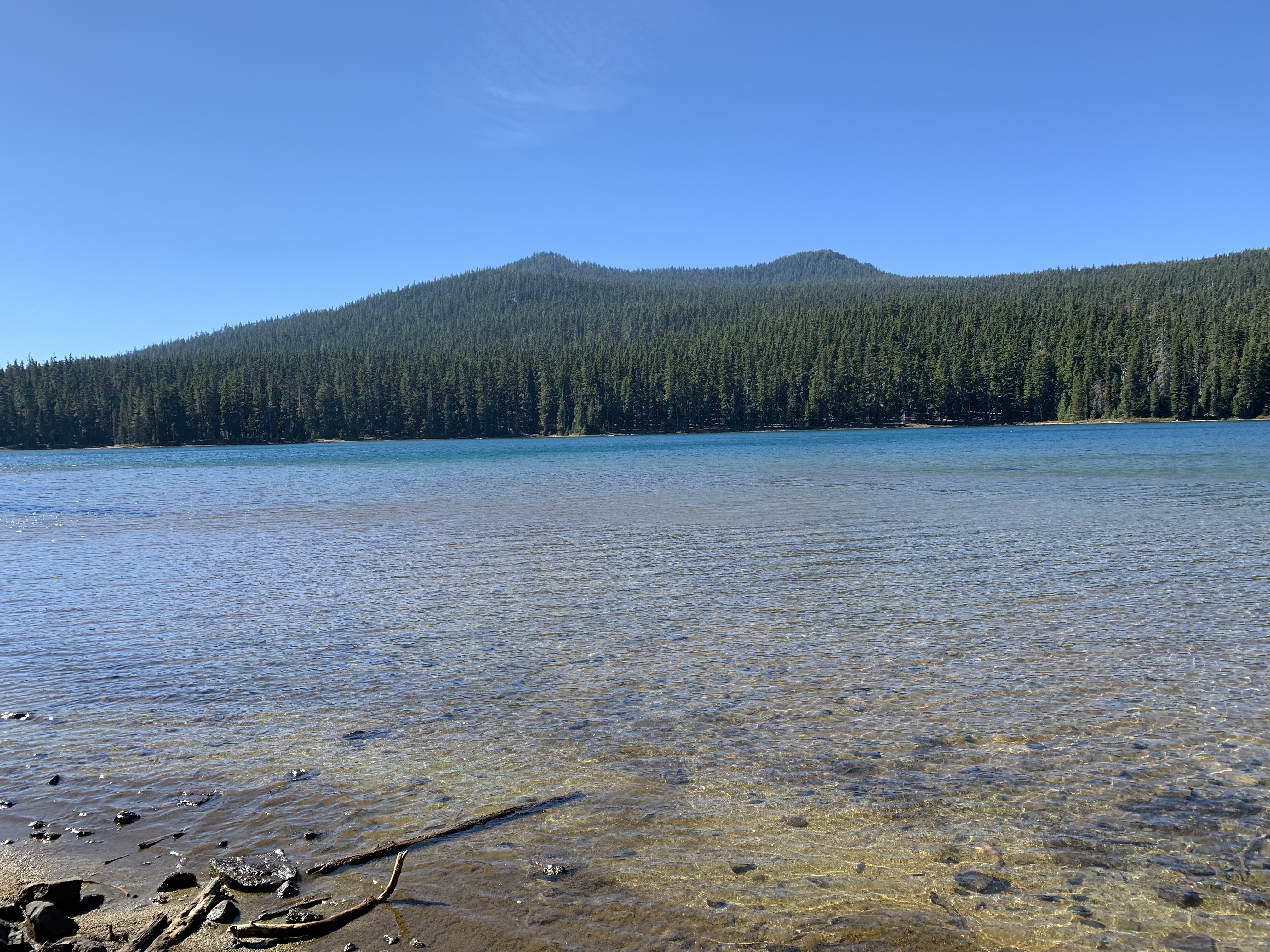
Brad and I ate lunch at Betty Lake, each of us finding an appropriate spot. I don’t sit on logs when eating but rather the ground, often leaning against a tree. Trail work has two lunch seasons: we had months of the summer one, where I looked for shade. We had just entered winter lunch season, where now I sought out sunlight. I ate, all the while looking out at the 40 acre lake. 

The south shore across from me was a quarter mile away, the west end a similar distance to my right. A few whitecaps were visible, pushed my way by the south wind. The sky over the distant trees was as deep blue as it gets. Somewhere out on the lake, I ate lunch one winter day when I snowshoed in nearly six miles from Highway 58 and sat on a pad in bright sunshine, my black pants absorbing the heat. I then snowshoed back out.

I’ve watched plenty of water from a Navy ship on multiple trans-Pacific crossings, and up close on a hundred canoe trips Up North. Never get tired of looking. 

It’s when I have to move after watching water that has changed. I used to stand right up. I now have a couple of false starts, hear some cracking, and gradually change position. Eventually succeeding, it was time to put the saw back up on my shoulder, make my back unhappy, rejoin the trail, and return to the trailhead.

STARTER CORD

December 24, 2024

It’s just an old plywood boat

With a ’75 Johnson

With electric choke

— Alan Jackson (singer-songwriter, from his song “Drive”)

I heard the sound of a starter cord’s being pulled but nothing started. 

I was leading a work party to the E2C Trail (Eugene to the Pacific Crest) from the North Shore Road by Lookout Point Reservoir up to Winberry Divide. I was familiar with the trail, 3 years ago having worked it and two days prior hiking it to be familiar with the upcoming job: clear encroaching brush and establish and clear water drainages. It rained two days earlier, and parts of the trail then looked like a Willamette tributary.

The crew split into dealing with one or the other tasks. I was one with the power brusher, which I like. I’m all thumbs with tools, but helping a person use a brusher was the first time I taught anything to another crew member. It’s rewarding to show a person how to use their own body to pull a starter cord hard enough to start the motor.

Well, sometimes.

I went over to the recalcitrant brusher, moved the fuel knob from choke to high, and pulled a couple of times. From the vibration, I knew it started, because with Kleenex in my ears plus the ear muffs on my hardhat, I couldn’t hear a thing. The brusher was back in business. I didn’t do anything special; maybe I got lucky, for the second time that day. Made me feel good. The brushers were listening to my whispers. While working, I wear a vest fastening me to the shaft. I move the rotating blade back and forth across the trail, couple feet on either side. Everybody with whom I’ve brushed thinks we clear about twice as much distance as we actually do.

I was a generation before Alan Jackson, when the motor on my plywood boat was not 75 hp but a 5 hp green Johnson SeaHorse, 2 cycle, no electric choke but a silver dial on the left side on the top. I had no idea it was a choke and in 1954 in Ontario too young to understand anyway. I turned the brass four cross screw left side and would hear fuel flow. I next opened the silver gas vent cap on top, hearing the hiss of escaping vapor. I then pushed the clutch out, which looked like a silver ear and put the shaft in neutral, moved the throttle to the stop, half way to the right, pumped the silver disk three or four times, and pulled the starter cord on the upper right part of the motor’s front, rewarded by smoke and the sound of the Johnson. Reverse was rotating the motor. Put me by that motor right now, fueled, and I could start it blindfolded and immediately recognize sounds I haven’t heard in seventy years. I share Jackson’s feelings he had driving his boat, “a piece of my childhood will never be forgotten.”

So perhaps it isn’t surprising I like brushing. The orange Stihl is a 4-cycle motor using a 2-stroke 50:1 fuel mix, 24.1 cc /35 mm bore, 25 mm stroke, and yes, it is loud and pollutes, but it allows us to clear brush from long sections of non-wilderness trail. On the lower part of Olallie Mountain, in the Three Sisters Wilderness, there is a long stretch of thimbleberry. In 2018, Brad and I spent a few hours brushing it by hand, a big chore. Sig spent a day on it a year ago. On Lowder Mountain, three of us spent a morning hand clearing only a third of the brush in the lower reach. I hiked Cummins Creek Wilderness trail once with waist high brush that completely soaked my pants, prompting a non-intended change to rain gear. Thick brush is a safety hazard; coming down Horsepasture Mountain last summer, there were 2-3 foot drop-offs on the trail we couldn’t see because the brush was so thick. Trails will disappear without brushing. 

We cleared a mile that day and established nearly ninety separate drainage spots on the trail. We’re half done.

OH, INDEED I DO

December 15, 2024

Smoke started curling out of the hole where I was drilling. The drill hadn’t seemed to work right from the start, requiring my pushing it more than I should have. Finally, my effort produced no further movement but plenty of smoke, so I pulled the drill out, noting removal was easy. 

“Something’s wrong with the drill,” I said.

“Try this one,” Sig gave me another drill. I had no trouble at all.

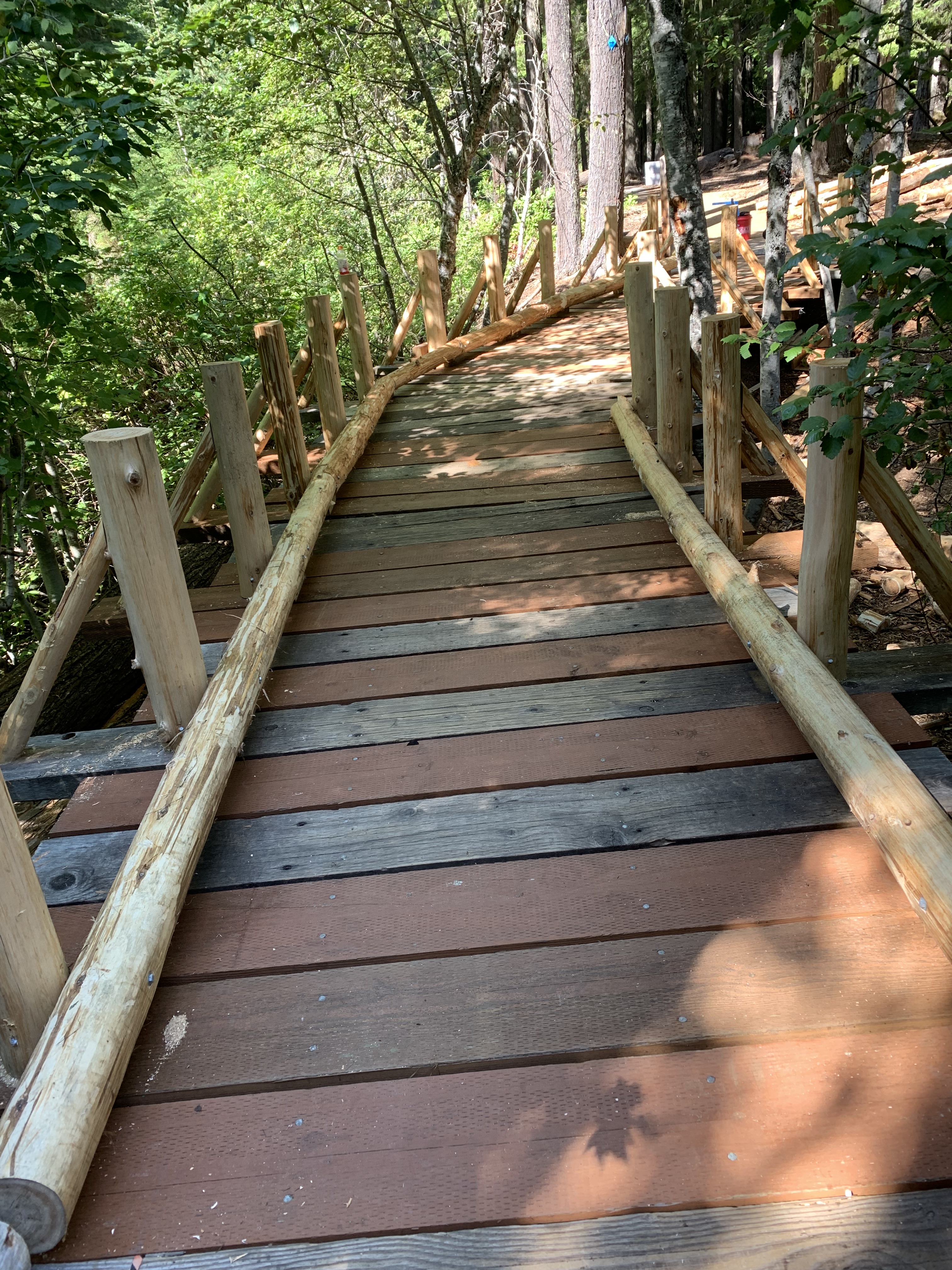
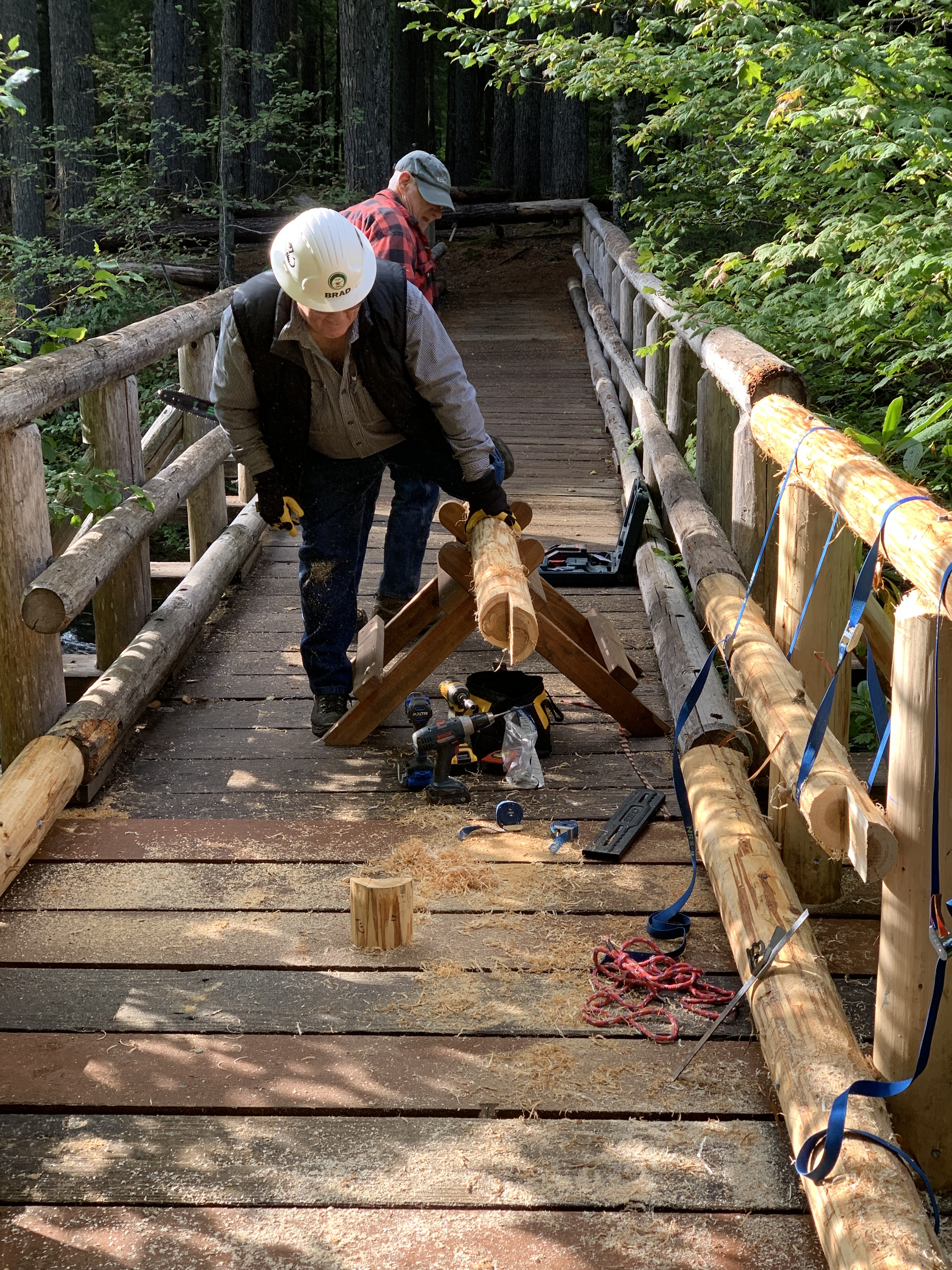
We were working on the bridge over Salt Creek not far from the falls. The bridge was about 60 feet long with a 45 degree curve on the west side. This bridge construction I worked on more than our first one at Indian Creek along the Middle Fork, where I did necessary grunt work of moving logs and debarking cedars. Here, I cut the rails, drilled holes for the posts and support structures, and using a high noise impact driver to put in the screws and toe nails holding everything together.

We had cut the logs down in the valley, where there was Western redcedar, covered the logs near the road with boughs to hide from poaching until we got a trailer from the Forest Service, then eventually moved 35, minus 3 or 4 that were stolen anyway, into a trailer.  We drove 20 miles up to the falls, where we unloaded them by the parking lot. I moved thirty of them one day a couple hundred yards to the work site, using a dragger Jim had rigged up. Some logs I just put over my shoulder and carried. My step counter showed 7 miles’ hiking that day without ever leaving a circle of 200 yards radius. I worked closely with Jim and Sig, learning about bridge construction during the nine outings I had there.

There was nothing wrong with the drill. It ran just fine. But it was in reverse and I as I pushed it in, the friction became intense enough to ignite the wood. I suspect Sig knew but didn’t want to embarrass me. Before using a drill again, I had discovered the little button that changes gears and turned the drill on briefly to ensure it was turning clockwise. It was a rookie mistake. I later graduated to where I had to figure out how to remove and replace the battery without asking anybody or taking too long.

Bridge work is a team effort.

About a year later, I volunteered in Cottage Grove for Huerta de la Familia, developing the seventh garden in the region for Hispanic families to grow their own food. My first trip there, the group was putting in fence posts, My job was to fill a wheelbarrow with gravel and take it to each of 35 such holes, where the gravel was mixed with the ever present mud to surround the post. There was another outing there recently, and I decided to go, despite the accurately forecasted rain, in full rain gear which I define as wearing enough clothing that one can’t tell if it is raining.

I was first to arrive, low clouds, spitting rain, not getting lost like I had the first time, and as I went out on the plot, Gloria, as she introduced herself, held a Ridgid cordless 18V power drill.

“Hi,” she said. “Do you know how to use this?”

Music to my ears. Oh, indeed I do, Before Salt Creek, I might have asked what it was. Nonchalantly, I said, “Yes, no problem,” as if I had that, a few yellow DeWalts, and a Stihl power brusher 25.2 cc one cylinder motor in my garage next to my Husky saw. Gloria didn’t need to know my past ignorance. It reminded me of being abroad on an overnight flight when the crew needed English speakers to sit by the emergency exit, which happened to have great seats. The flight attendant looked at me, and asked, “Do you speak English?” 

Oh, indeed I do. “Like a native,” I replied, drawing out all the words.

My job in the rain was to remove the multiple screws that held the planks and slats of several elevated garden plots so we could remove them. The job would require removal of upwards of 75 brass PowerPro brass Torx screws, many of which were so tightly bound I had to use the whole drill as a screw driver just to break them loose. I didn’t notice the rain, only my gloves getting progressively wetter. I was one with the Ridgid. I even helped Jean change a bit; all I had to do was vigorously unscrew the chuck.


The job was right up my alley, for all I had to do was to remove screws, so I used reverse the entire time.  Piece of cake.

See you on the trail

FOUR GOOD DECISIONS AFTER ONE BAD ONE

December 11, 2024

“When you have played basketball for a while…[Y]ou develop a sense of where you are.”

So wrote John McPhee about Bill Bradley, Princeton ’65, senator for 18 years, a remarkable man. 

When Bradley was playing college ball, I was in high school, and my best friend played for our high school team. He and I shot baskets out in his backyard, talking about girls and other things teenage guys did. That year, I went from an awful 30% free throw shooter to a decent 65-70%, taking his advice to shoot each one the same way and not let a bad shot change my mood. He told me to use the backboard for my jump shots, because it made bad shooters fair and fair shooters good.

Thirty-one years later, Jon Krakauer saved his own life on Mt. Everest while descending in a snowstorm by recognizing parts of the route he had taken up. He had a sense of where he was, trail memory. 

Backcountry navigation is having a sense of where you are, a sense that can be developed, using aids that make a bad navigator fair, a fair navigator good, and a good navigator excellent.

***

I pushed off from Wolf Creek into Burntside Lake, heading towards Crab Lake in the Burntside Unit of the Boundary Waters, a separate area of the wilderness I hadn’t yet explored that summer. It was a pleasant September afternoon, and my plan was to go north 2-3 miles and then I would be “on the map” I had in a plastic bag by my knee.  I was lacking the actual map of my starting point, but it was so close to the edge of the maps I did have I didn’t see any problem. North was in front of me. 

About a mile out, I could still easily see where I had launched and began looking for islands I would use for markers on the maps with me. There were several, and at first I thought I had found one, but the long axis wasn’t right, so I looked at a couple more. They weren’t right, either. This was bothersome, until I found an island that looked possible, now about 2 miles away from where I had pushed off. I started to look to the west, where I planned to go, but what I saw didn’t match the map.

I then continued, paddling, making the rookie mistake by “making” another island “fit” to where it should be for me to be where I thought I was.  That wasn’t working either. As a general rule, you can’t remake the surroundings, put the Sun in a different part of the sky, or change the shape of an island.

Finally, I did the first smart thing I had done since I had pushed off.  I stopped, drifting in the calm lake.

The second smart thing I did was to speak aloud, as I have done on other occasions, countable in number, I have been in this situation. I think it better if one speaks aloud. It sounds more honest, more compelling, more urgent.

“You do not know where you are on this lake.” I said to the waves and to the foam near the canoe. “You don’t need help, but you need to go back. Now.” Aloud, the words had power. I did a couple of draw strokes behind me to pull the stern to starboard and the bow to port, then did a figure of eight motion ending in a power stroke, this time moving forward again, south, towards the distant shore where I had begun, the third smart thing I did. Even without binoculars I could see where I had started. 

And where today’s trip would end.

When I got back to shore, I put the canoe on the car and drove back into town to look carefully at the maps of the lake. I easily needed to go another mile just to get on the maps I had.  

I then bought the map, the fourth smart thing of the day. It took four smart actions to deal with one dumb one. It seems like a bad ratio, but if you survive unhurt, except for your pride, the ratio is fair enough.

The following day, I returned to Burntside from a different jumping off point and into the Unit for three nights. I had no navigation problems. I had a mile portage in and back out. One night in there was my Outdoor Triad of wilderness, total quiet, and completely dark skies.  I took a long way back around to the starting point. With a good map, it was simple. The fall colors were beginning, I saw a bunch of duck decoys on the water in one place and got out of there fast. That was smart, too.

That experience occurred well before GPS. Today, I require two of the following: map, GPS, and trail memory. Having a compass is mandatory. Not often I’ve used one, but more often than my tourniquet.