Archive for February, 2025

CAPILLARY ACTION

February 28, 2025

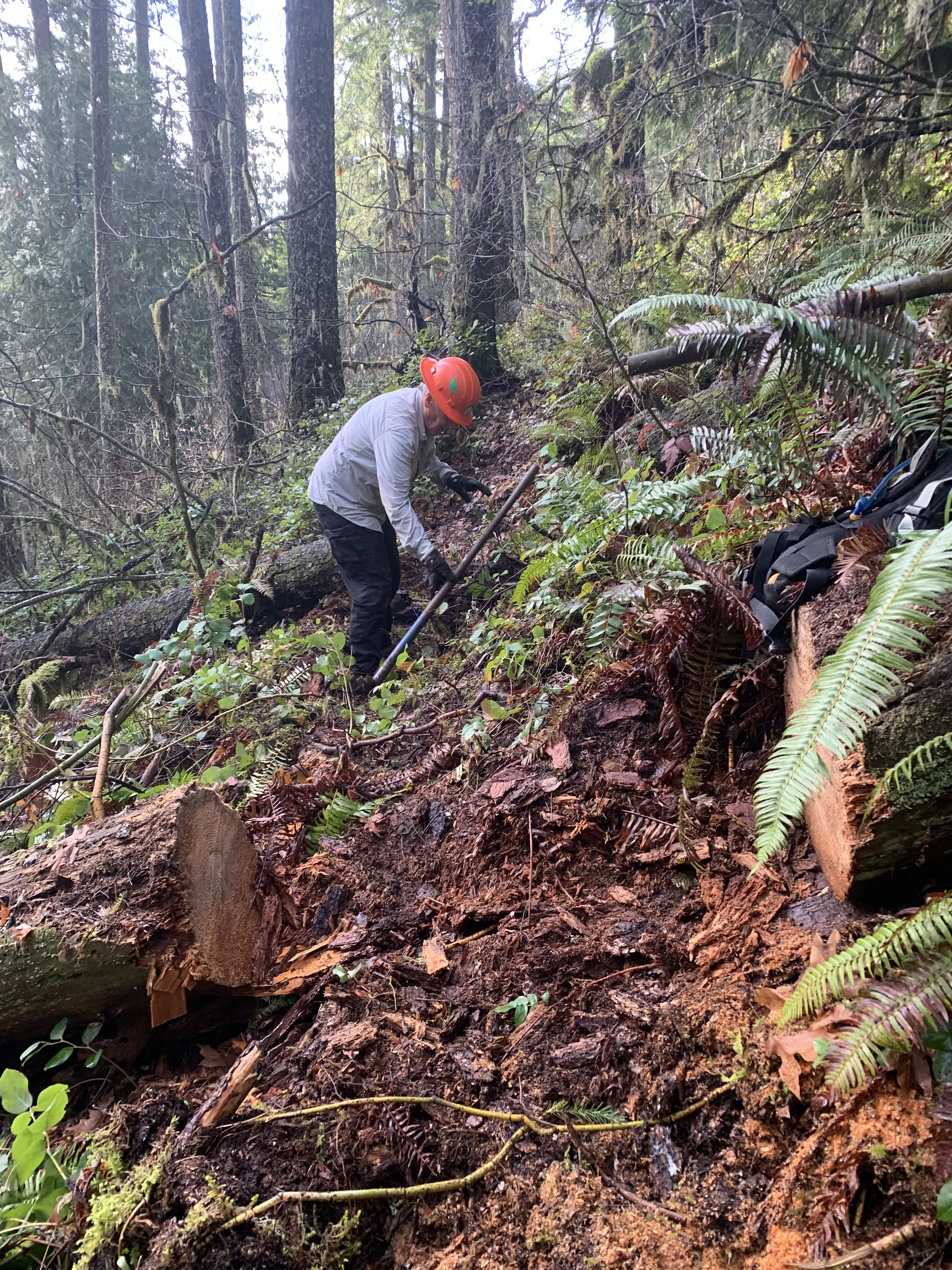
The rocks seemed like they would never end. I was digging into the lighter brown mineral soil, small rocks kept appearing which we didn’t want on the trail.

The Crew was working in Cloverpatch, five on the third bridge, which now had stringers across Tire Creek, rushing after the  recent rain, seven on the trail to the fourth and last bridge site. The stringers weren’t ready to walk across, so I waded through foot deep water quickly to the other side. My gaiters worked well; I had no sensation of wetness. 

I took the group a quarter mile further to work on the trail that had been flagged to the last bridge, a half mile further. Flagging meant someone had bushwhacked and put small flags on metal rods in the ground, marking a proto-trail, eventually to become a mountain bike trail. To make the actual trail, we had to remove large brush to get access to the ground, then plants so that the tread would be a yard wide, cut out roots and branches with hand saws, loppers, or tread tools, then scrape away organic detritus to the mineral subsoil, pushing the former off the trail. Digging uncovered rocks, some we couldn’t remove, others could be after several minutes, but many smaller ones kept appearing. The week before, eight of us cleared a couple hundred yards. I doubted seven of us today would get nearly that far.

The trail went uphill and side hilled, sometimes constraining the width sub-optimally. We then dug into the hillside, encountering more rocks, more dirt, and more plants.

I had noted rotten logs in the trail under which I was able to work a tread tool to lift parts of them out.  In the logs, I noted long stems of plant life, parallel to the grain. It was one of those new, odd things that I saw before moving on. I was bent over, and sometimes, to be easier on my back, I knelt on the trail to have better ability to use the Rinehart tool to move the organic duff and pick out rocks by hand. 

But I kept seeing rotten logs and roots. Finally, taking a longer, closer look, I saw how the stems had split the log longitudinally with smaller roots intertwined, like capillaries, with the rotten, still wet, wood. Cellulose and lignin are the two most common organic compounds in wood. These are glucose polymers—chains of connected glucose molecules— containing carbon, hydrogen, and oxygen. The non-cellulose parts have proteins, built with amino acids, organic acids with an amine group at the alpha-carbon, the one that is not the acid (-COOH ) portion. Glycine, the simplest, is vinegar (CH3COOH) with a methyl hydrogen replaced by an amino (-NH2) group. Twenty different amino acids are found in our proteins, 9 essential or required in our diet. Cells in rotten wood contain potential nutrients: nucleic acids have nitrogen, sulfur, and phosphorus. Other minerals are magnesium, essential for chlorophyll, potassium, and calcium.

Capillary is both a noun and an adjective. Capillary action is the ability of water to rise in a narrow tube due to attraction between the water molecules and the sides of the tube. It is an important way to transport water upwards through the xylem along with transpiration pull from the leaves.

By kneeling on the ground and moving much of it, I learned about the two forms of capillary and how the minerals present were being used to form new organic compounds that will appear in many phyla in both plants and animals in the area.

See you on the trail. Unless you are working trail, please leave no trace.

digging trail

COLD RELATIONSHIP

February 16, 2025

“Why are you wearing rain pants?”

I wanted to reply, “Why does it matter?” I simply said rain pants kept my legs warm. The questioner looked about 40 years younger. I have been his age; he has not been mine.

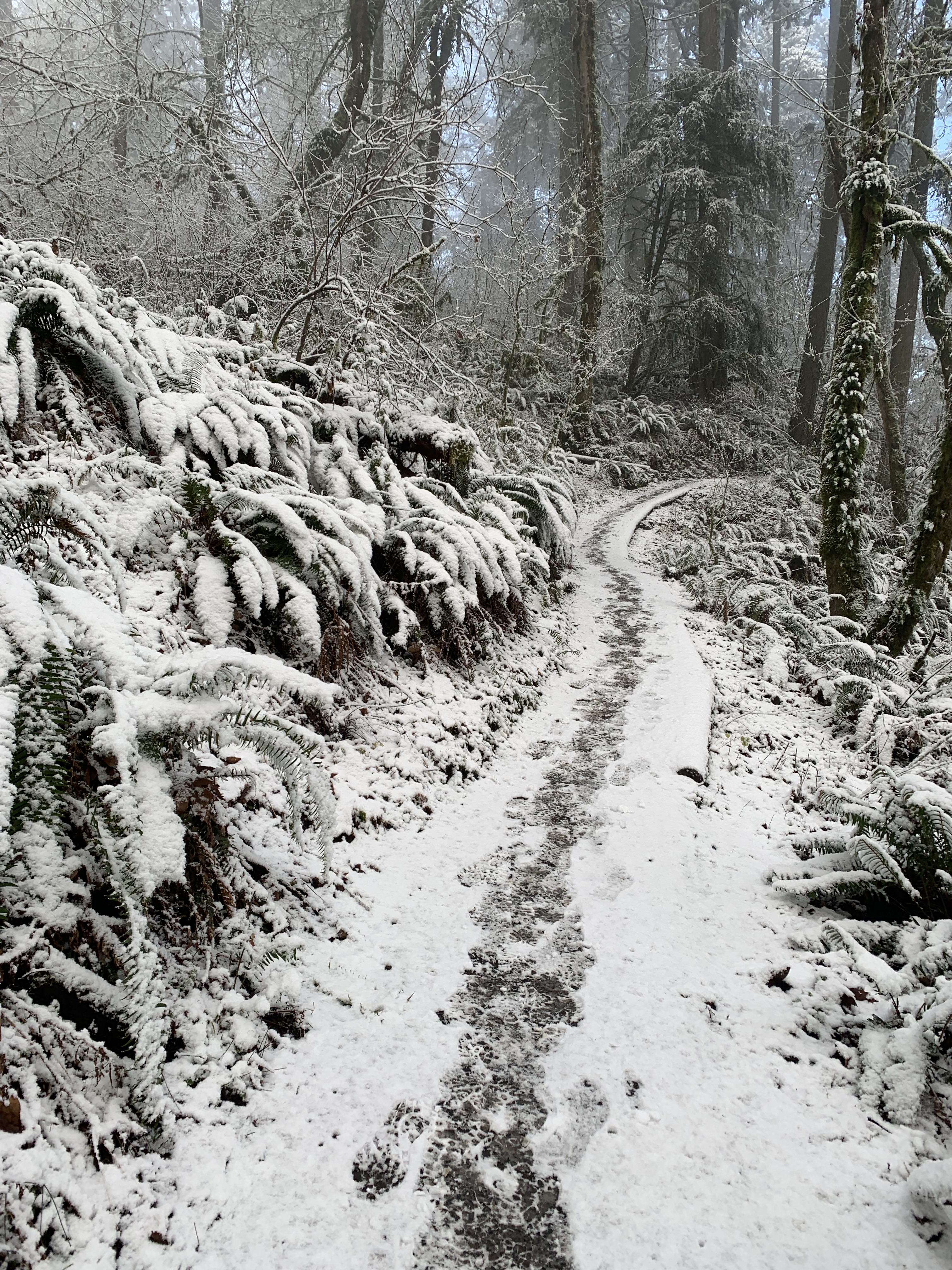
I recently hiked, avec pants, 5 miles upstream from Sand Prairie between the Middle Fork and FS 21. It was maybe upper thirties, partly cloudy, the first half mile exposed with a few inches of snow cover in the campground. Briefly, I wondered if I should have brought snowshoes, but soon the trail had only patchy snow, enough in places to slow me but not a problem. 

My feet not surprisingly felt cold, but the rest of me warmed up, although I never did take off my rain jacket. I wasn’t that warm, except for my hands, so I removed my gloves.

I reached FS 21 and decided to hike back on the road. The Sun was close to culmination (due south) and felt good on my back. I hiked a mile then found a sunny spot for lunch. Fifteen minutes later, having had sunlight on my black rain pants, my legs were warm, but when I stood up, I was stiff…and cold.  Lunch time has changed for me the past few years. I am definitely colder and stiffer afterwards and again need to warm up.

My entire relationship with cold has changed, sadly in the direction of less tolerance. I canoe tripped into my late fifties wearing shorts. I swam in September in northern Minnesota even later. Those days are gone. After years of starting cold and letting a hike warm me, my body is telling me to put more on. Three days after the Middle Fork hike, I went up Spencer Butte on a clear 20 degree day. I wore 3 layers above the waist, two below; I had gloves, a hat, a balaclava and the jacket hood up. For the first mile I was cold, especially my fingers, then felt more comfortable, actually removing my gloves, the hood, and partially unzipping my windbreaker. After two miles, I wondered whether I should take it off altogether but decided not to.

On the steps, the Sun was out but the wind cold. The gloves came back on, the windbreaker zipped up, the hood back up. On top, I placed the pack so the pad would get some sun and become warmer. I went behind a rock to sit out of the wind, using a glove between my back and the cold rock. No longer moving, I started to get cold and didn’t see any reason to stay up there. I put the pack, which hadn’t warmed, on, felt the awful sensation of cold sweat on my back, and started down. 

I never got warm. We burn a third the calories descending 10% grades compared to ascending. My gloves, hat, and hood stayed on the whole time. At the bottom, I drove to get coffee, the car’s heater on full. While warmer, I put my hands around the coffee cup. I was tempted to put my fingers in it.

When I got home, considering myself warm, I had lunch, read for awhile, then finally showered. Only then did I realize I was now finally normal.

See you on the trail. Wear what works for you.

Spencer Butte

WARMTH

February 13, 2025

I didn’t want to move from my spot in the tent. It wasn’t that I was comfortable, I wasn’t. I could have been warmer, but I at least wasn’t getting wetter, I wasn’t shivering; I just didn’t want to move.  We had just finished hiking the Chilkoot Trail from Dyea, Alaska, to Lake Bennett, in the Stikine Region of northern British Columbia. Far down the huge lake to the north was the 60th parallel and Yukon Territory. 

What I had brought for rain gear was not good, and kicking myself would not have been a bad idea, for if I kicked myself long enough, I might have gotten warmer. When we reached the lake we had paired up in canoes that had been previously stashed, and in the rain, paddled 2 or 3 miles north on the 26 mile long lake, camping on the west shore. We were following the Gold Rush trail, which began earlier back in Skagway, climbed historic Chilkoot Pass, the symbol of the Yukon, despite its being the border between Alaska and BC, glissaded down the snow on the north side and finished the 33 mile trail the fifth day. 

I heard some talking outside down by the shore. My partner and I had pitched our tent on the gravel well back from the water and dumped our gear inside out of the rain. He left; I stayed, like a worthless lump. A while later, I heard a crackling sound and smelled woodsmoke. That got my interest. There was a fire burning, and now I had motivation to move.

I went outside in the rain and saw a huge bonfire on the gravel beach. The lake was dead calm, rain droplets visible on the surface. I grabbed my wet gear and as I approached the blaze, there was a blast of oh so lovely heat and instant dryness. It was raining around us, but we were in a rain free cone zone by the fire.  I had undoubtedly been mildly hypothermic, and I stayed put for 2 hours, drying everything I could.  Life was better. Tomorrow, we would paddle a full day down the middle of the lake, the shore a mile away on either side, distance so vast that in an hour it did not appear like we made any progress compared to the nearby mountains. We would eat lunch at Boundary Island and camp further north on the east shore. The following day, with a south wind, we would lash two canoes together, use a tent fly attached to the paddles, held by each bowman, as a sail, and get a free ride to the north end at the small town of Carcross. After being windbound a day on Nares Lake, we paddled on through Tagish Lake to the beginning of the Yukon River and to Whitehorse, the capital, where the trip would end.

I recall similar life-restoring fires, like the one we had in Redwall Cavern on the Colorado River in the Grand Canyon one cold May day, when a spring storm put snow on the rim, caused beautiful waterfalls everywhere around us, but we were unappreciative because our provided rubberized rain gear leaked. For the first time, I had experienced shivering to the point of near exhaustion, taking me 3 hours by another big fire to become fully warm. We camped in the cave, against regulations, because of shelter from the rain and the unseasonable cold, slept dry, and made sure the next morning there was absolutely no trace of our stay.

See you on the trail. Leave no trace of any fire when you break camp. Even warmth in the fire bed must not remain.

UCD: “USUAL CHILDHOOD DISEASES”

February 4, 2025

I remember the dark room, closed door. My eyes ached. I ached. Seventy years later, I can still see the darkness.

Rubeola.

I could have died from it. Hundreds of kids like me did die every year, and that was a normal, usual, childhood disease. Some got encephalitis and survived, brain damaged, others died from…

Measles.

UCD. Usual Childhood Diseases. On medical records, you might still see this term.

When 100 children now die from influenza in a season, the country more than twice as populated as back then, it’s newsworthy. Back then, estimates were 500,000 measles cases annually in children. Virtually everybody got it, for measles is one of the most infectious diseases. The death rate was ten-fold higher per capita than influenza. What we didn’t know then was measles damaged the immune system for an extended period.  I wonder how that manifested with me. I had many strep throats. Could that have been a factor?

The following is my experience with UCD as a child and as a physician. The 6% of Americans my age or older have had similar experiences. We knew these diseases first hand. We all knew those who either died or had complications. These plagues are not extinct. They will return if we ever let down our guard. These diseases are not dichotomies between live or die; there are many in-between permanent complications, such as…

Rubella, a get out of school free card because we usually felt well, despite the rash. My wife was asymptomatic when a classmate diagnosed her. Adults knew, however, that rubella was far worse if a woman were infected while in the first trimester of pregnancy. My wife’s cousin was infected while pregnant during the rubella epidemic in the 1960s; her son was born with congenital rubella syndrome. He was deaf, leading to an obvious speech impediment, and had cataracts. Life is difficult enough when one is healthy; starting life deaf, limited vision, and trouble speaking puts one at a huge permanent disadvantage. His mother became a caregiver because of a disease which can now be prevented. Several lives were affected for every case. Twenty thousand had the syndrome in the early 1960s, but after licensure of the vaccine in 1969, there were about 100 cases per year in the 1970s, single digits annually now. These diseases occurred. UCD. Everybody got rubella, but many of us didn’t see the kids with congenital rubella.

We don’t know the potential lost with congenital rubella and other complications of UCD. It cost the son and his mother an incalculable amount, but we don’t measure or graph “incalculable” in economics. It is ignored. Lost productivity has a dollar sign, but happiness, joy, lack of pain, no disability, or having a child grow into an independent adult are more valuable even if unmeasurable. Had the rubella vaccine existed a decade earlier, the above tragedy never would have occurred. If we stop rubella vaccination, this story can recur, perhaps without a pregnant woman’s even knowing she had the disease.

We all got varicella, chickenpox, too. My wife remembers wearing mittens on her hands to prevent scarring of her face when she scratched. The disease for an individual wasn’t by mid-century standards bad, despite the death rate’s being triple compared to childhood influenza in a bad year today. Chickenpox never made the news. Everybody got it. Chickenpox is now dangerous for the many who are immunosuppressed. It also sets the stage for later infections with herpes virus, leading to zoster or shingles, and post-herpetic neuralgia is a nasty, miserable, difficult to treat condition. Two doses of the vaccine have a very high probability of lifelong protection.

A brother of mine had polio, fortunately not paralytic, but our parents feared summers and going to swimming pools or the beach because of potential spread of the disease. We grew up seeing March of Dimes money collection folders on store counters with pictures of children in iron lungs. I saw real people in them when I was a third year medical student. Unvaccinated young people traveling in the third world today are at risk for paralytic polio, a completely preventable disaster. Polio doesn’t care what color your passport is.

My other brother had mumps meningitis, fortunately not severe, but mumps can cause deafness and orchitis; the latter potentially causing sterility. When I was a Navy doctor, a sailor with a small testicle post-  mumps had his vas deferens, which connects the ejaculatory duct to the urethra, twist and cut off circulation to his testis, a torsion. This causes excruciating pain, like any blocked tube in the body, and especially for the testis. As a doctor right out of internship, I had never seen a testicular torsion, and I never would again, but the diagnosis was obvious. I successfully untwisted the torsion. The sailor was later found to be sterile. We now have a good vaccine for mumps.

When my wife and I were medical students, we went to the Crow Reservation in Montana, where earlier that spring there were three cases of culture proven diphtheria. In 1972. My father-in-law, who practiced ENT, told me that while throat membranes caused by the corynebacterium could lead to death from aspiration, what killed children was diphtheria toxin, a protein causing widespread organ damage including myocarditis, inflammation of the heart. Usual childhood disease. He saw a lot of it.

The first spinal tap I ever did was on a 2 year-old girl with stiff neck and fever. She had H.influenzae (H. flu; Hib) meningitis, which then afflicted 20,000 annually with 1000 deaths. She was treated immediately with antibiotics and eventually went home, but her parents may have wondered for years whether she could have suffered minor brain damage. We had a vaccine for Hib 7 years later that decreased the number of cases 99.5% with no deaths in 2021. Who would deny any vaccination that is so effective and risk Hib?

My mother had both whooping cough and scarlatina, the latter a strep infection with a specific toxin. My father had tuberculosis. We children wore white band-aid patches on our backs for a few days in summer to test for the disease. I have a small scar near my left shoulder where I was vaccinated for smallpox. Finally, I add two more Rs, roseola with its high fever and rash, and RSV, not known as a disorder until 1956. Having a vaccine for RSV is thrilling.

Usual Childhood Diseases became Unusual Childhood Diseases in my lifetime in one of the great triumphs of medicine. One may almost say that nobody gets these any more, a tribute to vaccine efficacy. The Salk Vaccine was so effective that the study was stopped early to start treating people sooner. I was in the first cohort for the Sabin oral vaccine. We must continue them and others.

I know many feel they must experience something in order to believe it. Having had measles, the sickest I’ve ever been in my life, I can confidently say one does not want to experience it. Ever.

Three messages from my generation: first, ignore these diseases at your or your children’s or grandchildren’s peril. Literally. Second, given the cost of treating these illnesses and their complications, vaccines are one of the most cost-effective treatments in existence. Finally, because these diseases didn’t happen doesn’t mean they were never possible, and not having a dollar sign value for something that didn’t occur does not make it any less valuable.