Archive for June, 2025

GREEN, IN THE LAND OF BLACK AND BROWN

June 30, 2025

I couldn’t miss seeing the green, since for the last two hours I had been in the land of black and brown,  black trees, black and brown soil, with occasional orange, which I learned was from clay having been burned. The few times I looked up from my work recovering the Pioneer Gulch trail, I could, if I stared hard enough, see some distant green across a valley through and behind the silent black trees around me. There were perhaps a dozen green plants growing in a pile of large rocks. Presumably the relative lack of fuel here plus the rocks helping to protect soil and moisture allowed the seeds to germinate. The leaves looked familiar but I couldn’t identify them. 

We were working in the post-fire zone on Pioneer Gulch Trail, in and adjoining the Diamond Peak Wilderness. The 208 fire burned 11,263 acres (about 17 square miles) between mid-July and the end of October 2024, when it was contained. Lightning caused, it was never a danger to property, but it burned wilderness in which we had worked for several years along the west side of Diamond Peak, well below the 8700 foot summit and the 1000 foot lower treeline, but high enough above the surrounding valleys, where beautiful Happy, Blue, and Corrigan Lakes were all in the burn zone. I had been on the trail several times but recognized nothing.

The official burned zone is not always a blackened moonscape. Fire footprints are a mosaic, where there can be surviving trees and ground cleared of downed brush. The Rebel Fire in 2017 cleared out the forest floor nicely. The place looks good. The 2018 Terwilliger Fire was another example of a mosaic.

Unfortunately, this part of the 208 fire had burned hot, and all the trees had burned. Pioneer Gulch climbs steeply 1100 feet in 1.3 miles and is used by climbers to access Diamond Peak. The Middle Fork Ranger District made restoring the trail a priority for us. We had finished our bridge and trail building on the Middle Fork Trail the week before and finally finished Cloverpatch work three days earlier. Those two trail jobs occupied 41 work days for me alone, although I missed out on three or four. Our job here was to cut the downed logs, remove them, find and repair the trail.

By working virtually every inch of the trail, we could make it visible for hikers. Burns kill roots, which disappear, leaving tunnels in the ground that can collapse under a hiker’s weight. They often move logs and rocks to where we don’t want them, like on the trail.

Seven months earlier, we worked on Bunchgrass Trail 30 miles north, two years after the Cedar Creek Fire. That was a moonscape with minimal regrowth and soil like powder, easy to dig in but difficult to find something solid below that would qualify as a trail. Here, there was a hard packed trail with frequent large holes, where the trail had disappeared. We filled the larger holes with rocks and then found nearby dirt to cover them, not unlike the approach to building a ramp to a bridge. Some places, the trail had eroded or would soon erode, so we moved it back into the hill a foot or more. Other places it was difficult to see the trail, but sometimes looking where a trail might be allowed us to find it. I used a Rinehart tool, a cross between a hoe and a shovel that had been bent 90 degrees. We had a Pick Mattock, a cross between a pick axe and a Pulaski, and other digging tools: Travis, McLeod, Rogue Hoe and a square shovel. I wasn’t sure what I would encounter, but the Rinehart worked fine. It could dig, acted as a small shovel, could cut many roots which were destroyed by the fire, lever moderate logs off the trail, and tamp down my fill dirt. It was light and easy to carry, doubled as a walking stick.

As we ascended, we found more trees that had survived the fire, so there was some shade. It would take us two work days to repair the trail, and we would need to do the same further south on Rockpile Trail, as well as the connector trail between Pioneer Gulch and Rockpile, and  south of that junction with an east-west Forest Service road, ending a series of trails that started at Salt Creek Falls, 20 trail miles, 65 road miles away.

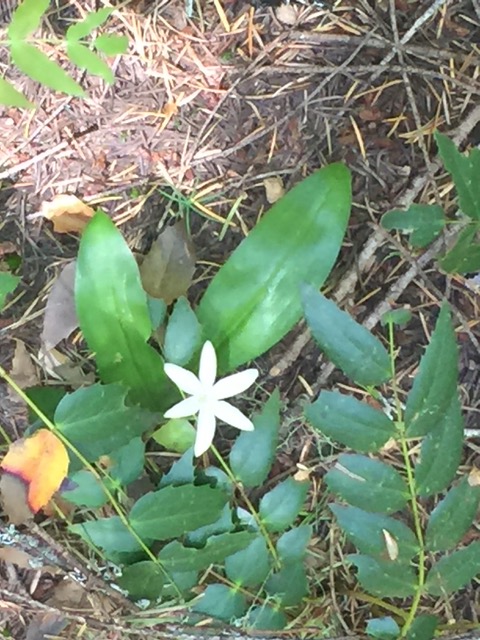
A short while later about ten yards past the group of plants, I had an “of course” moment when I saw one more living plant with similar leaves as the others, but this time blooming, immediately recognizable as a Bleeding Heart.

Bleeding heart plants (Lamprocapnos spectabilis)

Diamond Peak

WHITE FLOWERS AND UNDERBUCKING

June 8, 2025

I love queen cup flowers. Six separate white petals, not tall, they bloom in the sixth month of the year, following the five petal Oregon anemones, which bloom in the fifth month of the year. I noted them along with a few five petal wild blackberry flowers on the half mile Frissell Crossing Trail from the South Fork Trail in the Three Sisters Wilderness to the campground, effectively unusable because of blowdowns. At least 20 logs were over, on, and blocking the trail.

The Crew had split into two groups this Saturday, an unusual day to be out, but we had several interested who could come out only weekends. I came along fully expecting to clear brush at the far end of the wilderness trail, but I was assigned to a group cutting out logs outside of the wilderness. That was fine by me. My foot bothered me a bit, and I wouldn’t be hiking as far.

The first log was a teaching moment for another Mike, retired Forest Service, a crosscut saw expert with a wealth of information. He sharpens saws, a job that he says takes about ten years before a person does it properly. The classic saws we use are about a century old, with as many teeth as years, along with terms like rakers, gullets, guards, and made of high carbon steel, not requiring sharpening often but very brittle. The saw teeth should never touch dirt, and woe unto anybody who lets that happen. The handles may be removed or rotated 90 degrees. Once while bucking in a different crew where nobody knew me, I fastened a saw handle about as quickly as possible with gloves on. That doesn’t usually happen, and it meant something that day to have someone see it.

We soon had a couple pair of logs that had to be dealt with, plenty of work for everybody. I had done one logout earlier this year, so my arms were ready for another day’s handling of a saw. Along the trail the trilliums were now gone at our elevation about 3000 feet. It was about 60, comfortable, some stream noise in the distance from the South Fork of the McKenzie River and no bugs. Good day to be out.

I misjudged what one log was going to do and didn’t recognize a couple of things we could do on one that the other Mike pointed out. I wasn’t feeling good about myself thinking after more than 7 years out here and 120 plus days logging out, I wasn’t progressing, just getting old.

After lunch, we worked on a series of three logs that required six cuts, opening another section of trail. We encountered the last log about 12 inches in diameter, high over the trail, caught in the V of two trees on one side. My turn to say what to do. Nobody else was talking. 

I have visualized this sort of problem at night and tried to figure out how to deal with it.

I said we should go to the far end away from the V where the log was closer to the ground and cut it there. It had bottom bind, meaning it was bowed upward; a cut will have tend to have the log go upward and maybe come apart (like explode), with a great deal of force. Such logs are under a lot of tension on top with compression below. We started with a top cut, a small mistake but maybe not having been seen by others. The log started talking to us by cracking, and I told my partner to stop sawing and to move the saw underneath to underbuck, cutting from below. I like to do this anyway, but I should have done this right away.  If we cut into compression, the tendency of the log to explode when the tension is cut will be minimized so it won’t slab off, carry the saw into the air, or throw a Pulaski 30 feet, all of which I’ve seen. Earlier that day, I had underbucked  twice with the right offset so when the cut round fell, the saw stayed in the fixed part, completely protected.  That’s pretty cool if one is interested in this sort of stuff.

We underbucked maybe an inch into the log and then went back to the top. There was more noise, and I had us again underbuck about three inches away from the first time. We returned to the top and this time cut all the way through. The log dropped.

Perfectly. It didn’t slab, and it was now just below waist height. Wonderful. The V it had been hanging in was pulled apart just enough to keep the log off the ground. We cut through it and were done.

On the way back, I thought I saw a trillium, but the three sepals were white along with the rest of the flower. Trilliums have green sepals. When we got back to the vehicles, there was a whole group of these flowers growing nearby, and I took a closer look. They were Oregon Iris. It can be—and here it was—white.

Queen’s cup

Oregon anemone