Archive for July, 2025

COOL IDEA

July 28, 2025

The small, gurgling stream nearby had my attention. Should I or shouldn’t I?

I was brushing and logging out Lowder Mountain while working with a sore foot. The affected appendage gave me three good hours, but during the fourth, I started having discomfort, and I still had to hike out. At lunch, near a barely flowing stream, I remembered a few weeks back in the Diamond Peak Wilderness, the same sore foot, but additionally a sore toenail, worsened by wearing an extra sock. During lunch, I took off the boot, hoping it wouldn’t be a mistake. It wasn’t. It felt great. I pulled off the extra sock, the one underneath, and let the foot air out. It felt even better. After 10 minutes, I put the other sock back on and then the boot. My foot still hurt, but I could finish the day. 

Remembering, I again removed my boot. Same feeling, same questions. Should I or shouldn’t I? It’s difficult to put a sweaty sock back on a wet foot. So what? I have been on my knees all morning, two of us removing brush on every foot of the trail through the large last meadow, although admittedly we spared the scarlet gilia and the western coneflowers. It’s hot. I can use the top of the sock to wipe my foot dry. We have to wait anyway for two others returning from having gone further up to check out the summit; we had time. I deserve a break, and so does my foot.

I took off boot and sock, let my bare foot get some delightful fresh air, then put the boot back on and hobbled over to the stream to where the trail crossed several flat rocks with perhaps a half inch of water flowing slowly over them. I moved carefully off the trail, under an arch of branches, found a rock I could sit on near a small pool of water maybe 6 inches deep. Perfect. I sat down on the rock, removed my foot from the boot, and stuck it in the water.

Wow. Cold and great. Within 30 seconds, I felt no cold. I should have come over a half hour earlier and eaten my lunch here. The gravel bottom was fine. I could sit here for an hour or all afternoon. I wouldn’t, of course, but I got a chance to look upstream at the steep grade with a narrow chain of rivulets. It was shady and out of the way. I had hiked by this stream at least 10 other times and never knew what was back here. But today I discovered it. Twenty minutes later, it was time to do some work, so I removed my foot which dried in two minutes. I put the sock on, then the boot, stepped back on the trail, and five minutes later the other two showed up. The hike out went fine.

I don’t swim in Oregon because the water is too cold for me, an old man with thin skin and not much insulation. Or I am a chicken. It’s great others can. Last time I swam was 2017 by a campground in the North Cascades. Several of us had just finished a hot hike. There was a lake and a boat ramp. I stripped down to shorts and ran right into the lake, the best way I can deal with cold water. I wasn’t going to swim and didn’t, immediately getting right out. But I was cooled down for the rest of the day. Swims do that.

See you on the trail but probably not in the water.

One of many meadows on Lowder Mountain.

NOT QUITE BY THE BOOK

July 20, 2025

Twenty feet ahead of my knees were many Cascade asters on the left side of the trail. I decided I would work to them—on my knees—then take a short break. I adjusted my position and continued hacking at the encroaching thimbleberry with a hand saw, occasionally using loppers for their stems at the base. I was in the middle of a brilliant green, several acres, steep sloping meadow where the forest gave way to low plants.

One of several meadows on Lowder Mountain

 I was not quite halfway up Lowder Mountain trail, which began at FS 1993, ending about 600 vertical feet above me to my right at the summit. Olallie Mountain was across the valley to my left or south, and I could see individual trees, consistent with old fire damage near the summit. We had a crew working over there logging it out. I set up a concomitant trip to Lowder because I wanted to get in the woods, my sore foot wasn’t going to tolerate hiking up Olallie, and brushing Lowder was as important as logging it out, since the couple hundred yard stretches of thick brush in each of several meadows was both difficult to follow and concealed holes of some so far undetermined rodent. I’ve hiked Lowder maybe ten times, and one specific, treacherous hole has always been there—hidden by brush.

I arrived at the asters and had to decide what to do with them. They were on the downhill side of the trail, but there was adequate room to hike by. I couldn’t see removing all with my hand saw or loppers, because frankly they were really pretty, so I removed a couple carefully and left the rest. In a couple of weeks, they will have gone to seed, their job done, part of which was giving me pleasure.

I don’t like removing flowers, but trail work requires it. I purposely avoided power brushing a few dozen trilliums last spring on the Middle Fork National Recreation Trail, although I still accidentally removed three. Trilliums take years to grow and flower, and I felt badly about my error. Three years earlier, I left a large false Solomon’s seal hang over a trail on Fall Creek, because it would have been criminal to cut that beauty out. 

A few minutes after I reached the asters, I accidentally lopped off two tiger lilies, because with so many different plants encroaching, different size, different leaf arrangement, it was difficult to sort out which plant went with what stem. A little further there were two more over the trail. I didn’t cut those; I bent the stems and moved the lilies behind thimbleberry safely away from the trail. Their flowers can still be pollinated. It’s not in the manual for trail clearing, but flowers are flowers.

Western coneflowers appeared, and I slowed to make sure they were left alone. Their stem has a whitish cast, which I had not previously noted, although I never had been in the position—hiking through a meadow on my knees—to look to avoid cutting one. The brownish cone top with the green leafy bracts is a standout. I didn’t notice the green surround when I first saw these in the wet meadows of the Waldo Lake Wilderness years ago. I haven’t been back there since the Cedar Creek fire, but this day Lowder had many. The stems could also be bent so I could move the flowering top further from the trail. If I could find a similar flower nearby, I hooked one around the other. Coneflowers need hours of sunshine, perfect for where they were.

At lunch I saw some columbines and two deep purple flowers 20 feet away and below me. When I later walked to them, I discovered the purple was really a deep red of a columbine that was past its prime and fooled my sunglasses. False alarm. The bloom had collapsed, the colors darkened. Later, I saw a blue gilia, a small puffy flower with tiny blossoms and a thin stem. It was at a switchback near a broken log I wanted to push off the trail myself but was afraid it would land in the trail below and I would have to move it again. It would have to wait for the logout the following week.

Keiko came up to me during lunch and thanked me for saving the purple flowers—the asters. She had noticed them, too.  

Western starflower.

IT’S MORE WORK THAN YOU THINK

July 17, 2025

For the tenth time that day, we stop at a log to remove it from the trail. Each of us finds a spot to drop our pack, maybe before the log, because we want to get rid of the weight and bulk before clambering over the log, or perhaps after, so we don’t have to backtrack when we finish to get the pack. Placement sometimes requires later movement to prevent the cut log, a round, from running over it. Before dropping my pack, I need to put down what else I am carrying, usually an axe or a Pulaski, sometimes a large crosscut saw or a pry bar, then take off my gloves, unbuckle the hip belt and the chest strap, the latter often closer to my neck. Then I drop the pack directly through both arms or remove one arm strap and allow the pack to swing, whereupon I grab it, remove my other arm, then more gently lower the pack.

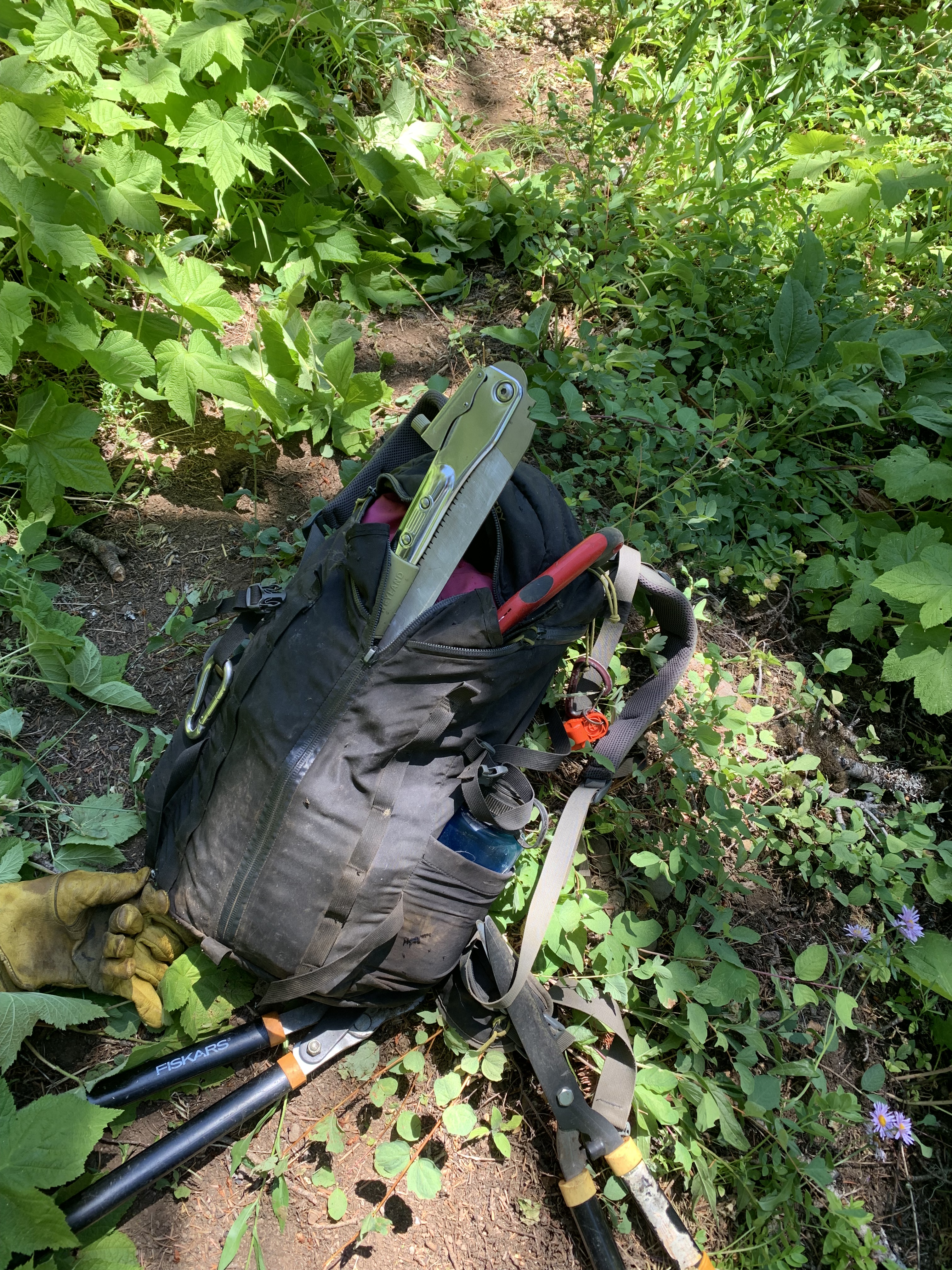
I have a Corona hand saw and a larger 500 mm KatanaBoy saw in the back of my pack that I want available, so I put my gloves back on and pull the two saws out. These, along with a Fiskars handsaw in my pocket, are used to trim branches or finish the cut, when the big saw is close to the ground and we don’t want its teeth to have contact, which will dull them. If I am carrying a crosscut saw, there are three velcro straps or buckles that have to be undone to free the saw from the blade guard. I try to do that with my gloves on, but sometimes I can’t.

I also carry three or four hard plastic wedges in my shirt and pants pocket for the cut. Last thing I want to do when cutting is stop, go to my pack or someone else’s and hunt for them. It’s more bulk to carry, but they are nice to have ready. Wedges keep the kerf—the cut—open and lessen saw binding.

After finishing the cut, which may take a few minutes or a few hours, we sheath the big saw, which on a good day can be done with gloves on and velcro’s behaving. On a bad day, the velcro has to be pried apart, the scabbard won’t line up properly, we put the saw on in the wrong direction, and the gloves have to come off again. Then I put my Katana in the pack, then the Corona, hopefully lining it up with its scabbard inside the pack, a 50-50 chance, which shouldn’t be if I could remember the whole day which way the scabbard curves, zip up the pack, pick it up with one strap and put it on. I now have to make a decision: if I think the next log is a minute or two away, I won’t bother with the hip and chest straps, and I keep the gloves off. Or, if I know from a scouting report the next log is some distance, or I guess right, I buckle up, but that’s a good day. I have to buckle the chest strap by feel, which may take one or many more attempts. If I decide to buckle up and the next log is around the corner, I have wasted energy and time. If I don’t buckle up and the next log is more than a couple hundred yards, I am going to have to stop, because carrying the pack unbuckled becomes uncomfortable. I usually keep my gloves on, because often there is something small that might need my pocket saw, unless I accidentally drop it or leave it somewhere. When one stops ten or more times a day, it is moving a lot of weight and taking a lot of decision making time that generates more fatigue. Other than that, logging out a trail work is just a day hike, with maybe 10-15 pounds extra gear, cutting a bunch of logs, moving the rounds off the trail by pushing with hands or feet, and going to the next one.

Maybe it’s a bit more than a day hike.

SWARM

July 9, 2025

The trailhead was several miles closer than I thought and the road better than expected.  Good start to the day.

Then I opened the car door.

Immediately, mosquitoes were all over me. Alone, I had their undivided attention. I have spent time above the Arctic Circle and hundreds of days in the Boundary Waters. I know mosquitoes. Just two weeks earlier at the southern terminus of the Middle Fork trail by Timpanogos  I was the only crew member not to wear bug netting or use bug repellent; generally, that is typical. I heard, “There’s a swarm all around you.”  No problem.

Today was different. I was at another southern terminus, this time Diamond Peak Trail, planning to scout north 2 miles to Rockpile Trail and then head east. Summit Lake was nearby, and there were many ponds near the trail. Figure lots of standing water, one mammal, swatting several at a time on a hand, inhaling some, glad for once I wore hearing aids, since at least the bugs wouldn’t go in my ear.

The day didn’t improve. Two hours later, the last hour at least mosquito-free, I was off trail. I wasn’t lost, because I knew where the trail was behind me and could always get leave the woods that way if I had to. I was annoyed at myself, however, because earlier I had come through the other direction and had no difficulty. I usually need to see a trail on two separate occasions to develop a decent memory of it. 

I had hiked past ponds, streams, and snow, swatting as much as I tabulated downed trees and possible needed tread work as a result of the 208 fire. There were so many downed trees I listed them by number every hundred yards. Trail scouting in a fire zone is like route finding in winter. With no ground cover landmarks, many spots appear to have a trail. Finally reaching Rockpile Trail and turning east, I quickly lost the trail. I hunted on the north and south sides and got lucky.  I then placed my pack on the ground to scout ahead more quickly, finally making a 25 inch diameter log across the trail my turn around point. I needed my GPS to find my way back. Note to self: keep your pack on when having directional trouble or at the least be extremely certain you can find it again. The phrase “think I can” is inadequate. I returned to the 4-way junction, headed south and after 3/8 of a mile lost the trail again.

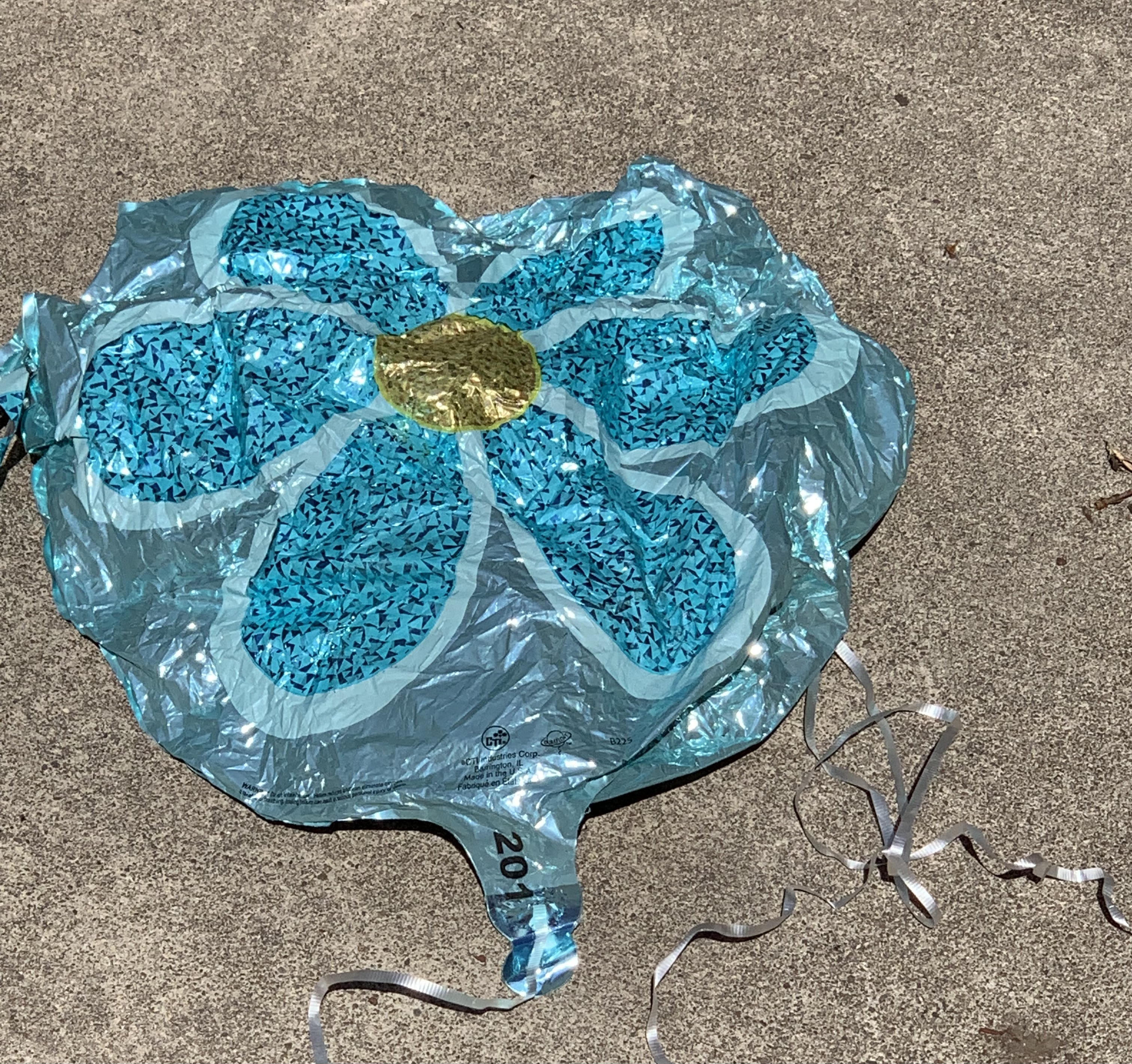
Then I saw a balloon. On the ground. In the Diamond Peak Wilderness.

At first, I thought it might be a weather balloon, for balloon soundings are sent up twice daily from Medford and Salem, and the balloons have to come down somewhere. But the gray ribbon bow was clearly not from the NWS. It was a balloon from a gathering somewhere. It still had some gas, probably helium, although I didn’t do a voice test. Someone likely to the west of me, given population centers and prevailing mid to high level winds, released it. Out of sight, out of mind. Sort of like tossing an apple core. You don’t see it again, but it still exists.

I felt like I was a little less in the wild. A balloon can do that. Once, in a remote area of Alaska, I encountered an Epi-Pen cartridge. I know that this region has not always been designated wilderness, but it has been officially wild in one form or another for 70 years and a balloon is as much out of place here as I would be in Times Square. East of nearby Summit Lake people used to drive in to what is now near the PCT. You’d never know it by how it looks now. I picked up the balloon, put it in my pack, finally figured out where I needed to go, found the trail, placed illegal but temporary ribbons for those who were going to log it out so they could find their way, and hiked downhill out of the burn area into the woods, where the mosquitoes were still waiting.’

See you on the trail. 

Unnamed pond, good mosquito source.
Turnaround point.