Archive for August, 2025

AN INTERESTING TWIST

August 23, 2025

This wasn’t an impressive year for huckleberries at my Waldo Lake spot near Shadow Bay. I had hoped for more, but I decided to quit early and drive down to Marilyn Lakes off Waldo Lake Road, where I knew there were both blueberries and usually  a few huckleberries. It was a cool August day in the Cascades with significant mist above 4000 feet when I drove up and even on Waldo Lake itself, at 5400 feet.

Marilyn Lakes, upper and lower, are similar size, a bit over 20 acres, south of 50 acre Gold Lake, the latter’s having a campground and not allowing internal combustion motors. There is a network of trails throughout the several lakes in the area: Gold Lake Sno-Park south of 58, with Odell, Midnight, and Arrowhead Lakes; Willamette Pass Ski Area 3 miles further up, where the PCT crosses the road northbound to the Rosary Lakes, with a northern access to the PCT from Gold Lake Road as well, passing above and south of Gold Lake on the Maiden Peak Trail.

I parked on the side of the road, just south of Fuji Mountain trailhead on the other side, hiking downhill a short distance to Gold Lake. I crossed the bridge over its outflow, Salt Creek, which flows towards spectacular Salt Creek Falls, 20 miles later joining the Willamette in Oakridge.

A couple of years ago, we power saw logged out the Marilyn Lakes trail system, during which I noted a nice patch of blueberries south of Upper Marilyn Lake. Somehow, during multiple prior times on the trails, it must have been before or after blueberry season, because I didn’t notice any. There are huckleberries as well, which I thought I might sample on my three-quarters of a mile hike to the blueberries. The trail is generally flat; upper and lower lakes are separated by only three feet of elevation and 300 yards.

I hiked in from the campground and within 50 yards saw blueberry bushes, although with few berries. The trail became wet, a small seepage maybe 50 feet wide with several large skunk cabbages with individual leaves over a yard long and blooms at least a foot high. Along a small wooden puncheon were multiple, large, thick branched blueberry plants the size of cultivated ones I frequent every year to pick my own berries for morning cereal. These larger plants had berries.

For the next hour and a half, I picked. My foot was bothering me, but once I started picking, I realized I didn’t need to hike further. After obtaining what I could from the puncheon, I stepped off into the dark mud over branches that at first I didn’t even realize were blueberry plants. Wild berries are smaller than cultivated ones, so I picked to save for maybe 40 minutes, before I picked several handfuls just to eat. The branches were thick, the ground damp, with a convenient small log to sit on while I picked berries individually or in groups of two, three, or four. I could go further into the woods if I wanted for more berries, but I didn’t need to. I came here for berries and to get into the woods on a nice, cool day. I had to decide whether to wear my sunglasses for sharper vision in the dark woods or to take them off for more light, but struggle with my astigmatism and perhaps miss my target.

As I worked my way back out of the bushes, trying to protect the branches from more abuse, I placed my berry bag on the trail so I could extricate myself. As I finally stepped onto the trail and bent down to pick up the bag, I saw something red on the other side peeking out from underneath a stem of a small plant with alternate leaves resembling a false Solomon’s seal. I picked up the end of the stem and looked underneath: there were a series of red berries hanging off the underside, which I had never seen before. 

This was twisted stalk (Streptopus amplexifolius). Earlier this summer, I had heard this name (as “twisted stock”) used at Pioneer Gulch Trail, describing something larger, in a different habitat, that clearly wasn’t. That latter plant remains to me unnamed. Twisted stalk berries are not poisonous, but I didn’t plan to eat any, only to be fascinated with their color, number, and hanging. 

When I was a guide for Sandhill Cranes viewing, some were impatient if the birds were late. I told them the world was unfolding as it should. The birds always came. I went for huckleberries, ended up with wild blueberries, saw an interesting plant, and learned something about real twisted stalk, its name, location, and hanging berries. The world unfolded as it should.

See you on the trail, and may your world unfold as it should.

WIN-WIN

August 9, 2025

Years ago, when I trained in neurology, I spent time at the Tucson VA Hospital. I remember a radiologist there, a pleasant man 30 years my senior, who once tried to get rid of extra chairs in his department. I don’t know how he ended up with so many chairs, but he wanted to get them removed and had no success.

Then one day, an edict came down from the fire safety manager saying the halls were unsafe in many departments because of furniture. If anything not fixed in place was left in the hall, it would be removed.  The radiologist was thrilled. He told his secretary to start leaving chairs out in the hallway. Problem solved.

The Crew was working Rockpile Trail from the trailhead on Pioneer Gulch to Rockpile Lake junction, about two and a half miles. The trail was mostly in the 208MF fire last year and had been badly burned over. We had to hike almost a mile where we had already cleared and logged out the trail before we got to the rest needing work. We had three saw groups and I led a fourth group to work on restoring the trail, which needed to be found in some places, have holes filled with rocks and soil, and dug out in other places so people could follow it.

At the trailhead, 600 vertical feet below where we needed to start, we lay all the tools out on the ground that we would need. Everybody takes at least one tool and maybe two. Not sawing that day, I left my axe, wedges, and hand saws out of my pack and off the ground.  That was 10 pounds less right there. The last tool remaining was a Rogue Hoe/Rake, which is fine, although I prefer a Rinehart with a better hoe with no rake. I had reached a certain degree of competence in trail work and had used many different tools. An experienced crew member told me a couple years back he liked the Rinehart the most, and with time I agreed with him. But a new person to the crew took it. I could have pulled rank and taken it from him, but I can work with a Rogue Hoe. Both it and the Rinehart are light; I can use either as a walking stick, shovel, or a root cutter, especially in a burn, where roots are easy to pull out, or if not that, to cut with a hard whack. The tool is stable enough vertically that I can use it to pull myself up after kneeling.

Starting the climb, I was slow, in part because of plantar fasciitis, which had me trying different sock combinations in addition to a boot insert. I found something that worked, but it was additionally humid with a chance of thunderstorms, and that slowed me down, too. Eventually passing the new person but staying well behind another, I made it to the junction, where we regrouped. We planned to leapfrog each other up the trail. The saw groups were ahead of us. I used the rake part of the hoe to break up the soil and move it, either to fill a hole, to uncover the tread, or to make a place for flowing water to drain off in order to limit trail erosion. There had been some recent rain, so there was almost no dust; the last time we did trail work even hiking left dust in the air, quite typical in Oregon this time of year.

About a hundred yards past the junction, I caught up to the new person, who asked me whether a gully on the side of the trail could be left as is. I preferred not to do that, so I used my rake to break up some dirt to put in the gully to fill it and uncover the tread where I thought it should be.

“Wow,” the newbie said. “I should have taken your tool.”

Music to my ears.

Quietly, I replied, “Want to trade?” 

I got a look like really? You are going to let me use that?

We traded tools.

The rest of the day went well. Why not? I just traded away a tool I didn’t prefer to somebody who wanted it and had the tool I wanted. We were both happier and he might think I was really nice to work with. Or not. I had put the chairs I didn’t want in the hall. Win-win.

See you on the trail.

Jean in the foreground using a Rinehart; Dale in the background with the Rogue Hoe/Rake he “traded” for. Rockpile Trail, Diamond Peak Wilderness.

FAMILIAR SEEN IN UNFAMILIAR SURROUNDINGS

August 5, 2025

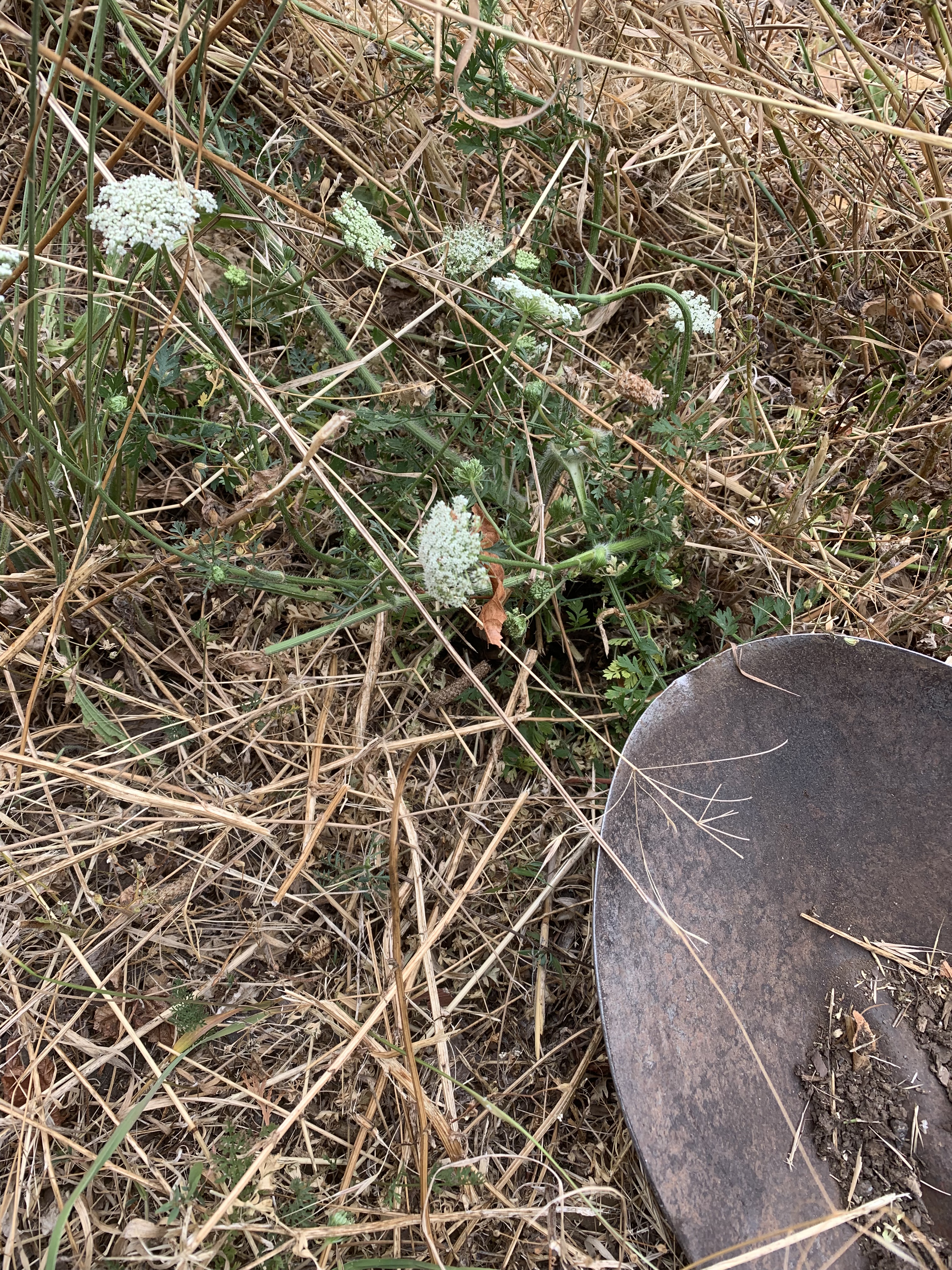
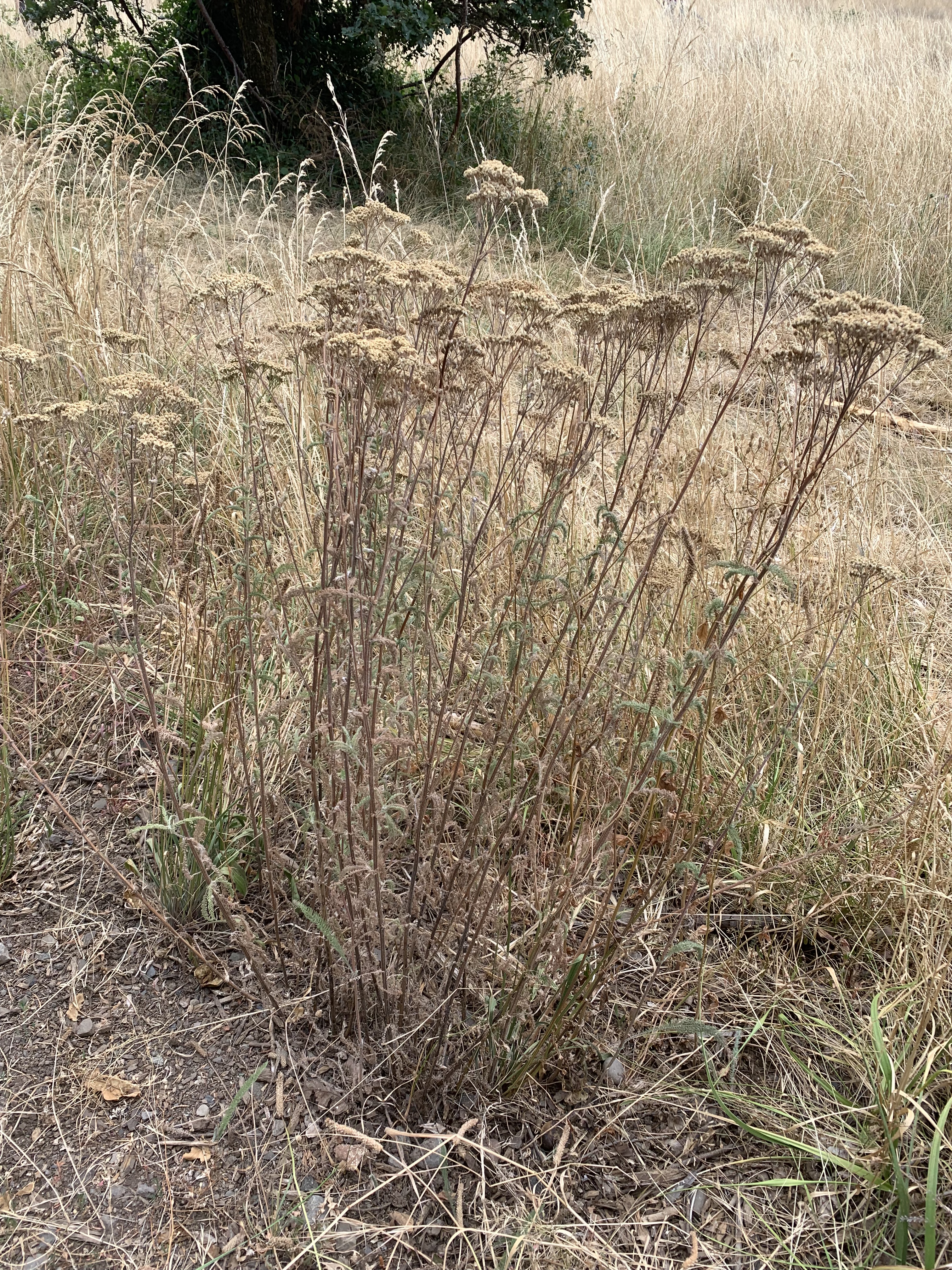
“Hey Mike,” Patrick called over, holding up a bunch of brittle brown stems. “This is yarrow. You can leave it.”

Blast it, I said to myself. I had looked at it, figured it was Queen Anne’s lace gone to seed and pulled it out. “You know, I wondered about that,” I said, “but it pulled out the way Queen Anne’s Lace did.”  

Chastened, I returned to work just below the gravel road at the Arboretum, in the brown grass, where real flowering Queen Anne’s lace needed removal. My job as one of several volunteers was to clear five or six meadows, each a few acres, of that, tansy ragwort, and Canada thistle. Queen Anne’s lace, 90% of what we were pulling out, is an invasive successful competitor, tansy ragwort is toxic to animals, and Canada thistle is also invasive. The first two are biennial; thistle perennial. We will need to do weeding next year in order to fully control the biennials.

I had just learned something about yarrow, because while I had seen plenty of the white blooms, I wasn’t familiar with yarrow that had gone to seed, a polite way to admit I had been around yarrow that had gone to seed but hadn’t noticed. The blooms had faded to brown, but the yarrow flower structures were still present. Had I looked at the flowers more carefully, I would have noticed the difference and besides, Queen Anne’s lace was still blooming. None appeared past the blooming stage. While true yarrow stems were the same size as Queen Anne’s lace and easy to remove, that was irrelevant.

We are pattern recognizers. It allows us to perform quickly and efficiently much of the time. But sometimes the familiar seen in unfamiliar surroundings can fool us. It reminded me of 24 years ago on a train trip back from a solar eclipse where that evening I saw an odd arc of stars just clearing the northern horizon over Zambia. It took me a while to realize it was the handle/spout of the Big Dipper, an asterism I knew well, the southern part of which was just visible from where I was at 16ºS., but had never seen in such circumstances. The stargazing I did south of the equator usually was focused on objects I couldn’t see from home. I stared at the handle for a long time.

I remember fields full of Queen Anne’s lace when I was a kid, but I didn’t see much of it afterwards. I was not consciously aware of its being called wild carrot because of its pale carrot-like tap root. I think I would have remembered. But perhaps not. As I worked, I developed a sense of what I had to dig up, how deep, how far around, what I could pull out just by hand, oddly using my non-dominant left hand as a decent lever that would either pull the plant out or not, whereas my dominant stronger right hand would often break the plant off above the ground and not be as helpful.

I noted the smallest Queen Anne’s lace flowers often bloomed from the same rosette of leaves. Once I discovered that relationship, I tried to remove the whole base along with its single large taproot, not each individual flower. Small free standing plants I could carefully remove with my “calibrated” left hand. Medium-sized plants I could comfortably pull out with either hand, and the larger ones I needed a shovel to clear out slightly more than 180 degrees around to pull them out. Six of us there cleared two acres, putting the removed plants in a large plastic bag, thicker than the one we used two weeks earlier, which ripped early and often, spilling seeds.

Back home the next day, Alton Baker Park was a sea of white Queen Anne’s lace. I looked at the flowers differently from the way I had before. I left these alone, more interested in picking blackberries from another invasive plant. I tried to visualize the number of tap roots out there. I like the smell, which reminds me of my childhood three thousand miles to the east.

Maybe see you on an Arboretum trail sometime.