Archive for September, 2025

EVENING PRIMROSE

September 30, 2025

My morning walk through Alton Baker Park was abbreviated because of foot issues, so I took a shorter route through a quiet neighborhood. I could do laps if I felt better than usual, but I missed walking further in wide open spaces I could see just a quarter mile away. I passed by a shaded curb at a corner, heading west….

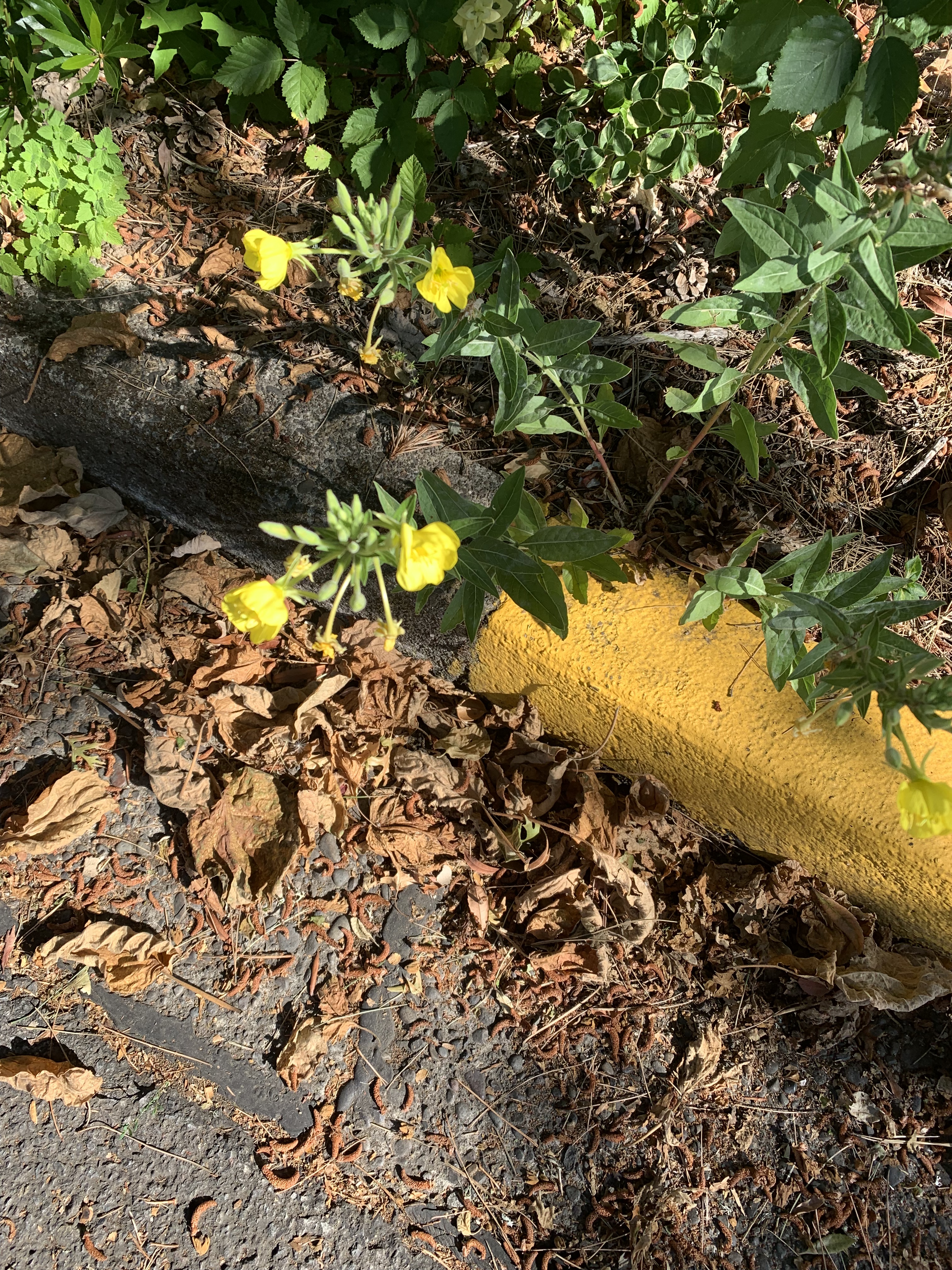
And stopped. I turned around. There was a yellow flower on a stalk, not a common mullein, because it had four petals; however, it was definitely, not a mustard.  I smelled it but didn’t notice anything, although my nose was a little stuffy. I wasn’t totally sure what it was, but if I had to make a call, I would have said it was an evening primrose (Oenothera biennis.)

I hadn’t seen a primrose in years, and I don’t know what limbic system-visual cortex-association cortex process made me so sure I knew what the flower was. I sensed it, and after I went home and looked it up, turned out I was right. I returned to smell the primrose, this time finding the slightest hint of a lemony odor. A few days later, 100 yards away, along a path leading to the park, I saw a second plant. I had walked there numerous times, including recently. I had to have gone by the primrose but didn’t notice it. I hadn’t even sensed it. But rather than beating up on myself for my lack of noticing—after all, I think of many things on a walk—I eventually noticed. That’s better than never. It took me decades to learn when my wife asked me about a problem, she wasn’t necessarily telling me I must fix it. Sometimes, she only wanted me to listen. Imagine that. I eventually figured it out. Yes, I’m slow, but there are some who never figure it out. I was late arriving at the show, but at least I got there. Some never do.

There are several other lessons. Curiosity about the surrounding world enhances life, and it’s like reading, nature, languages, music, art and so much else. The younger you are when exposed, the better the development. Sometimes a minor observation doesn’t become important until much later, perhaps a connection occurs at 2 a.m., which it often does for me. It helps to believe a routine outdoor walk may turn up an interesting surprise or observation, without expecting such to occur.I spent time on Isle Royale one night looking across Feldmann Lake in vain for a split second wolf sighting. A few hours later, I had a wolf in my campsite for 5 minutes. A seemingly unimportant occurrence may become the beginning of an unexpected chain of events, when remarkable subconscious associations form. Eight green leaves on a dead, burned log eventually led to my writing about how chlorophyll and heme have a chemically identical key structure with only the central metal different (magnesium vs. iron). One can’t force this; while some days are—let’s face it— routine, seemingly empty of notable occurrences, it is possible any day can provide a not-yet-appreciated key observation that combines with a future event to produce something special. Experiences are not wasted.

Eight green leaves, Big Bunchgrass Trail, 2024, post Cedar Creek Fire

In my walks, I have seen maybe 30-40 species of birds; I’m not a great birder. Still, some of the birds were a red bellied sapsucker, Pileated woodpecker, a heron’s trying unsuccessfully to swallow a fish, a rough legged hawk, and a turkey vulture on the ground a few feet away finishing off a squirrel carcass. I spent fifteen minutes one day watching a crow up in a tree drop nuts on a quiet street to break them.

Red-bellied sapsucker

During the pandemic, I took five mile walks, and in spring and early summer, routinely counted fifty species of wildflowers. One day, I saw a Fawn Lily growing under a bench right by the Willamette River. I had seen them only up on Spencer Butte. I do better with flowers than birds, maybe because as an amateur astronomer I like things that don’t disappear just as I get them focused on my retina. 

À propos to disappearing birds: recently, I went to see the semiannual Vaux Swift migration. This is my fourth year and wish I had started sooner. For several evenings, across the street from Hayward Field, home of Track and Field championships, Agate Hall, an old building with a defunct chimney, is a migratory stop for swifts. Twice a year, fall and spring, people gather for a chimney vigil. There was no guarantee anything would happen, in which case it still would have been a pleasant evening with a crescent Moon very low in the sky, as autumn evening crescents are. But this night the birds came, swirled and called out for 15-30 minutes in a huge circle high in the sky. Then, like the bottom of a celestial funnel, entered the chimney, black drops rapidly flowing into a container. Some birds didn’t get it right or for some reason only a swift knows, and did a go around. Within several minutes, nearly all the swifts were in the chimney. Their disappearing into a true Airdnb (dinner and bed) was the why we were all there. There were probably one to two thousand, but I’ve been there when nearly nine thousand entered. The migration is easy to see, fascinating, and describes exactly what writer Sam Cook said: “You don’t go out looking for cool things to happen, but you go out knowing cool things could happen any time. You have to be there.”

Vaux swifts descending into chimney

Get out. See you out there.

Oh, Near the end a different bird landed on top of the chimney, and the swifts immediately stopped entering. A few seconds later, that bird, either predator or prey—I couldn’t tell which— suddenly disappeared. Everybody present let out a sound. The swifts resumed their checkin.

Cool things can happen at any time. I saw another primrose this morning. 
NEXTGEN PLANTS

September 22, 2025

The seeds were floating everywhere when we exited the vehicles at Little Bunchgrass trailhead; nearby fireweed plants, the reason, were loaded with thousands of cotton-like floaters. Our first time working at this end of Bunchgrass, we were going to continue to restore the trail which burned over badly in 2022. We had worked a mile at the other end last year, seven miles east. There, it was 100% burn with residual powdered soil, difficult to work, especially where parts of the trail could not be found. Today, two of our crew would hike in over a mile and remove downed logs; three would use two power brushers to clear the trail of encroaching plants the first mile; the other four would work on the tread in several places to improve drainage. I started one of the Stihl brushers, strapped it to my hip, and starting at the trail entrance, began to walk slowly on the trail, swinging the brusher back and forth.

I immediately passed a 5 foot tall fireweed with husks of open seed pods, a closed seed pod zone, and finally the last pink flowers at the top of the plant. I love fireweed (Chamaenerion angustifolium). Four petals, perennial, tall, it is the calendar of summer in burned over areas, common in the high country. The first blooms are difficult to notice in early to mid-summer with all the other flowers, but late summer fireweed is a major show. The blooms begin at the lower portion of the inflorescence, above the spiral leaves that define the stem, and gradually continue moving upward to the top over several weeks. They become darker pink before turning into long, narrow dark pink seed pods. As summer progresses, the seed pods open in in a four-sided arc away from a common center to release the seeds, but not all at once. The inflorescence then becomes white with a tinge of gray. Each plant may produce thousands to tens of thousands of seeds that float in the air maybe a half hour, scattered to the four winds. “When you see cotton, summer will soon be forgotten.” I picked some leaves to take home to try to make fireweed tea. I made it on the Nahanni River in ’85, but then I just put a leaf in hot water, and it tasted like…hot water.

After brushing a couple hundred yards in an 80% burn with a few live trees, I entered a meadow that may have burned but recovered in the three years since the fire. I shut off the brusher. Others worked on the tread, just below the ill-defined summit of Little Bunchgrass Mountain at 5300 feet. I continued walking a couple hundred yards more until I reached a mostly burned over woods where more brush awaited me.

Just three days prior, 10-12 miles to the southeast, similar elevation, at Gold Lake Sno-Park, I reached up to grab a branch, pull it towards me, and cut it off. I was working a trail in preparation for winter recreation. There had been no recent fires in this area and was no fireweed. As I pulled the cut branch towards me, I noted two small cones together at the end, each maybe an inch long. I hadn’t seen that before. The needles, small and horizontal, were consistent with western hemlock (Tsuga heterophyyla). There were hemlock trees of all sizes here, tall, mature ones in the woods off trail, and on a winter trail that gets limited summer use, many smaller hemlocks, some only a foot or two high. The ground was mostly bare with dirt and some grasses, a bit eroded. The small hemlocks were left alone. They would be covered by snow in a few weeks and remain such for seven or eight months, especially on this north facing trail. 

Back on Bunchgrass, I restarted the brusher and continued work until I ran out of gas. I then traded jobs with another, who ran the brusher while I swamped, meaning I raked behind him and also carried our packs and fuel forward so the person cutting carried no extra weight. Here, bear grass (Xerophyllum tenax) had long since bloomed, large, beautiful white flowers covering the landscape, each with a definite pungent odor. Brown, brittle stalks remained, easily removed, but the tough perennial grass itself would not be as easily removed, due to a thick rhizome. Only the last few inches of the thin, perennial portion was easy to cut. I felt sorry for the tread workers who had to remove in-trail bear grass. Their job was unusually difficult. Three of us brushing reached a rocky stretch after a mile, which was as far as we needed to go.

Beargrass

I carried the now quiet brusher back back to the vehicles, using the over the shoulder technique, although carrying it strapped on, like we use when we are working, is reasonable. I returned through the woods, full of fireweed in some spots where cutting it made look like it was snowing. Eventually, I reached the meadow, finishing a few minutes later. I had time before the others returned, so after changing footgear looked around, finding some yellow Scouler’s Woolyweed  (Hieracium scouleri). I lay down for a few minutes noting the dramatically deep blue sky a quarter circle arc from the Sun. The variability of the intensity of blue in a clear sky is worth observing, especially at altitude. Something else caught my eye as I looked over at a group of surviving conifers.

There were several large cones at the top, easy to see, even from a distance, light brown, almost fluffy in appearance. They were Noble fir (Abies procera), and I had never seen the cones before. This was perfect habitat: decent moisture, good elevation, plenty of sunlight. Fireweed and fir; seeds and cones; the first will die off above ground and return the next year from the rhizome; both seeds will drop to the ground and start from there after a period of cold with moisture, cold stratification, required for germination.

AGE MATTERS, BUT IT DOESN’T MATTER

September 9, 2025

“you don’t go out looking for cool things to happen, but you go out knowing that cool things could happen every time…I just tell people, just go, just get out… You never know what you’re going to see, but you aren’t going to see it in the living room. You have to be there.” Sam Cook (Duluth Herald Tribune retired columnist)

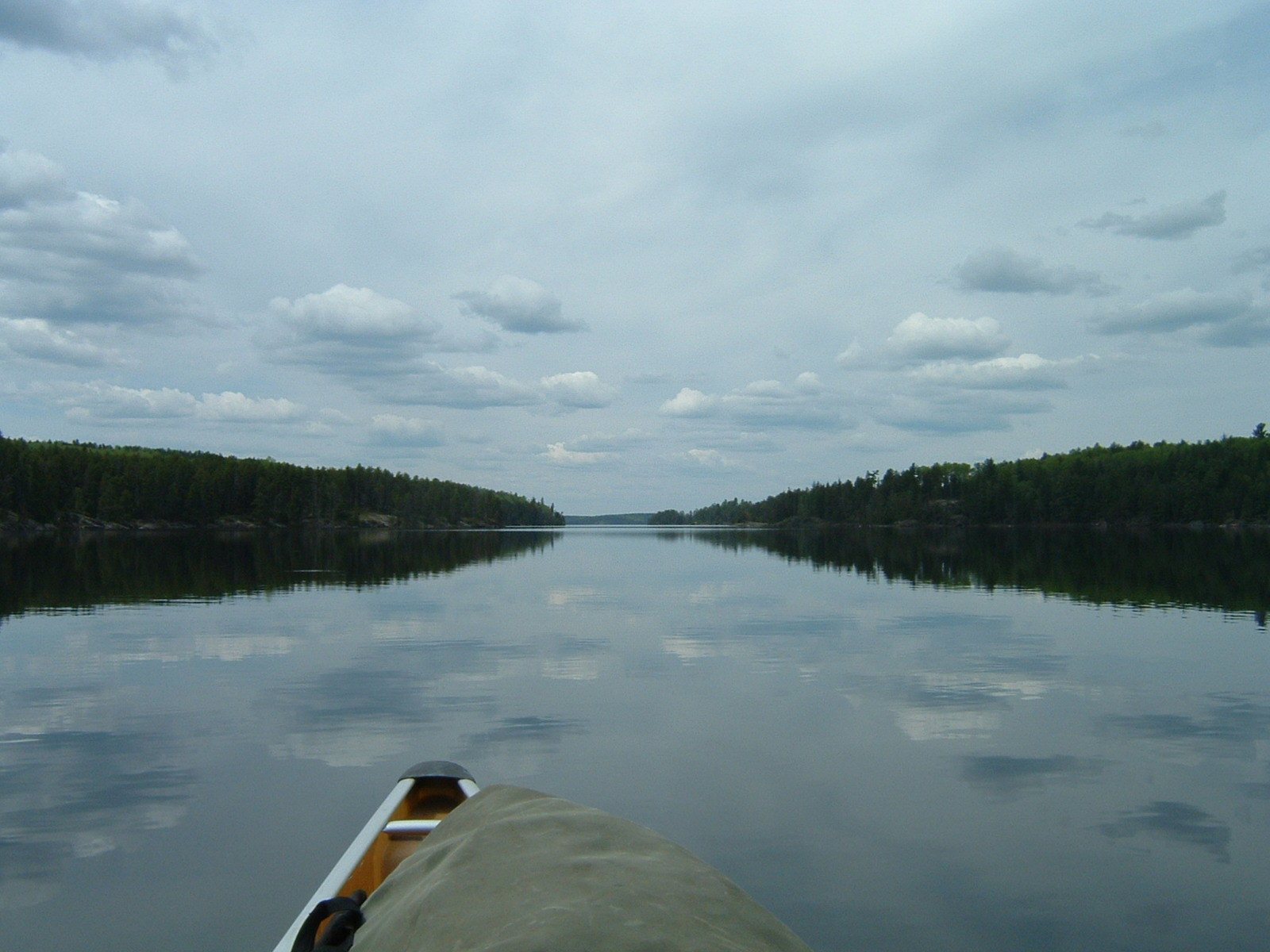
“Come on in,” called Dorothy Molter, after I had paddled up to shore at Isle of Pines, her island home on Knife Lake, and knocked at the door.  Dorothy was a legend.  She left nursing and Chicago in 1930, lived on an island in Knife, a long, narrowish lake,  with a few long arms, straddling the border between Minnesota and Ontario.  Called “The loneliest woman in America,” Dorothy had hundreds of visitors every year.  She was grandmothered in and allowed to live the rest of her life there after the Wilderness Act of 1964 required resorts to be taken down, power boats removed, limited numbers of people who could go in, and even how low planes could fly. 

Dorothy gave me some of her famous root beer, and as we talked, I commented that it was a little more difficult to canoe trip when I was 32 then it had been when I was 18, guiding canoe trips in Algonquin Park, wearing the coveted red neckerchief that only guides wore.

“Yes,” Dorothy replied, completely straight-faced, “I don’t paddle and carry as well as I once did, either.”  Dorothy had 42 years on me and she would live for 5 more, her statement a lovely put down to my comment about age.  

When Ely Echo editor Bob Cary interviewed me in 1992 about my season in Ely, the fact I had met Dorothy made the article. “Jackpine Bob” wrote a book about her, The Root Beer Lady.

I first put a canoe on my head 63 years ago as an apprentice, carried wooden Old Towns, slept in canvas tents or under a canoe.  Nobody had heard of Leave No Trace.  We had can pits, cut live balsam for tent stringers every night, and washed dishes in the lake.  In my 20s, my being on the water was salt water, in the Navy, fifty thousand nautical miles and 3 Pacific crossings.

In my 30s and 40s, I explored the Quetico-Superior as much as I could.  In my office, I had a map with dots where I camped and lines where I traveled. After each trip there was new ink on the blue and green splotches. I looked at the map often, dreaming and planning the next adventure. Eventually, I realized that giving back to the wilderness was more important than having a personal proving ground, but this land would always remain a personal decompression place for me.

At 43, I volunteered in Ely for the Forest Service, a half year leave of absence from my medical practice, took 22 canoe trips and spent 100 days in the woods that summer.  I was a decade older than the guy who visited Dorothy Molter, in better shape, knowing now the lakes, portages, campsites, trees and other plants. Four years later, my wife’s and my 25th anniversary, we paddled a 110 mile 11 day loop through three ranger districts. I stopped single carrying portages, all the gear and the canoe over in one trip, in 2001, at 52.  I had nothing to prove and a lot I could hurt.  Besides, I enjoyed walking back in the woods for a second trip across the portage. Single carrying didn’t matter.

After 2002, we base camped on Lake Insula for 7 years. We enjoyed day trips exploring side bays, finding trails that led to other lakes or were a short cut. In 2005, I soloed to Kawnipi Lake one last time. Many of us who plied the canoe routes of Hunter’s Island felt Kawnipi was the most beautiful lake on either side of the border. I won’t go again, but it doesn’t matter. I was there six times, loved it, thankful for my good fortune.

Author on island “The Rock”, Lake Insula, 2005.
Last time on Kawnipi Lake, Canada May 2005

The year I turned 60, my wife and I aborted the first day’s paddle to Lake Insula, one we could do in 7 hours, because of heavy rain. We stopped, pitched the tent and stayed comfortable. Making Insula that day didn’t matter.  We made it easily the next day. 

Morning fog, Lake Insula 2010

The clock ticked louder.  On my fifth backpack trip to the Brooks Range, in my 64th year, I carried 75 pounds up a long hill west of but still in sight of the northern Dalton Highway, on the way to Summit Lake in the Gates of the Arctic NP. It was a tough trip, and I wasn’t sure I would or could do a sixth, but there was a trip offered to the Wulik Mountains in the far west Brooks, country I hadn’t seen, wonderful, wild country, and perhaps I had one more trip in me. I backpacked the Wuliks.

Wulik Mountains, Alaska, August 2014

Several years later, nearly everybody  passed me on a tough hike up Oregon’s Larison Rock Trail, which I had led for years. It was a first, but it didn’t matter. When I was 76, I developed cancer and needed hormonal therapy. I changed, or perhaps was changed. I used to want to be on a saw, cutting out logs. But now, it didn’t matter. I enjoyed leading a crew twice to Lowder Mountain in the Three Sisters Wilderness to brush the meadows by hand so hikers could find the trail. What I didn’t expect was my becoming a connoisseur of smaller things, as if I had traded my hiking strength for increased ability to notice subtleties around me.  I changed my “macro” view from the open horizons of Sig Olson to a “micro” quiet magic view of Duluth writer Sam Cook, trying to follow rules of poet Mary Oliver: “Pay attention. Be astonished. Tell about it.”

That matters.

May be an image of 1 person, chipmunk and tree
Author, Black Creek, Waldo Lake Wilderness, August 2025

PAYMENT IN FULL

September 4, 2025

The day didn’t start well. Our third day working three years post-Cedar Creek Fire Black Creek trail in the Waldo Lake Wilderness since getting permission, and we had a new detour. Our drive was now 35 miles from Oakridge; 7 miles north through High Prairie plus another 8 on 1931, 4 on 1934, the latter two dirt roads through the burn and dust, just to get to paved FS 24, a few miles east of Oakridge. Then we had to go several miles through the staging area for salvage logging, by stacks of logs and heavy machinery before the final 8 miles on 2421, dirt with potholes to the trailhead. At least the final part was not in a burn.

We need permission to work in the forest; we needed special permission to work at Black Creek. Burned areas are dangerous; roads may be busy with heavy equipment, there are falling trees or limbs, maybe silent; treacherous ground with hidden holes; sloughing of the trail; rock slides. During the first two outings we cleared  0.8 miles and 0.4 miles respectively. If the geometric series continued, today we would clear 0.2 miles. Black Creek Trail, 3.7 miles, goes by Lillian Falls before climbing steeply to the west shore of Waldo Lake. We hadn’t even reached the falls. I encountered an all-day-work-on-one-log here several years ago, and logs that gushed sap making saws useless. One of our saw groups had one log that did both, soaking a guy with sap. Delightful.

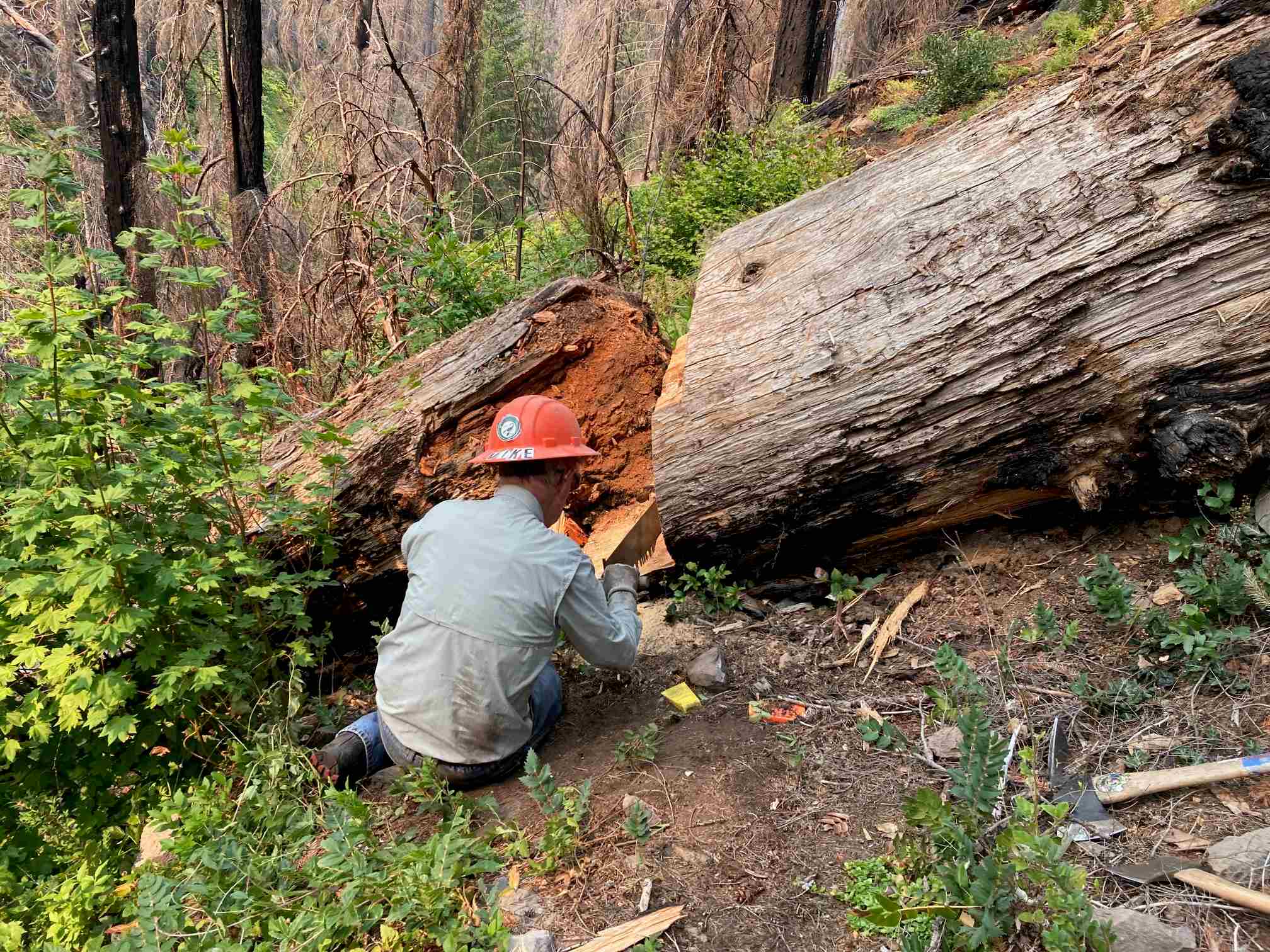
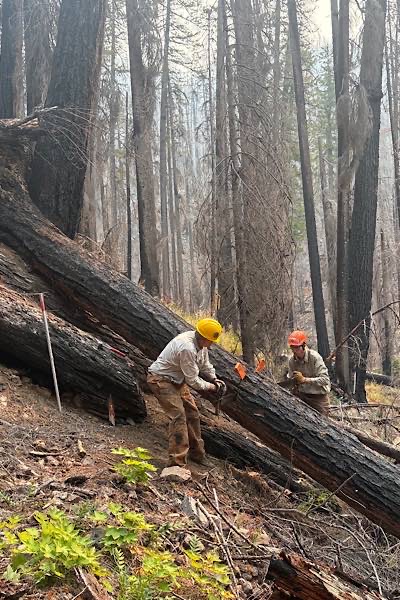
We split into three saw teams and hiked in, gaining 600 feet elevation, passing our previously cut logs, walking where we had repaired the tread. Two of us previously power brushed the quarter mille of trail outside the wilderness. I was in the middle group, where we needed to remove a 30 inch log, which had once been cut, but the remaining log had slid down and jammed two cut areas together. Much of the log lay on a steep uphill, so if we cut anything off below, there was a good chance the rest of the log might slide again. We managed to make a narrow passage through at ground level and started work to cut away the part over the trail. Between the dirt and the blackened bark, we were soon coated. The Emigrant Fire was south of us; by late morning it seemed darker than it should have been. The Sun was dimmer, smoke and white ash started to filter down from the skeletal forest high above us across the creek. We could smell smoke, and by lunch, many of us started coughing and had watery eyes. 

The group ahead of us finally got their log removed. The group behind us with sticky log syndrome still had more to do after two days work. Our log would need another day. 

By 1:15, I had had enough, enough of the heat, enough of the log, enough of the smoke, and enough of not being able to do enough. Human factors are important part of saw safety: wildfire smoke is dangerous to the lungs, especially given our activity, and coupled with heat and fatigue I felt our continuing to work was unhealthy. The Crew boss agreed and told us to pack up. On the way out, I went by the first group, still working, telling them we were knocking off. One asked me what time it was, and I answered “Time to leave.” We cleared 0.2 miles, mathematically perfect but depressing. I hope that changes, for otherwise next time we will go 0.1 miles and our mathematical limit is 1.6 miles. I really should think of other things.

While waiting for everybody to regroup at the trail head, a California Sister butterfly (Adelpha californica) landed on one of the other crew members. It looked like a white admiral but had a circular orange spot at the tip of each black wing. That was a new butterfly sighting for me.

It was a long drive home, 8 miles back on 2421, past log piles another few miles, then uphill, north, and west 12 miles on dirt to High Prairie. Far south, we saw the pyrocumulus clouds from the Emigrant Fire with a long plume of smoke to the northeast. When we reached a sign that said “Oakridge 2 Westfir 3” I looked at my map and said we could turn on McFarland and drive straight to Westfir, bypassing Oakridge. Nobody disagreed, but a quarter of mile down the road, we had to stop.

Perhaps fifteen elk, at least three young, slowly crossed the road in front of us. It was a tough day out there, dangerous dirty, dusty, hot, humid, and smoky, but seeing the elk helped, and at least for me, so did the butterfly. 

Payment in full. See you on the trail.

Author at work trying to open up more of a gap.
The haze is smoke.
The trail goes to the left of the two logs in the background.