Archive for November, 2025

HEAD SUPPORTING WALKING STICK

November 23, 2025

I never thought my walking stick could support my head, but it did one day, six times. I have used a saguaro cactus rib for 26 years as a walking stick, 1 1/8” rubber stop at the end, so when the rubber has to be changed out and removed, the part above the protection is much thinner than the rest of the stick. The stick and I have traveled over a thousand miles in fourteen states.

Near the summit of the Butte, I reached the top of the first two groups of steps, 13 now in the first, due to subsidence, where there were once 12, 14 in the second, where the trail made a right hand bend and my respiratory rate of nearly 50 per minute became insufficient. I was beat and stopped, putting my forehead down on the stick and wished I could lasso my breath because I didn’t see any other way to catch it. My legs were complaining, too, in a way that I really didn’t understand. I’ve had tired legs, but I had weird buttock discomfort, too, which I haven’t had.

After a short time, I budged then nudged forward a little, trudged a bit more wondering if I could fudge the idea of getting to the top without holding a grudge against the trail. I hiked up the next group of steps, stopped, waited, and then budged. I then hiked, rested, nudged, hiked, rested, and budged until I had used my walking stick as a forehead holder six separate times. My seventh and final stop was still well below the top just before the big tree. I saw a convenient rock and sat down. My prior  time up a few days before, I had to stop once. Two times before that I didn’t have to stop. This looked like a bad trend.

I hadn’t felt great all day prior to the hike. The radiation therapy was affecting my bowel, since the pelvis is deep—I mean in women a baby fits in it—but even in men it is deep enough, and my 27 cc size prostate—an ounce, give or take—was at the bottom. Worse, I had a node that appeared to be involved, so that area as well needed the photon beam, which encountered plenty of bowel in between the skin and the node. At the time I had 18 treatments. When I began the hike I didn’t feel right—well, I’ll be honest— I felt crappy. But even crappy now felt different from crappy as I had known it. Finally, I made the top, seven rest stops to finish less than a quarter mile distance climbing 190 vertical feet that I once did in under 5 minutes. 

At least I no longer felt crappy. I just couldn’t breathe. I began to feel fine after the first five minutes’ hiking. I can’t find the right words for what I felt. Radiation and hormonal mismatching mischief have made my body-speak another language, and I don’t learn languages easily. I thought I was doing fine until the steps.

I descended without difficulty but worried that this profound weakness was a sign of radiation-induced fatigue, which might even worsen for the next two months before slowly remitting. But I wasn’t convinced. I could walk 4-5 miles a day on flat ground with no significant effort. I had been chemically castrated for four months and doing trail work during that time. I wasn’t great, but nobody asked me what was wrong, either.

Five days later, I went back up Spencer on a cold, foggy day. I got up the first 26 steps, and the walking stick remained a walking stick, not a head support. When I reached the fiftieth step, I punched the air with my fist. I wasn’t normal—and I may never be normal again; I am at peace with that possibility—but I was able to get to the top using the walking stick only for which it was designed. Mind you, I still have 4 solid weeks of radiation ahead, and side effects may increase after radiation stops. But the operative word here is “may,” not “definitely” or “will.” And a great deal of radiation is behind me;  actually, it’s in me.
SNOW JOB

November 5, 2025

It was really Jean’s fault. Or maybe Daphne’s. Or both. I got an email with a picture of their Twin Peaks hike near Waldo Lake on a perfect day, enough snow on the ground to be pretty without making the hike dangerous. There ought to be a law against sending those sorts of letters and pictures to fog bound gimpy trail workers unable to hike.

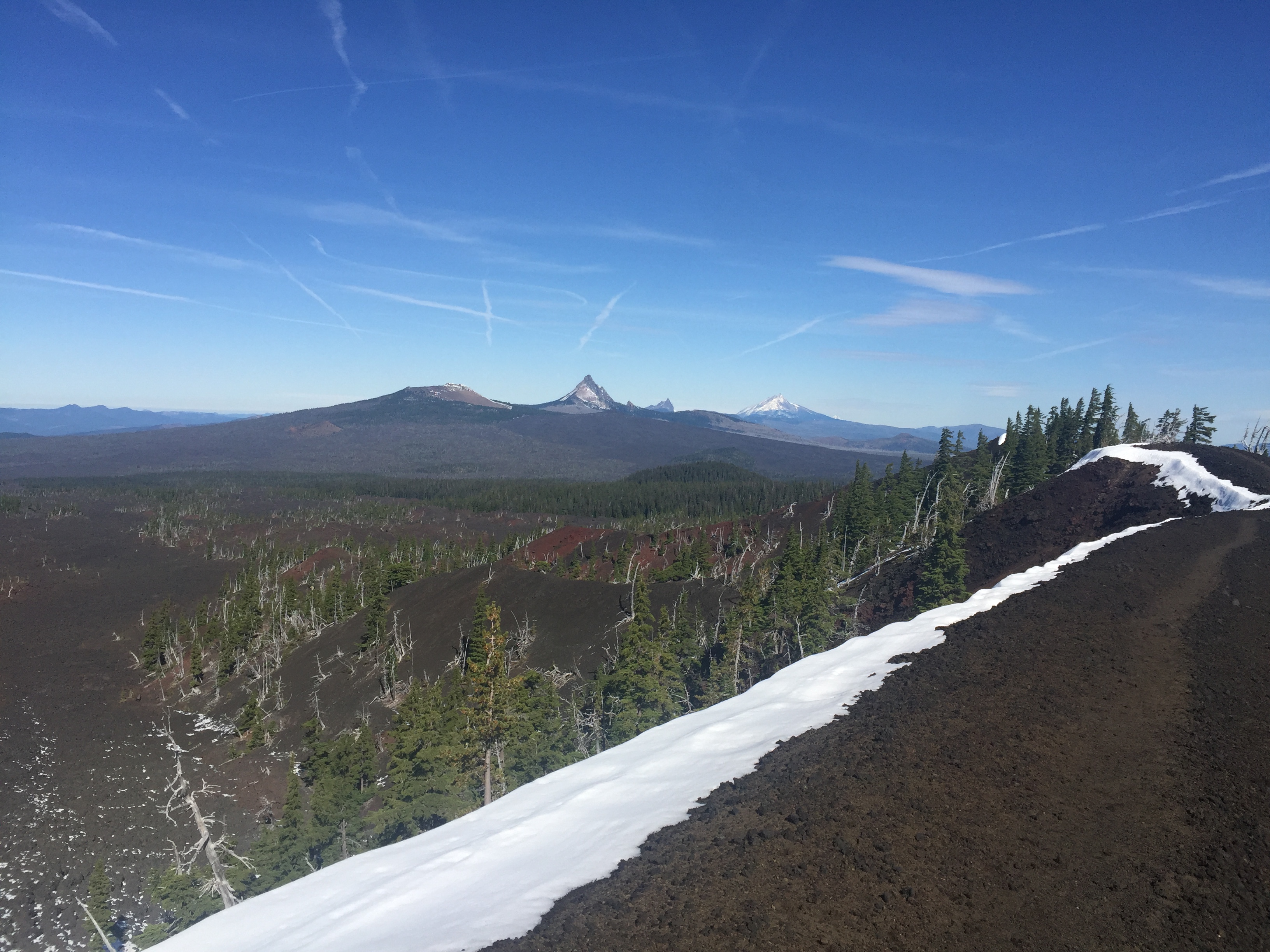
The picture of snow on the trail then began to trigger connections. I don’t know how these connections form, but they do for me, day or night, especially often after awakening in the middle of the night, far more common since I started taking hormonal blockers, androgen deprivation therapy, for prostate cancer. It took me only seconds to remember I led a hike to Four in one Cone each autumn. I knew it was in October and before the pandemic, so I started with 2019, and I found the picture. Our hike happened to coincide with a recent snow, so when we hiked up the cone itself, nearly five miles from the trailhead, snow was on a foot wide spot on the entire north facing rim and no more. It took two more weeks and 7 radiation therapy treatments to mess up my sleep enough so that when awake at zero dark thirty, more connections could be formed, and I had yet another recollection.

Four in one Cone with north rim covered in snow. Belknap Crater, Mt. Washington, Three-fingered Jack (barely visible), Mr. Jefferson in distance.

With of course less sleep.

The last connection took me back to the November morning up at Willamette Pass three years ago, 15 November to be exact, when it was 18 degrees, also exact, and not Celsius. I was standing in my snowshoes at the east end of the ODOT shed, Pulaski in one arm, pry bar in the other, a couple of hand saws in my pack, fuel for the saw, and ski poles. This was nuts.

It was really Sig’s fault. All because I said yes to him. He had called me and asked if I could help log out the PCT from the pass to Lower Rosary Lake.

After swallowing my initial reply of “Are you crazy?” I told him there was only one log up there to cut because I had scouted the trail the prior week when I checked my winter trails for diamond markers. I tried to remove the log using a hammer to knock rotten wood off, hoping I could make the log smaller. No great surprise, a hammer wasn’t the right tool for a logout. I then tried to rotate the log and made matters worse, taking another 30 minutes to undo my error. Sig said he went up there after the snow fell, and there were about a dozen logs needing removal, blocking several stretches of trail. The worst, naturally, was two and a half miles from the trailhead that absolutely, positively had to be removed with still another at Rosary Lake itself.

Job security. Two and a half miles in and out, minimum, maybe three. In the snow, 18 degrees Fahrenheit. I’d wait for spring, myself. Or at least Celsius.

Back at the ODOT shed, my first decision before I moved was whether I could carry two poles with a Pulaski, or whether I would use a single pole and the Pulaski as a partial. The pry bar strap went around my neck. I hike with one pole, but not in snow. Back then, my arms were stronger. I used both poles alternating the Pulaski with each arm. I’ve never liked carrying a Pulaski or axe in my pack, but that have might of been a better idea this day.

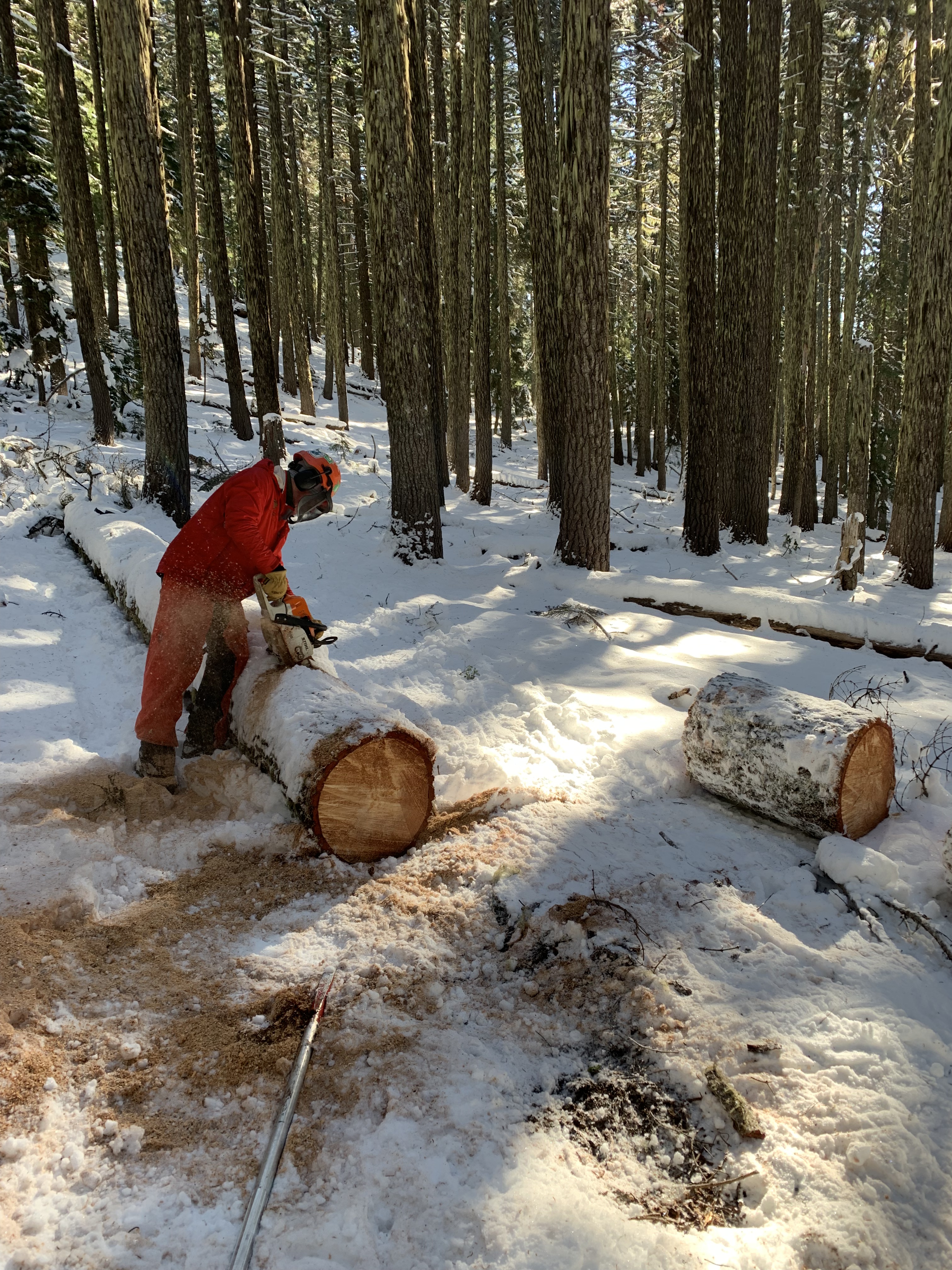
We snowshoed up the trail about nine-tenths of a mile to the first log, the one I unsuccessfully tried to move. The power saw made the removal a lot easier, hammering home the need for the right tool. The next two logs I dealt with using my hand saw, while Sig continued on up ahead. I knelt on the snow, difficult while in snowshoes, and started cutting. I was successful, although my knees got cold and kept sinking into the snow. Logs cut in winter don’t drop when they would in summer, and they are additionally frozen into the ground, so I needed the pry bar and more effort than expected to break them loose and then move them off the trail. Everything takes longer in winter.

I caught up to Sig, his snowshoes off, at a large log that fell right on the trail. I continued to keep mine on. We pushed the rounds off the trail using our hands, after first breaking them loose from the frozen ground using the pry bar. The next log had many branches frozen into the ground or the log, a messy job, since there was almost invariably a branch that would get tangled up in my feet. I still kept my foot gear on. At this point it was either a point of honor or a measure of stubbornness.

We finally made it to the troublesome log between the tie trail that went steeply uphill several hundred vertical feet and almost a mile to the west of the Rosary lakes and Lower Rosary lake. Indeed, there was no path around the log without removing skis or snowshoes. We stopped for lunch to try to restore our energy. Now 600 vertical feet above where we started, the snow was less tracked and deeper. It was impossible to sit anywhere and eat, so we stood, ate,  and after 10 minutes cooled off so much that we decided to cut the log from our side. My snowshoes stayed on. Finally successful, the trail was now open to Lower Rosary lake. Sig asked me if I was interested in going up to the lake for the last log. Hearing that as a query rather than an order, I answered no. He agreed. Somehow we both got back to the trailhead without falling. Or if we did, we stayed quiet about it.

We didn’t hear any complaints about the logs that winter. I finally removed my snowshoes back at the shed.