Archive for February, 2026

LIFE IS DIFFERENT WHEN YOU ARE IN CHARGE

February 22, 2026

Two weeks after my last radiation treatment, it was my second day working with the Crew, and I was doing tread work at Clark Camp at Fall Creek. At about ten, I had to stop temporarily to go down the hill to relay a message another had asked me to take to the Crew boss, who had just driven up. The boss looked at the message, then at me, and said, “I’m going out of town in three weeks. Can you cover the crew for 2 weeks? You know the trails that need to be worked.” Indeed, I did.

I hadn’t led a crew in months; I had just finished 45 photon radiation treatments of my prostate, and relugolix had removed all my testosterone. I was breathing harder than I liked going uphill, none of me was 100%, and yet the boss wanted me to lead two crews. I was thrilled and while nervous, I wanted to do it.

The first lead I had was Winberry divide trail, a three part path where the upper two parts needed a logout and the lower one needed two brushing crews. I had 10 crew members, one more than I had scheduled, but the last added was new, young, and from what I had seen, looked promising. Not only would I take him, I put him with the saw crews, because I saw his potential.

We did a good job; there were a few more logs than expected, which pleased the saw guys, the power brushing wasn’t too bad, either, except someone forgot to move a brusher’s pack forward with the rest of his gear, delaying that person’s lunch. But we got it straightened out, all of us finishing at the same time, even including the late lunch. Our group, nearest the vehicles, hiked out, while the saw groups, further up the trail, each trailhead reachable by dirt road, drove their vehicles back down to leave. I doubt anybody else noted how well the day worked out, but I sure did, because of planning, luck, and a little of both. I had the right people in the right place for the right amount of time.

The second trail required two separate days. The first day needed at least one brushing crew, although two would have been nice. I went up with Caroline, a first timer to the crew, showed her the shortcut by a trailer, avoiding the two dogs that lived there, leading to the high point of the South Willamette trail, (SWT), where I fired up the brusher and started cutting for 15 minutes before handing the machine over to her. She did great. I made one slight adjustment to how low she needed to cut, and 5 minutes later, told her she was cutting perfectly. The two of us got the job done quickly, and it was fun, too. 

Two days later, we needed to brush the mile and a half section of the SWT west of where we had been. Previously, I hiked up to the west end to cache a brusher, so on the day we worked, I could hike up more quickly without carrying it and therefore begin sooner. 

The trail also needed logging out, so work day, I sent the saw crew off to the Eula Ridge trailhead at the far eastern end to do their work, adding the same person I added at Winberry. There was a vehicle change to accommodate him, but the sawyer leader did me a favor and took him. When the new person becomes a good sawyer, I hope he remembers how he got some of his experience.

Our brushing group had 7, two pairs, each with a brusher, who would start at the east end, and I took the additional person, Camilla, with me at the west end. Camilla was new, had never used a brusher before, so I gave her a chance to work it, to learn how to start it herself, and she did fine. The two groups met about 0.6 mile from the east end. We did far more with one brusher, finishing much earlier than I expected.

As leader, I noticed who should work with whom, when to add another, and taking extra care with new people, so they felt like they were always within their comfort zone. It worked well. I watch the work being done, asking for changes when I think they are needed, but always at some point making sure if the work is good I tell the person that, for we all need good feedback if deserved, and it almost always is. I seldom had such feedback. Sometimes, I need to let go and let people do things with neither my advice nor help. There is a first time for everybody. Let them have it. Recently, I learned that reading someone’s body language and speaking with a soft voice gave them clear permission not to do some task that they thought they “should.”

The following day, I went south to the Umpqua National Forest, three men, two women. I wasn’t the leader or the sawyer, but wished I made some changes anyway. We took one chain saw instead of both. Chain saws can get stuck in a log. It is better to have an extra than it is to hike back for one, which I have now done twice in the Umpqua. Later, when we went to remove some nearby sills, large logs, I didn’t bring my pack. I knew better. Always take your pack. I needed my first aid kit; saws can slip, people can fall. I didn’t take a Pulaski, which would have worked well on the semi-rotten logs, making them smaller and easier to dispose of. 

Had I been in charge, I would have also thanked this third guy who came, for he carried saws, helped moving logs, and had a spare hardhat in his vehicle for the sawyer. Thanks would have mattered a lot to him.
GIVING IT UP

February 14, 2026

The first time it happened, I completely missed the significance. Indeed, I thought Jean was being a bit assertive in handling her saw. She was not going to let me take it to cut out a limb on a downed tree on Winberry Divide trail. We were both underneath a blown down tree that we didn’t have the saws to deal with but could address the branches, so that others could more easily go through underneath, and it would save the sawyers some time in not having to limb it. I asked her for her saw, and she wouldn’t give it to me. Jean cut out the branch on the log above our heads, put the saw away, and everything was fine.

I have done many hikes with Jean and usually took my saw to deal with such issues. True, from time to time she would cut out something because I wanted her to, like on Marianne Way in Gold Lake Sno-Park last year and the year before, where I had her cut out a 4 inch log. It wasn’t like I had to cut everything, but I did more than my share, although I didn’t appreciate that fact.

We had nothing else to deal with that day on Winberry. Some time later, we were cutting out branches and small logs on the South Willamette trail, and there were no issues, because all of us needed our saws to work on the logs.

It was the next time on that trail almost exactly a month after Winberry that Jean showed up with a saw and a scabbard, a set up that I immediately realized I wanted, because my scabbard didn’t attach to me and didn’t fit the saw, either. We had a branch to cut, and as I took my pack off to get my Corona, I saw that Jean was already dealing with the branch. The lights went on. I’m slow to get things, but given enough time, I finally found my way,

Jean was ready. Indeed, she had long been ready, long before today. It was I who had not been. She could deal with these branches as well as I— better, perhaps— and in any case, my job was to stand by to help as a swamper so that her sawing would be easier. The rest of the day, I never touched my saw. If we had a branch to cut, I held it and Jean cut it. Wow, I didn’t have to cut. We were now equals with the saw, assuming she was not better than I.

Four days later, we scouted Shotgun Creek on BLM land. I thought I had forgotten all my gloves (I had a pair in my pack as I almost always do, and didn’t look), so my hands were bare. Every branch was Jean’s unless the cutting was such that two people needed to do it. I kept my gloves off as she cut out about 8 or 9 small logs. Sure, I held a log up to make it easier for her to cut, but that is what a swamper does. 

As we finished Shotgun Creek trail and began to climb up Drury, it soon became clear that the volume of smaller logs was too much for any of us to cut, and our job was to scout the trail primarily, which was going to be a far longer job than any of us wanted if we removed every small log. Mind you, we were all throwing large branches off the trail when they blocked us, but even those were becoming a problem. I told Jean not to bother cutting any more, and she agreed, which told me that not only I had done the right thing, but she understood the situation, too. She could cut well, and she had good judgment, too. I finally admitted to her and apologized on the downhill side of Drury trail that I had been too slow to recognize what had transpired first at Winberry, but I now knew enough to let her do the work. She will tell me if she needs help. She also has the judgment to know when to stop cutting out everything when we are scouting. She is ready for B-certification, even leading a crew, although the latter may not something she wants to do. She has showed me for a long time that she is capable of doing all the sawing I can and will continue to do so, probably better, when I soon age out of the work. She will teach the next person. If I stay around long enough and have another under my wing, maybe I can understand when to let go sooner. At some point there has to be a first time for everybody, and while they may not be as perfect as you might be, they will learn more from their attempt than they will if you hover over them commenting on or doing the work they are doing. I learned that in medicine, and I learned it again on the trail.

“WOULD YOU BE HAPPIER IF…”

February 12, 2026


I hit the throttle and the brusher motor died.

Again.

I had cached the brusher four days earlier, but it hadn’t rained, nobody had touched it, and it had started fine. I just couldn’t get it to run. I started it again, hit the throttle again, and it died again. Jeff and Carol (not her real name), first timer to the crew, looked at me. If I couldn’t get the brusher going, we were going to have an incomplete, ruined day, Four others using two brushers were coming our way, and we needed to do at least a third of the trail. The others could not complete the whole trail.

A half hour earlier, when I addressed the other 6 in the brushing crew at Crale Creek Rd., I was ready for this day. It was my eighth time on the South Willamette trail (SWT) this year. Two days earlier, I had brushed 0.7 miles of it with Caroline, another new person, competent with a brusher, willing to take a shortcut to the trail, even going by an illegally parked trailer with a couple of dogs. We got the trail brushed, and we had fun doing it.

Today I had sent two teams of two west from where we were standing. I took Jeff and Carol and drove back to Hardesty trailhead to our west, hiked up 0.6 miles to the western terminus of the SWT, where four days earlier I had briefly brushed about 75 yards before caching the brusher. We were 1.5 miles from the other four and would work towards each other, assuming I could get the brusher going. 

I opened the fuel tank, which I had filled before I left. The fuel looked a little brownish. Maybe there had been water contamination. I took a chance and dumped the fuel. I refilled the brusher and pulled the starter cord. The motor started. I hit the throttle.

Success. We were in business, I was off and moving, taking long swings back and forth as I moved down the trail. About 15 minutes later, I motioned for Carol, who had never brushed before, to come up and take over. She put on the vest which would attach herself to the brusher, and pulled the starter cord. Nothing happened. I had her put her foot on the brusher and then pull, but nothing happened. I pulled the cord and it started right up.

“Oh,” she said, “I need to pull straight up and a little further.” She did, and the brusher started. She was the third woman I have taught how to start a brusher. Caroline was the second, and Jean, at the far end of the trail, was the first. Each of them loved being able to do it, and I thoroughly enjoyed watching them do it.

In this way, with Jeff’s solid help, we moved steadily east fast enough that a few times, I actually sat down on the side of the trail to rest. Once, I told Carol not to swing the brusher too far off the trail, but now she was perfect, and I made sure I told her that, too. I yelled “YO!” at her, and when she turned around, snapped her picture. People like to know they are doing things right and like to be photographed. I had given her instructions that to stop any time she thought she had had enough. 

I took the last long pull before lunch and where I ran out of gas, we had lunch. We could hear the other two brushers now, but we were at least half way, and our share was only a third. We were flying.

After lunch, Carol stood up,”Do you want to take another turn brushing?” I asked. For some reason, 12 feet away, she didn’t look eager. Maybe it was a second sense, but I cultivate my second sense. Carol thought about it and said, “I could do that.” The rest of the conversation comes from her letter to me.

“That was an honest answer. 

 “How I remember your next (perceptive) question was something along the lines of, ‘Would you be happier if you DIDN’T brush more right now!?’ and the answer, if I paid attention to my dear body, was that my forearms and hands would be happier to be doing something else. 

“I did appreciate your reframe of the question, because I would have tried and done some more, but, at least for me, it was a big win to honor the messages from my body rather than to try to prove anything to you and Jeff. 

“I have been working over the last few years to retrain that familiar pattern of self-abandonment or self-betrayal in order to get someone else’s approval. And it was a step forward for me to pause in that moment and not say an instant, “Yes!” and when you asked the second question, it gave me permission and encouragement to really examine what was most true for me in that moment, even if part of me REALLY wanted to pull my weight and do as much as you were doing.

“Your example of the story you tell below and your explicit statements about the value of resting when we need it and about pacing ourselves were super helpful, Mike. You made me feel welcome to be there with whatever I was able to bring. Hopefully I’ll get stronger, and there won’t be as much recovery necessary, but today would have been a memorable day for other, more painful, reasons if I didn’t have that support. Instead, it’s a day to celebrate a small victory in self-care!  Thank you for your part in this progress.

“Gratefully, 

“Carol””  

With 3 people and a brusher, we completed nearly two-thirds of the trail ourselves. I told Carol that we would be silent about our contribution and be glad the others did what they did, hoping they had a good time out there. That seemed to be the case.

I don’t know why I said the words I said, but I have been talking and writing for weeks now about how we trail crew leaders needed to respect the need for breaks, for rest, and we needed to couch questions about work in a way that did not show a bias towards more work is better and less is bad.

We three did a great job brushing, but the real triumph of the day was Carol’s words, and the person who was blown away by it all was me.

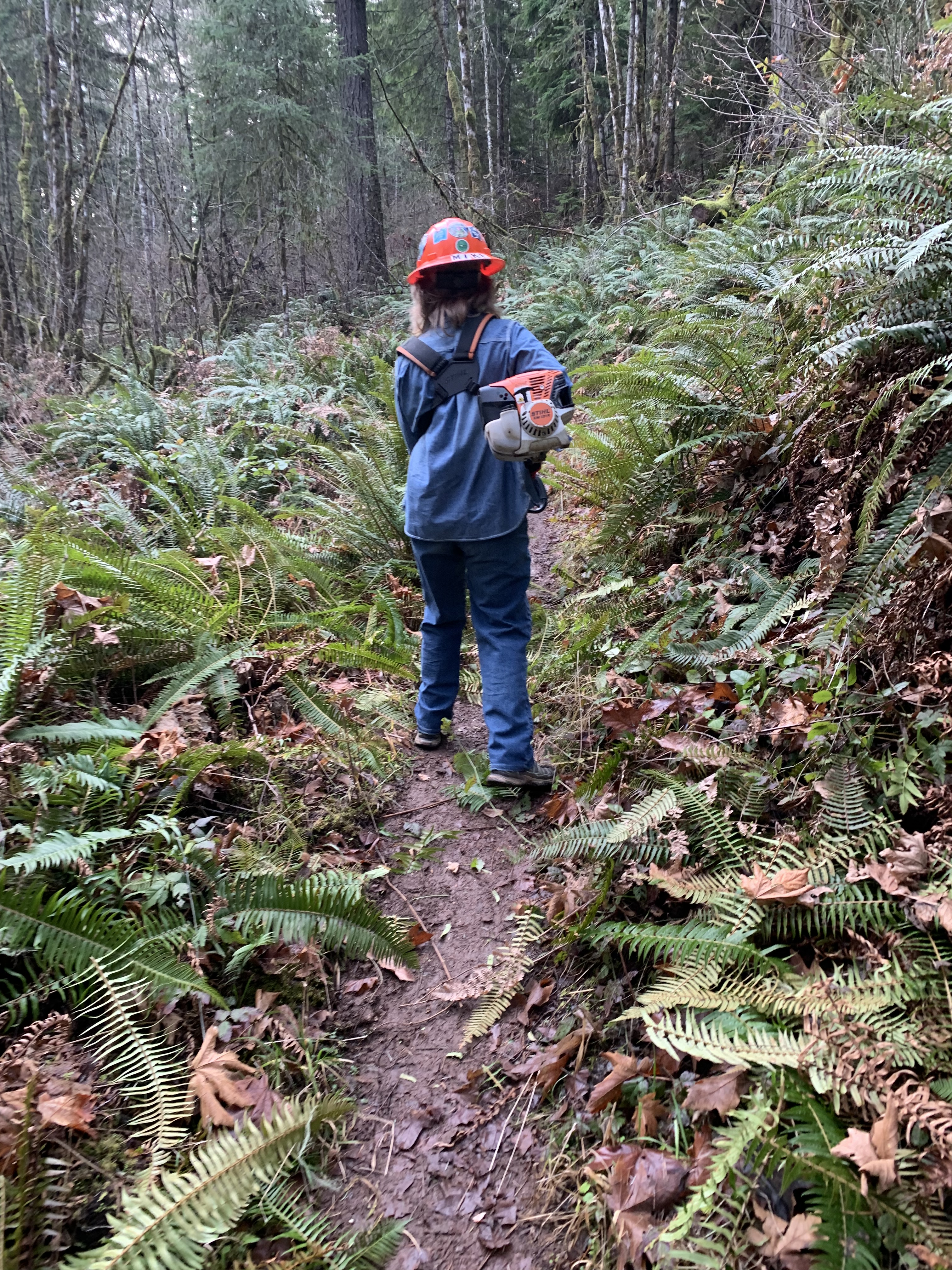
Carol brushing her way through a sword fern patch. She borrowed a hard hat from me.

MADE MY DAY

February 11, 2026

First day back to trail work after a 3 month hiatus due to 45 radiation treatments to my pelvis, and I’m grubbing trail in a spot where I dug almost exactly 6 years ago, just before the pandemic. Much of what I did back then, including carrying planks for a puncheon, or type of bridge, would be repeated on my second and third days out here as well.

We’re working at Fall Creek, where most of my work there in the past was required after a fire or later destroyed by a fire. ”Most” is actually an understatement. It would be all.

During this day, which I survived just fine, and the next, where I did more trail digging to make it free of organic material on top, I thought of the other tasks I did out here. I am not the best in any of them, but with the exception of power brushing, or weed whacking, I’m perhaps no better than average. I’m terrible with tools, horrible with hammers, can’t deal with chisels, ignorant about impact drivers, dumb with drills, sloppy with saws, and rough with a Reinhart. I do the best I can, which is showing up now nearly four hundred times to do the work. Last year, I was second in the crew in hours worked, and I had only nine months’ data before I had to leave for radiation. I have been first or second for five years, not remembering which, and not really caring, except I want to at least emphasize that I show up, and success is purportedly 90% showing up.

But something happened on the second day, a really difficult day for me, as two of us did the unglamorous work of digging out seven hundred feet of trail. Somebody had to do it, and we volunteered. In a crew, we support each other. The first 300 feet were worse as the plant life did not yield to our tools easily.

Later that morning, I saw the crew boss return to his truck, and from my vantage point of digging, having recently been given some information from one of the other sub-crews working nearby, I hiked down the hill we were on to his truck and relayed the message. He got it, paused, and then looked at me.

“I’m going to be away for two weeks at the end of the month. Can you take the crews for those two days? You have scouted the trails that need to be worked on.” Indeed, I had.

Wow, the foggy day suddenly became brighter. As already mentioned, I didn’t feel too competent doing a given task out on the trail. But when it comes to actually organizing a crew, making sure information gets online properly, knowing and getting all the equipment I need, ensuring everyone and the tools get there, function properly, and back safely, I am the go-to person for the crew boss. I have led the crew 33 times. I can’t do the job the boss can, but I am not a stranger to responsibility and organizing, know the strengths of crew members, where they should be working, and how to get the job done. The crew may not consider me the full deal, but they all know that I can handle the job, was asked to do so, and everything will be fine.

I had to deal with cancer, and while I am not the same as I once was, I can still work and still lead. I may not be good with individual tasks, but leading a crew is not a task. It is responsibility, serious work, an honor, absolutely necessary to do the job. I can do that competently. Knowing that day the boss still trusts me to run the crew in his absence made my day, and I have not had many days like this one in a long time.