Archive for March, 2026

PETTABLE TREES

March 14, 2026

“My daughter used to pet these kinds of trees,” said Camilla as we hiked away from the Slick Creek Cave interpretative site in near Fall Creek, where we were working the second part of the 12 mile trail. I didn’t take a picture, but did turn around and looked at a 3 or 4 year-old lime green conifer which indeed, did look like it could stand to be petted. I was wet, starting to get cold, and we needed to work more on the tread on the other side of the creek, so I kept moving to catch up to her.

I should have stopped. A pettable tree is something I hadn’t heard before and I quickly thought that the tree should be….well, petted. The tree was a larch, which I have seen plenty of in Minnesota swamps, but not here, at least as far as I knew. I now caution myself that just because it is a first of something I have seen, it’s likely I’ve probably seen many and just wasn’t aware. Its color was remarkable, really can’t be missed, although I almost did, but the next time I see one, I will be ready. 

To pet it, because why shouldn’t I? As a trail worker, I often remove small trees, because petting them and leaving them alone would get me reassigned to do something different on the trail, or told not to return.

Petting a tree I think is therapeutic, and when I started thinking of larches, my mind took me to Hatchet Creek, connecting Thomas Lake to Ina Lake, with smaller Hatchet Lake in between. I traversed this area on a gray mid-October day in the Boundary Waters 33 years ago, my last full day on my “V” or my 22nd and final trip, of my summer as a wilderness canoe ranger. I alphabetized each trip. The V trip was almost 5 months after my A trip, where pollen was on the water in a country awash in late May, as springtime can be in the North Country. 

This final trip began with a long paddle the first day with the second day in the tent because of pouring rain. The third day, threatening rain the whole day, I had 18 miles to travel to get back on schedule, now with early sunsets, knowing that stronger storms could hit. I did get back on schedule after a long paddle through many lakes, a couple of rivers, including a too close but fortunately uneventful moose encounter. The day ended in Little Saganaga Lake late, where I found a campsite on a tiny island. That night, I first heard geese, saw brightness on the roof of the tent, knowing it was likely clear, and saw geese flying south directly towards a Hunter’s full Moon. On this trip, I saw 0 people, 3 moose, one of which I would later see a few hours later that day, 2 blizzards, and camped in sheltered hollows away from the landing point to avoid the cold wind. Larch were turning yellow that October day, as I got to see them along the Hatchet Creek, taking my brief look at the “handle” of Hatchet Lake but not able to see the blade. I needed to keep moving, for it looked like it would rain or snow again that night and I had several miles ahead of me before exiting the wilderness right near the outfitters the next day, where I had started 6 days earlier. 

I portaged into Ina Lake, then paddled several small lakes before reaching larger Snowbank, where I paddled out in moderately rough water to an island, planning to camp there that night. I remember thinking then the biggest reason I wore a PFD was so people could find my body if I capsized. But at the end of that summer, I could make a canoe do anything I wanted, including stay afloat with me in it, and I would arrive at the site early enough to  set up, have dinner before the 4:50 pm sunset, and read in the tent, warm and snug, as it started to rain, sheltered from the wind, just the way I like a night in the North Woods.

At midnight or thereabouts, I awoke to silence, suggesting the rain had changed to snow, because I could additionally see the tent sag. Getting up and going outside was a necessary but cold chore, and I was greeted by a couple of inches of snowfall with light snow continuing. I would fall back asleep that night and take my final portage of the year in the morning, pack and canoe together. That summer, I could land the canoe and be walking with all gear in 45 seconds; I could put the canoe into the lake, load it, and get in 30 seconds after I stopped walking. I timed it once. Those were great days.

Anyway, nothing wrong with tree petting. It is calming and might bring back memories of other trips in the woods. Besides,m chloroplasts don’t mind at all.
WHAT KIND OF DAY WAS IT, ANYWAY?

March 6, 2026

The crew was back at Fall Creek again, further east at Bedrock Campground where we were going to tackle the trail eastbound, which climbed a few hundred feet vertically over 3/4 of a mile and then stayed on a ridge for awhile. The first step was to deal with logging it out, followed by brushing, which in this instance wasn’t necessary, then with tread work, which in places would be necessary. 

There were 46 logs in the first 1.6 miles, and the first one, 38 inches in diameter, was right at the start. We were divided into three crews: the big log and 0.8 miles to the top of the ridge was the crew I was with; the other two crews divided up the remaining 34 logs. It seemed reasonable, but when the crew is spread out in a linear fashion, it depends upon even distribution of the work, which with logs is never clear, since any given log may require a lot more work even with a power saw, although far more likely when 2 person crosscuts were used, which we were not using.

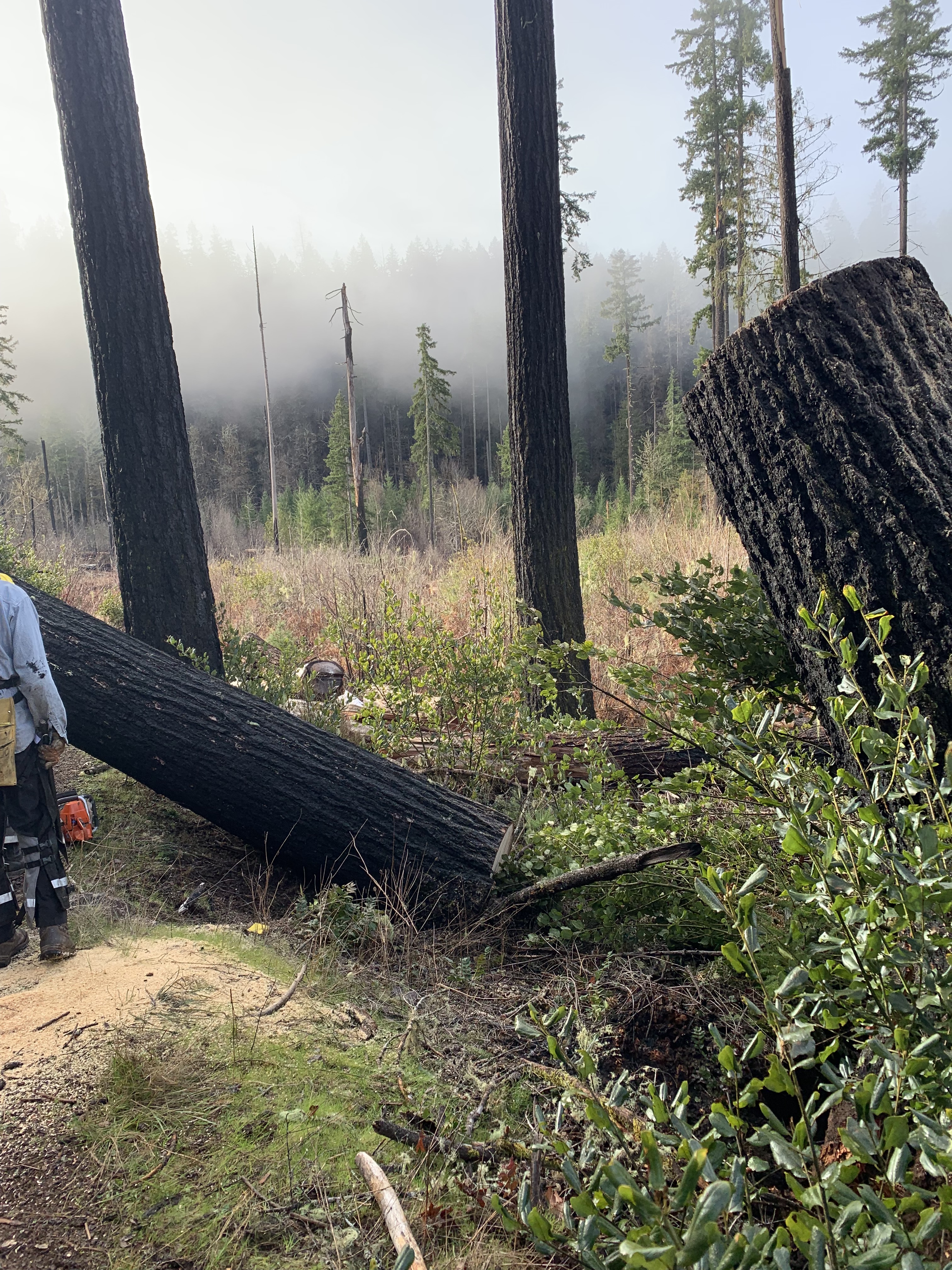
In any case, my group of 3 was two senior C-rated sawyers and me as an experienced swamper or helper. Our first log was a blown down tree attached to the root wad and extending about 150 feet up the hill, then over the top. We had no idea if the log would slide down if cut from below, because of different surfaces it was on with different friction. The first cut from below was effective, however, and the 12 feet of trunk still attached to the root wad stood back up, as we say, when the weight of the rest of the tree was removed. How much weight? I figured close to 300 pounds per linear foot at the bottom, gradually decreasing to the top. Maybe ten tons.

Once we had that removed, the removal of the rest of the blocking log was slow but steady and we finished the rest of our logs by lunch. Our radios were not working where we were, and we hoped the others made similar progress, but alas they had not. We had to stand around for about 2 hours, not doing much trail work, because the tread was in good shape on our section of trail. We finally left about 3, after 2 hours waiting, and 1 hour after the time we had been told we would be leaving.

It was interesting how I dealt with this. I am quite time sensitive, and I have led split up crews several times, often with everybody’s finishing pretty close to the same time. But there is a component of luck, too. It is difficult to look at logs on a scouting trip and to decide how long they are going to take, especially in light of destroyed tread, which while not requiring repair at the time, may need enough work so that passage to and from the rest of the trail to work it is both safe and feasible. 

Initially, when I got home, I was fairly down on the whole day, because our log was mostly handled by a senior sawyer who didn’t want to allow anybody to dig out part of the log or even have another C-certified experienced sawyer to do the rest of the cuts. This meant that two of the three of us were effectively cut off from doing work we could do. I wish some of the guys in the Crew could just let go and not try to be he-men.

I acted differently this day, however, not just blowing off steam, commenting that the whole day was screwed up, feeling like I didn’t help out at all. I have been known to say something like that, but this day I didn’t. I was not happy to be sure, but I started to take a hard look at what happened. I do wish we had been told if we were done, to continue on and do tread work on the next part where the other groups had logged out. That would have given us a chance to do something important and to allow those working to focus on the logs and not the tread. Additionally, we also would have known how close they were to finishing. Maybe next time we are in a situation like this we can do that. I was looking at solutions, not being angry.

I might send the faster hikers further and the others not so far, so that those who were at the end of our cutting “spear” would return more quickly. Like the time I was in the Umpqua NF and we didn’t have a second saw with us, or I was told not to bring my pack or a tread tool when I should have, I learned something. I may yet lead future trips, I need to be sure saws start before we leave, how to divvy up people for the job to do, which I think I am pretty good at doing, and when the work starts, check in more frequently with each group to see how far along everybody is. I think therefore I would have each group have a mandatory check in at 11 am. I have done this twice before and it has worked well. 

I don’t have power saw training. I won’t run such a saw myself. But I do know how much work they can do, and I can look at logs, people, multiple options and make good decisions. I hope I get the chance.

Note the “stump” standing up; a few minutes prior, it was connected to the rest of the log in the lower center.

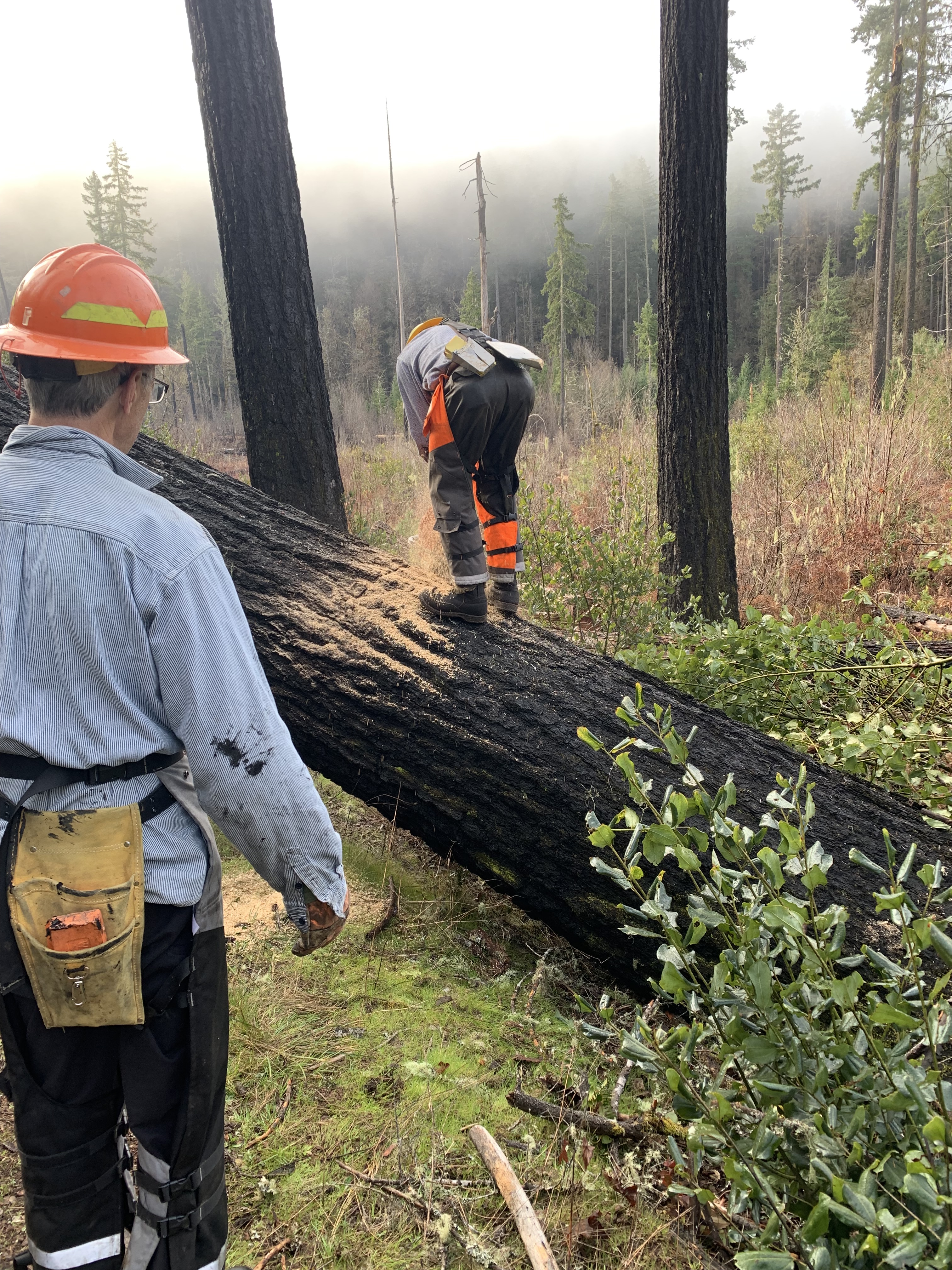
Cutting from the log.