Archive for April, 2026

CAMP OUT IN THE CATALINAS

April 14, 2026

Years ago, when I lived in Arizona, a few years before I moved to Oregon, one day I walked out the kitchen door, put down the garage door, shouldered my pack, and hiked to the top of Kimball Peak in the Catalinas. 

Just like that.

Well, not quite. I was running out of time to spend a night camped out in the Catalinas, within walking distance of my house, before I moved out of Arizona after more than 30 years residence. I had climbed Finger Rock Trail, 5 miles and 4300 feet of tough elevation gain, with no available water, many times. When I came down, I was fine initially but for the next 3 days my quads were so sore when I stood it took me about 30 seconds before I could walk. I figured I was getting old.

This day, I hiked from Table Mountain Road, where I lived, down Campbell, turned left on Skyline and stayed on it to North Alvernon Way, where turned left and walked uphill to the dead end and then began the desert trail. I was carrying enough water for 24 hours, a gallon and a half, and I drank a good deal of it on the way up, past Finger Rock itself, on the other side of the dry drainage, up, up, and more up, until I reached some forest and eventually the summit of Mount Kimball, 7200 feet elevation.

The mountain is forested with alligator juniper, some ponderosa pine, a bit of manzanita and small oaks. On one side below is Tucson; on the other side is Oro Valley, both nearly a vertical mile below. There is a path that goes further south and comes out at Pima Canyon, west of my house, which I had hiked only once, a much longer route up. This afternoon, I set up camp and lay in and also out of the tent, enjoying the breeze, reading, and recovering. I had an early dinner and then saw the sunset reasonably well, although there was some blockage by trees, retiring early, reading in the tent, then periodically checking the night sky and noting a million people below me, not more than a handful in this mountain range tonight. 

It was a cold night, and I had forgotten gloves, but I had socks to put on my hands and went outside to drop the sides of the tent so cold air wouldn’t have such easy access to me.It was nearly freezing at dawn, and I had what passed for breakfast, some coffee, some ice water at that temperature, and some chocolate. I struck the tent, packed it, and packed up everything else.

There are things in the world worse than going uphill long distances. One of them is going downhill long distances, as many a Grand Canyon hiker would attest. The descent from Mt. Kimball is steep and rocky, with many chances to fall, shindiggers to do just that to one’s legs. When I was about a mile from the bottom, I started resting for a completely different reason: my quads were shot. The prior day’s long climb coupled with the current descent had made it difficult for me to use my quads at all, which made hiking a problem. I limped out of the canyon with still over a half mile in desert scrub to get back to asphalt, where I would have another long downhill. I couldn’t believe how bad my quads felt. It was awful.

A few rests later, I came over a rise and saw the sign marking the trail’s end/beginning. There was no way I could even carry the pack further. I wasn’t sure I could even walk without it very far. I took off the pack, hid it, then slowly started moving forward and in that way somehow got back home. I got into the car, drove back to the trailhead, slowly walked to and retrieved my pack and eventually finished with everything I started with.

I did what I wanted to do the most: camp out in the Catalinas. I wasn’t able to do all what I hoped I could do, which was carry everything from the house to the top of the mountain, and home again, I could see where I had been, but I got up and down the mountain, and that would be as good as I would ever do. 

As for my quad problem being due to growing old, in Oregon I did several 3400 foot elevation gain hikes, routinely 2000 plus elevation gain hikes, and double digit mile hikes routinely, sometimes carrying tools along with my pack. I just wasn’t in shape.
MATH LESSON AT TIRE CREEK

April 6, 2026

My arms were aching, and it wasn’t even 11 am. We had hiked in a mile and a quarter to the second bridge site at Cloverpatch, shedding a few of the group to help Brian log out a 21 inch log that barely missed our first bridge. He planned to cut out several other annoyance logs on the three quarter mile trail between the first bridge site and the second. 

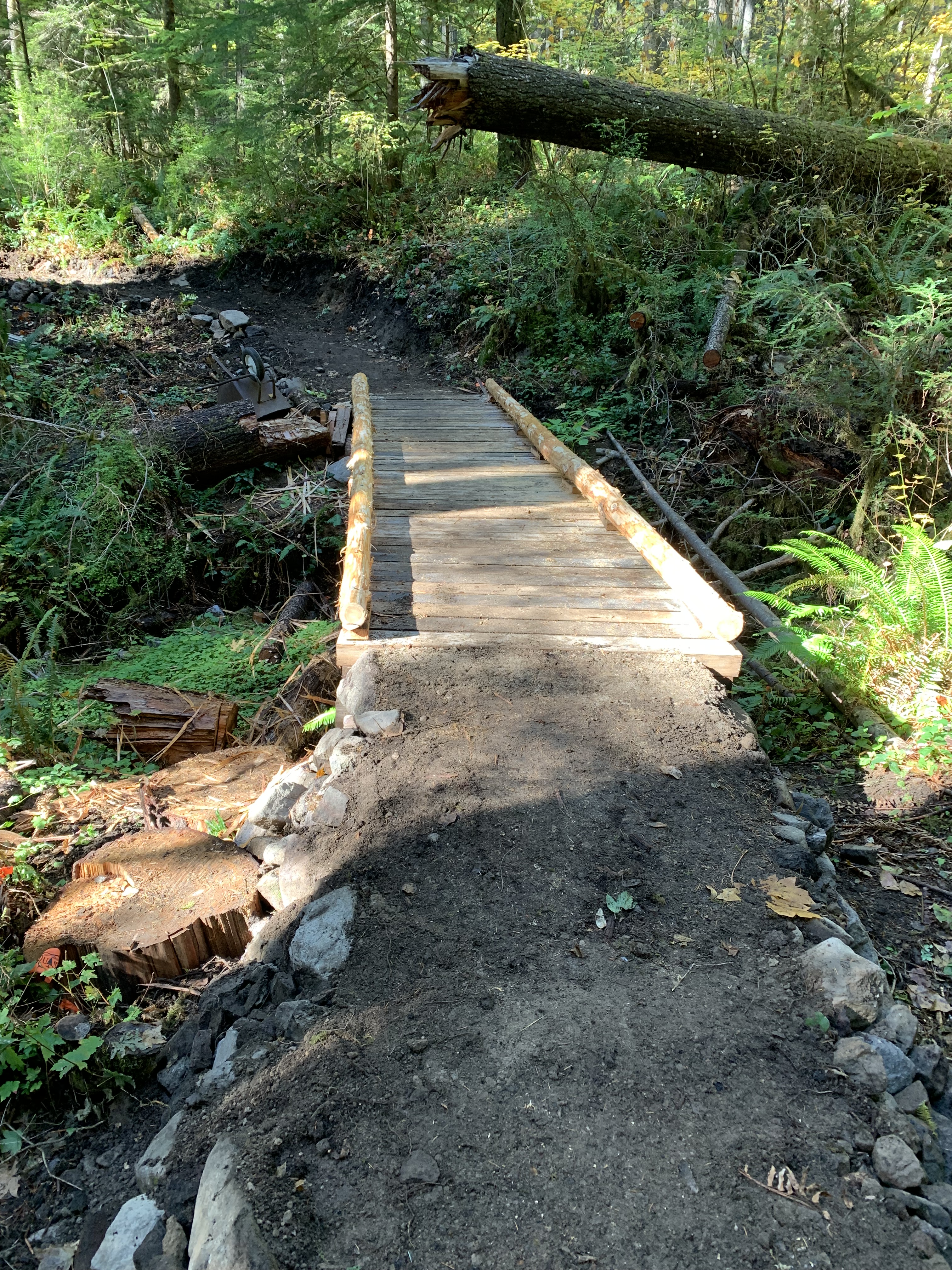
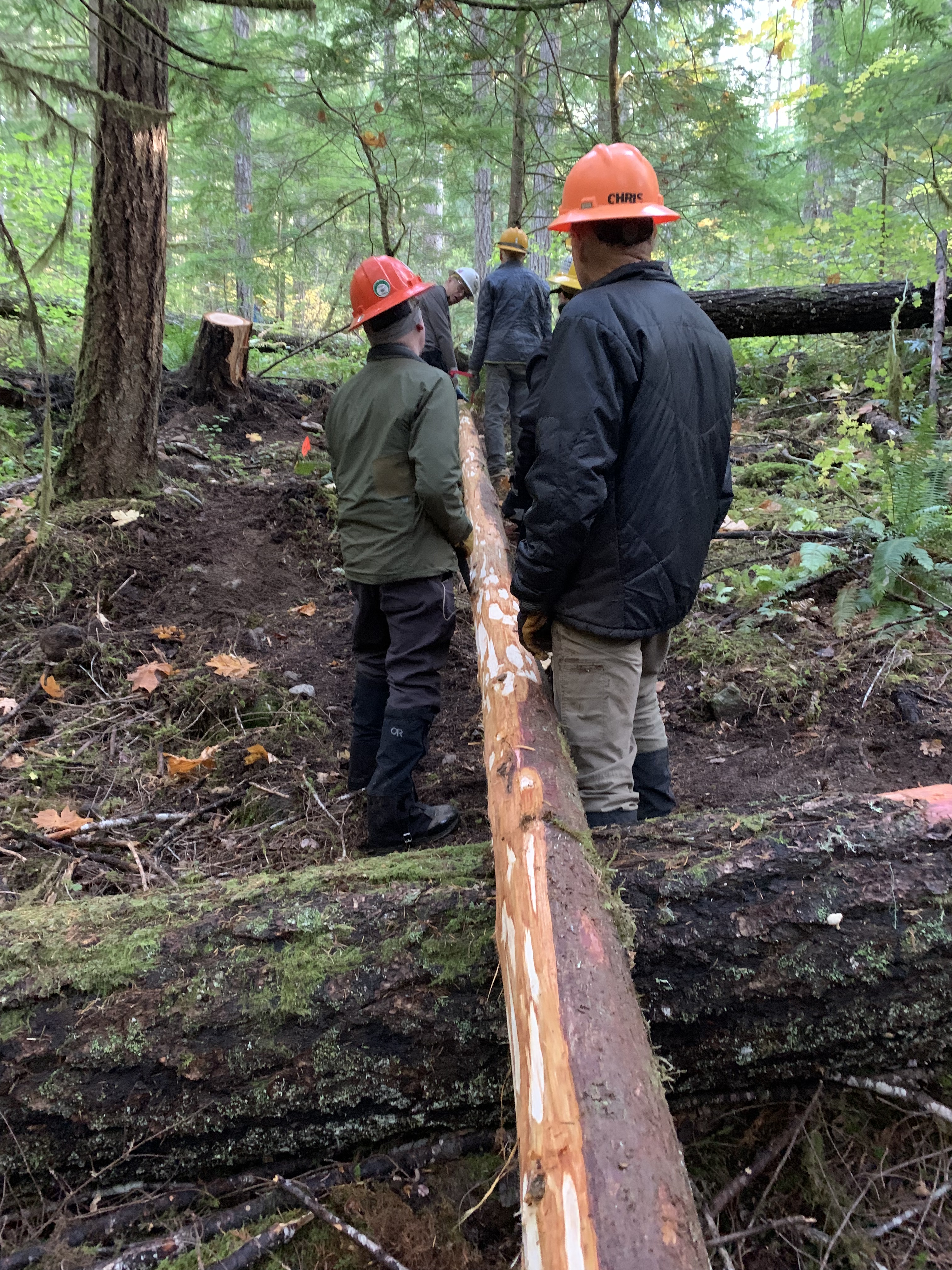
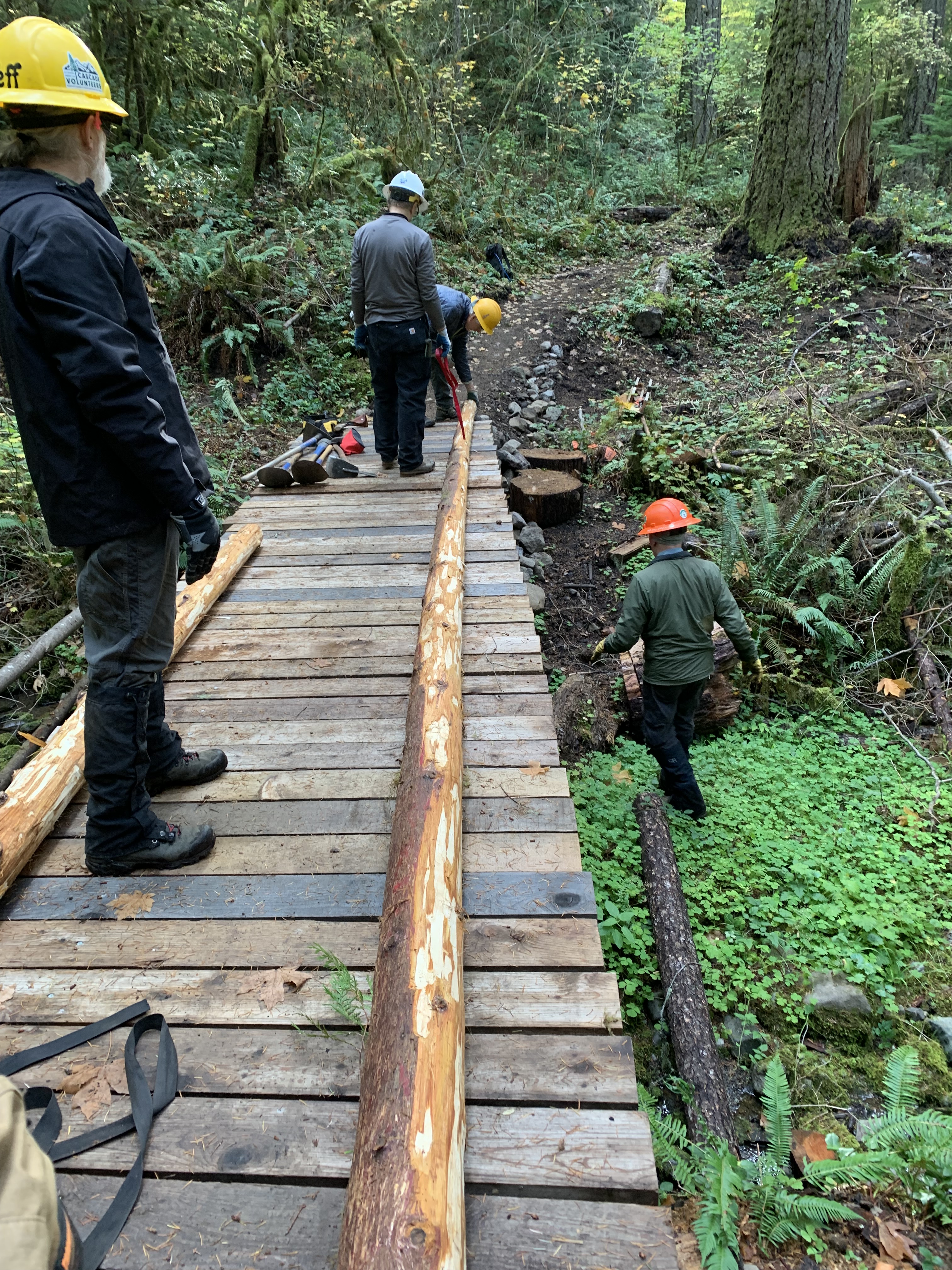
The rest of us planned to finish the second bridge by widening the eastern ramp and more importantly, fetching 50 feet of downed Western Red cedar from across Tire Creek, another third of a mile. Sig had cut three logs, they were mostly debarked, and they would become the base rails, the final step in bridge completion.

I lifted the end of a 25 foot log, 5-6.5 inches in diameter, a bit less at one end, as cedar tapers. This was heavy, and we needed to first get it across the creek, then move it uphill on a narrow trail and then more than a quarter mile back to the second bridge.

Jeff and I picked up the shortest log, 9 feet, put it on our shoulders and hiked back to the first bridge. My acromion, part of the scapula that is the point of the shoulder, protested, but 9 log feet had been transferred.

Eighteen per cent.

Getting the larger logs across the creek was an effort, with many ways to fall and fail.  When we had six people, we used straps and brute force, and with multiple stops, got the log across the creek and part way up the hill on the other side. I was asked to video, which was great, because I then didn’t have to help for thirty feet. I should have videoed the whole process.

I had been computing in my head 6 inches in diameter, 3 inches radius, quarter foot, area 1/16 square foot, times pi, or about 0.2 sq ft. multiply by 25 feet to get about 5 cubic feet of wood.  Now, Western Red cedar weighs 28 pounds per cubic foot dry, but this wood was cut 9 days ago and is green. How much?  Well, figure maybe 50% more, although one can find even higher numbers.  So the weight is probably 40-45 pounds per cubic foot, and we were carrying somewhere around 200 pounds. Two hundred solid, long, not bendable, heavy pounds. While we had six of us, at least two or more of us at any given time were not doing as much when the trail turned or there was an unfortunate rock or tree in our way. Six of us somehow got the log back over to the destination bridge with multiple stops. I felt sorry for Doug, who had the heavy end.

The third log remained. When I went back over, I noted one end was too narrow for what we needed.  Someone said we needed only 14 feet? That didn’t seem right, so I checked if we still needed 50 feet total. Yes.

OK. Jeff and I hauled 9 feet, and all of us hauled another 25. That’s 34. We need 16 feet to finish. There was a pause, then agreement. Think twice, measure twice, speaking of which, we had 25 feet of tape measure that wouldn’t roll back up. That’s a 300 inch metal mess spread across the trail.

We cut the log on the narrow end to 16 feet; the same six of us hauled it over, far easier with a third less weight. We placed it on the bridge, let Chris finish debarking; Sig and Steve would put it into place with spacers and lag bolts, we widened the on ramp, and the second bridge was finished! 

Two more to go. See you on the trail.

Oh, forgot to mention. On the way home, we got stopped for a train, then 5 minutes after moving again got stopped because of a police action in Westfir. We turned around and came home via the North Shore Road.

by Mike Smith

Willamette NF 2024

TEACHING, GENDER, GENDER ROLES ON THE TRAIL

April 3, 2026

I should have looked at the Oakridge forecast rather than Eugene’s, I thought, as rain spotted the windshield and I discovered I needed a better rain top than the one I had, in order to stay warm and dry. Four of us in the vehicle were part of a 6 person crew to log out Pioneer Gulch trail, steep, gaining 1100 feet in just over a mile, which Camilla and I had scouted a week prior. We had a brief window this day to get in there to cut out trail blocking logs before a major snow storm arrived that evening. 

After we got the gear sorted out at the trailhead, I went with Brian and Jean as one crew. Brian and I are both B-certified crosscut sawyers, but he is more experienced. Jean was going for her B cert next month. I wasn’t worried. She’s competent and will get it. Hiking in to the first log, two-tenths of a mile, I was concerned how I would hike with the rest of the crew. I am slower after my radiation treatments and didn’t want to hold anybody up. While I couldn’t stay with Jean or Brian, whom I knew I couldn’t, I did maintain some distance from Hal. I needed to know I could do that, even having hiked significantly the prior two days. I hadn’t been sure my hiking speed is adequate despite no testosterone; I won’t hold people up. If I can’t hike with the rest of the crew without significant delays, I will stop going out.

At the first log, Jean did the explaining, Brian critiqued her, and while I was odd person out, I did have a function being at the other end of the saw, until my arms got tired. When Brian offered help. I took it. I didn’t used to, but my endurance is less than it once was.

Note: I could have done more, but I had no reason to do so. It goes against the competitive, macho, man culture.

I found myself in a conundrum. On the one hand, I was glad seeing Jean’s getting instruction before her certification day. On the other hand, I never had such instruction in the 3 years before I obtained my certification to the A and then B level, other than the day long course before certification at the A level. None. I learned by being told I was “pulling” the saw, often without saying left, right, up, or down, and never by being told what I should be doing so I would not get this criticism. When Jean joined the crew, she immediately was taken under the wing of one of the experienced sawyers. When I joined, there was no such offer. When two young women worked with the crew on Hand Lake Trail a few years back, a couple of crew members were eager to help them. I watched an unusual scene: someone being taught how to saw. I never had that experience. 

It wasn’t that I never had good feedback: on my 47th outing with the Crew (now over 400), an experienced crosscut sawyer was on the other side of the log in the Waldo Lake Wilderness. We were underbucking, cutting from below, and the sawyer said I was one of three people with whom he would be willing to underbuck. Three people. He had decades of experience. Later, he asked me to evaluate a log, which is where I learned the important “when you make the first cut, see if you can envision what is going to happen to where you make the second cut.” I didn’t evaluate a log again by myself for at least 2 years after and never received that sort of compliment again.

I was surprised by my sudden vocalization of both disappointment and anger in the lack of teaching me how to use a saw. My words were heard by the others, with some surprise by me that I felt that way. After that; I remained quiet. For me, it was a major loss of potential that I never became and never will become the sawyer I hoped to be. I was the wrong gender. Knowledge should not be segregated by sex. Some men aren’t familiar with tools or saws; many women are. 

We need to teach those who need knowledge regardless of gender. When I joined the crew, nobody took me under his wing; I had no mentor, wasn’t invited to become even A certified until after three summers of log outs, and even then in my class was a person who had never touched a crosscut saw before; both of us got the same certification. It seems to me that men are assumed to know about tools, machines, and power equipment. This is wrong. On the other hand, I have seen four women in my crew immediately helped with their saw skills when they were on the crew, even though some had more experience with equipment and machinery than I had. This is sexism. Ideally, we ought to pair each new person with a mentor. Practically, we need a way to teach sawing to new crew members equally to allow them to function. It is not being done, and it should be.

Many feel teaching is not difficult. Many would be wrong. Being experienced in the field does not necessarily make one a good teacher. Good teachers make a field come alive, make their students want to be like them, and are a joy to listen to. They are uncommon. I’m a natural teacher.  A while back, when a young woman at the drug store couldn’t make change properly, I patiently explained the transaction to her two different ways. I did not berate her. She felt badly enough and apologized for her lack of math. I quietly told her not to worry about it. If she’s good, she will worry about it, and she will get better, but at least it was between me and her. Nobody else.

I am disappointed when a system appears discriminatory against men who don’t fit into the right mold. I don’t discriminate against those who can’t read a map, have poor trail memory, or can’t find their way to a trailhead. I assume everybody can do it, and if they can’t, I help them.

On the way back out, I carried a saw when the strap suddenly came apart where the hook held the saw. That happens. I stepped off the trail to fix it. Two others came by me. The first asked if he could carry the saw. I said I was OK. The second said the saw was a little strange to carry, and if I would take the pry bar, he would take the saw. I agreed.

In summary, I took relief during sawing; I gave up carrying a saw in exchange for an easier pry bar. I did something few guys I see do out in the woods, I asked for relief, and I accepted someone’s helping me by changing what I carried.

There may not be competition on the trail, but it feels like one. Men should keep going and not ask for help. Women should be helped. One man older than I wouldn’t give up a brusher he was carrying out of the woods. I was crew leader and asked if he wanted help. He refused. This sort of behavior should stop. It is symptomatic of why so many men function poorly in society today: deal with adversity quietly, don’t seek medical help, with consequences, must be a “man,” don’t let down one’s guard with weaknesses, hide emotions. And in the woods, be in charge, be in control, don’t be the first person to say “Enough!” On a job, you are the one who has to do it, don’t take help, show how good you are every chance you get. Life is a competition that one has to either win or at least not lose.

I decided to leave that game some time ago. I am a lot happier, and I think I will be a lot healthier, too. Whether I can change others remains to be seen, but I am going to try; too much is riding to stay silent on this matter.

Hal and Peggy working a log on the Pioneer Gulch Trail, March 2026

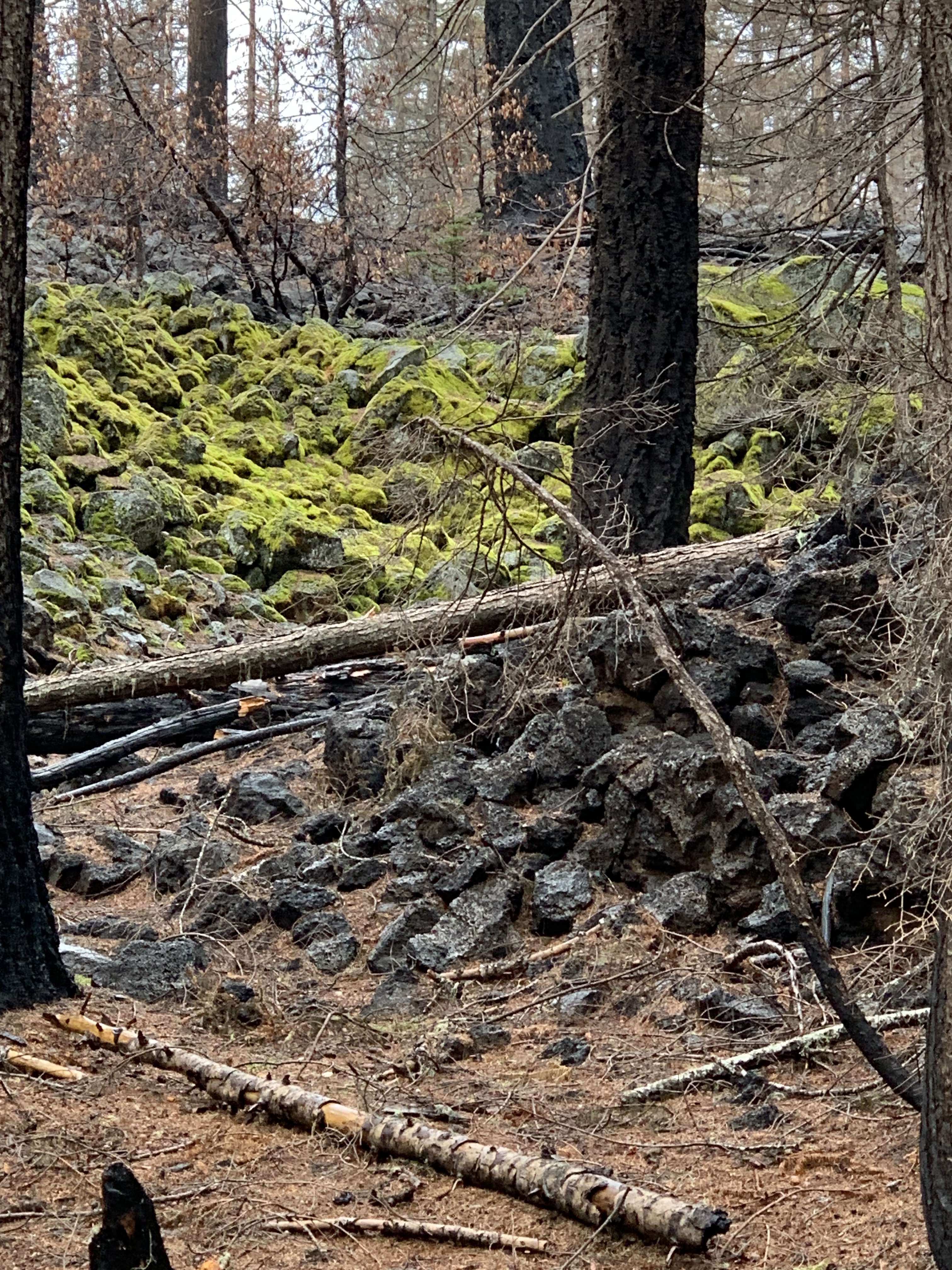
Some green in the black zone, Pioneer Gulch Trail