“you don’t go out looking for cool things to happen, but you go out knowing that cool things could happen every time…I just tell people, just go, just get out… You never know what you’re going to see, but you aren’t going to see it in the living room. You have to be there.” Sam Cook (Duluth Herald Tribune retired columnist)
“Come on in,” called Dorothy Molter, after I had paddled up to shore at Isle of Pines, her island home on Knife Lake, and knocked at the door. Dorothy was a legend. She left nursing and Chicago in 1930, lived on an island in Knife, a long, narrowish lake, with a few long arms, straddling the border between Minnesota and Ontario. Called “The loneliest woman in America,” Dorothy had hundreds of visitors every year. She was grandmothered in and allowed to live the rest of her life there after the Wilderness Act of 1964 required resorts to be taken down, power boats removed, limited numbers of people who could go in, and even how low planes could fly.
Dorothy gave me some of her famous root beer, and as we talked, I commented that it was a little more difficult to canoe trip when I was 32 then it had been when I was 18, guiding canoe trips in Algonquin Park, wearing the coveted red neckerchief that only guides wore.
“Yes,” Dorothy replied, completely straight-faced, “I don’t paddle and carry as well as I once did, either.” Dorothy had 42 years on me and she would live for 5 more, her statement a lovely put down to my comment about age.
When Ely Echo editor Bob Cary interviewed me in 1992 about my season in Ely, the fact I had met Dorothy made the article. “Jackpine Bob” wrote a book about her, The Root Beer Lady.
I first put a canoe on my head 63 years ago as an apprentice, carried wooden Old Towns, slept in canvas tents or under a canoe. Nobody had heard of Leave No Trace. We had can pits, cut live balsam for tent stringers every night, and washed dishes in the lake. In my 20s, my being on the water was salt water, in the Navy, fifty thousand nautical miles and 3 Pacific crossings.
In my 30s and 40s, I explored the Quetico-Superior as much as I could. In my office, I had a map with dots where I camped and lines where I traveled. After each trip there was new ink on the blue and green splotches. I looked at the map often, dreaming and planning the next adventure. Eventually, I realized that giving back to the wilderness was more important than having a personal proving ground, but this land would always remain a personal decompression place for me.
At 43, I volunteered in Ely for the Forest Service, a half year leave of absence from my medical practice, took 22 canoe trips and spent 100 days in the woods that summer. I was a decade older than the guy who visited Dorothy Molter, in better shape, knowing now the lakes, portages, campsites, trees and other plants. Four years later, my wife’s and my 25th anniversary, we paddled a 110 mile 11 day loop through three ranger districts. I stopped single carrying portages, all the gear and the canoe over in one trip, in 2001, at 52. I had nothing to prove and a lot I could hurt. Besides, I enjoyed walking back in the woods for a second trip across the portage. Single carrying didn’t matter.
After 2002, we base camped on Lake Insula for 7 years. We enjoyed day trips exploring side bays, finding trails that led to other lakes or were a short cut. In 2005, I soloed to Kawnipi Lake one last time. Many of us who plied the canoe routes of Hunter’s Island felt Kawnipi was the most beautiful lake on either side of the border. I won’t go again, but it doesn’t matter. I was there six times, loved it, thankful for my good fortune.
Author on island “The Rock”, Lake Insula, 2005.Last time on Kawnipi Lake, Canada May 2005
The year I turned 60, my wife and I aborted the first day’s paddle to Lake Insula, one we could do in 7 hours, because of heavy rain. We stopped, pitched the tent and stayed comfortable. Making Insula that day didn’t matter. We made it easily the next day.
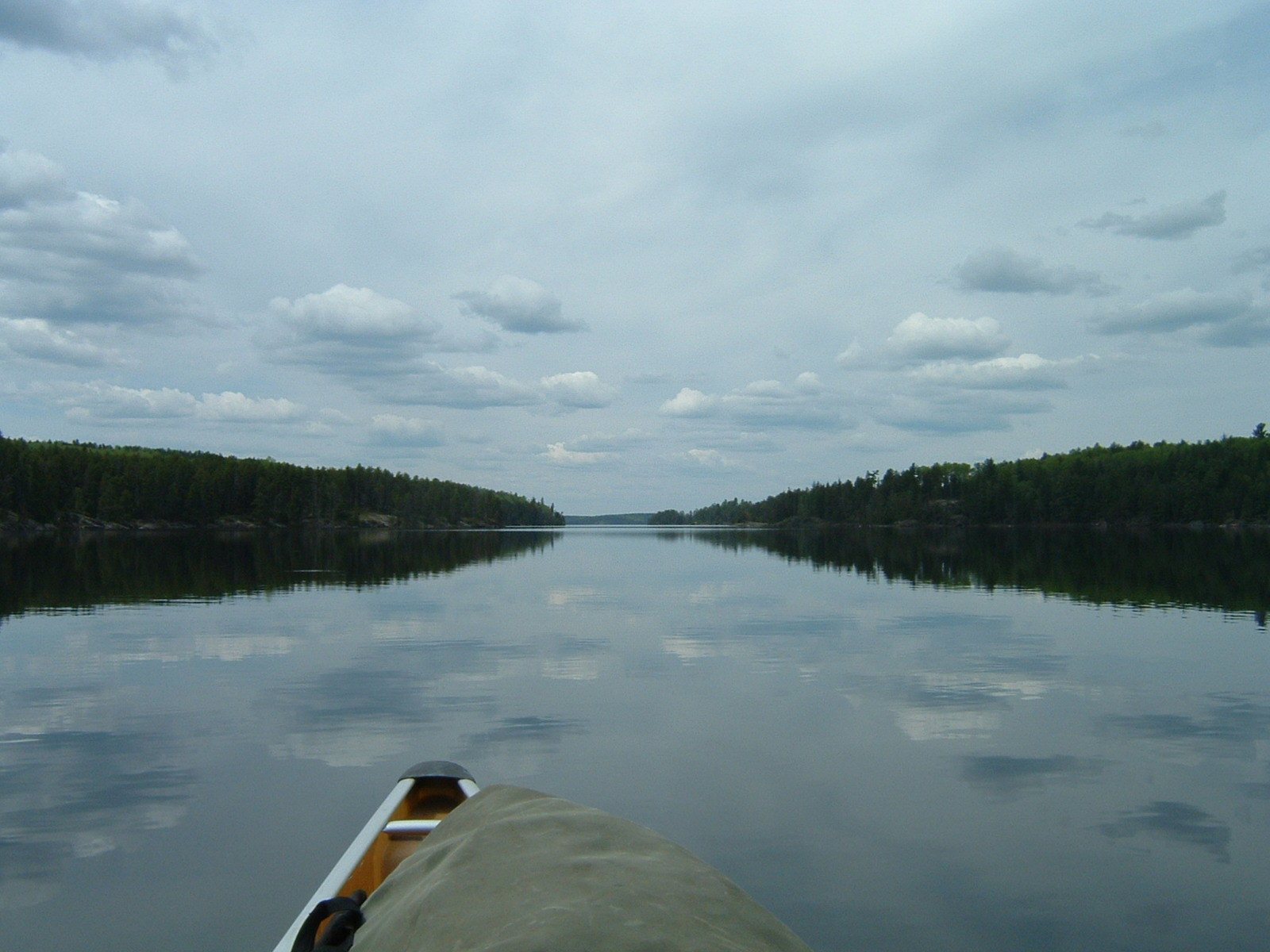
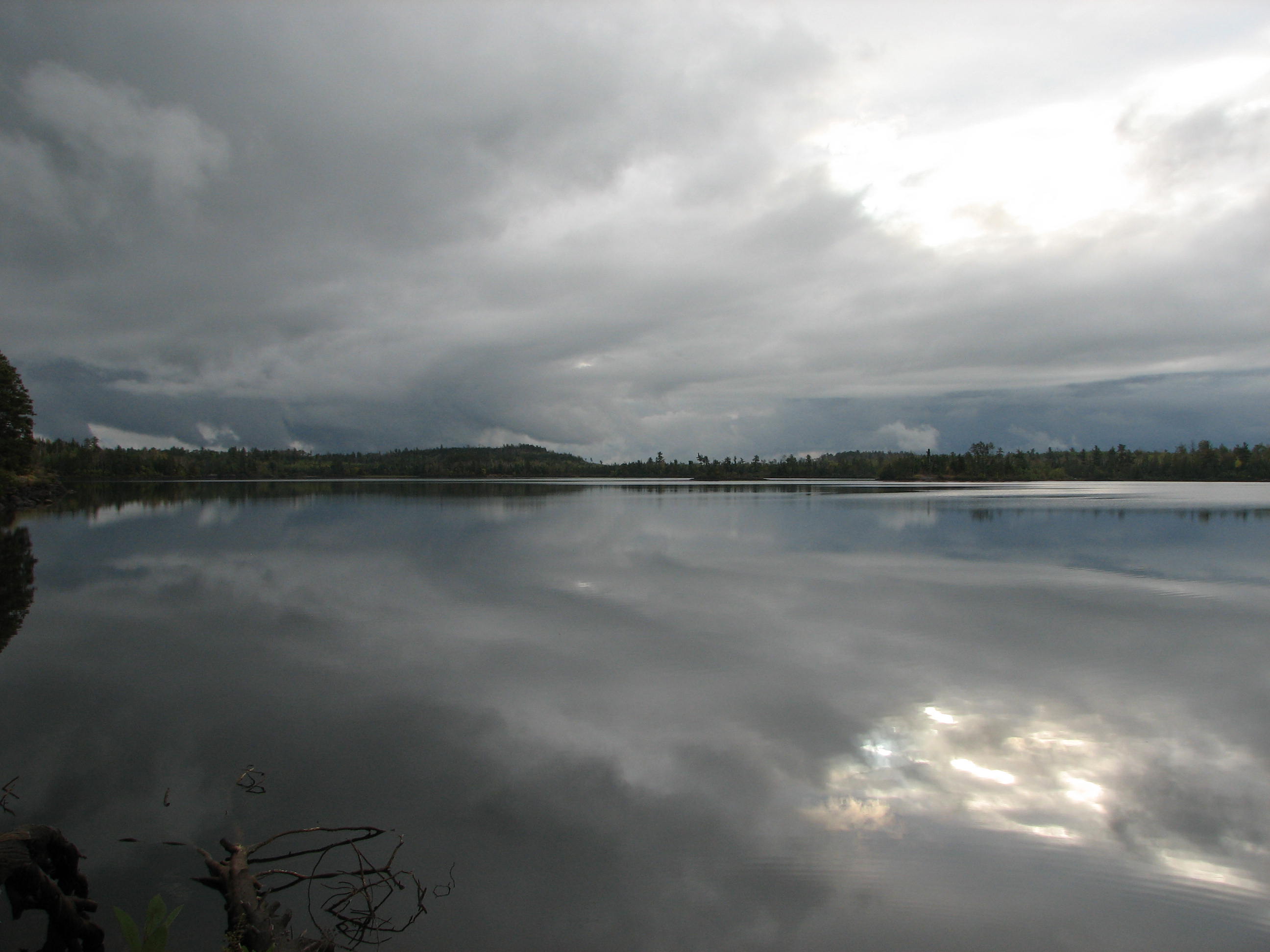
Morning fog, Lake Insula 2010
The clock ticked louder. On my fifth backpack trip to the Brooks Range, in my 64th year, I carried 75 pounds up a long hill west of but still in sight of the northern Dalton Highway, on the way to Summit Lake in the Gates of the Arctic NP. It was a tough trip, and I wasn’t sure I would or could do a sixth, but there was a trip offered to the Wulik Mountains in the far west Brooks, country I hadn’t seen, wonderful, wild country, and perhaps I had one more trip in me. I backpacked the Wuliks.
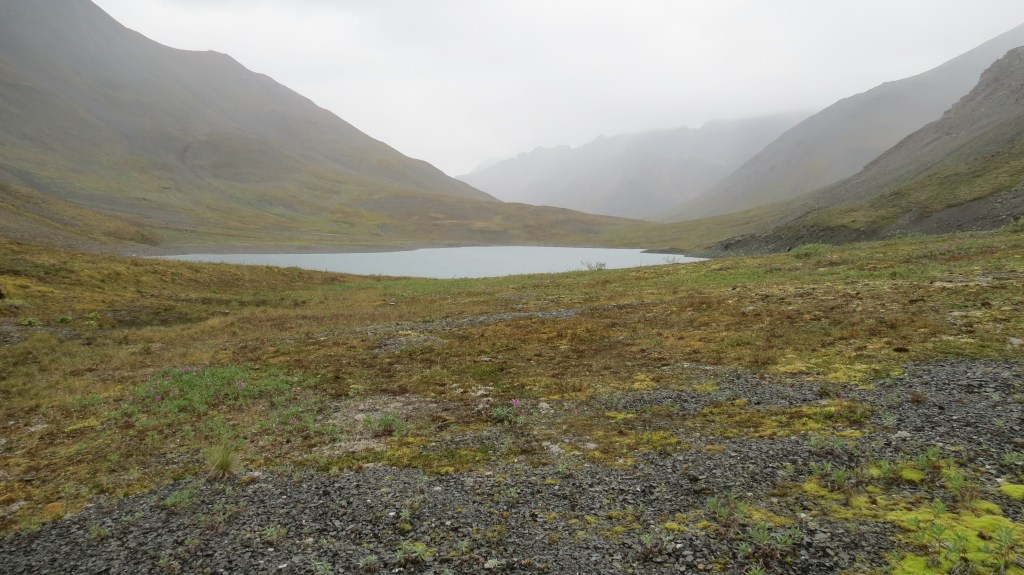
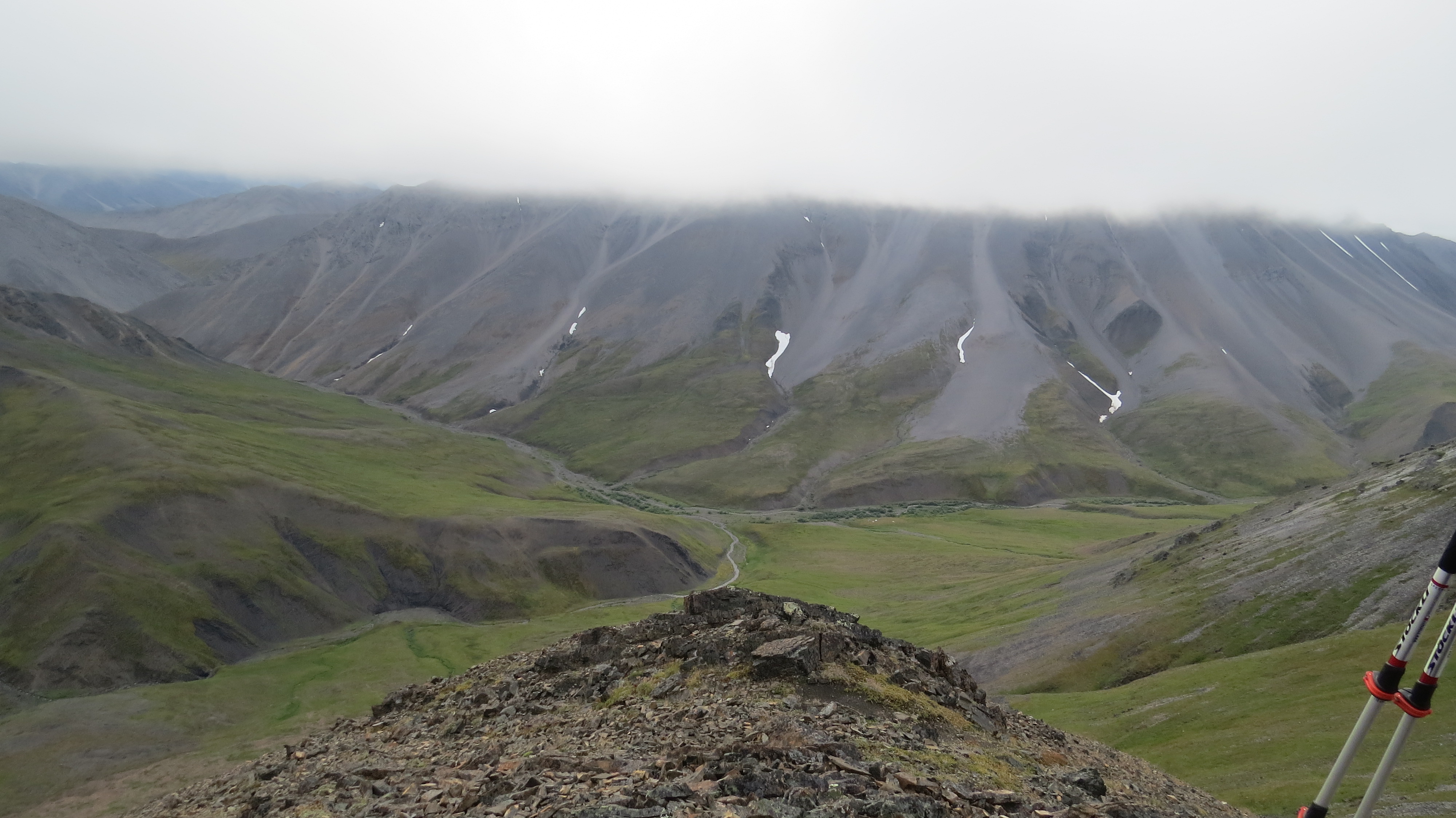
Wulik Mountains, Alaska, August 2014
Several years later, nearly everybody passed me on a tough hike up Oregon’s Larison Rock Trail, which I had led for years. It was a first, but it didn’t matter. When I was 76, I developed cancer and needed hormonal therapy. I changed, or perhaps was changed. I used to want to be on a saw, cutting out logs. But now, it didn’t matter. I enjoyed leading a crew twice to Lowder Mountain in the Three Sisters Wilderness to brush the meadows by hand so hikers could find the trail. What I didn’t expect was my becoming a connoisseur of smaller things, as if I had traded my hiking strength for increased ability to notice subtleties around me. I changed my “macro” view from the open horizons of Sig Olson to a “micro” quiet magic view of Duluth writer Sam Cook, trying to follow rules of poet Mary Oliver: “Pay attention. Be astonished. Tell about it.”
That matters.
Author, Black Creek, Waldo Lake Wilderness, August 2025
I stumbled out of the tent on to the grass for my middle of the night nature break. We were camped next to the Aichilik River, a beautiful, wild, braided flow that emptied into the Arctic Ocean, 30 miles to the north. Above the river was the full disk of the sun, a finger breadth or so, about two degrees, above the northern horizon, its light’s shimmering on the water. Two weeks from the solstice, and the midnight Sun was right where it should be at 69 N.: two degrees north of the Arctic Circle, two degrees above the northern horizon. Above the Arctic Circle in June, it’s daylight all night, and the Sun circles the sky.
I’m Up North. For me, north is my favorite direction, along with upstream, uphill, beyond the wilderness boundary. There is north, and there is Up North, a special construct in my world, sometimes referred to as “God’s country.” Minnesota outdoor writer Sam Cook wrote, “Up North is a map on the wall, a dream in the making, a tugging at one’s soul.” Sig Olson referred to it as “beyond steel, and roads and towns, where they will find release.” “They” is defined below.
My Up North is coming around a corner of Obsidian Trail in the volcanic area and seeing Middle Sister suddenly fill my vision. It is big water of Agnes Lake in the Quetico, stretching as far as I can see, open horizons that Olson wrote about, remembering head winds, rain, snow and the beautiful campsites on the Canadian Shield. Up North is seeing Mt. Adams from Timberline Trail; behind Upper Trestle Falls; the tors, granite poking through the ground, in Serpentine Hot Springs on the Seward Peninsula. It’s standing hanging to a tree at the top of Lowder Mountain, looking down at Karl and Ruth Lakes. It’s the vastness of Drain Creek Valley in the Refuge; the incredible view of the forests below Diamond Peak, seen from Hemlock Butte. It’s a hermit thrush in camp or being so high one can look down upon a golden eagle in flight. It’s autumn where the trees have more colors than just yellow, seeing the lake ahead when the portage is almost over, the primal feeling when you hear rumbling of thunder at night when camped in the wilderness. It’s Virginia Falls on the Nahanni.
All was well. It was normal nighttime cold, which always struck me odd with the sun out. We would hike on aufeis later that morning, frozen water that expanded out of the riverbed, providing a decent highway for hiking on the North Slope in June. We’d likely cross the river a few times. Wet feet are a given up here. If you were lucky, that’s all that got wet. That’s part of Up North. Wetness. It’s difficult, but it wouldn’t be Up North without it.
Up North is paddling the Yukon River into the vastness of Lake Laberge that Robert Service memorialized in “The Cremation of Sam McGee.” It’s understanding that “sweat and toil, hunger and thirst, and the fierce satisfaction that comes only with hardship” are why some of us —“they”—go.Olson didn’t add soaking wet, which I would be in 2 days, when we hiked in pouring rain, seven of us piling into a small cook tent for lunch where we had hot soup and briefly forgot how wet we were. The sun came out that afternoon. Up North is the feel of the warm sun on your soaking wet body, watching everything dry while you drink something hot. Up North is a solitary, haunting loon call down the lake.
See you on the trail. May you find your own Up North.
“Up North is a map on the wall, a dream in the making, a tugging at one’s soul. For those who feel the tug, make the dream happen, put the map in the packsack and go, the world is never quite the same. We have been Up North. And part of us always will be.” (Sam Cook)
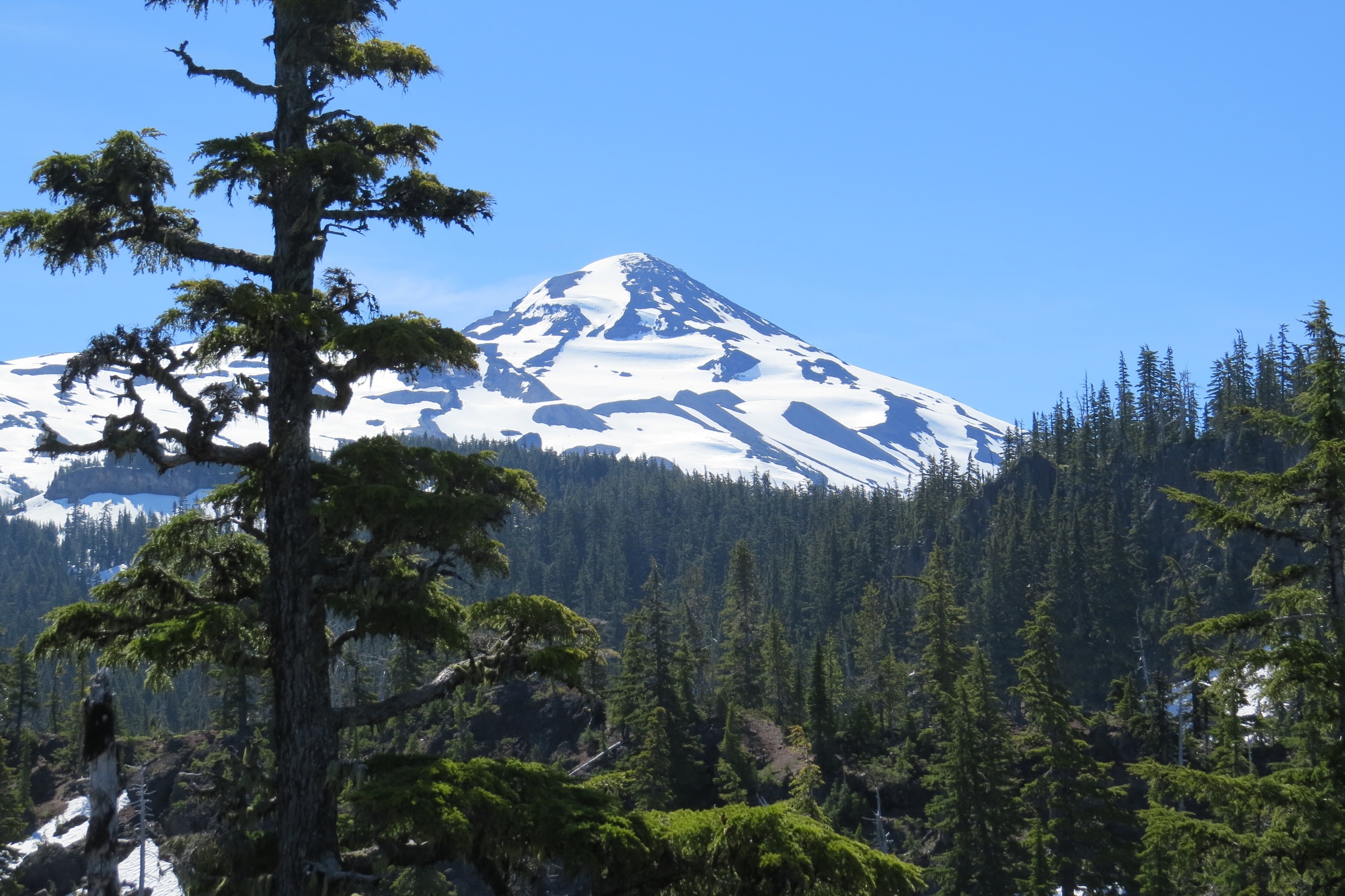
Middle Sister from Obsidian Loop Trail
Open Horizons from Agnes Lake, 2005, my last time there.
Tors, granite poking through the ground, Serpentine Hot Springs, Alaska, 2016
Karl and Ruth Lake, Three Sisters Wilderness, Oregon, 2014
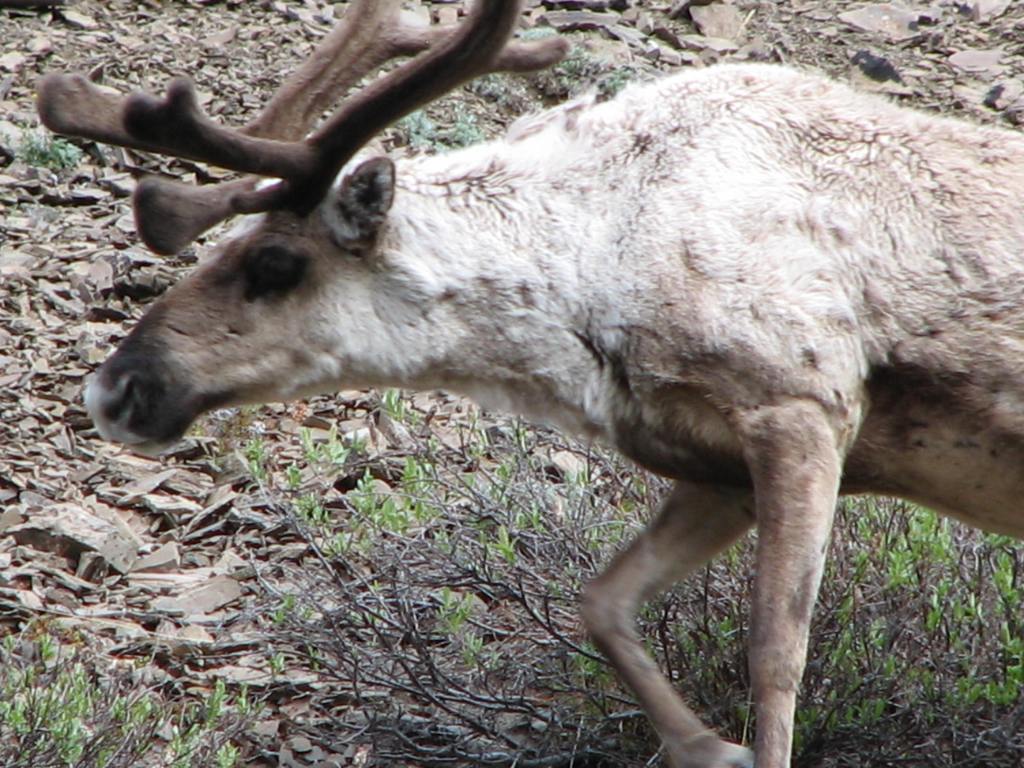
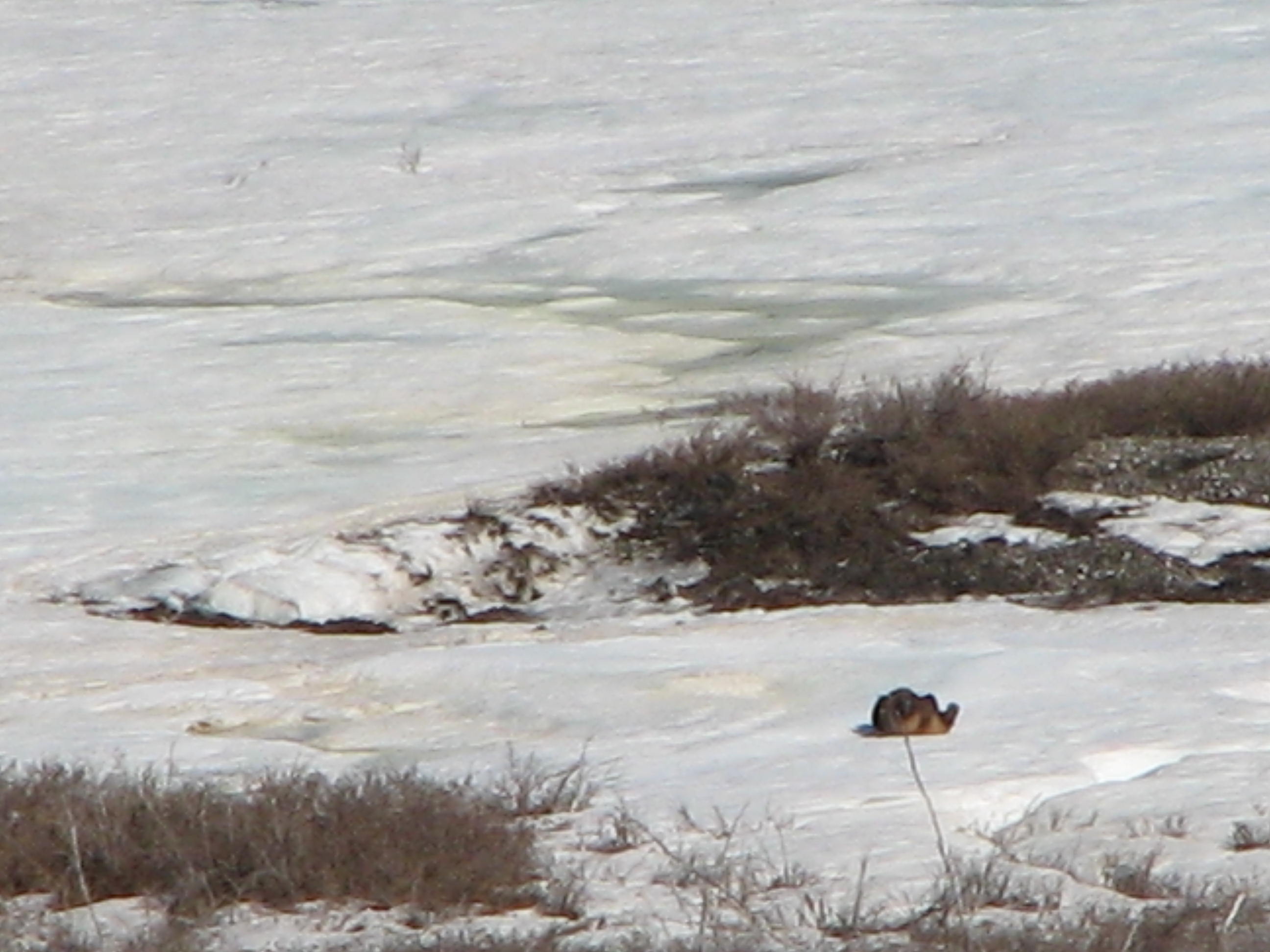
Caribou on aufeis, Aichilik River, Arctic National Wildlife Refuge, 2009.
I was in the Anchorage airport late one night on my way home from my tenth trip to “The Great Land.” I stopped in the men’s room, and before I saw the pair, I immediately recognized the smell that to me characterizes one thing: “we’ve just come out of the bush.”
I call it The Scent. Capitalized.
The Scent is difficult to describe. It is not evident when I do trail work for a day or hike a 20 miler. I sweat, I’m dirty, I come home and smell, but I don’t have The Scent. The first day out in the backcountry, I don’t have it. I smell clean. The Scent is days old sweat on clothes that have been worn far too long, unwashed, in places where there is usually a lot of dirt, rain, flowing water, skin that hasn’t been cleaned in several days, the combination’s often being mixed with woodsmoke from cedar, pine, birch or hardwood. Biologically, it is created by bacteria’s breaking down oils plus burned carbon, but I think some of it may be a special compound formed when hard work is performed in places where there are no signs, the rivers run free, people are few, and the sounds of traffic are ravens, eagles, hawks, hermit thrushes and flickers, marmots, wolves, and beaver tail slaps. The Scent requires tens of thousands of paddle strokes, dozens of miles under a pack or paddle, bug bites, sunlight, rain or dew, a few cuts, walking through muck, tripping on a root, fording a river, reaching a difficult summit, watching sunrise over a lake with mist, warming or talking by a fire at night or on a cold rainy morning, kneeling on the ground pitching a tent, watching an eagle fly, or collecting wood from a downed jack pine.
The Scent is not the smell of a men’s locker room. Nor is it the smell when one gets ill and doesn’t bathe for a few days. Long spells in wild country appear to inoculate the nose to ignore The Scent. But when I am on the last portage, the last mile of a trail, I can recognize a day tripper or a person who has just left the jumping off point. There is no trace of The Scent; they smell clean, soap and shampoo clean. They haven’t worked enough yet. Some of them will, and days later, they will be exiting the way I am and have The Scent.
Once out of the bush, I notice The Scent immediately. My wife and I weren’t able to shower once after we came off the water after a week out on Lake Insula in the Boundary Waters, with a lot of time under pack and paddle, near eagles, ravens, a wolf, nobody else for six days, a bit of rain, lots of flowing water, all the requirements. The outfitter changed out a propane tank, but something was wrong with the heating element, and he was really sorry, but there was no hot water. We ended up driving five hours without a shower. The next year we used a different outfitter. The Scent is that way: it is the smell of wild country and is foreign to cities, highways, crowds and buildings.
Lake Insula, 2007, before the fire. Le beau pays of Sig Olson
Walk through a trail town sometime, and by smell and sight, you can spot three different groups of people: those who are getting ready to go into the woods, on whom their clothes look normal and they aren’t self-conscious. The Scent is absent. The second group has just showered and put on clean clothes, looks scrubbed and are self-conscious and maybe a bit bewildered by being back in a strange world. No Scent on them. The third group has just come out of the woods and one can smell them yards away—or when opening the door to a men’s room. When I come out of the woods, I know I have The Scent, and I try not to get too close to others.
These two men were in the third group. They were self-conscious about The Scent, both wanted a shower, and they were trying clean up in a men’s room, knowing that they had several hours ahead of them on the redeye back to the Lower. Nobody wants to get on a plane carrying The Scent. It belongs in wild country.
As I washed my hands and turned from the sink, I accidentally brushed the pack one still wore. People in the backcountry for many days feel at one with their pack. I know thru-hikers on the AT and PCT feel that way, and when I section-hiked the AT, I discovered one day that getting ready to move meant I automatically put the pack on, like a shirt. I didn’t feel right without it. Anyway, the young man apologized. He probably forgot he had the pack on.
“Been there a lot,” I replied. While I’m shy, I know well both the country and the work required to produce The Scent. These young men were kindred spirits. “Where did you guys go?” I asked. I knew I wouldn’t hear “Anchorage” but the Chugach, not “Juneau” but the Chilkoot, not “Homer” but the Kenai, not “Fairbanks” but Denali.
We started to talk. They were young, at least 35 years younger than I, and this was their first trip to Alaska, where they spent 2 weeks, first in Denali and then the Kenai. They had wanted to do this trip now, while they could, because their lives were going to be busy in the coming years. They did it. They had The Scent to prove it.
Good for them, I said. I mentioned my then 5 trips to the Brooks Range, Up North even by Alaska standards: Arrigetch Peaks, twice in the Kongakut drainage, and a backpack/paddle on the Noatak. I didn’t say much more, because they were busy trying to get clean, but I suspected that when I used an Up North name, a lot of communication took place. There is a magic to certain words in the North Country for those who make it part of their lives. My last trip in the Brooks was where my guide and I got hauled up to the south end of Atigun Pass on the Dalton. We had stopped in Coldfoot for a break, and a lady who was a volunteer at the Visitor’s Center asked me whether I was going north or south, for the Dalton only goes those directions. I pointed west. She laughed. She knew.
We bushwhacked in to the Gates from the Dalton was about all I said, but perhaps my tone of voice unsaid told them the rest of the story. I used a few words like “Oolah” and “griz”, “tussocks” and “Boreal.” We had climbed over a thousand foot divide, camping at what seemed like the top of the world, then traveled for 3 days in the rain in and by rivers, past Oolah Lake and more rivers, finally hiking six miles in flooded tussock country to Summit Lake. We saw a griz. I finally got to see Frigid Crags and Boreal Mountain—the Gates of the Arctic that Bob Marshall named. They had that look in their eyes—maybe I should call it The Look—which others have seen from me. It’s a far away gaze of longing, of thinking about wild country, of rivers that run free and few people in the Lower have ever heard of, like Aichilik, Nigu, Itchilik, Alatna, Hulahula, or Kobuk. It’s mountains and remote valleys, wild country, open horizons, where the Sun in summer travels in a circle above the treeless tundra. It’s slogging through tussocks, rivers, swamps, and in bear, caribou, Dall sheep, wolverine, and moose country. It’s hiking on residual ice, or aufeis, and bugs in June, blueberries and crowberries in July, rain, autumn colors and the return of night in August. It’s the most difficult country to hike that I have encountered, also the most beautiful. It is a country that kicks one’s butt, until finally one accepts it with the simple words, “It’s Alaska.” Everybody up here who has worn The Scent understands that.
Oolah Lake
Normally, I don’t talk much to strangers, but if I’ve been out in the bush for a while, I find myself pretty talkative. These guys were me when I was a young man. Then, my dreams took me every year to the Boundary Waters Canoe Area Wilderness, “le beau pays” of Sig Olson, to get into the backcountry, away from people, civilization, only me, the wild lakes and rivers, loons, beaver, otter, eagle, moose, bear, and wolf. I went into the country scrubbed and clean, explored it and came out with The Scent. Eventually, I knew that area as well as my home town. Maybe better. I sure loved it more. Always will.
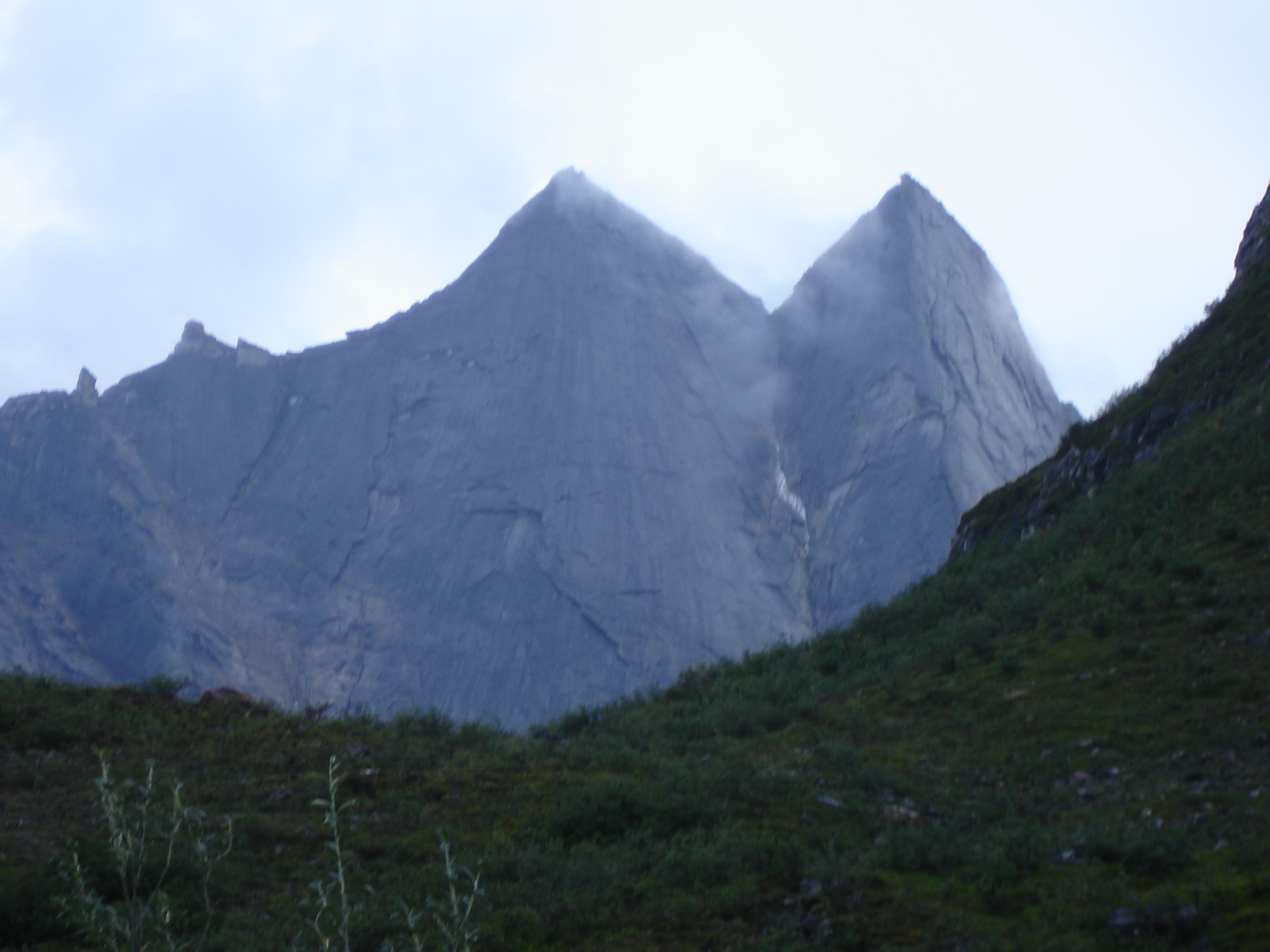
It was much later that I discovered Alaska. Oh, I did the Chilkoot Trail in ’84 and ’87, paddling the Yukon as far as Carmacks; I paddled the Nahanni in the Northwest Territory in between those two trips. I didn’t camp above the Arctic Circle until 20 years later. By then, I knew if I didn’t start to make my dreams come true, I never would. First on the list was the Arrigetch Peaks in the Gates, spending four nights at the base of the mountains, close enough to hike up and place the palm of my hand on the granite. We tried to get back into Aquarius Valley, but the rain made it too slick and unsafe to see the whole thing. We got to the glacier that is the headwaters of Arrigetch Creek. On the eight mile hike back to the Alatna River, there had been so much rain that we had to detour upstream a mile to finally cross in fast water that was mid-thigh in depth, then walk a mile back down to move forward a net ten yards.
Base of the Arrigetch Peaks
Afterward, I said that if there were a guarantee I could see Aquarius, I would go back. But there was too much else up there. I never did. I returned to Fairbanks with The Scent, took a quick shower and the redeye to Seattle.
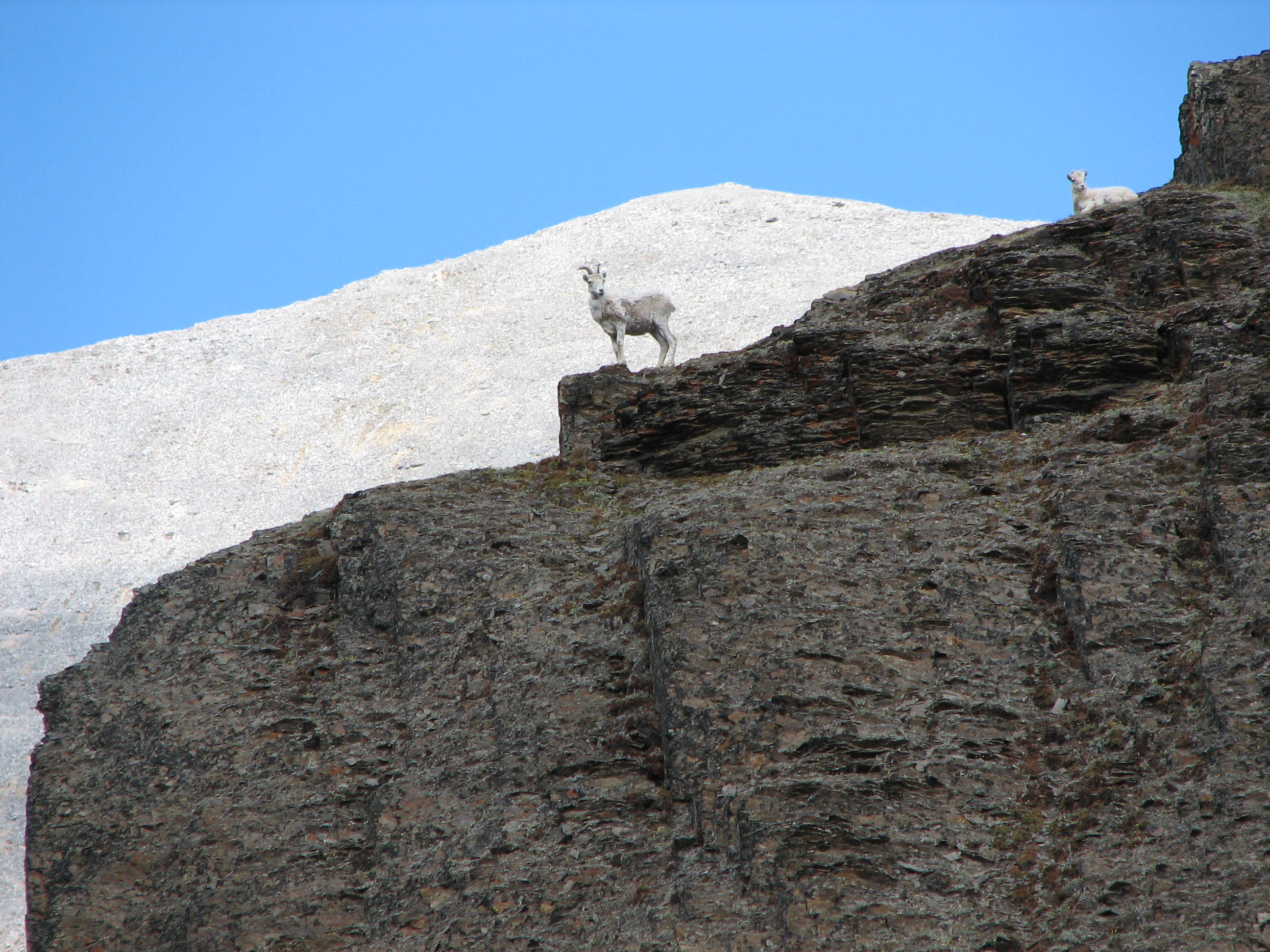
The next year, I came back to see ANWR, and we did a loop hike from the Kongakut River that got us into Drain Creek, bordered by mountains called Bathtub Ridge, with a mountain to the east called “The Plug.” This was the ANWR I was looking for, with huge vistas, miles of tussocks full of caribou, and a braided river. We went in early June to beat the bug hatch and camped at the base of a cliff that was a salt lick for Dall Sheep. I remember being up at 1 am watching them in bright sunlight, high on the rocks above, moving on the near vertical face more easily than I could move in tussocks.
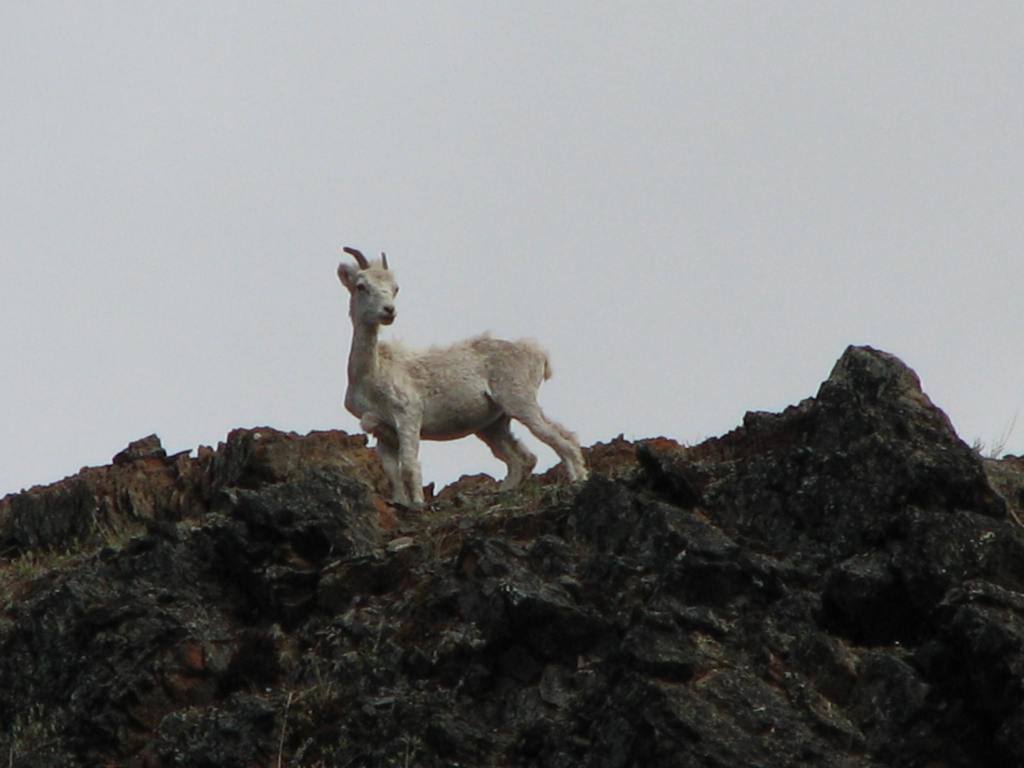
Dall Sheep on a salt lick.
I thought once to ANWR would be enough, but that Christmas I got a letter from the guide saying he planned a special ANWR trip to the Aichilik River. I went into the garage, smelled my pack, which had some residual of The Scent, and decided I had to do that one, of course, because, well, I had to. I knew there was a longing in my eyes. I could see Dall Sheep and Caribou, another braided river and maybe a griz, so I went.
We landed on semi-flooded tundra and my boots were soaked for the next 11 days, temperatures most of the time hovering at freezing. I packed four pairs of wool socks, kept one pair for night, which meant after three days my dressing began with cold wet socks. It mostly rained or rain-plus— hail, graupel, or sleet. We crossed and recrossed the Aichilk, walking on ice by caribou, as we headed south into the Brooks Range. One day, we sat down on the tundra for lunch near the entry into the mountains and had caribou walk close enough to touch, between us and the river. That afternoon, we hiked underneath rock faces where Dall Sheep stared down from us from thirty feet up. I had a wolverine run right by my tent one morning and a caribou calf do the same one evening. The last day, in sunshine, we saw a griz rolling on ice and then hiked over a mountain rather than take a chance on a valley with a rain-swollen stream.
Caribou on iceDall sheep
A year later, I backpacked the upper Noatak and kayaked a couple hundred miles downstream to Lake Matcherak. I saw another wolverine and we saw a dozen grizzlies, including a sow, two cubs and a yearling that walked right through our camp and another that we had to encourage to turn around on the shore of Matcherak. I flew back to Bettles with others in a float plane loaded with gear, flying past the Arrigetch in clear weather. It was fabulous, except the poor pilot had a planeload of The Scent.
Boreal Mountain, part of the Gates of the Arctic
I thought I had seen all I wanted to up there, except I still haven’t. Probably never will. I wanted to see the Sheenjek Drainage in ANWR, but things happen and I never got around to doing it. When I write about this, I know I have the look in my eyes those young men had. I can still see the Noatak far upstream from where I stood one day, when we climbed a mountain and stood on the summit in the wind, astounded by the beauty of the country.
I didn’t tell the pair to follow their dreams, as I have tried to follow mine. They were already dreaming. They had The Look. They didn’t know how they were going to get up here again, where they would go, or what they would do, but they were going to do it.
They will see the Brooks Range, ANWR and deal with all the issues Alaska throws at those who go into the bush. They will come out of the country with The Scent, of course, not mixed with woodsmoke, because they will have been north of the treeline, where darkness doesn’t exist in summer. Their speech will be peppered with Up North words, and they will again take the redeye to Seattle then the Bay Area, where they live, thrilled to have done the trip, already planning the next one. They will have adventures the way I did, and look back later with fondness at their good fortune, as I have.
Maybe they will travel together, alone, or have company—spouses, children, other friends— who will discover these wild places and carry The Scent. Maybe some day they will meet a traveler outside the bush with The Scent, ask where that person came from, and share some of their memories of the back and beyond.
If for some reason they never go back, they went once, saw it, came out with The Scent, and that mattered.
I arrived home from the hardware store just in time for the rain. Note: I didn’t say I just beat the rain home, but rather I arrived home in time to enjoy the rain.
Rain has a bad rap, and since I like rain, it means that once again I am on the wrong side of conventional likes and dislikes in society. I live in the city but love the wilderness, but I don’t fully belong in either. I am an introvert in a society that extols extroverts. I don’t like the idea that everything has to be set to music, which puts me at odds with conventional likes. The other day, I was sent a YouTube video of the Geminid meteor shower, which was a collage of pictures set to music. I commented: “Nice. Nicer without music.”
I think summer is overrated, too.
I’ve felt this way most of my life about rain. I enjoy being inside reading a book, while listening to the rain. But lest one think that being indoors is somehow cheating, I love nothing better than being warm in my sleeping bag and listening to the rain on the roof of the tent. Oh, I’m sure I will have to get up in the middle of the night and go out in it, but then it’s that enjoyable to be able to go back inside and hear it as I again get warm.
I led a hike to Heckletooth Mountain outside of Oakridge, Oregon, last October, when we had an atmospheric river hit us the night before. An AR is a plume of moisture spreading from places like Hawai’i, Saipan, or Japan all the way in a continuous feed to the Northwest US. Recipients can get several inches of rain. I had some cancel that morning, calling me to say how they were staying home and not coming. I initially envied them a little, but when we started hiking, the rain gear worked just fine (October hikes are great for testing rain gear), fall colors were beautiful, and while we were wet on the outside, we were warm. Sure, we had to be careful about hypothermia, but hiking uphill helps warm one up, and so long as one hikes back down steadily, cold is not a problem. Great hike.
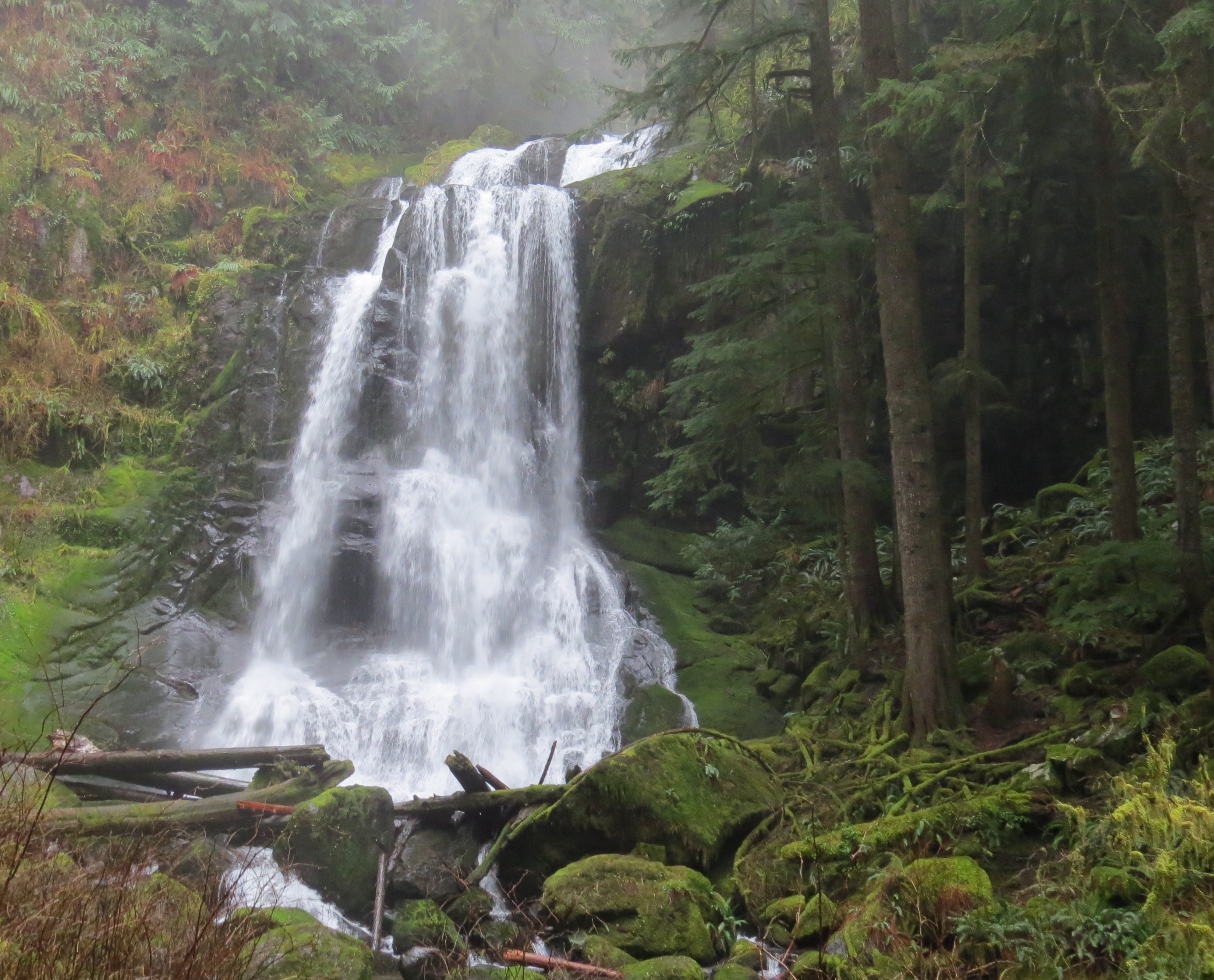
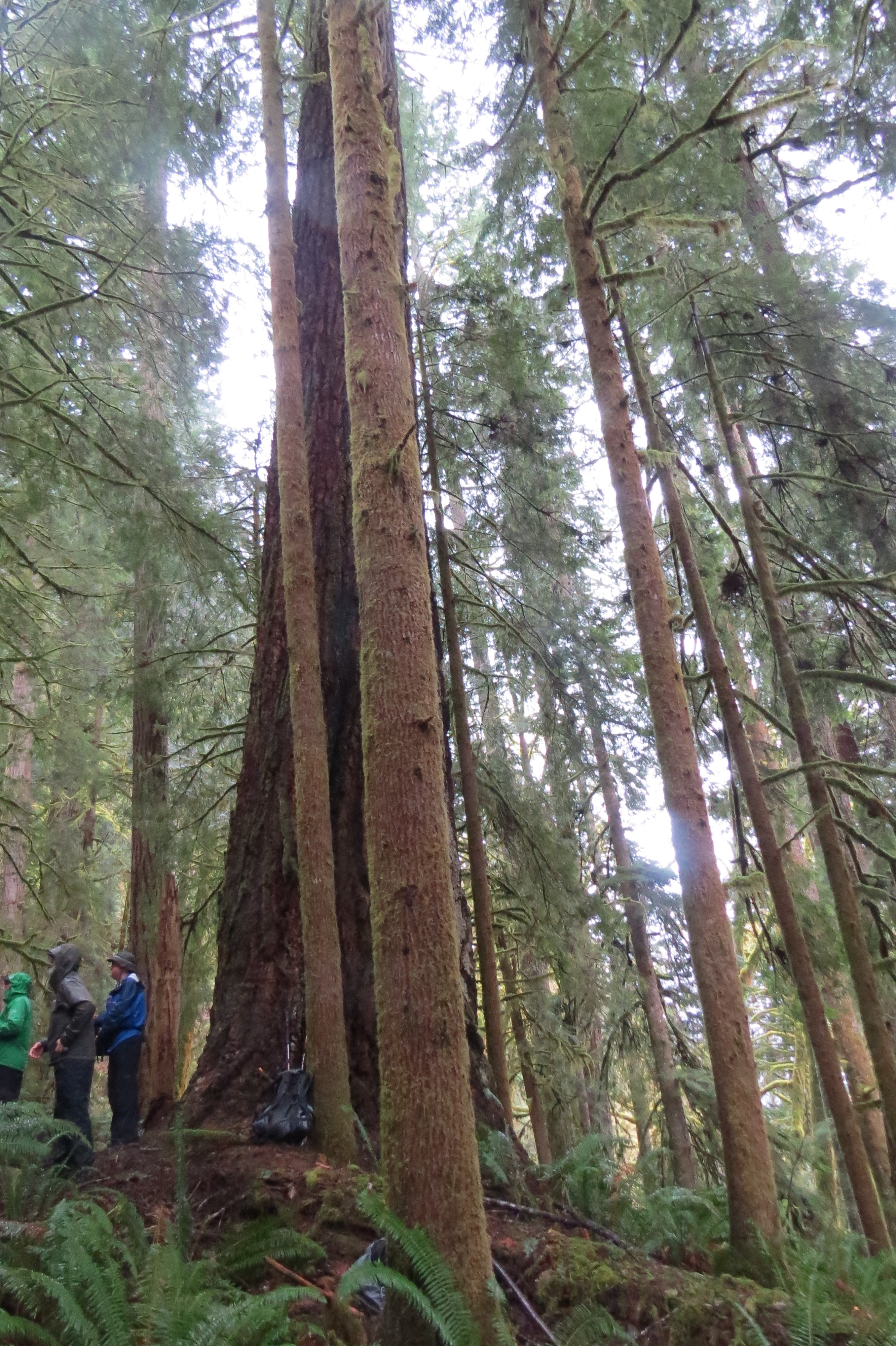
Several of us hiked into to Kentucky Falls last January on what has been the wettest hike I’ve been on in Oregon. We ate lunch standing up, in rain that managed to get to the forest floor through 600 year-old Douglas fir trees. Hiking back out, we were totally soaked, and I loved it. I knew I would dry off eventually, I wasn’t going to get hypothermia, and we were getting what we needed in winter—a long, cold rain.
Part of the Kentucky Falls area
Eating lunch by a 600 year-old Douglas fir
Kentucky Falls, one branch. I stayed so long that when I turned to leave, the rest of the group was long gone. Rain makes for beautiful waterfalls.
I’ve backpacked during a 6 day rainy spell in Alaska’s ANWR when the temperature never went past 40, our boots were completely wet, our tents, too, but we stayed warm by hiking, then pitched those wet tents and got into our mostly dry clothes. The cook tent we set up had enough shelter for eating. We saw snow on Bathtub Ridge in Drain Creek in June. Yes, I had to put on wet wool socks first thing, but it was only cold for a few minutes, then my feet were warm.
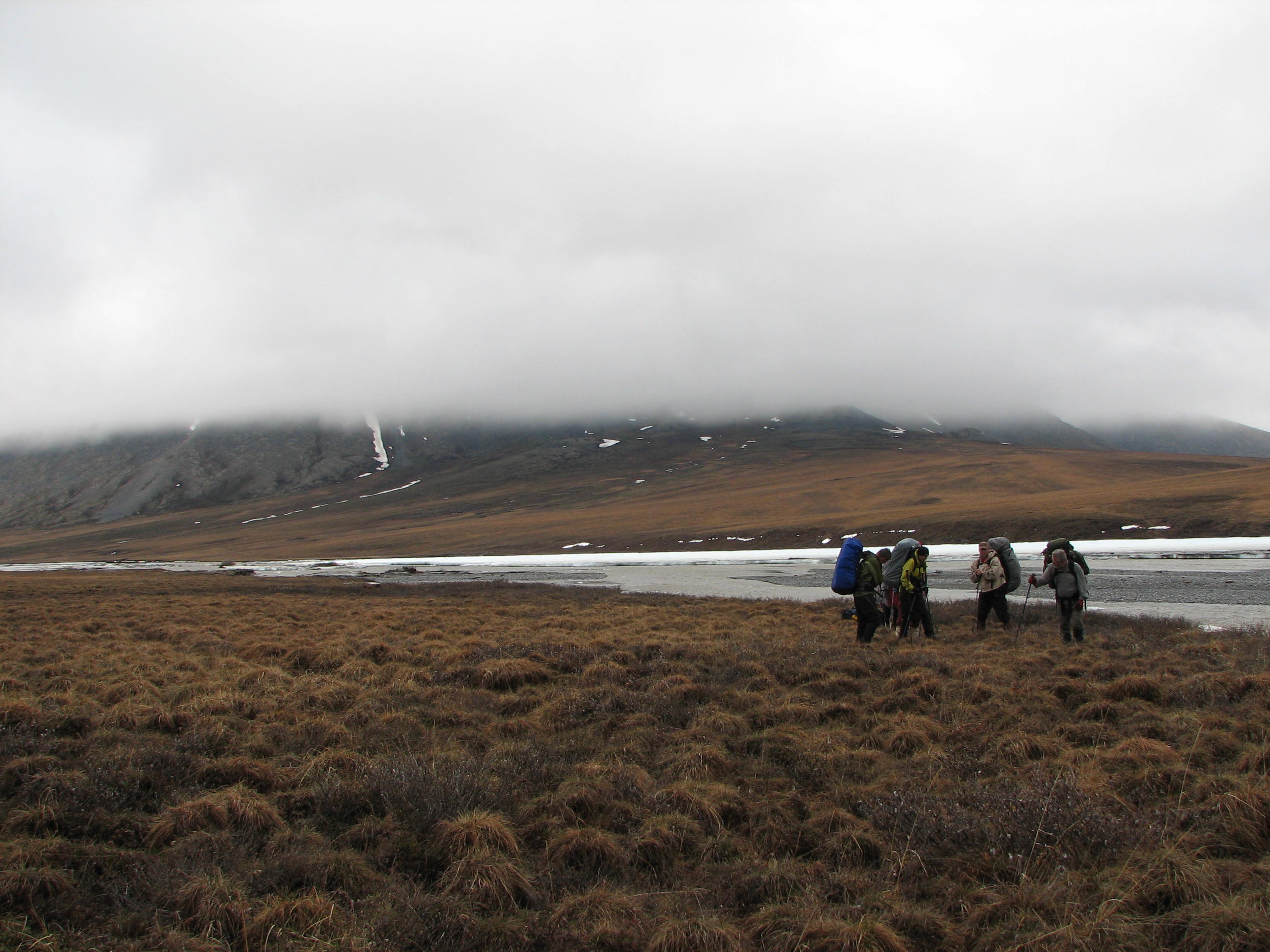
Alaska’s North Slope, ANWR, shortly after being dropped off to hike south through the Brooks Range (2009).
Hiking through fog.
Brown bear rolling on ice, Drain Creek, ANWR.
Snow on distant Bathtub Ridge, after climbing out over a pass. The prior picture was taken far down the valley and to the right.
Years ago in the Boundary Waters, out on the waters of Crooked Lake, just south of the Canadian border, I got packed up, while everything was dry, then on the lake got hit with a downpour I had to pull ashore on an island to empty water from the canoe, and I was really wet, but since I was paddling and portaging the whole day I stayed warm enough. Once I reached my campsite, I had a dry tent—at least briefly—and dry clothes awaited me. I had a quick dinner and got into bed, staying warm, listening to the gentle, steady rain.
I remember rainy days on the trail better than sunny ones. I remember the cold rain in Temegami, when rain gear wasn’t as good, but our young bodies were able to deal with cold. I wasn’t as happy with it back then. A quarter century later, and ago, I remember the Fourth of July week on Basswood Lake with the Forest Service, where it rained every day, and I worked to have dry socks each morning. The woods were empty that weekend, the lakes were beautiful, and we patrolled a vast wilderness alone. That was the weekend I learned how to stay fairly dry during days of rain.
I missed the rain when I lived in Arizona. We had summer thunderstorms, and if I were lucky, we had at least one nighttime boomer, where I could watch the lightning, hear the thunder, and hope the desert would soak up the water. I hate droughts, and the 22 year one in Arizona was something I complained about often. The few times it did rain, I heard weathermen and newscasters say that it was a “bad day,” as if we could live our lives with no water at all.
Before I moved to Oregon, I was at a party talking to somebody who heard I was moving. He began berating me about its climate. “It rains all the time up there!” he said.
“Yeah,” I replied. “Great, isn’t it?”
After I moved, we were in a drought for 18 months. I heard how it would rain all winter, but we got a third of what we needed. When it was 80 in the mountains in January, an acquaintance told me how “spectacular” the weather was. I stayed quiet. I was told that March could be rainy, but it wasn’t, and that spring could be very wet, which it wasn’t, either. I was told that hot weather was not common, but that summer we broke the record for number of days over 90. In October, my neighbor asked me how I was, and I replied, “nothing that 10 inches of rain can’t fix.” In December, the “fix” came, not all at once, and never for 24 consecutive hours.
In November, a woman said on the radio that soon it would be cold, but it wouldn’t last long, and before we knew it March would be back, then spring, and then summer. We had just gone through a summer with multiple days over 100, no rain for three months, wildfires that burned a quarter of the huge Three Sisters Wilderness and the Gorge, 20 days of bad air quality in Eugene, requiring special masks. No thanks. I can wait a long time for summer. It’s overrated, at least in the American West, where it starts a month or two sooner than formerly, lasts a month or two longer, drier, and with more fires. Arizona and southern California now have 12 month a year fire seasons.
I like rain. I know it’s possible to get too much of it, but I have not had that experience in decades. I had forgotten how many different shades of green there are in the Pacific Northwest. In the desert, green is washed out by comparison. I like flowing water, just to watch it, in the wild, not in some fountain. I like the Sun when it comes out after a good long rain. Then it is nice. I enjoy it.
“The goal of the (backcountry responsibility) code…would be to encourage simple things like speaking up when someone is doing something unsafe….” Outside magazine, article dealing with avalanche safety.
“I don’t like this!” I called, and stopped hiking.
The day hike we took on the third day of the Wulik Peaks backpack trip was going to be easy. The whole trip had been. While hiking in Alaska is seldom synonymous with the word “easy,” the abundance of caribou trails, low water in creeks, and hard ground made 2.5 mph possible, triple what I had been used to in my five previous trips to the Brooks Range. My feet had stayed dry, and in my prior 50 days of backpacking in the Brooks, never had I ever finished one with dry feet.
We camped early, had lunch, then took a day trip up a long valley, over a pass, into a second valley, climbing to a ridge overlooking two mountains and a beautiful green cirque. The Sun was out, the air clear, the wind light, and the way to the high ridge overlooking our camp easy.
People reaching summit of unnamed mountain in fog. This one was safe.
Cirque at top of second valley.
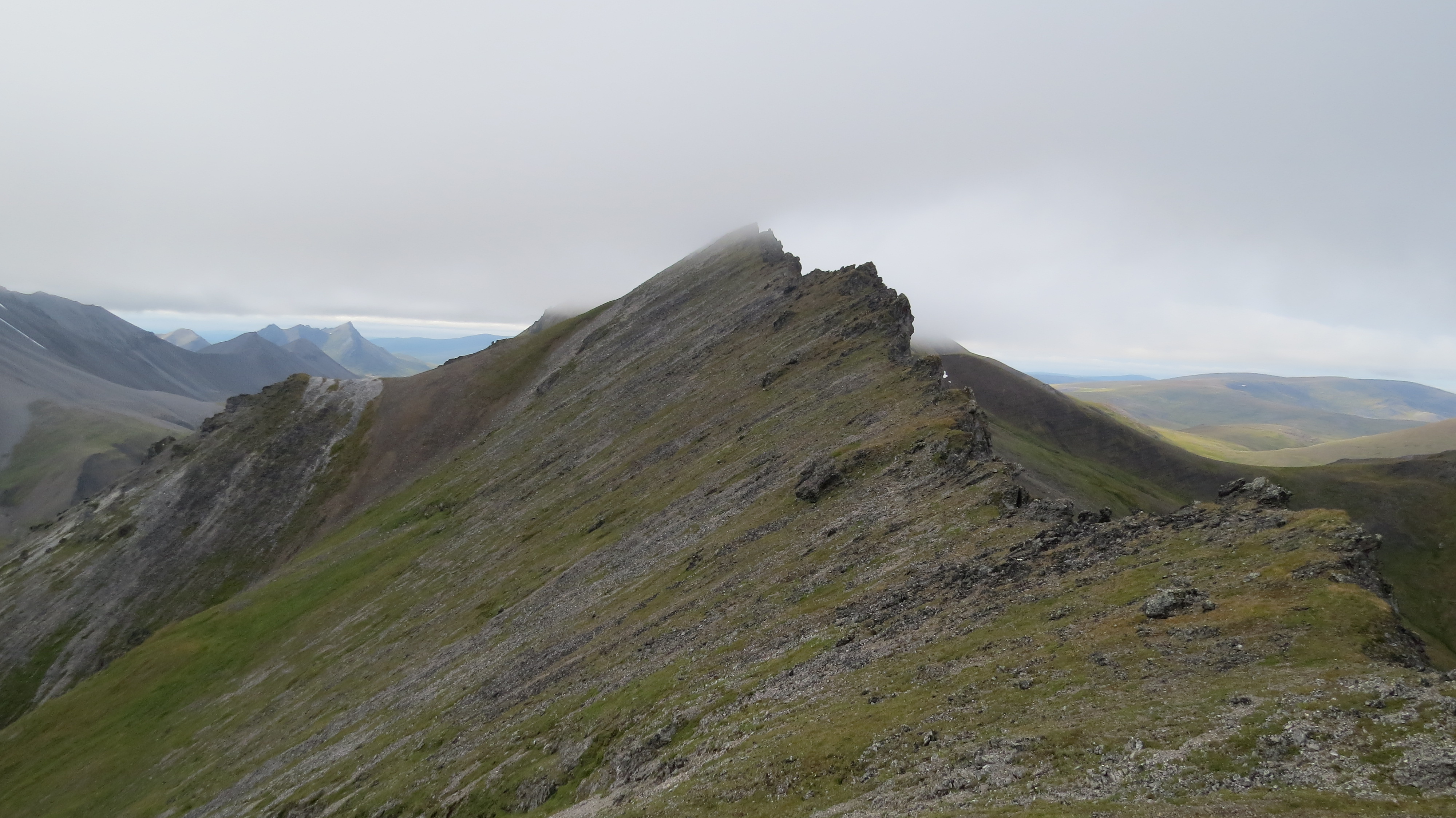
Once on the ridge, however, we realized we had to skirt a large slope of rock scree at about a forty-five degree angle. There was the hint of a caribou trail there, but then the guide went one way, and I did not want to follow. I saw no good route, and while falling on the rocks would not likely been considered life-threatening, in remote Alaska, there is no such thing as a “minor injury”. This wasn’t the South Col, but it was more than I had bargained for on this hike.
I promise my wife before each trip that I will be careful, and I broke my promise. I got away with it this time, much like the Space Shuttles got away with O-ring problems before Challenger didn’t, on 28 January 1986.
The guide called back, “It is only 100 feet around.” A hundred feet means a lot of different things, and vertical vs. horizontal is a big difference. I took it as meaning very short, without considering what modifiers “short” had.
Top of the ridge, after the crossing.
Where the ridge turned from rocky to grassy.
I replied about my not being one of Outside magazine’s world class climbers. Every other person on the trip seemed comfortable, but one offered to go back with me. Against my promise, and therefore against my better judgment, I went forward. I reached the bottom of a 25 foot steep climb up to the guide. I took large steps, stayed close to the mountain, being told by the guide I was going too fast.
I don’t like criticism, and I spend most of my life trying to do well to avoid it. I ignored him, wanting very quickly to get to the top. The guide had convinced me to do something I didn’t think safe and then criticized how I did it. I said nothing about the event then or for the rest of the trip. We had been required to hike single-file, and I didn’t like having to set my pace with another person’s. When there are sharp-pointed walking sticks involved, people can easily get hurt, if they aren’t paying attention, and follow too closely. I erred there, too, because I did not mention that problem at the outset of the trip, and I should have brought it up. But the guide and another client had far more Alaska experience than I.
After the trip, when I got to a telephone, I told my wife about the incident and apologized.
Up on the ridge, I should have turned around and gone back. The fact that I made it safely did not mean it was safe. This concept is poorly appreciated by many, who feel if one “gets away with something,” it is safe. No, one played the probabilities and succeeded, but the probabilities significantly predicted a bad outcome, and we read about those in newspapers.
In the Alaskan bush, one has already taken significant risks. There is simply no reason to cross a potentially dangerous ridge that does not need to be crossed. Going back around would have been safe and taken 30 more minutes. Big deal. But we didn’t do it. I didn’t go back; I got caught up in “Group think,” and I didn’t want to disappoint anybody. As it was, I felt like I was the worst hiker on the trip, as if it mattered, as if I were going to see any of these people again. I disappointed myself, breaking a promise, because of a bunch of rocks.
The guide erred, and I erred, too, by not pointing it out to him. He should have told me to turn around, rather than say, “It’s good that you know your limits” before making me violate them. He should have decided to either have people look before proceeding or deciding on his own not to do the traverse. That is what a guide really gets paid for, not for cooking a meal or leading a single-filed group of 6 on caribou trails in northwestern Alaska.
It is one thing to know a person’s limits. It is quite another to respect and not violate them.
I suspect the rest of those on the trip have either forgotten the incident or thought I was a sissy. I didn’t make a stink. I moved on. But I didn’t forget it. If I am a sissy, so be it. I’m alive to hear the words.
Many of us don’t like to say anything negative on a subsequent survey, especially if either our name is known or our identity obvious from the response. Those who survey should remember that their questions may not capture significant complaints. People must feel safe to report problems, straddling a fine line between wanting to state their case without getting somebody in trouble with their bosses, many of whom do not have the gift of constructive criticism. I did not feel safe commenting. The guide erred. I erred twice, when I didn’t turn back and when I did not discuss the issue with him, out of earshot of others. That would have been best.
It is one matter to wrench a knee during a necessary stream crossing; it is inexcusable to risk injury on a day hike to a ridge. The former is a significant problem, but stream crossings are a necessary part of Alaska hiking. Crossing hazardous ridges on day hikes were not necessary on this trip. Had I fallen and broken a few ribs, at 65, my life would have been in jeopardy. Day hikes are not necessary; often, they are treated with less, rather than more, care.
I regret my silence and not turning around. Fortunately, I am alive to regret it.
The Wulik Peaks area of Alaska is separate and west from the Brooks Range and lower, not rising much above 3600 feet (1100 meters), compared to twice that in the central Brooks and nearly thrice at the highest peak. I hadn’t even heard of the Wuliks before this year, but when one Alaska trip to the Refuge (Arctic National Wildlife Refuge) didn’t pan out, I discovered this trip, a part of the Brooks I had never seen, and one that immediately intrigued me. Wilderness I haven’t seen intrigues me.
The advantage of living in Oregon meant that I could get there in a day, arriving in the evening, and leave on the trip the following morning, which I hadn’t been able to do on my five previous trips to the Brooks. I did so, met the 5 other people who would be along, representing England, Germany, and the states of New Jersey and Alaska, as well as mine. Our guide was finishing a trip in the Wuliks, and we would fly in to meet him the next day.
I had dinner with the Englishman that night, and the next morning, we all flew into the Wuliks in two planes. It was a smooth trip, over the Noatak Delta, inland, and landing on a slight uphill rocky strip. The planes left, and it was quiet. There are not a lot of birds in the Brooks, especially in mid-August, and it is a very quiet place.
Noatak Delta in the morning.
Landing spot.
The guide gave us instructions on bear spray and dealing with bears, and we hiked as a group. We covered about 5 miles the first day, typical for Alaska, camping where two creeks joined. We would stay there two nights, doing a day hike the next day. Hiking up here was much easier than I had been used to: we were often on caribou trails, and while caribou go places I don’t want to tread, their trails are a very useful highway. The grass was low, dry, and the creeks and streams, all having a good amount of flowing water, were not difficult to ford. I stayed dry, and I would have dry feet the whole time we were out there, which I never would have expected in the Brooks; it had never happened in the 50+ days I had hiked in five different parts.
The second day, we climbed in fog to the top of a mountain nearby, gaining about 1100 feet (340 meters) and having lunch in the shelter of a rocky area. We returned to camp and then crossed the river and climbed up into another area, not as high, but with a view back to the north. The nights were cool but not cold; heavy cloud cover limited radiational cooling, but the high humidity plus any wind made one cold.
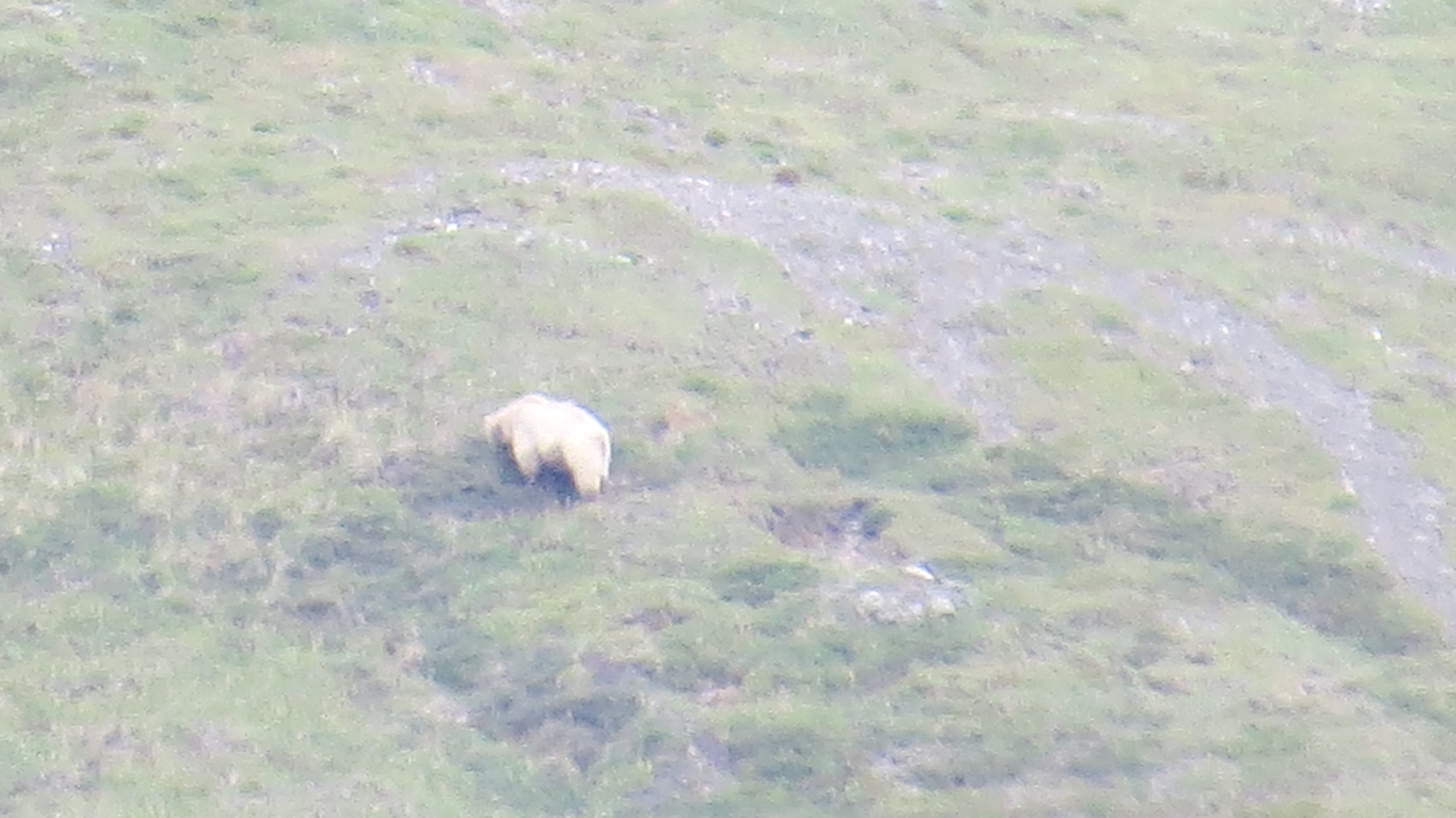
Bear, from 800 meters. He was the only one we would see.
People reaching summit of unnamed mountain.
Wheatear
The third day was the only day we saw sun, as we headed up to a divide between two streams, climbing about 700 feet (210 meters) and descending almost as much. We set up camp on a bluff a little above a stream and then day hiked into the mountains, doing a loop that at one point reached a narrow edge with a scree slope with large rocks at a 45 degree angle. I did not want to go on, but I allowed myself to be talked into it, crossing without incident. That was my only regret on the trip: we had “group think,” and had I turned around, somebody would have gone with me. The fact I could negotiate the area without incident did not make it safe, something I refer to as “Challenger thinking,” after the 1986 disaster, which had plenty of prior warnings, but since nothing bad had happened, the warnings were not heeded.
Forget-me-not
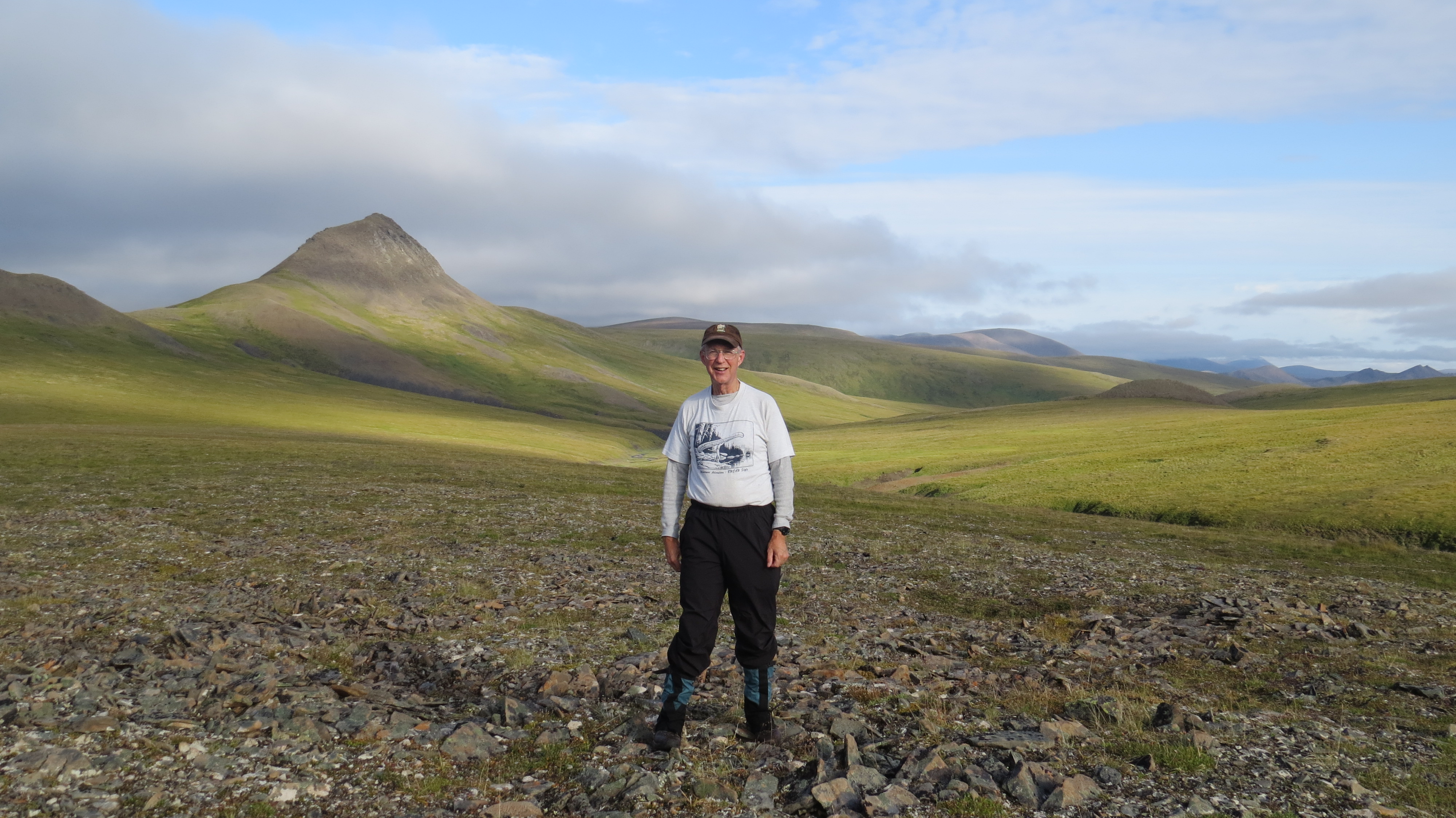
Author on a plateau at 1800 feet (550 m)
The vastness of the Alaska mountains above the Arctic Circle
We then hiked downstream to where the West Fork of the Wulik River widened and camped, climbing another 1000 foot peak nearby, without the issues of the prior day. The fifth day, we went up another stream, through the fog, across many side channels, where there was a steep drop on uneven ground to the stream bed, followed by an equally steep climb out. After crossing a divide between two watersheds, we camped in what was later called “rain camp,” for the moisture appeared to funnel through the mountains and turn into rain here, but not in adjacent valleys. Indeed, as I would later learn, there was moisture funneling into the Wuliks, but the surrounding area outside the mountains was relatively dry.
West fork of Wulik River.
View from unnamed mountain.
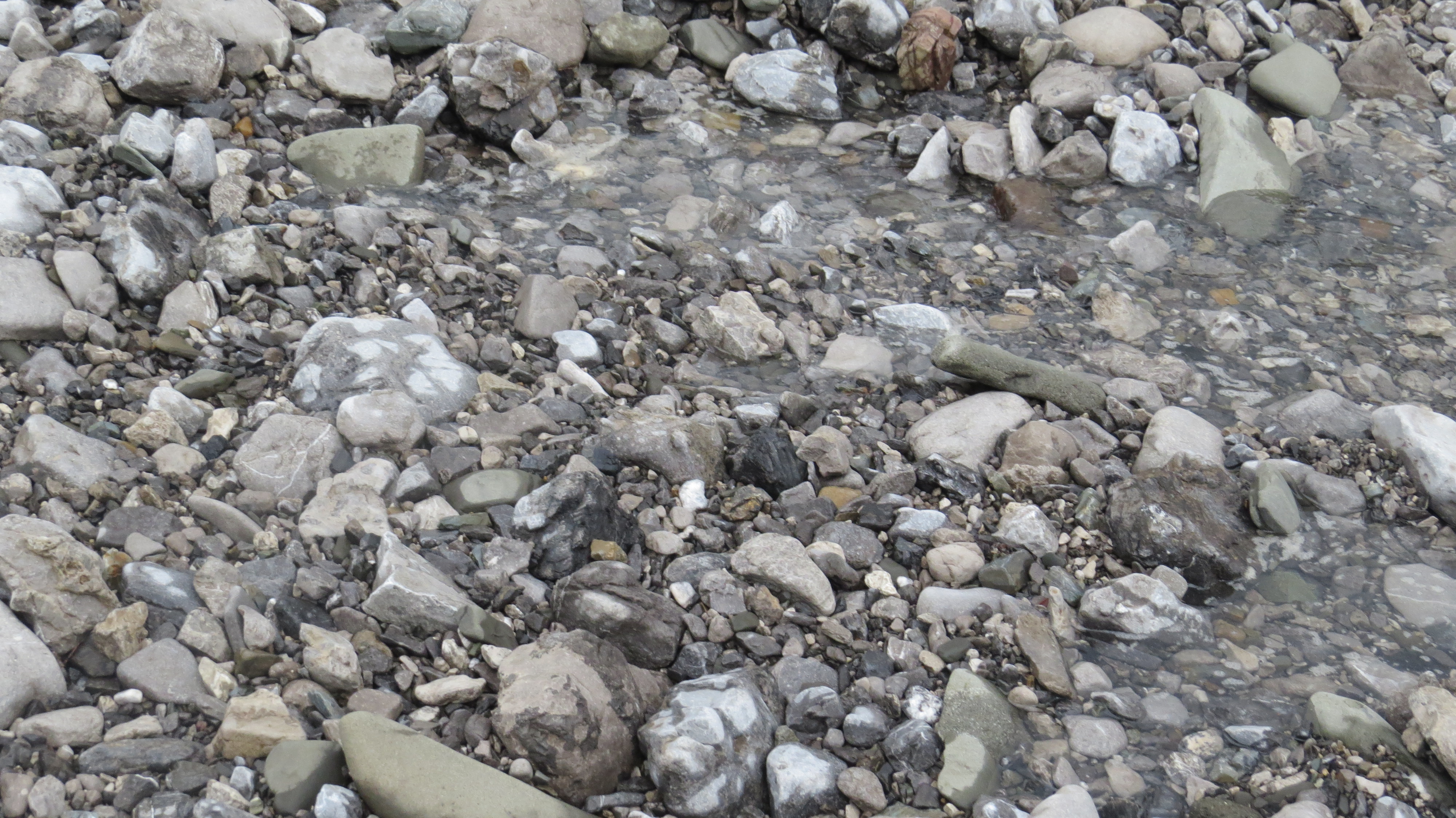
Water slowly moving down a stream bed.
It was a short walk from rain camp to where we were to be picked up. We could see the stream beds, previously dry, start to flow, the water moving downstream about 1 meter a minute, slowly, but steadily. Whether the water, and the few fish present, would reach the main river, was not clear. With more rain, the water would make it, and the fish survive; if not, they would die.
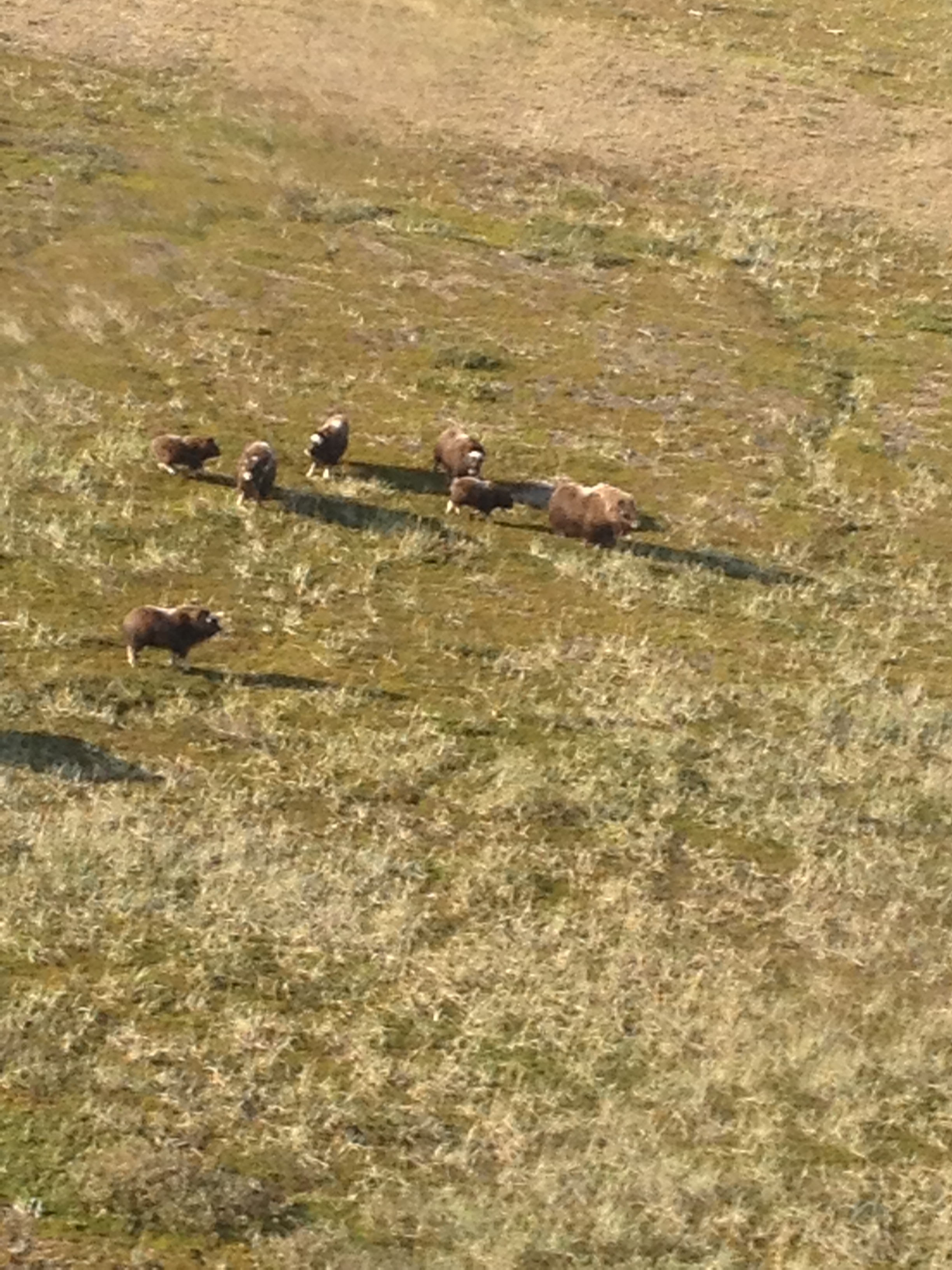
We camped our final night in a foggy valley, where we could clearly see the moisture funneling into the area from which we had come. We were mostly dry. I had hoped that on the flight back, we would fly over the coast and see the musk ox, that were clearly there. That didn’t happen, but when we landed, I spoke to the pilot, who agreed to take me and one of the people on the trip out off Cape Kreusenstern where we could see them.
And so a high point of the trip came, not in the mountains, but at sea level. I asked for what I really wanted, and the answer was yes.
On the highway from Anchorage to Wrangell-St.Elias National Park, there is a small restaurant half way to the Richardson Highway, right near the view of the Matanuska Glacier. If you are lucky enough to have the owner serve you lunch, you will have the choice of getting the dessert first. I was at first taken aback, but the lady was an Alaskan, and I figured she knew what she was talking about. Alaskans often do.
It was a fantastic lunch, with the best cream pie I ever had, followed by a grilled cheese sandwich. On the way back from the Park to Anchorage, I had a late lunch, because I wasn’t going to eat anywhere else. I ordered the pie first and the grilled cheese second. Granted, my lunch was not a big ticket item, but I was one customer who came back, because of how I was served. I saw four national parks on that trip, and they were beautiful, as I expected they would be. What I didn’t expect was to ever eat dessert first….and enjoy it.
*************************
“I’m sorry I didn’t get back to you. I just got back from vacation, and I had a meeting that was dumped on me this morning.”
I heard that after I answered my phone to hear, “Mr. Smith, how are you?”
My answer was terse: “That depends upon what you have to say.”
Normally, I don’t partake in pleasantries, which I have been trying to change for years. In this instance, however, “How are you?” was ludicrous. It ranks with a customer service person not helping you, and then ending the conversation with “Have a nice day.” Do people realize what they are saying? The previous day, the same individual, from the cable company, had failed to show for an appointment to look at the wiring at my house and tell me what I needed to do to get service. This was electrical science, not rocket science.
One hundred five minutes after the agreed upon appointment, a voicemail was left on my phone. At the time, I had long since given up and did not have my phone with me. Apparently, this individual didn’t have his phone either, at the time of the appointment, or he could have used it to call me earlier in the afternoon to cancel or to change the time, something in my era that required a land line and knowledge of where all the pay phones in one’s city were located. I thought it ironic that a man from the communication industry couldn’t make a simple call.
We agreed to meet the next day at 1. At 2, still waiting, I called him, with the above exchange. He eventually appeared, told me about his vacation (to watch a football game) and eventually set up the service, although he didn’t stay around long enough to make sure it worked. It didn’t, although I was eventually able to fix the problem myself.
Here are some lessons for people in the service industry:
If you can’t keep an appointment, tell the customer immediately, apologize, don’t offer excuses, especially that you were on vacation (many people these days can’t afford them or are taking an unplanned, unpaid one), and had extra work. Your family is interested in excuses; your customers are not. We are interested in an apology and a new, early, convenient appointment.
If you miss a second appointment, you are in trouble. You begin the conversation with “I am so embarrassed, and if I can still convince you I will show up, I will give you a month’s of service free.” That is an apology and use of a term called “recovery,” which was shown to me by the motel clerk in Anchorage, after I slept on the floor in the airport because they had given my reservation to another Michael Smith. I got two nights in a large suite at half price. Unfortunately, the night “sleeping” on the floor was not refundable.
You are so in trouble, that you need to drop everything and serve that customer. That means you don’t call ten minutes later and check where the customer lives, especially since you have a computer-phone which can give you that information as well as even substitute for a pay phone.
You make it certain that you have your phone with you at all times, especially if you are in the–uhhh communications industry, so if your boss calls you unexpectedly, you make sure that your customers are aware if there will be a delay. If your boss objects to that, find a new line of work or a new boss.
I read body language well, and it was clear the cable guy either wanted to leave or needed to use my toilet. I’m not sure I ever did it right, but I have had doctors who were incredibly busy but made me feel they had all the time in the world for me. Those people are worth a great deal. Find them.
*************************
In this city, to which my wife and I travel frequently, we eat almost exclusively at a certain restaurant. After a while, not only did they give us “a little extra” or “try this and see what you think,” great business practice, the owner, a woman, remembered us, despite our sometimes having been absent for months. That is impressive; if you have that skill, you need to tell any potential employer you have it. People like to be remembered. Why would we eat anywhere else?
I was recently at this restaurant, this time alone. Unfortunately, the owner was away on vacation, and there was a fill in staff. The food was great, but the place wasn’t the same. I still left a large tip, because these days tips matter a great deal to people.
The next night, however, was different, maybe even a disaster. As I entered, I noted many cars parked outside. There was a large group in one room. I sat down and immediately ordered, not because I knew there would be a wait, but because I knew what I wanted. Fifteen minutes later, the woman across from me asked if anybody was going to serve her. This was a bad sign. Ten minutes later, I was told by one waitress there was a group of 14, and the kitchen was getting “slammed.” There was an apology, but the lady still not had her order taken.
Fifteen minutes later, and fifteen minutes before I was going to leave, my food came, slid to me by the server, without one of the side dishes I particularly like. I had to go up front to request that side dish, and when it arrived, it was again slid about a meter across the table to me by a hurried waiter. Simultaneously, a table of 5 was getting special treatment by one server. It was an elderly lady’s birthday, but I wished that they could have just ordered the dessert a little faster. The lady across from me was now saying people who had come in behind her were getting served. I finished as fast as I could and left. I did leave a tip, less than I normally do, and left.
This restaurant was too busy that night. The lady across from me will never go there again, UNLESS there is recovery and her meal is free. That would likely bring her back at least for another try. Is a free meal worth it? I think so.
The next night I returned. Within 30 seconds of sitting down, I had my order taken and the side dish was at the table. I had a good meal and left a good tip. On the way out, I did talk to one server I knew. I told her that had the restaurant told people there would be a 15 minute wait, they likely would not have had so much difficulty. People are willing to wait to be seated, so long as the wait time is reasonable. What people don’t like is be put at a table and forgotten. Once a customer is seated, the process has to begin. The server thought I had a good idea. This isn’t even electrical science.
*************************
The following night, at a different restaurant, I got prompt service, but the menu was stained with food, and I received an “is everything OK?” called to me from about 10 meters. To be fair, I was the only one in the restaurant, so maybe that was fine. It seemed a little tacky, however. The bill came with a feature that costs the restaurant industry millions in lost revenue every year: Nobody asked me, “Would you be interested in looking at our dessert menu? We have some interesting choices.” I’m thin for my age, and on this particular day, I was hungry. I paid the bill, left a better tip than deserved, and left.
You can bet the lady running the restaurant in the Alaskan hinterland wouldn’t have forgotten the dessert.
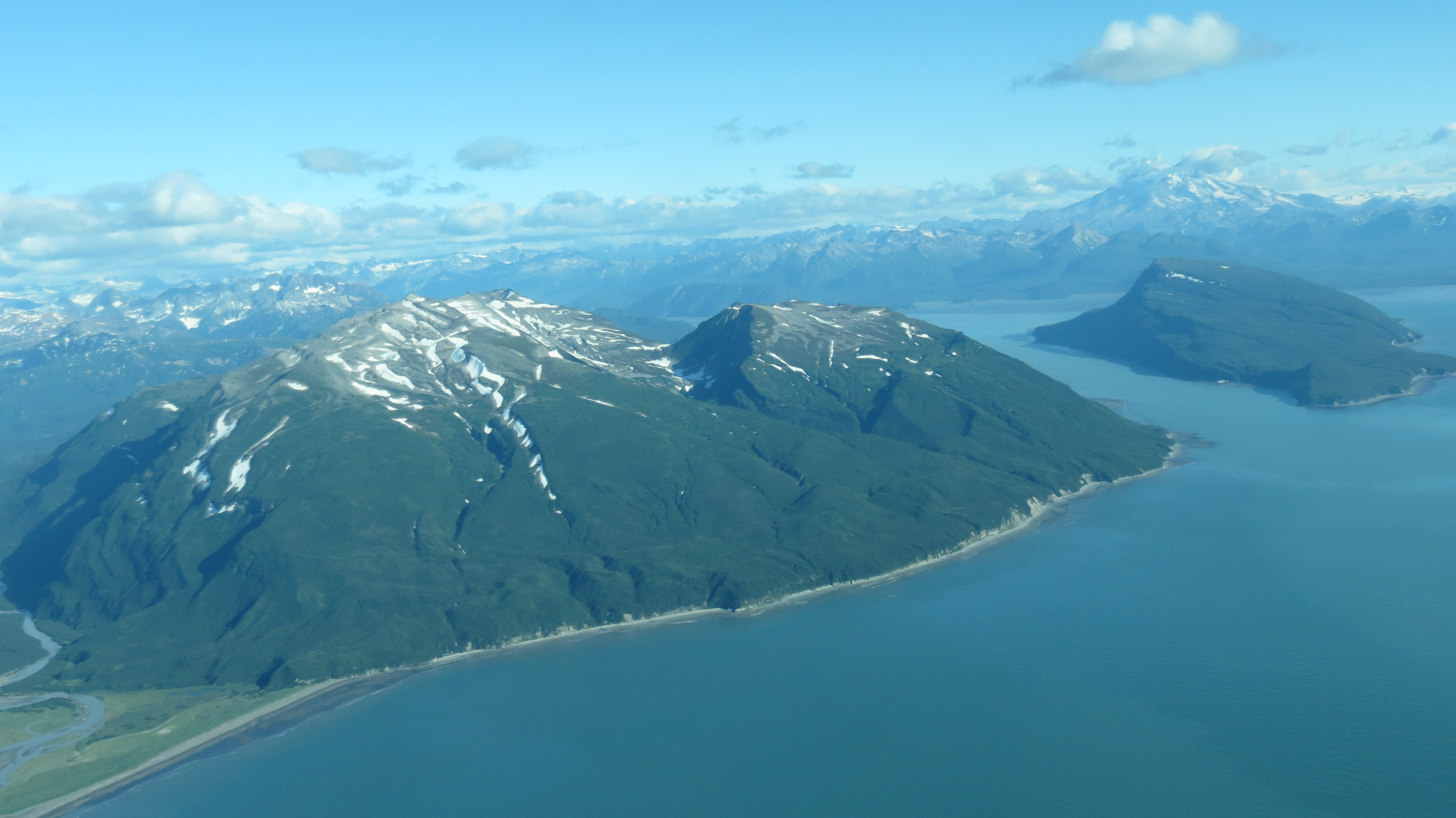
Katmai National Park is for bear viewing and the valley of the 10,000 smokes. I didn’t see the latter, but I did get to the former, and the bear viewing was spectacular. Located about 220 nm SW of Anchorage, it is reached by float plane, with about an hour and a half ride over rather spectacular scenery.
Scenery on flight to Katmai
One arrives at Brooks Lake, and gets off the float plane on the floats. There is a short walk to the visitor center, where the ranger talks, and there is a good 10 minute video on dealing with bears. These are not the same behaved bears as in the Brooks Range, who have likely never encountered people. These bears are near people, but so long as people stay on walkways, there shouldn’t be much of a problem. The bridge over the Brooks River can be closed if there are bears in the vicinity, however, and bears are unpredictable.
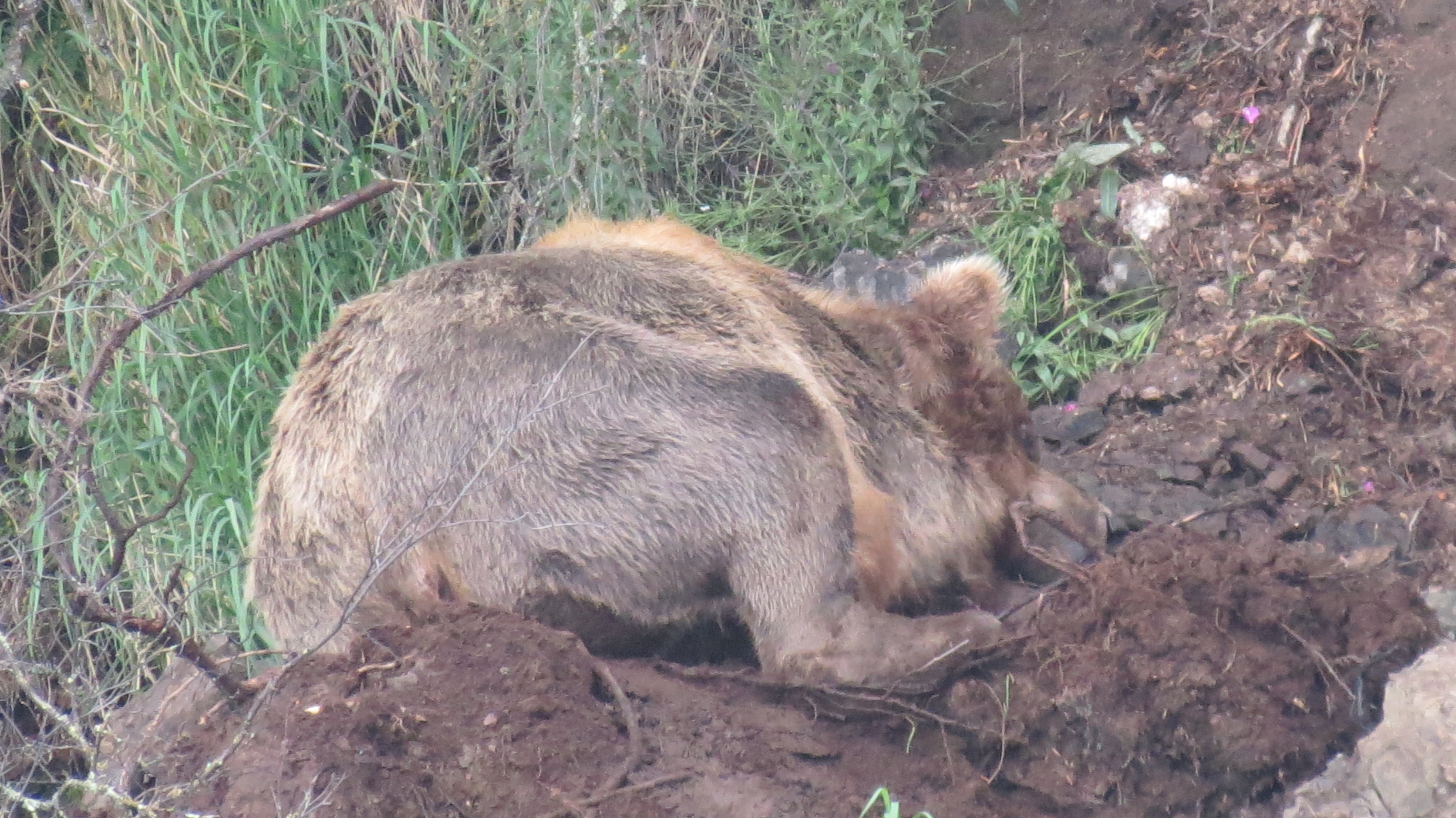
The area for viewing has a lower and an upper platform. The downriver or lower platform is open without waiting, and the smaller bears tend to congregate there. The upper platform has room for 40, and one may stay no longer than an hour. However, after one leaves, they may immediately put their name on the list to go back. I did just that and spent an enjoyable 45 minutes at the lower platform seeing one bear sleeping in mud and another carrying his prize catch back into the woods.
Brown bear sleeping in mud.
Look what I caught!
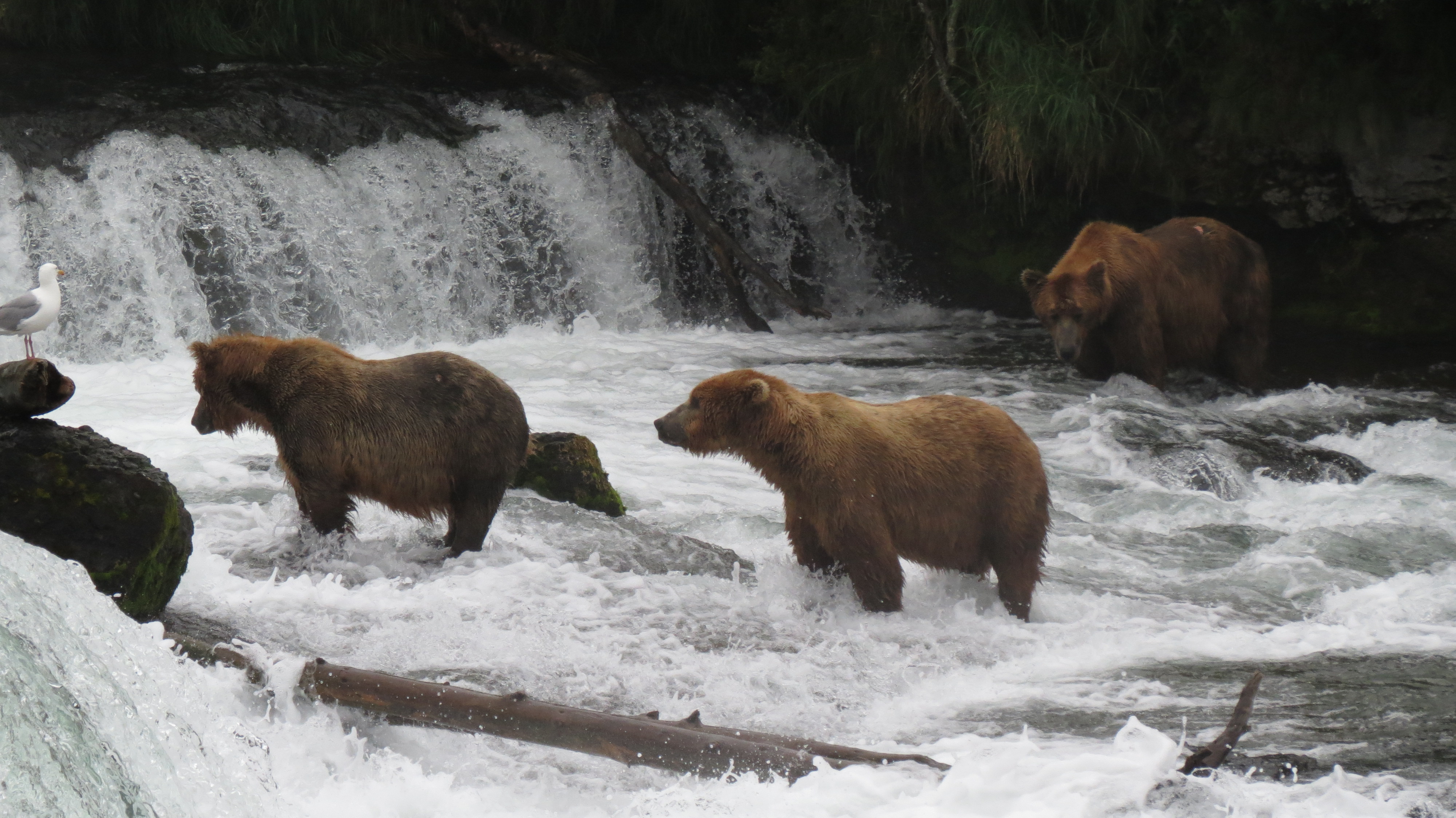
The upper platform has a great view of the falls and bears will walk under the platform.
Some of the bears at the upper falls viewing area.
Fishing from the top.
The highlight was a cub chased up a tree by a big boar, who barely missed him. Young bears until 3-4 years of age can climb, but older bears fuse joints necessary to climb and no longer can. After awhile, the boar left and the sow returned with 2 siblings, sending them up the tree as well.
\ Literally climbing for his life
The reason.
Mom at bottom.
Two.
The third.
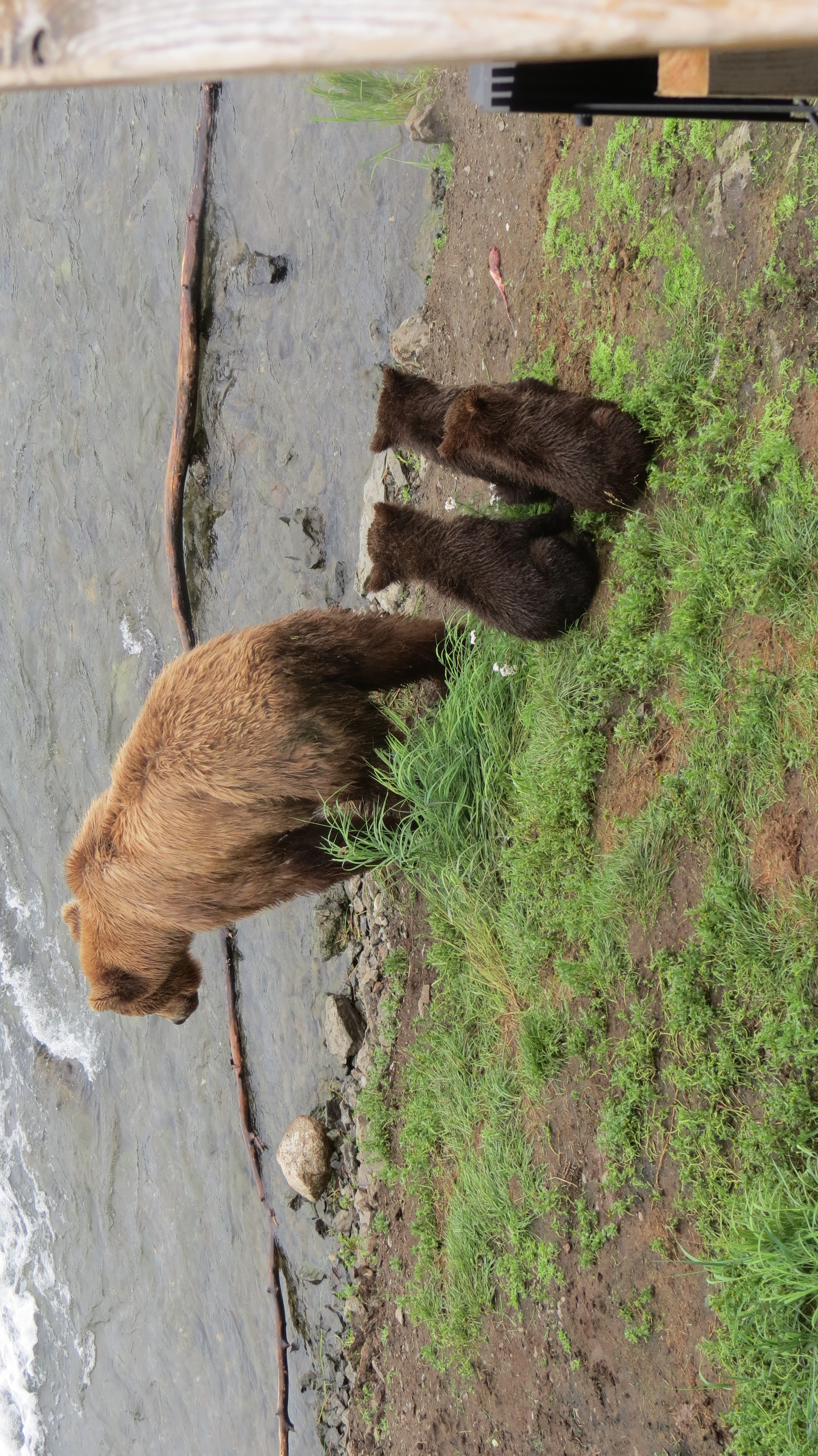
Mom with spring cubs.
The three cubs did come down from the tree, Mom got them a salmon from upriver, and they disappeared into the woods. It is difficult to know how many will survive. There is a lot of food, but there is also a lot of predation. The spring cubs got a much later start, and it will be less easy for them.
We don’t know the effect of human visitation has on the bears. Hopefully, it is not significant. The day was spectacular, and this is a park I definitely want to see again.
I was in the Anchorage airport, late one night on my way home from my tenth trip to “The Great Land.” I stopped in the men’s room, and before I saw the pair, I recognized the smell that to me characterizes one thing: “we’ve just come out of the woods.”
It’s a difficult odor to describe. It is woodsmoke plus something more. Many people would just say the person needs a bath, and they wouldn’t be wrong. But in the woods, we neither notice the smell nor particularly want a bath. I can attest to that with a great deal of experience. It is when one comes out of the woods that one notices the odor and really wants a shower.
As I washed my hands and turned from the sink, I accidentally brushed the pack one was carrying. He apologized.
“Been there a lot,” I replied. While I’m shy, I knew these young men were kindred spirits. “Where did you guys go?” I asked. They knew I wasn’t talking about cities but wild country. I wasn’t going to hear “Juneau” but the Chilkoot, not “Homer” but “The Kenai”.
We started to talk. The pair was young, at least 35 years younger than I, and this was their first trip to Alaska, where they spent 2 weeks in Denali and the Kenai. They had wanted to do this trip now, while they could, because their lives were going to be busy in the coming years. They did it.
Been there, too. I told them about my 5 trips to the Brooks Range, and their eyes showed a gaze I’ve seen many times, and which I have shown others. It’s a far away gaze of longing, of thinking about wild country, of rivers nobody down here has ever heard of, like Kongakut, Aichilik, Nigu, Itchilik, Kobuk or Noatak. It’s mountains and remote valleys. It’s slogging through tussocks, in rivers, in swamps, in bear country. It’s aufeis hiking and bugs in June, blueberries in July, rain and autumn colors in August. It’s the most difficult country to hike that anybody can imagine, and it is also the most beautiful. It is a country that kicks one’s butt, until finally one accepts it with the simple words, “It’s Alaska.” Everybody up here understands that.
Normally, I don’t talk much to strangers, but when I’ve been out the bush for awhile, I find myself pretty talkative. These guys were me, 35 years ago. Then, my dreams took me to the Boundary Waters Canoe Area Wilderness, every year, to get into the backcountry, away from people, civilization, only me and the wild lakes and rivers. I explored that country until I knew it as well as my home town. Maybe better. I sure loved it more. Always will.
It was much later that I discovered Alaska. Oh, I did the Chilkoot Trail in ’84, the Nahanni the following year and the Chilkoot and the upper Yukon in ’87, but I didn’t camp above the Arctic Circle until 20 years later. By then, I knew if I didn’t start to make my dreams come true, they never would. I hiked to the Arrigetch Peaks in Gates of the Arctic National Park, and then decided I’d come back to see ANWR. I thought once to ANWR would be enough, but when Christmas came I got a letter from the guide saying he planned a real special ANWR trip the following year. I had to do that one, of course, because I had the longing in my eyes. I could see the Dall Sheep and Caribou, a river I knew would be special, so I accepted and did the trip. Tough? Very. Weather issues? Plenty. But we saw wildlife I couldn’t believe, and I came out of there saying I had seen the ANWR I wanted to.
Except I still haven’t. Probably never will, either. I did two more trips into the Gates, one combining backpacking with a paddling. We saw a dozen bears, four of whom walked blithely through our campsite one night. Alaska.
I still want to see the Sheenjek Drainage in ANWR. I would be 65 if I did it, but I think I can. A guide-friend is willing, and I know a pilot who would get us to the jumping off point. No question that we could do this trip. When I think about it, I know I have the look in my eyes those young men had. Age doesn’t destroy that look.
I didn’t tell the pair to follow their dreams, as I have tried to follow mine. They didn’t need me to say anything; they were already dreaming. I could see it in their eyes. They didn’t know how they were going to get up here again, where they would go, or what they would do, but they were going to do it.
They will see the Brooks Range, ANWR and deal with all the issues Alaska throws at those who go into the bush. They will come out of the country filthy again, smelling, but not of woodsmoke, because they will have been north of the treeline, where night doesn’t exist in summer. They will again take the redeye to Seattle or the Bay Area, where they live, thrilled to have done the trip, and already planning the next one. They would have had adventures I would be jealous of, but only a little.
No, the two needed no encouragement to come back. Had I shown them my pictures of the Arrigetch, the Aichilik, or the Noatak, they might have cancelled their flight and stayed. Some people do that.
To the wife of one of them, should either some day be married, I apologize. I just happened to run into a fellow dreamer, somebody who reminded me of myself, and planted a few more dreams in his head.
Let him go to the Far North. He has to do it. He will come back better for it.
But he will want to go the following year.
And maybe some day he will be 64, in a men’s room in an airport, talking to a 30 year-old who has just finished his first backpacking trip in Alaska…..
2 year-old griz on the Noatak. Out of focus because my hands were shaking. Distance: 25 meters. Anything between us? Air
Bull caribou, Noatak.
The Maidens, part of the Arrigetch Peaks, Gates of the Arctic National Park.
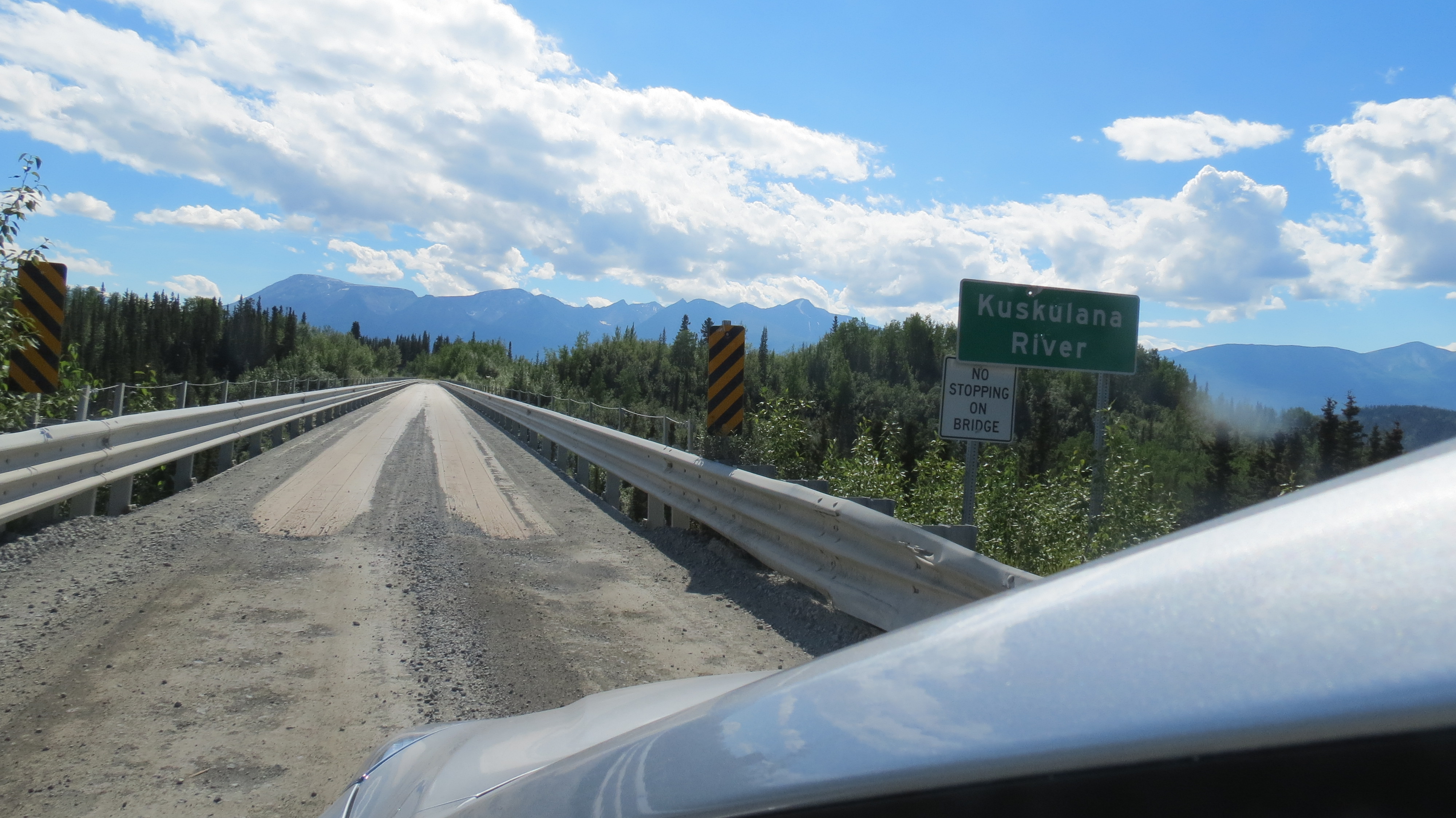
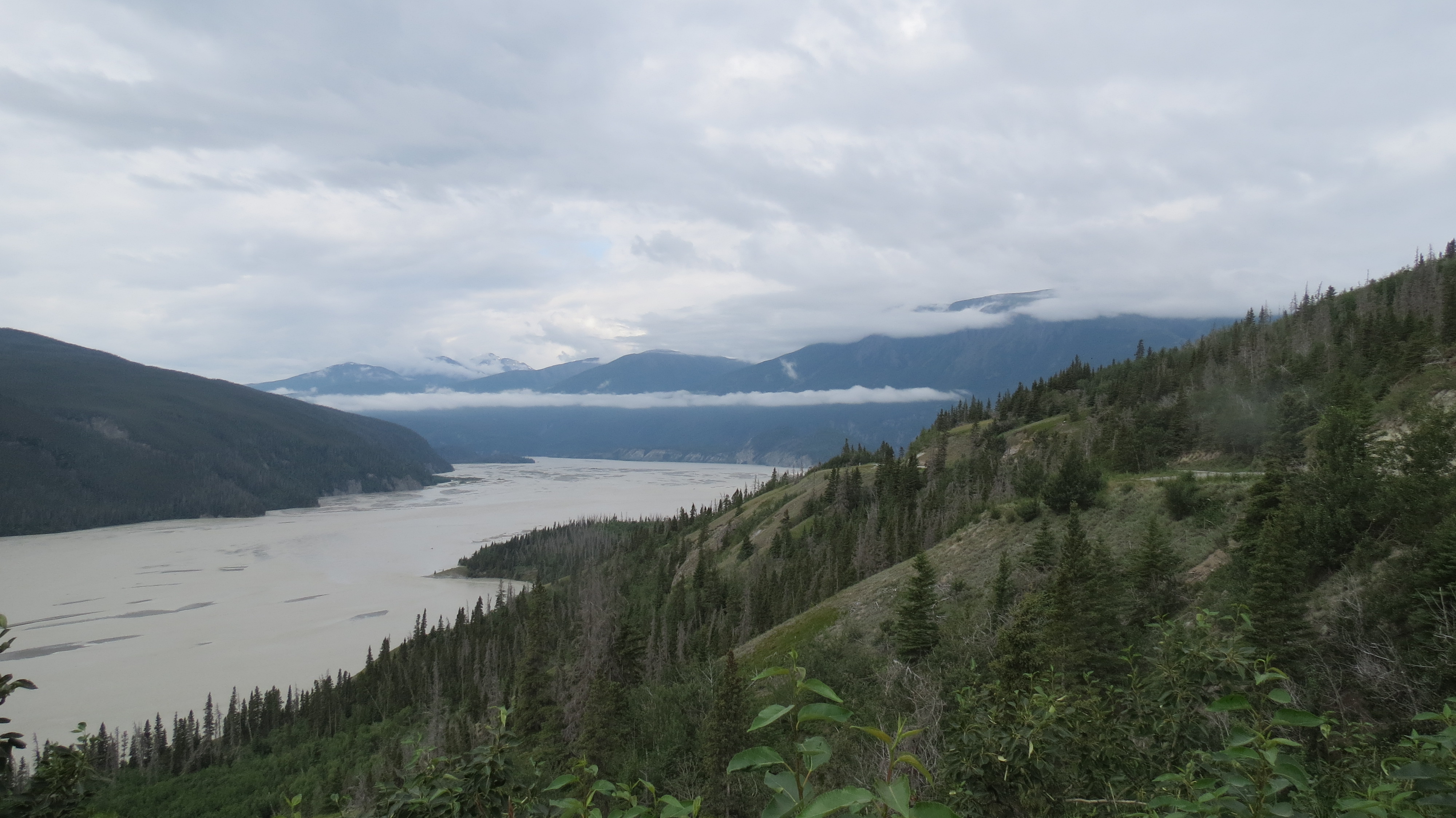
Wrangell-St. Elias is the largest park in the US, and conjoined with adjacent Kluane in Canada, the largest area of protected land on the Earth. The park is difficult to get to. For those who want to set foot into it, you can’t–without a significant drive or a day on a bicycle. It is 7-8 hours from Anchorage up the Richardson highway, which has a lot of no passing zones on the first part and construction with flagmen on the second part. Then, one takes route 4 south about 30 miles. The visitor’s center is along this road, but you are not in the Park. You turn at a sign that says Chitina 33 miles, McCarthy 93 miles, and the distances are accurate. The last 60 to McCarthy is on a dirt road, which is better than it used to be, but the first 10 miles aren’t great. Plan on 35 mph after that, and watch for those who are doing 45 or more coming the other way. You end at a river, where you park for $5 a day, and call a lodge to bring a vehicle down to pick you up. It is about a half mile walk, and camping is allowed at the river for $20 a night. The town is not in the Park, but one has passed through the Park and Preserve many times on the drive in. The town is lovely, quaint, and the food/lodging good. It’s 5 miles up the road to Kennicott, but there is a shuttle, should one wish.
For me, this is a climbers park and a fly-sightseeing park. There is certainly good backcountry for camping, and there is a lot of it.






























 Boreal B[l]og