“you don’t go out looking for cool things to happen, but you go out knowing that cool things could happen every time…I just tell people, just go, just get out… You never know what you’re going to see, but you aren’t going to see it in the living room. You have to be there.” Sam Cook (Duluth Herald Tribune retired columnist)
“Come on in,” called Dorothy Molter, after I had paddled up to shore at Isle of Pines, her island home on Knife Lake, and knocked at the door. Dorothy was a legend. She left nursing and Chicago in 1930, lived on an island in Knife, a long, narrowish lake, with a few long arms, straddling the border between Minnesota and Ontario. Called “The loneliest woman in America,” Dorothy had hundreds of visitors every year. She was grandmothered in and allowed to live the rest of her life there after the Wilderness Act of 1964 required resorts to be taken down, power boats removed, limited numbers of people who could go in, and even how low planes could fly.
Dorothy gave me some of her famous root beer, and as we talked, I commented that it was a little more difficult to canoe trip when I was 32 then it had been when I was 18, guiding canoe trips in Algonquin Park, wearing the coveted red neckerchief that only guides wore.
“Yes,” Dorothy replied, completely straight-faced, “I don’t paddle and carry as well as I once did, either.” Dorothy had 42 years on me and she would live for 5 more, her statement a lovely put down to my comment about age.
When Ely Echo editor Bob Cary interviewed me in 1992 about my season in Ely, the fact I had met Dorothy made the article. “Jackpine Bob” wrote a book about her, The Root Beer Lady.
I first put a canoe on my head 63 years ago as an apprentice, carried wooden Old Towns, slept in canvas tents or under a canoe. Nobody had heard of Leave No Trace. We had can pits, cut live balsam for tent stringers every night, and washed dishes in the lake. In my 20s, my being on the water was salt water, in the Navy, fifty thousand nautical miles and 3 Pacific crossings.
In my 30s and 40s, I explored the Quetico-Superior as much as I could. In my office, I had a map with dots where I camped and lines where I traveled. After each trip there was new ink on the blue and green splotches. I looked at the map often, dreaming and planning the next adventure. Eventually, I realized that giving back to the wilderness was more important than having a personal proving ground, but this land would always remain a personal decompression place for me.
At 43, I volunteered in Ely for the Forest Service, a half year leave of absence from my medical practice, took 22 canoe trips and spent 100 days in the woods that summer. I was a decade older than the guy who visited Dorothy Molter, in better shape, knowing now the lakes, portages, campsites, trees and other plants. Four years later, my wife’s and my 25th anniversary, we paddled a 110 mile 11 day loop through three ranger districts. I stopped single carrying portages, all the gear and the canoe over in one trip, in 2001, at 52. I had nothing to prove and a lot I could hurt. Besides, I enjoyed walking back in the woods for a second trip across the portage. Single carrying didn’t matter.
After 2002, we base camped on Lake Insula for 7 years. We enjoyed day trips exploring side bays, finding trails that led to other lakes or were a short cut. In 2005, I soloed to Kawnipi Lake one last time. Many of us who plied the canoe routes of Hunter’s Island felt Kawnipi was the most beautiful lake on either side of the border. I won’t go again, but it doesn’t matter. I was there six times, loved it, thankful for my good fortune.
Author on island “The Rock”, Lake Insula, 2005.Last time on Kawnipi Lake, Canada May 2005
The year I turned 60, my wife and I aborted the first day’s paddle to Lake Insula, one we could do in 7 hours, because of heavy rain. We stopped, pitched the tent and stayed comfortable. Making Insula that day didn’t matter. We made it easily the next day.
Morning fog, Lake Insula 2010
The clock ticked louder. On my fifth backpack trip to the Brooks Range, in my 64th year, I carried 75 pounds up a long hill west of but still in sight of the northern Dalton Highway, on the way to Summit Lake in the Gates of the Arctic NP. It was a tough trip, and I wasn’t sure I would or could do a sixth, but there was a trip offered to the Wulik Mountains in the far west Brooks, country I hadn’t seen, wonderful, wild country, and perhaps I had one more trip in me. I backpacked the Wuliks.
Wulik Mountains, Alaska, August 2014
Several years later, nearly everybody passed me on a tough hike up Oregon’s Larison Rock Trail, which I had led for years. It was a first, but it didn’t matter. When I was 76, I developed cancer and needed hormonal therapy. I changed, or perhaps was changed. I used to want to be on a saw, cutting out logs. But now, it didn’t matter. I enjoyed leading a crew twice to Lowder Mountain in the Three Sisters Wilderness to brush the meadows by hand so hikers could find the trail. What I didn’t expect was my becoming a connoisseur of smaller things, as if I had traded my hiking strength for increased ability to notice subtleties around me. I changed my “macro” view from the open horizons of Sig Olson to a “micro” quiet magic view of Duluth writer Sam Cook, trying to follow rules of poet Mary Oliver: “Pay attention. Be astonished. Tell about it.”
That matters.
Author, Black Creek, Waldo Lake Wilderness, August 2025
A gray October morning, third day out without seeing anybody, and I was trying to make up time because of my staying put in the tent the prior day because of a pouring rain. I needed to make decent miles before the early sunset and hoped the weather would hold, although cloudy skies showed little promise. I had paddled perhaps five of the eighteen miles I needed to go and was moving up Spoon Creek, when I suddenly sensed something ahead.
Right around the corner were a moose and calf. Right there. Fortunately, unlike four months earlier, when I passed a moose and newborn calf on a lake, needing to out paddle a swimming angry cow, this calf was larger and the cow just stared at me. I had my paddle in the water, using it to brake, but I couldn’t back up or move to the side if she charged me. She didn’t, and the two quietly left. I was on schedule later that afternoon. That night, geese awoke me as they flew south towards a Hunter’s Moon. The following day, I paddled in dense fog, the day after in a blizzard, and before I finished would see three more moose and no people.
On the canoe trips my wife and I took, we had a joke that I was ”expected” to find a moose, and nature often delivered. Still, I never go into the wild expecting to see something. I try to put myself in the right place and hope I will get lucky. I certainly have been. Showing up in the wilderness and showing up in life are important parts of success.
On one trip, our moose sighting was a bull seen on a back road on our way to the jumping off point to Lac La Croix in the western Quetico. We encountered one on a portage coming into Basswood Lake, where I kept the canoe on my head a lot longer than planned so my wife could join me and see it 10 yards away. There was the last day out on a trip, previously moose-less, when I went down to the lake to get water, looked down the shore, and saw a cow standing in the lake 50 yards away. I got my wife’s attention and motioned her to come down. The country had delivered its annual moose sighting.
We saw our ’96 moose at the end of the first of what would be 15 portages on a day we took the Frost River to Cherokee Lake. Eight years later, we saw one swimming across a lake towards us, initially impossible to identify because there were so many branches stuck in his antlers that he looked like a motorized floating tree.
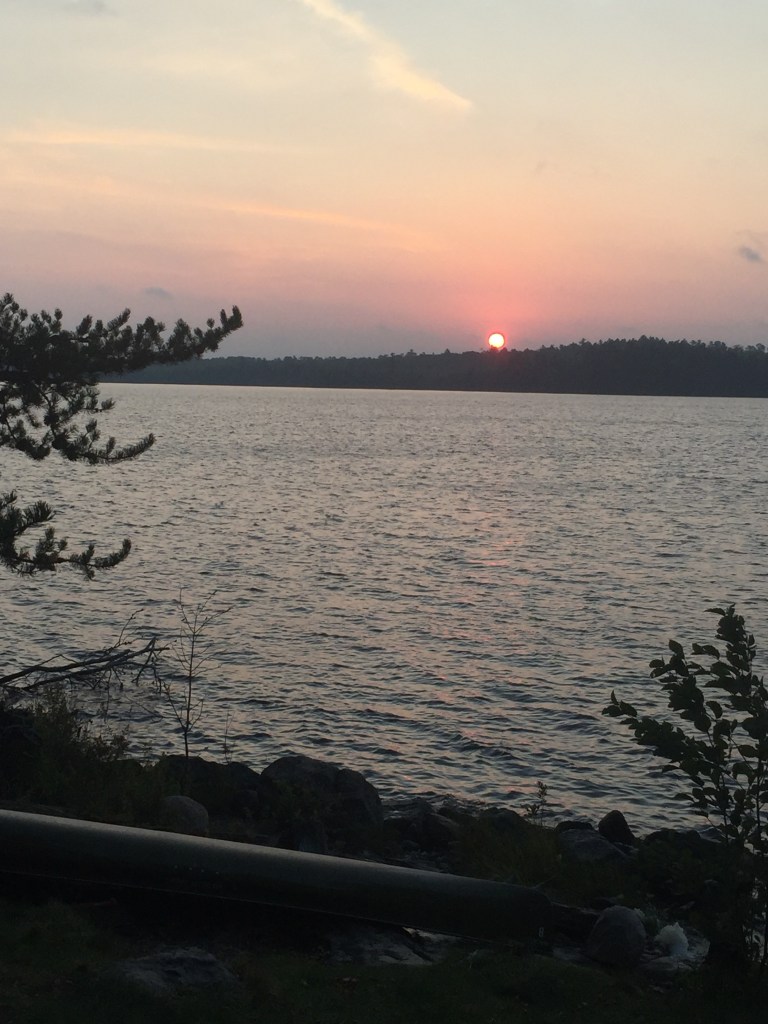
In 2010, we were at our favorite campsite on Lake Insula, what would be our last time there, a year before the Pagami Creek fire. The site was at the head of a quiet bay, and few ever left the main travel channel through the lake to go there. It was serene, views in all directions, lovely ledge rock of Canadian Shield. After dinner, I walked over to look out on the bay and the sunset. I always carry binoculars just in case I see something; If I stayed past dark, I could check out the Double Cluster in Perseus or Andromeda Galaxy.
It was calm and well into nautical twilight, where the light is too dim to read by, and the first stars are visible, when I heard a distant, odd sound with two components. I looked with my binoculars then quickly ran to get my wife. There was a bull moose on the far shore, walking right at the water’s edge, clopety, splash, clopety, splash. Water carries sound well. I didn’t realize it at the time, but the noise was in phase with the sight from our viewpoint, because the moose was walking at precisely the speed so that we heard the prior splash when he was making the next step into water.
We listened to the distant clop, splash for two minutes in deepening darkness until he turned into the woods and both he and the sound disappeared.
See you on the trail. Any wildlife sighting is a gift.
I stumbled out of the tent on to the grass for my middle of the night nature break. We were camped next to the Aichilik River, a beautiful, wild, braided flow that emptied into the Arctic Ocean, 30 miles to the north. Above the river was the full disk of the sun, a finger breadth or so, about two degrees, above the northern horizon, its light’s shimmering on the water. Two weeks from the solstice, and the midnight Sun was right where it should be at 69 N.: two degrees north of the Arctic Circle, two degrees above the northern horizon. Above the Arctic Circle in June, it’s daylight all night, and the Sun circles the sky.
I’m Up North. For me, north is my favorite direction, along with upstream, uphill, beyond the wilderness boundary. There is north, and there is Up North, a special construct in my world, sometimes referred to as “God’s country.” Minnesota outdoor writer Sam Cook wrote, “Up North is a map on the wall, a dream in the making, a tugging at one’s soul.” Sig Olson referred to it as “beyond steel, and roads and towns, where they will find release.” “They” is defined below.
My Up North is coming around a corner of Obsidian Trail in the volcanic area and seeing Middle Sister suddenly fill my vision. It is big water of Agnes Lake in the Quetico, stretching as far as I can see, open horizons that Olson wrote about, remembering head winds, rain, snow and the beautiful campsites on the Canadian Shield. Up North is seeing Mt. Adams from Timberline Trail; behind Upper Trestle Falls; the tors, granite poking through the ground, in Serpentine Hot Springs on the Seward Peninsula. It’s standing hanging to a tree at the top of Lowder Mountain, looking down at Karl and Ruth Lakes. It’s the vastness of Drain Creek Valley in the Refuge; the incredible view of the forests below Diamond Peak, seen from Hemlock Butte. It’s a hermit thrush in camp or being so high one can look down upon a golden eagle in flight. It’s autumn where the trees have more colors than just yellow, seeing the lake ahead when the portage is almost over, the primal feeling when you hear rumbling of thunder at night when camped in the wilderness. It’s Virginia Falls on the Nahanni.
All was well. It was normal nighttime cold, which always struck me odd with the sun out. We would hike on aufeis later that morning, frozen water that expanded out of the riverbed, providing a decent highway for hiking on the North Slope in June. We’d likely cross the river a few times. Wet feet are a given up here. If you were lucky, that’s all that got wet. That’s part of Up North. Wetness. It’s difficult, but it wouldn’t be Up North without it.
Up North is paddling the Yukon River into the vastness of Lake Laberge that Robert Service memorialized in “The Cremation of Sam McGee.” It’s understanding that “sweat and toil, hunger and thirst, and the fierce satisfaction that comes only with hardship” are why some of us —“they”—go.Olson didn’t add soaking wet, which I would be in 2 days, when we hiked in pouring rain, seven of us piling into a small cook tent for lunch where we had hot soup and briefly forgot how wet we were. The sun came out that afternoon. Up North is the feel of the warm sun on your soaking wet body, watching everything dry while you drink something hot. Up North is a solitary, haunting loon call down the lake.
See you on the trail. May you find your own Up North.
“Up North is a map on the wall, a dream in the making, a tugging at one’s soul. For those who feel the tug, make the dream happen, put the map in the packsack and go, the world is never quite the same. We have been Up North. And part of us always will be.” (Sam Cook)
Middle Sister from Obsidian Loop Trail
Open Horizons from Agnes Lake, 2005, my last time there.
Tors, granite poking through the ground, Serpentine Hot Springs, Alaska, 2016
Karl and Ruth Lake, Three Sisters Wilderness, Oregon, 2014
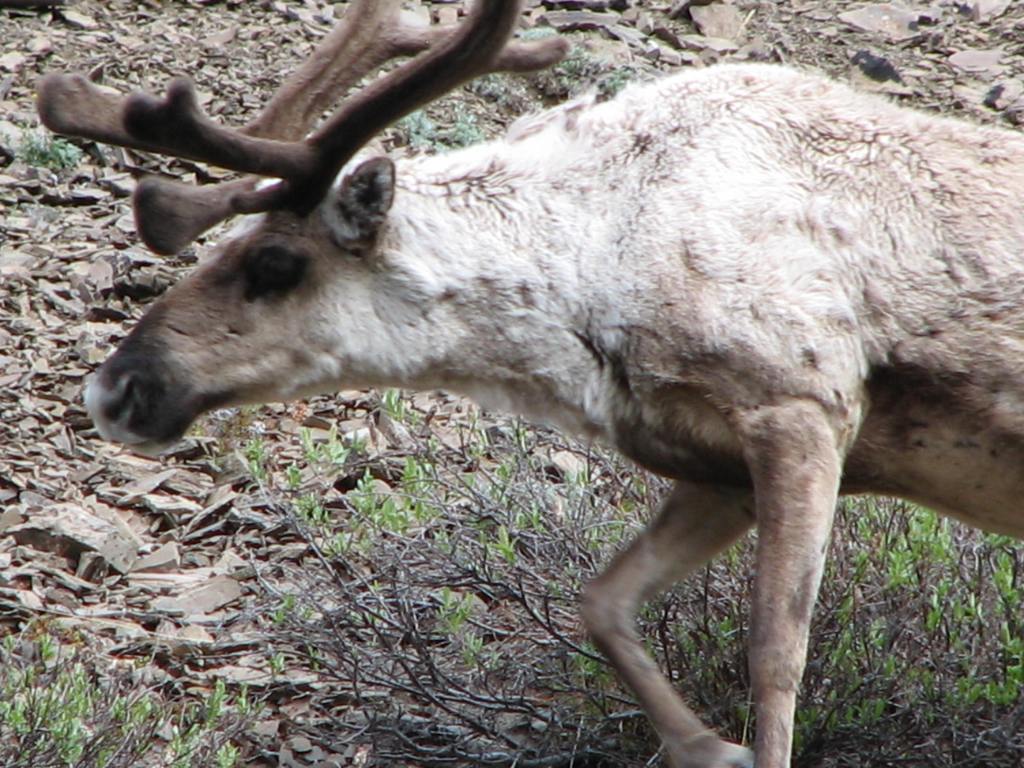
Caribou on aufeis, Aichilik River, Arctic National Wildlife Refuge, 2009.
I was in the Anchorage airport late one night on my way home from my tenth trip to “The Great Land.” I stopped in the men’s room, and before I saw the pair, I immediately recognized the smell that to me characterizes one thing: “we’ve just come out of the bush.”
I call it The Scent. Capitalized.
The Scent is difficult to describe. It is not evident when I do trail work for a day or hike a 20 miler. I sweat, I’m dirty, I come home and smell, but I don’t have The Scent. The first day out in the backcountry, I don’t have it. I smell clean. The Scent is days old sweat on clothes that have been worn far too long, unwashed, in places where there is usually a lot of dirt, rain, flowing water, skin that hasn’t been cleaned in several days, the combination’s often being mixed with woodsmoke from cedar, pine, birch or hardwood. Biologically, it is created by bacteria’s breaking down oils plus burned carbon, but I think some of it may be a special compound formed when hard work is performed in places where there are no signs, the rivers run free, people are few, and the sounds of traffic are ravens, eagles, hawks, hermit thrushes and flickers, marmots, wolves, and beaver tail slaps. The Scent requires tens of thousands of paddle strokes, dozens of miles under a pack or paddle, bug bites, sunlight, rain or dew, a few cuts, walking through muck, tripping on a root, fording a river, reaching a difficult summit, watching sunrise over a lake with mist, warming or talking by a fire at night or on a cold rainy morning, kneeling on the ground pitching a tent, watching an eagle fly, or collecting wood from a downed jack pine.
The Scent is not the smell of a men’s locker room. Nor is it the smell when one gets ill and doesn’t bathe for a few days. Long spells in wild country appear to inoculate the nose to ignore The Scent. But when I am on the last portage, the last mile of a trail, I can recognize a day tripper or a person who has just left the jumping off point. There is no trace of The Scent; they smell clean, soap and shampoo clean. They haven’t worked enough yet. Some of them will, and days later, they will be exiting the way I am and have The Scent.
Once out of the bush, I notice The Scent immediately. My wife and I weren’t able to shower once after we came off the water after a week out on Lake Insula in the Boundary Waters, with a lot of time under pack and paddle, near eagles, ravens, a wolf, nobody else for six days, a bit of rain, lots of flowing water, all the requirements. The outfitter changed out a propane tank, but something was wrong with the heating element, and he was really sorry, but there was no hot water. We ended up driving five hours without a shower. The next year we used a different outfitter. The Scent is that way: it is the smell of wild country and is foreign to cities, highways, crowds and buildings.
Lake Insula, 2007, before the fire. Le beau pays of Sig Olson
Walk through a trail town sometime, and by smell and sight, you can spot three different groups of people: those who are getting ready to go into the woods, on whom their clothes look normal and they aren’t self-conscious. The Scent is absent. The second group has just showered and put on clean clothes, looks scrubbed and are self-conscious and maybe a bit bewildered by being back in a strange world. No Scent on them. The third group has just come out of the woods and one can smell them yards away—or when opening the door to a men’s room. When I come out of the woods, I know I have The Scent, and I try not to get too close to others.
These two men were in the third group. They were self-conscious about The Scent, both wanted a shower, and they were trying clean up in a men’s room, knowing that they had several hours ahead of them on the redeye back to the Lower. Nobody wants to get on a plane carrying The Scent. It belongs in wild country.
As I washed my hands and turned from the sink, I accidentally brushed the pack one still wore. People in the backcountry for many days feel at one with their pack. I know thru-hikers on the AT and PCT feel that way, and when I section-hiked the AT, I discovered one day that getting ready to move meant I automatically put the pack on, like a shirt. I didn’t feel right without it. Anyway, the young man apologized. He probably forgot he had the pack on.
“Been there a lot,” I replied. While I’m shy, I know well both the country and the work required to produce The Scent. These young men were kindred spirits. “Where did you guys go?” I asked. I knew I wouldn’t hear “Anchorage” but the Chugach, not “Juneau” but the Chilkoot, not “Homer” but the Kenai, not “Fairbanks” but Denali.
We started to talk. They were young, at least 35 years younger than I, and this was their first trip to Alaska, where they spent 2 weeks, first in Denali and then the Kenai. They had wanted to do this trip now, while they could, because their lives were going to be busy in the coming years. They did it. They had The Scent to prove it.
Good for them, I said. I mentioned my then 5 trips to the Brooks Range, Up North even by Alaska standards: Arrigetch Peaks, twice in the Kongakut drainage, and a backpack/paddle on the Noatak. I didn’t say much more, because they were busy trying to get clean, but I suspected that when I used an Up North name, a lot of communication took place. There is a magic to certain words in the North Country for those who make it part of their lives. My last trip in the Brooks was where my guide and I got hauled up to the south end of Atigun Pass on the Dalton. We had stopped in Coldfoot for a break, and a lady who was a volunteer at the Visitor’s Center asked me whether I was going north or south, for the Dalton only goes those directions. I pointed west. She laughed. She knew.
We bushwhacked in to the Gates from the Dalton was about all I said, but perhaps my tone of voice unsaid told them the rest of the story. I used a few words like “Oolah” and “griz”, “tussocks” and “Boreal.” We had climbed over a thousand foot divide, camping at what seemed like the top of the world, then traveled for 3 days in the rain in and by rivers, past Oolah Lake and more rivers, finally hiking six miles in flooded tussock country to Summit Lake. We saw a griz. I finally got to see Frigid Crags and Boreal Mountain—the Gates of the Arctic that Bob Marshall named. They had that look in their eyes—maybe I should call it The Look—which others have seen from me. It’s a far away gaze of longing, of thinking about wild country, of rivers that run free and few people in the Lower have ever heard of, like Aichilik, Nigu, Itchilik, Alatna, Hulahula, or Kobuk. It’s mountains and remote valleys, wild country, open horizons, where the Sun in summer travels in a circle above the treeless tundra. It’s slogging through tussocks, rivers, swamps, and in bear, caribou, Dall sheep, wolverine, and moose country. It’s hiking on residual ice, or aufeis, and bugs in June, blueberries and crowberries in July, rain, autumn colors and the return of night in August. It’s the most difficult country to hike that I have encountered, also the most beautiful. It is a country that kicks one’s butt, until finally one accepts it with the simple words, “It’s Alaska.” Everybody up here who has worn The Scent understands that.
Oolah Lake
Normally, I don’t talk much to strangers, but if I’ve been out in the bush for a while, I find myself pretty talkative. These guys were me when I was a young man. Then, my dreams took me every year to the Boundary Waters Canoe Area Wilderness, “le beau pays” of Sig Olson, to get into the backcountry, away from people, civilization, only me, the wild lakes and rivers, loons, beaver, otter, eagle, moose, bear, and wolf. I went into the country scrubbed and clean, explored it and came out with The Scent. Eventually, I knew that area as well as my home town. Maybe better. I sure loved it more. Always will.
It was much later that I discovered Alaska. Oh, I did the Chilkoot Trail in ’84 and ’87, paddling the Yukon as far as Carmacks; I paddled the Nahanni in the Northwest Territory in between those two trips. I didn’t camp above the Arctic Circle until 20 years later. By then, I knew if I didn’t start to make my dreams come true, I never would. First on the list was the Arrigetch Peaks in the Gates, spending four nights at the base of the mountains, close enough to hike up and place the palm of my hand on the granite. We tried to get back into Aquarius Valley, but the rain made it too slick and unsafe to see the whole thing. We got to the glacier that is the headwaters of Arrigetch Creek. On the eight mile hike back to the Alatna River, there had been so much rain that we had to detour upstream a mile to finally cross in fast water that was mid-thigh in depth, then walk a mile back down to move forward a net ten yards.
Base of the Arrigetch Peaks
Afterward, I said that if there were a guarantee I could see Aquarius, I would go back. But there was too much else up there. I never did. I returned to Fairbanks with The Scent, took a quick shower and the redeye to Seattle.
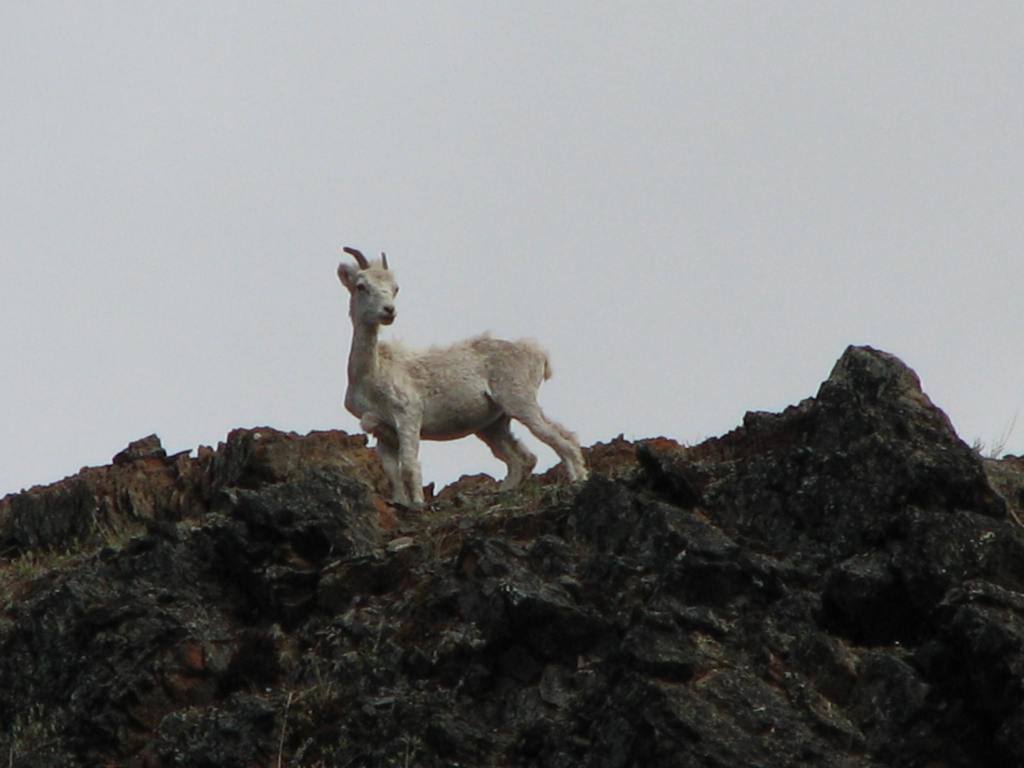
The next year, I came back to see ANWR, and we did a loop hike from the Kongakut River that got us into Drain Creek, bordered by mountains called Bathtub Ridge, with a mountain to the east called “The Plug.” This was the ANWR I was looking for, with huge vistas, miles of tussocks full of caribou, and a braided river. We went in early June to beat the bug hatch and camped at the base of a cliff that was a salt lick for Dall Sheep. I remember being up at 1 am watching them in bright sunlight, high on the rocks above, moving on the near vertical face more easily than I could move in tussocks.
Dall Sheep on a salt lick.
I thought once to ANWR would be enough, but that Christmas I got a letter from the guide saying he planned a special ANWR trip to the Aichilik River. I went into the garage, smelled my pack, which had some residual of The Scent, and decided I had to do that one, of course, because, well, I had to. I knew there was a longing in my eyes. I could see Dall Sheep and Caribou, another braided river and maybe a griz, so I went.
We landed on semi-flooded tundra and my boots were soaked for the next 11 days, temperatures most of the time hovering at freezing. I packed four pairs of wool socks, kept one pair for night, which meant after three days my dressing began with cold wet socks. It mostly rained or rain-plus— hail, graupel, or sleet. We crossed and recrossed the Aichilk, walking on ice by caribou, as we headed south into the Brooks Range. One day, we sat down on the tundra for lunch near the entry into the mountains and had caribou walk close enough to touch, between us and the river. That afternoon, we hiked underneath rock faces where Dall Sheep stared down from us from thirty feet up. I had a wolverine run right by my tent one morning and a caribou calf do the same one evening. The last day, in sunshine, we saw a griz rolling on ice and then hiked over a mountain rather than take a chance on a valley with a rain-swollen stream.
Caribou on iceDall sheep
A year later, I backpacked the upper Noatak and kayaked a couple hundred miles downstream to Lake Matcherak. I saw another wolverine and we saw a dozen grizzlies, including a sow, two cubs and a yearling that walked right through our camp and another that we had to encourage to turn around on the shore of Matcherak. I flew back to Bettles with others in a float plane loaded with gear, flying past the Arrigetch in clear weather. It was fabulous, except the poor pilot had a planeload of The Scent.
Boreal Mountain, part of the Gates of the Arctic
I thought I had seen all I wanted to up there, except I still haven’t. Probably never will. I wanted to see the Sheenjek Drainage in ANWR, but things happen and I never got around to doing it. When I write about this, I know I have the look in my eyes those young men had. I can still see the Noatak far upstream from where I stood one day, when we climbed a mountain and stood on the summit in the wind, astounded by the beauty of the country.
I didn’t tell the pair to follow their dreams, as I have tried to follow mine. They were already dreaming. They had The Look. They didn’t know how they were going to get up here again, where they would go, or what they would do, but they were going to do it.
They will see the Brooks Range, ANWR and deal with all the issues Alaska throws at those who go into the bush. They will come out of the country with The Scent, of course, not mixed with woodsmoke, because they will have been north of the treeline, where darkness doesn’t exist in summer. Their speech will be peppered with Up North words, and they will again take the redeye to Seattle then the Bay Area, where they live, thrilled to have done the trip, already planning the next one. They will have adventures the way I did, and look back later with fondness at their good fortune, as I have.
Maybe they will travel together, alone, or have company—spouses, children, other friends— who will discover these wild places and carry The Scent. Maybe some day they will meet a traveler outside the bush with The Scent, ask where that person came from, and share some of their memories of the back and beyond.
If for some reason they never go back, they went once, saw it, came out with The Scent, and that mattered.
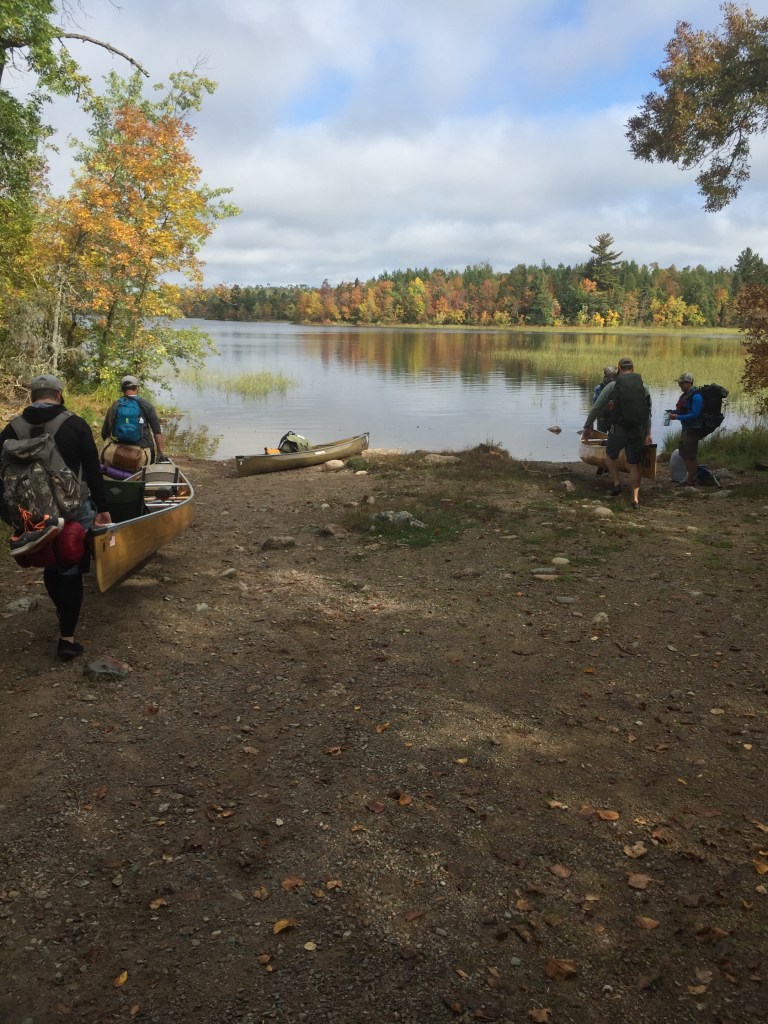
I had never triple carried a portage before: 5 trips across, 3 carrying gear and 2 backtracking to the start to collect another piece. Fall-Newton, the portage named for the lakes where it started and ended, was only about 90 rods or a quarter mile, but that was still a lot of walking. There was some time pressure this first day out, because of a possibility of significant rain later in the day or evening. Still, I got an early enough start and a late day would occur only if I were choosy about campsites.
I was operating with one good hand, and I didn’t want to push matters on the first carry. I got the canoe up on my head with a sharp pain in my left wrist and carried it across the portage, getting the same pain removing the canoe from my head. The large pack was carried across without incident. On my fourth trip across the portage, to get the last pack, I encountered a group of young men, three to a canoe, a guy at each end, the third presumably spelling one as they walked across.
I’ve never portaged that way, preferring to flip the canoe up on my head and shoulders and carry it that way, pack at the same time or separately. For a brief moment, I wondered if I should tell them how canoes ought to be carried across. Fortunately, I kept my mouth shut, after I saw what was in the canoe. They had all their gear, unsorted, in the vessel, plus each guy was wearing a small backpack with more gear. Given their strength, it certainly appeared easier to walk the canoe across than to be “pure” and do it my way, especially since they were going to make one trip across, and I was making five. With all that loose gear, they would have taken five trips, too.
I looked into the last canoe and saw my food pack. The last group noted it at the end of the portage and put it in the canoe. How nice of them! That saved me a bunch of time.
Newton Lake, my canoe in the upper center.
I’ve certainly done a similar thing for other people when I have been on a portage and a group was coming the other way. I picked up loose stuff and carried it across. It’s something you do for others in the woods, if you have the ability. You help someone; some day someone helps you. It’s a circle.
It was on this same trail, seven weeks shy of ten thousand days prior, that this particular circle began, the summer of ’92. I was working with the Forest Service as a volunteer wilderness ranger, and we were camped at the end of the portage, on the Fall Lake side. While we had lunch there, we heard a crash in the woods. I got up and went to look, finding a canoe in the middle of the trail, almost exactly where I was standing in 2019. There was nobody around.
Figuring the person was headed our way from Newton Lake, I picked up the canoe, put it on my head, and took it the rest of the way across the portage. It was a 75 pound Grumman “AlumaPig,” as we called them, and that summer I had no problem carrying 75 pound canoes.
Ten minutes later, after I was back finishing my lunch, the presumed owner appeared.
“Oh my God, thank you thank you thank you!” He called. I waved.
“Need any help?”
He did, so my partner and I walked the portage back to Newton Lake and we decided what gear to take. On the walk, we learned the man was from Florida, and this was his first—and last-trip to the Boundary Waters. He had had enough. The conversation went something like this:
“This place is awful.”
“Really?” I responded, “I’m a volunteer. What went wrong?”
“The lakes are huge, and it was windy the whole time.”
“Yes, that can be an issue.” Builds character, I thought, but decided not to say it.
“And the fishing sucked.”
“It has been a tough summer for fishing, It has been very rainy, but we did get some walleye in Basswood the other night.”
“And it’s so rocky on these PORT uh ges or por TAJES, whatever you call them.”
“Builds character.” I couldn’t resist. Shame on me, but hey, I was carrying his stuff.
The man stared at me. “And the bugs!!” He paused, staring at me. “Or are you into them, too?”
I’m truly sorry he had a bad trip. I have had less than ideal trips, too. Still, I helped the man from Florida, and it was fitting that on the same portage, years later, I was helped. That’s closing the circle.
Even the difficult days in the canoe country—especially the difficult ones—are memorable. I remember fighting two foot waves in the rain on large Agnes Lake on the Canadian side. We camped on Silence Lake that night, and I told my partner to get into his sleeping bag and warm up, while I got wood and made a fire—one match even. I have few other recollections of that trip.
The same partner and I made it through a swamp to Silence Lake from a different side a couple of years later. It poured that night, and neither of us had dinner. We were beat, mostly dry and weren’t about to get wetter again trying to make it.
Or the 20 mile day down Basswood River on a late September day in 1992, standing up at times because I was so sore sitting. I got hissed at by an otter in Wednesday Bay on Crooked Lake, and reaching the main body of the lake, my arms about ready to fall off, the Sun was a large red ball appearing to bounce of the white pines somewhere over Friday Bay. I put up the tent, ate dinner and went to bed. That was the night I heard the wolves.
Or the day my wife and I went down the Frost River and fifteen portages later, reached Cherokee Lake, We had been a bit behind schedule, but we were smart to leave the river for the beginning of the day. I’ve never before or since put a canoe on my head that many times in a day. As we paddled out to look for a campsite, some people hailed us and asked what the weather was going to be. I said, “Rain.”
“How come?”
“New south wind, and up here that means low pressure is coming.”
It rained the whole next day. It was fortunately a day of rest for us.
There are also the days like the one on Museum Bay in Lake Insula, a decade ago, when after dinner, we heard “clop, clop, SPLASH,” and spotted a moose, half mile away, walking along the shore. That’s the reward for all the hard work; indeed, the hard work IS the reward, as every outdoors person worth his or her salt would say. Wilderness writer Sig Olson wrote that eighty years ago.
Thanks, guys, for bringing my pack and making my day easier. I appreciated it. You closed a circle for me, and some day someone will close it for you. For the one guy who noted I was solo and said he wanted to go solo, may you do it and enjoy it thoroughly. Thank you for showing me that the way you portaged, gear in the canoe, can work quite well. I was wrong all the time I thought that was silly.
I began to hear a gentle tapping on the tent fly.Then it stopped for a minute or so but began again and increased.It was raining, and judging by the way the clouds had looked all day and this evening, it was probably going to rain for some time.
Fine by me.Great, even.I was in my tent, warm, had a book, a light, no place to go, and nobody knew where I was, other than on some lake in the Boundary Waters. The tent wasn’t going to leak, water wasn’t going to soak the floor, and I was at total peace with the world.I’m not sure what that is worth, but in the woods, where puddings are currency, tundra swans on the wing are news, loon calls are music, and I can turn my full attention to a single leaf with interesting drops of water on it, a rainy night after the day’s work is done ranks high on my list of good things.
It was a gift, I concluded, a wonderful night in the woods.I turned off the solar charged light I had and just lay in the dark.I would later drop off to sleep, awakening some time after midnight to no sound.When I went outside, there was a dense mist just this side of rain, but not so dense as to let me hear it on the tent.
That night brought back memory of a similar experience–“gift”–on the Nahanni River, a beautiful wild river in the Northwest Territories, west of Great Slave Lake, that I ran with a Canadian group back in 1985.I said several times I’d go back but knew I probably wouldn’t and never did.It wouldn’t be the same anyway, now having been “discovered.”We had camped above the 96 m high Virginia Falls one evening, after having had time to view it in bright sunshine. I still see myself as a strong 36 year-old, shirtless, standing near the falls at the top and in rain gear at the bottom, because of the heavy spray.We would portage 3/4 mile around the falls the next day and shoot the rapids, camping on an island well downstream from Fourth Canyon.After dinner, the canoes were pulled well up on shore and tied, for losing one would have been death out there.Cleanup complete, we settled in our separate tents, rain starting, barely audible over the roaring rapids nearby.It is one of the nicest memories I have of the trip from Rabbitkettle Hot Springs to the Liard River.
To be a “gift,” the rain can’t start before dinner.Heavens, not that.I can think of trips where heavy rain did occur early, and we dined on a granola bar. One memorable rainy night followed a day where a friend and I left Kahshahpiwi Lake in the west central Quetico, which has no easy way in or out, and after negotiating a nasty swamp that was too wet to walk over but not wet enough to paddle, found our exhausted, sweaty selves in the pouring rain on Silence Lake lucky enough to have a place to pitch our small two man tent, neither of us with either the energy or the initiative to make dinner.
Another time was a decade ago with my wife, when a thunderstorm brewed up in the afternoon over our sand beach camp on Lake Insula, a beautiful spot, but with the fireworks starting just as we boiled some water.We retreated to the tent while the storm continued for several hours, one lightning strike within probably 100 m of the tent. I finally had to go out once to get a water bottle and to leave behind my own water, and I didn’t feel a bit safe doing it. True, the odds were against my being struck by lightning, but luck and hope as a safety plan are considered bad form by accident investigators, coroners, and other such parties.
Rain’s beginning just before one awakens doesn’t qualify, either, because a major day’s decision needs to be made quickly while one is still half asleep:“Do I get up, dressed, rolled, packed and get the tent down now before everything gets wet, or do I take a chance, sleep in, and end up both being wet and packing wet?”“Or do I stay put until it stops?” An hour before, I had heard wolves howling out on Crooked Lake. I remembered the strong south wind the day before that pushed me 20 miles north, and noted, when I was trying to find the wolves, clouds moving up through Orion’s belt, showing a continued southerly flow in the upper atmosphere. That meant rain.At least I had the good fortune to already be awake, but still had to decide on a plan.Sometimes, like that day, I made the wrong decision: I packed and moved on, and neither my gear nor I remained dry.It was about the only time on a lake I had to pull into an island to empty rain water out of the canoe.
Thunderstorms are another matter.From a sheltered, safe place, I love watching them.It is one of the things I miss about Arizona.When I was a volunteer ranger patrolling with the late Mike Manlove, I would spend the first night outside of Ely in the “Belfry,” a wood shack that Mike built predating his marriage, and where he and Becca first lived.They then built a log cabin, leaving the Belfry for their kids, and later a for a guy like me who was headed out the next day with Mike to patrol. One night, I could hear the roll of a line of thunderstorms, a menacing celestial growl, counting seconds after each bolt of lightning, tracking the progressively decreasing number associated with progressively louder thunder. I love being in bed in a nice shack listening to that. Two nights later, on Ima Lake, a flash of light entered a dream I was having, and the loud CRACK made sure I was awake, so that we could rescue our canoe–without needing a flashlight– that had been blown into the lake.
A thunderstorm when it is still dark, and one is solo, brings a sense of foreboding, especially if the boomer is part of a squall line coming through.I awoke on my Oyster Lake site one September, far from anywhere or anybody, to a thunderstorm in the pre-dawn hours.It’s primal. We feel we can control our environment, but a thunderstorm shakes me to my core. With another person, one can at least discuss it, even if holding the tent poles to keep the tent from being blown down, which my father and I had to do in one storm when I guided him and my brother into Canada.
I listened to the patter of the rain, thought back over dozens of canoe trips, hundreds of days out in the woods, thousands of miles under pack and paddle.I sometimes wonder what I did with my life, and then I realize how fortunate I have been to have spent so much of it out in the back and beyond.Nearly sixty years ago, I was told that one remembers the difficult days on the trail, and I do remember those hard days in Temagami, Algonquin, Boundary Waters-Quetico, Gates of the Arctic; I have fond memories of difficult days on Lady Evelyn, White Partridge, Agnes, This Man, and Takahula lakes. These places, that weather, those who came along were all part of my experience.
I would have two more “gifts” on this solo trip, which was worth all the work, all the wind, all the rain, all the difficulties of being an old man soloing in the woods, to have more memories to cherish.
I arrived home from the hardware store just in time for the rain. Note: I didn’t say I just beat the rain home, but rather I arrived home in time to enjoy the rain.
Rain has a bad rap, and since I like rain, it means that once again I am on the wrong side of conventional likes and dislikes in society. I live in the city but love the wilderness, but I don’t fully belong in either. I am an introvert in a society that extols extroverts. I don’t like the idea that everything has to be set to music, which puts me at odds with conventional likes. The other day, I was sent a YouTube video of the Geminid meteor shower, which was a collage of pictures set to music. I commented: “Nice. Nicer without music.”
I think summer is overrated, too.
I’ve felt this way most of my life about rain. I enjoy being inside reading a book, while listening to the rain. But lest one think that being indoors is somehow cheating, I love nothing better than being warm in my sleeping bag and listening to the rain on the roof of the tent. Oh, I’m sure I will have to get up in the middle of the night and go out in it, but then it’s that enjoyable to be able to go back inside and hear it as I again get warm.
I led a hike to Heckletooth Mountain outside of Oakridge, Oregon, last October, when we had an atmospheric river hit us the night before. An AR is a plume of moisture spreading from places like Hawai’i, Saipan, or Japan all the way in a continuous feed to the Northwest US. Recipients can get several inches of rain. I had some cancel that morning, calling me to say how they were staying home and not coming. I initially envied them a little, but when we started hiking, the rain gear worked just fine (October hikes are great for testing rain gear), fall colors were beautiful, and while we were wet on the outside, we were warm. Sure, we had to be careful about hypothermia, but hiking uphill helps warm one up, and so long as one hikes back down steadily, cold is not a problem. Great hike.
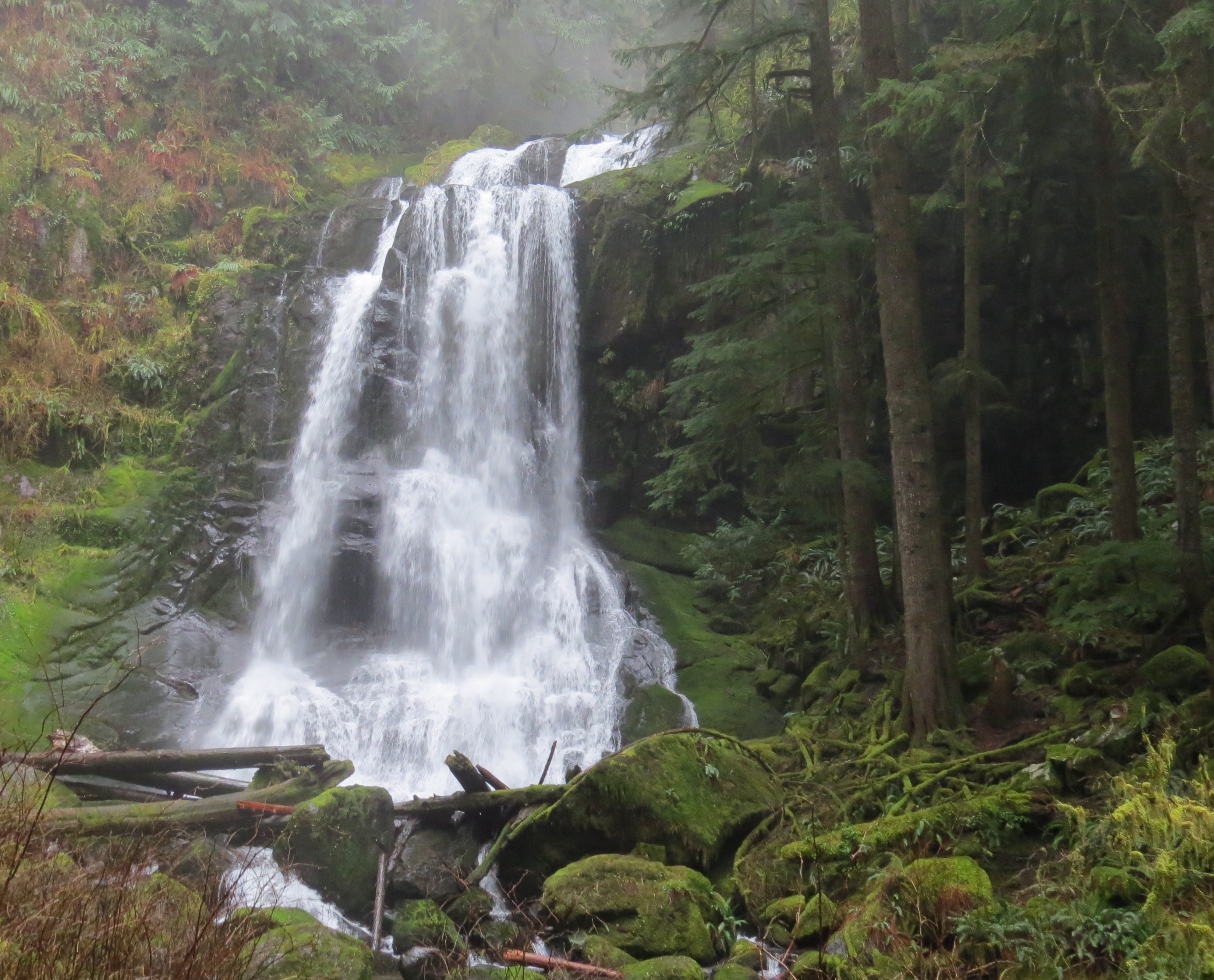
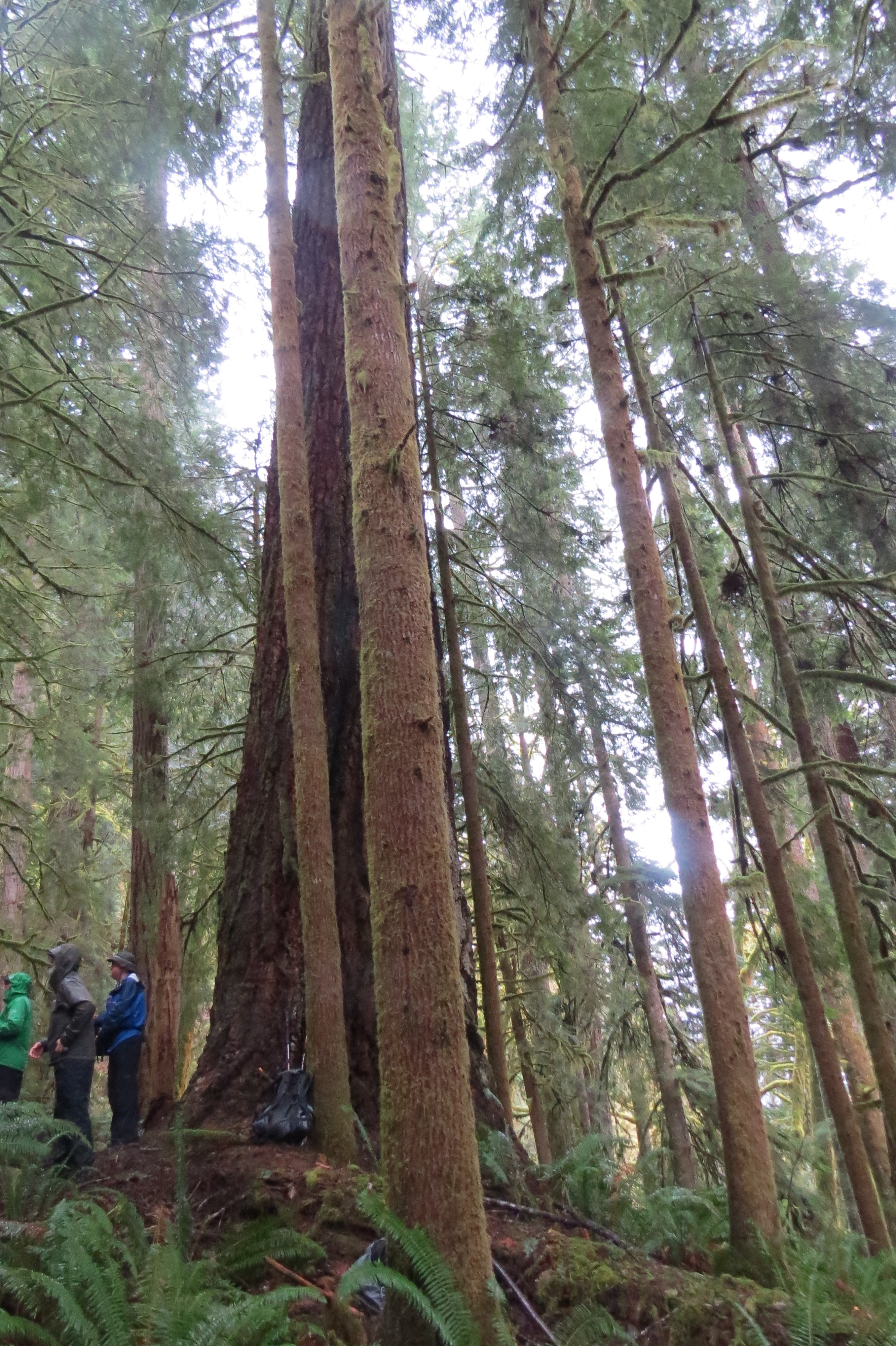
Several of us hiked into to Kentucky Falls last January on what has been the wettest hike I’ve been on in Oregon. We ate lunch standing up, in rain that managed to get to the forest floor through 600 year-old Douglas fir trees. Hiking back out, we were totally soaked, and I loved it. I knew I would dry off eventually, I wasn’t going to get hypothermia, and we were getting what we needed in winter—a long, cold rain.
Part of the Kentucky Falls area
Eating lunch by a 600 year-old Douglas fir
Kentucky Falls, one branch. I stayed so long that when I turned to leave, the rest of the group was long gone. Rain makes for beautiful waterfalls.
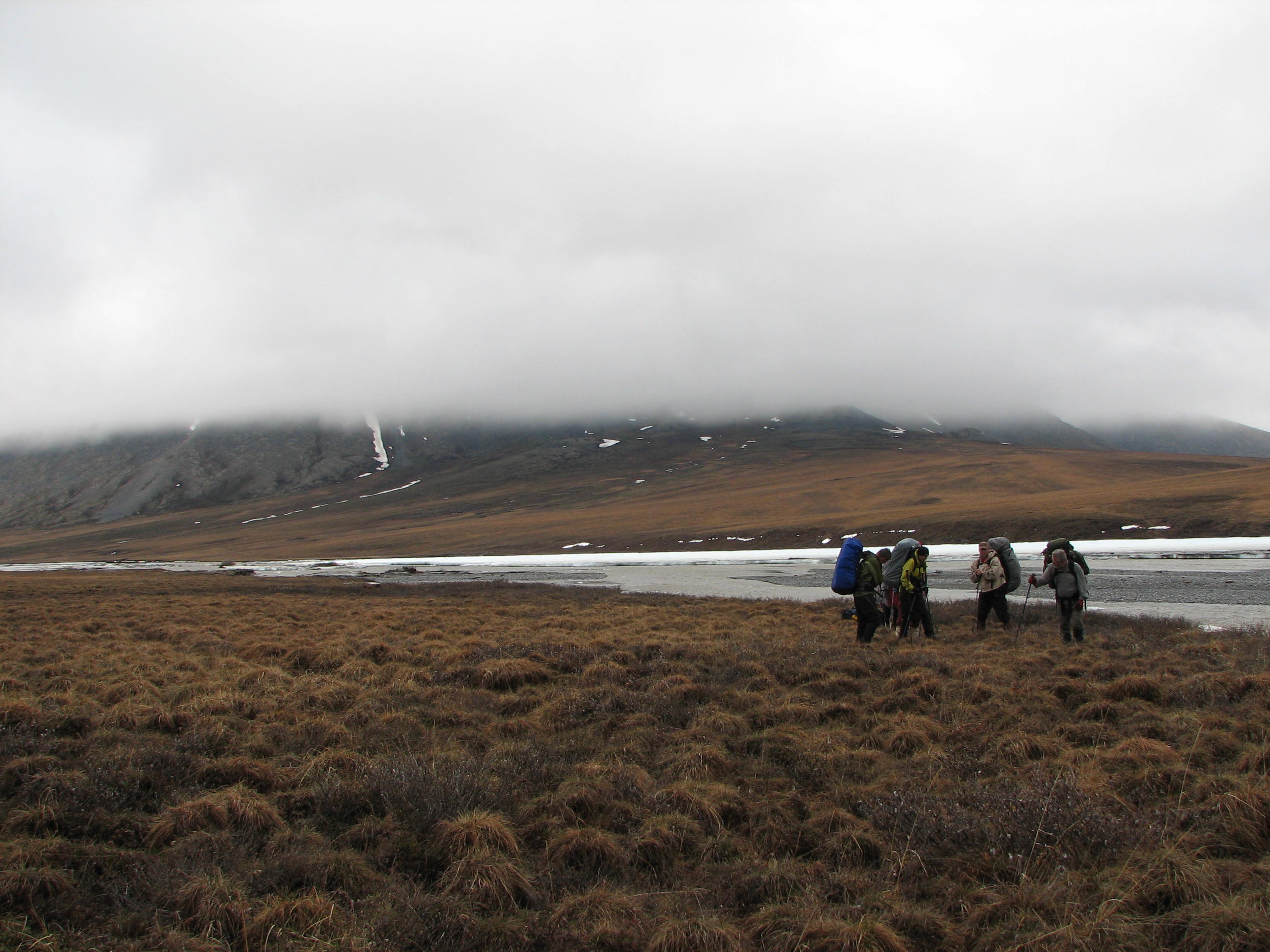
I’ve backpacked during a 6 day rainy spell in Alaska’s ANWR when the temperature never went past 40, our boots were completely wet, our tents, too, but we stayed warm by hiking, then pitched those wet tents and got into our mostly dry clothes. The cook tent we set up had enough shelter for eating. We saw snow on Bathtub Ridge in Drain Creek in June. Yes, I had to put on wet wool socks first thing, but it was only cold for a few minutes, then my feet were warm.
Alaska’s North Slope, ANWR, shortly after being dropped off to hike south through the Brooks Range (2009).
Hiking through fog.
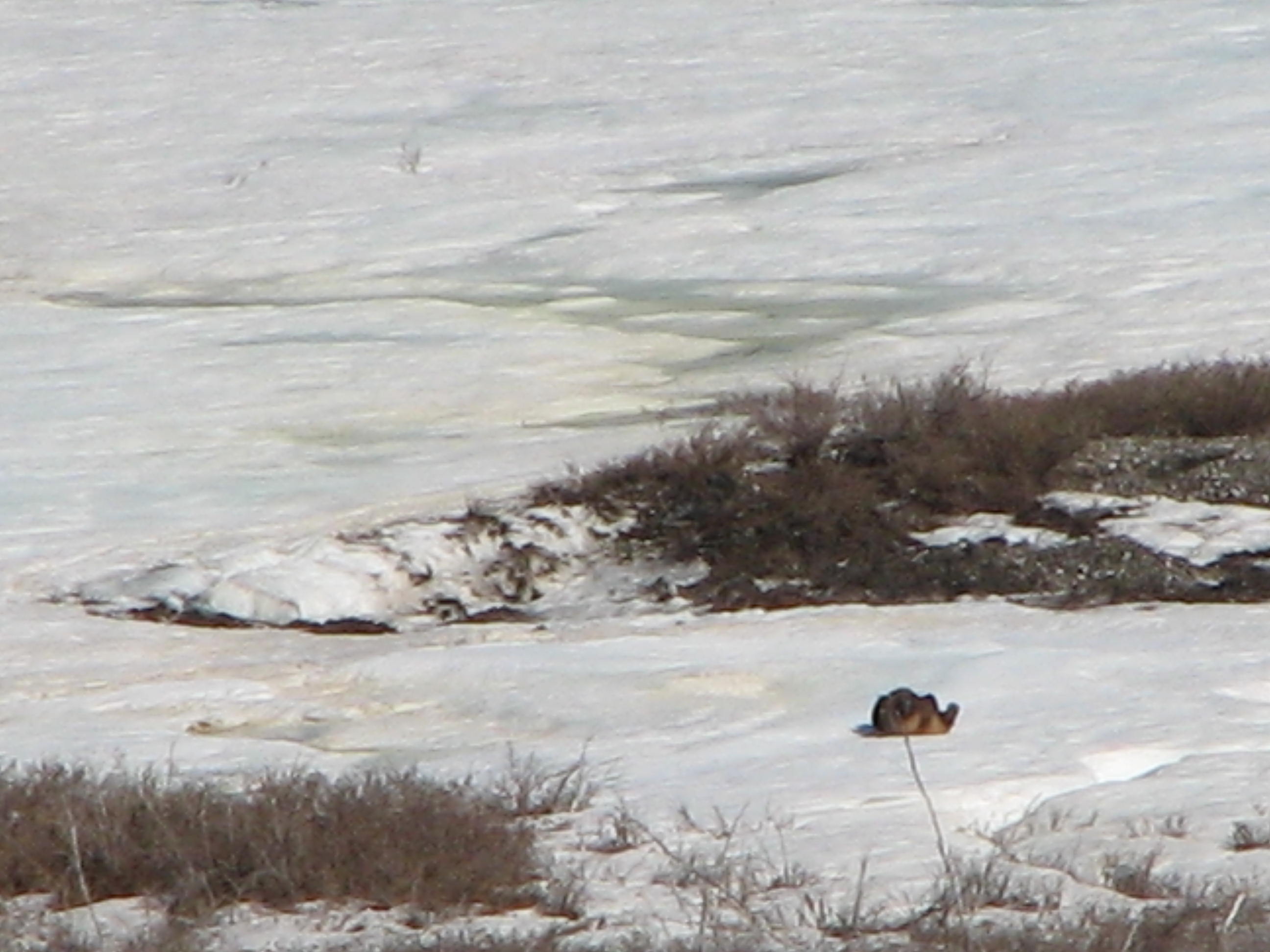
Brown bear rolling on ice, Drain Creek, ANWR.
Snow on distant Bathtub Ridge, after climbing out over a pass. The prior picture was taken far down the valley and to the right.
Years ago in the Boundary Waters, out on the waters of Crooked Lake, just south of the Canadian border, I got packed up, while everything was dry, then on the lake got hit with a downpour I had to pull ashore on an island to empty water from the canoe, and I was really wet, but since I was paddling and portaging the whole day I stayed warm enough. Once I reached my campsite, I had a dry tent—at least briefly—and dry clothes awaited me. I had a quick dinner and got into bed, staying warm, listening to the gentle, steady rain.
I remember rainy days on the trail better than sunny ones. I remember the cold rain in Temegami, when rain gear wasn’t as good, but our young bodies were able to deal with cold. I wasn’t as happy with it back then. A quarter century later, and ago, I remember the Fourth of July week on Basswood Lake with the Forest Service, where it rained every day, and I worked to have dry socks each morning. The woods were empty that weekend, the lakes were beautiful, and we patrolled a vast wilderness alone. That was the weekend I learned how to stay fairly dry during days of rain.
I missed the rain when I lived in Arizona. We had summer thunderstorms, and if I were lucky, we had at least one nighttime boomer, where I could watch the lightning, hear the thunder, and hope the desert would soak up the water. I hate droughts, and the 22 year one in Arizona was something I complained about often. The few times it did rain, I heard weathermen and newscasters say that it was a “bad day,” as if we could live our lives with no water at all.
Before I moved to Oregon, I was at a party talking to somebody who heard I was moving. He began berating me about its climate. “It rains all the time up there!” he said.
“Yeah,” I replied. “Great, isn’t it?”
After I moved, we were in a drought for 18 months. I heard how it would rain all winter, but we got a third of what we needed. When it was 80 in the mountains in January, an acquaintance told me how “spectacular” the weather was. I stayed quiet. I was told that March could be rainy, but it wasn’t, and that spring could be very wet, which it wasn’t, either. I was told that hot weather was not common, but that summer we broke the record for number of days over 90. In October, my neighbor asked me how I was, and I replied, “nothing that 10 inches of rain can’t fix.” In December, the “fix” came, not all at once, and never for 24 consecutive hours.
In November, a woman said on the radio that soon it would be cold, but it wouldn’t last long, and before we knew it March would be back, then spring, and then summer. We had just gone through a summer with multiple days over 100, no rain for three months, wildfires that burned a quarter of the huge Three Sisters Wilderness and the Gorge, 20 days of bad air quality in Eugene, requiring special masks. No thanks. I can wait a long time for summer. It’s overrated, at least in the American West, where it starts a month or two sooner than formerly, lasts a month or two longer, drier, and with more fires. Arizona and southern California now have 12 month a year fire seasons.
I like rain. I know it’s possible to get too much of it, but I have not had that experience in decades. I had forgotten how many different shades of green there are in the Pacific Northwest. In the desert, green is washed out by comparison. I like flowing water, just to watch it, in the wild, not in some fountain. I like the Sun when it comes out after a good long rain. Then it is nice. I enjoy it.
There is serious possibility of opening a sulfide mine in the Boundary Waters watershed, with politicians on both sides supporting it, because it will create jobs. I haven’t heard much about the costs of such an mine. Costs are different from money. For example, we have spent more than a trillion dollars in Iraq and Afghanistan. That’s money. The cost, in dead, maimed, displaced, and ruined families is uncountable, but I would submit it is enormous. Because we can’t place a value on a human life, we don’t, so the money we were told we would spend–a laughable $1.7 billion–was at least four if not five orders of magnitude too low. Before going to war, costs should be understood, but few in Congress understand costs.
Without doubt, the mine near Ely would provide jobs, although mining is more than pick and shovel work these days. Mining requires engineering skills, knowledge of geology, and more important, knowledge how to do it safely, which means disposing of the waste in such a way that the environment is not polluted.
There are a few of us who think this mine is a bad idea. A really bad idea. One company that may be involved is not American; while that doesn’t make it necessarily bad, they don’t have the deep connection to the Boundary Waters that some of us have. Worse, these types of mines have in every instance been shown to have left toxic metals on the surface that leach into the water and pollute it.
The name of the most beautiful wilderness in the Lower 49 is the Boundary Waters. Connect the dots. This region has some of the cleanest water on the continent. I have drunk from the lakes on every one of my 62 trips up there. How many places can we still drink water out of a lake?
Fish live in water, too. The second Saturday in May is a special day in Minnesota, for it is fishing opener. I wonder how people will feel about the possibility of far fewer fish, should the mine pollute the watershed.
But the mine won’t be a problem, I have been told. I will hear the good-looking young men and women, who sound so sincere, say that there is nothing to worry about. The executives, who have so much money to gain from the mine, will say technology will make this mine safe, and there won’t be a problem. The jobs that will be created will be so important to the Iron Range communities, where many are short on money and long on clean water and forests. Everything will be just fine. Listen to the reassuring voices. Look at the handsome young people. Watch the pictures of cute deer drinking out of a lake near the mine site. Everything will be fine.
Until it isn’t. Let me repeat that in a different way. Everything is safe until it isn’t. That goes for Challenger, Columbia, Tenerife, the Comet, Electra, and DC-10, shipping oil out Prince William Sound, pipelines through Arkansas, Deep Water Horizon, Chernobyl, Fukushima, and I suspect Keystone XL.
When the you know what hits the fan, suddenly people will be sorry. “It’s an Act of God,” “we couldn’t have possibly foreseen this,” “we will do everything we can to make you whole.” And the company will file for bankruptcy. I wasn’t born yesterday. I could name dozens of other catastrophes.
But then it will be too late. It will NOT be an Act of God, any more than rheumatic fever or tuberculosis was, death from infected hangnails, or acute lymphoblastic leukemia. Complex systems will fail. It is a matter of statistics and probability, and there are not many who understand these concepts.
The questions I ask are quite simple:
1. How much is the Boundary Waters Canoe Area Wilderness worth?
2. What is the probability that the mine will pollute, and how are you computing that probability?
The first question has no answer, and the second is difficult to compute. We could do an Expected Value analysis on the Boundary Waters. We could add up the tourism dollars, the cost of the timber, the fresh water, the campsites, and multiply it by 1, since it already exists with probability 1. We could have the money the mine puts into the hands of the people of northern Minnesota (not how much ore is there, but how much money goes to the locals, which is a much smaller number) and multiply it by the probability it will cause no problem, which from past experience, is fairly close to zero, and get another expected value. We then compare the two. But the first expected value is too low, because no price can be placed on the Boundary Waters. We can’t place a cost on certain things, like people’s lives, unless we want to use human trafficking as a means. Is this what we’ve come to?
Because these mines have ALWAYS had problems, it is incumbent upon those supporters to show why THIS mine will be different. But let’s get back to what we can’t measure–the value of wilderness that is nowhere else this accessible, this pristine, and this transformative of people. No, we can’t say what that is worth, but it sure is worth something. It falls into the category of “It ain’t for sale at any price,” and that is what some of us are saying.
There are a few other things that ought to be pointed out as well.
First, Ely, one of the towns that would be impacted by this mine, was once populated by miners, whose kids went to work in the mines. There is a community college in Ely–Vermilion Community College–where the last Thursday in April is a scholarship banquet, where $42,000 is donated to students. I am responsible for 3 of those scholarships.
In 2007, I gave a scholarship to a young woman, whose parents came to the banquet. Her father worked in the mines on the Iron Range west of Ely, where the mine tailings are, for lack of a better word–ugly. He was so proud of his daughter, whose education would have her not go into the mines, the way he did.
Now we are offering jobs back in the mines. We seem to be going backward.
Second, many call the Boundary Waters “God’s country,” a term used for unspoiled wilderness, Up North, in Boreal Country. I wonder how many believers up there think that mining in a sensitive watershed is in keeping with Creation. Just a thought.
The third issue I have is one that we don’t discuss in this country, because the major religions don’t believe in it, and many people don’t either. We need to have fewer children. If we had fewer children, we wouldn’t need to find so many jobs for them. The notion that somebody can finish high school, go into the mines for good money (so long as the mine keeps working), buy a truck, a snowmobile, a boat, have 5 or 6 kids, lots of debt, and expects the kids will be able to do the same thing–and their kids, too–just doesn’t apply any more in this country.
I’ve got skin in this game, although I have no kids. I think we leave some areas off limits to mining, just as we limited the dams in the Boundary Waters, even though it was a matter of cheap power. Really? Cheap? What would the cost have been had we destroyed Curtain Falls and flooded Crooked Lake and Lower Basswood Falls? It almost happened.
Curtain Falls today: Crooked Lake at top; Iron Lake at bottom.
The Friends of the Boundary Waters, of which I am a member, is going to fight this mine tooth and nail. So is Steve Piragis in Ely, for whom preservation of the water resource is his livelihood. I will support them. The Friends wants to expand its scholarships too, so that more young men and women are trained to do jobs that wilderness management requires. That is where the money ought to go.
It’s a harder slog to fight this mine as it was recently for me to get into Angleworm Lake in 3 feet of snow. I’m not young, handsome, or have a reassuring voice. I am in the minority who dares say we have too many people and that polluted wilderness will not return. I’m looking at 10-100 years, not next week’s pay check. I’m thinking of those like me, who need wild country to find themselves and to think thoughts that can only be answered in God’s country. I may not win.
My wife and I got spammed on Jackfish Bay on our last canoe trip. No, I didn’t have a computer; I saw a plastic bag in the forest behind the campsite, and it had three full cans of SPAM, the real deal. Minnesota is the Spam capital of the world; for those who don’t know the etymology, it is shoulder of pork and ham. When I first canoed, 50 years ago, Spam tasted pretty good. Then again, in the woods, most things taste good, even pine needles.
On the same campsite were two empty beer cans and a burned out can in the fire area. We carried all of this garbage out, along with our trash. The white pine in the center of the campsite had dozens of scars from people who had to chop at it. Despite that, the tree was tall and had no signs of blister rust, unusual for a tree this age. White pines are the most beautiful tree in the woods; the wood from them is prized. Why anybody would deliberately chop at a tree that was likely a sapling when the Voyageurs came through 225 years ago is beyond me.
White pine (Pinus strobus), scarred by prior campers.
But, give a guy (usually a guy) an axe, and everything in the woods becomes fair game.
On the way out of the woods, we passed a campsite where somebody had cut a few dozen balsam pine boughs for a mattress. There was a time, half a century ago, when we cut balsams down for tent stringers, used their boughs for mattresses, put cans in the campsite can pit (or in the lake), and threw axes at trees. These days I thought were gone. Having cleaned some 500 campsites in the Boundary Waters, those days are not gone. Note to campers: aluminum foil does not burn completely in campfires. No, it does not.
The Wilderness Act of 1964 establishing the Boundary Waters (BW), made most of it, except for a few lakes, including Basswood, non-motorized. Cans were not allowed, green trees were not allowed to be cut (they don’t burn, and there is no reason to do so), permits were required (and were free for more than three decades), and the number of people who could congregate at one spot was limited to 9. The BW was and is the largest roadless area in the contiguous states. This did not sit well with some, and Sig Olson, one of the first great wilderness writers, was burned in effigy in his hometown of Ely.
Sig knew, far before many, that wilderness was no longer something to be conquered or to be lived off but something to be protected. It was a massive shift in thinking that many still have not embraced.
We now have lightweight and safer gear: air mattresses, chairs, small saws, rain suits, good tents, barbless hooks, food packaged in plastic, but not metal, that it ought to be easy to travel in the wilderness without harming it.
I write this to those who do not know the rules but wish to abide by them; I hope maybe a few of the others might think about what they are doing as well. The BW is not pristine America post-glacial era. Most has been logged, about a century ago, and it has been burned by natural and human-caused fires. I’ve seen a third of the campsites with hot ashes or frankly burning fires and no inhabitants. I’ve seen many other fires built outside the fire area. Given the dryness of the soil–dig a latrine, as I have and you realize this fact–fires can spread underground. Fire is a natural phenomenon, lightning sparked fires, such as the Pagami Creek Fire last year, clear the forest for new growth.
The debate should be about whether we let naturally caused fires to burn. There should be no debate whether somebody should be allowed to leave an unattended campfire.
The BW is open to fishing and hunting. Fishing has to change too, from a half century ago. Catching large stringers of fish–or one huge fish, a breeder–has to stop, and catch and release, except for a meal, with barbless hooks should be done. Is this inconvenient? Sure. But what about the upcoming generations? BW lakes are not sterile, but the northerly climate makes them far less productive of fish than many lakes at lower latitudes in the US.
The world changes. We are no longer voyageurs with canoes in an unmapped wilderness. We are a quarter million annual visitors in the wilderness the size of Rhode Island. While there is much room, large numbers of people put pressure on the wilderness with human waste, human trash, and other impacts. Humans belong in the BW, but as our numbers increase, our impacts must lessen. Even the best camper may break rules when caught out in severely inclement weather. I’ve seen hundreds of pounds of abandoned gear. The late Mike Manlove referred to this as “being out of one’s comfort zone.”
Wilderness is not only subject to attacks from within but from without. Fish have mercury, lakes become acid. Water quality may deteriorate from sources far from the wilderness. Careless boaters can transfer invasive species from one infected lake to a previously normal one. Heavily log or burn much of the forest, and streams and lakes will become muddy. This affects fishing. Eventually, such damage may clear.
Mining, on the other hand, is forever. A sulfide mine, planned near the wilderness, is a huge concern. Communities need jobs, but sulfide mines are particularly toxic to watersheds, and the BW is a watershed if ever there was one. Another pillar of the local economy is tourism. Destroy the watershed, and tourism will disappear. I am told the mine will be safe; things tend to be “safe” until they are suddenly not safe. Then, everybody is sorry, the money made, the rich folks gone.
One hundred fifty years ago, the virgin pine stands of northern Minnesota were thought to be inexhaustible. Forty years later, the state was importing lumber. Log enough, and the jobs eventually end, along with the forest. Mine enough, the jobs eventually end, along with the surrounding area. If we have an unemployment problem, one good solution would be for many families to have a lot fewer children. The US population has more than doubled in my lifetime; we have one of the highest birth rates in the industrialized world.
This is the 21st century, and we need natural resources, wise use of land, and a lot fewer people than we are producing. If we continue to act the way we did in the 18th century, nearly exterminating the beaver, the 19th century (the buffalo and the forest), and the 20th (treating wilderness like a playground), there will be a large emptiness in the 21st.
Nature can recover, but within limits, and often with very different outcomes than even the best biologists can predict. Enjoy the wilderness, carry out what you brought in, and maybe a little stuff that others brought in, too.
“Come on in,” called Dorothy Molter, as I had paddled up to shore on her island home on Knife Lake and knocked at the door. Dorothy was a legend on Knife Lake. She left nursing and Chicago around 1930 and lived on an island in Knife Lake, which straddles the border between Minnesota and Ontario. Called “The loneliest woman in America,” Dorothy had hundreds of visitors every year. She was grandfathered (or mothered) and allowed to live the rest of her life on Knife Lake after the Wilderness Act of 1964 required resorts to be taken down, power boats removed, limits on numbers of people who could go in, and even how low planes could fly overhead.
Dorothy was a legend. She gave me some of her famous root beer, and as we talked, I commented that it was a little more difficult to canoe trip when I was 32 then it had been when I was 18, guiding canoe trips in Algonquin Park, wearing the coveted red neckerchief that only guides wore.
“Yes,” Dorothy replied, completely straight-faced, “I don’t paddle and carry as well as I once did, either.” Dorothy had forty years on me and she would live for 5 more, her statement a lovely put down to my complaint about age. I never forgot that.
In the ensuing 31 years and twice as many trips I have taken into the Quetico-Superior, not exactly easy from Arizona, I can count lots of things–wildlife sightings, fish caught, bear charges (1), aurorae seen. What has fascinated me the most, however, has not been the three seasons in which I have paddled, but the changing seasons of my life with the canoe country.
I first put a canoe on my head 50 years ago, in the spring of my life. I was an apprentice guide, and I carried wooden Old Towns, slept in canvas tents or under a canoe. Nobody practiced Leave No Trace camping. We had can pits, cut live balsam for tent stringers every night, and washed dishes in the lake. I carried up to 140 pounds, dragged reluctant canoes down rivers, and fought waves so large they hurt, when the bow crashed down on the other side.
In my 30s and 40s, in the summer of my life, I discovered and then explored the Quetico-Superior, covering as much distance as I could. I had a map on the wall in my office, and after each trip there was new ink on the blue and green splotches. Miles mattered, new routes mattered, single carrying portages mattered. I was up early, paddled hard all day, and slept well at night? Rain? I got wet. Headwinds? I worked. Portages? They were a chance for me to show what I had.
When I was 43, I volunteered in Ely for the Forest Service, spending six months away from my medical practice and 100 days in the woods between mid-May and mid-October. I was a third again older than the guy who visited Dorothy Molter, in far better shape, but I now learned about the trees and the plant life that I had walked by, cut, and burned. I learned that giving back to the wilderness was more important than having my own personal proving ground.
As I approached 50, I brought my wife along, a previous non-camper, and taught her how to travel. She in turn taught me how to enjoy the woods–together. I stopped single carrying portages in 2001, when I was 52. I had nothing to prove and a lot I could hurt. I enjoyed walking back in the woods for a second trip.
When I was 56, I soloed into Kawnipi Lake one more time. Many of us who ply the canoe routes of Hunter’s Island feel Kawnipi is the most beautiful lake on either side of the border. I may go back again, but it doesn’t matter now whether I do. I have been there six times, love the place, and am thankful for what I’ve seen there.
“Bowling alley.” Kawnipi Lake.
The northern sweep of Agnes Lake, on the way to Kawnipi.
The year after, my wife and I sponsored a scholarship at Vermilion Community College (VCC). We have no formal tie to the school, but Ely has given both of us a great deal, and we get great pleasure from helping the next generation of wilderness enthusiasts, many of whom not only live at the edge of wilderness but at the edge of poverty. These young–and older–men and women are doing great work, and each year at the spring banquet, I meet them and hear their stories.
After 2003, my wife and I started base camping in Lake Insula. I never thought I would base camp, but I enjoy the day trips where we explore side bays, sometimes finding trails that lead to interesting views. It is nice not to have to set up camp every night and break it down every morning. Do I miss the long days and the multi-lake trips? No, I look back on them with fondness. My pictures have faded; neither the diaries nor my memories have.
We’re now well into our 60s, the autumn of our lives, and every autumn we come up and base camp somewhere else. We find a nice place, explore, relax, and forget about the “road, steel and towns” that Sig Olson wrote about. We are in his “back of beyond.” We enjoy canoeing and we work well together. The lakes are old friends; the campsites second or third homes. Every year we can come up is a gift–one more chance, one more trip, a few carries, the automaticity with which I put a canoe on my head, or deal with a 2 foot chop. I have watched with great joy my wife become an excellent canoe tripper who also loves the woods, and helps me make a comfortable camp, in all sorts of weather.
We established a second scholarship at VCC and contribute to a third. VCC has become family. I come up for the banquet in April and take a solo trip for a day or two. I don’t go far, I just want to be out there, alone, thankful for those who saved this wilderness from damming, clear cutting, and roads. In the autumn of my life, I get to see others in the spring of their lives and canoe in spring, too.
We don’t know how long we will be able to canoe. The autumn is a brilliant time in Ely, and it is a brilliant time in our lives. This past trip, I saw Lesser Sandhill Cranes fly high over me on Pipestone Bay. Next March, I will be in Nebraska, at Rowe Sanctuary, showing people these same birds during their spring stopover along the Platte, one of the two great North American migrations.
We will camp as often as we can in the Boundary Waters. We know there are no guarantees reagarding ability or longevity. We hope to canoe into our 70s. I dream of going out in the winter of my life when I am 80; I took my father into the Quetico when he was 78. We hope there will be enough of those with sense to guarantee the future of this region to those whose lives are not only drawing to a close, but those whose lives have yet to begin.
Eventually, we will die, like every living organism we have seen in the wilderness. Our ashes will be spread in the area, finally being part of the wilderness we have travelled, loved and supported.














 Boreal B[l]og
