Archive for the ‘ECLIPSE TRIPS’ Category

 IT WAS NOT JUST TOTALITY, IT WAS THE PEOPLE THERE

April 11, 2024

Six days before the total solar eclipse, a NWS forecaster at Dallas-Ft. Worth, also an eclipse chaser, wrote in the weather discussion, “this is a soul crushing forecast.” He was right. Weather models predicted cloudy skies over much of Texas in the eclipse path, all of it that I could drive to from my hotel in San Antonio. One recent change in the forecast was for severe storms to cross Texas not long after the eclipse. Great, I thought, if I get clouded out, I now have an additional chance of being a storm casualty on the drive back.

This being my 29th eclipse trip, 18 total, 7 annular (ring) seen, I remembered two aphorisms:

“It ain’t over until it is over and you didn’t see it.” Last minute luck in seeing totality has occurred on more than one occasion. In 2009, a hole opened in the rainy sky in China at totality and we saw the corona.                                                           

“If I don’t go and people see it, I will never forgive myself.” I had a storm delay on my way to the 2010 eclipse in Patagonia, with a miserable weather forecast there, too. Had I missed my international connection I might have gone home. I made the connection, the weather improved, and I saw the conical shape of the Moon’s shadow the eclipsed Sun inside the shadow, and the shadow’s lifting off the Earth above me, minutes before sunset. Ten minutes later, it started snowing. 

I spent a full day in San Antonio the day before the eclipse checking the Canadian and US weather models, and when it was less than a day away, the HRRR (high resolution rapid refresh) and RAP (rapid refresh) models, which are high resolution out to 18 and 21 hours respectively, looking at everything in the eclipse track from about 50 miles south of Dallas down to the Rio Grande. I decided to go north, because the fewest clouds were predicted, no low or middle but cirrus clouds 2000 m thick were predicted. That’s a thick cloud, but between 1 pm and 2 pm the RAP showed some thinning north of Lampasas, and Evant was at a crossroads, 29 miles north of the former.

So here I was, driving into Evant, Texas, a tiny town with a few hundred people.  I saw some eclipse setups in a small park and looked for any other possible viewing spot in the northern outskirts, didn’t find any, and turned around. 

The small park had enough room, so I pulled in and parked, 3 hours prior to totality.  My minimal eclipse viewing set up was binoculars with solar filters, goggles with a welding filter, and a camera. I noted small groups of people, several small telescopes, and smoke from a grill where one was setting up a barbecue. The sky looked promising, and I was amazed.

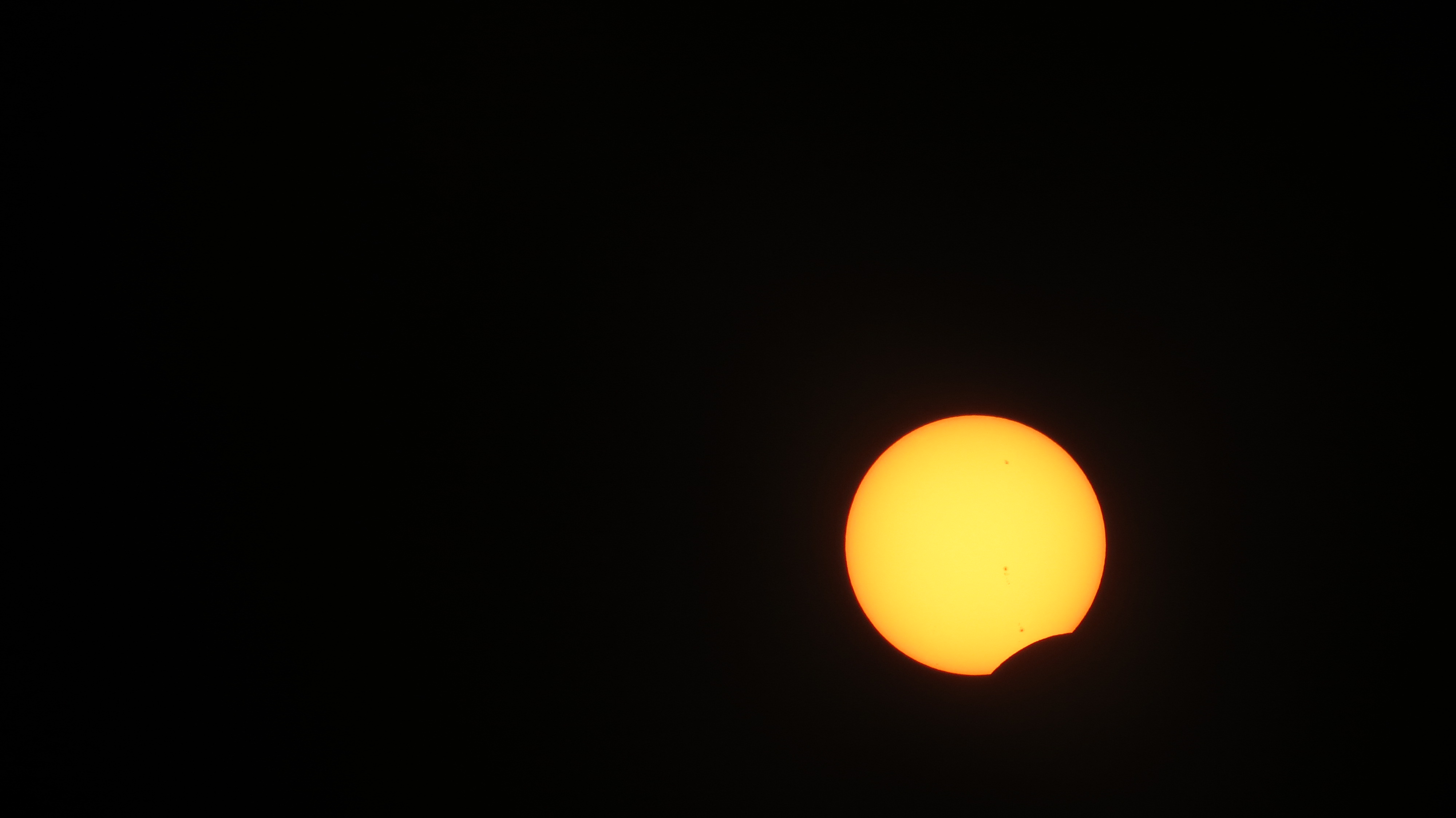
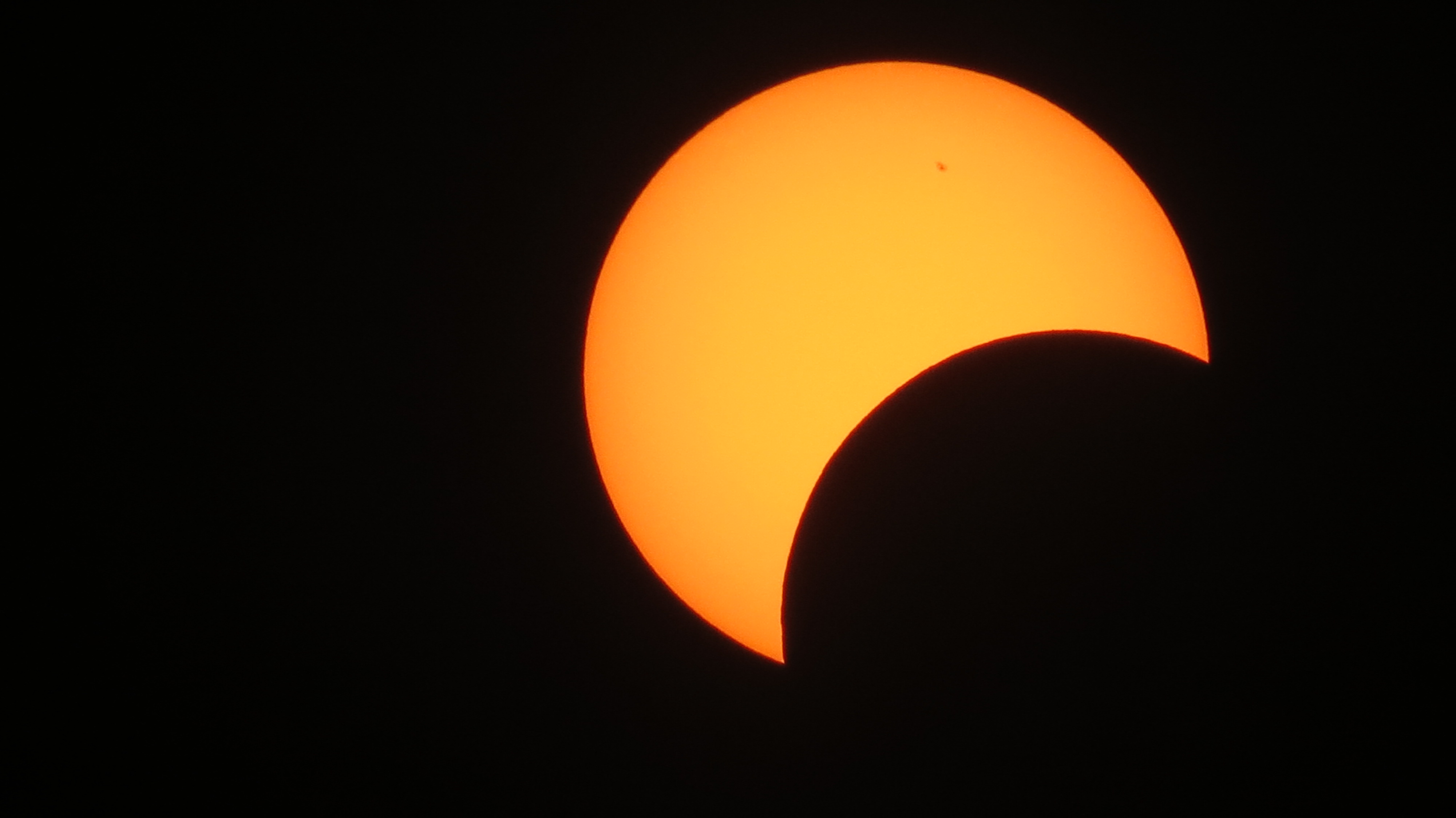
I’m an introvert, but if I start to teach something, I change. With eclipses, I am totally, literally and figuratively, in my element. I wore my Indonesian eclipse T-shirt from 2016 that lends me some credibility and is a good conversation starter.  I walked with my binoculars across the street near a church where I asked a woman if she wanted to look at the Sun. Most never see the solar disk, which to our eye is the size of the Moon, which is why we were all where we were, and there was a sunspot visible, too. I returned to the square and started showing the Sun to others, including a couple, helping the woman with the viewing.  A man came by wearing a 2017/2024 T-shirt and we chatted. He was from Austin, it was his tenth eclipse, and we exchanged stories from past ones. As he left, he patted me on the shoulder and thanked me for showing the Sun to the woman who had just left.

Two hours prior to totality, others stopped by to talk and to ask questions. There were many first timers, families, couples, a pair of guys my age, who had road tripped from Minnesota. They had gone to college together but had not seen each other until recently. There was a group of about a dozen Brazilians; how they ended up in Evant, of all places, I never knew, but then again, I wasn’t expecting to be there either. I showed them my red rental car parked under a tree, dozens of crescents on it, because the leaves above acted as pinhole cameras. We were no longer strangers but a group sharing a remarkable day.

One family had a young man who wanted me to talk about eclipses, and so I did. He was so interested I gave him the “nerd talk,” about how the three major cycles of the Moon, the synodic, anomalistic (perigee to perigee), and draconic (node to node, or crossing the plane of the Earth’s orbit going north for example, to doing again) all come into exceptionally close alignment (5 hours) with 223 cycles of the first, 239 cycles of the second, and 242 cycles of the third. The alignment is every 18 years 10-11 1/3 days (depending upon leap years and time zones). Each member has a path similar to the previous and shifts a third of the way around the world to the west. I saw this same family in Libya 29 March 2006, and three cycles prior to this was the 7 March 1970 eclipse that went up the Eastern Seaboard, where I was outside the path of totality (and regret it every time I hear Carly Simon song, “You’re so Vain”). He was fascinated.

As totality approached, I kept waiting for the proverbial shoe to drop, or realistically, for clouds to appear, for the models had shown a huge difference in cloudiness between 1 and 2 p.m., and the eclipse occurred about 1:35. But cloudiness would not be a problem.  We would see this. The young man had earlier asked me what he would see at totality. I had replied simply, “I’m not going to tell you. I want you to find out for yourself.” He did, after 4 minutes and 8 seconds.  

Ten minutes later, it was cloudy. 

I went to Texas knowing a soul crushing forecast and yet saw the eclipse under excellent conditions. But what will stay with me even more than the beauty of the eclipse was the enjoyment I had with many others, explaining to them why this old man has made 29 sometimes odd journeys for a few special seconds, not guaranteed. I am 75 and felt that day like a wise elder, sharing knowledge accumulated over decades of experience. I felt wanted and useful. As I helped make the event more special for those around me, I made the event more special for me, too.  This was a great eclipse, and it was due to the people I was with.

As I started to drive away, the young woman, who had just asked me if she were now an eclipse chaser (yes, ending up in Evant, Texas, qualified) and had asked when the next one is (12 August 2026), called out:

“We love you!”

THE ANNULAR ECLIPSE OF 2023

October 21, 2023

I wasn’t sure where I was going to be at the annular eclipse until 30 minutes before annularity began. 

And I had just driven about 170 miles.  The sky was mostly clear, finally; the partially eclipsed  Sun in front of me was still too bright to clearly see that it was eclipsed. I saw one group at the side of the road, and I just swung off 50 yards from them.

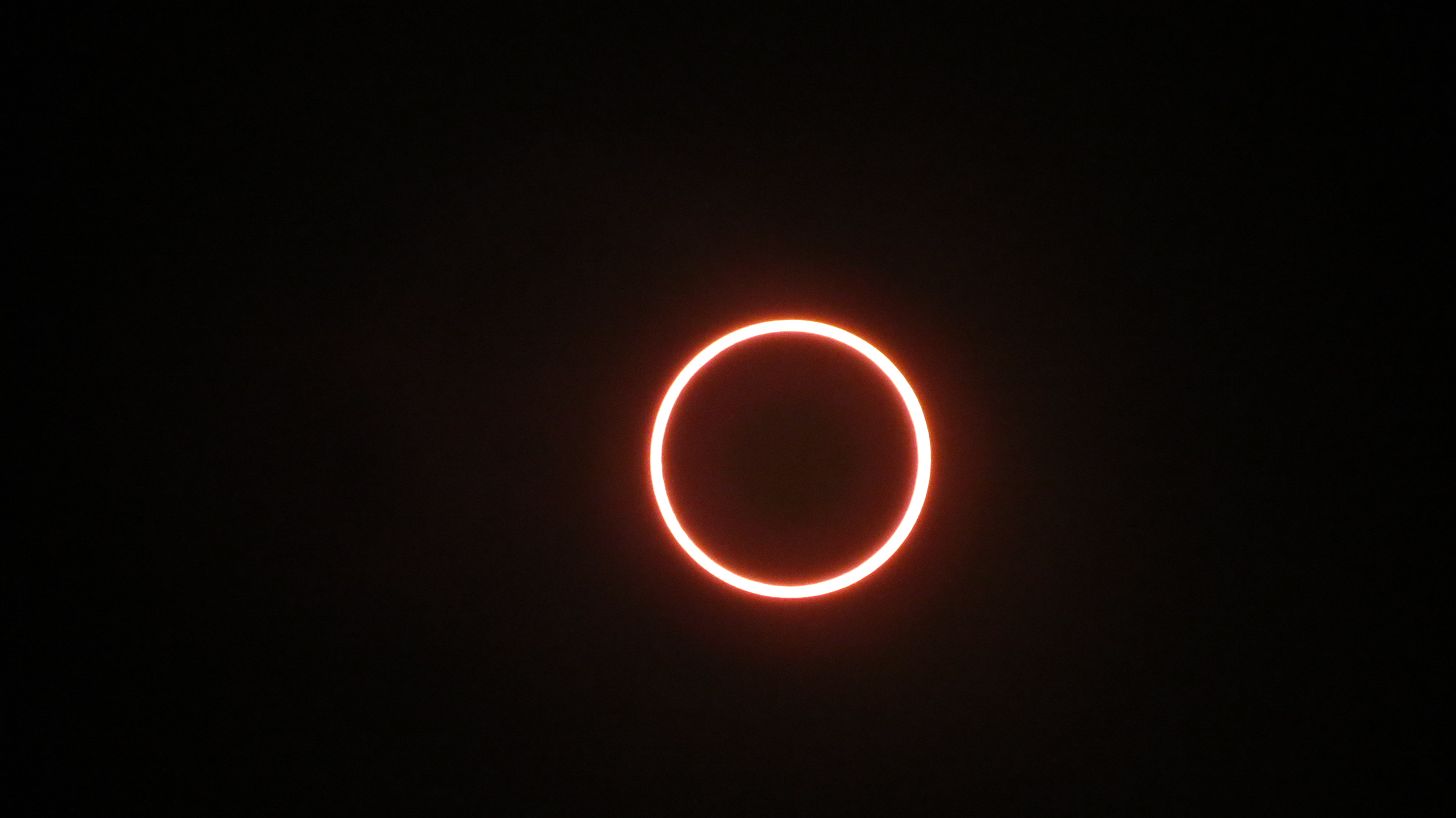
Eight years before, I didn’t even know there was going to be an annular eclipse here, although I had known about the 2024 total eclipse for probably two decades.  Annular eclipses are central, but here, the Moon is too far away (about 6,000 miles too far.)  If you have had a recent “Supermoon,” a term I don’t particularly like, a full Moon that is close to Earth, the New Moon will then be far from the Earth, and if it covers the Sun, it will do so incompletely. 

The first annular eclipse I ever saw was 4 January 1992.  Before I left for San Diego, I told someone at the astronomy club what I was doing, and he said, “Annular, big deal.  And you will probably be clouded out.” We didn’t care. It was a weekend in San Diego, and we would either see the eclipse or not. We weren’t true eclipse chasers, then, because if we had been, I would have been all over every source of weather information for eclipse day that I could find.

We went to Mt. Cube, to get up high, because we were at the end of the track, so close to the end, that if we were at ground level, we would miss it. The Moon started covering the Sun and annularity occurred as the Sun set through a cloud bank over the ocean. The colors were fabulous, and the picture of this annularity is recognizable from all others. We were with a small group of maybe 10, and unlike now, where people dot the road looking at an eclipse, nobody else was out there viewing.

Thirty minutes later, it was pouring rain.

We saw another annular in 1994 from Bisbee, Arizona, and a third from Costa Rica in clouds, barely visible, in 2001. I did get clouded out (pouring rain) in Iceland in 2003, but we saw the annular in Spain in 2005.  We were on the coast near Javea, and on eclipse day, there was thick fog. We drove inland 10 miles to see the eclipse in sunny skies, with one other group near us and near busy traffic without anybody else’s showing interest.  This particular eclipse was destined to re-occur 18 years and 10 1/3 days later, and given time zones and leap years, that would be 14 October 2023, a third of the world west of Spain, like the US.

In the intervening time, I saw an annular from Kenya, about eight minutes’ duration, in 2010, the same family as the first one in 1992. We saw the repeat of the 1994 eclipse in 2012, only the former was in the early morning and the latter was in late afternoon, both in Arizona. The last we saw from a hotel parking lot in Page. It was a hot afternoon, and eleven of us had access to an air conditioned lobby,  It certainly beat being among several thousand below us about 500 vertical feet and 5 miles distant, from the LA Astronomical Society over Horseshoe Bend of the Colorado River.  We were joined by Sergey, whom I met at the Kenya eclipse, and my wife rescued a pair of Swiss women who accidentally locked themselves out of their room from their balcony.  The eclipse went well, nobody came out from the meeting in the hotel conference room.  After the eclipse, we packed up and drove back to the South Rim that evening, just beating the traffic from Horseshoe Bend, cars parked for a half mile on either side of the road to the overlook.  

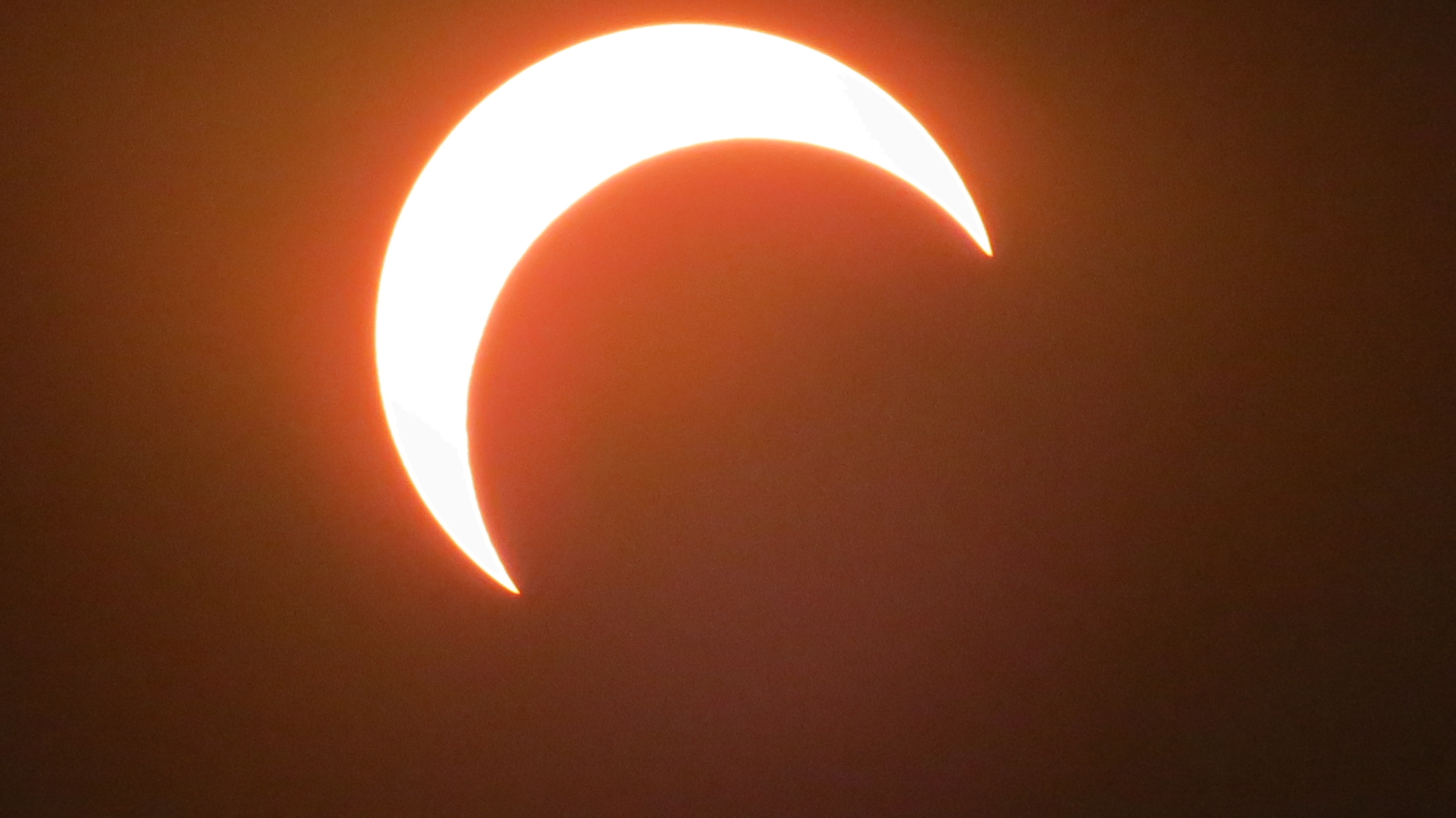
Annular eclipse, Page, AZ 20 May 2012

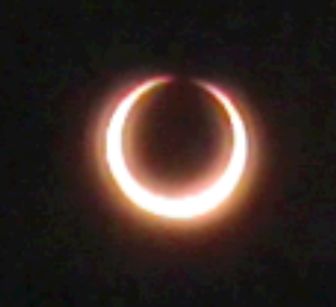
Annular Eclipse, Lake Nakuru National Park, Kenya 15 January 2010. The Moon was further away and the eclipse lasted over 8 minutes.

he annular would begin shortly after 8 and would be annular between 0916 and 0920 in Eugene. 

I start looking at the weather models 16 days out, just to get an idea of what the pattern would look like. All I get then is an idea of rain or no rain, and the weather did not look completely rain free.  About a week out, I use Spot Wx to start getting an idea of cloudiness.  The site is superb with cloud percentages, and one can look easily at many locations. From 10 days out the models go to 3 1/2, then 2, then 1. It became clear the few days prior to the eclipse that we wouldn’t have clear skies.  I started to investigate other portions of the eclipse track and found better conditions east of the Cascade crest.

Two days before, Club hikes to see the eclipse were canceled due to cloudiness predicted. I heard that Eugene would be clouded out.  Maybe, but maybe not, so I posted the following for general information:

“Tomorrow’s annular eclipse has not yet been clouded out. It ain’t over until it is over and you didn’t see it. This will be my 28th central eclipse trip (total + annular), and I’ve been successful 24 times.  Several were successful at the last minute, including a hole that opened up in rain clouds at totality in China in 2009. Unreal. Or the amazing total eclipse in 2010 where we could see the conical shadow from the end of the track in Patagonia, and 10 minutes after totality it snowed. Or Siberia, in 1997, when the cloudiness lifted just in time for first contact.  Or the annular in ’92 in San Diego, where the beautiful eclipsed Sun set in clouds into the Pacific Ocean and an hour later it poured rain….  

“I don’t like to tell people what they should do. I just tell them what I am going to do, and why, and being an old geezer, I’ve been around long enough to have gotten lucky. A lot. I saw this annular series 3 Oct 2005 from Valencia, Spain, where we had to travel inland quickly to escape the fog on the coast. 18 years and 11 days later, it is back, 1/3 of the way west around the world. Why that happens is as beautiful as the sight itself.  

“Fortune favors boldness.

“Anyway, just some thoughts.”

The night before, I was using the HRRR model, which has mile resolution. I had hoped for clear skies over the Cascade passes, only an hour and a quarter from my house, but by early morning, the only clear skies predicted were in Klamath Falls, so I was on the road early. My wife opted to avoid 350 miles of driving and took her chances here.

We were both pleased with what we got. She saw annularity from the house; I saw it in clear skies. 

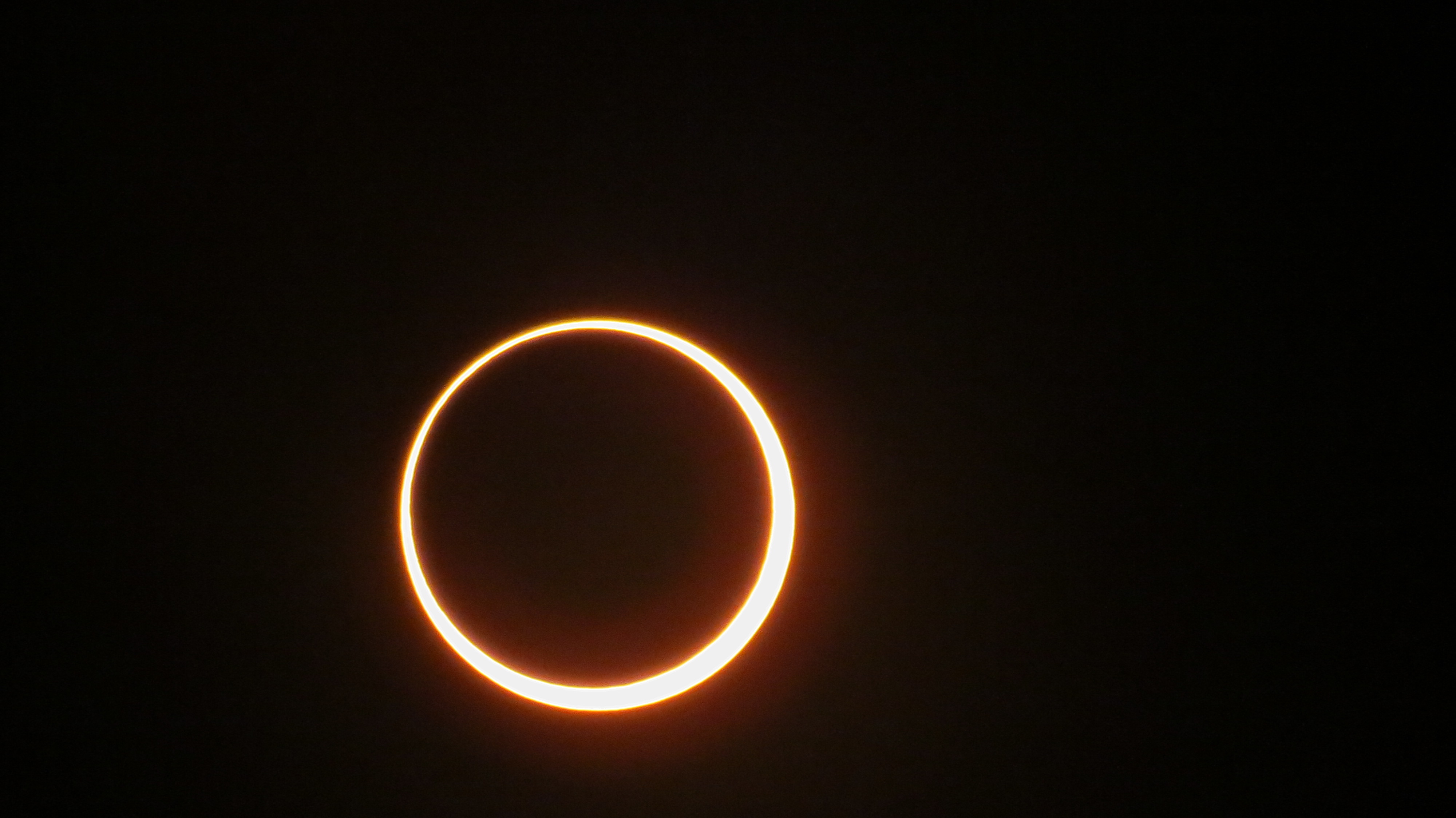
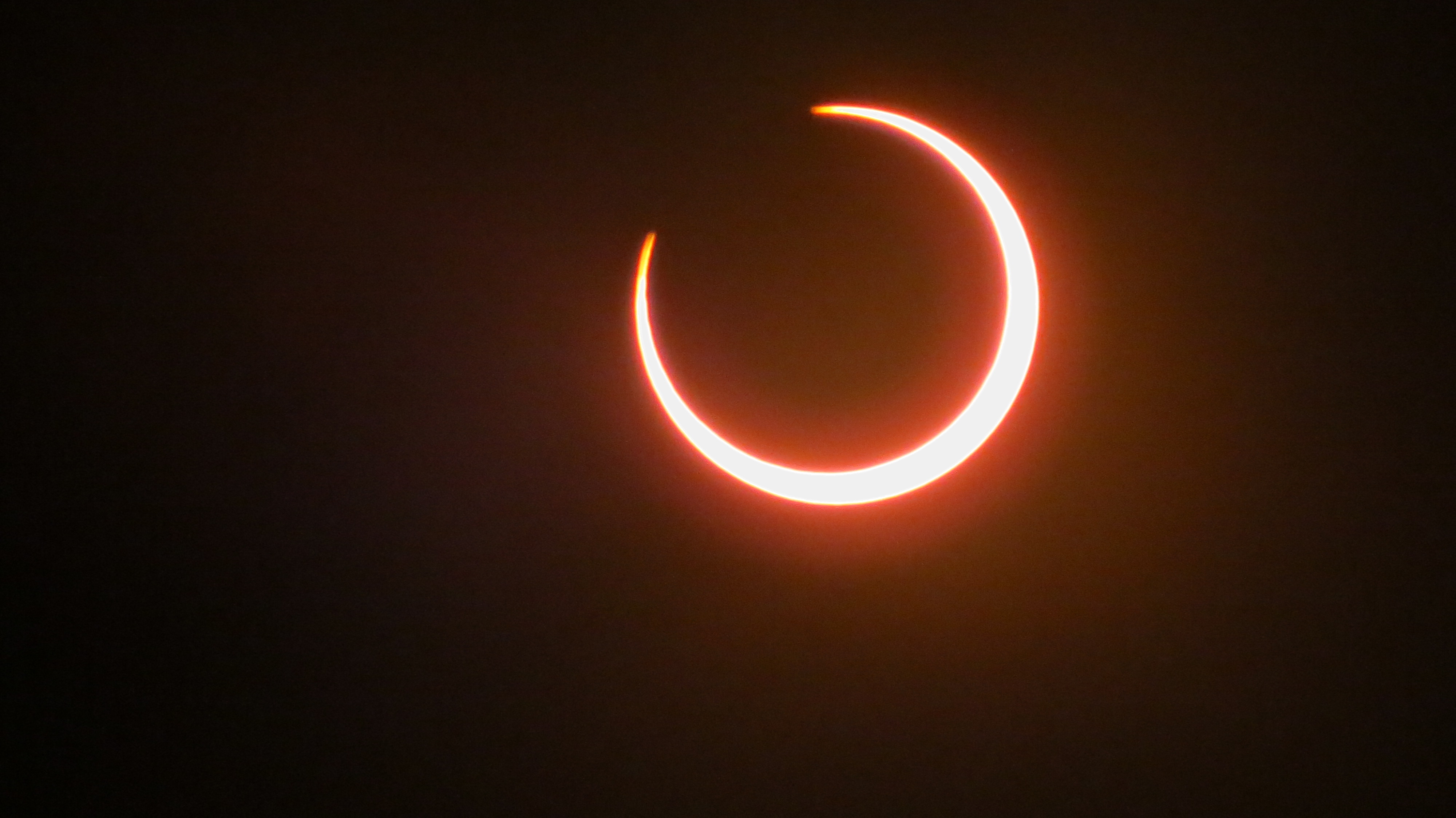
Annular Eclipse, 14 October 2023, Klamath Falls, Oregon.

UGANDAN ECLIPSE, SAROS 143; 3 NOVEMBER 2013

November 13, 2013

Saros 143, the name given to this particular eclipse family, was seen by my wife and me  on 24 October 1995, in Mandawa, India.  We saw it as a morning eclipse, with a brilliant purple chromosphere, the Sun’s inner atmosphere, and 42 seconds of totality.  It was short but exceedingly beautiful.

Total solar eclipses require 3 simultaneous occurrences: New Moon, the Moon’s passing directly in front of the Sun, and the Moon’s size viewed from Earth being larger than the Sun’s apparent size.  The Moon’s orbit is not coplanar with the Earth’s, and about every 13.6 days it crosses the plane of the Earth’s orbit.  This must occur with New Moon, for a Total Solar Eclipse to occur.  Finally, the Moon must be close enough to the Earth and the Sun further away, so the Moon will cover the Sun.  It is a remarkable cosmic coincidence that the Moon is about 1/400 th diameter of the Sun and the Sun is about 400 times further away.  Without going into the mathematics in great detail, these 3 events come into line every 18 years 10 or 11 days (depending upon a leap year) and a third of a day, which shifts each eclipse in the family about 1/3 of the way around the world and either northerly or southerly (in this case southerly).  This eclipse was 18 years and 10 days after the Indian eclipse and was shifted 1/3 of the way around the world.

This time around, the eclipse was further west, beginning near Bermuda and ending in Ethiopia.  We saw it in Uganda in late afternoon.

There are often problems getting to the eclipse track, and for me, it involved four flights, two of them 7 hours or longer, and arrival the following night after I left early in the morning.  The transatlantic flight was badly delayed, but I eventually got to Entebbe.

The next morning, three of us toured the Botanical gardens

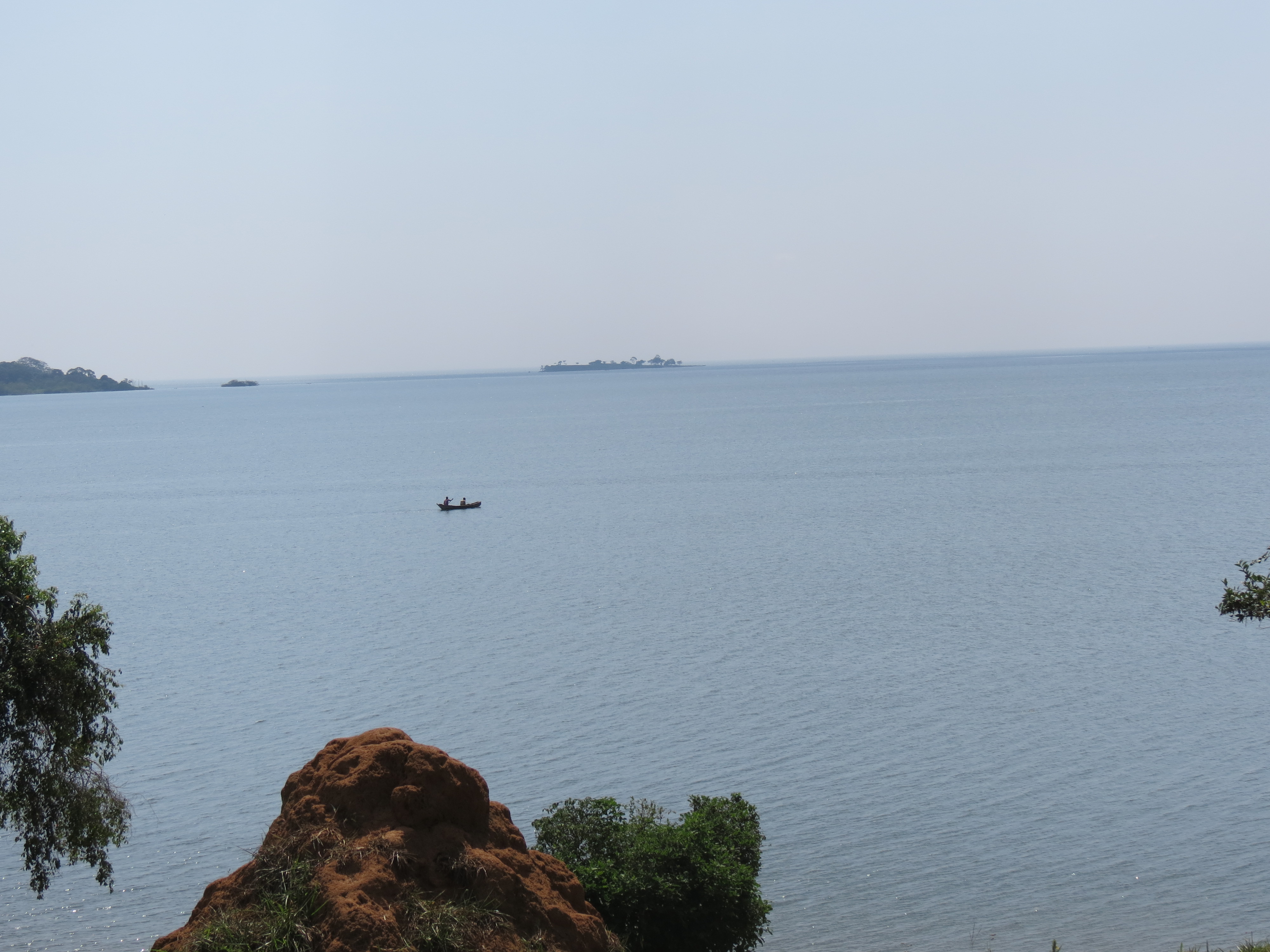
Lake Victoria from the Botanical Gardens

Lake Victoria from the Botanical Gardens

and in the afternoon the sanctuary where Ugandans are trying to bring back endangered species.  We had our first meeting about the eclipse that evening.  I was one of only two non or partial German speakers, and the other was married to a fluent speaker.  Most of the group spoke good English.  The difficulty with my German and the softness and accent of the Ugandan English would make this a more difficult trip than I had expected.

We drove northwest to Murchison Falls the day before the eclipse.  We did not, however, scout for eclipse sites.  This would prove to be unfortunate on eclipse day, when the primary site, north of Pakwach, was scouted by us with nobody having their eclipse gear–cameras, telescopes, computers, and quite complex instruments that many take to an eclipse.  Had the site been optimal, we would have had to return to get the gear and tell others.

We returned to the hotel and left for a site east of where we were, where the road curved into the track, and set up in a field nearby.  The southeasterly flow brought cumulus clouds, and afternoon convection occurred, although it was capped at about 2500 meters.  We missed first contact by about five minutes, then had clear skies through about 60% partial phases.   Unfortunately, cirrus outflow from a distant thunderstorm had a northerly flow, and we had progressively thickening clouds as time passed.  At 10 minutes before totality, I lost the view in binoculars, because of clouds and dimming sunlight.

Approach of the Moon’s shadow.

Just after third contact, with the Moon’s moving away from the Sun.

Totality.

Totality.

The shadow appeared in the western sky as a huge black conical wall.  We were able to see the diamond ring, Bailey’s beads, the inner corona (not the outer) and a lovely eclipse through clouds.  I think while some were disappointed, they were only a few.  We were extremely lucky to see this eclipse.  The climatological predictions were against us, but we got to a good spot and had a good view.  I’ve seen better; I’ve seen a lot worse, and there are few things more depressing than being totally clouded out for a total eclipse.  

The next day, we toured the nearby national park and took an afternoon boat ride up to Albert Falls.

Albert Falls, Nile River

Albert Falls, Nile River

What struck me most was the beautiful green of the African bush.  The wildlife was good, especially from the Nile; the green was something I had not seen on my trips and safaris to Kenya, South Africa, Botswana, Zimbabwe, Zambia, and Namibia.

The following day we drove south to Kibale Primate Park, This turned out to be about a 12 hour slog along dirt roads that were so bumpy that my stomach hurt, a first.  Lunch was late, at Fort Portal, and we pulled in about 6.  Darkness comes early after sunset in the tropics; it comes relatively early in Tucson, at 32 degrees N., and it comes much later in the northern US (45-49 N).

Mousebird, Kibale National Park.

Mousebird, Kibale National Park.

Water Lilies, Kibale

Chimpanzee, Kibale

Chimpanzee, Kibale

After the primate tours, we went to Queen Elizabeth National Park, crossing the equator, and took game drives and a boat ride along the channel of Lake Edward.

The drive back to Entebbe took a day.

I don’t go into detail here about safaris, except to show pictures.  This was an eclipse trip with safaris being a big part of it.  Such a concept is foreign to many people, including the eclipse leader in this instance.  The primary purpose of the trip is to see the eclipse, and that has priority over everything else, including sanctuary visits, seeing wildlife, buying trinkets and newspapers.  Admittedly, that is my opinion, but had we avoided those mistakes, more options would have opened to us on eclipse day.  We were lucky; we saw the eclipse.  We could have easily had missed it.

Next total eclipse is 20 March 2015.  We will fly this eclipse, since ground viewing is low probability in difficult to reach places.  I do have concerns about the flight and frosted windows, which severely degraded the view my wife and I had on the 1 August 2008 eclipse.  The plane must have clean, dry windows.  Water gets in only through the doors and from cleaning; it does not affect the windows from the outside, only the inside of the outside window.  This concept has yet to be fully understood by tour operators, although one will use isopropyl alcohol to clean the windows, which has a lower vaporization temperature.

Interestingly, although my comments have not been completely believed, those who fly eclipses are now carrying hair dryers and long extension cords, suggesting that perhaps some of my rather heated past words are hitting home.

The other concern I have is the ability of some eclipse chasers to feel they are better than others and take views from windows to which they were not originally assigned.  This probably will not be changed.

In 2015, I hope to speak German much better.  I plan on commenting in both languages at the pre-flight briefing.  Those who disagree with me were not present during the time of the eclipse.  They had clear views through clear windows.

All of us who pay for one of the great experiences in the world deserve an equally good experience, assuming the weather cooperates on eclipse day.

TOTAL SOLAR ECLIPSE OVER AUSTRALIA, 14 NOVEMBER 2012

November 22, 2012

This eclipse was not going to be a high probability one to see on the continent.  Saros 133, which is the name of this family member, last seen in South America 3 November 1994, would again visit the Earth 18 years and 11 1/3 days later, this time a third of the way around the world, beginning east of Darwin, crossing the Gulf of Carpentaria, then Queensland, near Cairns and Port Douglas, before heading out into the South Pacific Ocean north of New Zealand.  One per cent of the Earth would be covered by totality, but only a small part of that one per cent would be visible over land.

Cairns, on the northeast coast, is in the tropics, about 17 degrees South latitude.  The tropics have a good deal of convective rain showers, and Cairns had about a 50% probability of one’s seeing the eclipse.

We wanted to see Australia, and if I saw the eclipse, it would be the seventh continent I had seen an eclipse on and over.  But more importantly, it would be another chance–my thirteenth–to see one of the most spectacular shows in the world.  We eclipse chasers are addicted to the sight.

We flew to Melbourne, stayed there for 2 days, getting to know the city, and meeting up with two friends from Germany, one of whom I had met before at the last eclipse, over Patagonia, Argentina, 28 months earlier.  Every eclipse, I meet people from prior eclipses, and this one was no exception.

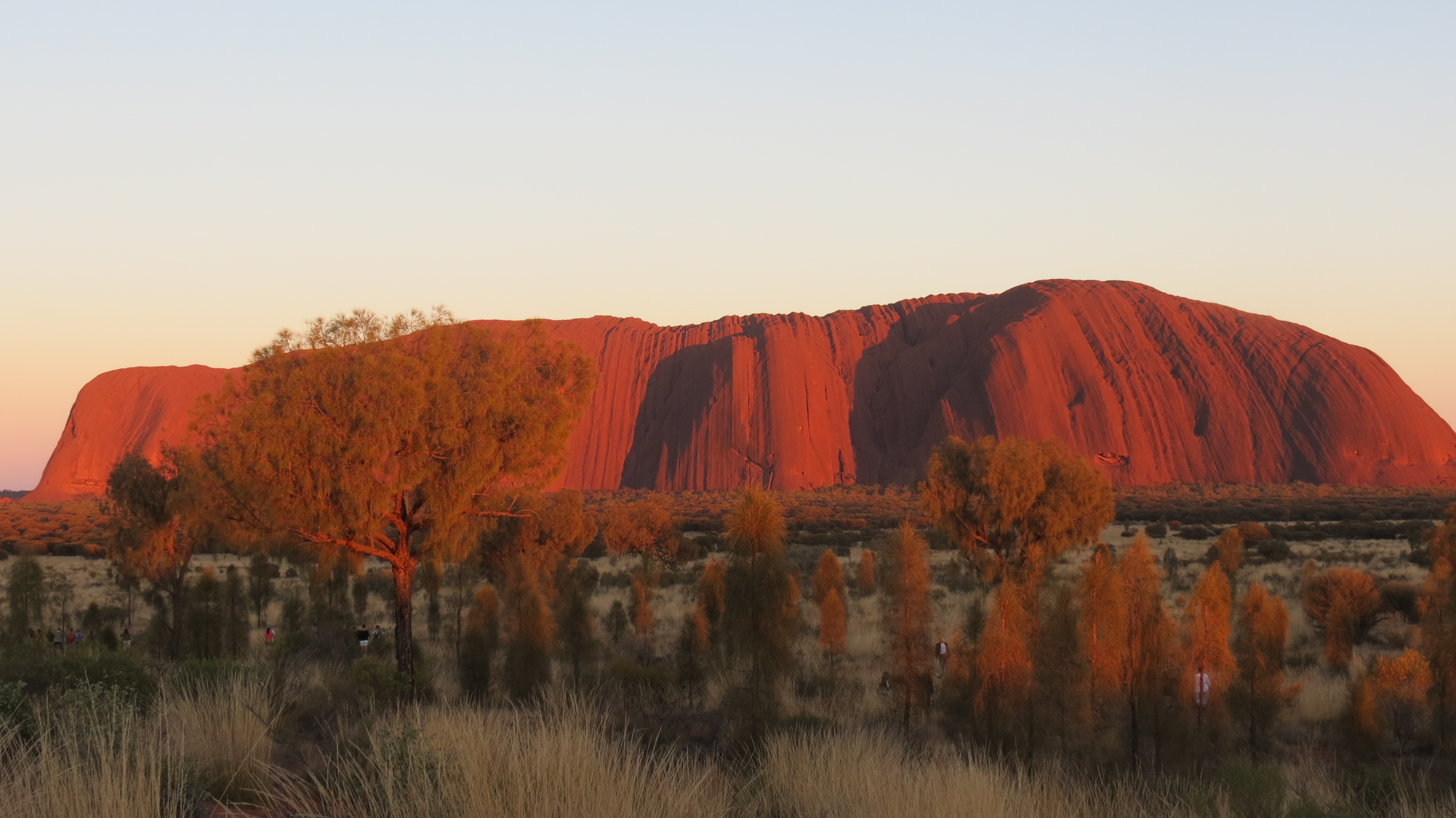
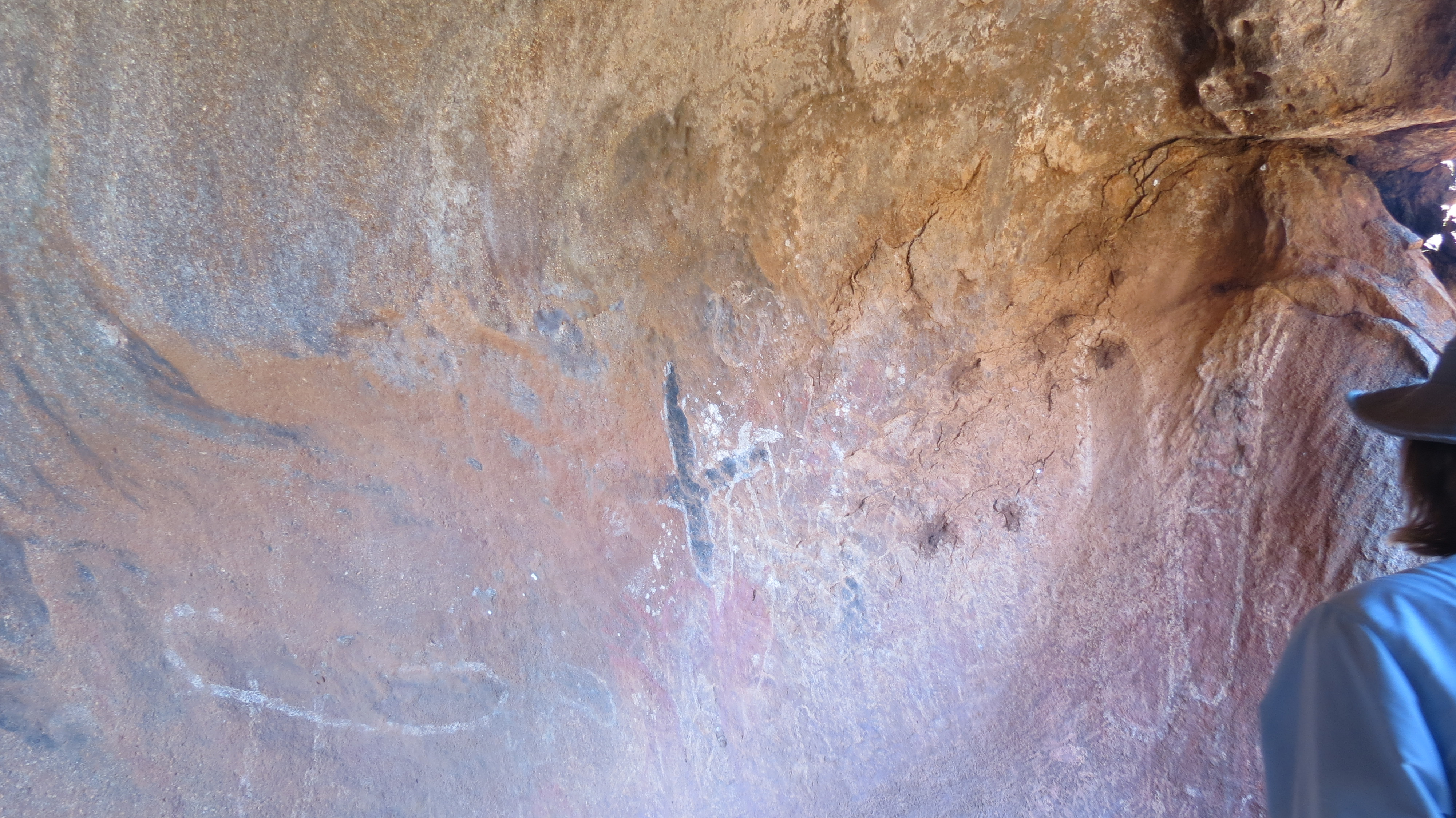
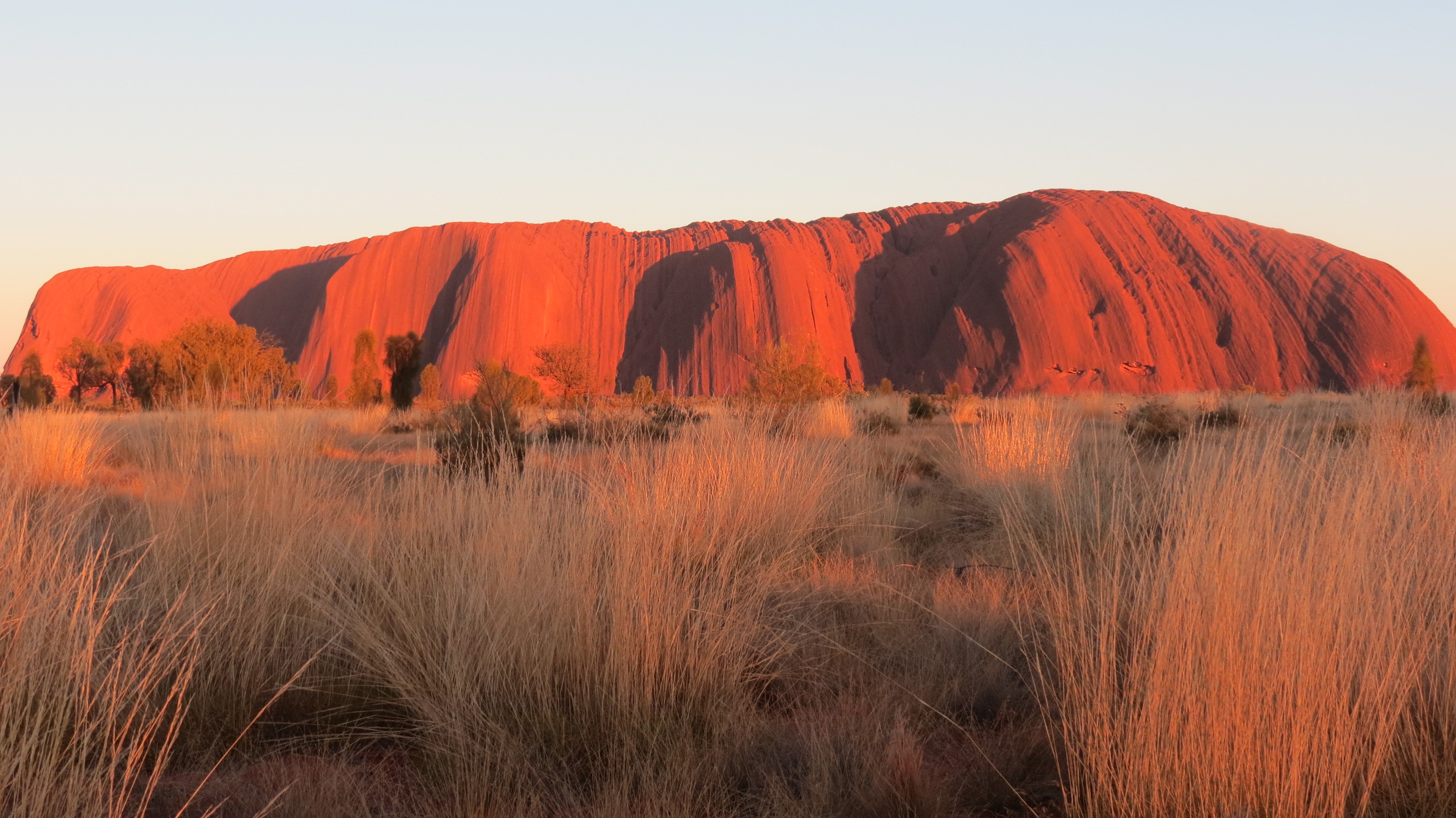
We then flew to Ayers Rock (Uluru) by way of Alice Springs, and visited the monolith at sunrise and sunset, along with a walking tour, so we could see the caves, the petroglyphs, the sandstone, appreciating that for 60,000 of the 350 million years, people have marveled at this place, making it a sacred spot.

We then left, and flew to Cairns by way of Alice Springs again, this time having time for a tour of the town that is virtually in the center of the continent.

The following morning, Cairns was cloudy, except for a nice hole in the sky, that would have been 15 minutes late, had the eclipse occurred that day.  We went out to Green Island, noting that it seemed to be clearer, although the locals said that it had a similar climate to Cairns.  But it didn’t.  Cairns is deeply recessed from the Coral Sea, with an eastern peninsula that was catching moisture from storms to the south and spilling over those of us in town.

We had decided not to get up at 1 a.m. to go out to Green Island for the eclipse, figuring we wouldn’t have mobility.  The problem was we didn’t have mobility in Cairns, either, to go inland or to Port Douglas, both of which might have been better spots to view the spectacle.

My wife suggested I e-mail meteorologist Jay Anderson, who has achieved fame as an eclipse climatologist and meteorologist.  I have been on several eclipses with Jay, knew he was on a cruise ship for this eclipse, but figured he wouldn’t have time to write me back.  Still, what did I have to lose?

As it turned out, it was the best decision I made during the trip.  Jay gave me a weather synopsis and said succinctly at the end of his e-mail:  “If you can, get offshore.”

In the meantime, I met two Russian friends.  Sergey and Tatiana were at the annular eclipse in Kenya in January 2010.  Sergey works for an oil company in Luanda, Angola, and Tatiana is a travel agent in Slovenia.  Sergey was also at the annular eclipse in the US last May, and we saw it together in Page, Arizona.  Sergey was doing automatic eclipse filming, using programs that were far beyond my comprehension.  He was going to stay on land and hope.  Tatiana would do the same, and she had to fly out of Cairns about 2 hours after totality.  Cairns was flooded with eclipse chasers for several days.

So, at 1 a.m. on 14 November, eclipse day, we awoke and caught the 2:30 a.m. boat to Green Island, setting up on the northeast beach at 3:30.  The sky above us was clear, and darker clouds were behind us, back towards Cairns.  It was easiest the clearest skies we had seen so far on the tirp.  We had great views of the Southern Cross, the Magallenic Clouds, alpha and beta-Centauri, and upside down Orion.

There were clouds on the horizon, but we could see sunrise, and first contact, where the Moon begins to cover the Sun.  As the Sun rose, the clouds increased, and so did the tide, which was due to rise 3 meters 2 hours after totality, at 6:38.  We figured we were safe from the tide, but it rapidly appeared that this would not be the case, so we moved well up on shore.

As the Sun rose further, the clouds began to become a little larger and darker–typical convection in the tropics.  We saw several clouds–one in particular–that were worrisome, when we were only 7 minutes from totality.  But then convection shut down due to atmospheric cooling of 3.5 C from the eclipse itself.

This eclipse had a wonderful diamond ring at both ends (do any not?), with a very delicate corona extending about two solar diameters to the east of the Sun.  It was not a dark eclipse, and there was little red along the horizon, but like the family member I saw in Bolivia, the shadow was visible in the morning sky.  Trees on Green Island prevented us from seeing the shadow arrive, but I had no difficulty seeing it depart.  And two minutes later, the eclipse was over, just like that.

Easily three hundred people saw this from the end of Green Island.  There were experienced chasers and many first timers.

Every eclipse is different, but it is difficult to say whether one is more special than another.  Each person sees something a little different, and each person who is fortunate enough to have seen more than one sees something different.  I try to go through a checklist of things to see with each eclipse, but like my camera and video plans, it usually is forgotten at the critical moment, which lasts on average of 2 minutes, but feels like 8 seconds.  We are left asking….”When is the next one?”  It will be 3 November 2013 in the South Atlantic, ending in Ethiopia.  Getting to that one will be difficult….but not impossible.  We have a connection in Africa–Sergey–who has been to Kampala three times and thinks Uganda is a decent possibility to see 24 seconds of totality–yes, 24 seconds–next year.  We discussed the trip, and several other eclipses coming up, including the long-awaited 2017 eclipse in the US, when we met at Sydney a few days later.

Fifteen seconds of fame:  I was interviewed by Australian TV after the eclipse, while on the boat back from Green Island.  I have no idea if anything appeared on TV.  And while lying in bed that night, I got a call on my cell phone beginning with “44” .  A journalist from CNN in London wanted to interview me about my experience, that I published on CNN iReport.  What is interesting–and discouraging to me–about iReport is that most of the featured pictures were of the crescent Sun.  Few showed the total eclipse itself, which is far more beautiful.  Indeed, the difference between totality and a partial eclipse (even 99%), is the difference between day and night.

Eclipse families:

Currently, there are 13 total eclipses in every 18 years 10 or 11 1/3 days, depending upon leap years and time zones.  Each one of the 13 total eclipses is a member of a family that begins at either the north or south poles and moves the opposite direction over nearly 1300 years or 70-75 eclipses.  Some of these start off as total; most begin as partial, become total or annular for many “visits” and then end as partial.

The reason for this repetition is the 3 requirements for a total eclipse:

Synodic period–New Moon–every 29.530589 days.  The Moon has to be in line with the Earth and Sun.                                                    223 New Moons = 6585.3213 days.

Draconic Period–every 27.21222 days.  The Moon’s orbit is inclined 5.1 degrees to the plane of the Earth’s orbit, and the nodes, where it crosses the Earth’s orbit, are constantly moving.  The Moon has to be near a node when it is new.  This particular eclipse was near the ascending node, where the Moon was near crossing the plane of the Earth’s orbit.                                                  242 Draconic periods=6585.3572 days.

Anomalistic period–every 27.554550 days.  The Moon and Sun are nearly the same angular size in the size, but the Moon’s size can change 12% from our view depending upon whether it is near the Earth or far from it.  The Sun-Earth distance changes about 3% every year.  The Moon has to be close enough to the Earth to appear larger than the Sun.                                                                    239 Draconic periods=6585.5376 days.

The first two determine a central eclipse, where the long axis of the Moon’s conic shadow reaches the Earth.  They occur every 6585.3213 days.  Eighteen years are 6570 days, and 4 leap years, or 5, make the period between successive eclipses in a family 18 years and 10.32 or 11.32 days.  The third of a day is important, because it shifts the path of the eclipse about a third of the way west around the world. This eclipse was seen in South America in 1994 and Australia in 2012.  It will be seen in the South Atlantic and Africa in 2030.

While the periods are almost alike, they are not exact.  There is a 0.03 day difference.  This seems minor, but over time, the Moon arrives at the node 2 hours later each cycle.  The Moon doesn’t have to be exactly at the node for a total eclipse to take place, but eventually, the Moon will arrive too late and the eclipse will not happen.

This particular Saros, 133, is an ascending node eclipse that began in 1219 and had its first total eclipse near Prague in 1544.  In the 19th century, it generated eclipses greater than 6 minutes, long for an eclipse.  In 1850, an eclipse was 6m50s, the longest this particular Saros would generate, and it occurred in the eastern tropical Pacific Ocean, north of the equator.  The last total eclipse of this family will be in 2373, and the last eclipse of the Saros will be in 2499.    Because these cycles are not perfect in their lining up, eventually the Moon will miss the node when new, and the eclipse family will die.  But at the same time, one new one will reach the node at the right time, and a new Saros will be born.  I find the workings of the Saros cycle as beautiful as the sight I saw from the Great Barrier Reef last 14 November.

ULURU

November 19, 2012

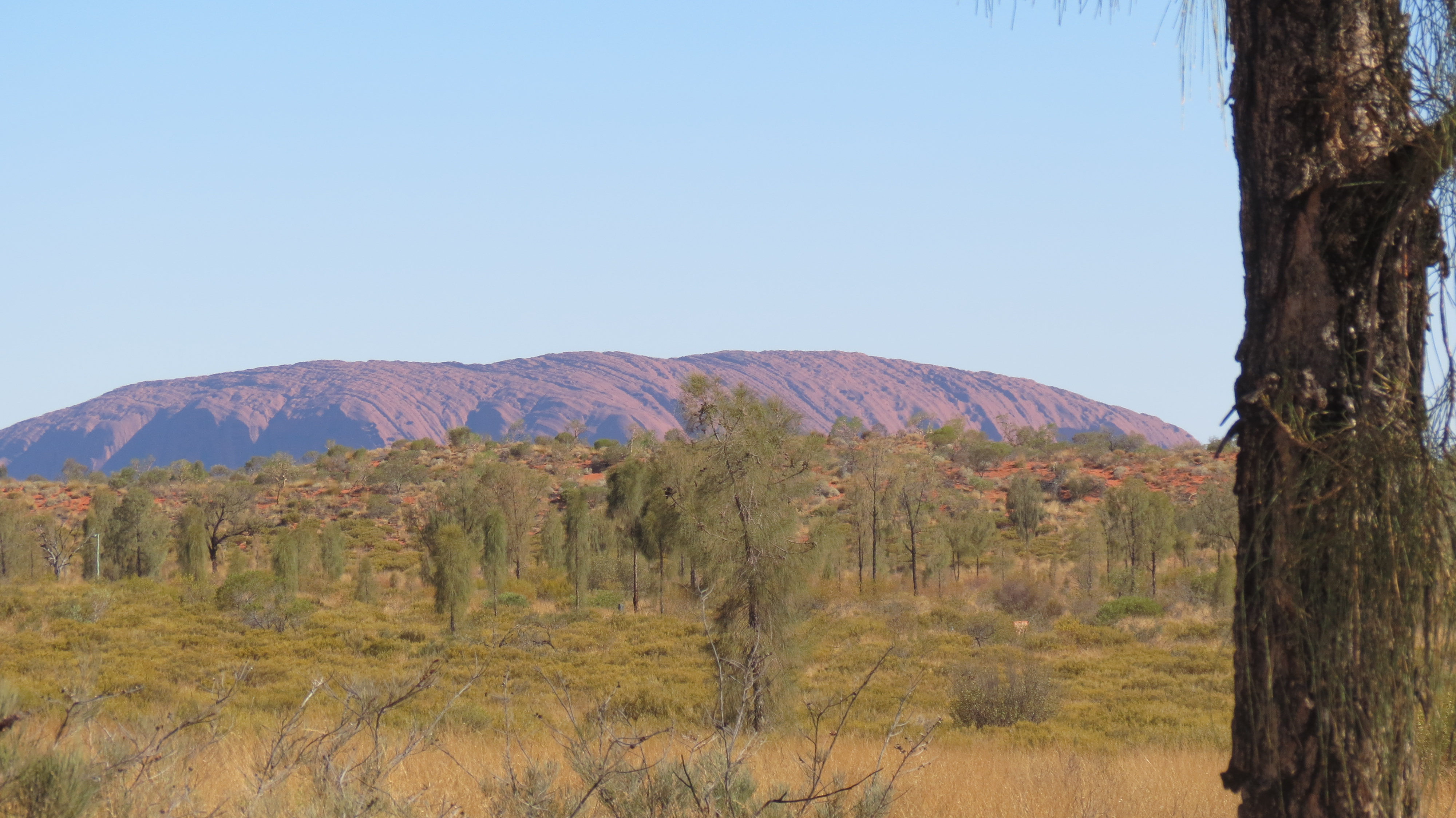
From 20 km, I finally saw the monolith, Uluru (Ayers Rock), that for years had been at the top of “The List,” of things I have wanted to see or do ever since I saw a wolf on Isle Royale, six and a half years previously.


The day after we flew in, we took a sunrise tour, where we saw the low rays of the Sun, in a few days to be briefly eclipsed by the Moon, strike the sandstone.  Then we approached it.


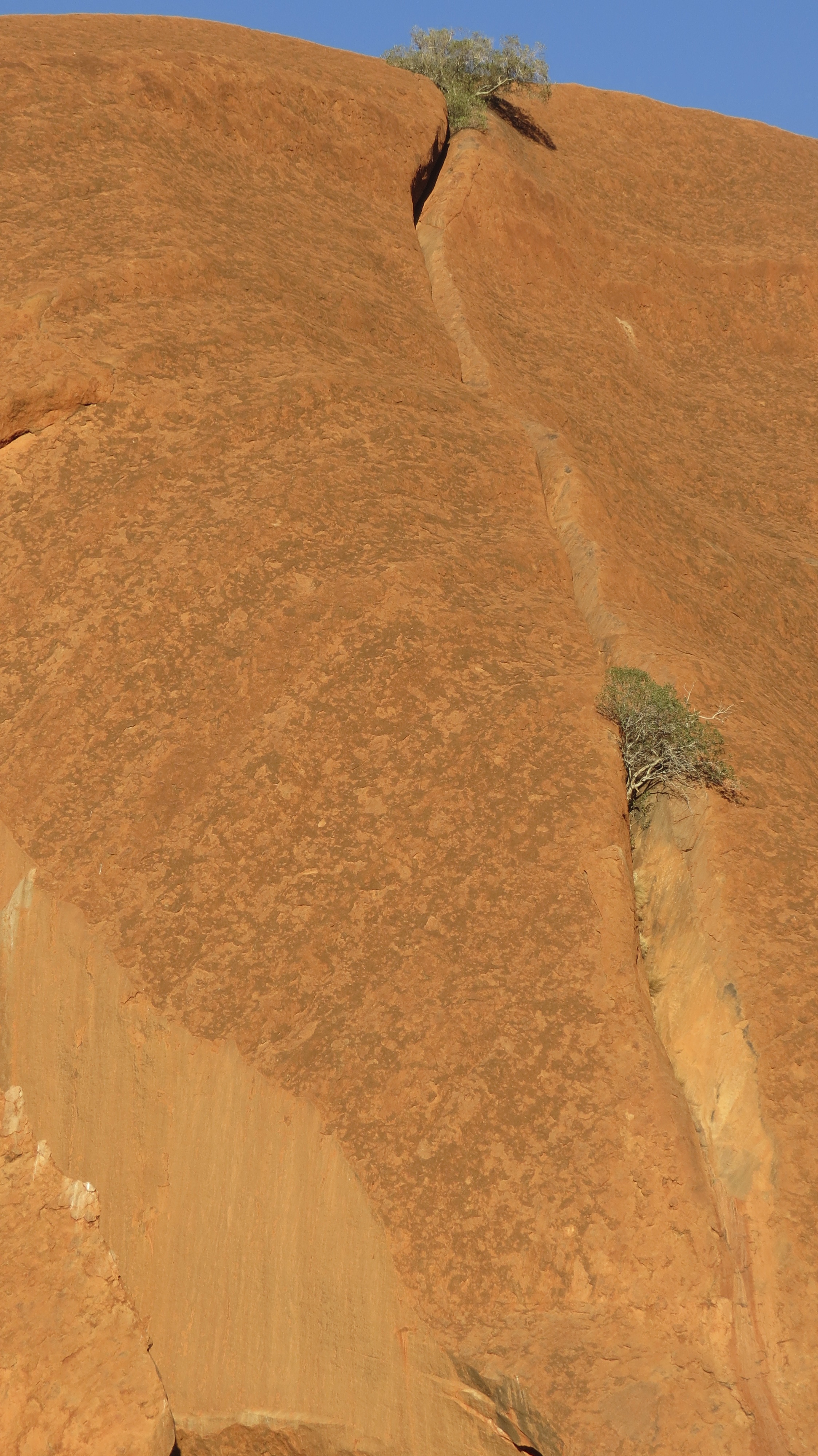
Uluru has been around for 350 million years.  What we see is the tip of a large uplifting, with rock extending about 2 km below the surface.  I didn’t know that, and that was only the beginning of discovering what I did not know.


For example, we visited numerous caves and inlets to the rock.  Uluru is not simply a rock with vertical faces; there are many places where water can collect, places where people can–and have–hidden, lived, and practiced their faith.  The aborigines, who were once shot on sight by the first white men on the continent, have been present in this area for 60,000 years.  That is roughly thirty times the existence of any other major religion on the Earth.  To them, Uluru is sacred.  There are places along the trail where one is not allowed to photograph, just as it is considered insulting and wrong to photograph an aborigine without their permission.  The visitor’s center is off limits to photography as well.

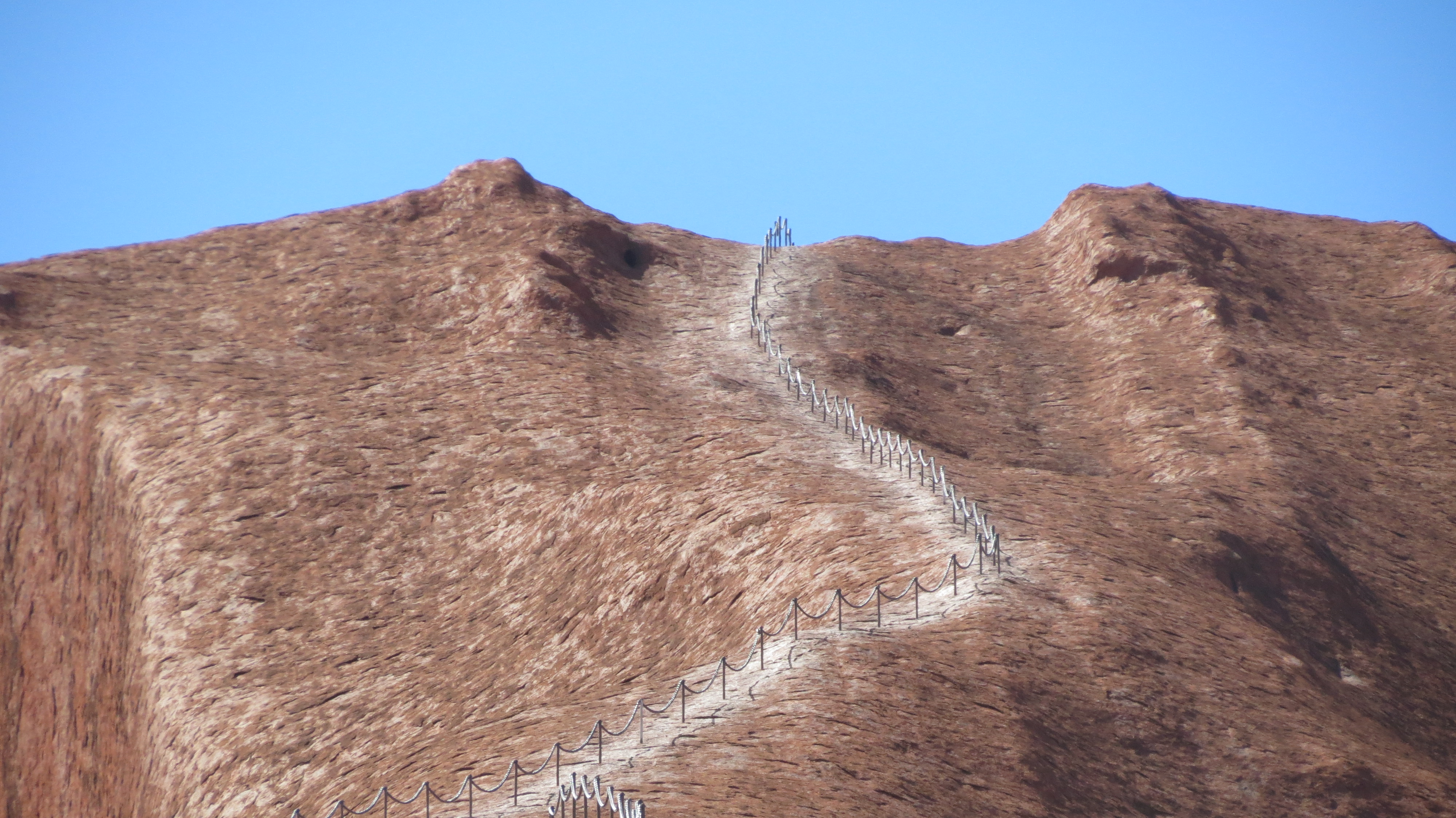
As one leaves the visitor’s center, there is a request–not a requirement, since there are no requirements at Uluru, only requests–not to climb what is considered sacred to the aborigine people, who never climb the rock.  There is a chain that allows people to climb the monolith, but the day I was there, the rock was closed because of high winds.  It didn’t matter to me, since I had not planned to climb it anyway, knowing it was sacred and ought not to be climbed.


Thirty-six people have died on Uluru from climbing, and for each the natives have required a ceremony to help those who died into the afterlife.  There are several memorial plaques that were placed on Uluru as well, although there are no new ones, because that affects the monolith, too.


Frankly, I found it good to go to a place where there were no extreme sports allowed.  There were no races up Uluru, no helicopter rides or hot air balloon rides to the top.  Indeed, the airspace over Uluru is also off limits.  There were no people BASE jumping, or using other conveniences to fly off the mountain.  Other than the chain fence, and the worn path into the Sandstone, there were no marks on Uluru other than a few paintings in the lower caves.

I can only imagine what Uluru would be if left to the white people.  There would be multiple routes to the top, the sandstone would be pockmarked with pitons, there would be ropes hanging off it, old campfires, tents, mountain biking, tours to the top, marathons ending at the top, races around the monolith, human waste and other litter.


I don’t have a problem with any of the above races, so long as they take place where it is appropriate, not one sacred to people who have existed in an incredibly harsh environment for sixty thousand years and have not destroyed it.

Theodore Roosevelt once said about the Grand Canyon, “You cannot improve on it.  Leave it as it is.”  We have not done that.  South Rim Village is large, although it is a relatively small area on the Rim.  There are trails, although they are limited as well, and they require a great deal of effort to walk.  We have, however, filled the airspace with fixed and rotary wing aircraft, creating a great deal of unnecessary noise.  By Uluru, one hears the wind, the birds, and very little else.

That evening, we took a sunset tour, again watching the change of colors that were a function of the Sun, the sandstone, the caves, and the black stripes where water drained off the monolith with each rain.  It was spectacular.  A group of Austrian tourists were nearby, and I practiced my German with them.  I lent them my binoculars so they could see parts of the monolith that I now knew something about.  It was the first time I had taught about nature while speaking only German.  I explained the pools along the rock that collected water and then overflowed to pools below.  I found words that I knew as I needed them.  It wasn’t great, but they understood what I was saying.  In two roles that I was comfortable in, teaching and nature, I was able to relax and speak.  It made the view even more magical.  How many different languages had been spoken at this site during the past six hundred centuries, I cannot imagine.  But one man spoke two that night, and for him, and that was special.


It’s nice for once to see something truly unique, virtually unspoiled, and will stay that way, except for the path to the top, which may some day be closed.  I hope it will be.


I went to Uluru to see the largest monolith in the world.  I came away thinking how nice it was that Australians, most specifically the most maligned ones–the aborigines–have not allowed the large numbers of people who have to show they are the best at whatever sport they decide they must do.  World class is to me an overused term, but at Uluru, the term is deeply appropriate.

What a blessing.


ANNULAR SOLAR ECLIPSE; PAGE, ARIZONA, 20 MAY 2012, SAROS 128, #58 OF 73 IN THE SERIES

May 21, 2012

Finally!  An eclipse we could drive to, for the first time since the previous member of this family of eclipses 10 May 1994!  Saros 128, the member of this family, returns to the Earth every 18 years 10.3 days.  Last time around, it was a morning eclipse.  This time, it was a late afternoon eclipse, further north.

We spent 2 days at the South Rim of the Grand Canyon and then drove north to Page on eclipse day.  The distance is about 230 km (140 miles).  We found a place at the back of a motel which had a perfect view of the western horizon, including the Kaibab Plateau, the Vermillion Cliffs, and Lake Powell.  This time, I set up the C* telescope I was able to bring, attached the solar filter, and used that for views.  The sunspots were striking!

I then set up a video camera at about 25 x and a filter, so it would run during annularity with minimal effort on my part to adjust it.  I had a camera with 35x optical, and I put a solar filter over the lens and took pictures periodically.  Annular solar eclipses do darken the sky a little, there is an “eclipse wind,” and the temperature cooled 5.8 C, or about 10.5 F.  The sun was starting to set, but obviously the eclipse had an effect on the temperature, since 5 p.m to 6:30 p.m.temperature drops are usually less than half that.

We had a nice group with us, with two men from the UK next to us, many German tourists, so I could practice my German, a motel, where they did not mind our using their cold water and toilet facilities, and a place to park right next to our gear!  My wife helped rescue two Swiss women who were on the balcony of their room and were locked out.  For that, she got some Swiss chocolate!!

We left page at 7:30 p.m.,, drove past the unbelievable crowd of cars at the site overlooking Horseshoe Bend in the Colorado River, and returned to the South Rim at 2200!  Video of the eclipse is here.  All pictures of the eclipse and the Grand Canyon are here.

Mid-annularity

Just after “First Contact”

Mid-annularity

TOTAL SOLAR ECLIPSE, PATAGONIA, ARGENTINA, 11 JULY 2010

July 12, 2010

Yes, we did see this.  And we were lucky.  My video on YouTube was a simple camcorder set up facing the Sun and then left running, while I and Maria, a young German astrophysicist, watched.  This was Maria’s first eclipse, and she wanted to see it more than anybody I’ve known.  Her crying is not unusual; total solar eclipses are beautiful, primal, spiritual events.  They affect us deeply!

This was my 20th eclipse trip:  I’ve seen 11 total eclipses (this was my 12th), 5 ring (annular) and 3 times missed from clouds, wind or rain.  This trip featured a flight over the S. Pacific along the track, which is why I and many others signed up for it.  Seeing it from a plane is a 100% probability as opposed to the ground, especially on islands, where mobility is limited if there are eclipse blocking clouds.  Unfortunately, a week prior to the eclipse, the plane was taken out of service for major mechanical problems (or so we were told).  We had no plane and were going to see the eclipse in the worst possible spot:  the Argentinian Patagonia in mid-winter at the end of the eclipse track.  I’m a weather junkie, and all the models were pessimistic about clear skies in Patagonia for eclipse day.  Worse, because of the low position of the Sun, ANY significant horizon cloud would kill the eclipse.

I almost didn’t get out of the US.  Tucson to Houston flight was diverted to San Antonio because of T-storms over Houston.  I got to Houston at the other end of the airport from the Intl Terminal, plane to depart in 25 minutes.  Frankly, because of the lack of the eclipse flight and the distance traveled to likely see nothing, I would not have minded missing the plane and going home. But I did make the plane and was in Buenos Aires the next morning.

We stayed in B.A. 2 days then flew to Patagonia (more worries, because there had been an air traffic control strike as well which had cancelled many flights and made many others late) and got there with mostly cloudy skies that worsened as time progressed.  However, I knew high pressure was building in the eastern Pacific, and more importantly, the water vapor fetch that had been slamming into Patagonia shut off the night before the eclipse.  We had clear skies the next morning.  We first went out and viewed the southern sky and saw the ISS pass overhead.  On the way to the glacier, I got the idea to stop the bus and view the Magellanic Clouds from a dark site.  I was a bit nervous about holding everybody up, but NOBODY vetoed the idea, and several who had never seen them before got a chance.

The glacier was fine, the skies completely clear, the wind light.  I was starting to get optimistic, which is an oxymoron when used in conjunction with eclipse day.

We left the glacier at noon and were back in El Calafate at 1:30.  We got into 4  x 4s that held 15 people, had chains, and went up a single track that topped out about 3000 feet above the town and Lago Argentino nearby.

The views were stunning.

By this time, there were clouds on the mountains, which worried me, although they were mostly lenticular and were dissipating as they moved north, about where we were told (wrong, as it turned out) where the Sun would set.  First contact, where the Moon begins to cover the Sun, occurred about 1 hr 5 min before totality.  It couldn’t happen soon enough.  Clouds were starting to build on the mountains.  But when we realized that the Sun couldn’t possibly set where we were told it would, I finally relaxed, knowing that everything would be fine.

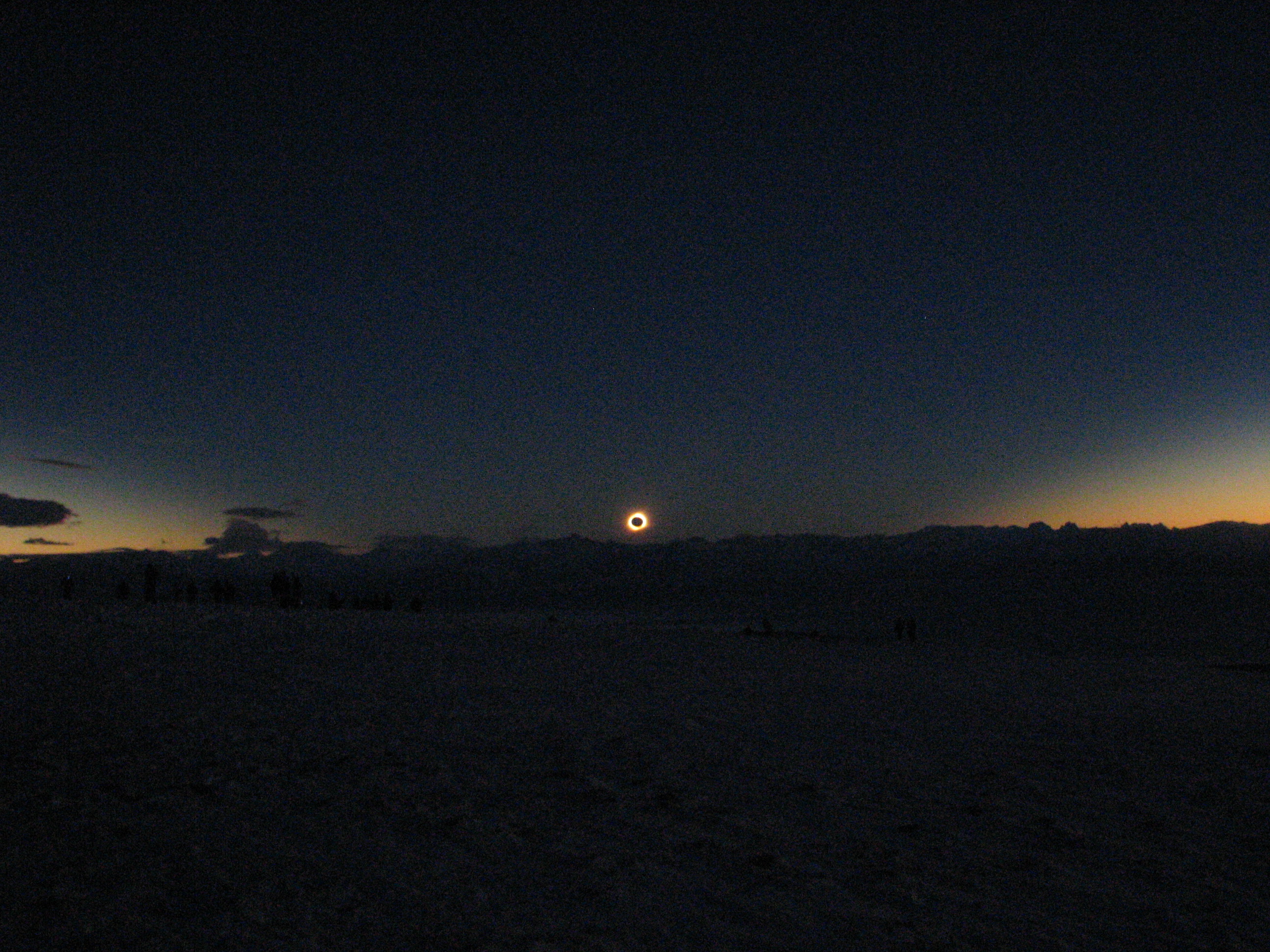
It was a beautiful eclipse.  Photographs, especially mine, don’t do it justice.  The corona was not particularly impressive, but the low Sun and the long, beautiful diamond ring were.  What captivated all of us was the shadow cone, as the Moon’s shadow lengthened as the Earth curved away from it.  This is captured very well on the photographs, and I saw it head into space after the eclipse was over.  It just appeared as a darker than normal area of sky.

Each total solar eclipse is special in its own way.  This one will be remembered by me for three things: (1) the difficulty getting there and my constant checking of multiple weather models of the south Atlantic, (2) the stunning shadow cone, and (3) Maria, a delightful young astrophysicist who had never seen a total eclipse before, desperately wanted to see this one, and joined me.  She was so moved, she was crying, not at all an unusual emotion, and one that is captured on the video.  I want all first timers to see the eclipse.  Of course, I want to see it, but I’ve seen them before, a first timer has not.  Watching the awe on their face when they see what we’ve been discussing is truly remarkable.

The eclipse was my 12th total solar, and with Russia, was probably the toughest, most worrisome one we saw.  But we caught a break in Patagonia and had 2m40s of totality.  Were we lucky or what?

ECLIPSE TRIPS

October 4, 2009

First trip:  11 July 91 to the Baja to see the 6 1/2 minute total solar eclipse.  We didn’t plan on seeing any others, but about a year later PBS had a special on that eclipse, and we both asked, “when and where is the next one?”  That’s a sign one is getting hooked!

Second trip:  3 November 94 to Sevaruyo, Bolivia.  We called that the trip where every other night we had a bed.  I was altitude sick for a day in La Paz, and then we took the train south to get into the track.  Most memorable moment (and remember, this is 1994):  the train stops in the middle of nowhere in the middle of the night.  Somebody asks, “Where are we?”  Simultaneously, about 5 people say “18 degrees South 64 degrees west.”  Totally correct and completely useless!

Third trip:  24 October 95 to western India.  This eclipse was a guarantee on weather for days before.  We saw birds roost about 10 minutes before totality.  Because totality was so brief, we saw the chromosphere (the inner atmosphere) of the Sun for the whole time.  It was a lovely lavender.  I would put the shot on here, but my cable release broke prior and using my finger caused some blurring.  It may have been the prettiest I’ve seen.

Fourth trip: 9 March 97 to Siberia.  That is described elsewhere in this blog.

Fifth trip: 26 February 98 to Aruba.  We went to the south end of the island, where it started to rain.  We went back north and saw it in cloudy but adequate skies.  Had we stayed put, we would have been just fine.

Sixth trip: 21 June 01 to Zambia.  Jan had broken her humerus and had external pins in.  I could have been a nice husband and stayed home to help her.  Or I could have gone to the eclipse, which I did.  We saw totality about 50 miles north of Lusaka, the capital.  It was the only eclipse trip I was on where everybody in the group was silent.  That in of itself was probably the weirdest experience of all!

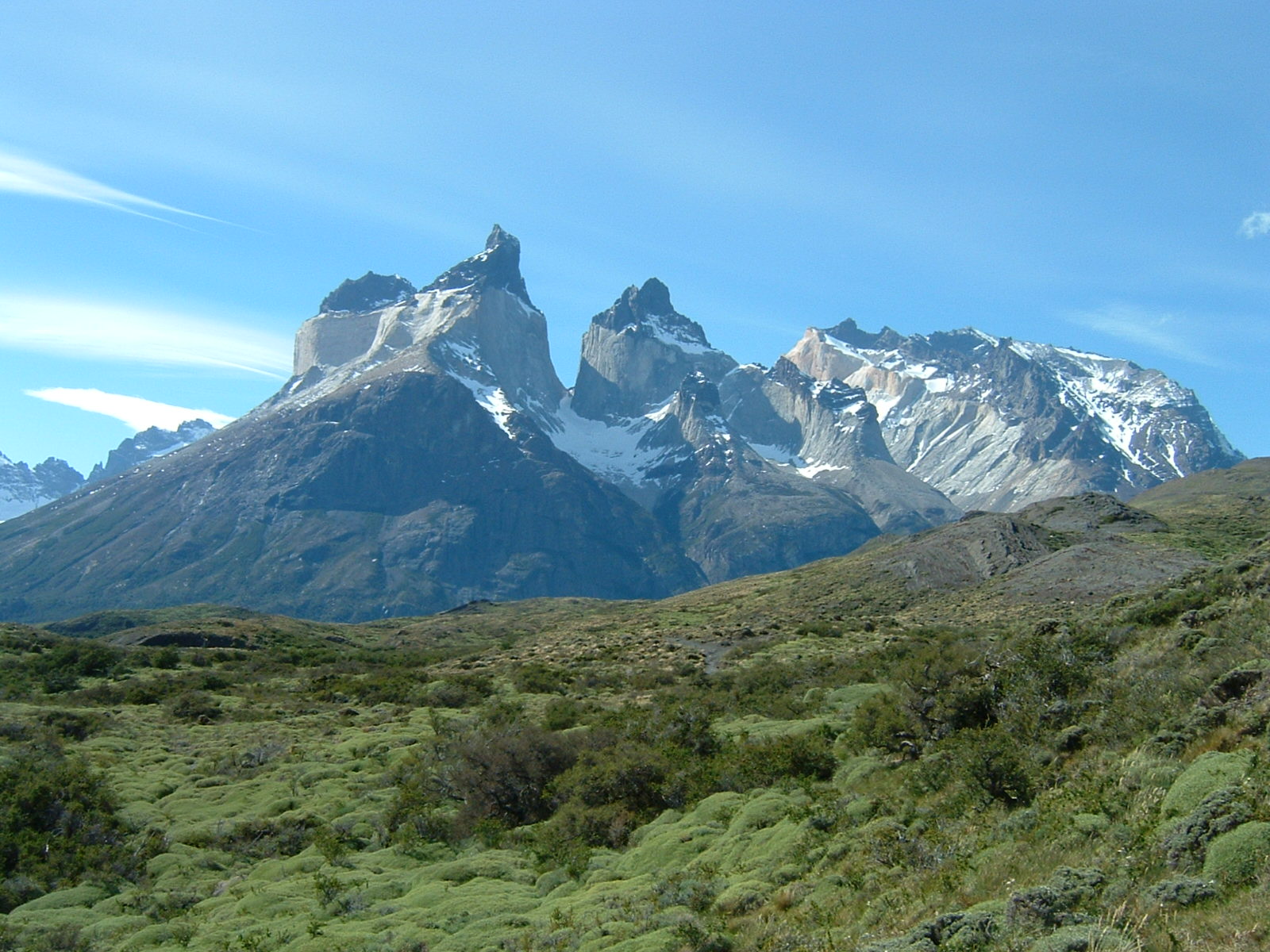
Seventh trip: 23 November 03 over Antarctica.  We flew to Punta Arenas  Chile, then took a couple of days to see Torres del Paine, a remarkable formation of climbable (not ever by me!) rocks.  We then took a Lan Chile flight with open cockpit (meaning you could look over the pilot’s shoulder, especially when he was taking pictures himself), getting totality somewhere around 73 degrees south latitude.  We then flew over the South Pole from an alititude of 2500 feet.  We came back over the Presidential range, flew around Vinson Massif twice and came back to Punta Arenas.  It was a 14 1/2 hour flight.  Next afternoon, we caught flights to Santiago, Lima, LAX and finally Tucson.

DSCF0126

Torres del Paine:

DSCF0146

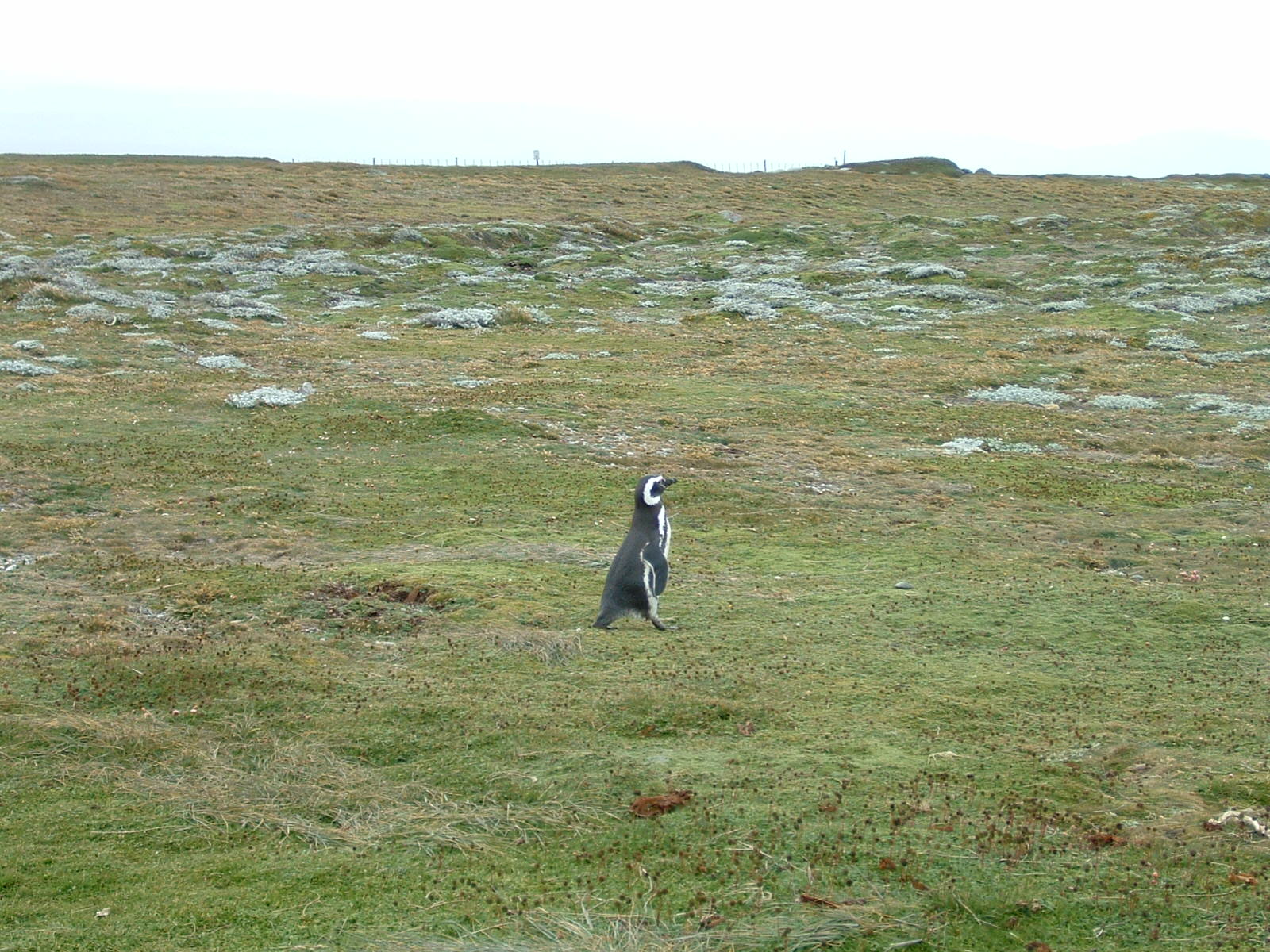
Magellanic Penguin:

DSCF0056

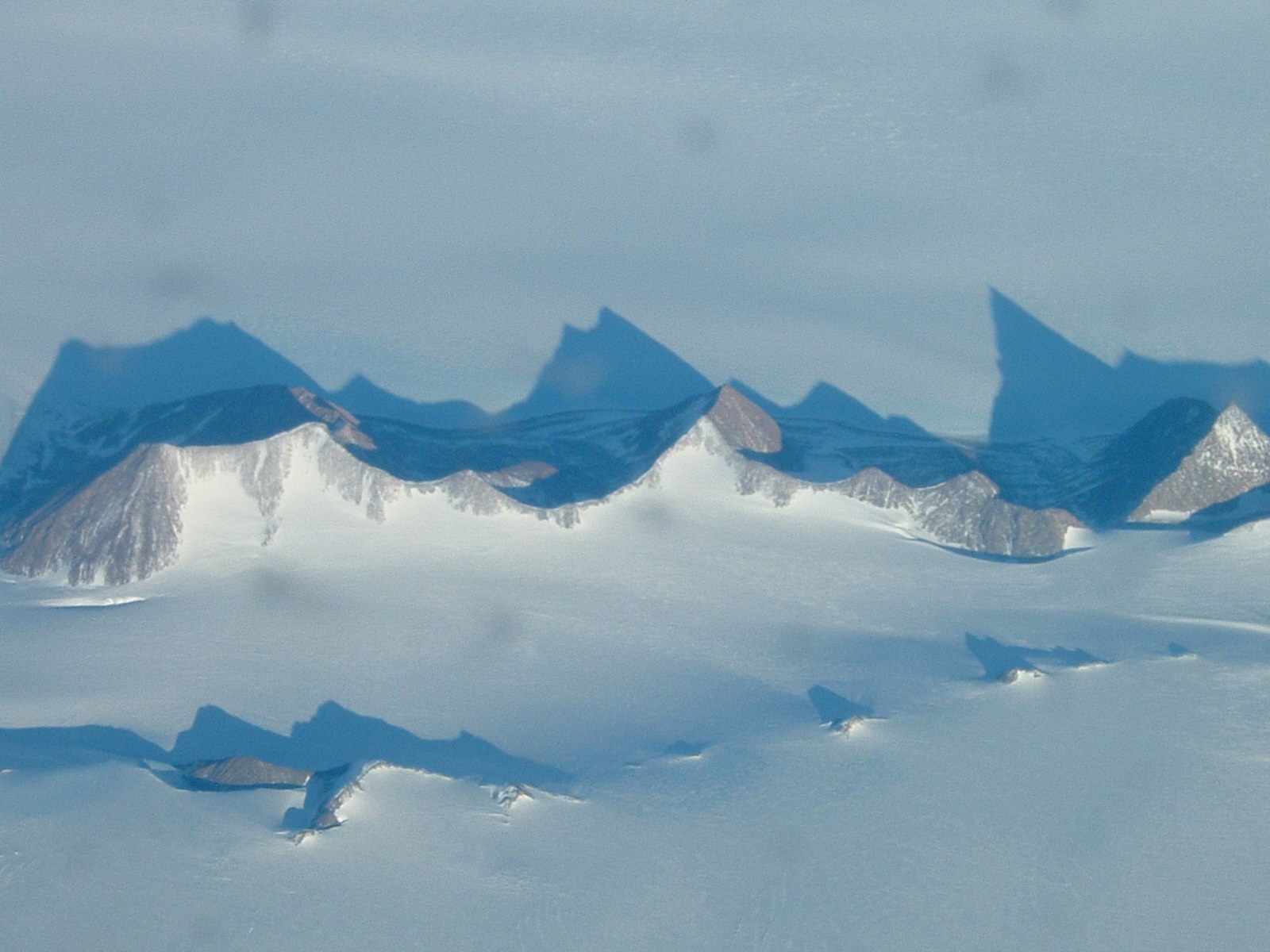
Antarctica Mountains:  The clarity of the air and the starkness of the shadows were remarkable.

Below is the South Pole station.  While we flew over (two passes), a C-130 cargo plane took off.  The contrail at the surface was incredible to see.   DSCF0031

Vinson Massif, highest mountain in Antarctica:

DSCF0076

Eighth trip:  8 April 2005 to the South Pacific.  We flew to Tahiti, took a cruise by Pitcairn and Easter Islands, then ended in Callao/Lima.

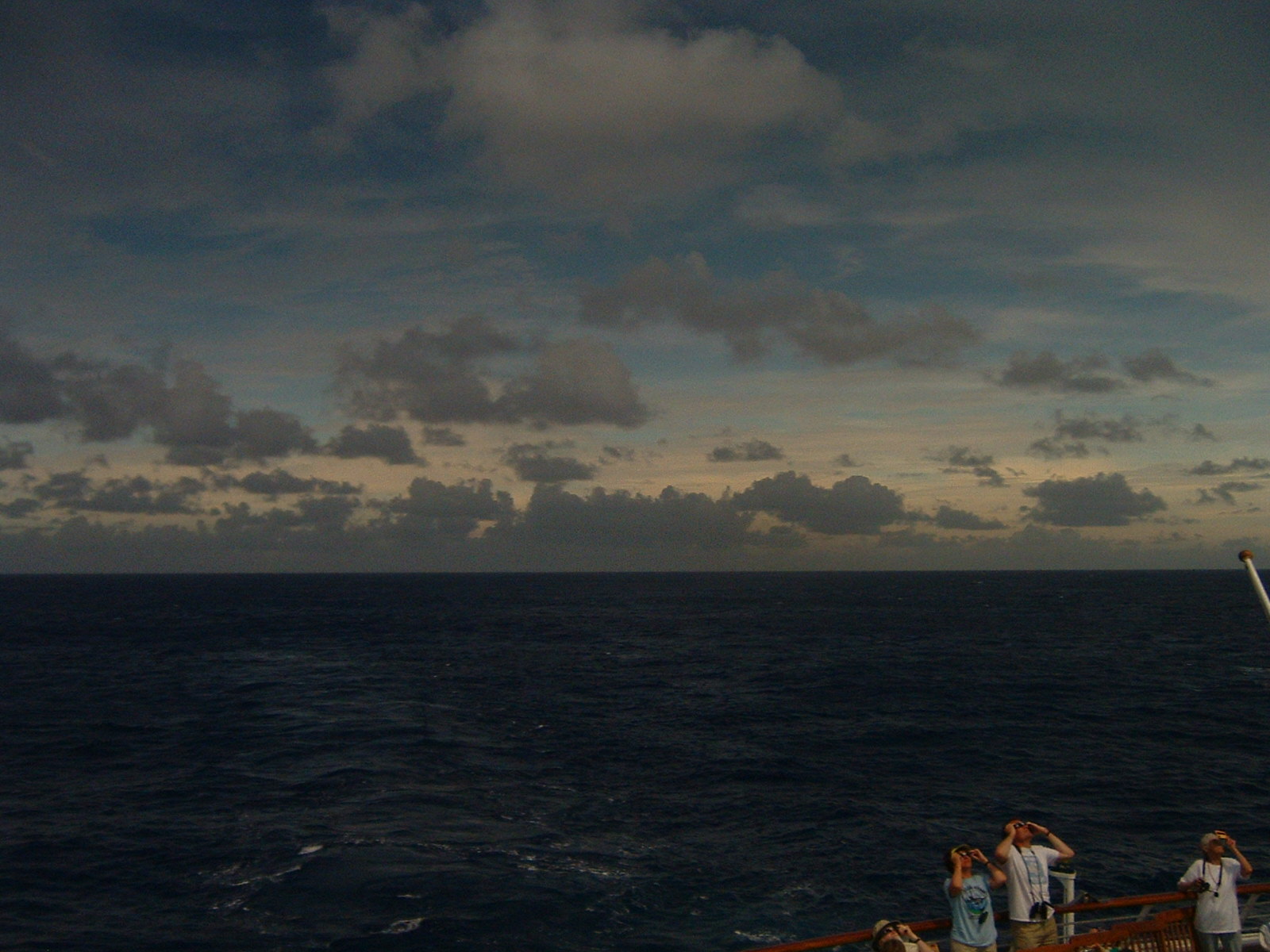
This is right after totality.  The dark clouds are the departing Moon’s shadow.DSCF0154

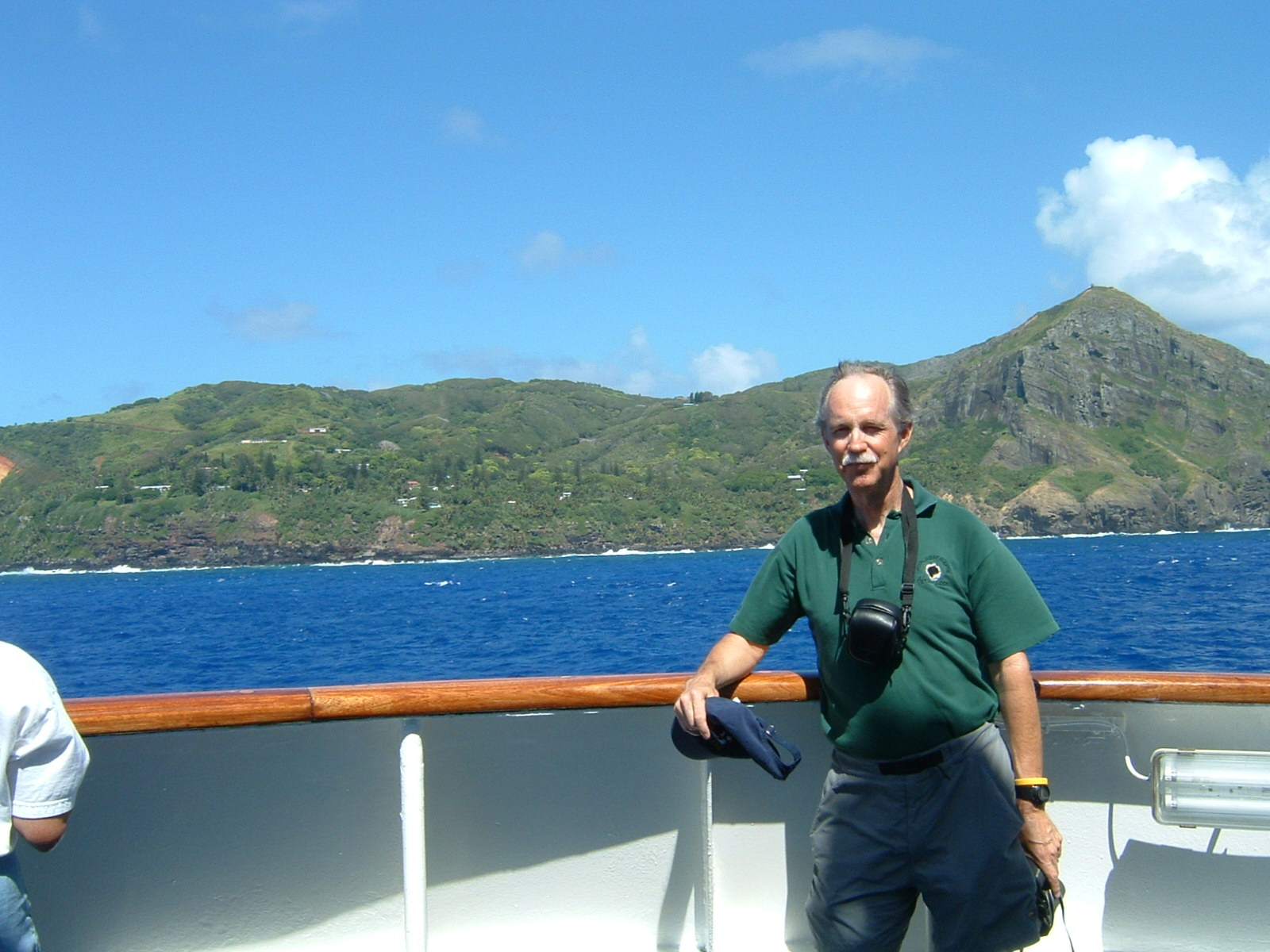
DSCF0100The author, with Pitcairn Island in the background.  It was too rough to land.  We really lucked out with this eclipse, because a low pressure system suddenly strengthened to our south.  Meteorologist Jay Anderson had the captain move us further northeast along the track the night before.

DSCF0110This is Tongariki, where the Moai were ordered.  I found that and Anakena interesting, but the quarry was to me the real Easter Island (below).

DSCF0166

Ninth trip:  29 March 06 in Libya.  We flew to Genoa, Italy and cruised to Naples, Syracuse, Alexandria, and landed at Tobruk, where we saw the eclipse inland.    As you can hear in the video, when totality occurred, a bunch of Libyans in cars came honking across the desert like a modern day Lawrence of Arabia.

Tenth trip:  1 August 08 in the high arctic, by air.  Unfortnately, our window was very icy, and our view was significantly degraded.  Efforts to try to find out why this occurred were totally stonewalled, which I think is unfortunate.  Still, we did see totality, and anybody who goes to Eliot Schechter’s web site will see a shot of totality taken from the plane at 36,000 feet (11,000 meters).

Here is our shot of the North Pole:IMG_0691

And proof of sorts:IMG_0689

Eleventh trip: 22 July 09, south of Shanghai China.  This is about as close to missing one without actually doing it.  After days of high humidity and record temperatures, a front sagged south on eclipse day.  We moved south, but alas, the front followed us, and while we had good views of the Sun 2 hours before, it clouded over until 2 minutes before totality.  Then we got this:IMG_1477 Not impressive, but we did see the corona.  Because of the thick clouds and the length of this eclipse, we had a wide shadow and it got dark.  Really, really dark.  Eclipses normally drop the light to late twilight.  Not this one.  It was NIGHT!

11 July 2010:  See the related post on this one.  We were supposed to fly and then the plane got cancelled.  We got one clear day in the austral winter and got one great eclipse!