Archive for the ‘MY WRITING’ Category

WELCOME WAGON

January 23, 2026

Tree swallow nesting boxes, each with art work painted on the plywood, were spaced more or less evenly on my left, like mailboxes on an avian country road, which disappeared around the bend ahead. On our right was a pond from an old gravel pit where Jim told me occasionally he had seen otters, although there were none today.  He said the pit would soon overflow from rain, flooding the brown grasses nearby. We were on Green Island, north of the confluence, and Jim, with extensive experience with the 90 nesting boxes, explained how he and others did a swallow survey. Both of us carried binoculars, because one does so in this kind of place. Jim was a good birder; I, not so much. 

Jim told me that Kit, part of the survey crew, didn’t believe in the idea that touching a bird was bad for it. “Kit opens the door, and usually the bird flies out, so he counts the eggs or young and then closes the door. If he has to, he can lift the bird off the nest to do it.” In any case, the survey crew had been dealing with 90 nesting boxes and counting every bird there for a long time. They had useful data, and I was impressed with their skill and dedication.

My route to this spot was 15 miles and 8 long months with biopsies, prodding, a PET scan, and bad news, for I was diagnosed with advanced prostate cancer, the same disease that killed Barry Lopez. I began androgen deprivation therapy in July, rendering me chemically castrated, estrogen side effects that made things on my body too large or too small, and gave me hot flashes. Only one knew my disability when I was doing trail work in the wilderness, my plantar fasciitis being a silver lining why I couldn’t hike as fast as usual. My 45 radiation treatments occurred from mid-October to Christmas Eve. Each day I had treatment, I left an outdoor essay, appropriately numbered, in the waiting room. The essays were for anyone to read, but they were my daily therapy as surely as the photons that were shot into my pelvis.

I discovered that hormonal changes seemed to improve my observational skill and ability to find beauty in unexpected places. I removed encroaching brush on Lowder Mountain trail in the Three Sisters Wilderness, eschewing trail work rules by refusing to remove a clump of Cascade asters I found, moving cone flower and tiger lily stems out of the way rather than cutting them, as I wrote in my essay “Not Quite by the Book.” I slept poorly during my treatment, but many of these nights I had a useful revelation I could later use in my writing. Jim arrived at the radiation center my 42nd treatment day. I acted like a welcome wagon host in the waiting room, totally foreign to how I perceived myself, perhaps again an effect of my mixed-up mischievous hormones. I introduced him to our small group who had similar times for treatment, how we all supported each other, our camaraderie. These were without question the best 15 minutes of my day. I went early to my appointment, just for those minutes. Jim found interesting my then 42 essay pile in the room for those awaiting photon beam treatment, figuring the author might be interesting as well. I had been about to take the essays home after I finished at the center. However, the prior day the techs told me that many were reading them, so I left the essays there. I told Jim he could take them home as long as he brought them back. He must have realized that even in this short time, I might be interesting enough that it might be worth showing me Green Island, so here we were on a gray day that promised drizzle but not much else.

Back near the river a couple of miles north of the confluence, there was a red tail hawk that flew over along with a couple of flickers, some robins, and my only contribution, a spotted towhee. Jim said he was interested in my story about iron in heme and magnesium in chlorophyll, the only difference between the two structures in their central part, adding he needed to do a lot more reading.

We continued walking, not seeing much this time of year, until we reached the Willamette, with what looked like a 2-3 knot current with significant erosion on the east side where we were. While I was nautically investigating, Jim spotted a pair of eagles on a tree across the flow. It’s been a while since I have seen a pair of eagles. He got closer to the edge of the river than I, who thought the water looked cold with no easy egress if one went in. We talked about radiation. Jim had finished his sixth treatment and told me he now had fewer than forty to go. I liked his attitude. I counted up my treatments on my essays. Jim felt like he had some changes he needed to make; I told him what I did, but we both knew that each of us has to find his own way.

We finished our walk with a good look at many wigeons in the distance and then returned to the vehicles. 

I went out to Green Island not knowing what I would see, remembering the North Country writer Sam Cook’s thoughts that “you don’t go out looking for cool things to happen, but you go out knowing that cool things could happen every time. I just tell people, just go, just get out… You never know what you’re going to see, but you aren’t going to see it in the living room.” 

It wasn’t until afterward I realized the connection I was destined to find that day was not with plants, the sky, or even the eagles, but with Jim, from the welcome wagon and essay writing side of me to his welcoming me into an important part of his life. When I by illness was unable to find connections in nature, I developed others in the radiation center. I wasn’t going to find it in the living room, but I could find it in the inner waiting room of a radiation therapy center.

.

A THIRD CHAPTER

January 18, 2026

This past year I discovered that I had yet another chapter in my relationship to the land. The first chapter occurred during my fifty-odd years when I lived for outdoor adventure, a land shark who needed to keep moving, each trip planned to see a maximum of new country. I often spent hours planning trips, some real, some more fantasy, poring over maps, fingers tracing blue spots of lakes, dotted black lines in between, occasionally with red numbers denoting distance in feet, yards, miles, rods, chains, kilometers, or meters, wondering what was out there. The maps were on my wall at work, dots where I camped, lines where I paddled, portaged, or hiked. I was discovering the “Open Horizons” of Sig Olson, one of the first wilderness writers.

When I reached my late fifties I began to base camp, visiting a familiar, well-liked area—an old friend— more closely, looking more up and down than out, noting birds, butterflies, clouds, flowers, greenery, the Moon, moss, roots, stars. The past eight years I have not camped but done trail work on scores of the same trails each year. I cleared logs and brush, repaired tread, made reroutes, helped build bridges using on site materials. I write about these paths, now my old friends, the Quiet Magic of the land, described by North Country writer Sam Cook.

Last May, I was diagnosed with advanced prostate cancer, the disease that killed Barry Lopez, who forty years ago in Tucson signed my copy Of Wolves and Men. My androgen deprivation therapy began in July by removing all my testosterone, decreasing estrogens I had, my body larger than I wanted above my waist, smaller than I wanted below, with hot flashes. Work was difficult, although I hid my testosterone absence from others on the crew because of an odd silver lining of plantar fasciitis, a good excuse to hike slower.

Without proof, I wonder whether this hormonal minimization mischief led to a burst of creativity ushering in a third stage of my relationship to the land. I was and still am discovering connections among the close in experiences I have and had in the woods. For example, at the end of a particularly difficult day working Black Creek near Waldo Lake—hot, humid, and ending early due to smoke—a California sister butterfly landed on the shirt of another crew member. I had never seen one before. On the long drive home we stopped near High Prairie Road so a herd of elk with at least three young could cross. That led to my essay “Payment in Full.” A brief glance across a trail after picking blueberries near Gold Lake, seeing one red berry hanging down, led me to identify a twisted stalk plant. A five foot high fireweed on Little Bunchberry showed a downward transition on the stem from blooms through seed pods to open pods to floating seeds, the seed connection occurring because this had been a good year for noble fir and hemlock cones, the latter I first saw a week earlier working at Gold Lake Sno-Park.

I had 45 radiation treatments. Each day, I brought an essay. Some were read, but my writing and bringing them was more important to me. The formal title of essay #23 is “Not Quite by the Book.”

Twenty feet ahead of me were many Cascade asters on the side of the trail. I decided I would work to them—on my knees—then take a break. I adjusted my position and continued hacking with a handsaw at the stems of encroaching thimbleberry, occasionally using loppers. I was in the middle of a brilliant green several acre steep sloping meadow where the forest gave way to low plants.

I was crew leader, not quite halfway up Lowder Mountain trail, which began at FS 1993, the summit 600 vertical feet above. I led the trip to Lowder because I wanted to get in the woods, my sore foot wasn’t going to tolerate hiking up nearby Olallie Mountain, and brushing Lowder meadows was as important as removing logs, since the couple hundred yard stretches of thick brush in several meadows were both difficult to follow and concealed large holes of some so far undetermined rodent.

I don’t like removing wildflowers, but trail work requires it, unless I break the rules. I purposely avoided power brushing a few dozen trilliums last spring on the Middle Fork National Recreation Trail. Three years earlier, I left a large false Solomon’s seal hang over a trail on Fall Creek, because it would have been criminal to cut that beauty out. That story was essay #4.

I finally arrived at the asters and had to decide what to do. They were on the downhill side of the trail, but there was adequate room to hike by. I couldn’t see removing all of them with my hand saw or loppers, because they were really pretty, so I carefully removed a couple and left the others. They would shortly go to seed, their job done, part of which was giving me pleasure.

A few minutes after reaching the asters, I found two tiger lilies over the trail. I didn’t cut them; I bent the stems and moved the flowers behind some thimbleberry safely away from the trail. They could still be pollinated. There is a manual for trail work; it is subservient to my opinion about wildflowers. 

Western coneflowers appeared, and I slowed to ensure they were left alone. Their stem has a whitish cast, which I had not previously noted, although I never had been in the position—hiking through a meadow on my knees—to look carefully at one. The brownish cone top with green leafy bracts was a standout. The stems could also be bent so I could move the flowering top away from the trail, hooking one flower around another.

At lunch, a crew member thanked me for saving the “purple flowers,” the asters. Nice my work was appreciated.

Turns out there was a third stage, and who knows, there may be yet more.

I NEVER KNEW

January 12, 2026

We trudged a mile back to the vehicles from near the Middle Fork of the Willamette River at Elijah Bristow Park, having logged it out after the ice storm. We went the wrong way into a flooded area but logged that out too, then backtracked to a trail where we were supposed to be.

When I reached the car, I noted an email from someone I know but not one from whom I would expect a message. The contents were strange, in that I was asked to buy something and send it to a friend of the sender, some sort of birthday present, but I wasn’t clear why I would be doing it, except the sender would be out of town. I wrote her (it was a she) back and asked for more information. I never heard back. The whole exchange was strange, and I felt like she needed money for something and I was available. But then why didn’t she respond to my request for more information? I never knew.

Periodically over the last two years, I have occasionally thought of the exchange, never hearing more, and not even having seen the person, which was somewhat unusual, although I didn’t think much of it. I never knew.

On New Years’ Day, I was leading the hike up Spencer Butte for the Club as part of a three pronged hike on the day to have the annual club celebration on top. I noted the woman of the strange email had signed up, and I was maybe intrigued, but I decided I would come across normally, but not ask anything and just lead the hike. She showed up and we exchanged greetings. It was raining, so I let her and some others go early to the top. They at least would be warm until they stopped hiking, and well then, it was my problem as leader to ensure that nobody got hypothermia. I planned to tell them shortly after I arrived that they could descend whenever they wished.

They summited, and I came soon after, soon talking to several who were sitting on the rocks at the north end of the bare spot, just out of the way of people arriving. The woman was seated in front of me, and suddenly interrupted the person on my right who had been talking to me.

“Mike, you met my daughter up here once.” It was like she had to get the words out, and get them out now.

I vaguely remembered that day.

“She had breast cancer.” I wasn’t so sure I remembered, but I think I did. I was staring at a green line of moss on the rock below. This wasn’t going well.

“She died two years ago. She was 52. I miss her so much.” 

Happy New Year to a guy who had never known what was going on. Two years ago at Elijah Bristow, the bizarre letter appeared. I wasn’t about to ask about the letter. I wouldn’t ever know about it, but a whole lot of things came into focus, not the least that every bad feeling I had had about her in the past two years was just plain wrong. I can’t label this shameful, because in good faith I did not know. I did not send an email again, but I could have done at least that. I never knew.

She continued, “I wonder if the chemo she didn’t take was the reason she died.” I couldn’t answer that for sure, so I didn’t. It was a pill and someone else said that it likely made no difference in the outcome. I was still staring at the green line of moss below me on the rock.

“She had cancer involving the covering of the abdomen, which was odd,” was the next thing she said. That I could answer and told her it was generalized carcinomatosis, and this sadly occurred all too frequently in the peritoneum, along with the meninges and any organ coverings.

I said I was so sorry she was suffering so badly this wet, cold day on top of the Butte. She wanted to tell me, and she did. I wished I could have replied better, and I didn’t. I never knew.

She departed down soon after to get warm. When I got home, the first thing I did was to email her and to again express my sympathy and then to apologize for my behavior.

“Mike, there is no correct time or way to communicate this.  Thank you so much for your kind thoughts.  All the best to you and Jan, and Happy New Year!”

I never knew.

 TAKING THE TIME

January 2, 2026

I led Jean and Roy up Winberry Tie Trail, a three part trail that intersects a Forest Service Road twice up to the Winberry Divide itself, climbing 1200 feet through 2.5 miles to the height of land separating Winberry Creek from the drainage leading to Lookout Point Reservoir, part of the Middle Fork of the Willamette drainage.

I used the term “leading” advisedly as I happened to be first. Yes, I organized the hike, but Jean and I had both worked on the trail at least a combined 25 times, and Roy’s experience in the outdoors was a league or two above mine. He didn’t know the trail, so I introduced him to it. It was wet down in the first brushy part, and I had worn my summer hiking boots because they were lighter. I didn’t care that my feet got wet, which they soon did. We noted one downed log on the first part and that the trail needed removal of encroaching growth. The second part of the trail needed less brushing but had a couple of downed logs that Jean and Roy cleared the branches from. The logs themselves would require a power saw to remove.

About half way up the third part, I was finding my respiratory rate way too loud and way too fast, which it has been ever since my testosterone was removed and the hormonal mischief has additionally given me both estrogen side effects concurrently with estrogen withdrawal effects. Earlier, on the first crossing of the Forest Service road, I had one of the worst hot flashes I had since starting the drug nearly six months prior, sweating far out of proportion to my effort.

I thought my breathing wasn’t as bad as it could have been but did a rate check and disappointed to find it 51 per minute, what I have at the top of Spencer Butte. That was disconcerting, so I took a break just after a switchback near a root wad that Jean and I had worked on with a few others four years ago. She and Roy were right behind me. After they stopped, they began to loosen their rain pants, and then I noticed they didn’t continue to remove them, just tied them up a little bit to put them out of the way. I think they thought I was ready to keep hiking.

Maybe it was my fatigue, maybe it was hormonal, I mean, it is a good excuse these days for anything I don’t like, but I noticed what they had done, and lately my ability to notice subtleties seems to be enhanced.       

They wanted to take off their rain pants. I could see that. And I needed to tell them to do so: “Go ahead and take off your rain pants and put them away. We’ve got plenty of time.” Roy had commitments later that day, but one of the things I do really well on the trail is to have a sense of time of day and distance. I know both virtually every minute of a hike. We had plenty of time for the remaining distance, even factoring in the time that I was going to be acting as Santa Claus at the end of the hike, which they did not know.

With pleasure, I noted that the pair continued to remove their rain pants and put them in their respective packs. When they looked ready, I shouldered my pack, and we continued up the trail. I said nothing. I don’t know if anything was noted by them, for it was such a minor event, but my stopping and letting them deal with their gear was a very major action by me. I noticed and acted on it, rather than kept hiking when they weren’t ready. Maybe my hormonal lack was doing something positive.

The remainder of the hike went fine. I played Santa Claus, where Jean ended up with a saw along with a turquoise bolo tie, which she promptly put on. It looked great. The saw was obvious; she does trail work. The bolo tie was a first choice of 30 that I had donated to the radiation center, because it was her idea that I wear something special daily for my therapy. So, I counted only one present. I then asked if the two wanted to leave or have lunch where we were. Jean wanted to have lunch, so we all ate, then I drove them back out to their vehicle, where they had plenty of time to deal with the afternoon’s commitments.

It was a great hike. We scouted the trail, I know what needs to be done, Roy learned a new trail, the pair had a fun outing together without having to worry about driving out there, navigating, or worrying about time. I managed all of those and tried to make it all happen quietly.

And played Santa as a bonus.

You know, I guess I really was a guide after all.

ANSWERING THE QUESTION

December 31, 2025

Roy looked over at me and asked, “Are you going back up to the Boundary Waters this year?”

I went mute. I had organized this hike, driven the three of us here, and led the hike from Winberry Creek up to the Divide, climbing about 1200 feet. Jean and I had worked every inch of the trail a few years ago. I got everybody up to the top, we hiked back down, I gave a little bit of unexpected Christmas to Jean, and was ready to drive the two back to their vehicle well outside the forest. To say I was a hike leader or guide for these two was a bit of a stretch, but I had been in control of the route, the time on trail, the gifts, everything. I had been a minute away from having everyone in the car and leaving with no issues.

Until now.

Jean had heard the question, too, and I was still fumbling with an answer which came out as “well, I sure would like to get back up there, but I will have to see.” That wasn’t exactly a clear answer from someone in control, but the two of them were merciful and let the answer stand.

What was I going to do? For the first few days, I didn’t think about the question at all. I was at the end of my radiation therapy for prostate cancer, it was the holiday season (although that day at Winberry was the end of my gift giving), and I had other things on my mind.

About a week later, the three of us took another hike to see Upper Trestle Falls after a heavy rain, 3-5 inches in the mountains. The hike was fabulous. I had thought of the idea to go, organized it on short notice, did the driving, got the three of us up to the falls, where I threw my arms in the air and shouted happily above the roar. We then hiked back down, went for coffee afterwards, my idea, Jean’s recommendation of a place. I had offered to pay for the coffee as a “sweetener” to get everybody to come. Roy mercifully didn’t ask the question again, but I now started thinking in earnest of the answer. I initially went about it the wrong way. It wasn’t an awful wrong way but it was still wrong. I didn’t want to leave Jan, my wife, at home alone while I went up for a minimum of 4 nights, maybe 6, and if only 3, it didn’t seem worthwhile. even going. Jean and I were going to meet for a walk a few days later and I wanted to have an answer.

I finally came to my senses and checked out my concerns with Jan that day. While she understood my concerns, she thought she would do fine. I wasn’t as certain, and we had a heart to heart talk about my leaving her behind and her being left behind. I didn’t want to leave her home alone several days. That is where everything stayed.

The better question then surfaced. Given enough enough time, I usually can find my way to either the right answer or the right question.  

“Do I really want to go to the Boundary Waters this year?”

No, I do not. See, Mike, that’s not so difficult now, is it? 

Two years ago, I said if I didn’t go that year, I wouldn’t go again. I was smarter back then. In the meantime, I had prostate cancer, would complete radiation, still have hormonal mischief affecting my power, hadn’t camped in five years and hadn’t canoed in seven. I bounced this question off Mina, my friend in Germany, with whom I have corresponded for nearly 15 years. She doesn’t camp but gives me spot on advice about everything. She offered the wise comment: “About the Boundary Waters: it seems you asked yourself the right question and found peace with your choice, without trying to push yourself to be like the old version of you.” What I was indeed longing for was the version of me in the old days with a vision of my seventieth trip the same of all the others. I would fly from Portland or Seattle to The Cities (they are Minneapolis-St. Paul to most people, but in Minnesota and for a few other people like me, are “The Cities”), do an airport hike to get a rental car, drive part way up, stay overnight, then arrive in Ely the next morning. I would need to get food, pack everything, get other things I needed, like stove fuel from the outfitter, who now wouldn’t know me, get the canoe, put it on the car, drive to the jumping off place, take the canoe off the car myself and then start paddling. I did not know how my arms, clearly from what I have seen here doing trail work locally, having neither normal power nor endurance, would react to quartering winds and long paddles. I have not set up camp in a long time. It’s work, and more work now with an older, weaker, out of practice body than it was years ago. I think I had a romantic idea of what it is going to be like, and the reality would likely be very different. That old version of me is gone, forever. There is a newer version, not as strong but with some nice attributes that I need to develop.

Years ago, I postponed a trip to the Appalachian Trail because of neck problems. I said a good woodsman would not go hike there with a bad neck. I waited until my neck was better and went then, section hiking three hundred miles  (500 km) with no problem and great memories.

I have been and still am a good woodsman. I’m returning to trail work soon. I am ready for that. I have wonderful memories of the canoe country. I explored it like few do; I was a volunteer for one full season. I left my mark up there with the four scholarships I have created. The country left its mark on me.

I am at peace with this decision, and I feel very very blessed to have done what I have.

At trail work the following week in Fall Creek, recovering a trail after the Bedrock Fire, my first Crew outing in three months, Roy and I were alone by a section of trail we had both worked on. When we took a break, I got to tell Roy the answer. He had forgotten asking the question, but he completely understood my decision.

POUNDING THE AIR

December 27, 2025

Two midnights after a fabulous hike, I’m awake having spent the evening writing about it, still unable to find a specific event that made the hike so fabulous. I quickly moved myself mentally along the mile and a half hike and still couldn’t find anything. What was it? After getting out of bed yet again, I returned several minutes later and closed my eyes. I’m not sure what my conscious state was when I suddenly saw black block letters on a dark green background.


The words spelled “Pounding the Air.” Of course!!! A phrase I have neither written nor spoken perfectly captured what I was looking for! I can still see those black letters. I probably will always remember them. I’ve never had that experience before.


Five midnights earlier, that would be three nights prior to this special hike, time I needed to be sleeping, I was again awake. With radiation therapy, my sleep was broken up into separate short chunks, followed too often with long periods of wakefulness. My mind worked nonstop during these latter times, and I learned to get up, walk into the living room, not to read, but to unload everything I was thinking verbally, giving each snippet brief light in darkness, talking to it, quieting it, putting it into snippet bed so I could then return to my bed and hopefully sleep. The heavy rain that night likely stimulated one of these snippets and back in bed, still awake, much later I thought, “Upper Trestle Falls at the east end of the Brice Creek Trail.”


I struggle to understand what happens in my mind to produce these connections, but the result is remarkable, and I like it. Here, my mind continued with: See the falls, soon. A year ago, I had stalled too long and missed the last big flow by a couple of weeks, but this was an ideal time to go, soon. The only day I had free in this tight interval was Sunday, three days later, and I had to move fast if I wanted company, which I did. So a couple hours later at 6:02, I fired off an email to Jean in Cottage Grove, subject line “Exit 174 visit.” I was unusually terse, only 101 words, which is terse for me, saying I would be at Exit 174 at 8:15 Sunday, heading east to Champion Creek Trailhead. I offered to take her, her Roy and anybody else who wanted to come, and I was also willing to pay for everything at Slabtown Coffee afterwards. I have learned from the many cats I have had that it never hurts to ask for what I really want. I left out the length of the hike. The two knew the distance.


Within an hour, Jean had accepted the whole package except for a time change of 9 am, which was even better, for it gave me a chance to drive to Cottage Grove High School and look at the quarter acre garden many of us Obsidians (hiking club) helped create a year before. I saw that before driving to Jean’s, arriving a little early. Before 9, I was driving east in the rain, Jean and Roy with me.


The rain let up before we reached the trailhead. The trail climbed steeply for a good half mile with many fallen branches of various sizes present. We all knew the route, and I used my walking stick to flick branches off the trail, occasionally picking up a few. The many I didn’t get were taken care of by the pair behind me. We had hiked this several weeks earlier after my 9th treatment; now it was after my 42nd. I felt better this time, encouraging, because I appeared to have avoided radiation fatigue. I was still breathing louder than I wanted to, but the idea of seeing the falls after a 3-5 inch rain moved me along. One 4 inch diameter log jutted out over the trail. I pulled it out barehanded, because I was too lazy to put my gloves on, dragged it across the trail, then two-handed it off the trail. I was acting like I had testosterone, when in fact that steroid was a distant memory to my body’s receptors. I was excited about what was coming.


I heard the falls a good five minutes before reaching them, got what I guess is called stoked, and when I had my first good look, threw my arms upwards and was pounding  the air, I was so happy. I conceived this hike (with the help of a snippet), made the plans, drove everybody there, all of us then hiking in to reach this wonderful cataract to see it in strong flow. We made it!!!  In my case, my body was telling me it was recovering and might be more useful in the coming months. Why wouldn’t I pound the air?


I can remember only two other experiences where was pounding the air. Five weeks earlier on Spencer Butte, I was so exhausted I rested my head on my walking stick six times in a quarter mile and sat down once as well. I thought I was better than that and hiked it four days later, and I was better. When I knew for sure, well up the top steps, I pounded the air. Ever since that time on the Butte, when I reach that same spot, my right fist is pounding the air to say to myself and to the surroundings “I am back, I am still here, I am going to finish this.”


The only other time I pounded air was when I skied a tough, steep mogul field perfectly, hitting every mogul, and only the mogul, all the way down, stopping only when my knees or lungs gave out. 


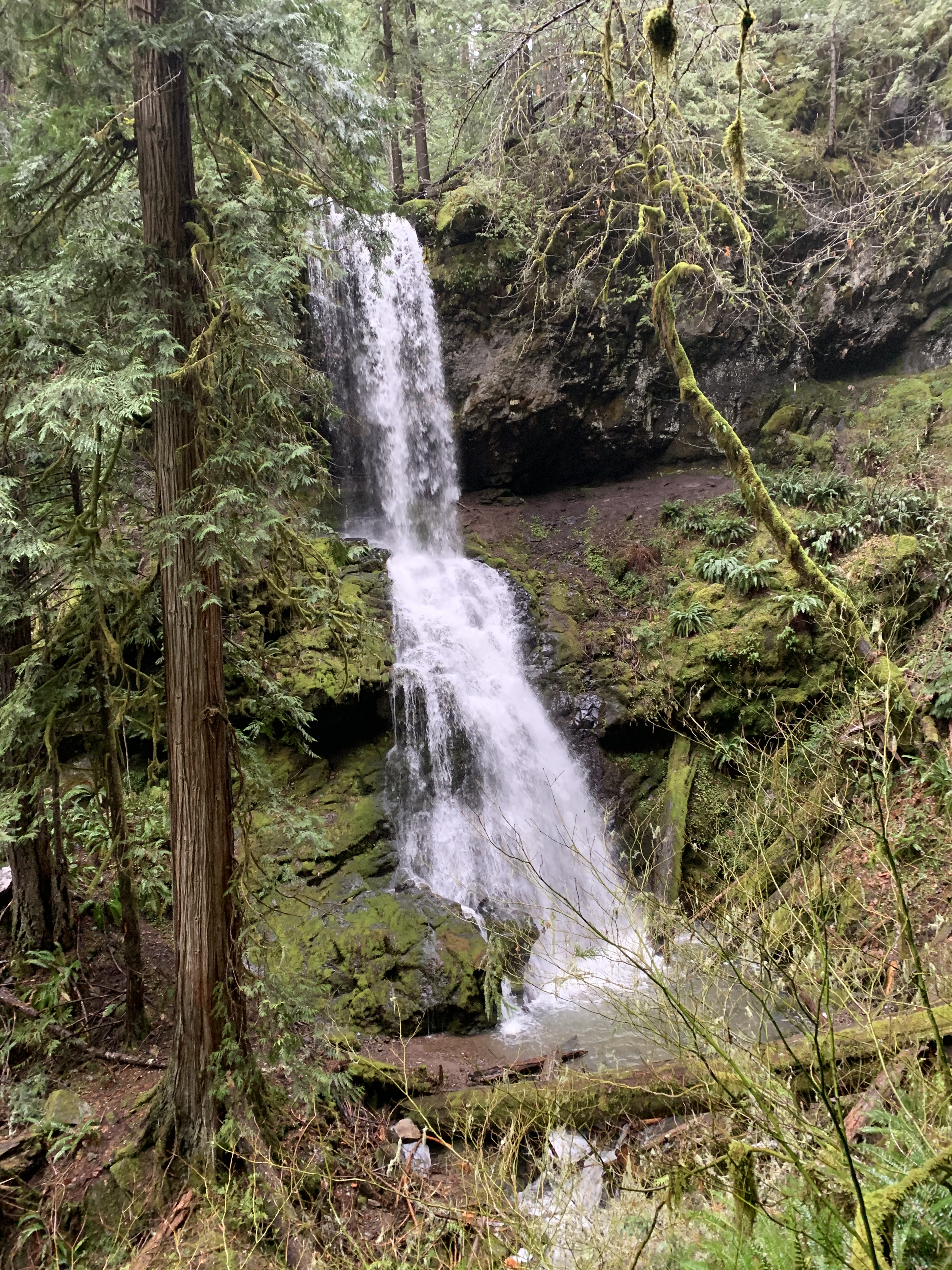
The 20-25 yard falls was perhaps 3 yards across at the top and closer to 10 at the bottom. We took pictures then hiked back out, clearing a few more branches we had missed on the way in.

As soon as we got into the car, the rain started but we were dry, other than sweat, and a bit cold, which heat could fix, returning to Cottage Grove for tea, cocoa, and cookies, all on me, with great pleasure.
After I dropped Jean and Roy off back at Jean’s house, I felt like pounding the air again. I pulled this off!!

Umpqua NF December 2025

Upper Trestle Falls, Umpqua NF
Jean and Roy in a small cave, holding two. I got wet.

Falls on 2 November.

GROUNDED

December 26, 2025

Recently, out at the Arboretum, I was part of a group spreading mulch. I was shoveling it into wheelbarrows until I got tired of turning to my left. I then switched to moving wheelbarrows, dumping their loads on an area of trail needing mulch. Then I returned to shovel some more, and not surprising for me, knelt on the ground on both knees to shovel the last of the mulch into a wheelbarrow. I could have stood to do it, but there wasn’t much mulch left; it was at ground level. I like the ground. I put as much of myself into contact with the ground as I can.

I spent three consecutive trail work days, the first in town, digging out hemlock, the other two out in Fall Creek, recovering trails by digging out the grass and organics on top. The last, nine days after the second, two of us were digging out the grass on yet another trail. All of the other workers on both days in both places stood up to do the digging. I was on my knees, in the first sliding a shovel along the ground to get under the taproot; in the second using a Travis tool to dig. With a shorter distance to the ground, I produced less force, but I didn’t need much and was far more comfortable where I was. The third time I used a Rinehart tool, and while it was wet and I didn’t have ideal knee protection from the wetness. I still was on the ground. It’s uncanny.

Lunch time on the trail, and I am likely to sit or even lie on the ground. Occasionally, I will sit on a log or a rock, the latter still technically the ground. Rarely, I may eat standing up, but I would say at least 90% of the lunches I will be on the ground, eating.

I have a special relationship with the ground, be it the forest or a floor. I sit on it, kneel on it, lie on it. When I practiced medicine and had to examine a patient’s legs, I knelt on the floor to do so. I had two chairs in the exam room, and if the patient and family member sat in them, I sat on the step stool used to get on the exam table. I was closer to the ground and had eye-to-eye near horizontal contact. If I left the stool to look closer at a patient, I knelt on the carpet itself. When I did spinal taps I knelt on the floor, almost invariably. I didn’t try to talk down to my patients, figuratively or literally.

Camping is great for ground time. I sleep on the ground, eat sitting on the ground, or lean up against a tree. I often watch the water or distant hills, sitting on the ground, of course. Sure, I could stand, but I usually don’t. Even in a canoe, I am more likely to kneel than to sit.

It carries over to sawing as well. If the log is the right size and location, I can stand and rock back and forth on my legs to saw. It’s efficient and not difficult. I like doing that. Otherwise, however, I am looking for a way to be in contact with the ground with either one knee or both, occasionally pulling the saw towards me between my legs. People say it is strange, but they aren’t grounded. I am. It’s not a coincidence. This it is likely due to my personality type, which from the book Human Dynamics, is a “Physical,” an uncommon (5%) personality type that fits me. I am well grounded, in touch with the land around me, literally and figuratively, “a slow processor who requires time to gather large amounts of data to understand a situation.” That is so me.

Slow processor. At the end of the third day, the Crew leader mentioned a future trip I would run, my thirty-fifth as a crew leader. He said we wouldn’t need a large crew, looking at me. 

I didn’t agree, but I didn’t have an exact number of the people I would need, but it was 7-9. 

“Can’t hear me?”said the crew leader.

“I can hear you fine,” I replied. “I’m trying to figure out how many we need.” I am a slow processor. I had another interaction that day where I wish I had expressed my unhappy feelings better, but I just didn’t know how…until about 18 hours later.

“Physical…people typically have a prodigious capacity to remember data. They can recollect events from even the distant past in which they were fully engaged in extraordinary sensory detail… and they often convey information through detailed stories.” Check.

”[T]hey gather and assimilate large amounts of data, and think in terms of the interconnections that make up whole systems of functioning. Because of their affinity for the systemic, they may be fascinated by the patterns they observe in the flow of events across time.” Yessir.

The Human Dynamics model had a huge impression on me. It allowed me to understand my slow processing and to treat it as a virtue, a blessing, something to be cherished and developed. It got me through graduate school, when numerous times difficult mathematical concepts became clear after a night’s sleep, and seemingly impossible matrix or integral problems could be solved in a matter of minutes the following morning. Major writing requires my setting something aside for a period of time regardless of how well I think I have explained it. A recent “major ah hah moment” led to an immediate summary of some trail issues I had. A day later, I changed the wording. Two days later, I switched to human factors, which had been the original idea, shortening the letter about 1000 words. It still wasn’t finished but much better. Two more days, and I sent it, getting an immediate positive reply. I learned recently that this human factors paper will be a template for a Code of Conduct for crew leaders, then going to the annual conference of trail leaders and so will become a very big deal.

CONNECTIONS

December 20, 2025

When we try to pick out anything by itself, we find it hitched to everything else in the universe.

John Muir

I have found connections between a fireweed plant and a noble fir, between magnesium in a chloroplast of a tiny plant and iron in heme, a connection between these two and the formation of the Earth. Recently, I found a connection between two women several thousand miles apart who did not know each other. 

This story of the “bracelet connection” is fascinating. It’s a bit long, and the bracelet part won’t appear for some time. It began on 20 October 2025 when I finally landed on a rectangular table with a huge gantry of photon shooting metal above me, Day 0, at the urology radiation center, getting my dry run. I would receive 45 radiation treatments ending on Christmas Eve. Each treatment was brief, a few minutes; the preparation, however, important, rectum empty and bladder mostly full, no gas, and maintaining this careful balance until 9 am, my radiation time at the center. After I began a low residue diet, life was better, but it still took me four long weeks to discover that.

The first change I made to my clothing apparel was Halloween, a Friday, my 9th treatment, and I wore a Halloween tie. The techs loved it, and after that I thought that every Monday I would wear a tie. I told Jean, a dear friend, about this and she suggested maybe I could wear a special tie or hat each day. I had several ties, but after wearing my Jonathan Livingston Seagull one, I decided instead to wear bolo ties, for I had a collection of 35.

I wore a different bolo tie to radiation for the next 30 treatments. Each day, I took a picture for Jean and sent a full length picture to Maryam, a good friend in Germany, with whom I have corresponded for nearly 15 years. She even bought the novella about Jonathan, by Richard Bach, arguably the first time anybody read a book I recommended. I wore the ties for the techs Cecilia and Alyssia. I looked forward to going to radiation, so they could see my ties. Who looks forward to going to radiation? A few ties had stories behind them, and the two techs loved hearing those stories.

For the first hour of the treatment day, I was fourth of 4, all of us Mike, a major name shortage in Springfield apparently requiring reusing names, and we were all allowed to be in the inner waiting room together, not the usual rule. We were pretty special. Two of the Mikes eventually finished, a Dan joined us, and we three spent 15 minutes for four weeks chatting each morning until Mike 1 had to get radiated, then Dan, at which time Mike 1 would dress and the two Mikes talked, then Mike 2—me— would get his treatment. 

As we passed Thanksgiving and then my birthday in early December, I had a middle of the night revelation. I was nearing the end of different bolo ties, nearing the end of treatment and wondered what I should do with the ties. I wouldn’t likely wear them again, although I found myself better dressed now than I had been for at least twenty years, but I knew these ties would end up in an estate sale some day. Why not donate them to the center and give the first choice to the techs? I wanted to give a present to the employees at the center, but gift giving is a tricky proposition in the medical profession, and giving stuff under the table isn’t proper. But donating bolo ties? That was a superb idea.

Cecilia couldn’t believe it. Well, I told her, I wanted them to go to a good home. I kept five of mine that I really liked. When I learned Jean liked turquoise, because she gave me the idea of different ties, I gave her first dibs on picking one of the five turquoise bolos which she did on a hiking scouting trip at the Winberry Divide Trailhead, with her Roy standing nearby. She promptly put it on over her hiking outfit which pleased me immensely. She liked it a lot. That mattered to me. I will keep a picture of her with the bolo on. When you give, you get more back. Really. Read on.

The next day, I brought a bag with the remainder of the bolos. I gave the techs first choice, my only requirement being that everybody at the center needed to have a chance of getting a bolo tie. Support staff make the place go. Oh, and I didn’t want to take any back home.

That is where matters stood on Wednesday the 17th. The next day, Thursday, Mike 1 was having his penultimate treatment, and he said he would return Christmas Eve for my final treatment. We spent 10 minutes every morning talking about everything, especially our treatments, because we understood completely what the other guy was going through. When Mike told me he would return to this place of prostate plastering photons for my final day and bonging, I was touched to the point of tears. I was then called for my forty-first treatment, and I got to the room only because I knew the route, for my vision was blurred. When I was done, Mike 1, of course, was gone.

I wasn’t done crying.

When I left the treatment room, Alyssia started talking to me. There was a gap in the patient flow, and she was free. She showed me her wrists, each with three thin metal bracelets. She told me that she had them made by local artisans where she had spent special time, Martha’s Vineyard, Sedona, and Ireland. 

“I won’t wear a bolo tie, but I can have one made into to a bracelet by a local artisan—it is important it be done locally—…” I listened, about to have my life changed.

“I will have a bracelet made from a bolo you gave me, and part of you will be always be part of me.”

I just lost it. As I started to cry, she came over and gave me a big hug. When she let go, I was glad there was a wall near me to fall against.

I walked out—with difficulty, because I was emotionally drained, and when I got in the car, Mike 1 was across the street in his car and gave me a wave. The guy’s got class. I drove home, and later emailed Maryam whom I tell these sorts of things to. She emigrated from Iran to Germany in 2015, runs a lab, and is fluent in German, Persian, and English to the point of having corrected my punctuation. Years ago, I helped her with her Master’s thesis translation into English, which was fun, and she and her husband treat me like I am rare and special. Maryam’s and my letters to each other are a mixture of German and English, and other than politics, which she hates, I can discuss anything safely with her and her advice is spot on. She’s brilliant, beautiful, witty, and polite. She always thanks me for my time with her English questions, when frankly receiving them is a definition of a good day for me. She loves it when I remember Iranian holidays, and I always get Yalda and Nowruz food pictures. Iranians know their food. Maryam knew about my diagnosis early and was incredibly supportive and commented on my good attitude. Anyway, I told her about the bracelets. She wrote:

“The story about the techs and the bolos was beautiful 🥹. Knowing that something you gave will stay with them, and even be passed on, is incredibly meaningful.

“I have to say I really, really, really loved the bracelet idea. Very creative. Also emotional and meaningful — I’m honestly a little jealous in a good way. She actually kind of inspired me. On future trips, I might start buying something small and decorative for myself, something local. I’ve bought clothes, purses, … before, but never local jewelry. This kind of thing feels different, like it carries a story. I wish I could thank her for the inspiration. Hearts for her. 😊❤️

“Leaving the bolos was a great idea, Mike. It sounds like it brought a lot of warmth into a hard place, for them and for you. It’s nice to have people around who make you feel better. No wonder you walked out of there emotionally drained. 

“About Alyssia — it’s actually interesting to think that a message could reach someone I don’t know at all. Two people who didn’t even know about each other’s existence having some kind of connection.”

All this came from my wearing a Halloween tie, having Jean suggest wearing something special daily, changing to bolos, having the techs like them, informing Maryam of this by sending a daily picture of my tie du jour, donating the bolos, and then stepping aside so the world could make some necessary connections.

by Mike Smith

Springfield OR October-December 2025

HEAD SUPPORTING WALKING STICK

November 23, 2025

I never thought my walking stick could support my head, but it did one day, six times. I have used a saguaro cactus rib for 26 years as a walking stick, 1 1/8” rubber stop at the end, so when the rubber has to be changed out and removed, the part above the protection is much thinner than the rest of the stick. The stick and I have traveled over a thousand miles in fourteen states.

Near the summit of the Butte, I reached the top of the first two groups of steps, 13 now in the first, due to subsidence, where there were once 12, 14 in the second, where the trail made a right hand bend and my respiratory rate of nearly 50 per minute became insufficient. I was beat and stopped, putting my forehead down on the stick and wished I could lasso my breath because I didn’t see any other way to catch it. My legs were complaining, too, in a way that I really didn’t understand. I’ve had tired legs, but I had weird buttock discomfort, too, which I haven’t had.

After a short time, I budged then nudged forward a little, trudged a bit more wondering if I could fudge the idea of getting to the top without holding a grudge against the trail. I hiked up the next group of steps, stopped, waited, and then budged. I then hiked, rested, nudged, hiked, rested, and budged until I had used my walking stick as a forehead holder six separate times. My seventh and final stop was still well below the top just before the big tree. I saw a convenient rock and sat down. My prior  time up a few days before, I had to stop once. Two times before that I didn’t have to stop. This looked like a bad trend.

I hadn’t felt great all day prior to the hike. The radiation therapy was affecting my bowel, since the pelvis is deep—I mean in women a baby fits in it—but even in men it is deep enough, and my 27 cc size prostate—an ounce, give or take—was at the bottom. Worse, I had a node that appeared to be involved, so that area as well needed the photon beam, which encountered plenty of bowel in between the skin and the node. At the time I had 18 treatments. When I began the hike I didn’t feel right—well, I’ll be honest— I felt crappy. But even crappy now felt different from crappy as I had known it. Finally, I made the top, seven rest stops to finish less than a quarter mile distance climbing 190 vertical feet that I once did in under 5 minutes. 

At least I no longer felt crappy. I just couldn’t breathe. I began to feel fine after the first five minutes’ hiking. I can’t find the right words for what I felt. Radiation and hormonal mismatching mischief have made my body-speak another language, and I don’t learn languages easily. I thought I was doing fine until the steps.

I descended without difficulty but worried that this profound weakness was a sign of radiation-induced fatigue, which might even worsen for the next two months before slowly remitting. But I wasn’t convinced. I could walk 4-5 miles a day on flat ground with no significant effort. I had been chemically castrated for four months and doing trail work during that time. I wasn’t great, but nobody asked me what was wrong, either.

Five days later, I went back up Spencer on a cold, foggy day. I got up the first 26 steps, and the walking stick remained a walking stick, not a head support. When I reached the fiftieth step, I punched the air with my fist. I wasn’t normal—and I may never be normal again; I am at peace with that possibility—but I was able to get to the top using the walking stick only for which it was designed. Mind you, I still have 4 solid weeks of radiation ahead, and side effects may increase after radiation stops. But the operative word here is “may,” not “definitely” or “will.” And a great deal of radiation is behind me;  actually, it’s in me.

SNOW JOB

November 5, 2025

It was really Jean’s fault. Or maybe Daphne’s. Or both. I got an email with a picture of their Twin Peaks hike near Waldo Lake on a perfect day, enough snow on the ground to be pretty without making the hike dangerous. There ought to be a law against sending those sorts of letters and pictures to fog bound gimpy trail workers unable to hike.

The picture of snow on the trail then began to trigger connections. I don’t know how these connections form, but they do for me, day or night, especially often after awakening in the middle of the night, far more common since I started taking hormonal blockers, androgen deprivation therapy, for prostate cancer. It took me only seconds to remember I led a hike to Four in one Cone each autumn. I knew it was in October and before the pandemic, so I started with 2019, and I found the picture. Our hike happened to coincide with a recent snow, so when we hiked up the cone itself, nearly five miles from the trailhead, snow was on a foot wide spot on the entire north facing rim and no more. It took two more weeks and 7 radiation therapy treatments to mess up my sleep enough so that when awake at zero dark thirty, more connections could be formed, and I had yet another recollection.

Four in one Cone with north rim covered in snow. Belknap Crater, Mt. Washington, Three-fingered Jack (barely visible), Mr. Jefferson in distance.

With of course less sleep.

The last connection took me back to the November morning up at Willamette Pass three years ago, 15 November to be exact, when it was 18 degrees, also exact, and not Celsius. I was standing in my snowshoes at the east end of the ODOT shed, Pulaski in one arm, pry bar in the other, a couple of hand saws in my pack, fuel for the saw, and ski poles. This was nuts.

It was really Sig’s fault. All because I said yes to him. He had called me and asked if I could help log out the PCT from the pass to Lower Rosary Lake.

After swallowing my initial reply of “Are you crazy?” I told him there was only one log up there to cut because I had scouted the trail the prior week when I checked my winter trails for diamond markers. I tried to remove the log using a hammer to knock rotten wood off, hoping I could make the log smaller. No great surprise, a hammer wasn’t the right tool for a logout. I then tried to rotate the log and made matters worse, taking another 30 minutes to undo my error. Sig said he went up there after the snow fell, and there were about a dozen logs needing removal, blocking several stretches of trail. The worst, naturally, was two and a half miles from the trailhead that absolutely, positively had to be removed with still another at Rosary Lake itself.

Job security. Two and a half miles in and out, minimum, maybe three. In the snow, 18 degrees Fahrenheit. I’d wait for spring, myself. Or at least Celsius.

Back at the ODOT shed, my first decision before I moved was whether I could carry two poles with a Pulaski, or whether I would use a single pole and the Pulaski as a partial. The pry bar strap went around my neck. I hike with one pole, but not in snow. Back then, my arms were stronger. I used both poles alternating the Pulaski with each arm. I’ve never liked carrying a Pulaski or axe in my pack, but that have might of been a better idea this day.

We snowshoed up the trail about nine-tenths of a mile to the first log, the one I unsuccessfully tried to move. The power saw made the removal a lot easier, hammering home the need for the right tool. The next two logs I dealt with using my hand saw, while Sig continued on up ahead. I knelt on the snow, difficult while in snowshoes, and started cutting. I was successful, although my knees got cold and kept sinking into the snow. Logs cut in winter don’t drop when they would in summer, and they are additionally frozen into the ground, so I needed the pry bar and more effort than expected to break them loose and then move them off the trail. Everything takes longer in winter.

I caught up to Sig, his snowshoes off, at a large log that fell right on the trail. I continued to keep mine on. We pushed the rounds off the trail using our hands, after first breaking them loose from the frozen ground using the pry bar. The next log had many branches frozen into the ground or the log, a messy job, since there was almost invariably a branch that would get tangled up in my feet. I still kept my foot gear on. At this point it was either a point of honor or a measure of stubbornness.

We finally made it to the troublesome log between the tie trail that went steeply uphill several hundred vertical feet and almost a mile to the west of the Rosary lakes and Lower Rosary lake. Indeed, there was no path around the log without removing skis or snowshoes. We stopped for lunch to try to restore our energy. Now 600 vertical feet above where we started, the snow was less tracked and deeper. It was impossible to sit anywhere and eat, so we stood, ate,  and after 10 minutes cooled off so much that we decided to cut the log from our side. My snowshoes stayed on. Finally successful, the trail was now open to Lower Rosary lake. Sig asked me if I was interested in going up to the lake for the last log. Hearing that as a query rather than an order, I answered no. He agreed. Somehow we both got back to the trailhead without falling. Or if we did, we stayed quiet about it.

We didn’t hear any complaints about the logs that winter. I finally removed my snowshoes back at the shed.