Archive for the ‘GENERAL STUFF’ Category

THE WAR OF 1812

October 6, 2012

A friend of mine in Bosnia, whom I help learn English, has a 16 year-old daughter who is an exchange student at a high school in southern Illinois.

Her daughter got the best grade in her class on an essay about the War of 1812.  She knew that part of American history better than her American classmates.  They would not be expected to know much about Bosnia, although I was shocked at two of the questions they asked the young woman, when she arrived at the school:

  1. Did you come here by train?
  2. Do you take showers?

I often say there are no dumb questions, except asking one that was just answered.  Questions reveal a great deal about the one who asks them, and the above two questions revealed a shocking lack of education or curiosity.  Personally, I would have asked, “What is it like to live in Bosnia?” or “What languages do you speak?”

I don’t expect most Americans to be able to accurately find Bosnia on a map, although the 1984 Winter Olympics were held in its capital, Sarajevo, and there was an horrifically devastating war and genocide there in the early 1990s.  Considering that the US was part of ending that war (the Dayton Accords), it was at the time the first instance where air power alone was able to end a war, that is something worth knowing.

Instead, we have a large number of people who can’t find important countries on a map, countries where geography determines history, and history determines behavior.

Indeed, at a time when many Muslims in the world do not like America, to put it mildly, it would not hurt to remind them that we were helpful in ending the genocide against Muslims in Bosnia.  The mother and her daughter are Muslims, and the former has taught me a great deal about Islam.  She is one of best, purest, nicest people I know, who lives her religion.

She taught me that “Balkans” is a word that means “blood and honey,”  probably one of the best descriptors of the region.  This area will likely explode again.  There is no Tito, no Yugoslavia, now Serbia, Croatia, Bosnia/Herzegovina, Kosovo, Montenegro, Slovenia, and Macedonia.  I tell many of my European friends that one thing many Americans cannot understand is why Europeans appear to lean towards dividing into smaller groups.  We now have Moldova and Romania.  The USSR was divided into 14 different countries. People in Dagestan are Russian, but they call themselves from Dagestan.  (It’s west of the Caspian Sea.)

I often have discussions with my wife about what American students ought to know, and she says, probably correctly, that I am too strict.

But, given student loans and credit cards, students ought to know something about debt.  They ought to know the Rule of 72, which says that the doubling time of debt is 72 divided by the interest rate in %  (not decimal).  Debt at 8% interest doubles in 9 years (72/8); at 24% in 3 years (72/24).  That is why credit card debt is so deadly.  Yes, and students ought to be able to quickly convert decimals to percentages and vice versa.  I am not asking that students be able to derive the Rule of 72, which is P=Po[(exp(rt)], which is [P/Po]=exp (rt), and since P=2Po, we have 2=exp (rt), ln 2=rt  and t = ln2/rate (decimal).  ln2=0.693) so if I multiply numerator and denominator by 100, I get 69.3=t .  Seventy-two is a much easier number to deal with than 69, so we use that.  I do expect knowledge that 1/4=25%  and 0.62 is 62%.  Yes, really.

I think American students ought to know the difference between a billion and a trillion.  Politicians discuss money figures of this magnitude frequently.  There ought to be a simpler way to explain, and perhaps this would be a good debate question to ask politicians, along with the age of the Earth. The Earth has existed more than a trillion days, assuming, of course, we are teaching that the earth is 4.5 billion years old.  A billion is the number of seconds old we are in our early 30s.  A million is the number of miles the Space Station travels in about 2 days, 40 trips around the Earth, the number of miles a busy driver will drive in a lifetime.

I think American students ought to be able to name nearly all the states without looking at a map.  I think they should be know Canada is our biggest trading partner, and that it and Mexico border the US.  I think they should be able to name most of the original 13 colonies, know when the Declaration of Independence was signed, and the Constitution ratified.  I think at least half of the Bill of Rights should be known, at least 3 Supreme Court justices, and the last 5 presidents.

We should require more writing, more research projects, more math and science.  Students ought to understand the basic concepts of statistics, such as means, variance and the concept of error.  They might then recognize the chance they could be wrong.  Music and art should be studied, care of animals, the mistreatment of which is a red flag for sociopathy.  The students ought to periodically go outside for exercise and learn about the plants, water, and sky.  They should spend one evening under a clear sky and see the Moon and stars.  They should learn at least one foreign language, and if they already know one, to learn another.

Students should be taught that being unique and being special are not the same.  One is given, the other has to be earned.  Wow, we have a lot to do in a short time.

Fortunately, we have a lot of retirees who could help, and it would be great for them and great for the schools, too. The War of 1812 is not particularly difficult to understand.  It’s not like when it happened is a mystery.

GOLDEN PEARLS AND DIE LIBELLE

September 15, 2012

One of the interesting experiences about learning is a new language is the new world that opens up to one who can read books written in that new language and listening to videos narrated by speakers of that language.  Translations are important, but there really is a difference when one reads a book written in the original language.

Reading several German books has nearly doubled my vocabulary in the past six months, for while I can understand the meaning of a book, it is essential to look up specific words I do not know.  This flies in the face of some advice, to learn words in context, but when I took my PSAT exam years ago, my contextual definitions were often wrong.  From that day forward, if I am uncertain what a word means, I look it up.  I have multiple different lists, and I memorize….daily.

I am not going to use all those words, but if I am to understand German–.and now Spanish, too, for I am learning that — I need to know what those other words mean, for while I may not say them, others will.  I am continually amazed by words I thought I would never need to know that were said a few days later.  I learned “die Libelle,” dragonfly, and wondered when I would ever to use it.  A week later, on German radio, there was a description of research done about die Libelle, and I immediately thought “wow, something is going on about dragonflies”.  The something was how they caught die Stubenfliege, fly.  Every word that I can understand gives me more pieces of the puzzle that is called conversation.

My experience with German is one person’s.  I am mostly self-taught, because there have been few with whom I have been able to speak or write on a regular basis.  Good grammar books are not common.

German videos have shown me all parts of the world.  Many are from Germany itself, so I have seen the large cities and the northern coast–North and East Seas–separated by the Danish peninsula.  I have seen parts of Bayern–Bavaria–that I did not have time to see when I was in München.

Still other videos have shown me, narrated in German, apricot harvests in Turkey;  nomads in the high arctic of Russia, dealing with the “gas rush”; salt mining in Bolivia; tree houses for research in Costa Rica; research on the Andean Condor in the Argentinian Patagonia; a women’s co-op in Yemen and water filtration in Peru.  One was about Portland, Oregon, describing the lifestyle.  Another in the US showed homeless eking out a living in the California desert, living in conjunction with snowbirds.  A third showed Detroit beginning to turn into a farming city, using empty neighborhoods to grow crops.  I miss some meaning, but I don’t miss much.  A lot of the translations are slow, and I know enough Spanish and French to know when there is not a full translation into German.  That is a lot of fun to recognize.

A recent video was about harvesting pearls in the Philippines, off the coast of Palawan, the long island at the western end of the Archipelago.  I never saw Palawan, but I have spent a lot of time in the Philippines.  I was struck by not only the way pearls were harvested, but the science being used to run genetic crossing of the mussels, trying to produce the most valuable golden pearls.

There are other problems, too, that I hear about.  Virtually every video that discusses the environment comments on climate change, viewed from the local perspective. On these videos, I have not heard one word saying that climate change is a hoax.  Perhaps the videos are biased; perhaps not.  Coral reefs are bleaching, which is not news.  The northern end of Palawan is too warm (32 C., or nearly 90 F.) for growing mussels.  The oceans are getting warmer.  This is a fact, not fiction, not a hoax.  They are also growing more acidic, which is also a fact, due to carbon dioxide.  For those who say that man is not changing the environment, ocean acidification is the smoking gun that says we are.  This has made the news in the last several months; I knew about acidification in 2006.

Water vapor is, of course, the most prevalent greenhouse gas.  As air warms, there can be more water vapor present, because warming makes gas molecules move faster, keeping them from condensing.  Air at 31 C, all else equal, may contain 2 grams more water per cubic meter than air at 30 C.  The amount of air over the tropical ocean would best be measured in millions of cubic kilometers.  Does it prove anything?  Perhaps not, but there is a lot of circumstantial and non-circumstantial evidence to suggest we have a problem.  Water expands with heat, with a coefficient of expansion of about 0.0002/degree C.  Warm water 1 degree C. and the worldwide 110 million square kilometers of ocean surface plus a significant depth expand a lot, when multiplied by 0.0002/C.  Add glacial melt, and we get ocean rise, which is well documented to the tenth of a millimeter per year.  This rise will be at least 70 cm this century, but some think maybe a meter, and can easily flood a coastline where there is a shallow angle from sea to land.  In addition, salt can easily contaminate the water table.   If you live in Kansas, that is no big deal, unless we prove that the drought of 2012 was due to climate change.  It may not be.  Or, it may be.  The question goes back to Clint Eastwood in “Dirty Harry”:  “How lucky do you feel?”

What continues to interest me is how nearly every place these videos are shot has an environmental overtone.  Water in Peru is a problem because of the receding glaciers.    Drought in Yemen is the cause of decreasing biodiversity, which is important both for the planet, and for humans, because many of our ideas for new medications or molecules come from natural compounds.  There are just too many of us, and the planet is showing signs of big signs of wear.  I haven’t heard much about this in English, but I sure am hearing about it in German.

ALL MODELS ARE BAD; SOME ARE USEFUL

September 10, 2012

On a recent science podcast, climate models were being discussed, one conclusion of which was that droughts like the 2011 one in Texas were 20 times more likely to occur today then they were 50 years ago, and that this was due to climate change.  However, floods that devastated Bangkok recently were felt not to be due to climate change, but rather a cyclical issue that was worsened by the way Bangkok had built since the last such flood.

There was a call from a listener, and as soon as I heard the tone of voice, I said to myself, “Uh oh.”  Some listeners call in with questions, some give speeches.  This one did both.  He wanted to know if the models were so good, what the temperature was going to be in a certain city in the Midwest next July 4 and for the following 3 July 4ths.

He had a very angry, challenging tone of voice.

Climate models are not the same as weather prediction.  We cannot predict the weather accurately more than a few days in the future.  Does that make the GFS, ECWMF, NAM, AVN and other models wrong?  Yes….and No.  As a statistician, I learned the following:  “All models are bad.  Some are useful.”  Weather forecasts are based on atmospheric models, which differ according to initial conditions and the relative weight of the known variables.  I remember 50 years ago, when weather forecasting was done by a non-meteorologist on television, and the forecasts were not very good.  We have gotten a lot better; short-term forecasts, in the 24 hour range, are exceptionally good; I use the GFS 9 day model as a rough idea of what to expect in the coming days, but I know matters will change.

Climate forecasting is another science altogether, taking into account different long range variables.  From 40 years ago, when climate scientists, unaware of key variables, thought there might be cooling, to now, where virtually all believe warming is highly confident (95% being considered highly confident), there has been much research and ability to get information about the past.  The fact that a confidence interval is used means that statistical techniques have been taken into account, and while the conclusion may be wrong, it is highly unlikely that it is.

Let me explain a confidence interval:  it is NOT a probability, or it would be called such.  It is a range, based on the evidence, of where the parameter (the true measurement) is expected to be.  The parameter is unknown and unknowable, so that the interval either contains or does not contain the parameter.  This makes no sense with probability, so we call it confidence.  If we are able to repeat the experiment 100 times, we would expect 95% of the intervals generated to contain the parameter.  We would not know, of course, which 95 would.  The fact that models are not perfect is taken by far too many to allow them to take the other view, that they are wrong.  One may, of course, choose to do so, but it behooves those who disagree to come up with their own margin of error, p-value, and confidence interval, so the data can be appropriately discussed.  To say,”models are wrong,” is inappropriate for a scientific discussion.  Of course they are.  Statistics as a predictor is wrong, but good statistics state the likelihood an error of a defined amount will occur.

Probability is forecasting the future.  There is almost nothing complex in our world that we can forecast perfectly.  There must be some error.  Every responsible scientist quantifies that error in some manner; to do otherwise is to say that one can predict with absolute certainty what the future will bring.  We don’t do this with temperatures in Iowa on July 4th, where the next hurricane will form, or even its 10 day path.  Nor do we say, with absolute certainty, that the Earth is warming.  But the range that the models are giving us does not include zero or a negative number with high confidence, and that means the conclusion is, based on the current data, that the Earth is warming.

While correlation does not equal causation, there may be factors that make such causal.  Because we know that one greenhouse gas has increased (carbon dioxide), that another, in the face of warming, has increased (water vapor), a third and fourth (nitrogen oxide and methane) are increasing, we have reason to believe that the conclusions are not in error, and that there is a causal factor.

Anybody who follows hurricane forecasts is familiar with the cone of uncertainty, and the fact that the cone changes with time.  We saw this with Irene last year, and we saw the gradual westward shift of Isaac this year, as the initial forecasts showed Isaac to strike Tampa.  With time, the models showed a westerly drift of the hurricane’s expected path, and for it to ultimately strike New Orleans.  The models were constantly updated, and the gradual change was noted.  What did not happen was that the hurricane dissipated, it curved into the western Atlantic, or it went south into the Caribbean.  The models were good.  They were not perfect, but they were very good, and three days before Isaac made landfall, it was predicted to hit very close to where it eventually did.

Nate Silver says that the cone of uncertainty for hurricanes was 700 miles in diameter 25 years ago and 200 miles in diameter today.  He is studying models to understand why some work and others do not.  But the poster child for good models is weather and climate science.

Models to some have become the new “Bad Boy” of climate science.  Every responsible scientist develops models, if it is all possible.  Indeed, the dawn of simulation was about 15 years ago, and I remember running simulations in graduate school in 1998.  We are now able to do this so much better than we once did.  Debate should be over what models are used, their initial factors, the variables, and the conclusions, not whether or not we should use them.

SWIFT BOATING VACCINATION

August 13, 2012

On a science podcast I listened to a few months ago, the moderator interviewed an actress from a well-known television series.  She had a Ph.D. in physics from UCLA.  The moderator himself was on the show one time, and that may have colored his viewpoint of what happened in the interview.

The woman had not vaccinated her children, saying,  “There are a third more vaccines now than there were when I was growing up, and I thought that was too many.”

She thought that was too many?  Based on what science?  Her statement appalled me, and I was equally appalled when the moderator did not call her out on her actions.  So what if there are a third more vaccines?  I haven’t seen a measles case in years.  A measles cluster involving about 7 people occurred here a few years back, and it made the newspaper.  Fifty years ago, only 7 cases of measles in a neighborhood  would have made the newspapers as real news.  Measles kills and is extremely contagious:  1 in 1000 die from measles encephalitis.  It is a nasty, nasty disease.  Does this mother want to spin the roulette wheel on her children?

Or rubella, the disease we kids loved to have, because we felt fine but had to stay home from school.  Unfortunately, pregnant women may catch rubella–and may not know it–until too late.  Does she want her daughter to have a child with congenital rubella syndrome, like a cousin in my distant family?   He is deaf, retarded and partially blind, and he lives with his mother.  What happens to him when she dies?  What happened to his life, and what happened to his mother’s life?

What about polio, where most cases are asymptomatic?  Perhaps if her children never leave the US, they will be fine.  What if they go to Bangladesh, Paraguay, Uganda, or even Mexico?  Does she want to take the chance they will get polio that is not asymptomatic?  Perhaps they will not be allowed in, because some third world countries actually believe that vaccination is important, even if some in a First World country don’t.

Mumps orchitis (testicular inflammation and a chance of sterility), pertussis, and H. influenzae meningitis are not benign diseases. This is the worst year for pertussis in decades.  What is this woman thinking?  Does she believe these diseases no longer exist because a higher power took them off the Earth?  Does she not know the Salk Trial was stopped early, because the vaccine worked so effectively?  I was part of that.  I was in the first cohort who got the Sabin vaccine.

When I was a medical student, forty years ago, we wrote “UCD” in a patient’s history, meaning “usual childhood diseases.”  I have no idea what they are now.  If we did as a country what we should do, and mandate vaccination for those who clearly have no contraindication, we would not have many “UCD” at all.  In Arizona, half of all children in charter schools are not vaccinated; 15% in public schools are not.  It’s bad enough we are destroying public education in this country; now the kids are going to be at higher risk for bad diseases, too, in addition to no solid proof in Arizona that charter schools deliver a better education.

Regrettably, all it takes is for a few vociferous people who will not believe sound science to convince many that white is black, and black is dangerous.  There are many people convinced vaccines cause autism and vaccines are bad, when good science has not shown that.  There are many who don’t believe we landed on the Moon, that astrology is meaningful, who can’t find Polaris, don’t know why we have seasons, don’t know metric or English measurements, think 9/11 was a US government plot, and the Marfa Lights are UFOs. Even more believe that the climate is not changing, and that we can continue to grow economies infinitely using finite natural resources.  The latter beliefs are unfortunate; not vaccinating when there are no contraindications is child endangerment.

Before 2004, not many people had heard of Swift Boats.  Today, the term is an English verb: “To Swift Boat somebody”.  You take a fact, say it isn’t or discount its worth, repeat the lie over and over again, and you can get a lot of people to believe it.  Swift boat ads helped defeat a decorated combat veteran by turning his Vietnam service against him. We have Swift Boated vaccines, and at some point we will pay the piper.

I wish I could have had the measles vaccine in 1956.  I did get the mumps and shingles (zoster) vaccines.   The zoster vaccine decreases the risk of neuralgia by half and cost me $200. I thought that was a good bargain, since post-herpetic neuralgia is a miserable, poorly treatable disease.

For most of history, disease, not hostile action, was the biggest cause of battlefield casualties during war.  Small wonder that the military believes in vaccinations.  It would be nice if the rest of the country did.

THE DEMENTORS AMONG US

July 22, 2012

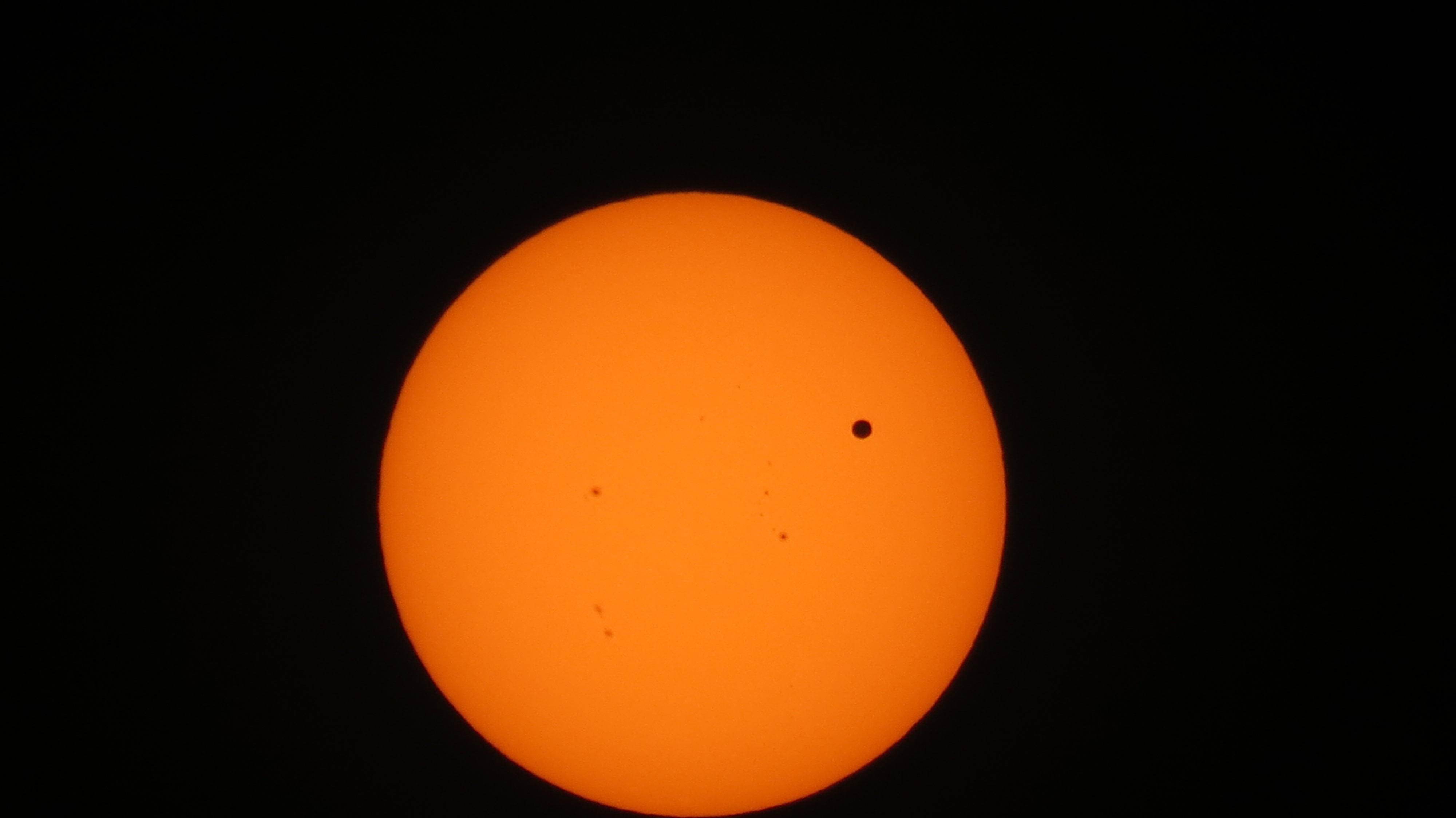
On 5 June, I took my telescope, a camera, and a videocamera, all with solar filters, to the local medical society, and showed about 100 people the transit of Venus, at the same time shooting video, taking pictures, and answering questions.  This exceedingly rare event occurs in pairs, 8 years apart; the next pair will occur 105.5 years from now.  Only Venus and Mercury, inner planets, can cross the Sun as viewed from the Earth.  Of the 100 who came, nobody knew it would be the last time I would be involved in a local medical community event; from now on, before our move next year, I will be only a patient, and hopefully not too often.

The transit was not as beautiful as many astronomical events I have seen, but it is so rare that nobody alive today will see it again, including the baby who looked through the eyepiece of the telescope; his grandchildren, should they live long enough, will.

TRANSIT OF VENUS, 5 JUNE 2012, WITH SUNSPOTS VISIBLE

A picture I took of the transit appeared on the Society’s magazine where I was once a columnist until I resigned last spring, because of reasons explained in the link.  It was a beautiful picture, and it was a good way to leave medicine, as a volunteer, who took a good photograph of a rare event, and shared it with the members.

Everybody who came was nice, except for a few comments, that while were not nasty, I could have done without.  One man, whom I know well for his right-wing beliefs (even as he gets AHCCCS, Arizona’s Medicaid) asked me the distance it was to Venus, and I said about 26 million miles.  He said, “Wow, that is less than the national debt.”

Why does politics have to be brought up during an exceedingly rare astronomical event?  The distance to alpha-Centauri in miles is greater than the national debt.  So what?  We have the national debt for a lot of reasons, some of which I think are important (Medicaid, Social Security, Medicare, FAA, FDA, NIFC (National Interagency Fire Center, which saves lives, towns, and houses) FEMA etc.), some of which are not (Iraq, Afghanistan, aid to dictators, farm subsidies, tax breaks for millionaires).   But it sucked a little happiness out of me.  Dementors do that.

Another person came whom I consider a true enemy.  The person has never once laughed in my presence in the 35 years we have known each other.  Not once.  The individual does not believe in evolution, vaccination, climate change, and thinks there should be no government involvement in medical care.  Just seeing this individual depresses me.  That is a  Dementor.  I was polite, and while that person asked good questions, there has been “too much history,” and too many hateful comments from that individual for me to let down my guard.  Since this is likely the last time I will likely ever see this person, or anyone else there, I sucked it up for 2 hours.

A few months back, my wife and I had dinner with a neurologist friend and his sister, a retired nurse.  She had worked in emergency departments, and was vehement about those who misused them.  This happens.  I was up in the middle of the night a lot, caring for drunks, helmetless people who had motorocycle accidents, people who had not taken their anticonvulsants, and were in a state of continuous seizures.  Most of these people did not have insurance, and I didn’t get paid, although I could have been sued for everything I had, were I wrong.  That is part of a physician’s life–caring for many people come to EDs for conditions that they do unto themselves.

This woman we had dinner with felt that those patients wasted time, money, and effort, should have not been rescued, but left to die on the street.  Really.  A nurse said that.  My wife was shocked; I had missed that part of the conversation.  Well, Ron Paul also said that, too, and was loudly cheered by many, who if they have no insurance, are only a drunk driver, appendicitis, a kidney stone, or viral meningitis away from being in an ED without money and 5 figure costs.  My wife said if we again had dinner with the neurologist, and his sister came, I would go alone.  We left the dinner depressed.  Dementors do that.

Last March, in North Blind on the now dry Platte River, I was in my third year as a volunteer tour guide for the Sandhill Crane migration.  I was in the lower level of the blind; my co-guide had never been there and wanted the upper level, which had better views.  I had a family of four with two tweens, who were bored.  Their mother wasn’t interested, and only the father was taking a few pictures.  It was a good show–not spectacular–but good, and the kids obviously wanted to be elsewhere.  I couldn’t teach about Crane behavior, because they weren’t interested.  I guided 20 times during my stay, and this was the only time I left the blind depressed.  In a place where you can see cranes in fog, snow, close up, or 50,000 in the air above you, darkening the sky, with a haunting call that I simply love, who have been on Earth for nearly 10 million years, where it is one of Jane Goodall’s top 10 sights, and where the governors of Colorado, Nebraska and Kansas came one night, to have a bored family was a real downer.  They were Dementors.

EVENING ON THE PLATTE, MARCH 2012.

Twenty years ago, I helped a man on the Fall Lake portage in the Boundary Waters.  It was his last portage before returning home to Miami.  He had had rain, poor fishing, bugs, and not a good time.  I thought the weather had been fine, the fishing good, and the bugs non-existent.  I helped him get his gear across the portage and wished him well.  He was a Dementor, too, but the beauty of the Boundary Waters was strong enough for me to ignore his complaints.  Indeed, I parried every one of his comments; when he came to insects, he said “And the bugs!!!” He then looked at me and said, “Or are you ‘in’ to them, too?”  No, I am not “in” to bugs, but I recognize their presence, and I realize that they limit the number of people in the wilderness certain times of the year.

I’ve had my Dementor moments; many of us have.  But there are some who are always Dementors, and I try to avoid them if possible.  If they persist, I change the subject.  I had buttons made commemorating the Transit of Venus.  I didn’t make one for myself, for I only wear solar eclipse buttons,   The Dementor at the viewing got a button and liked his.  I almost wished I had seen that.  Harry Potter had the gift; maybe briefly, I had it, too.

METRIC FLUENT?

July 9, 2012

I happened to have the TV on, during the Tour de France, when I saw and ad for a $50 gold coin, which was going to be sold for $9.95.  The coin, which looked like the 1 ounce gold coin that the US Mint made, was clad in 14 mg gold.  “Clad” means to wear or to cover.  Fourteen milligrams of gold were used to cover the coin, so it looked like the real thing.

Looks mean a lot in today’s society.  We have to get rid of gray, have white teeth, be the right weight, have the right figure–in short, be debonair.  What is inside a person, which really gives them lasting beauty, does not appear to be to be nearly as important.

So, how much is 14 mg of gold worth?  If you are metric fluent, you know immediately this is a bad purchase.  I might call it a scam.  With a little work, you can determine how much of a scam it is.  Otherwise, you pay $9.95 for what you think is a real 1 ounce gold coin.  Don’t laugh; the company wouldn’t advertise if they didn’t think this was a good idea.  They will likely make a lot more money than I will this year.  After all, looks matter.

Let’s say gold is worth $2000 an ounce, an overestimate of course, but I want to give a clear overestimate of the coin’s value.  One of the problems with today’s math teaching is that many are so calculator dependent that they can’t estimate things.

How many grams in an ounce?  Oh, about 30.  The actual number is 28.35, give or take.  I’m writing this without looking up any numbers.  I know that a pint has 453.6 ml, and there are 16 ounces in a pint (which most students I teach don’ t know either, but hey, they look great in their miniskirts and low cut blouses and tight pants, right?)  Divide 16 into 480 and you get 30, so my estimate is not far off.  And divide 16 into 453.6 and you get 28.35.  Use a calculator if you wish.

Now, you have to get to milligrams, which means you multiply grams by 1000.  This is what makes the metric system so nice to use.  We don’t have 7/16 th of a meter in most calculations, but do any carpentry, and you find sixteenths of an inch all the time.  OK, 30 gm of gold is 30,000 mg, and that ounce is worth $2000, or 200,000 cents.  It helps to convert dollars to cents, but one does not have to.  One may disagree with my opinion,  but so far, this is not difficult math.  That works out to about 7 cents per milligram gold.  You don’t need a calculator and 8 decimal places.  You need the ability to make quick estimates.  If you want to be more exact, 200 divided by 28.35 is not far from 210 divided by 30, and the latter is 7.

Don’t laugh.  Last spring, I saw a math teacher write down the tangent of 67 degrees to 8 decimal places, when he only needed one.  Since the tangent of 60 degrees is sqrt 3, the tangent of 67 degrees ought to be at least 2 and likely a little more, but not 3.   I took a stab at it and was pretty close to the actual number.  Again, it is a matter of estimating, not looking up 8 decimal places.  I don’t expect many to know what the tangent of 60 degrees is, but I do expect high school math teachers to know, without a calculator.

Anyway, back to gold.  This coin has 14 mg or roughly $1 worth of gold in it.  The company is selling nickels with $1 of gold for $9.95.  I don’t know if shipping and handling is included).  How many people are going to buy this?  The guy selling the coin looked good, sounded earnest, and was absolutely sure you should do this.  Today, that counts for a lot.  All of us are subject to make bad purchases based on irrational approaches.  I sure am.

It’s just a question here whether paying more than 9 times as much for something than it is truly worth counts for you.

WALKING AWAY FROM A BATTLE, SADLY AND QUIETLY

July 1, 2012

“When god created the horse, he said to the magnificent creature: I have made thee as no other. All the treasures of the earth lie between thy eyes. Thy shalt carry my friends upon thy back. Thy saddle shall be the seat of prayers to me. And thou shalt fly without wings, and conquer without sword; oh horse.” 

— the Qu’ran

And Ruth said, Intreat me not to leave thee, or to return from following after thee:  for whither thou goest, I will go, and where thou lodgest, I will lodge: thy people shall be my people, and they God my God.

–Ruth 1:16.

What is wealth? Being happy with what you have.

The Torah

September 1963.  I begin 10th grade in a new school in Wilmington, Delaware, a southern leaning state.  Before class starts, we have the Pledge of Allegiance to the Flag.  We sit down.  Then, the homeroom teacher opens a Bible and begins to read.

I was stunned.  Bible Reading?  This isn’t upstate New York, any more, Mike.  You are in the South.  She read a few verses, then we all stood and recited the Lord’s Prayer.  Well (n-1) did, because having been raised Unitarian, I never learned it.  Within a week, I knew it cold.  Good thing, too, for the Supreme Court banned Bible reading after that.

Prayers in the school, before events were common.  Frequently, I would hear “let each of us in our own way, pray.”  I like that.  What I didn’t like was the leader ending it “in Jesus’ name”. when a good share of the school was Jewish, or me, a Unitarian, where it was said the only time the word “God” was spoken was when the janitor fell down the back stairs.

On Memorial Day, 2012, one of the Arizona legislators gave a speech, honoring “Christian veterans.”  I was appalled.  I was also angered.  I am a veteran who happens not to be Christian.  Did that make my service somehow less valuable?  What did being Christian have to do with military service?

Two months earlier, two Jehovah’s Witnesses came to my front door.  I listened politely, then told them that I did not foster my religious beliefs on others, and I did not appreciate their trying to convert me.  I asked them, using “Please”, to leave.  They did.  My late mother had a different approach, when the Witnesses said, “Don’t you want to live forever?”  My late mother, a Unitarian, said, “Certainly not.  I can’t imagine anything worse.”  The Witnesses were tongue tied.  That might have been a first.  My late father was fond of saying, “My prayers were answered, and the answer was ‘NO’.”

On a language Web site, a Muslim from Algeria looked at my profile, saw that I didn’t put a religion, only that “We are stewards of the Earth.”  He wrote me, saying while I had a good profile, it was a shame that I would be going to hell.  I seethed but stayed silent.  I knew I would never change his opinion, so why waste his time?  Not responding is one of the best ways to stop a conversation.

On this same Website, religion seems to keep appearing as a topic.  I was teaching English to a Russian woman from southwest  Russia, near the Caspian Sea.  One Saturday, I asked her what she was doing that day.  The answer was “Not much. I’m Muslim.”   She quickly followed with, “does that bother you?”

It didn’t….until later.  I am reading the Qu’ran, and I have found many Muslims on this language site who have taught me a great deal about their religion.  Unfortunately, this woman then said, “I hope you will convert.”  That bothered me, because I don’t ask people if they will convert to my way of thinking about religion.  I said, that I couldn’t believe in Allah, although I liked many other aspects of Islam.  She replied, “You’re wrong,”  two of the most charged words in the English language, almost guaranteed to make somebody angry.  I just said, “Whoa…..stop this right now.  This is your opinion and not mine.”  She did.  I wrote her later, and told her that a lot of Americans would have immediately ended the conversation permanently.  Little did I know I would be one of them.  I mentioned in my letter that 9/11 was devastating to how many Americans felt about Islam, to which she countered: “The US government caused 9/11 for oil.”

That was the final straw.  I had not brought up religion.  She had.  And in the space of 18 hours had managed to want me converted, said I was wrong, and espoused a conspiracy theory.  I told her that if she did not admit the possibility of being wrong, she would not hear from me again.  I got back, “You just don’t want to hear the truth.”

And so ended my teaching experience with her.

All religions offer solace to their believers.  The most beautiful writing from three of the world’s great religions is at the top of the page.  Those who live their faith are fine people.  Those of us who believe how we live our life defines us as human beings can also be fine people.

I have noted throughout history that was once God’s will is now understandable. People used to die from infected hangnails, or mild gunshot wounds, like President Garfield.  Now, we can treat these problems.  Rheumatic Fever and death from diphtheria or acute lymhoblastic leukemia were “God’s will,”  until the advent of penicillin and chemotherapy. Hemoptysis from bronchiectasis was God’s will until we discovered it was M. aviae complex, and treatable with triple therapy.  Untreatable cleft palates were God’s will, until plastic surgery.  We don’t see these problems much any more.

I believe in good science, which self corrects and moves forward, each generation standing on the shoulders of the previous generation and looking further.  I also believe there is a great deal that is unknown and to date inexplicable, There are many ways people deal with the unknown.  I am curious about it and want to know why.  Others use faith.  If I liked their way better, I would take it.  I don’t.  And I don’t ask them to take my way.  It is impolite, it is not going to happen, and it will make them angry.

To the legislator who honored Christian Veterans, I have these comments:  Jews, Muslims, Mormons, Buddhists, Wikkans, Atheists, Agnostics and others like me make up this country and have served honorably.  Honor those who serve.  Keep religion out of the discussion.

Faith, or lack of, is deeply personal.  Honor others’ views, unless or until they cross a line that you find you cannot tolerate.  Then walk away, sadly and quietly.

“PEOPLE SHOULD TAKE CARE OF THEMSELVES” (Colorado Springs Resident)

June 14, 2012

For more than 10 years, I cleaned a two mile (3 km) stretch of Highway 83 north of Sonoita, Arizona, alone, in the high grasslands.  I hauled out a huge bag of garbage for every 0.4 mile (0.6 km), on one side, counting over 100 cigarette butts in that distance, too.  Considering the fire danger there, small wonder “government” made it illegal to throw cigarette butts.  We could have just made it voluntary, but even with regulation, every week thousands of people threw cigarette butts out the window along that 25 mile (40 km) road.

People don’t regulate themselves when it comes to littering.  That is a fact, and I saw it in the Boundary Waters in the 400 campsites I cleaned, too.  I don’t think we have laws against throwing soda bottles at those who pick up litter, so I guess it was acceptable to be hit while trying to “keep America beautiful.”  It was hot, dirty work, with rattlesnakes, fast cars nearby, and sharp sticking plants that had plastic bags impaled on them.

By cleaning those two miles, I saved having the government doing it and therefore made government smaller.  All government had to do was haul away the trash every week.

A while back, This American Life had a show called “What Kind of a Country Do We Want?”  The discussion was about size of government, using Colorado Springs as an example.

TAL is a good show.  They interviewed people on both sides of the issue, and even had an interview with Grover Norquist, who runs Americans for Tax Reform, and has been quoted as wanting government so small it can be drowned in a bathtub.  In his New Yorker article and later, he said, “We’re winning.”  I think he’s right.

And that scares me.  The other thing at the end of the show that scared me was a guy who said he was anti-taxes, even when it cost him more money to turn on the street lights, because “people should take care of themselves.”  Wow.  That’s a great idea.  Until your life caves in.  You lose your job, and you’re are my age.  Good luck in finding another.  You get deathly ill, and each CT scan rings up a few thousand dollars you don’t have.  Or you are a woman who gets breast cancer, and have to have chemotherapy and miss work.  Oh yes, you are a single mother, too.  I haven’t mentioned things that don’t always kill, like meningitis, M. aviae complex (MAC disease), but cost a great deal of money.  Nor did I mention a woman I know, who does vigorous outdoor work for a living, who needed surgery for spondylolisthesis, which gave her disabling back pain.  Without the surgery, covered by insurance, she’d be bedridden and her family destitute.

Sierra Vista, AZ, would have burned down last year, had it not been for the National Interagency Fire Center, a wonderful melding of 8 governmental agencies, to save duplication, that prioritizes fires and sends trained people to put them out.  No, I didn’t hear anybody in Cochise County complain about big government as government workers put their lives on the line to save the town.

Nor did I hear Iron Range residents in Minnesota, who threw out one of the best Congressman in the House, easily the most bicycle friendly one, because they wanted an anti-government person representing them.  When the Pagami Creek Fire jumped the lines and ran 12 miles in one day in the Boundary Waters Canoe Area, I heard not one voice speak out against the firefighters, who held the fire to 92,000 acres and kept it from running 60 miles further to Lake Superior.

An acquaintance of mine, who hates big government, is on government assisted medical care, and is not old enough for Medicare, a government program, although 40% of its and SSI recipients aren’t aware of that. I never called him out on how he can hate big government and yet take health saving benefits from the government.  I thought such a question rude.  I am usually called out on my contradictions immediately.  I haven’t asked this man if he gets Social Security.   “Keep the government out of my Medicare” was a remarkable line during the insurance reform debate.

Government is big, it is expensive, it has some inane rules, and at best it is often the butt of jokes.  How big should government be?  And that is an important national discussion we need to have.

For me, the answer is big enough to do those things for people that they just cannot do for themselves, like defend the country, take care of those who have catastrophic needs, ensure safety in public places–highways, the sky, put out huge wildfires–and in short, be the arbiter when two individuals or groups claim right of way, and something has to give.

In other words, we need government, because we cannot regulate ourselves properly, because it is impossible, or we choose not to do it.  Some examples:

  1. Airline security.  That was run by the airlines until… 9/11.  Now it is run by the government, and it was a Republican government who created the cabinet position.
  2. If you watch “Coast Guard Alaska,” there are a lot of independent folks up in “The Great Land” who have been saved by the Coast Guard.  For them, that part of big government works, although as a group, Alaskans probably don’t think much of big government….until water pours into the engine room of a fishing boat on a windy night 100 miles off the coast in 40 degree (4 C.) weather.  That’s OK.  It’s a contradiction, but that is the basic problem.  We all want things, but we don’t want to pay for them.  Congress is just people, who want everything, and want to cut the national debt.  It can’t happen, any more than you can lose weight by eating more and not exercising.
  3. JCAHO, which has accredited hospitals.  As a neurologist, medical director of a hospital, and former member of the executive committees of both my county and state medical associations, I can assure you that doctors don’t regulate until they are forced to do so.  Then the regulations are a real pain, like lab safety (CLIA), JCAHO itself, and patient privacy protection (HIPAA).
  4. The Interstate Highway system, begun under a Republican administration.  This was a federally funded system that revolutionized transportation in the US.
  5. The Federal Aviation Administration, which has rules as to who takes off and flies what route and when.  I can’t imagine a free for all in the skies.  I sure wouldn’t fly.  Read on to see what happened when there was a free for all.
  6. The National Park Service, which keeps areas like the Grand Canyon available to the public.  Sure, we could allow building and development all along the Rim, and down in, but at what cost?  It was the 26th president, a Republican named Roosevelt, who said “you cannot improve upon it.”  The NPS didn’t regulate flights over the Grand Canyon, which created a lot of unsavory noise, until a helicopter and a fixed wing collided on 18 June 1986, killing about 20 Dutch tourists and a few others near Tuna Creek, probably burned to death before they hit the ground.  Yes.  That happened.  Now, flights go elsewhere, and the Canyon is safer….and a lot more quiet.
  7. Lack of regulation of Medivac helicopter flights, which led to two helicopters colliding near a Flagstaff, AZ hospital, killing 7, all of whom, including those being transported, would have survived without flying.  I think we need regulation of Medivac helicopter flights, because in many instances they are not urgent and life-saving.  Two people from the hospital I worked at died in the Pinaleño Mountains near Safford, AZ in 1992, when a helicopter collided with a mountain at night.  The person they came for could have been transported by ground and indeed was.
  8. The Department of Defense, because somehow a bunch of 40 year-old men in Idaho aren’t going to be able to build and operate aircraft carriers and B-1 bombers.
  9. The funding that allows every doctor to go to medical school, and allows others to graduate from college.  The funding that allows research to be done and put in the public domain, where others can view it, a critical distinction from private research.

Do I really need to go on?

I don’t know where government should stop.  As soon as people self-regulate and do things that might not be in their economic interest, then we might not need government to do it.  Had the medical community adopted my voluntary reporting of medical errors to a neutral body, we wouldn’t need to look at federal regulation.  I contacted more than 5 dozen heads of medical groups and got zero support.  We don’t know how many such errors occur every year, because we don’t count them, something else I offered to do for free in Arizona, but got no support.  This is a fact.  Indeed, more House members backed my measures in Arizona than doctors.  The Hospital Association killed the legislation.

Nor do we have regulation as to how much radiation people should get for medical procedures.  Approximately one-third of ED patients get a high radiation imaging procedure, and 1/3 of all children get one.  We are performing an uncontrolled experiment on the people in this country when it comes to radiation.  There is no excuse for whole body scans, when a good physical examination can guide the imaging procedure.  It is costly, dangerous, and unnecessary.  Having been sued, which is usually the excuse given for doing these procedures, I will still say many are unnecessary, and I will predict an increase in certain cancers and in birth defects beginning around 2020.  I really hope I am wrong.  But my strong statements need some way to prove or disprove them.

But I come back to “we just have to take care of ourselves.”  I remember Katrina, when we saw the homeless outside the Superdome, because we had decimated FEMA.  Every city has tens or hundreds of thousands of those who cannot pay for a major illness, cannot insure themselves against a host of things, cannot afford to retire, but can no longer work.  It’s a great idea to let people take care of themselves, until they just can’t.  Then what?

Do we privatize things?  I don’t know.  In theory, it is a good idea.  Private companies have to compete, and they will provide better quality for less money.  Maybe.  Private companies also have to make a profit, and the experience with privatization in Iraq wasn’t great, with shoddy workmanship, which led to electrocutions in showers, and substandard body and vehicle armor.  Can privatization work?  Yes.  I’d like to see my wireless bill drop and my successful calls increase, instead of the reverse.  How big?  How much?  I don’t know.

What kind of country do we want?  Ideally, one that works and doesn’t cost a lot.   We have to have a government run court system to adjudicate matters.  That is clear.  We have to have a group to pass laws, because we need laws to govern a society.  That is also clear.  And we need an executive body to set the tone of the country and to negotiate with other world leaders.

Like many things in the world, there are no easy answers.  Both Republicans and Democrats have increased the national debt.  Both have raised taxes.  Both have started unfunded wars.  It is not really a partisan issue.  Before we offer solutions, let’s ask good questions:

  1. What is America about?
  2. What should the government do and not do?
  3. What should people do and not do?
  4. At what point does a person’s freedom to do something (like not wear a helmet or get obese) conflict with another person’s freedom not to have to be taxed to pay for it?

There are other questions we probably need to ask, too.  Let’s ask all the right questions and then start working on figuring out what the best answers are.  Those answers won’t be right, but they will be a start.  I know one thing for sure:  sound bites are no solution.  This is a huge gray area, and we are doing too much arguing from the black and white sides.

It’s time to take a hard look at where the country should go.

This was written before the big fires that hit Colorado, including Colorado Springs.  One of the requests for President Obama was to be for “cash”.  It is ironic, although not surprising, that Colorado Springs, where a man said, “People should take care of themselves,”  must depend upon the resources of the federal government in order to survive.   Most of the time, we should want to be able to take care of ourselves.  Sometimes, however, we just can’t.  And that’s where we need the government.  Life just isn’t as simple as we’d like it to be.  My taxes should go to help the National Interagency Fire Center help Colorado Springs, even if I never plan to visit that city again.  I should be taxed for this.  Voting against one’s economic self-interest is something I should do.  

THE POWER OF “THANK YOU”

May 27, 2012

Richard DeBernadis founded El Tour de Tucson, a nationally known bicycle race, nearly 200 km around Tucson.  There are 3 shorter races, too, and a kids race.  Every November, the Saturday before Thanksgiving, El Tour takes place, rain or shine, often with wind.  One year it snowed.  And 5000 people showed up.  I was there one year with a starting temperature about 0 C., And 10,000 others were with me.

The Perimeter Bicycling Association of America (PBAA), which encourages riding around things, like cities or mountains, sponsors several events a year.  When I rode, I did all of them, including the Cochise County Classic, where I did the second longest ride (270 km) one year, in 8 hours and 20 minutes.  I was sixth.  Twenty of us rode.  It was an incredible experience.

The Tour of the Tucson Mountains is a late April event. One year, when I rode as Bike Patrol, Richard saw me before the race and asked if I could direct traffic at a “T” intersection, showing people where to park, to free him up.  Richard is a lot more important than I, so I directed traffic that year and the following year.  After my last bike accident, I gave up riding.  I left the cycling community.

But each year, for 2 hours one day in late April, I get up at 3:30 a.m., drive to Marana, and direct traffic.  As the cars come by, sooner or later Richard shows up, and for a brief second, his arm comes out the window, he shakes my hand, and says four words:  “Thank you so much.”

That action and those words are why I still volunteer, although now the race has been cancelled.  I directed traffic for eight years.  Richard thanked me every year, for two measly hours doing something anybody can do (although I was pretty good at it!)

For nearly a decade, I volunteered in the public schools.  I did so, because I strongly  believe in public education.  My parents were  both educators in public schools, and I believe strongly in Horace Mann’s six principles.

I stopped volunteering, primarily because I wasn’t busy enough, and I found, quite by accident, that I could have more influence if I became a substitute teacher.  Perhaps that is because when you charge for your services, it appears (I can’t prove it, but it sure does appear) that your services are more valuable.  I got thanked more as a well-off practicing physician than I did as a doctor on a Navy ship, one of those “government doctors,” who took care of 600 people, who got their care for free, often alone in a three quarters of a million square nautical miles of ocean.  And yes, those numbers are correct.

It was interesting.  The one teacher who really didn’t need me, for he was so good with students, always made it a point to thank me for coming and how helpful I was.  Others were different:  in one class, I volunteered during lunch, so the teacher could eat in the teacher’s lounge, have some privacy, and still offer tutoring.  She never once thanked me.  In another school, I got thanked once in a year by a teacher, for whom my presence on the day I came allowed him to do other things while I answered questions the students had.  Another teacher thanked me three times that year.  People are busy, but the busiest teacher was the one who thanked me each time I came.  I don’t think that is a coincidence.

I volunteered because I love teaching, and I am really good at math.  Indeed, I could offer areas where math is used outside the classroom, where many teachers could not. Being older, I had a little other wisdom to impart as well, about how to take tests, what to study, and what to ask.  Being thanked is one of those things in life that can’t be asked for, like love.  It has to be spontaneous, or it is meaningless.  Some people don’t particularly care whether or not they are thanked; I do.  I dress informally, and I am informal about what people call me.  But I am exceedingly formal when it comes to manners and grammar.

Thanking people, especially when they are thanked for specific actions, are very powerful.  Richard knew that.  I learned it when I was a child.  So did my only cousin, who married a Swiss ambassador and lived all over the world .  “Please and thank you go a long way in any language,” she once told me.

Indeed, specific comments at the right time are incredibly powerful.  I was one of three people to send a sympathy card to a prominent nurse, whose husband died in a flash flood in the Rincon Mountains in 1978.  I must have shown surprise on my face, because her next comment was that she thought that people were afraid of death.

When I send sympathy cards, I always try to add something specific about the person.  When David Goldblatt, the editor of A Wise Owl, on this blog and the best thing I ever wrote, thanks to him, died, I wrote his widow and told her how much David meant to me and the specifics of our relationship, things she did not know.  She later wrote me and said of all the people who wrote her, and David was one of the most well-known neurologists in the country, those words from me meant the most to her.

I have kept every thank you note a patient every wrote me, and some of them are now 40 years old.  I seldom look at them, but I am not about to throw them out.  They mean something, during those days when I am hammered by my detractors or wonder why I even bother.  In my case, one harsh criticism can ruin a day….or a week. But one really good thank you note can make my day.  It has to be from the heart, and it can’t be forced.  I’ve known people who overuse them.  But I’ve learned the power of the right words at the right time, and if I can learn this, so can others.

Richard DeBernardis knows that I came back because he thanked me.  I was sure to tell the PBAA how much his words meant to me.  I’m sure he knew they did, but my making sure he knew probably made his day.  He made mine.

ARE WE FIGHTING A WAR ON SCIENCE?

May 24, 2012

I have become very discouraged lately.  We appear to be fighting a war on science even as we enjoy the tools and the improved health science has given us.  Without doubt, I would be dead if it were not for science.  I had strep throats when I was younger, and without penicillin, I likely would have had rheumatic fever and rheumatic heart disease, the surgical treatment of which back then was far less effective than it is today.  In 20 years of practice, I never once saw rheumatic fever.

We have a vaccine rate that in Arizona is scary.  About 85% of public school students are vaccinated; 50% in charter schools.  There are many who are convinced vaccines cause autism, because of the Thimerosal in the vaccine.  This has been disproven.  Indeed, some of the research stating such was shown to be fabricated.  A recent guest on Science Friday said she did not vaccinate her children, in part because they get a third more vaccines than people like me did.  Is this wrong?  If so, do we have good data and a good analysis of those data?

Let me talk about the past…60 years ago.  Back then, we had iron lungs for polio victims (my brother had polio), and kids didn’t spend summers in crowds, because we were convinced we would get polio, we were so scared.  Today, at a clinical pathological conference in the United States, asymmetric paralysis of a limb might well be misdiagnosed, for polio is so rare.  The Salk Vaccine trial was stopped early, because it was so effective.

We don’t need vaccines, some say, because these diseases are no longer present.  They are not present because we vaccinated against them.

“UCD”–usual childhood diseases–used to be on a patient’s chart.  What are the usual childhood diseases?  I had rubella.  When was the last time somebody saw a deaf child, because the mother had rubella during pregnancy?  My wife has a cousin, who lives with his mother as an adult, because his mother had rubella during pregnancy.  Today, if we vaccinate against rubella, we will never see this happen.  Rubella is a very mild disease, and it is possible not to know one is ill.  I had rubeola (measles), and I can still remember the dark room and the sickest I have ever been.  Measles kills 1 in a 1000 people and is extremely contagious.  It is now news when there is a small epidemic.  When I grew up, everybody had measles.

Varicella, or chickenpox, was a rite of passage, a time one had to stay home from school but felt perfectly fine.  Mumps caused orchitis, or testicular swelling.  When was the last time one saw a person who had mumps?  My other brother had mumps meningitis.

Hemophilus influenzae meningitis was a common disease in young children.  What happened to it?

Diphtheria killed thousands in my parents’ generation.  In 1972, Native Americans on the Crow Reservation were still getting it.  I know.  I was there.  When was the last time anybody heard of a case in the US?

Pertussis affected my mother.  This disease has lately come back, often in adults, and has caused deaths. That scares me, because this disease may be eliminated, as we have done with smallpox.  I have a smallpox vaccination scar; most Americans do not have one.  I saw one case of tetanus in my life….in Malaysia, when I was in the Navy.

Do we really want to take the chance these diseases will come back?  Maybe I am wrong, so I will make a prediction.  In Arizona, there will be a major epidemic of a preventable childhood disease in the next 10 years.

Science gave us safer automobiles.  We have a death rate from motor vehicle accidents half of what it was in 1980.  This is due to several factors, but seat belts and airbags have been the major ones, along with a push to decrease drunken driving, better highways, and better automotive design.

Science has given us better food safety, too.  We don’t see brucellosis from unpasteurized milk, although there are many who drink it and want the right to do so, as espoused by Ron Paul, during his campaign.  Prediction #2:  we will see at outbreak of brucellosis or milk-caused tuberculosis in the next 10 years.  I can be wrong, so I think it is only fair I make predictions….and hope I am wrong.

Science gave us better aviation safety.  When I grew up, airliner crashes were frequent.  We have often gone years without a major commercial aviation accident.  There are many factors:  Doppler radar, knowledge of windshear (change in wind direction with altitude), and the ability of pilots to safely report mistakes without retribution are among them.  Doctors would do well to learn from pilots; my medical safety reporting system was drawn up 11 years ago and went nowhere.  We don’t know how many people die from medical errors, but four members of my small family have suffered from their consequences.  The crash on Mt. Weather in the 1970s occurred, because pilots did not realize where the summit was on the approach to Washington, D.C.  Six weeks earlier, pilots on another airline noted that the summit was a potential danger point.  Because there was no safe way to report that fact, nearly 100 people died.  That issue is no longer present–in aviation.

Science has given us the ability to look up things we want to know about.  I remember encyclopedia salesmen and still have Bartlett’s book of quotations.  Why do I need it?  If I want to know something, I go to the Internet.  The problem with the Internet is that one can find any counterargument to any topic, because there is no peer review.  All technology has a downside.

Science has given us evolutionary theory, which has been politicized (court cases as to whether it should be taught in school would to me qualify as politicized), which over time has better–not worse–explained how we arrived on the Earth.  Our DNA is nearly 99% in common with some primates, and yet we still have a large number of people who disagree that we evolved.  For the record, we did not descend from monkeys; we descended, the evidence shows, which to me appears sound, from a common ancestor to both of us, that no longer exists.

The vast majority of climate scientists have concluded, with high confidence, that man has caused climate change and warming of the Earth, both terms must be used.  Instead of a fair discussion of the data, this issue has become one of the most polarizing topics I can think of, and it is sad.  I wrote a column on the subject for the Medical Society, when I was an invited writer, and I got absolutely hammered in the letters column.  I did my best to argue from facts, and try not to get caught up in the personalization of the arguments, which is so easy to do.

Here are some of the facts that I have looked at that helped me make my decision.

The Earth is clearly warming, we know that from long term trend analysis and we know that from the fact that nearly all (there are exceptions) glaciers are retreating, and the ocean is rising 3.2 mm a year (from satellite measurements, which is astounding that we can do that).  A recent downturn was explained by flooding in Australia and Amazonia.  The Earth goes through cycles of warming and cooling, so there have been questions raised as to whether this is cyclical.

Carbon dioxide levels have risen since the Industrial Revolution.  We know this from ice core analysis, and we are dealing with CO2 levels that have never been this high in the history of mankind.  In addition, the oceans are acidifying at a rate not seen in the past several million years.  The oceans are buffering CO2, but nobody knows for how long they will do so, or what the current 30% increase in hydrogen ion concentration will do to shellfish, coral, and a million other species in the ocean.  CO2 is a potent greenhouse gas, although water vapor is more common, and it would seem reasonable to think that this is the cause.

Correlation is not always causation, but it can be.  Tobacco correlated highly with lung cancer, and this was enough to remove advertising from TV (yes, that once occurred).  When carcinogens were discovered in tobacco smoke, then the correlation became causal.  The high correlation of [CO2] with global temperature rise to me is strong evidence, given that CO2 is a greenhouse gas.

Around the world, people are seeing climate changes they have never before have  seen, especially in the high latitudes and high altitudes, where the changes are much greater.  If the permafrost melts, methane, an extremely potent greenhouse gas, will  become a factor.

Is this a certainty?  No.  But there is high confidence such is occurring.  Do we assume it is wrong?  We have to balance the risks of changing our lifestyles with the risk that climate change is truly occurring.  If we are wrong on the front end, we have spent money we didn’t need to spend to change how we get our energy.  On the other hand, an oil or coal driven economy cannot continue indefinitely.

If we are wrong on the other end, we have changed the planet, perhaps irrevocably.  I think Americans who argue climate change should use Fahrenheit and not Celsius, so as to honestly keep the numbers fair.  Celsius is 55% of Fahrenheit, and 3 C. does not sound as bad as 5.4 F.  Warming of 1.4 F. of the Earth, which has occurred in the past 130 years, is not insignificant.  A month 1.4 F. warmer than normal is quite noticeable to people.  A month 6 F. warmer is a record.

What I do not understand is why Americans, almost alone in the world, have such low percentages of belief that climate change/global warming is occurring.  Only 12% are “alarmists,” to quote a poll, and roughly the same number are at the opposite end.  Most of the middle is concerned, but think we have a lot of time.  Interestingly, about 90% of  Europeans believe in global climate change.  Are we smarter?  Educational results wouldn’t seem to agree.  Is it because we live in a temperate climate, where we don’t see the changes, and many Europeans live at a Canadian latitude?  Why has this issue become politicized?  I simply don’t know, but on Facebook and among people I am around,  the issue is incredibly polarizing.

In part, I wonder whether it is because science education has become poorer in this country.  More people believe in astrology, which has been soundly shown not to be the true, then know why we have seasons.  My late father edited two high school science books 60 years ago, and his explanation of seasons is still the best I have ever seen.  Many of us cannot find Polaris, although uneducated slaves on the Underground Railroad knew it well, as they fled north 150 years ago.  Only a minority know what a year represents.  Many do not know how to compute the doubling time of money (72/interest rate), feet per second a car goes at 60 mph (88), number of feet in a mile (5280), or the weight of water (8.3 pounds per gallon), the latter of which perhaps explaining why so many people get in trouble, when they try to cross running water in an automobile.  All of the above have everyday applications.  Science works, and its predictions in many instances may be verified.  Perhaps that is why there is so much resentment of science; it predicts things–bad things–accurately.  Carl Sagan called science a “candle in the darkness,” a statement I particularly like.

I was asked to debate this issue in the medical society and declined to debate. Doctors would do well to debate how we are going to improve health care access and quality, not climate science.  Yet many of my colleagues do not believe in evolution, which I have to admit I find astounding, given the evidence.  Then again, many believed surgery on asymptomatic carotid artery stenosis was beneficial, even when the data overwhelmingly showed it was harmful where I practiced.  I was unable to change something where we had clear, easy to understandable data; I don’t expect I am going to change something where the data are less understandable.

Lately, the hot button issue has been calling the issue climate change and not global warming.  That puzzles me.  Climate change occurs when our cities absorb so much heat that the nighttime temperatures rise and rainfall patterns change.  Climate change occurs when dust from Chinese coal plants lands in the Rockies, and the absorption of sunlight causes an early melting of snow and a change in runoff.  Climate change has occurred when 3/5 ths of the bird species in the Christmas Bird Count have the center of their range at least 160 km (100 miles) further north.   Climate change occurs when there are major changes in rainfall patterns.  Climate change occurs when a long standing lake in Gates of the Arctic National Park can no longer be used as a landing strip, because it is too shallow, from melting of the permafrost.  Many, many Alaskans are well aware of climate change.

The fact that nearly every climate scientist believes we are changing the climate does not, of course, mean they are right.  Science moves in fits and starts and is not based on what the majority believe.  It would appear, however, that the science behind the discussion is, if anything, under-predicting the severity of the issue.  A recent article I reviewed on Facebook used regression to show the Earth had cooled since 2002.  The regression line was not significantly different from zero, and the assumptions underlying the regression were not met.  That alone did not disprove climate change, of course, but all data used have to be subject to scrutiny by both sides, and poor data needs to be removed from the discussion.

Could my mind be changed?  Yes.  If my own city had 2 years in a row with normal temperatures–even 1 degree above normal would be acceptable–I might rethink my position.  If the Arctic Ice Cap increases in size every year for the next decade, the global temperature falls every year for the next decade, and the ocean rise stops, I would rethink my position.  I would have to.

The questions I do have are these:

Can you argue your position without personalizing it?  This is extremely difficult, but the subject is climate, not Al Gore, cap and trade, big government, conspiracy theorists or environmentalists.  It is about science.  I don’t think it is fair to state the numbers of scientists who believe there is no climate change when the vast majority do believe.  But again, science is not about majority rule; it is about facts and interpretation of facts.

Can you offer statistical evidence that shows confidence intervals that include zero (no change) or fail to include zero (a change), a p-value >0.05 (or any other value you think is worthwhile).

Can you state what it would take for you to change your mind, so that you are offering predictions as to what is going to happen to the climate?  This way, we can test your predictions versus other predictions.  If nothing will change your mind, then it is senseless to discuss the subject.

Can you state fairly what will happen to the Earth should you be wrong?  If you reply you cannot be wrong, then you are saying you can predict completely accurately the future of a complex system that we do not completely understand.  Nobody I know can do that.

It is high time we approached this issue sensibly, using the science that brought us vaccines that saved my life, transportation and food safety that keep us alive, moving and comfortable, and technology that makes our lives so much easier.  Science was at its best with Hurricane Irene last year.  With time, the models were revised and revised, so that the predictions were better and better.  If instead, we choose a path that Governor Rick Perry chose with Hurricane Rita, to pray that it stop and turn around, we are going to kill a lot of people.  We can choose to have an honest look at the science behind global climate, and look at the models, or we can choose a path that Congress did, passing a resolution, which denied climate change.  Resolutions don’t affect the climate; many factors do affect it, and we know many of them.  Right now, most scientists believe the factors are significant.  If they are wrong, we should know fairly soon.  The problem is that if they are right, then by the time there is convincing evidence for every person, it is going to be too late.  I guess that puts me in the “alarmist” camp, and I really want to be  in the “I was wrong” camp, hearing, rather than saying, “I told you so.”