Archive for the ‘GENERAL STUFF’ Category

NOT WHAT WE WANT TO HEAR

July 14, 2014

Years ago, soon after I began practicing, a colleague brought his wife to see me.  After a workup, I diagnosed her with probable MS.  About a month later, the colleague somewhat gleefully called, telling me he had his wife seen at University Hospital by an expert, who felt she did not have MS.  I don’t remember my reply.  I probably was quiet, concerned I had erred.

At a medical meeting dinner, years later, this same colleague was seated at the same table as I, and he told someone aloud about his wife’s treatment at UCLA for “MS.”  I stayed quiet; he didn’t show any sign of having made a faux pas. I was wise enough not to remind him. Being right doesn’t require one to say it.  My mistake that first day?  I told both of them what I thought was wrong, not what they wanted to hear.

Ted Cruz said the President was acting outside the law on immigration, when in fact Mr. Obama’s actions are in accordance with a 2008 law, signed by Mr. Bush, requiring deportations from countries other than Canada and Mexico to be processed here.  The Central American refugees came through not only a hole in the border but a hole in a law Mr. Cruz and his colleagues are in charge of making.  Mr. Boehner won’t move any law on immigration through this year.  He has the power to do something great, but he won’t.

DML News tells listeners what they want to hear: “we’re screwed,” bad immigration stories, things wrong in Washington, nuclear material missing, how Obama is destroying the country and wasn’t born here (which has become really tiresome), Benghazi an impeachable offense, and we should take action in Iraq.  The big problem in Iraq didn’t happen this year; it happened when we invaded it.  Remember Colin Powell’s “Pottery Barn” comment?  Remember the horrible year, 2006?  No, that is ancient history, and people don’t like to hear about inconvenient history.

Mr. Obama inherited two wars, an economy in shambles, a banking system almost shut down, an incipient depression, a horrible deficit (the war funding was kept off budget) and a divided Congress.  If one doesn’t want to hear that, I’m telling it anyway, because I tell people what I think, if it is truthful.  Surprise:  Obama hasn’t fixed everything yet.   Surprise:  He has had nearly zero Republican support.  If Ted Cruz or Rick Perry becomes President, by golly, we will have everything fixed and right with America in 100 days, max.

To those who believe that, please comment in detail exactly what needs to be done, and send to me, because I‘m curious.  Please address the following: how we will balance the budget, give every American health insurance, deal with immigration, the EU, Iraq, Iran, Palestine, North Korea, Russia, China, fix infrastructure, schools, and climate. I want details.  Please, tell me how we should deal with California’s water crisis using knowledge of what an acre foot is.  In this blog, I have addressed the budget, Iraq, schools, climate, and California’s water crisis.  It isn’t what a lot of people want to hear.  I may be wrong, but I used facts and offered detailed suggestions.  An acre foot is about 325 K gallons of water, by the way.

People don’t want to hear about climate change, because it bothers them.  People want politicians to tell the truth, until they do, and then vote for the opponent, because the truth is so unappealing.  The world is not simply a matter of US troops fixing what is wrong.  Superheroes don’t exist.  We cut FEMA to save money but then complained when government wasn’t immediately present after Katrina.  Remember Katrina?   Remember Sandy?  Who was president during each, how was the response and in what year did each occur?  If you are an American and can’t answer at least 7 of those 8 questions, shame.

Tell me how we fix unfairness that gives the Deep South more government money than they send, yet has taken a trillion dollars from New York State in the last 20 years.  Yes.  Look it up.  Incredibly, the South gets money from big government, hates same, and many of its states rank 45th or below in major health care indicators compared to the rest of the country.  What gives?

We live in a complex world, unable to be simplified in 30 seconds.  Immigration is no exception. I think overpopulation is the most significant issue we face, along with consequential environmental degradation and climate change.  In my lifetime, not likely to be more than a decade or two, I will survive. People, like Ted Cruz, in their 40s, are going to reap the wind they have helped sow.

I am a strong believer in public education, not only because people with education get good jobs, they have fewer children.  Complex problems are not addressed with simple answers: it is easy for Mssrs. Flake and Cruz, who don’t have to run the country, tell people what they want to hear.  Like my doctor colleague, they blast guys like me who conclude something else.  You are wrong, they say, and yes, I might be, words not one of them has used.  I have been right on evolution, climate change, the stock market bubble and Iraq, not because I am particularly brilliant, but because my education taught me to think about issues, open my mind, look at all sides, and draw conclusions, which subsequently I may change.  

We need good ideas about immigration; we need skilled workers who are legally here.  The 2008 law needs to be changed, and Mr. Cruz should be leading, not using his charisma and debating ability to tell people what they want to hear.  We must deal with illegal immigration, not win a debate, and there is no perfect solution.  Nobody wants to hear that.  Nobody is even saying it.

Nobody can balance the budget or pay for everything we want without raising taxes.  This is a mathematical truism.  Instead, politicians tell us what we want to hear:  “I will protect America’s elderly and borders, we will have a strong military, and I will do it without raising taxes.”  If we believe that, we are either downright stupid or believe in magical thinking.

I was sorry the woman had MS.  I was sorry for all the families to whom I told a loved one was either brain dead or irreversibly brain injured.  I am sorry for the people whom I told had metastatic cancer to the brain or carcinomatous meningitis.  I told the truth.  Many of my colleagues disliked me, for I said things that people didn’t want to hear.  Many referred patients elsewhere, not to me.

What interested me was that a dozen of these physicians—I counted— brought themselves or their family members to me, even though they sent neurological consults to the other guy.
 

PULLING UP THE FOOTBALL

July 4, 2014

In the famous Peanuts cartoon, Charlie Brown is running to kick the football, when Lucy pulls it up, and Charlie kicks at air, falling down.  Every time, he thinks the result will be different, and every time, he is wrong.  That is the famous definition of insanity.

So maybe I am insane.  I’m getting better, but it has taken me a long, long time to do so, because I still kick at air.

Last summer, I got a call from a younger alumnus from a canoe tripping camp that I attended in the ‘60s, both of us going to the camp’s reunion in August.  There was a special request to create a special endowment for this centennial year, and I planned to give.  I thought that was obvious, since I give financial support to young people who cannot afford the camp’s fees.

Yes, fifty years ago, I was in a select group of canoe trippers that canoed Temagami Provincial Park in northern Ontario.  It was a difficult trip; I still remember my knees hurting from kneeling in the bow in 2-3 foot waves.  We were never allowed to sit in the bow seat.  We knelt. In the stern, the staff man sat. To this day, if I am in the bow of a canoe, I kneel.  Every day on that trip it rained, but it was a good trip. We saw remote country, and while I never will see Temagami again, the memories of places called Lady Evelyn, Ostergut, Makobe, and Fat Man’s Misery Portage are part of me.  I have trod that country.

The caller was interested in my subsequent canoeing experience, and I gave him a brief rundown of my outdoor water resume:  the Nahanni, the upper Yukon Basin from Lake Bennett to Carmacks, the Alatna and Noatak Rivers in Alaska, and 32 years canoeing the Boundary Waters-Quetico.  I have been blessed.  The caller had canoed Labrador, which I thought cool, but he especially wanted to see my Nahanni pictures, a trip he had always wanted to do.

Yep, sooner or later, it came to money, and I told him I would contribute, as I had planned to.  The conversation ended soon afterwards, and I felt a little used, but hey, maybe he was busy, and we would learn at the reunion about each other’s trips.  Maybe. These things almost never pan out:  the call was about money, interspersed with feigned interest of what I had done.  People seldom call me curious about what I’ve done.  The calls are usually about money or medical advice.

I arrived a day early for the reunion in late August, back on a lake where I spent 6 summers, and I got to see the island, 46 years later, with relatively few people present.  The next day, the rest arrived; I was present at the dock where they came in.  I heard the name called of the individual who had phoned me, and I went over to introduce myself. He greeted me semi-warmly then saw somebody else he knew and disappeared.  For good.

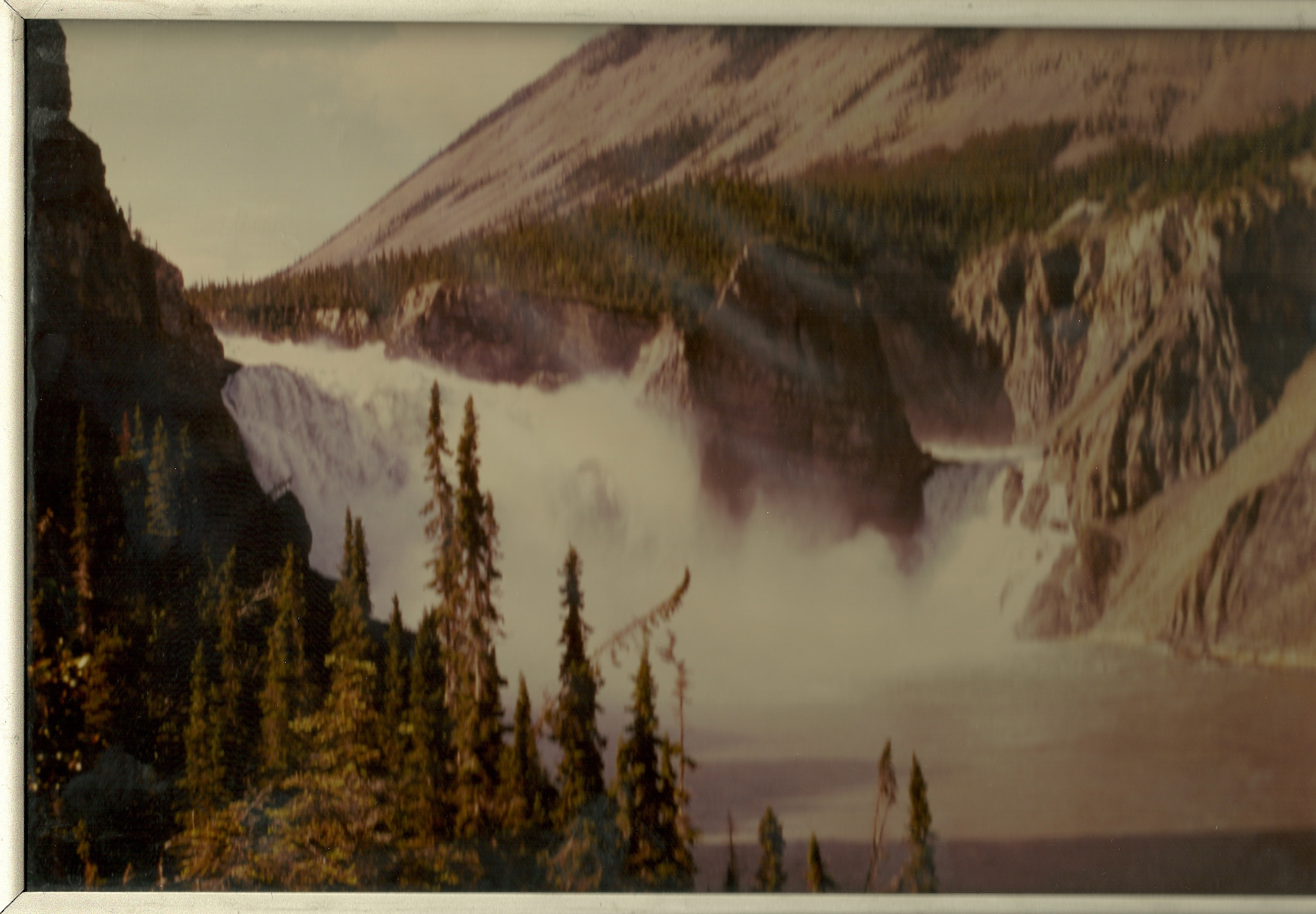
The football had been pulled up.  I had the Nahanni slides with me, for we took slides in 1985.  I had lost the roll of film, wrote Parks Canada, saying it might be in the campground at Fort Simpson, where we had stayed on our last night.  Incredibly, six weeks later, the roll was sent to me.  Canadians do those sorts of things.  I had pictures of a remarkable area very few people will ever see.  After arriving at Fort Simpson, we flew to the Nahanni in a Twin Otter with 6 people and 3 canoes, landing on a sandbar.  The Nahanni was a difficult trip through Class III rapids, the worst mosquitoes I have ever seen—and I have seen more than most— but I saw the highest waterfall, Virginia Falls, in North America.  I paddled through four canyons almost as deep as the Grand Canyon itself, sat in some natural hot springs, came out on the Liard River and saw the great Mackenzie.  The Nahanni was pure wilderness.  It is the crown jewel of my outdoor water resume.


Virginia Falls, South Nahanni River, NWT, July, 1985.

Virginia Falls, South Nahanni River, NWT, July, 1985.


I should have known better than to bring the slides.  Getting money from me was the issue, not what I did or who I was.  I’ve felt that way a lot, these past 16 years, after I left medicine.  I give on my own terms to those I wish.  I do what I can, hope to make a difference, and wish some day one of my ideas will be accepted, improved, and have a significant impact.  I had many such ideas in medicine.  My wish to be a busier volunteer in the public schools has yet to be granted.  We ought to have paid universal mandatory national service, which would give young people a sense of purpose and direction, lessening the likelihood of student debt catastrophes.  We ought to be saving water every way possible.  We should ban companion animal breeding.  I have written about all of these in this blog.

We should have had incremental single payer medical care, starting with the very young.  This would have been easier, cheaper, and less likely to have been voted against.  We should have tracked a whole host of quality issues in medicine.  We need free, unbiased, end-of-life counseling to elderly people to help them understand what “all those tubes” mean, and what their options are.  By ignoring the elderly, we ignore elders, wasting resources I can’t begin to fathom.  In short, we need incremental changes, keeping both the enemies of change and the perfectionists at bay.

I wish I hadn’t brought the pictures of the Nahanni back up to the country where they were taken.  I knew he would not be interested, but I persevered, hoping, like Charlie Brown, it would matter. People are busy, too busy for guys like me.  I tried to travel light, and those pictures and his call were excess baggage.

But I was lucky.  I have seen the Nahanni, drunk the water, know what’s out there. There is no blank spot on my map.  While it’s on my resume, far more importantly, it is in my brain.  I can call it up any time I want:  the magnificent falls, Fourth through First Canyons, Pulpit Rock, and the Gate. Wow. I was there!  I got back up to the camp one last time, and I don’t ever need to go again.  I have taken my last look.  Yeah, the football was pulled up, but I had a soft landing.

It was his loss, not mine.  That line is in Peanuts, too.

OUTFOXED

June 30, 2014

A recent Fox News show claimed Minnesota was the first state to allow Sharia Law.  The reasoning included Somali cab drivers at MSP Airport, who refused to transport people who carried alcohol and a Muslim cashier at Walmart, who refused to handle bacon.  The latter was re-assigned.  The former?  Well, if a cab driver doesn’t want to take me, there are a lot of other cab drivers who would be more than happy to jump the queue.  We all must decide whether we are willing to take the financial consequences of our beliefs.

Assuming this is true, and given Fox, I would have liked to see this for myself, these are scare tactics, NOT news.  Sharia Law says that a nonbeliever must be put to death after first being allowed to convert to Islam and refusing.  I have been to Minnesota well over forty times, I have spent more than 300 nights in the state, and I haven’t even seen a mosque.  Fox plays on American fears of Muslims, the 25% who believe Mr. Obama is a Muslim (as if it mattered if he were), and Muslim beliefs.  Let’s look at a few of those beliefs: eschewing alcohol (like Mormons), not eating pork (like Jews), praying in hundreds (which every large Church does during its service).  Fox omits saying Islam requires charity outside of taxes, limits loan interest, which we would do well to adopt, believes in prayer as a time to reflect upon one’s life (doubt many do that), and fasting to remember how the poor feel. I respect these tenets, just as I respect many in Judaism and Christianity.  There is a lot of good in religion.  The Holy Books have beautiful passages.  The idea is good; the execution often is too good, using a different meaning of “execution”.

In other words, Fox News was cherry picking, and the cherries weren’t ripe to begin with.

Let me demolish the argument right now by going back to 1960, before most of the anchors were born.  John F. Kennedy was seeking to be the first Catholic President of the US.  Back then, people then said that if Kennedy were elected, the Pope would be making American policy.  Yes, I remember that.  We also know that the Pope did not make American policy.

Now, we have over 60 million Catholics in the US, our vice-president is one, and I didn’t hear anybody’s saying that an Argentinian (good heavens, a LATIN-AMERICAN) would order, from ITALY, of all places, Mr. Biden or 20% of our population what to do.  Fox missed the boat on that one.  Indeed, in the process of googling this, I saw a picture of women whose hair was covered, and thought they were Muslims.  They were NUNS. Why is it fine for a nun to cover her hair but not a Muslim woman who desires to do so?

This particular clip upset some.  One said the Somalis should “become Americans.”  What is that?  I think she meant waving the flag (even if you don’t look at it when the national anthem is played), have a yellow ribbon on your car (but never have served), go to a Christian Church every Sunday (but deny people who love each other the right to marry).  We have the right to believe what we wish in this country, no matter how detestable it may be.  They believe life begins at conception, have no idea how the fetus develops, but do not care about the baby’s welfare after birth, especially if a person of color.  The Declaration of Independence said all men are created equal, but didn’t say “physically equal”: some have bad genes and really rotten luck.  As a doctor, I saw many with horrific conditions, some preventable, most not.  How do we handle them?  By dismantling safety nets?

What is an American? Somebody who believes what Fox News says, or somebody who thinks about what they say and disagrees?  Somebody who believes food stamps should be outlawed because of an abuse story, yet thinks guns should be available despite very deadly countable daily abuse?  Food stamps have less fraud than Medicare. Illegal gun sales are common, not just anecdotes.

What is an American?  Somebody who thinks America right or wrong, but tosses litter out the window, or puts a box of kittens out in the desert?  Somebody who obeys laws they don’t like, or grazes cattle on public land without paying?  What is an American?  Is it prayer at public events, Christian prayer, that is, insulting non-Christians and non-believers, like me?  Who is “big government” we love to hate?  Do we hate ourselves?  WE ARE THE GOVERNMENT.  Would we demand government tell a Somali cab driver whom he should carry?  He has the right to refuse to serve a person.  Or do rights belong only to “native born” Americans?

Does being an American mean we need to start speaking and writing English better?  I’d welcome that.  Is it knowing American history?  Then why didn’t we learn from Vietnam and not attack another country in a part of the world that we have little understanding of?

Jews eat Kosher; their diets forbid pork, so I don’t see a problem with a Muslim who doesn’t want to touch pork.  I am vegetarian and don’t want to touch meat. The Native American Church is allowed to use peyote, otherwise illegal.  The Catholic Church uses wine, alcohol, in its services, forbidden by Islam.  Ironically, “blue laws,” which restrict the sale of alcohol on Sundays, affect me, although I neither abuse alcohol nor am a believer.  I have to obey religious doctrine in buying alcohol on Sunday.

How is a Somali’s refusal to transport alcohol Sharia Law?  Do we have Jewish, Catholic or Mormon Law in this country?  No, we have religious beliefs of many types, and we try to accommodate those beliefs.  The NCAA doesn’t make BYU play tournament games on Sunday.  Jews don’t work on their holy days, and we allow that.  Catholics celebrate Holy Week, most of of us Christmas.  Sharia Law?  No.  Are there women who wear the Hijab here?  Yes. Sikhs wear head coverings.  So do nuns.  What’s wrong with that?  At the last funeral I attended, the number of people wearing jeans appalled me.  And we worry about covering hair?  I’m ex-Navy, and I soon learned when one did and did not cover.  One salutes only when covered, not otherwise.  Sounds like covering the head is special.

People have strong beliefs.  I have mine, too, that one may read in the nearly three hundred posts here on the blog.  Some are perhaps irrational; others may appear to be but are not.  Decide for yourself this belief of mine:  Fox News promotes hatred and fear, is biased, too often appears in public places, and violates the interpretation of the First Amendment. There are limits to “free speech,” and Fox has crossed them.  If I am wrong on that, correct me.  Then try to convince me Fox is “fair and balanced.”

If my wife wears a cover in Minnesota, it is to protect against mosquitoes, not Sharia Law.


STUDENT-ATHLETES

June 17, 2014

At the recent Track and Field championship in Eugene, I heard numerous announcements and saw commercials on the big screen about “student athletes”. I don’t like big screen ads during competition, since it is distracting, and I doubt the money generated goes to help students in financial difficulty or to pay grad students better,

It appears the NCAA is pushing the term “Student athlete” vigorously, as former UCLA basketball star Ed O’Bannon is suing them about not receiving compensation for the NCAA’s use of pictures of former “student athletes”.  He was joined by Oscar Robertson, who puts Mr. O’Bannon in lofty company.  O’Bannon was one of the few who succeeded professionally in his sport.  He led UCLA to the NCAA basketball championship in 1995.  He was drafted 9th but played only 2 years in the NBA and 8 years in Europe.  He now sells cars in Las Vegas.  He disappeared, but his reappearance now may be the most important thing he does in his life: change the sham that college football and basketball are played by “student athletes.”

Universities generate $4.5 billion from football and basketball alone, enough to cancel 190,000  student loans of $24K, the average for Oregon.  Or pay grad students better.  Or pay the players who actually do the work, not those who benefit from such work.  Alabama’s football coach makes $5.5 million; Arizona’s basketball coach $2 million, and he is far from the best paid.  The median salary of an associate (tenured) professor of physics is $70,000.   In Eugene, Matthew Knight Arena cost $227 million, a 2002 “facelift” at Autzen Stadium was $20 million.  The NCAA generates nearly $1 billion, mostly from the “March Madness” basketball tournament.  I heard numerous times 89 championships and 450,000 “student athletes,” with 90% of the revenue returning to the schools.  Why would the NCAA be saying what per cent goes back to the schools, unless they felt they were under fire?

So, $100,000,000 remains, and I write the number, because seeing it is often useful. The $4,500,000,000 ($4.5 billion) is one-seventh of what America spends on the NIH, which I think does a lot more good for people, but I might be wrong.  Sports are perhaps more important than finding cures for diseases like Alzheimer’s.

The issue the NCAA doesn’t appear to understand, or at least doesn’t want to admit, is that football and basketball are different:  athletes and coaches involved in these sports are not the same as athletes and coaches in other sports.  John Calipari at Kentucky has well over a $35 million package for the rest of the decade.  An assistant football coach makes 6 figures, one has made a million; an assistant track and field coach makes about $20-40K.  Look it up.  I did.

The question for the NCAA is this: how much should men’s basketball and football players be paid?  It isn’t “whether” but “how much?”  These players are abusing their young bodies, not mentally mature, and vulnerable to being used.  They often do not finish college, taking a slim chance they will have a pro career, that in the case of even O’Bannon was short. The probability a college football player’s playing professionally is 2%; basketball is 1%.  OK, 1.2%.  The probability of graduating without a degree and without playing a professional sport is a minimum 15-30 times higher, approaching 70% in some places. These players are not going to find good jobs, their joints worse than mine, and I am 3 times older.  Football brain damage isn’t even being factored in here.

The concept of “student athlete” works if it is a Dartmouth runner who loves to run but must meet high standards of an Ivy League school.  The runner may perform well enough to be in the 5000 meter finals in Eugene, but he was lapped well before the end. This is a student athlete.  He loves track, but his life work will be something else.  Dartmouth, like all Ivy League schools, does not offer athletic scholarships.  If a university does, it is subsidizing an athlete, not a student.  This to me, a Dartmouth alumnus, is an important distinction.  Only a third of the 450,000 get athletic scholarships; four sports: football, men and women’s basketball, and women’s volleyball, give full rides.  Is that payment?  If it is, then they aren’t primarily students.

Football and basketball players are too often athletes who happen to attend classes.  Their graduation rates approach 70%, better than it was, but a significant number of programs graduate fewer than half. What was their major? I doubt it was physics, chemistry, mathematics, English, or literature.  Many athletes on full athletic scholarships are a farm team for the pros, leaving college when they believe they can turn professional.  To put their faces or names on a shirt, while they are in college, so that the NCAA or the school can make money, is using them as pawns.  This happened to Michigan’s “Fab Five” 20 years ago.

There are student athletes, and there are student athletes.  The NCAA compares both equally, and they are not.  The volleyball coach at the University of Arizona knew full well that successful recruiting and funding of his program depended upon a successful football and basketball program. Eleven of Arizona’s 13 programs listed lost money, including volleyball.  The profits from men’s football and basketball were about $26 million, more than enough to compensate.  Graduation percentages are tricky, and I don’t like the 6 year definition; I got through Dartmouth in 4, and the Dartmouth man who ran the 5000 at the NCAAs will likely do it in 4, too.

I am concerned about big corporations buying advertising, using handsome young men and pretty young women with nice voices to push a toxic agenda, be it chemical, like ExxonMobil, or sport, like the NCAA.  Money talks, it talks too much, and it is time to shut it up. Money could be used to pay for good professors, not coaches, lessen the burden of student debt, develop first rate researchers, writers, educators, and try to lift more poor out of poverty.  Ads? Request retired people like me to help tutor or use our experiences and wisdom.  Bet they wouldn’t cost much on a Jumbotron.   This is the 21st century.  We need educated people to understand the growing complexity of this world. Fox News has a simple answer for everything.  There are few simple answers, and that makes life difficult. Instead of embracing complexity, we pay tens of millions to a coach to help young men put a ball through a metal rim.  If your team wins, you feel better about life. Is escape the point?

When I cared about basketball, O’Bannon was a name to be feared in Arizona.  Now, I wish him every bit of success off the court.  Stay with this cause, sir, for this is where you may make your mark in life.  I bet you never expected that.


BROKEN SYSTEM: C2 FIXING IT

June 11, 2014

An elderly man is seen in a major hospital in a large city with neck pain following an automobile accident.  He is evaluated with neck X-Rays, read as normal, and discharged in a cervical collar.  A day later, he goes to another hospital in another large city with the same complaint and is found to have a fracture of C2, the second cervical vertebra, the so-called “hangman’s fracture”, because this bone is broken in hanging, compressing the spinal cord above where the phrenic nerve, which runs the diaphragm and breathing, exits.

The man will survive, and he will survive without deficits, although he will require a surgical procedure to stabilize the fracture.  Elderly people tend not to complain about head and neck pain the way younger people do.  When I practiced, new onset headache and neck pain in the elderly was something I took seriously.  You won’t read about this in books; a lot of neurology I learned in practice.  I noticed things, and I counted.

Had the man been rear-ended or even had a minor fall, he could have died suddenly.  At his age, with no autopsy, he might have been diagnosed as “heart attack,” with the outpouring of grief and comments about his life cut short.

And nobody would have noted the error.

The system will continue unchanged, with the first hospital’s staff thinking they provided high quality care, not knowing that they made a major error; they missed an odontoid (the name of that part of C2, the axis) fracture.  Somewhere in their clinical evaluation, they failed.  They don’t need to be sued, nor do they need to be publicly humiliated or embarrassed.  They need to learn from this error.   I learned medicine through gamesmanship and humiliation when I made a mistake; making people feel fearful, stupid or embarrassed (or sued) isn’t how they learn.

Ironically, 12 years ago, I went to this hospital and explained to the CEO why we needed a reporting system for medical errors.  He told me that they had one of the best systems in the country.  If that were truly the case, for this problem to occur a dozen years later says the quality of our programs to prevent errors needs immediate attention.

Doctors make mistakes.  They are human.  They make errors for all sorts of reasons: There may be insufficient knowledge, hurry, distractions, interruptions, lack of sleep, shift changes, miscommunications, and other reasons.  To assume a doctor is perfect is to deny reality.

What is needed is recognition of this reality and building of systems robust enough to find problems before they become critical.  How the system works is a matter of involving those who are involved.  It doesn’t come from the government, although if the medical profession doesn’t change, it will some day, and will have all the problems that come from government regulation.  Changes don’t come from the CEO or the head of the emergency department either.  They come from involving the doctors who work in this department, the nurses, the technicians, the people who first see these patients, the first responders who bring them there, and the radiology department.

The question to be answered is this:  How do we ensure we never miss this problem again?  The goal should be 0 misses, which means that part of the solution has to be followup with the patient, the way my veterinarian calls me at home the day after she does dental surgery on my cat.  If a cat can get better followup medical care than a human, then I have a major complaint with the medical system in America.

Hubris.  “World class.”  “We will take care of it.”  “We don’t need you.”  “Centers of excellence.” “99.99% of our patients do fine.”  The last I particularly worry about, because it means that 1 in 10,000 does not do fine, and if it is wrong-sided surgery, that is 2 cases a year in a busy hospital.  There are some things where percentages are appropriate, and there are others where counts are better.  There should be 0, null, zero, cases of missed odontoid fractures after an automobile accident.  Does everybody need a CT scan of the neck?  No.  Who should get one?  Look at the literature.  We put people in cervical collars routinely, when they have no neck pain, no neurological findings, no drug or alcohol abuse, and no tenderness to palpation of the neck.  Having all of these negatives was shown two decades ago not to require a collar.  Yet, we do it anyway, “just in case”.  In case of what?

I am telling the medical community to fix their broken systems, for they are broken when an important bone is broken and not recognized.  We have the ability to easily diagnose these problems when they occur, and we know enough about algorithms to know when we should work these patients up further, and when we do not need to.

I get follow-up surveys from nearly every company I deal with.  Amazon now surveys the packaging process.  I don’t know if anybody actually does anything based on these surveys, but if there is a mistake, they sure hear from me.  I would bet a great deal of money the hospital never called the patient to find out how he did.

If Comcast, for heaven’s sake, surveys, and if my veterinarian calls me to ask about my cat, it would appear maybe medicine ought to start doing the same thing.  Aviation has been investigating errors and disseminating the results for 40 years.  In 2001, I suggested medicine do the same.  I contacted 64 different groups.  Nothing happened.  Fine, don’t use my system, but put something in place to address this problem, because it happened once and it shouldn’t happen once; you guys aren’t learning from your mistakes, and you aren’t even counting.  

I wonder in the past 13 years how many hangman’s fractures were missed, causing death.

I wonder if in the next 13 years we will address the issue.  The smart money bets no.


NO ANONYMITY WITHOUT RESPONSIBILITY

June 3, 2014

“I can’t find a goddamn parking place in this  f——- town!” we heard, while walking to the Prefontaine Classic.

The middle-aged man walked away from a series of parking meters that were good for 2 hours, not quite long enough to see the event.  On the other hand, had he been willing to walk a few more blocks, he would have been able to park for free.  Had he anticipated the potential problem parking, he might have left home earlier, wherever home was.  He had “skunk anger,” and I quickly recalled my arm, after I had begun to point out parking spots.  Nowadays, it doesn’t take much to set some people off, and with the only restriction on firearm possession these days appearing to be price, I thought it wise to quietly walk away.

Public displays of anger are scary.  I vividly remember a fist fight breaking out over who was next in line at a gas pump during the 1973 oil shock.  I saw a man pummeled in Nairobi once, and stayed far away.  Over the phone, it is too easy to express anger, for one doesn’t see the effect upon the other person.  Sadly, many who receive these nasty calls weren’t involved in setting up the faulty system or designing the flawed product.  Highly paid executives are shielded from much of the difficult work that is “customer service.”

Letters may also be hurtful. Virtually everybody has regretted at some time hitting “send” too soon.  Angry letters require rereading and preferably should sit 24 hours before being sent.  It is remarkable what will be deleted after waiting.  Many such letters I never sent.  Still, angrily written letters have a name and an address; they are not anonymous.

The Internet has brought anonymity to public discourse, which I find both disconcerting and dangerous.  Read the comment section of an online newspaper article.  The comments do not sit for a day before posting, the grammar and spelling are often atrocious, the venom almost visible, the comments close to libelous, and the points often not factual.   Anonymity allows every frustrated individual to write whatever he wants: a free pass for hate mongers, the ne’er do wells, a public voice for those who used to say their indecent words in private, or at least not in my presence.  People I never will meet vent about all sorts of topics, truth being the greatest casualty, the beautiful English language a close second.

Letters to the editor are difficult to get published, because they require knowledge of basic English grammar, which many do not have.  These letters have an approximate 150 word limit, requiring careful thought, not a long-winded exposition.  I find it ironic that many who decry the use of Spanish—a language I wish I could speak fluently—cannot write a decent English sentence.

Online, every time I read one’s advocating physically fighting the government or secession, I wonder why these people don’t have their IP addresses tracked and informed their comments are treasonous. Many say the government is incompetent, rather than taking the small step to say some people who work for the government are incompetent.  Yet, this same “incompetent government” is somehow able to keep secrets about Area 57, currency reform, 9/11, the New World Order, and faked the Moon landings.  The inconsistency of these two concomitantly held viewpoints baffles me.

What I almost never read in diatribes are detailed suggestions how we might fix problems.  Perhaps many of us have given up. Ideas are seldom seriously considered by any organization I’ve sent them to.  Message to those in power: you do not have a monopoly on good ideas; they can come from anywhere, not just your staff or the same people that have been in the public eye for decades, some of whom need to move on.  You might be surprised what we have to offer.

Simplistic suggestions: “Deport all of them,”  “lower taxes,” “repeal Obamacare” are not solutions.  Mandatory national service, encouraging national volunteerism and using the experience of older people are starting points. I have been open to different ideas, so long as they have data, inferences, margin of error, ways of tracking effectiveness, and are well thought out.  My name is visible, and information about me is available.  It’s is clear what I believe, and it is clear that I may be influenced.

I had no idea the jerk I heard—and the man was a jerk, continuously swearing at the top of his lungs in a quiet neighborhood about a city I happen to love—would lead to an article.  It didn’t quite, until I read online in the Green Valley News (Az.) that a Hispanic shot and killed by the Border Control was an unarmed US citizen.  He had a prior record, was stopped and allegedly fled on foot, not at all a physical threat.  He was hauling marijuana, not human flesh.  He broke several laws, no question, but he didn’t deserve death.  I wonder whether those who have decried illegal immigration will speak out against killing our own citizens in these circumstances.  I chose not to read the comments, because I suspected I would read “the man deserved it”, “most of these people are illegal,” “his papers were probably forged”, “we still need a wall”, and of course “this is only one instance,” which in the issue of death happens to be irreversible. Is there no shame?  The Border Patrol has a difficult job, but we cannot use that as an excuse.

Anonymity is used by cowards.  My name is on my posts and letters; I don’t hide behind “Blueheeler2”. Stating comments in public requires thought. I suggest we edit these sites, in order to make some of the comments readable, shorter, and enforce common decency.  We used to, and violent threats online ought to be investigated.  They have led to shootings, which takes me full circle.

Some say anonymity is the price we pay for the Internet.  I say we shouldn’t pay it. If WordPress wants to edit me, fine.

Please, however, don’t have your editors make grammatical mistakes in their comments.  That annoys me no end, but I will try to be polite in my letter to you.


Michael S. Smith, MD MS (Stat.)


WHERE’S THE BEEF?

May 30, 2014

Twenty years ago, medical director of a hospital, I took a call from a woman who wanted to know how many Abdominal Aortic Aneurysms (AAA) her husband’s surgeon had repaired the prior year at our facility.  She asked a good question, because the surgery is difficult, fraught with risk, even when done electively, which in this instance it would be.  Too often, it is done after the aorta ruptures.  My cousin’s husband died of a ruptured AAA; I have dealt with the issue emergently, and it is difficult to control the bleeding while simultaneously repairing the vessel.

I didn’t know the answer.  Therefore, I had no idea her husband’s chances of survival, how long he would likely be hospitalized, or his condition six months later.  We didn’t track that.  It took me four years to get the hospital to track outcomes from cardiac surgery, after I exploded one night in the ICU saying that I had been consulted 26 times in 270 open heart cases in one year.  Consulting a neurologist after a heart case usually doesn’t bode well.

I mention this, because AAA is one of the outcome measurements Leapfrog uses in determining how well a hospital performs.  So is Aortic Valvular Replacement.  The Tucson hospitals that used Leapfrog scored no better than “C”; one scored “D”.  Some of these hospitals had marketed themselves as being “one of America’s top 100 hospitals.”  It seemed that they were not quite as good as they thought they were.

Leapfrog tracked drug errors, too, and no hospital in Tucson scored better than “C”.  On 2 May 2002, I met with administrators at University Hospital in Tucson to outline my reporting program to reduce medical errors.  A year earlier, I had met with their cardiac surgery program to help track outcomes better.  I can’t believe I was so naive to think that I, who had practiced, been an administrator, had a Master’s in statistics, and 2 months earlier had written an op-ed on an error reporting system we needed in medicine would take on Big Hospitals.  Capitals mine.

Both groups wanted to know, in an unfriendly tone, who I was.  Being from the same city was a minus; had I been from outside, I might have had more credibility.  It would have helped if I were good-looking, exuded charisma, and showed glossy paper with colorful bar graphs, rather than having sound ideas and a quiet demeanor.

Needless to say, the cardiac surgery program wasn’t interested, and I was assured, that second of May, that University Hospital had “one of the best safety records in the country.”  They gave me no data.  They wanted to know what software I would use. I didn’t need software; I needed reports of errors in order to understand them better.  Unfortunately, computers and charisma mattered more to them.

Leapfrog was initiated by a group who had the smarts, the looks, the networking ability, and the leadership skills I lacked.  My ideas were ahead of theirs.  In 1974, I was counting outcomes in medicine when I was an intern.  I was selecting my surgeon to do carotid surgery in the mid-1980s, based upon his outcomes.  I raised concerns about our cardiac surgery program in 1990.  I wasn’t surprised that hospitals were graded “C.”

Every member of my immediate, now small family, has suffered from a medical error.  People make mistakes.  I accept that.  People should learn from them, too, which they often don’t.  For years, we had lousy data and lousy tracking systems.  No, we had no data and no tracking systems.  We hadn’t a clue, and we let Big Medicine, called the Joint Commission, dictate what hospital quality was.  I met with the Joint Commission, too, on 14 August 2001, in Chicago, at my expense.  They were quite interested, so they said, but I never heard again from them.  No e-mails, no calls, no response to my written requests, nothing.

It takes 30 seconds to compose and send an e-mail saying one is not interested.  They weren’t  too busy.  They were rude, arrogant, and wrong, as wrong as Condoleezza Rice had been 8 days earlier and the Bush administration would be four weeks later.  The only difference is a lot more people die from medical errors every year than died on 9/11.  We just don’t know how many.  Our estimates are bad, and the margin of error of those estimates is seldom given.  That violates a basic rule of statistics.

We should be tracking outcomes of common procedures in medicine.  When I broke my hip in an accident, the surgeon had no idea I had done well until I wrote him.  I fractured my fifth metacarpal, had a cast for four weeks, and told that alcoholics often took off their casts with no sequelae.  When I was told I needed two additional weeks of the cast (which did not change the angulation of my metacarpal), the comment my father made was “that is what your doctor learned to do where he trained.”

“Why?” I asked, “don’t we know whether somebody with a broken metacarpal even needs a cast?  Why don’t we know the optimal time? Do metacarpals heal depending upon geography?”  This is not a rare injury.  If we don’t need a cast, wouldn’t that save money and time?  How many other conditions don’t we know the results?  Perhaps some shouldn’t do certain procedures, like colonoscopy, lumbar punctures, bronchoscopy or angioplasty.  How many of these have you done, doctor?  And what happened to the patients?

We physicians like to say we are scientifically trained, and non-physicians don’t have data to show they make a difference.  Where are the numbers?  What should they be?  And what are we doing to achieve those numbers?   Too many ideologues argue using rhetorical questions, which I find annoying.  A statistician’s job is to ask questions.  Ours are good questions, answered with data, uncertainty and appropriate inferences.

We don’t need high speed computers to measure outcomes.  Pen and paper work just fine, with a lot of curiosity, and an open mind.


TIME TO LEARN FROM THEIR SILENCE

May 23, 2014

I hiked the other day with a group, including a man who had driven to the trailhead with a “Disabled Veteran” license plate on his vehicle.  He was the lead hiker and set a good pace. He was probably my age, give or take a few years, and we started talking, since this was an aerobic hike—fast, but not so fast that we couldn’t talk.

When I mentioned I was a retired physician, he said a corpsman saved his life.  I didn’t have to ask where.  I knew it was Vietnam.  Corpsman=military=my age=Vietnam.  He didn’t say what happened, only that he ended up in Yokosuka, Japan, for 5 weeks before being sent back home.  He is a Marine (note the tense, for Marines consider themselves for the rest of their lives as a Marine), and we talked about ships, sailors, and generalities.

We did not talk about what happened to him.  He mentioned Hue (“Way” is the pronunciation, for this household word in 1968), and I was polite enough not to inquire further.  I had a pretty good idea what happened to the Marines in Hue, and it was ugly, awful, and part of the devastation we inflicted on many of our countrymen and their families plus another country and their people that year.

This man lived; 58,000 Americans died, as well as least three million Vietnamese, probably a lot more. Cambodia and Laos were subsequently sources of many more deaths.  This man wasn’t killed but wounded, and when one starts tallying the wounded, we are in eight figure range—more than ten million.  Americans never trusted the government quite the same again after Vietnam.

The man didn’t talk about the war, and neither did my late brother, who served in Da Nang.  When we start talking about the numbers of people who were indirectly affected by the war, the number is immense.

Only non-combatants like me, who served on a ship that was near Vietnam, but 6 months after “Frequent Wind,” the exodus, talk about our military service.  The guys who were the grunts, the hiker with me called himself one, remain silent.  Almost all of them do.  They don’t brag about their service, and even John Kerry didn’t throw his military record into Bush’s face in 2004, only his medals, about 30 years earlier.  A lot of men who fought in World War II remained silent for years…or forever.  The Republicans at the 2004 convention who wore bandaids, deriding Kerry’s service, were among the most shameful behavior I have ever seen.

This silence should tell everybody how bad war is.  It is so bad that people who have witnessed the tragedies stay silent.  Such is likely is a protective mechanism, but may come with a cost, perhaps PTSD.  The man was a good hiker, and we got up to the top of Spencer Butte and down in about 3 hours, a decent time, although he could have pushed the pace had he wanted.  Four days prior, he and I were part of a group that hiked up Rooster Rock, north of Eugene, 2300 feet vertical, and he was good.  He didn’t mention his military service that day.  It took a second hike with me to mention what he did.

Perhaps the men who start or continue these wars, many of whom have never served in the uniform of this country abroad might think a bit more about the cost.  No, I am not talking about the kept off budget “Emergency Authorizations” during the Bush administration, which were barely challenged by any American, let alone in Congress.  That’s just money; when Republicans spent it, we were patriotic, when the Democrats did it, there was howling about budget deficits.

No, I am talking about the cost to a CIB (combat infantry badge) veteran, disabled, who doesn’t talk about it, and the men who died and will never talk again.  What did they see that kept them silent?  What did they see that their families didn’t even know?  What is this cost?  Well, of course, there is life insurance, but that is a monetary cost.  I’m talking about other costs, something Wall Street, bankers, a good share of politicians, and too many Americans don’t think of and never will, unless it affects them.  To them, unless there is a dollar cost, they aren’t interested.  Health insurance costs money, so many don’t like the country’s spending money on it.  The fact that people feel relieved to have such insurance, and that is a fact, is unknown to them.  Wilderness is board feet of timber, cubic feet of water, a place where they should be able to mine.  The value of what I see, feel, and do in wilderness has no monetary value, so these people ignore it.

Wars are at times necessary, but in my lifetime, Vietnam, Iraq, and Afghanistan were all unnecessary, fought under false pretenses, and run by old men. When I hear jingoistic phrases and see flag waving that make war romantic and patriotic, I wonder why almost nobody asks, “Why do veterans not talk about what they saw?”  I am profoundly saddened, puzzled, angry when people discover that war does bad things to people that we try to sanitize, so the public won’t be offended.  Why were only 16% of us against invading Iraq?  I saw what was going to happen, wasn’t it obvious?  It was to me.

I wonder why we still hear men push to go to war with Syria, Iran, and Russia.  I wonder, of course, where the money is going to come from, since the Republican-led Congress, and that includes the Senate, since they are running that for all practical purposes, wants to cut spending.  I wonder why we act surprised when the VA isn’t helping veterans.  This happens with every war.  That costs money we don’t have.  Why didn’t these guys die or go elsewhere?  A significant number are homeless.  They served, then were thrown away, like old furniture.

When we go to war, we are going to change the lives of every individual who serves in harm’s way.  People will die, families will change, and money will be spent.  The first two have incalculable cost.  The third we try to ignore.  If we go to war, we need to have a national discussion on this, without Fox News, Karl Rove and jingoistic “leaders” calling the shots.  We need to discuss what exactly what it is that makes this particular war so necessary., because thought and negotiation must be expended, before lives and treasure.  Lives are treasure that we cannot put a dollar value on, regardless of what the actuaries and the lawyers say.

Nothing short of the survival of the country should be a cause for war.


SITKA SPRUCES

May 15, 2014

It’s only a few hundred yards.  The air feels the same, the elevation barely changes, and the ground feels the same.  To any human hiking west, towards the ocean, the woods and the trees are the same.

But they aren’t.

In this short distance, giant Douglas Firs in the old growth Siuslaw National Forest give way to Sitka Spruce, equally large, so much so that not far north of me is one 550 years old, 15 meters, (50 ft) in diameter, and nearly 50 meters (160 ft) in circumference, 70 meters (230 ft) tall.  A kilometer further inland—maybe only a few hundred meters—there are no Sitkas.

By "Big Tree," 550 years old.  The cave underneath once had a log from a fallen tree, that helped this tree grow.  It was called a "nurse log."

By “Big Tree,” 550 years old. The cave underneath once had a log from a fallen tree, that helped this tree grow. It was called a “nurse log.”

In this transitional zone, there are slight changes in the atmosphere and the soil sufficient to change the climate of the forest enough, allowing one type of tree to thrive and to displace another.  I don’t notice it, but the trees do.  Like the Redwoods south of here in northern California, Sitka Spruce can live only a few miles from the coast.  Any further inland, and the air, the soil, everything changes so that these trees can’t survive, but others can.

It’s a lesson we need to learn.  We are more like these trees than we think.


Douglas Fir, with 1.3 meter (4 foot) walking stick for comparison.

Douglas Fir, with 1.3 meter (4 foot) walking stick for comparison.

IMG_0585

Indeed, when one looks at what the human body can tolerate, our cells, too, live in a microclimate that is just right.  Drop the partial pressure of oxygen in the air suddenly by a third, and we die. Change the sodium concentration in our blood 15%, and we are in trouble.  Change the potassium 30%, we die.  Change the calcium 10%, and we can’t think clearly.  Put 50 cc blood suddenly in our head, outside the dura mater, and we die.  Put a few cc in the medulla, and we die.  Change our body temperature 4 C in either direction, and we die.

We are like Sitka Spruce.  Given the ideal climate, we thrive.  Change that climate too much, and we can’t.

Let’s think about the planet as a whole.  We are dependent not only upon the lower portion of the atmosphere but upon the upper portion of the soil, plant life, and pollinators, most of which we call bees.  I wonder if that is taught in Common Core.  It should be.  We think trees are immobile.  So are we, when we consider our habitable zone not the distance from the ocean, but the Earth itself.  If the planet is destroyed, I am as immobile as a Sitka Spruce.

Change the acidity of the ocean 25%, warm it just 1 C. (1.8 F.), and coral bleaches and dies.  Oh, that has already happened.  The ocean’s pH has fallen by 0.1 unit.  To most, this is meaningless, but do the math, yes, the nerdy math, by taking the negative log [H+], and you will understand I am right.  Increase the average monthly temperature 1 C., only one-third a per cent, and we call it warm.  Is every day 1 C. warmer?  No.  Some days might be even cooler, maybe 5 C.  Increase the change to plus 2 C. and we call it a hot month.  Change it 3 C., and we have record warmth.  One per cent increase in temperature is record warmth.  In Tucson, the annual change since 1980 has been about 1.5 C (2.7 F). I noticed it 25 years ago. People like warm winters, even when it is 90 in February and winter rainfall is a third of what it once was.  I am not a Sitka Spruce.  I moved. The desert plants cannot move.  If they can adapt, they stay; if not, they die.  We’ve seen a lot of death in the Sonoran Desert.

Decrease rain 10%, and it’s a dry year.  Decrease it 20%, and we are in drought.    Decrease it 30%, which has happened in Tucson for the last decade, and you have…..silence.  Nature doesn’t say right or wrong, only allows organisms adaptable to local conditions.  Change the conditions, change the organisms.  The desert is still there but is no longer the same.

Our habitat is a small planet in a perfect orbit around the right star.  We thrive.  Or we used to, before several things happened.  We became too plentiful, and our resource use is unsustainable.  When there are too many people, governing becomes more difficult and less gets done.   We aren’t acting.  The Western Antarctic Ice Sheet is going to melt, and sea rise will eventually increase 3 meters, or 10 feet.  There goes Pacific Islands, Bangladesh….and Florida.

The Chambers of Commerce are going to have a hard time with the last.

Nature isn’t out to kill us.  Nature, biology, physics, and chemistry have no conscience.  They are.  Change the habitat, and Sitka Spruces—or humans—will disappear. The oceans are rising; there is absolutely no doubt about that:  the two causes are glacial melt and expansion of warm water.  No political rhetoric will change that fact, nor will any change the fact that increasing carbon dioxide will acidify the oceans.  It already has.  The Earth will stay in heat balance, regardless what happens in Brussels, Washington, Moscow, or Beijing.  If there is more heat, it will be balanced by storms, for a hurricane is a heat exchanger.  The Tea Party may say it isn’t happening, but they have no evidence.  Nature doesn’t hear “hoax;” changes have consequences.  We know some; we don’t know all.

Sitka Spruces use soil and air.  Eventually, they succumb, to root rot, to wind, and perhaps to excessive rain on certain slopes. They give back during their life, sequestering carbon and producing oxygen.  When they die and fall to the forest floor, they are recycled into new trees.  For thousands of years, they have born, lived, and died, in tune with their environment.  Walk among these giant trees, and you see all parts of the life cycle.  It is a cathedral of life, for from a dead tree springs new life.

It is the way of the world that was set into motion.  It is fair to argue what set the world into motion.  I happen to believe in The Big Bang and evolution.  To me, the evidence is compelling.

It is neither fair nor right to argue that changing the conditions of the world will not affect what life forms will exist.  It will; it has. Denial is short-sighted, stupid, and sad, not just what we have done, but that we never tried to fix it.  We didn’t try and fail.  We didn’t even try.

Nature, however, will not judge.  There will be only consequences.  They are already here.


IMG_0700

Nurse log that actually never died. Not only do the trees (the 3 on the right, although the center is did) get their nutrients from the downed tree, they were original branches. I have never seen this before.

Douglas Fir on the right; The Sisters in the distance.  Oregon Coastal Range, but 30 straight line miles (50 km) from the ocean.

Douglas Fir on the right; The Sisters in the distance. Oregon Coastal Range, but 30 straight line miles (50 km) from the ocean.

IMG_0618

Another example of the size of a Douglas Fir. Notice the deep grooves in the bark. This tree probably germinated during the reign of Queen Elizabeth of England–the first one (1558-1603).

HOW ABOUT MISTER SMITH, OR EVEN SIR?

May 12, 2014

“Dr. Smith, lay to the bridge.”

John, my hall mate back aft on the O3 level, cringed, and then let loose with a few epithets.  He and I had the two aft staterooms separated from the rest of “Officer’s Country” by a door.  It was colder there when it was cold, like off Korea in March, and it was hotter there when it was hot, like in the Philippines in June.  But we were mostly left alone, had an exit door aft, with a good view of the ship’s wake, when we weren’t working.

The numbering system for decks started with the Main Deck, then 2,3,4 going below or down.  Going topside or up, it was O1, O2, O3, to the uppermost deck, our bridge on the O4 level.

John cringed, because “lay to the xxx,” was used only to call enlisted personnel. “Your presence is requested to xxx”  was for officers.  Put succinctly, it was a breach of etiquette. The Navy was polite.  As coarse as the day-to-day language was, contributing to my current curse word vocabulary well into three figures, there was politeness.  I had to salute senior officers once a day on board, but only if I were covered, or wore a hat.  At sea, hats were not required, although most of us wore ball caps.  Navy men never salute uncovered.  Covers were not allowed in sick bay; they were required on the bridge.  In port, in uniform, one was always covered outside.  I learned these rules fast; I had to.

Coming aboard, one saluted twice, once aft, where the colors (flag) flew, and once to the officer of the deck, concomitantly saying, “request permission to come aboard.”  The procedure was reversed when one disembarked.  One needed an ID ready, too.  Ashore, one saluted any senior officer, holding it until the salute was returned. We called senior officers “Sir,” but on board, the executive officer was “XO,” the Captain was “Captain,” or plain “Cap’n”.  He didn’t mind.  When the Captain appeared, the first person spotting him said, “Attention on deck,” and we all jumped up.  The Captain would say “at ease,” and we would sit down.  This was formal stuff.  When the XO appeared in Sick Bay, I stood up.  It showed respect.

In correspondence with junior officers or enlisted men, we wrote, “Your attention is directed to xxx.”  To senior officers, we wrote, “Your attention is invited to xxx.” To this day, I take that and three other things with me from the Navy: short hair, my shirt buttons lined up with my pants zipper, and use of the word “Sir.”

I mention all of this, because the other day at the local pharmacy, where I get my medications, I stood inside the privacy line, painted on the floor.  Privacy is a big deal these days, except everybody knows everything about me, so I don’t really believe in it.  I may not see a prescription, but even with bad ears I hear what people are getting.  In any case, I was chided with a “Get back behind the privacy line.”

Gee, sorry that I am old, new in town, and honestly didn’t see the line, since the letters were faded.  I got half my medicines, since one was still not ready, five days after I dropped off the prescription, another problem with today’s “just in time inventory.”   I decided to return the next day.  As I left, I heard , “Thank you, Michael,” and cringed.

I don’t like strangers, especially the young, calling me by my first name, and I don’t like it when people on the phone with whom I speak ask me how I want to be called.  You call people Mr., Mrs., Dr., or Ms.  It is default.  You don’t ask, you do it, and you ought to know that.  I still call the former head of neurology where I trained “Doctor.”  He is in his 80s, and he has always been “Doctor” to me.  The past Executive Director of the Medical Society always called me “Doctor,” although we spoke on a lot of issues as friends.  It’s a sign of respect.

I don’t push the issue, but maybe it’s time to.  If you are too polite, you will be given an honor (yes, it is) to call someone people by his or her first name.  One should not put people in an uncomfortable position of asking how they want to be called, which happened with me with AARP.  How about “Mr. Smith”?  It is always in style, never wrong.

Thirty years ago, I flew over to San Diego to attend my Chief’s retirement.  I stayed in my stateroom one last time. I could have called both the Captain and the XO by their first names, for I was a civilian.  I could have called my chief by his first name, too.  But I didn’t.  I never had.  These people were “Captain,” “XO”, and “Chief”.  They were, and they always would be.

I discovered in civilian life that “Sir” is a powerful word showing respect for the office or age, but properly pronounced may be used to show distaste for the individual or task.  I learned the last to more than one lawyer’s chagrin, when he thought he was dealing with an arrogant doctor: my use of “Sir” with the appropriate tone was devastating.

“Sir, could you please step behind the privacy line?  Thank you.”

“Thank you, Mr. Smith. Good-by.”

“Mr. Smith, may I outline the benefits of our program?”

Notice the “Sir,” “please”, “Thank you,” “Mr.” and “may I”. These seven words exude politeness.

Many gun owners have told me that gun ownership will create a polite society.  I disagree.  I didn’t think the 19th century was so polite, the 20th or especially this one, while gun ownership has increased rapidly.  People must be scared of something.  Congress won’t even fund the CDC to find out why.  If we had 25,000 people dying from a new virus every year, you bet the CDC would get money.

Ironically, one of the most polite places where I worked was one where rifles were locked up, we enforced the Uniform Code of Military Justice with Captain’s Mast (non-judicial) more than courts martial, and fights were almost always with fists, even in liberty ports.   I treated a lot of STDs; I honestly can’t remember treating even a knife wound.

But please, dear reader, bear with me, for my memory is no longer good.  I might be mistaken.  But not about gun violence.