Archive for the ‘GENERAL STUFF’ Category

BUT I WORKED SOOOO HARD!!!

November 19, 2013

In late September 1966, Dr. Taylor passed back the first paper I wrote in his English 1 class.  I had worked hours on this paper, written 15 drafts, back when we used typewriters.  Each draft was poorly written.  I can still see the angle of the red “E” on the paper.  I was devastated.  

“But I worked so hard!” is what I told my stunned parents. That paper alone kept me off the Dean’s List for the only time in my college career.  I got a C minus in the course.  I got an A in English 2.  One of the reasons I like science and math is that subjectivity is less an issue.  I did not suddenly become a good writer by the spring of 1967, any more than I was such a poor writer in the autumn of 1966.

Spring 2003.  I am teaching a statistics class for business students in Nogales and give  a group a B on their presentation.  One man said: “But we worked so hard!! We deserved an A.”  I explained that while hard work is a virtue, such does not itself deserve an “A”.  Results matter.  For every Olympian, there are hundreds of others who worked just as hard or harder but didn’t have the ability or the time, got hurt, had a bad day during the trials, and didn’t make it to the top.  Hard work is necessary but not sufficient.

I worked for years to become a better writer.  It was never a goal of mine, but I discovered that I communicate better by writing than by speaking.  I have published 60 papers in 9 different fields; won two writing awards; been an astronomy columnist for the newspaper for 20 years, writing nearly 800 columns; and been a 9 year columnist for the medical society.  I have  240 posts on my blog.  I’ve written several op-eds in the newspaper, and 75% of the letters to the editor I write get published.  I am a writer.  I am not an exceptional writer, but I am good.  Last July, my letter to the editor appeared in The New Yorker, not easy to do.

I’ve heard hospital advertisements saying how hard their staff work to care for patients.   I assume people work hard.  What I do want to know is should I get operated on, and I’m a clean case (no bowel perforation or gun shot wound, for example), my likelihood of a wound infection is less than 1%, not 4%, which it was in the hospital where I was medical director. Hard working people who work in bad systems deliver hardship.  A hospital that has a 3% higher wound infection rate for 10,000 clean cases a year has 300 more wound infections.  The human cost is significant in longer hospitalizations and possibility of permanent complications, including death and lawsuits.  The cost of these 300 infections is several million dollars.  Yet we still argue that quality costs money. I said twenty years ago, in vain, that quality saved money.

I worked hard to get my Master’s in statistics, and while I obtained it my hard work didn’t substitute for my inability to become a successful statistical consultant.  I trained hard to be a platinum bike rider, to complete the 112 mile El Tour de Tucson under 5 hours, and I missed it by 7 minutes.  I worked as much as many of the riders who beat me.  I achieved my potential, and it was less than theirs.

The concept that hard work is all people need to do to escape poverty annoys me.  Mitt Romney’s son got $10 million to start his business.  Very few of us get that “seed money.”  Many connections get some kids into the top schools, where they meet other people, network, and get good jobs.  It isn’t all hard work.  Some is genetics; there are some very talented people.  A lot of it is networking.  If one is good at networking, one will do better than somebody like me, who is not good at it.

I knew David Levy nearly 30 years ago when I was an astronomy columnist for the paper and he had yet to discover his first comet.  David discovered his first comet and had the personality that led to his connection with Eugene Shoemaker.  That led to Comet Shoemaker-Levy and Mr. Levy’s becoming famous.  I was dismissed from the paper with hardly a “by your leave” in 2004, after 20 years of writing.  Networking….and luck.  No comet in 1994,  no fame.

A Nurse’s Aide who is a single mother works hard on the night shift in a nursing home.  She does things that would repel most.  I know, because I have helped these women change soiled patients, dress bed sores, try to get the patients out of bed, and dodge blows that demented patients throw at them.  She makes a little more than minimum wage, but she works hard.  She might not have been born with great intelligence, and she might not have done well in school. Many of our politicians weren’t great students.  Vice President Dan Quayle couldn’t spell “potato.”  Arizona’s governor didn’t go to college. But these NAs aren’t blue bloods.  Yes, I wish they hadn’t gotten pregnant, but the Republican Right is trying to defund Planned Parenthood, which will exacerbate the problem.  We all make bad choices.  These women are going to be poor all their lives, no matter how hard they work.

Achieving success requires many factors, in addition to hard work and intelligence.  It is being in the right place at the right time, knowing the right people, and a lot of luck, too.  A lot of luck.

A country that pays rock stars, athletes, and entertainers millions of dollars, most of which is taxed at far too low a rate, has its priorities wrong.  A country where financiers who only move money around and collect fees ought to tax their bonuses, which annually are more than I earned in my lifetime, at 80%.  Teachers provide more value than these people, and research has shown that.  I have forgotten what rock concerts I have seen; I was lied to by financial advisors about the economy in 2007, and the list of sports stars who went bankrupt is long. I can still remember the name of my kindergarten teacher, my high school math, chemistry, and physics teachers, all of whom had a profound effect on me.

No, Mitt, and Sarah, and an especial NO to Ted and Rand; most of the millions of poor people in this country are not lazy.  A lot of them have decent ideas, want to work, and want to work hard.  If you think hard work is all that is necessary, then start with yourself in Congress, by working hard for THIS country, rather than your petty party. Your behavior is shameful, and if I were a believer, I’d call you horrible sinners.  When a person fails to achieve his potential through his own behavior, that is a shame.  When another prevents him, deliberately, from achieving his potential, that is …. I don’t have the word for it.

Perhaps if I were a better writer or had the right connections I’d find that word.

NO MORE PURPLE RIBBONS

November 15, 2013

THE “10 AND 18”

Ten Standard Fire Orders

  1. Fight fire aggressively, but provide for safety first.
  2. Initiate all actions based on current and expected fire behavior.
  3. Recognize current weather conditions and obtain forecasts.
  4. Ensure instructions are given and understood.
  5. Obtain current information on fire status.
  6. Remain in communication with crew members, your supervisor, and adjoining forces.
  7. Determine safety zones and escape routes.
  8. Establish lookouts in potentially hazardous situations.
  9. Retain control at all times.
  10. Stay alert, keep calm, think clearly, act decisively.

Eighteen watch-out situations

  1. Fire not scouted and sized up.
  2. In country not seen in daylight.
  3. Safety zones and escape routes not identified.
  4. Unfamiliar with weather and local factors influencing fire behavior.
  5. Uninformed on strategy, tactics, and hazards.
  6. Instructions and assignments not clear.
  7. No communications link with crewmembers/supervisors.
  8. Constructing line without safe anchor point.
  9. Building fireline downhill with fire below.
  10. Attempting frontal assault on fire.
  11. Unburned fuel between you and the fire.
  12. Cannot see main fire, not in contact with anyone who can.
  13. On a hillside where rolling material can ignite fuel below.
  14. Weather is getting hotter and drier.
  15. Wind increases or is changing direction.
  16. Getting frequent spot fires across the line.
  17. Terrain and fuels make escape to safety zone difficult.
  18. Taking a nap near the fireline. 

1949: Mann Gulch fire.  Thirteen died when the fire blew up due to strong winds.  From the time trouble was recognized until the men were dead was 11 minutes.  Those who died did so running uphill.  They died from asphyxiation or burns.  The fire was not affecting houses or civilian lives.  We had a culture from the 1910 fire, where 87 died, that all fires were to be put out before 10 a.m. the next day.  Ironically, this has created many problems we face today.

1994: South Canyon fire, near Glenwood Springs, Colorado.  In early July, a lightning strike started it.  Because some residents complained about smoke, a decision was made to fight the fire, which was not endangering any structures or lives, and was 5 acres when a decision was made to attack it, despite its being one of the lowest priority fires in Colorado at the time, where there were at least 35 fires burning, and resources were stretched.  When the fire was initially scouted, the difficulty and the risk were noted, and recommendations were made not to fight it in that particular area.  Catastrophes occur when there are major errors, but they also occur when there is a concatenation of smaller errors.  This fire was an example of the latter.  It was attacked because a person complained of the smoke–an inadequate reason.  Had the fire grown, it might well have been clearly inaccessible to attack in the place where the people who attacked it subsequently died.  It might have been fought differently.  I do wonder whether those who complained about the smoke ever wondered whether they were culpable.

Fourteen people died, including most of the Prineville, Oregon hotshot crew, when they descended a hill, in this worrisome area, in thick growth to build fire lines. Several members thought this maneuver was dangerous, because they had unburned fuel, extremely volatile fuel,  between them and a fire they couldn’t see (Watch out #9). Nobody spoke up, except some smokejumpers elsewhere on the fire, who did not think what they were asked to do was a good idea.  Eight of the ten major rules for fire fighters, 12 of 18 Watch Out guidelines were eventually compromised or violated.

A dry cold front came through that afternoon, predicted, but the information wasn’t relayed to the firefighters.  At 1520 hours, concerns were raised, and some left the area.  At 1600 hours, all left, but sawyers were still carrying their saws, and many were walking.  Twenty minutes later, they were dead, shelters not deployed.  Not only can fire move faster than we can run (this one moved 14 mph), superheated gases and radiant heat can kill people at a great distance, and winds can knock them over.  On Mann Gulch, winds lifted a survivor up and down three times.  The idea that fire suddenly erupts and people die with no warning is not true.  Fire does suddenly erupt, but usually there are hints.  There were such hints at South Canyon.  There were draws, and there was wind, an ideal situation for fire spread, and one that had been previously noted.  Many firefighters didn’t appreciate the severity of the situation until it was too late, for the safety zones were too far away and uphill.

The recommendations after South Canyon were hoped to make fire fighting safer.  They didn’t.

Thirty Mile Fire, Washington State, 2001.  Four fire fighters died after deploying their shelters in a rock field when a small fire earlier in the day suddenly exploded, overwhelming the crew. The problem was another concatenation of errors–virtually no sleep the night before (impairs judgment equivalent to being legally drunk), going suddenly to a fire that they hadn’t planned on, faulty equipment, slow start, and pulling in the lookout.  At the lunch spot, not a safety zone, two spot fires were noted up a dead end road (which had not been previously appreciated when the group arrived at the fire), and tankers were sent to the spots.  At this point, the video given by survivors stops, and the listener is told to put himself in the position of the fireboss, rather than knowing what happened later.  The fireboss sent more help to the spot fires, had no lookout to look at what the main fire was doing, and ultimately, the whole group was cut off from escaping from the lunch site the other way.  Instead, they went up the dead end road (which also had civilians present) to what appeared to be a safe area, with a stream to the east, a rock slide with no growth (but fuel between the rocks), and the road.

Thirty minutes before the fire overwhelmed the crew, many were taking pictures of themselves, not looking for safe spots or beginning shelter deployment, not knowing this would be the last picture of them alive.

Shelter deployment means that people were in an area they should not have been in.  They were too far from the safety zone.  That happens.  Shelters are a last ditch effort to save oneself.  Had everybody deployed on the road, they would likely all have survived.  But some deployed on the rocks.  They died of asphyxiation.  Many at the time were not adequately trained to deal with shelters, which one must be able to get in either standing or lying.  Several wore fusees and backpacks into the shelter; fusees burn at 375 degrees and can ignite if in contact with the shelter itself.  Some lost gloves, which were in retrospect available and nearby, and others left backpacks too close to the shelter, where they burned, adding fuel near the shelter.  I don’t know what I would do if I were in that situation.  I haven’t been trained; all of these people were.  Many deploying shelters do so when there is a great deal of wind from the fire, sometimes ripping the shelter from a person’s hand. When I saw this haunting video, I said to myself, “When the tanker on the downwind spot fire radioed that they needed additional help, that is when I would have pulled out.  Everything is going wrong on this day, and we need to regroup.”

We get back to the basic part of fire fighting.  It is dangerous, and everybody who fights fire knows that.  My experience is nearly nil, only having driven a water tanker on a controlled burn in 1995.  The culture had been not to question orders, and there is a degree of pride in being able to handle adversity.  Nobody likes to lose a fire, nobody wants to say that they couldn’t attack it.  Nobody wants to see houses destroyed.

What I don’t remember about 1994, although I could be wrong, was that we didn’t refer to the fallen firefighters as heroes.  They were professionals, and they were sadly victims. The fire should have been allowed to burn, nobody should have been deployed in any area that was unsafe, regardless of the risk to property and especially not because somebody complained about the smoke.  And that brings me to 19 years later, a lot closer to home.

2013:  Arizona.  Nineteen firefighters die fighting the Yarnell Hill fire.  The video on the Web site was quite syrupy, and I use that word exactly as I mean to. Nothing was mentioned about the “10 and 18”.  There was a discussion about the sudden, fast fire shift, which is a known phenomenon.   I read at least one hundred comments by others, many of whom are firefighters.  A lookout was posted, and he radioed that the winds had shifted and he was leaving.  What we don’t know is critical:  why did the Hotshots leave a safe area to hike downhill, into areas where they couldn’t see the fire, into areas almost impassable on a normal day?  We have heard remarkable things about the Superintendent, who put this group together in half the time of others crews.  Did anybody of the 18 others speak up about violation of the “10 and 18?”  Or was there a culture of expertise, like we have had in medicine and aviation, where nobody speaks up to a leader who is twice their age?

We heard that the fire was moving at unbelievable speeds of 12 mph.  It was moving faster at Storm King.  Winds were expected, but the way the winds shifted was not appreciated.  There were 2 minutes to cut a place and to deploy shelters, which meant that the fire was about 600 meters away before action was taken.  Were the firefighters not aware of how close it was?  At least 5 of the 10  and 10 of the 18 were violated.  Why?  We don’t know.  More than one report is comparing the Yarnell Hill fire with the South Canyon fire.  Both were initially small, both were in difficult terrain with extreme drought, and both were handled by hotshots.  Both had a major, predictable wind event, both had unburned fuel between the firefighters and the main fire, and both led to disasters.

This was NOT an Act of God.  That statement to me is a copout, an excuse for not trying to understand circumstances that people should understand, and a way to sweep the matter under a rug.  Mistakes were made.  Thunderstorm downdrafts, erratic winds, Venturi effects, plentiful dry fuel, and a hotter than usual fire are all understandable.  Whether we can predict what they will do is another matter, and evidence is beginning to mount that our modeling of fire behavior is inadequate due to increased size of fires because of suppression, climate change allowing bark beetles to survive winters, and more houses in the wildland-urban interface.  Ability to recognize danger and to speak up is part of firefighter training.  If we cannot adequately predict the worst case scenario, and plan for it, then we have no business sending people into harm’s way, except to save lives, not property.  Worst case scenario planning is why firefighters are required to have safety zones and exits to them, both hopefully plural.

Just as Challenger repeated 17 years later with Columbia, almost to the day, with many of the same cultural problems still persisting in NASA, so did South Canyon repeat 19 years later with Yarnell Hill, almost to the day.  I suspect, like NASA, there are still cultural problems in the firefighting community.  Hopefully, the investigation will uncover these issues, and the wildland firefighting community will address exactly how we will approach fires, what we will do, and what simply will not be tolerated.   We didn’t learn from Mann Gulch in 1949; 45 and 52  years later we had South Canyon and 30 Mile fires respectively.  We didn’t learn enough from them, and 12 years after 30 Mile we had Yarnell Hill.  My prediction:  it will recur.  My hope:  It won’t.

No more purple ribbons.

CREAM PIES, BAD SERVICE, AND OCCASIONAL RECOVERY…WHAT’LL IT BE?

October 13, 2013

On the highway from Anchorage to Wrangell-St.Elias National Park, there is a small restaurant half way to the Richardson Highway, right near the view of the Matanuska Glacier.  If you are lucky enough to have the owner serve you lunch, you will have the choice of getting the dessert first.  I was at first taken aback, but the lady was an Alaskan, and I figured she knew what she was talking about.  Alaskans often do.

It was a fantastic lunch, with the best cream pie I ever had, followed by a grilled cheese sandwich.  On the way back from the Park to Anchorage, I had a late lunch, because I wasn’t going to eat anywhere else. I ordered the pie first and the grilled cheese second.  Granted, my lunch was not a big ticket item, but I was one customer who came back, because of how I was served.  I saw four national parks on that trip, and they were beautiful, as I expected they would be.  What I didn’t expect was to ever eat dessert first….and enjoy it.

*************************

“I’m sorry I didn’t get back to you.  I just got back from vacation, and I had a meeting that was dumped on me this morning.”

I heard that after I answered my phone to hear, “Mr. Smith, how are you?”

My answer was terse:  “That depends upon what you have to say.”

Normally, I don’t partake in pleasantries, which I have been trying to change for years.  In this instance, however, “How are you?” was ludicrous.  It ranks with a customer service person not helping you, and then ending the conversation with “Have a nice day.”  Do people realize what they are saying? The previous day, the same individual, from the cable company, had failed to show for an appointment to look at the wiring at my house and tell me what I needed to do to get service.  This was electrical science, not rocket science.

One hundred five minutes after the agreed upon appointment, a voicemail was left on my phone.  At the time, I had long since given up and did not have my phone with me.  Apparently, this individual didn’t have his phone either, at the time of the appointment, or he could have used it to call me earlier in the afternoon to cancel or to change the time, something in my era that required a land line and knowledge of where all the pay phones in one’s city were located.  I thought it ironic that a man from the communication industry couldn’t make a simple call.

We agreed to meet the next day at 1.  At 2, still waiting, I called him, with the above exchange.  He eventually appeared, told me about his vacation (to watch a football game) and eventually set up the service, although he didn’t stay around long enough to make sure it worked.  It didn’t, although I was eventually able to fix the problem myself.

Here are some lessons for people in the service industry:

  1. If you can’t keep an appointment, tell the customer immediately, apologize, don’t offer excuses, especially that you were on vacation (many people these days can’t afford them or are taking an unplanned, unpaid one), and had extra work.  Your family is interested in excuses; your customers are not.  We are interested in an apology and a new, early, convenient appointment.
  2. If you miss a second appointment, you are in trouble.  You begin the conversation with “I am so embarrassed, and if I can still convince you I will show up, I will give you a month’s of service free.”  That is an apology and use of a term called “recovery,” which was shown to me by the motel clerk in Anchorage, after I slept on the floor in the airport because they had given my reservation to another Michael Smith.  I got two nights in a large suite at half price.  Unfortunately, the night “sleeping” on the floor was not refundable.
  3. You are so in trouble, that you need to drop everything and serve that customer.  That means you don’t call ten minutes later and check where the customer lives, especially since you have a computer-phone which can give you that information as well as even substitute for a pay phone.
  4. You make it certain that you have your phone with you at all times, especially if you are in the–uhhh  communications industry, so if your boss calls you unexpectedly, you make sure that your customers are aware if there will be a delay.  If your boss objects to that, find a new line of work or a new boss.

I read body language well, and it was clear the cable guy either wanted to leave or needed to use my toilet. I’m not sure I ever did it right, but I have had doctors who were incredibly busy but made me feel they had all the time in the world for me.  Those people are worth a great deal.  Find them.

*************************

In this city, to which my wife and I travel frequently, we eat almost exclusively at a certain restaurant.  After a while, not only did they give us “a little extra” or “try this and see what you think,” great business practice, the owner, a woman, remembered us, despite our sometimes having been absent for months.  That is impressive; if you have that skill, you need to tell any potential employer you have it.  People like to be remembered.  Why would we eat anywhere else?

I was recently at this restaurant, this time alone.  Unfortunately, the owner was away on vacation, and there was a fill in staff.  The food was great, but the place wasn’t the same. I still left a large tip, because these days tips matter a great deal to people.

The next night, however, was different, maybe even a disaster.  As I entered, I noted many cars parked outside.  There was a large group in one room.  I sat down and immediately ordered, not because I knew there would be a wait, but because I knew what I wanted.  Fifteen minutes later, the woman across from me asked if anybody was going to serve her.  This was a bad sign.  Ten minutes later, I was told by one waitress there was a group of 14, and the kitchen was getting “slammed.”  There was an apology, but the lady still not had her order taken.

Fifteen minutes later, and fifteen minutes before I was going to leave, my food came, slid to me by the server, without one of the side dishes I particularly like.  I had to go up front to request that side dish, and when it arrived, it was again slid about a meter across the table to me by a hurried waiter.  Simultaneously, a table of 5 was getting special treatment by one server.  It was an elderly lady’s birthday, but I wished that they could have just ordered the dessert a little faster.  The lady across from me was now saying people who had come in behind her were getting served.  I finished as fast as I could and left.  I did leave a tip, less than I normally do, and left.

This restaurant was too busy that night.  The lady across from me will never go there again, UNLESS  there is recovery and her meal is free.  That would likely bring her back at least for another try.   Is a free meal worth it?  I think so.

The next night I returned.  Within 30 seconds of sitting down, I had my order taken and the side dish was at the table.  I had a good meal and left a good tip.  On the way out, I did talk to one server I knew.  I told her that had the restaurant told people there would be a 15 minute wait, they likely would not have had so much difficulty.  People are willing to wait to be seated, so long as the wait time is reasonable.  What people don’t like is be put at a table and forgotten.  Once a customer is seated, the process has to begin.  The server thought I had a good idea.  This isn’t even electrical science.

*************************

The following night, at a different restaurant, I got prompt service, but the menu was  stained with food, and I received an “is everything OK?” called to me from about 10 meters.  To be fair, I was the only one in the restaurant, so maybe that was fine.  It seemed a little tacky, however.  The bill came with a feature that costs the restaurant industry millions in lost revenue every year:  Nobody asked me, “Would you be interested in looking at our dessert menu?  We have some interesting choices.”  I’m thin for my age, and on this particular day, I was hungry.  I paid the bill, left a better tip than deserved, and left.

You can bet the lady running the restaurant in the Alaskan hinterland wouldn’t have forgotten the dessert.

IMG_1526

DR. NONEG

October 11, 2013

When I was medical director of a hospital, I dealt with a Dr. Noneg, a prominent member of the medical staff.  Noneg entered practice near the time as I was changing my role to hospital medical director from neurologist.  Because of personality clashes, he soon left the practice that hired him.  He wouldn’t budge on his demands, but he was new to the practice, so there were choices, but not very good ones.  He could lessen his demands, or he could leave.  He left and began his own practice.  He was against insurance companies, as many were, and for some time got a great deal of press because of his outspokenness.

Noneg occasionally practiced outside his field.  When we were both in practice, he handled carotid artery disease cases, something I believed then and now only a neurologist should do.  Since 1984, I had tracked outcomes and referred my patients to only one surgeon, whose outcomes were slightly better than untreated disease.  I made my data available, but the local surgical community slammed me for my data and approach.  I was the only one to deal with this issue using outcomes at my local hospital.  Dr. Noneg did not.  He handled MS cases, which an internist can, but really a neurologist should.  For me, it was a matter of doing what is best for the patient; I wasn’t protecting my turf. Indeed, I wanted less work, not more.

Noneg and I clashed when it came to coverage of the emergency department at night.  Many patients who come to the emergency department don’t have physicians.  If it were a particular specialty, that patient would be assigned to the physician on call for that speciality.  Each physician was on call in a rotation that lasted a month, and several of us had several months a year we had to take new patients.  When one was building a practice, this was a way to do it, unless, of course, the patient couldn’t pay for the services.  I wrote off $30,000 a year in unpaid bills for over a decade.  It was considered normal, but I made good money in spite of it.

Noneg didn’t like this coverage arrangement, and he convinced many of his colleagues that the hospital should pay for such, $500 a night per specialty.  Needless to say, this would have been a great expense for the hospital, since there were at least ten specialties a night that would need payment.  Noneg wouldn’t negotiate.  Not a bit.  In many ways, he reminded me of the Republican Party.  There was no give or take.  If you did what he wanted, he was a nice guy.  If you didn’t, he was an enemy.  Had the hospital capitulated, I certainly would have been laid off, which I could have dealt with, but then the physicians would have had to deal with their issues (yelling at nurses, turf wars) themselves, which physicians, for all their power, are loath to do.  By the way, physician behavioral issues were the single biggest problem I faced as medical director.  I counted.  “Administration is the problem,” was said, until there was a thorny issue, and then “administration needs to fix it.”  Substitute “government” for administration, and you have a common national refrain.   We hate government, until a Cat 5 or an EF4 devastates our town, and then we can’t have enough of it.

Back then, we had nurses from managed care companies review patient charts to see if continued care was necessary in the hospital.  On the one hand, it was a physician’s decision whether or not to discharge a patient, not an insurance company’s.  On the other hand, many physicians would write “Doing well” for days, without any indication of why if the patient were doing so well why they needed hospitalization.  Hospital resources were consumed, not the physician’s worry.  But if somebody is paying the bills, that somebody usually wants to have some control over the costs involved.

An additional issue with utilization occurred in winter, because the city had an influx of visitors, and hospital beds were in short supply.  Getting patients discharged was necessary to allow new admissions, otherwise having to go on “divert,” which was not good for the city.  It was not uncommon for patients to stay in the Emergency Department 24 hours, no bed being available.  This was not good care.  When we didn’t have a bed, because a physician hadn’t visited that day, the physician said the patient wasn’t ready to go, without any documentation in the chart, or because the person covering for a physician refused to make a decision, we had one less bed we could fill.  Dr. Noneg responded to the notes from managed care nurses, polite as they were, with a simple “Drop Dead.”

In a hospital, that is not particularly funny.  Nor was it helpful.

Dr. Noneg persuaded his colleagues that the care of emergency department patients was the hospital’s problem, and the physicians stopped accepting them.  Accordingly, the hospital hired people willing to practice in the hospital full-time, called hospitalists.  They took care of these patients, and during their stay, found a physician willing to care for them after discharge.  I would have liked that job: regular hours, taking care of sick patients, then not having to manage their problems in the office afterwards.

Soon, hospitalists started caring for more and more inpatients.  For some physicians, who were very busy in their office, this was a good idea.  For others, who found that they were no longer going to be able to take care of their patients in the hospital, this was resisted.  The state medical association tried to intervene, but when physicians give up control of taking care of emergency patients, sometimes there are consequences.

Not negotiating has consequences outside of medicine.  It has tied Congress in knots over a host of issues, all of which could be dealt with given some creative thinking and a little willingness to let the other side have something.  But if you are Dr. Noneg, or a member of the Tea Party, you simply don’t negotiate.  Maybe the other guy caves, maybe not.  I learned early in life that the world isn’t going to do what I demand it do.  I had a lot of temper tantrums.  Some apparently do not learn that.

Eventually, Dr. Noneg set up a boutique practice, where he would be available 24/7 for his patients, each of whom paid him $1500 a year.  It wasn’t for the money that Dr. No did this, of course, except whenever somebody says it isn’t for the money, it is always for the money.  Dr. Noneg tried to have his patients jump the queue in Emergency Departments, but one soon learns in medicine that ED physicians and nurses are extremely strong-willed individuals who work in a high stress environment and deal with it well.  They don’t negotiate, either.  Dr. Noneg lost, and his patients had to wait.  The $1500 didn’t cover hospital or consultant costs, although I suspect–but cannot prove–many patients thought it would.

A while back, I got a call at home from Noneg’s office, wanting “my staff” to pull a chart of a patient I had once treated.  I haven’t practiced in over 20 years, and my charts, if still intact, would have remained with my group.  I was surprised that Noneg didn’t know that.

I was also surprised he didn’t demand I produce the charts. That would have been an interesting negotiation.  I would have enjoyed it.  But the world doesn’t always work the way I want it to.

PRIORITIES

October 8, 2013

Vermilion Community College in northeastern Minnesota had to cut its budget 8.5%, or $750,000.  Concomitantly, there is a tuition freeze.  The latter is good for students, but further budget cuts are required, and they can come only from curtailing services, like laying off faculty members. Gee, that’s a great way to help unemployment, cutting college budgets so that fewer students can get an education that helps them get a better job, or to create jobs, through innovation.

Big government has often been the enemy, until 2005, when most of the country asked “Where’s FEMA?” and heard “Heck of a job, Brownie.”  That was the answer to gutting FEMA.  Fast forward to 2012 or 2013, where FEMA was positioned before Sandy hit and Moore was devastated.  Watch Coast Guard Alaska sometime and see how many lives are saved by government people–military personnel–who fly choppers into harm’s way to save people.  Does anybody in their right mind think we could do this privately with less cost?  Many feel each of us should take care of ourself.  That’s fine, until a family member is T-boned at an intersection with major trauma, a spouse says “I have cancer,” or a child needs something common–an appendectomy–and you don’t have insurance.

Vermilion is uniquely located in a town of 3400 at the edge of the largest roadless area in the Lower 49.  North and east of Vermilion, one travels only by canoe.  Vermilion offers courses in wilderness studies, including management, biology, and law enforcement.  Ten per cent of their students are minorities, and the student body comes from 250 different high schools.  Ask your local community college how many high schools their student body comes from.  Or whether they offer studies in Park Service Law Enforcement.

There are scholarships awarded to VCC students.  I am involved in three.  In the past seven years, the monies have doubled, from $20,000 to $45,000.  That’s a long way from $750,000.  I am trying to get the Friends of the Boundary Waters to create more scholarships than the one I initiated and mostly fund.  I want 3, 4, or 5 scholarships.  The Friends couldn’t stop the cell phone tower that is visible for 20 miles in the wilderness, and they probably can’t stop the sulfide mine, either.  But the Friends could fund several scholarships, sending a strong message to the Conservationists with Common Sense and those who think mining is the answer to joblessness that no, it is education that matters in Ely, and education is what will save the town, not mines.  My letter to the membership will be sent soon.  But even 100 scholarships would barely make a dent in the deficit.

There is a vocal group in this nation that says we should all pay our own way.  They are against government funding for education, immunizations, family planning, health care, food safety, milk pasteurization, science in all forms, weather forecasting, and early reading programs, all of which pay huge dividends.  This vocal group does not consider long term issues, like what happens should you get disabled, demented, ill, hurt, or suffer from consequences of a hurricane, tornado, flooding or drought.  To these people, government is bad, the private sector is good.  Stated differently: Republicans in government are public servants; Democrats are bureaucrats.

The congressman from Colorado, whose district was devastated by the recent flood, voted against Hurricane Sandy aid.  Many in Congress whose districts have been  beneficiaries of FEMA voted against aid to Sandy victims.  That’s real Christian.  Perhaps the churches can fix the roads in Lefthand Canyon, where I once lived, with a few collection plates.  Without federal aid, these people are SOL, because they lived in the wrong place, like Moore, Oklahoma, or Joplin, Missouri.  Should we pray more, like Governor Perry suggested?  Or do we fund the National Weather Service? I sometimes wonder what century I live in, whether I need to reset my watch back 75 years.

This vocal group is dangerous.  They will destroy the country as we know it.  They want to remove SSI and Medicare, devastating the elderly, destroy public education, and send us into default that will destroy our leadership and the world’s economy.. They want troops to go everywhere, so long as troops aren’t them or their children.  Only 7% of us are veterans.  I don’t think this group will ultimately win, but  Mr. Obama inherited a huge mess in 2009: 2 wars, the credit markets nearly frozen, and bad unemployment.  The wars had been kept off budget, so it wouldn’t look so bad. He couldn’t fix the mess in 2 years, and those with insurance were so vociferous about the Affordable Health Care Act that the American public voted in a bunch of crazies, who will do whatever it takes to bring down the government to get their own way.  They are also impolite, shouting “lie” at the State of the Union Speech, and shouting down a CIB Congressman (Combat Infantry Badge) who was against the Iraq War.

We could, of course, fund education and basic research better.  We could restore public education to the extent that the US educated its citizens to read books, write a coherent sentence, understand enough math to deal with debt and calculate interest (the Rule of 72 for doubling time of money–P/Po=exp(rt); P/Po=2, and take ln–the natural log– of both sides, so that the doubling time is 72 divided by the interest rate in per cent).  They  ought to know where, say, Azerbaijan is and why it is important (Caspian Sea, oil, proximity to Dagestan and Iran) and speak 2 or maybe 3 languages.  We could do this.  Then perhaps we wouldn’t complain about outsourcing of jobs to countries who believe education is important.

I find it annoying and hypocritical that Rand Paul’s state of Kentucky gets more in federal aid than it pays the government.  I think Kentucky should get funding for one thing:  Mammoth Cave National Park. New York State in the past two decades has paid more than a trillion dollars (that is 1E12, Rand, in case you didn’t know) than it has received.

Back to Vermilion, which could, of course, raise tuition and force students to get loans.  That would balance their budget but create students leaving with large debt.  Well, then, let’s open a sulfide mine.  Except mining jobs don’t last.  Only the tailings do.  Unemployment on the Iron Range, is the highest in the state, triple that of other parts.  Ask the people in Morenci, Arizona, how well things are going now.  Ask people who work in the mines what they want their kids to do.  Hint: it is not work in the mines.  The world has changed; the days of high school to the mines to having lots of money with ever increasing benefits are gone.  That was a past world.  The present is much leaner.  The future will be even more so.

With both age and illness stalking my life, I’m more interested in next year and the next decade, too, hoping that good science will be there when I need it, not prayers and collection plates, because I don’t believe in the first, and the second denies the reality of medical costs.  We could start with a tax rate of 39.5% for AGI over $250,000 and 50% for AGI over $2 million, because nobody in my view is worth $2 million a year.  In addition, deny them SSI, and tax 80% for bonuses of any sort.  Oh yeah, charge a buck for every $1000 trade in the stock market.  Stop policing the world, and fix the infrastructure that our “strange weather” (that really is no longer so strange) destroys every year.

Yes, raise taxes.  It’s an investment.  Fixing infrastructure will create jobs and long lasting value.  Fixing education will allow young and older people get out of the rut to go places their families never have gone before.  Health insurance will improve lives.  This has been proven in Oregon.  Hire more teachers at Vermilion and have a scholarship fund that allows deserving kids to have impacts in many areas. We need mines: we need them to be more productive of materials, safer, using less energy, with  far less impact on the environment.  Those new mines exist; we need only the right people to create them.  They will appear, if we educate them.

ELDERS

September 1, 2013

“We have a Michael Smith booked tonight, but he’s from Washington.  We don’t have a reservation for you.”

It was 11 p.m. in Anchorage, and I had been looking forward to a quick shower and getting to bed, after the flight down from Kotzebue through Nome.  I had a seat mate who kept jabbing me, her husband fell asleep (lucky him) and she didn’t want to leave the row at deplaning.  I got behind two women who were slow going up stairs, and each took one side, together blocking the stairwell.  It had been a long day.

The women were elderly, and I said nothing.  At my hotel, I was stunned at the news, and all other rooms were booked in the city. The night manager had no suggestions.  I looked outside for a place to sleep, but I camp in the woods or tundra, not cities.  I finally thought of one place where people sleep without being arrested–the airport.  I took the shuttle back to the airport, and the young woman driver was a bit sharp with me.  When she spoke, I was slow to respond, because I was tired, trying to solve problems, not create a scene.  Her loud: “Hellooo?” didn’t help.

It was a long, short night.  I heard: “It’s one thirty,” “two thirty,” and “four thirty” on the loudspeaker.  I got up at 5 to the sound behind me of people shuffling in line to check in at a counter.  Embarrassed, I collected my gear and went to the men’s room to clean up.  Fortunately, I slept in my clothes; unfortunately, I really needed a shower.  I called the hotel to send the shuttle, and the same young woman came to pick me up.

“Do you have a room?” she asked.

“Nope.”

“Then why did you call the shuttle?” Her tone was angry.

“Because I felt like it.”  I replied, a little annoyed.  She knew that I had been at the hotel and might have a reason to go back.  I was thrice her age; I didn’t know if this was power over somebody, gender, race, my age, or she was just having a bad day.  I was wise enough to stay silent.  As a 64 year-old guy who just got 1 hour of sleep on the floor in the Anchorage airport, with a 7 hour drive ahead of me, I tried to be polite.  Treating elderly people with respect mattered when I was a kid, and I resent it when young people treat me with disrespect.

I am more than elderly.  I consider myself an elder, and the women at the airport who went up the stairs slowly I considered elders, too, which is why I didn’t yell at them to move faster.  Elders have lived long, have wisdom, listen a lot, and are willing to change their beliefs in the face of new evidence.  I qualify on all counts.  Some call it “being young,” which is fine.

When I got to the hotel, I was given a room, then asked to pay for it–full freight–until check out time 5 hours later.  I almost signed the sheet, not because I would pay for it, but it was going to be billed to the other Michael Smith, the guy from Washington.  But that wouldn’t have been honest. Elders must be honest, too.

The manager of the hotel was present and let me use of the room and shower for free.  I used two towels, leaving the room otherwise untouched. Subsequently, I spent two more nights there, in a nice room with a big discount.  That is why that woman is a manager.  She problem solves and knows that a customer who gets treated well after a bad outcome is likely to choose that place to stay the next time.  Indeed, I shall.

She was an elder, too.

I think the Native Alaskans were on to something.  Not only did the they clearly adapt their lives to the seasons, far better than we do, and existed a lot longer than we; their belief system respected elders.

I grew up told to respect elderly people, not all of whom were elders, but many were.  I was to listen and be polite.  Many elders taught me; I would have learned more if I hadn’t been a know it all kid, although I wasn’t a total loss.

I respected my parents, and my mother, a feminist before the word existed, and against segregation long before most of the country was, told me to treat all people with respect.  Making my parents proud of me was important. I didn’t always succeed. but I did when they began to die, and I had to become a parent to them.  They were not only my parents, but elders, people who taught me, people who deserved respect.  I had to help them exit this world with dignity, which I did, the second best thing I ever did in my life (marrying my wife was the best).

Yes, the Native Alaskans got it right.  The picture below was taken in the Headquarters for Kobuk Valley National Park.  The building is in Kotzebue; the Park 100  air miles east, barely reachable by water, not at all by land or roads, so I went by air.  It is noted for its sand dunes, which came from wind funneling between two glaciers millions of years ago, picking up silt and depositing it. I saw it, my 45th Park, and was thrilled to walk on the dunes.

But what I did not anticipate was far more important: to understand better what an elder is and the responsibility they have to pass their wisdom to the next generation. I needed to see Kobuk Valley, the Visitor’s Center, have a hotel reservation cancelled, and sleep on an airport floor for all this to happen.

Kobuk Valley Visitor’s Center; Kotzebue, Alaska

HITTING ROUGH PATCHES, AND FINDING SMOOTH WATER LATER….

August 27, 2013

“Hey, Rick, good to see you!”

I was at the reunion celebrating 100 years of Camp Pathfinder’s existence, where I learned to canoe trip in the ‘60s, and saw a familiar name tag near me.  I found the face vaguely familiar, as much as a face one hasn’t seen for 46 years can be familiar.

Rick (not his real name) turned and said hi, without nearly the surprise I had.  I told him the college I was fairly certain he had gone to (correct), and reminded him that I stayed at his house on a trip from the camp back to Rochester, New York, to accompany the campers back to the camp in central Ontario the next day.  I even got his street right, remarkable, considering I had not visited Rochester in 45 years.  I then asked what he was doing.

“Teaching math.  And I have authored five textbooks.  Good to see you again after the last reunion.  What do you think of the place?”

I had never been to a reunion.  We had not seen each other in 46 years.  I have taught math, and I certainly can subtract 1967 from 2013.  I haven’t authored much of anything, other than a few articles in several different fields, like neurology, Navy medicine, wilderness.  I certainly haven’t authored any textbooks.

I replied: “The things that changed needed to, and the things that didn’t need to change are the same.”  Rick liked that line, saying that was exactly what he was going to talk about at the “Council Meeting” the next day, where we would all be.  He then saw somebody else and left me, without another word.

I had known Rick really, really well at Pathfinder.  I had worked with him in the camp office, when I wasn’t out canoe tripping, which half the time I was.  I was–in a word–bummed.  I saw him several more times at the reunion, always with a lot of people near him, for he was a prominent person in the camp and a major “player” at the reunion.  I made it a point, however, not to initiate any further conversations.

I’m shy; while at times I can force myself to talk to strangers, if they reply the way Rick did, I shut down.  To an extrovert, that is no big deal; to me, I have put myself on the line and failed badly. I wish I could easily change this behavior, but it has been exceedingly difficult to do so.  I tried to tell myself that probably Rick had a lot of other things on his mind, but I was bummed.  I had no desire then to look for another name tag with a familiar name. Maybe I would the next day. Frankly, I was ready then to leave the reunion.

Instead, later that evening I sat outside the kitchen, away from the many gatherings, next to a couple, enjoying the coolness and the beauty of sunset over Source Lake, which I had not seen for nearly half a century.

“Venus is setting,” I commented, half to the couple, half to the sky.  It is how I start conversations.  If I can teach or get into my comfort zone, I open up.

The woman was interested in my comment, found Venus, and her husband looked, too.  They were from Brooklyn, where seeing stars or planets is often impossible.  Above Venus, I showed them Arcturus; overhead, the Summer Triangle, in the south, Antares.

“Let’s go down on the kitchen dock,” I suggested.  It was a clear, pleasant night.

With the wider view afforded by the dock, I showed them Cygnus the Swan, the Northern Cross, with bright Deneb at one end and dimmer Albireo at the other. With a telescope, I told them Albireo is one of the most beautiful double stars in the sky.

I pointed out the Big Dipper, showing them how it could be used as a clock, running counterclockwise around Polaris every day.  Using the Big Dipper, one can tell time at night, which fascinated them. I showed them Polaris, using my outstretched fists to show our latitude of 45 degrees.  In two minutes, they just had learned how to tell the time and latitude without anything more than their eyes and hands.  That’s heady stuff.

We turned to the south to view Scorpius, the head, Antares, and the tail.  The whole constellation appeared before us, barely clearing the quiet boreal forest across the now lovely, dead calm lake.  I told them how my wife and I once saw Orion rise over a calm lake late one night, perfectly reflected in the water.

It was late, and while the parties were occurring all over the island, I was tired.  As we walked back to where we had been sitting, I mentioned that they could always see the Moon from Brooklyn, and if they started following the Moon’s cycle, they would learn a lot.  The Moon is essential in both the Jewish and Islamic calendars.  If they used the bright stars like Vega, Altair and Deneb like Broadway, Madison Avenue, and Wall Street, they could learn to find their way to the lesser known areas in the sky.  It isn’t difficult, and I suspect perhaps this couple will.  I wrote an astronomy column for a newspaper for two decades without any formal astronomy background.  It takes rocket science to go to the stars, but not to learn them.

I have neither written a textbook, let alone five, nor changed thousands of schoolchildren.  I was not speaking to three hundred people at a reunion; I was only showing the sky to two young adults from Brooklyn.

But that night I like to think I changed a couple of lives. If I didn’t, I certainly changed the course my evening had been taking.  I didn’t whistle when I went to bed, but I felt a lot better about myself.  The reunion would turn out fine, Rick had just been a small rock in the water that my canoe hit.  I was again back on calm water, paddling ahead strongly.

Wilderness and a clear night sky are a wonderful tonic for the blues.

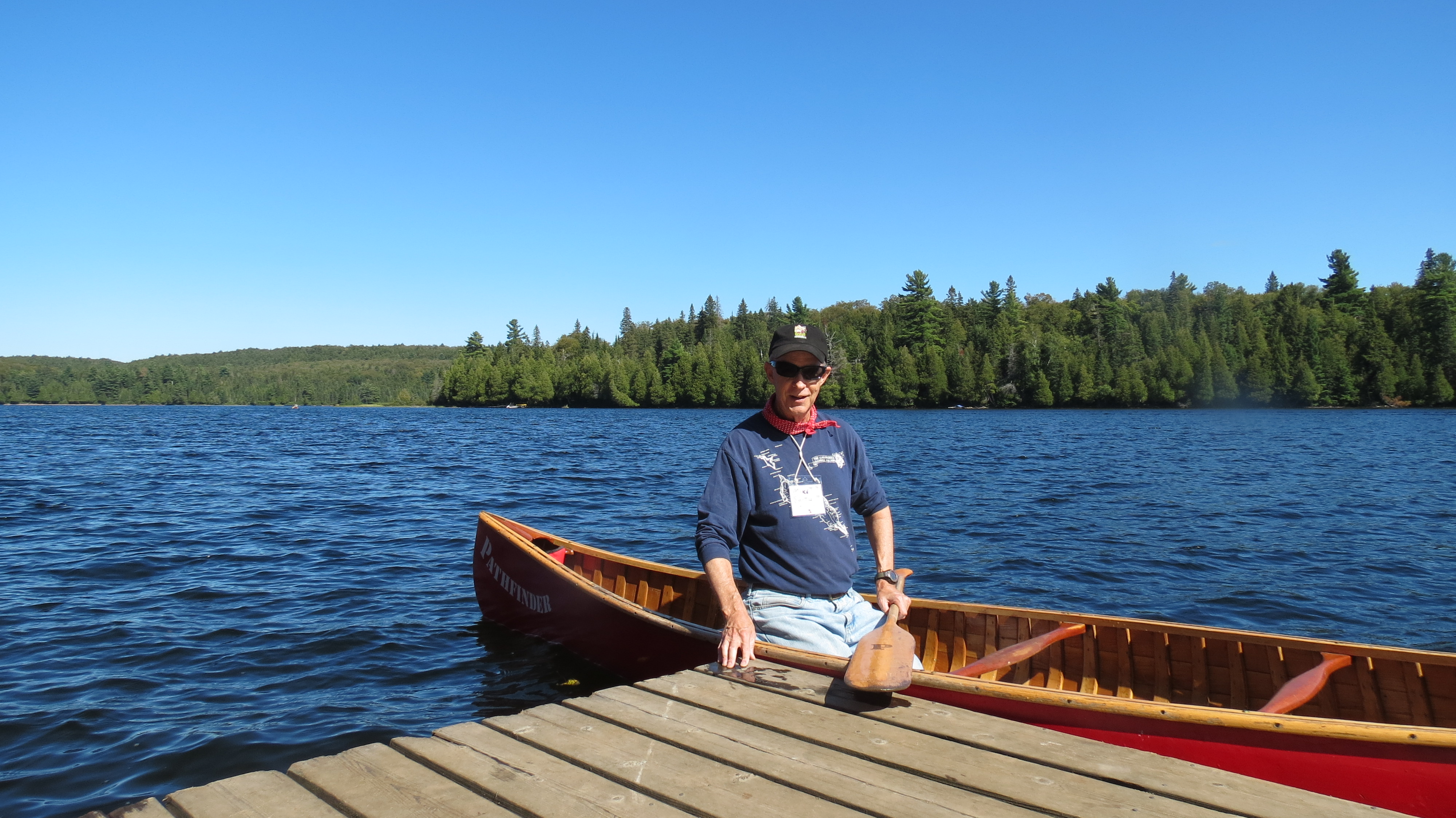
Day trip in Algonquin Park, on Little Island Lake. I camped on this very spot 50 years ago. I am back right.

Back from a paddle around the island….and of course a little more. These red canoes are hand made, still wood and canvas, and weigh about 41 kg (90 lb). On the day trip, I carried it 1400 meters without stopping. To still be able to do that was one of the high points of the trip. My shoulders hurt for several days after.  Notice the red neckerchief. That is the sign of a head man.  I earned that, and I was not the only one at the reunion who wore one.

Loon and chick, Source Lake, Algonquin Park.

COMING HOME AT LAST

August 27, 2013

When the plane touched down in Rochester, New York, where I spent my childhood, I expected I would view the city with considerable interest, since I had not been back for 45 years.  I didn’t expect that my immediate view would be blurred, because I was immediately teary-eyed.  That surprised me, for while I certainly cry, I usually have some warning.  I deplaned, telling both the flight attendant and the pilot that this was my first time here in 45 years.  They smiled.  I walked through the airport, far, far different from the last time I had been here, arriving at the rental car counter.  As I was getting checked in, I told the young man it was my first visit here since 1968.

“Welcome home,” he said.

I lost it.  No, it wasn’t just teary-eyed, I started crying, the kind of crying where you simply cannot talk and your face is soaked.  It didn’t last long, but the emotion caught me totally by surprise.  As I write this, I am teary.

I lived in Rochester from shortly after my birth in Berkeley, California, until 1963, when I left, to finish my last three years of high school in Wilmington, Delaware.  Other than working a summer at Eastman Kodak in 1968, where I hardly ever explored, I had not set foot in the city, or even New York, for that matter.  I finished high school in Wilmington, and I had a lot more friends there, but when I returned to Wilmington 42 years later, I did not have those emotions.  I was curious, but I did not cry.

Driving out of town, for that evening, I wanted to see our summer place on the Finger Lakes, I saw names I had not thought about for years–5 and 20 (a well known road my pediatrician told my mother I should play on, which would solve some of her problems), Rush, Henrietta, Conesus, Canandaigua, Lima, Livonia, and Honeoye, the last the lake where we had our cottage.  I was about 6 miles from Honeoye before anything looked familiar.  Even West Lake Road was different.  The numbering system had changed, and only the fact that I went past the cemetery on my right told me I was on the right road.  “California Ranch,” a peninsula, was now “Ranch Road.”  I went by “Poplar Road”, which I remembered immediately as being the last road before the one to our cottage.

Had you asked me any time in the last 40 years where Poplar Road was, I would not have been able to answer.  But I knew it immediately when I saw it.

The cottage was basically the same, but the trees, the new cottages, the whole area was different.  The owner was kind enough to let me in, and I was standing in a room where my feet had trod when I was a young boy, not an old man.

That evening, on the dinner menu, “Texas hot dogs” were advertised.  I hadn’t heard the term in decades.  Rochester is home to red and white hot dogs.  I can still hear the waiters at “Don and Bob’s”, which now exists at Sea Breeze: “Two texas, three white!”  When we left Rochester, that was the end of white hot dogs and Genesee Beer.

The next several days, I visited Cleveland to see my 49th national park, and drove around Lake Ontario to a camp reunion and to visit a good friend in Ottawa. This was a true “Remembrance Trip.” I returned to Rochester from the east, drove down Elmwood Avenue, and again saw street names I hadn’t thought of in decades.  I arrived at 12 Corners, immediately recognized it and the three schools I had attended through the 9th grade.  I was speechless, but I was done with the tears.  I saw the schools, turned down the street I lived on, and saw the house where I grew up.  It looked good.  So did the window from my room.  I looked at the sidewalk and the driveway, where a half century earlier, even almost two-thirds of a century earlier, my feet walked.  It was good.  I needed to see my house.  I was through with the tears now.

I drove to the hotel near the airport, on Chili, which I immediately knew was pronounced CHI lie, not CHILL e, where I was flying out the next day.  I told the counter clerks that it was my first time back in 45 years.  They smiled.  I tried to say that it was the first time I had seen my house and my school in a half century, but I couldn’t speak.

I started to cry.  I absolutely could not get a word out for five minutes.  They smiled and nodded.  I was astounded at my emotions.  For years, I always considered a home town is where somebody currently lives.  That is, after all, literally your home town.

But I had been wrong the whole time.  I have a hometown.  It was so obvious that it perhaps never occurred to me.  It was, and always will be, Rochester, New York.  Had I listened to my heart and eyes, I never would have doubted it.  The brain is smart, but the heart and eyes know things the brain can’t understand.  The mind of the child takes in things that the adult brain simply can’t comprehend.  My heart and eyes knew I was home.

I took the trip, because I wanted to see where I grew up one more time.  I did that.

I just didn’t know that after all these years, I was finally going home, and how important this would be.  I went to school in Rochester for many years.  I learned a great deal in Rochester.  But this beautiful city had one more lesson to teach me, 45 years later.


FIGHTING BATTLES SILENTLY

August 18, 2013

I was insulted by a friend recently, although he will never know.

I’ve never had a lot of friends; in the past 15 years, I’ve had even fewer.  When I rode the bike, I had several, but after I quit riding, I lost contact with them, for the only connection we had was the bike.

The friend to whom I refer once practiced medicine next door to my office.  He often brought his dogs to the office, and I took an afternoon break from seeing patients to go over and pet them for 10 minutes.  It was relaxing.  He retired just before I went back to graduate school, moving to another part of the country.  He sent Christmas e-cards and generic letters, telling his friends what he was doing.  We weren’t close, but I did consider him a friend.  Until yesterday.

He sent an e-mail to me, probably to everybody in his address book, about how the Senate almost voted to give to the UN the right to take away the right to own a gun.  I haven’t followed this debate closely, but I know enough to know that treaties require 2/3s approval, which this vote wasn’t even close.  If it is not a treaty, it won’t pass the House.  In any case, I fail to see how anybody who is thinking clearly thinks it is physically possible to confiscate three hundred million firearms in this country.

We can’t even pass a law strengthening background checks of who should have a firearm, despite overwhelming (85% of firearm owners in favor is overwhelming) support by the public.  Newtown has been and will be forgotten until December.  I knew it would be.

I have never touched a handgun and don’t plan to.  I shot skeet once, in 1976.  I have no use for firearms.  I also know that in my lifetime, we will never control their use.  Firearm control is like the Middle East peace process:  it comes up from time to time, somebody thinks something good will happen, and nothing ever does.

The e-mail annoyed me.  I started to write the sender, saying that politically hot issues should not be e-mailed to those whose political beliefs you do not know.  It is a good way to destroy a friendship, which he just had.  It was short and to the point.

Then I let the letter sit and deleted it 6 hours later. I have learned to wait before hitting “send”.  I pick and choose my battles.  I will go to the mat on some issues, like the climate, but a wise man doesn’t fight every battle.  I thought perhaps the sender might becoming demented.  He is old, and his recent Christmas cards have become extremely religious compared to prior years.  I haven’t seen him since 1998 and don’t know his current situation. I won’t change his mind and will only annoy or hurt him.  Why do that?

This isn’t the first friend I’ve lost over political issues.  One crossed a line that I considered important, and I decided not to contact her further.  I’m not going to change her mind, and silence is the best option, for it has many meanings.  Silence can hurt, but unlike hateful words, silence can be reversed.

A third individual, from Russia, whom I help learn English, explained Islam to me.  At first, I learned several facts I found interesting.  But later, she told me that I was of course going to go to hell.  I was more than a bit miffed and thought about stating to her my lack of belief in hell, except here on Earth. I could have asked what happens when two people, both believing their religion is “the proper way,” collide. It comprises a good deal of the world’s problems.

I remained silent a few days. She finally wrote me to see if I were upset. Yes, I was very upset, but I replied only that I was ready to teach her English. My silence had been my answer.  Maybe she understood what it meant; I doubt it.  Remaining silent in the face of hurtful comments, or comments that make one livid, is difficult.  I’m getting better at it.

I don’t ask people to read what I write here.  People log on, read my words and decide whether they want to read anything else I write. They choose.  I write, because it is how I discuss difficult or interesting issues. I hope my words will make people think about the world in a different way, I also hope my pictures will show people parts of the world that they are likely never to see.  Perhaps if people see how beautiful this world is, they will be happier and will work to protect it.

What I have learned, which took far too long, is that sometimes it is better to let others have the last word, especially a spouse.  For many, having the last word matters.

My silence makes it impossible for others to know what I think. That’s powerful.  For me, having the last action matters.

Even when it is silence.

MR. STERNER

August 14, 2013

Mr. Sterner might have been a reason I became a doctor.

Walt Sterner lived with his wife Sadie all year at Honeoye Lake, next to our summer cottage in the Finger Lakes.  He was old in 1956, when we bought the cottage, and Sadie was wheelchair-bound from arthritis.  Mr. Sterner loved her.

Mr. Sterner was an elder.  No, he didn’t have a college degree; I doubt he graduated from high school, but he was an elder.  He could fix anything, building and assembling most of the things at his house.  He had a metal track about 50 yards long that he could use to transfer his boat from the boathouse to the lake.  He later built a second ramp for Sadie to easily get in and out of the cottage.  Mr. Sterner had his priorities.  I think Sadie noted that, too.

Mr. Sterner liked dogs, especially ours.  He had a gruff voice, but when Vixie, our dog, was hungry, she didn’t hang around our place, she went next door.  She got something, and Mr. Sterner got to pet her.  I can still hear him one night saying, “Pretty slim pickins’, Vicki.”

Mr. Sterner didn’t suffer fools gladly.  He never showed off his weapons, although I know he had a few somewhere.  One day he walked over to our place with his shuffling gait, blue work overalls, smoking his pipe, and started complaining about the kids down the way making too much noise the prior Saturday night.

“They do that again, and I’m gonna get my goddam thirty thirty.”

Nowadays, you could get arrested for saying that sort of stuff.  Mr. Sterner had no plans to kill anybody.  He was just venting, although I bet if somebody broke in, the muzzle of his “thirty thirty” would have been venting smoke.

My mother baked a cherry pie one week and took it over to the pair.  Mr. Sterner looked at the pie, cut a piece, and said, “Where’d you get the cherries, Ruth?”  For decades, that line was never forgotten at my house, used when something new was made by my mother.  I haven’t seen my brothers in years, but if I quoted that line to them, they would immediately know what I was talking about.

One autumn weekend, my father took me on a trip up into the Bristol Hills near the cottage.  We went to a slaughterhouse, where Mr. Sterner worked.  To most kids, this would have been pretty gross.  I was fascinated by what I saw, when I looked at the carcasses.  I don’t remember much of who said what, but Mr. Sterner and my father gave me a good instruction in anatomy that day.  I was absolutely entranced, and it is probably no coincidence that a quarter a century later, I was teaching neuroanatomy to medical students.

There was nothing false about the man.  What you saw was what you got.  He was an elder, and I always called him Mr. Sterner, as I still do.  I suspect I could have called him Walt.  It wasn’t right, however, and it never once dawned on me to do it.  A half century later, I still can’t call the chairman of neurology, who trained me, by his first name, even though I’m 64, he’s 87, and I’ve known him for 36 years.  I doubt he would care, but it just wouldn’t be right.  That’s one way you know somebody is an elder–at least in my generation.

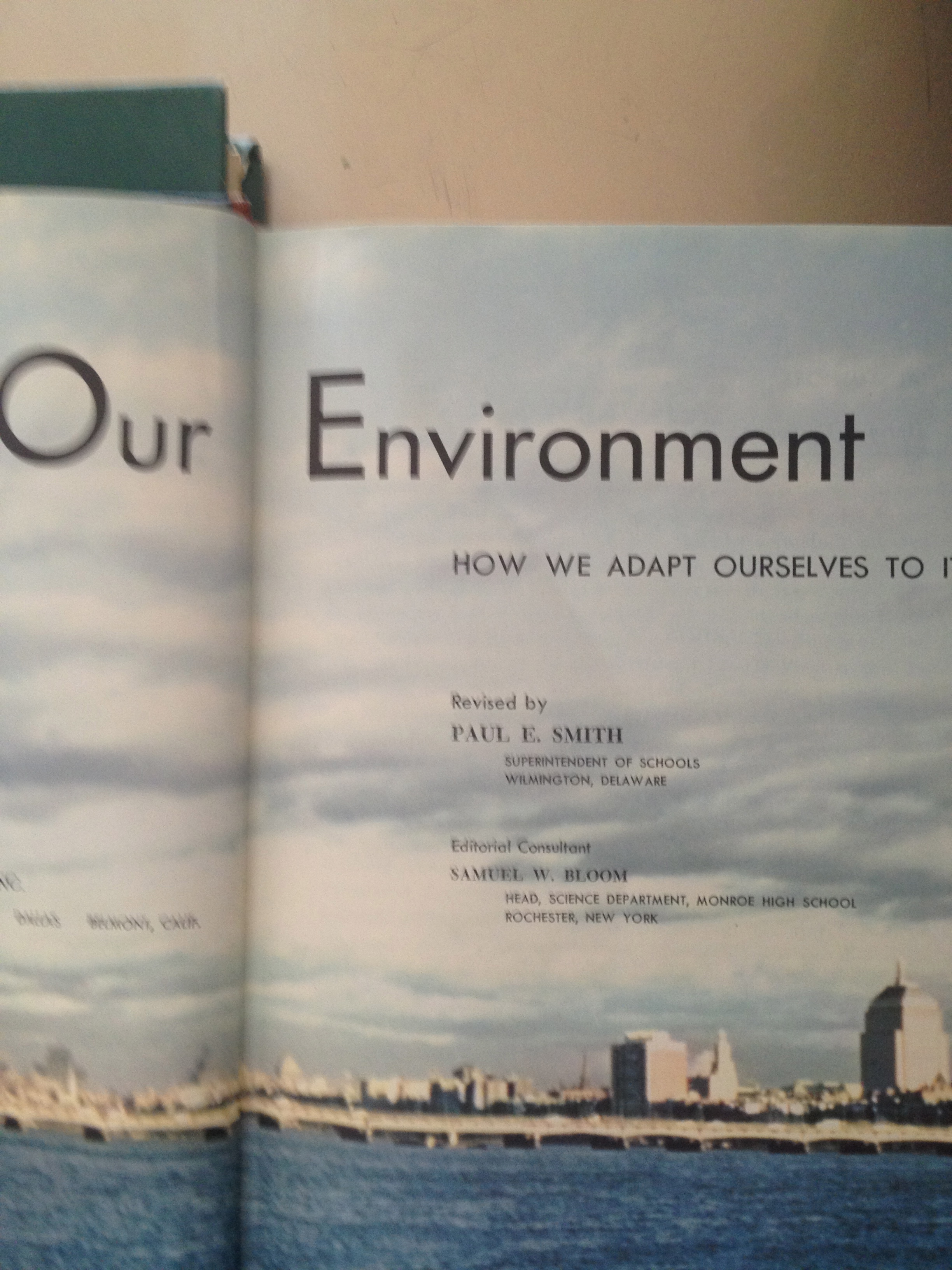
During what was my father’s final illness, at one point he needed a Chest X-Ray.  The technician kept referring to my father as “Buddy.”  I was infuriated but remained silent.  My father, Dr. Paul E. Smith, at the time nearly 92 and mentally sound, wrote two science books that sold more than a million copies each in the 1950s, when a million was a lot, and were the mainstay for science education in many schools. A lot of people would learn a lot if they read those books even today.  Dad worked his way up the educational ladder, from science teacher to principal, assistant superintendent, and superintendent of schools in 3 cities, finishing as an Assistant Dean at a College of Education.  He traveled the world.  He could fix cars and taught me how to change plugs and points.  He raised 3 sons, spent the War in Brazil educating pilots who flew to Dakar, and learned Portuguese. When he was 78, we did a canoe trip together.  Dad still knew the Latin name for a White Pine (pinus strobus).  I was impressed.  He was an elder.  He should have been called Mr. Smith, Dr. Smith, or Sir.

Not “buddy.”

When you are in the presence of an elder, be it a gruff farmer from rural New York State with minimal formal education, or a chairman of neurology at a major university, you call them Mr. or Dr.  Nowadays, many of the young call everybody by their first names.  That’s not only impolite, it is failure to recognize one may be in the presence of an elder.

Elders have seen and done a lot, but they also know what mistakes they’ve made.  In short, they have a great deal to offer to those who will only listen.  If an older person is listening carefully to you and asking questions, you may be talking to an elder.  Be sure to open your ears and close your mouth, too.  Be patient, because many elders think a lot before they speak.  They’ve learned that thinking before speaking is often valuable.  When an elder begins to speak, you will know you are in the presence of somebody special.

I’ve been fortunate over the years to have seen and done many things.  What I don’t know is whether I will become an elder in my society.  I can’t imagine a better way to grow old than to be an elder.

Title Page

This page is as informative today as it was then.