Archive for the ‘OUTDOOR WRITING, PUBLISHED’ Category

IN THE ZONE

February 29, 2024

The day was going well. I was in the zone, strapped to a Stihl power brusher, felt fine, and was swinging it back and forth across the trail comfortably, clearing the Salal, ferns, and Oregon grape encroachment. My goal was to reach Harper Creek, which looked like a sure thing; if we could work up the other side, that would be icing on the cake. I had added cotton to my ears and they and the hardhat ear muffs dulled the sound well. The brushers can be fussy; I have the touch to start them, knowing how much to choke (1 pull) and can have been known to fix them, unless a blade has sheared off, in the field. The crew boss was cleaning the filter one time and said it would be better if he could burn the gunk off but he didn’t have any matches. I said that I had a lighter in my pack, and he couldn’t believe it. Hey, it is one of the essentials. 
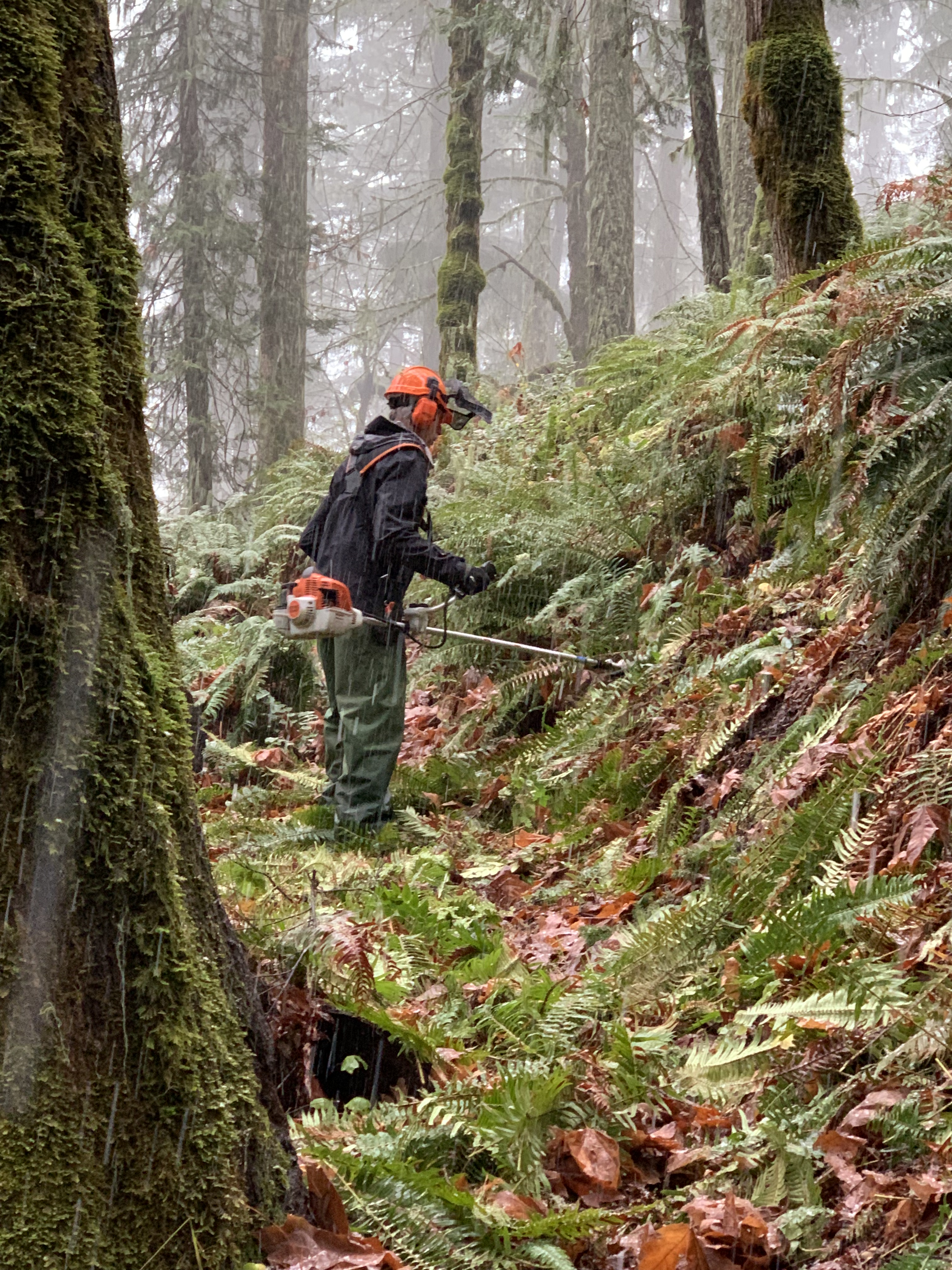
We were clearing the South Willamette Trail, a 5.1 mile path paralleling route 58 from Eula Ridge trailhead west to Hardesty Trail. It completes a 14 mile loop that starts at Hardesty trailhead, goes to the top of Hardesty Mountain and down Eula Ridge, gaining 3200 feet net vertical plus another thousand feet plus up and down on the South Willamette. Mountain bikers love the trail. There is additionally a trail running race on this route that one has to complete in four hours to be considered a finisher. I hiked it once in four and a half, in full hiking gear, and while I thought I could knock thirty minutes off my time by going light, I wondered why I would want to do that, so I never did. 

The trail has an entry at Crale Creek Road, about a third of the way from Hardesty to Eula, and we had worked both directions from there. The next step was to hike in from Crale and continue east, but I had checked a map and did some scouting to discover that I might be able to join the trail further along where the road and trail were close. I look at maps a lot and see possibilities for shortcuts. I should do a post sometime on the ones we do as trail workers. After I had scouted the trail, I hiked out to Crale, bushwhacking 100 yards, then having a decent track to the road. This track wasn’t the closest way to the road, but the elevation change was minimal, the path good, and the hike was much shorter and flatter. Short distance and many contour lines equal hills or worse.

I took the crew to the new spot I had found, and we parked near an RV that was there for the winter. I held the usual Tailgate Session reminding people to call out, whistle or touch a person ahead of them if they wished to pass.  It is unsafe to try to sneak by somebody working with a brusher or a saw, and going off trail to pass can lead to tripping. I spoke about controlling bleeding, since that is one of the few emergencies out here where quick action can save a life.  As a former neurologist, I can attest to many cardiac arrest “saves” who became vegetative, and I was the one who had to deal with telling the family the person wasn’t going to wake up.  Bleeding can’t wait, as a tragic death on the Dutch Creek Incident showed in 2008, where a tree that was cut down hit another which broke off, fell, and shattered the femur of a young man on his first fire. He bled to death. We deal with many sharp objects, and bleeding is a major worry of mine in the woods. A heart attack or a stroke out there is going to do what it will, and we can’t do much about it. Bleeding, however, we can and must control. I carry an Israeli bandage in my pack and I told everybody where it was. I also mentioned optimal places where we would try to get an injured person to.

I also was the only one who knew the route in, which gave me some credibility. I had organized the work party and chose the trail, brought the brushers, fuel, rake, and Pulaski. I knew where I was, the distances, the creek, the elevation, everything necessary. On the way in, I discovered another marking ribbon different from mine, and without missing a beat, moved towards that ribbon that showed an opening in the woods that turned out to be a user trail I had missed when I was trying to find a way from the other direction. I went straight to the main trail, no bushwhack necessary.  One of the other workers asked me—the only one who did—where the bushwhack was that we were supposed to do, and I told him that I saw the new ribbon and on the fly I took it.  The others either didn’t notice or were happy enough just to get to the trail, saving a few hundred feet of climbing and a three-quarters of a mile hiking. I love finding these shortcuts and can think of many instances where they have helped. New parking area, significant shortcut, favorable weather, everybody working well, yes, I was in the zone.

At lunch, we stopped just above Harper Creek, trail visible on the other side. I knew the area well; I have hiked the SWT many times, having cleared the trail in parts in fifteen to twenty different outings. After we finished, well above the creek on the other side, a few days later I would scout the far end and then lead a crew there the following week, either brushers only or having a sawyer along, too, depending upon what the scouting showed.

We don’t clear each trail every year; every other is usually sufficient. And necessary. 

REFLECTION

April 18, 2023

Maybe it was the silence that woke us at our campsite on Horse Lake. The wilderness is seldom totally quiet, but we caught a moment when air, plants, and animals were simultaneously still. I had experienced such quiet only two other times, once in the Grand Canyon, the other in the Boundary Waters. In any case, I was awake, quietly unzipped the netting, and crawled outside, barefoot.

Before me was a phenomenon few witness: a clear, dark night sky with no light pollution. We were in the largest roadless area in the contiguous states, and it was a long way—2 days’ travel by canoe—to the nearest road and a good deal further to any sort of town. The Moon was almost new and wouldn’t rise for two hours. Below me, I felt the cold, wet, dewy grass of the campsite. It might yet become foggy for the morning travel south through two lakes and a river to Jackfish Bay on Basswood. 

Looking over at the calm lake, I saw Orion’s reflection in the water before I even looked up at the sky itself; Betelgeuse, Saiph, Bellatrix, Rigel, with the three stars in the belt, Alnitak, Alnilam, and Mintaka, all clearly visible. I’ve seen good reflections in the daytime; this reflection was the best I had ever seen at night. Up in the sky was the actual Orion, Jupiter a little to the north, among the stars in Gemini, so bright that I first thought I was seeing Venus, although that was clearly impossible at 1:30 am. 

When I view Orion, I often follow the belt to the right or west two fists at arm’s length to Aldebaran, in Taurus, in the Hyades Cluster and then another fist length to the Pleiades, nearly high overhead, through the white pines on the campsite.  I didn’t have my glasses on, but the sky was transparent, perfectly calm, but if a touch of a breeze came up, fog would form. 

For the first and only time in my life, with the naked eye I could make out the seven bright stars in the Pleiades using averted vision. If one views in low light, looking slightly to the side of a desired object focuses the image on the dim light sensitive rods of the retina, not the bright light sensitive cones of the macula, where sharp, colorful images are discerned, but at the cost of sensitivity in low light. That’s why we see colors poorly at night. In any event, I saw Alcyone, the brightest Pleiad; then Electra, Maia, Celaeno, Sterope, Merope, and…yes, there it really was, Taygate, near Maia.

I’ve noted when it is quiet, I talk in a whisper. There are few places in the modern world where one is immersed in wilderness, dark skies, and silence, my “Outdoor Triad.”  On the September trips, we had either darkness like this or saw the post-Harvest Moon rise almost at the same time for the next two to three nights. If the weather were clear, we could watch the Moon rise through the trees, or, by changing our perspective to the correct one, realized we weren’t seeing the Moon rise, we were watching the Earth rotate. 

Try to watch the Earth rotate sometime. You don’t even need to leave town, although it’s a lot better in the woods. Changing one’s perspective is good for the soul. 

See you on the trail.

Obsidian Journal (obsidians.org) April 2023

COMPASS

February 19, 2023

 I have been invited to submit monthly articles for the Obsidians (Eugene outdoor club) bulletin. This article was adapted from my article Thump, which occurred in 2006 and was posted in 2009. Many articles will have single word titles, my choice.

11 p.m., somewhere on the southwest corner of Isle Royale, the national park island in Lake Superior, part of Michigan, but closer to both Minnesota and Ontario.

It’s cloudy and dark, but the rain and wind have stopped, and I hope my mag lite will keep working. I have seven miles to go to Windigo, where I can camp, unless my light quits and I have to camp on the trail. 

Three hours earlier, I had been lying supine on my bag, almost dozing, shoes off, when I heard a few thumps outside the tent. One more thump, I told myself, and I’m going out there to see what is going on.  

Thump. 

I put on my shoes, opened the screen and looked in front of me.  Nothing. I crawled out, stood up, and turned around. Twelve feet away, separated only by air, was an adult wolf.

“Oh. My. God. “ I said. What I was seeing had been for decades at the top of The List of things I wanted to see.  But like this?  The wolf and I stared at each other, and he slowly circled the campsite for the next 3 minutes, looking up at my hung pack on a nearby tree. His jumping at it was perhaps the thump I heard. Then, suddenly, he was gone. 

I intellectually knew there was no documented case of a healthy adult wolf’s attacking an adult person. That’s fine to know, but it means little should one be ten trail miles from the nearest other person, where there was no way whatsoever to communicate. No way I would stay put; I packed up and shortly before sunset under an overcast sky was back on the trail.

I thought on this May night, it might be light enough in the woods, but not when overcast. The trail was easy to follow at first, and I only had to worry about moose that might bed down near it. I made decent time despite my having already hiked ten miles and now doing another ten, rather than sleeping. I admit to occasionally turning around and looking behind me.

I approached a large jackstraw of logs in the middle of the trail and started to pick my way around. I kept going until I finally found the trail and started hiking normally again. A few minutes later, something didn’t feel right. I’m analytical to say the least, and while I don’t pooh-pooh gut feelings, I like to have hard evidence. Then again, this evening, I went with my gut and got out of that campsite. What I was feeling now was every bit as disquieting. 

Am I going back the way I came?

I generally have good trail sense, but I have become turned around before, and I was now seriously concerned, so much so that I stopped, took off the pack, opened the pocket where I had a compass, something that I have almost never used on the trail.  I took the compass out, didn’t worry about the declination, held it away from me in the direction I was now going, shone the light on it and asked one question: am I facing SW or NE?  

The direction was SW. I had turned around. 

I put the compass away, turned around, and started hiking again. Sure enough, I soon reached the blowdown, this time more carefully finding the trail continuing northeast. At 1:30 a.m., I arrived at Windigo, pitching my tent on the lawn at the Ranger station. When I awoke a few hours later, I was 50 yards from an empty three-sided shelter.

See you on the trail.  Bring a compass.

THE ANNUAL CONJUNCTION OF SPRING, A SPECIAL RIVER, AND A SPECIAL BIRD

March 7, 2014

It’s late in the evening in March on the Platte River, bone-chilling cold in the viewing blind, where I stand alone.  I am in the center of what many call “fly over” country, about to witness one of the greatest scenes in nature.  It is one of my top four, but don’t take my word for it: Jane Goodall lists it in her top ten.

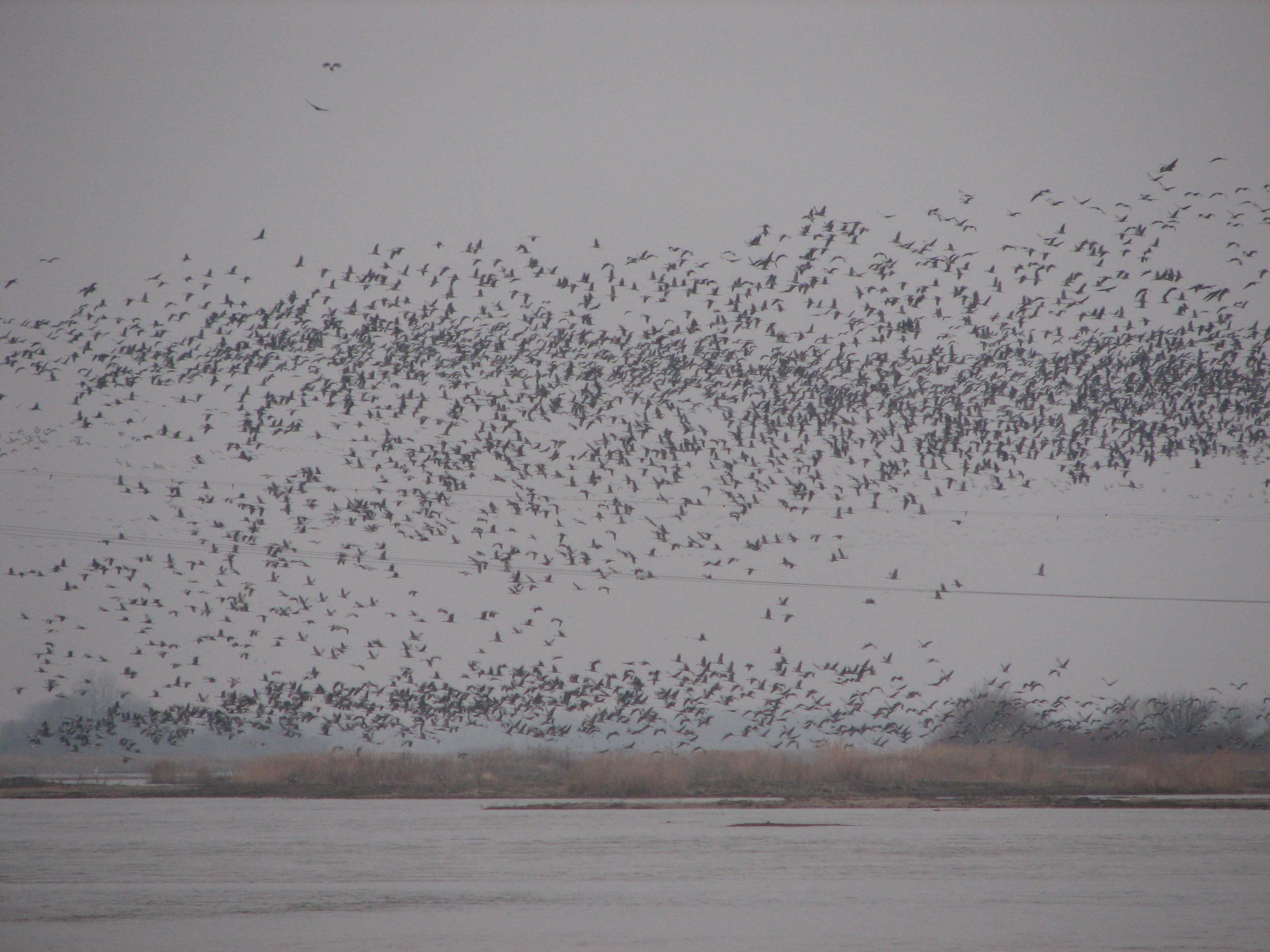
I hear the whining noise that sounds like a jet engine, but this sound is a lot closer.  It is the sound of thousands–no, tens of thousands–of Lesser Sandhill Cranes, coming into the river for the night.  Fly over country, indeed.  I am in fly over country; the birds are flying over the blind, in circles around the blind, at the blind, at me.  I am freezing cold, shivering with thrill, holding the video camera, exclaiming words I don’t usually say:

“I have never seen anything like this in my life.  The sky is black with birds.”

It is not often I post before I have completed what I want to say, but crane season is now, and I want to get some pictures up and some videos as well.

IMG_2729 IMG_3978

Platte evening

Platte evening

I’ve been in the viewing blinds 90 times, alone, with other clients, which I once was, and with clients whom I now guide to the blinds.  I have been in the blinds in 80 and 15 degree weather, thunderstorms and snow, gorgeous sunsets and with a biting wind that only Nebraska can dish out in March.  There is not one single time I have failed to learn something, about the birds, people, or myself in the blinds.

I am proud to be a Rowe Sanctuary volunteer.

IMG_2471 IMG_2920

Rowe was established forty years ago, now having a lovely visitor’s center, made of recycled wood from Nebraska schools, insulated with straw, and microphones to pipe in the sound of the cranes at night, which few hear, except in scattered farm houses along the river.  There are other buildings to house volunteers, with all sorts of tools and vehicles.  They now have a Crane Cam, too, which once I help put up, far upstream, so that when one “runs” the camera at night, the individual is showing the entire world the sight.

IMG_2809

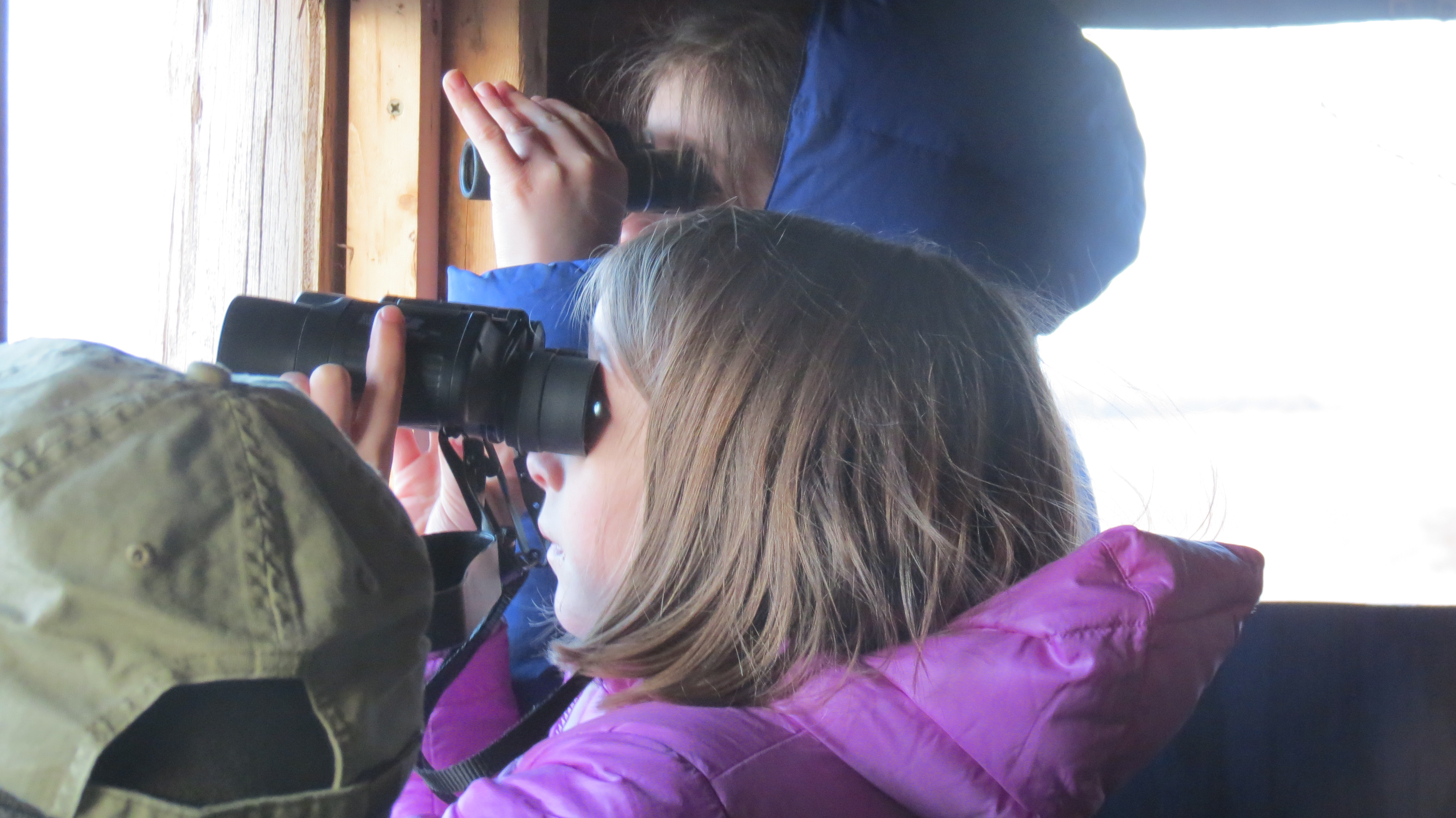
A big reason why I volunteer. It is for the children, so they will learn to love nature and the beauty of the world. Tower Blind.

Far more briefly than what I tell people, the cranes winter in the southern states and migrate to Arctic Canada, Alaska, and Siberia.  I have seen them in Bettles, north of the Arctic Circle. They do their final staging for their migration in the southern bend of the Platte.  They cannot perch in trees, so they live on the ground, in the air, or in shallow water, which keeps them safe from predators at night.  During the day, they feed on waste corn primarily in the fields near the river.  They go to the river at night for safety.  They gain 15% of their body weight in this period of time, the Platte’s becoming the largest single bar in the world for Sandhill Cranes.

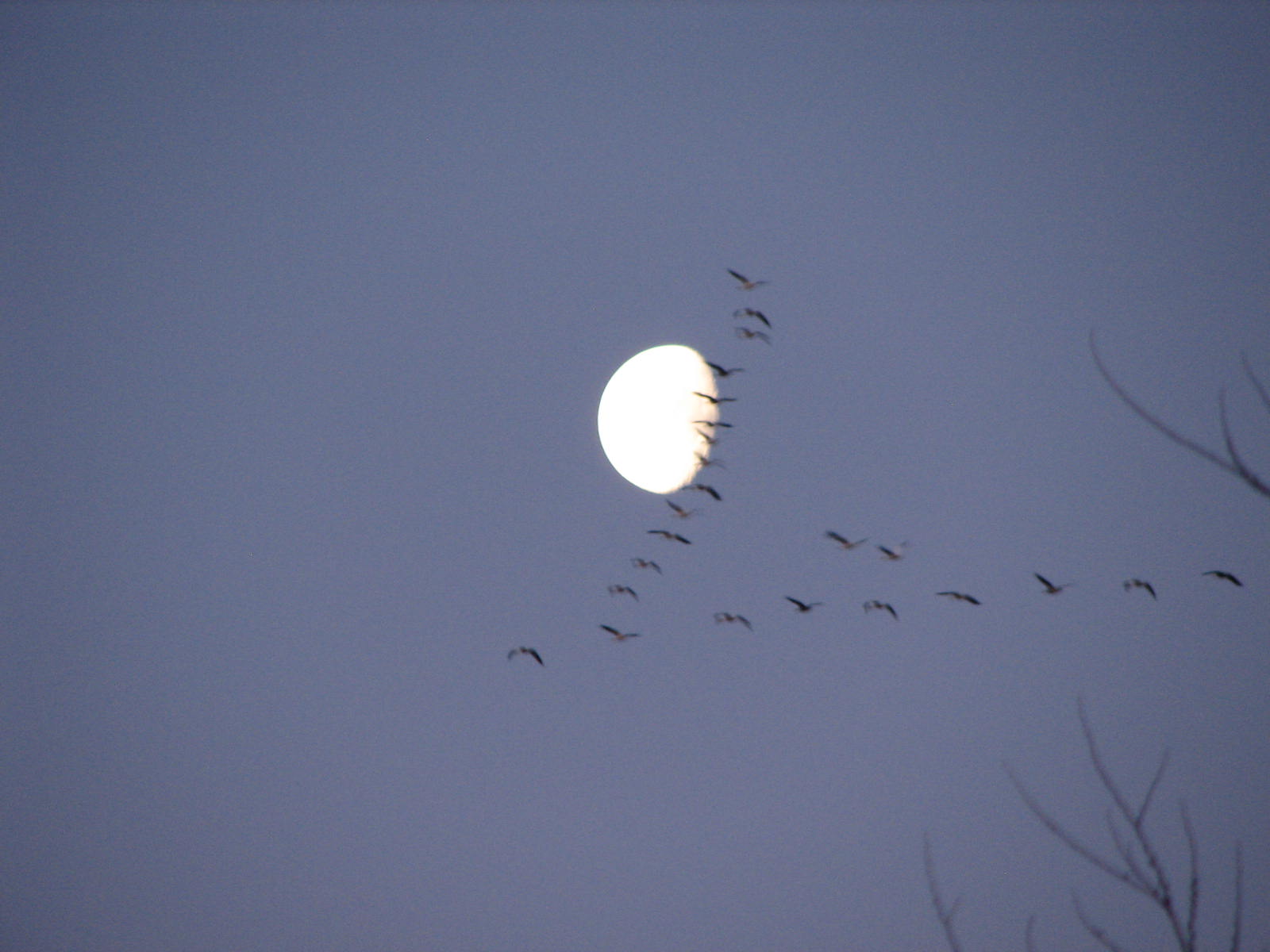
Crane Moon

Crane Moon, 2010

From my bed, on the floor in the visitor’s center at night, I hear the cranes before I drop off into a brief sleep, for I will be awake at 4:30, getting Rowe ready for the 6 a.m. blind tours.  I may go as a guide, I may go to help a guide, but I will go.  The morning is different, because one arrives in darkness, hearing only cranes, or sometimes nothing, complete quiet, itself a rarity in this country today.  As the river wakes up, the cranes start to move.  Some “dance,” better than the stage, one lady told me, and they do it for courtship, pair bonding, and likely for fun.  Occasionally, all the birds leave at once, and one can see 25,000 in the air simultaneously.

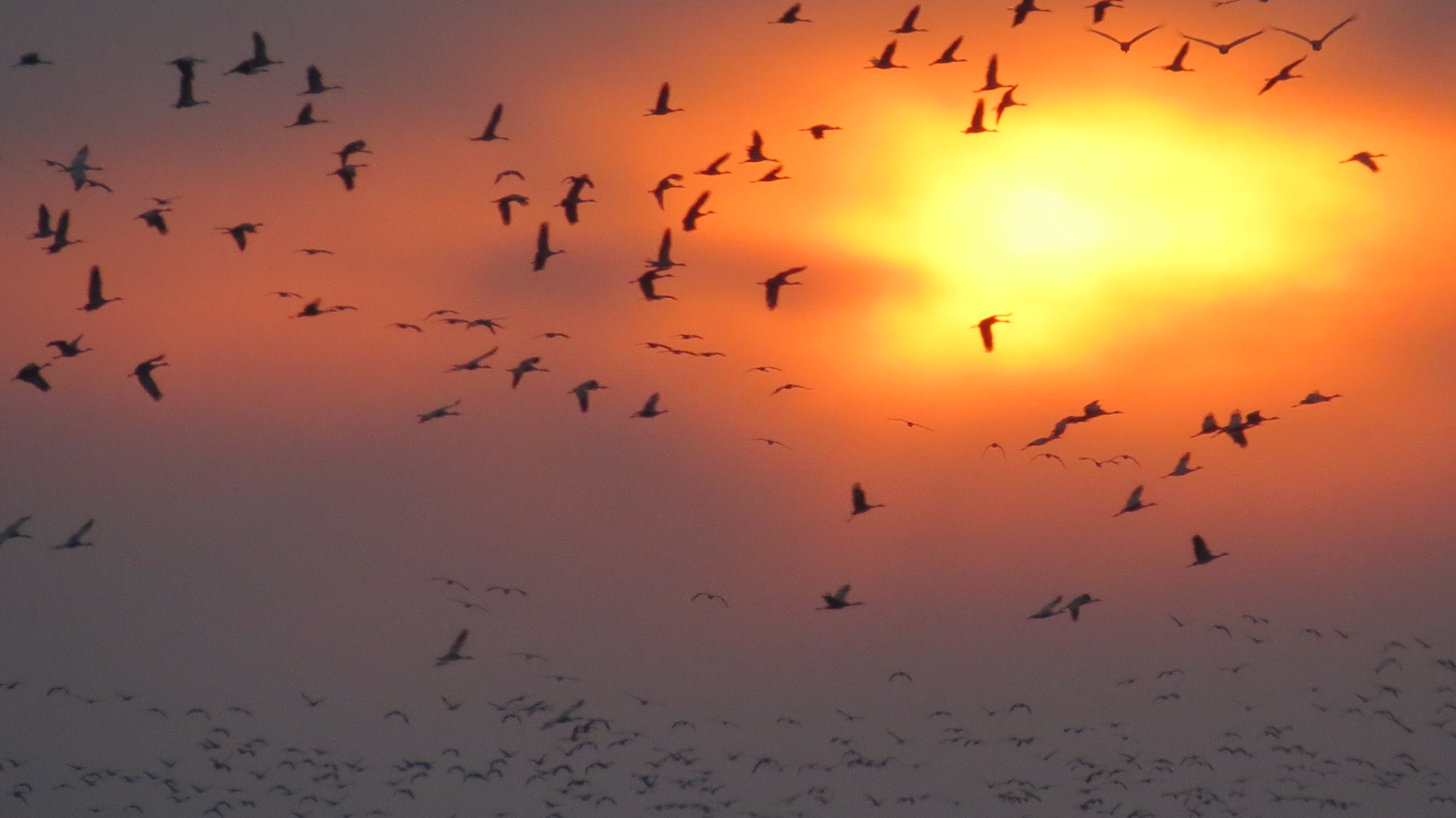
Platte sunset.  So many nights I never thought I would see a good sunset.  So many nights I was wrong.

Platte sunset. So many nights I never thought I would see a good sunset. So many nights I was wrong.

The evenings are when the birds return.  They may stage in fields and wait until after dark.  One evening, I told a group we would leave a few minutes late.  “They are nearby in the field over there,” I said.  Two minutes later, several thousand erupted before us.  It made the tour.

large group on river

large group on river

The colors at sunset are remarkable

The colors at sunset are remarkable

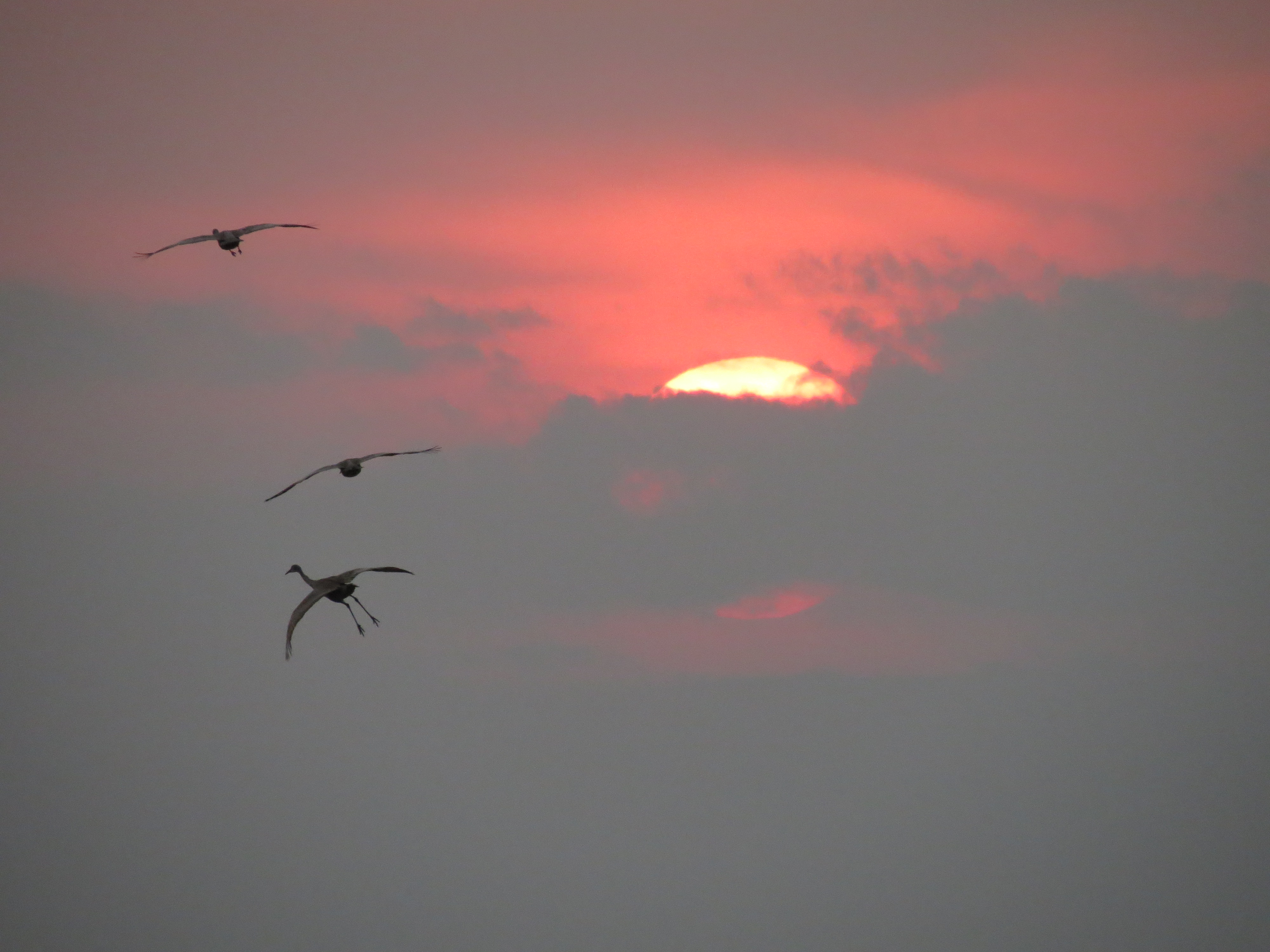
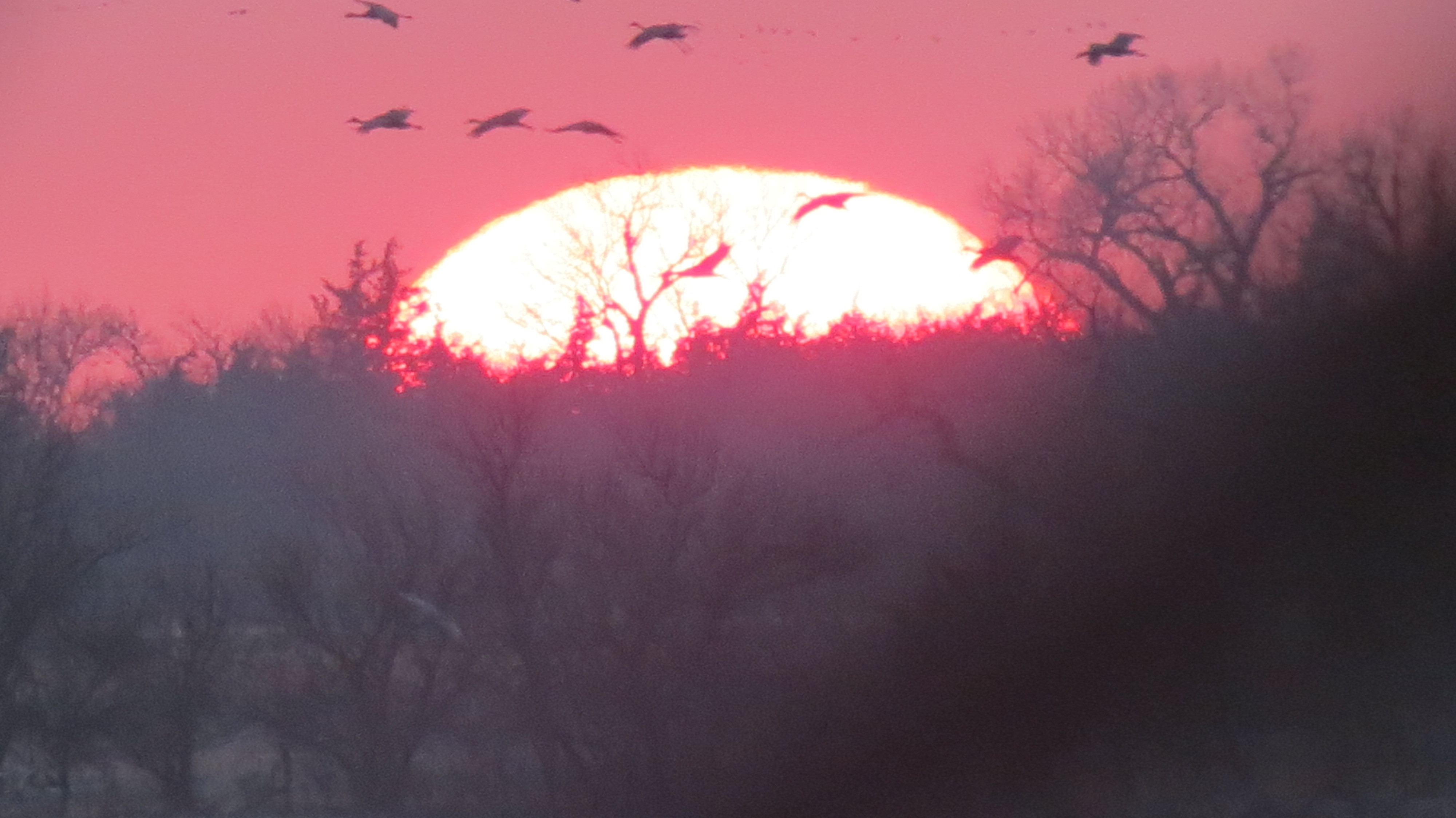
Birds and setting sun.

Birds and setting sun.

nother evening, I counted approximately 10,000 in 30 minutes. coming from one direction.  I’ve seen two flocks of 10,000 meet overhead.  I cannot describe the sight or the sound.   They come across the Sun, too.

IMG_2878

IMG_2955

When I became a neurologist, I learned that birds have “basal ganglia” brains, their behavior programmed, just like our walking, so we don’t think about it.  Last year, however, I learned the avian brain is configured differently.  The same neurotransmitters are present, and that was a tipoff maybe I could deal with my cognitive conflict: how can a bird with automatic behavior may appear to have fun.

The answer lay in the fact that birds can learn.  This has been seen and documented by a couple in Fairbanks, Alaska, who see the same pair of cranes return each year.  They see the cranes teach their young to fly.  A young crane who died was visited by the parents and sibling, who pulled grass over the body.  I don’t know what that means, and I am not even going to speculate, but I don’t think this is basal ganglia behavior.

Pair close by.  The red patch is featherless.  It becomes larger, should the bird be angry or aroused in any way.

Pair close by. The red patch is featherless. It becomes larger, should the bird be angry or aroused in any way.

I think my learning neurology forty years ago assumed things were later questioned.  Others may disagree with me, but they are disagreeing with a human neurologist who has seen pictures of how the avian brain is constructed, and has left, shaking his head, saying, “That is why they look like they are having fun.  They are.”

I have also learned how much fun I have, when I am at Rowe.  I work 17 hour days, occasionally with breaks to upload pictures or talk to people who visit–except that is supposedly work.  I clean toilets, drive ATVs to take people to the special photography blinds, expensive, but these are booked far in advance, and nobody ever complains about being cooped up in a 4 x 8 piece of plywood over night with a 4 foot high roof, 4 windows, and a chamber pot, not allowed to leave for any reason until morning pick up.  I’ve brought these folks back to the sanctuary, dirty, sleepy, and happy, with stories of what they have seen.  I’d be jealous, but I have seen most of this, too.  I am happy for them.

Tours run morning and evening, about 25-30 in a blind.  All tours are different, and sometimes a two minute period makes the day, or the week; the video I uploaded was 2 minutes, after about 2 hours of watching a pleasant river.

I meet volunteers from around Nebraska, with a few from neighboring states.  These people teach me common sense, how to work with tools, how to be a better person.  We don’t always agree, but we do whatever we can for each other.  Seldom have I had this experience anywhere else.  Last year, a 75 year-old woman taught me how to back a trailer.  She had been doing it since she was 8.

The cranes?  During the day, I have stopped driving the pick-up with the Buffalo or Hall County license plate, gotten outside, and looked up, sun reflecting off their wings of cranes, soaring at 500, 1000, or 2000 feet.  In late spring, they rise like a giant beehive, waiting to catch the south wind at 1600 meters, spread their wings, and as one volunteer put it, “Godspeed,” as they go to the Canadian Arctic, Alaska, or even Siberia to nest.   I’ve seen them migrate south over the Boundary Waters, and Hilt, California, the most northerly city in the state.

The few weeks a half million spend on the river are beyond compare.  I never tell people what they will see except “Cranes, plural.”  It is not my show, it is the birds’ show.  Almost everybody likes it, a few are changed a bit, and a lucky few, like me, are forever transformed, looking forward to the special time of year when as Paul Johnsgard puts it, the season, the river, and the bird all come into conjunction.

Spring, the Platte, and the Lesser Sandhill Crane.  All are needed.  All are sufficient.

FIFTIETH ANNIVERSARY

February 11, 2014

“A wilderness, in contrast with those areas where man and his own works dominate the landscape, is hereby recognized as an area where the earth and its community of life are untrammeled by man, where man himself is a visitor who does not remain.” –Wilderness Act of 1964

I am alone at 9453 feet, on a mountain top the way I imagine it, a quarter acre, maybe half, no trees, drop offs up to 1000 feet on all sides.  Above me, swifts are catching insects, their swept wings making identification easy.  I am dehydrated after hiking up on a hot June day, the 32 ounce drink I had at the start long gone before I even reached Josephine Saddle at 7200 feet. I am more than a vertical mile above Green Valley and 5 miles from the trailhead.  A million people live in the area I can see, but not one of them is within three hours of me by trail, and that is the only way up here.

My thirst doesn’t matter; I am higher than any other person in southern Arizona, seeing a wonderful sunset I will never forget, the reds and oranges stunning.  It was worth hiking up from my Baldy Saddle campsite to the top.  I must leave soon, as it is starting to get dark, and some of the trail will not be safe in darkness.  I will awaken tomorrow, away from the rush hour traffic of a large city, in one of the wilderness areas of Arizona, the trailhead little more than an hour’s drive from my house.  Few ever see this place, the Mt. Wrightson Wilderness, my favorite spot in southern Arizona, where I myself am a visitor and will not long remain.

I have camped here alone in a snowstorm, warm inside my sleeping bag, hearing the snow accumulate and then slide down the tent.  I have camped up here five times, a lot of work needed to haul a pack up the Old Baldy Trail, as it is known, but every bit of it worthwhile.  I have taken day hikes, once playing hooky from work for a few hours to come up in a snowstorm, returning to my job that afternoon, completely soaked, but absolutely happy and thrilled to be alive.  I have hiked up here and down the other side to Gardner Canyon, because I had never seen the Gardner Canyon trailhead.  I then turned around and came back up and over.  Wow, was I thirsty that day.  I came up the north side one day and stayed too long, hiking down in the dark with no flashlight, in old growth forest, never once cut, an owl’s sudden hoot making me almost jump off the trail.  That was a great hike.  They all are.  I know the trails like old friends.

From Baldy Saddle, reached from the west by 33 switchbacks, I see Green Valley and the Catalinas north of Tucson.  To the east, about 30 steps, I see Sonoita, Sierra Vista, and south into Mexico.  From the top, I see all of these by just rotating, as is the Earth.

It took much effort to get up here, but that makes wilderness special.  I am getting my reward tonight. I earned this view, through the thirst and soreness I endured. I don’t yet know that later tonight, I will hear a cougar close by.  I need wilderness.  I can’t explain it or put a dollar sign on it, but I need it.  Periodically, I reach a stage in my life where I know I need to get outside and hike somewhere.  It doesn’t have to be long, but it has to be away from people.  I can’t prove it, but I suspect others might become happier if they went into the wilderness, even a short distance, where they too would not long remain. I think mankind still needs wilderness, but perhaps the need has been allowed to atrophy too much.  I needed Mt. Wrightson tonight. Right now, I need to return to my campsite.  The swifts call, still catching bugs, as I start down the rocky trail, the last bit of red still visible in the west.

THE DEMENTORS AMONG US

July 22, 2012

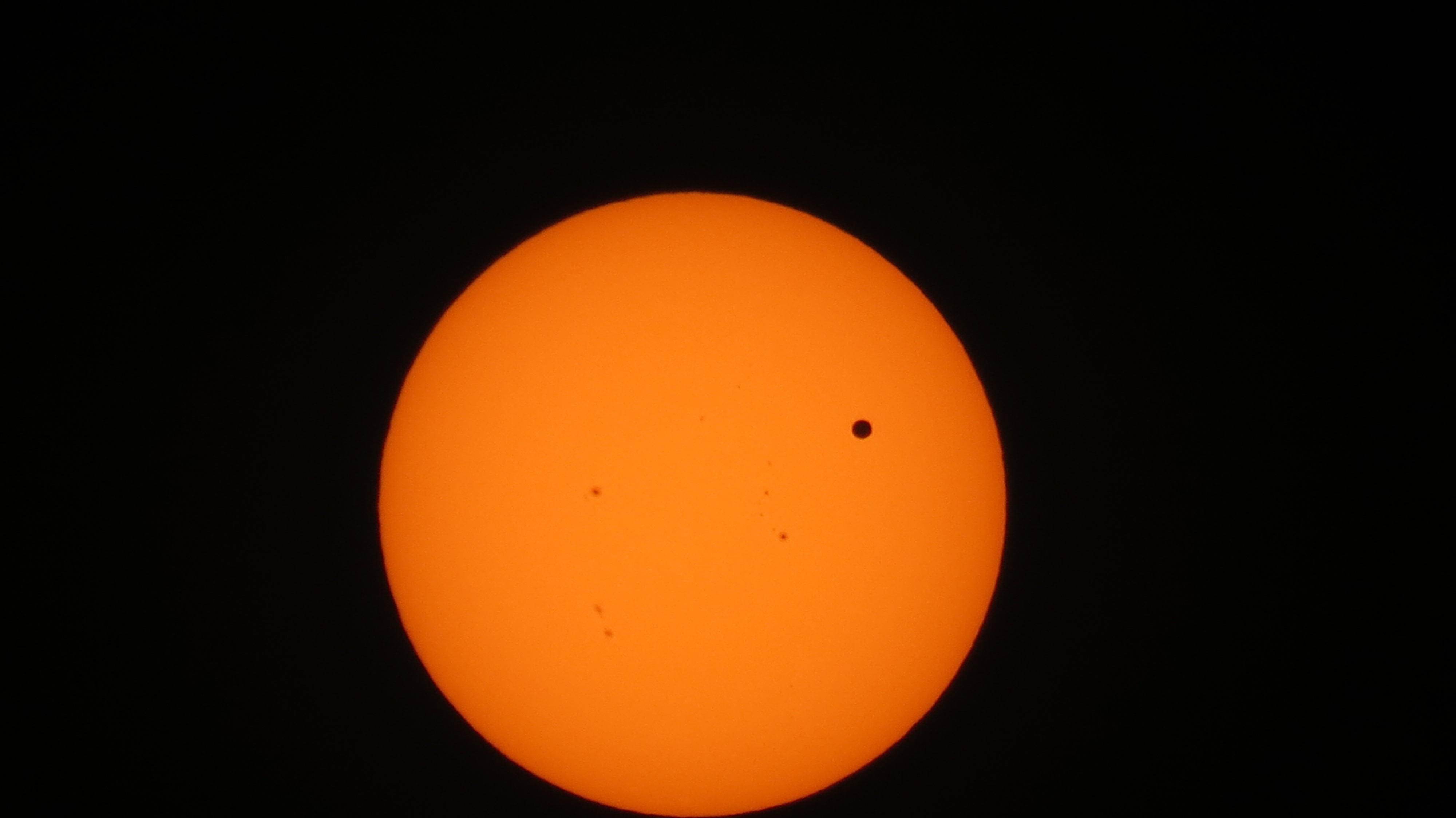
On 5 June, I took my telescope, a camera, and a videocamera, all with solar filters, to the local medical society, and showed about 100 people the transit of Venus, at the same time shooting video, taking pictures, and answering questions.  This exceedingly rare event occurs in pairs, 8 years apart; the next pair will occur 105.5 years from now.  Only Venus and Mercury, inner planets, can cross the Sun as viewed from the Earth.  Of the 100 who came, nobody knew it would be the last time I would be involved in a local medical community event; from now on, before our move next year, I will be only a patient, and hopefully not too often.

The transit was not as beautiful as many astronomical events I have seen, but it is so rare that nobody alive today will see it again, including the baby who looked through the eyepiece of the telescope; his grandchildren, should they live long enough, will.

TRANSIT OF VENUS, 5 JUNE 2012, WITH SUNSPOTS VISIBLE

A picture I took of the transit appeared on the Society’s magazine where I was once a columnist until I resigned last spring, because of reasons explained in the link.  It was a beautiful picture, and it was a good way to leave medicine, as a volunteer, who took a good photograph of a rare event, and shared it with the members.

Everybody who came was nice, except for a few comments, that while were not nasty, I could have done without.  One man, whom I know well for his right-wing beliefs (even as he gets AHCCCS, Arizona’s Medicaid) asked me the distance it was to Venus, and I said about 26 million miles.  He said, “Wow, that is less than the national debt.”

Why does politics have to be brought up during an exceedingly rare astronomical event?  The distance to alpha-Centauri in miles is greater than the national debt.  So what?  We have the national debt for a lot of reasons, some of which I think are important (Medicaid, Social Security, Medicare, FAA, FDA, NIFC (National Interagency Fire Center, which saves lives, towns, and houses) FEMA etc.), some of which are not (Iraq, Afghanistan, aid to dictators, farm subsidies, tax breaks for millionaires).   But it sucked a little happiness out of me.  Dementors do that.

Another person came whom I consider a true enemy.  The person has never once laughed in my presence in the 35 years we have known each other.  Not once.  The individual does not believe in evolution, vaccination, climate change, and thinks there should be no government involvement in medical care.  Just seeing this individual depresses me.  That is a  Dementor.  I was polite, and while that person asked good questions, there has been “too much history,” and too many hateful comments from that individual for me to let down my guard.  Since this is likely the last time I will likely ever see this person, or anyone else there, I sucked it up for 2 hours.

A few months back, my wife and I had dinner with a neurologist friend and his sister, a retired nurse.  She had worked in emergency departments, and was vehement about those who misused them.  This happens.  I was up in the middle of the night a lot, caring for drunks, helmetless people who had motorocycle accidents, people who had not taken their anticonvulsants, and were in a state of continuous seizures.  Most of these people did not have insurance, and I didn’t get paid, although I could have been sued for everything I had, were I wrong.  That is part of a physician’s life–caring for many people come to EDs for conditions that they do unto themselves.

This woman we had dinner with felt that those patients wasted time, money, and effort, should have not been rescued, but left to die on the street.  Really.  A nurse said that.  My wife was shocked; I had missed that part of the conversation.  Well, Ron Paul also said that, too, and was loudly cheered by many, who if they have no insurance, are only a drunk driver, appendicitis, a kidney stone, or viral meningitis away from being in an ED without money and 5 figure costs.  My wife said if we again had dinner with the neurologist, and his sister came, I would go alone.  We left the dinner depressed.  Dementors do that.

Last March, in North Blind on the now dry Platte River, I was in my third year as a volunteer tour guide for the Sandhill Crane migration.  I was in the lower level of the blind; my co-guide had never been there and wanted the upper level, which had better views.  I had a family of four with two tweens, who were bored.  Their mother wasn’t interested, and only the father was taking a few pictures.  It was a good show–not spectacular–but good, and the kids obviously wanted to be elsewhere.  I couldn’t teach about Crane behavior, because they weren’t interested.  I guided 20 times during my stay, and this was the only time I left the blind depressed.  In a place where you can see cranes in fog, snow, close up, or 50,000 in the air above you, darkening the sky, with a haunting call that I simply love, who have been on Earth for nearly 10 million years, where it is one of Jane Goodall’s top 10 sights, and where the governors of Colorado, Nebraska and Kansas came one night, to have a bored family was a real downer.  They were Dementors.

EVENING ON THE PLATTE, MARCH 2012.

Twenty years ago, I helped a man on the Fall Lake portage in the Boundary Waters.  It was his last portage before returning home to Miami.  He had had rain, poor fishing, bugs, and not a good time.  I thought the weather had been fine, the fishing good, and the bugs non-existent.  I helped him get his gear across the portage and wished him well.  He was a Dementor, too, but the beauty of the Boundary Waters was strong enough for me to ignore his complaints.  Indeed, I parried every one of his comments; when he came to insects, he said “And the bugs!!!” He then looked at me and said, “Or are you ‘in’ to them, too?”  No, I am not “in” to bugs, but I recognize their presence, and I realize that they limit the number of people in the wilderness certain times of the year.

I’ve had my Dementor moments; many of us have.  But there are some who are always Dementors, and I try to avoid them if possible.  If they persist, I change the subject.  I had buttons made commemorating the Transit of Venus.  I didn’t make one for myself, for I only wear solar eclipse buttons,   The Dementor at the viewing got a button and liked his.  I almost wished I had seen that.  Harry Potter had the gift; maybe briefly, I had it, too.

HUNTER’S MOON

May 7, 2011

Muddy and wet, I reached the end of the portage to Little Saganaga Lake an hour before sunset on a dreary October day.  I pushed the canoe off my shoulders, flipped it over, caught it on my knees and gently lowered it to the ground, pushing the bow into the water.  Wearily, I removed my pack and dropped it in the bow compartment, the sound echoing from the woods across the small bay.  I picked up the wooden paddle, grasped both gunwales, and carefully stepped in, pushing off from the rocky landing.

The rain had finally stopped, but once clear of a nearby point, the cold northwest wind caught me full force, as if to say winter had nearly arrived in northern Minnesota and canoeists were no longer welcome.  For perhaps the tenth time that day, I asked myself aloud why I was out here instead of back in town.  The previous day I had spent in the tent, rain-bound.  After eighteen grueling miles of solo travel through a dozen lakes and as many portages, I was back on schedule but needed to find camp soon, pitch the tent, put on some warm clothes and eat.

The lake, dotted with islands, was undoubtedly pretty in summer, but my mood matched the dark water and low nimbus clouds.  Only with difficulty was I able to keep the canoe on course as I crossed the quartering waves, the splash further chilling my mitten-covered hands.  I was therefore satisfied to land in the lee of a half acre rocky island containing a few groves of cedar and scraggly jack pine.  The campsite would have to do; it was too late and I too tired to continue looking for another one.

I carried the pack thirty feet uphill from the shore to a flat spot, then pulled the canoe up and turned it over, tying the bow to a nearby root.  I unpacked, placing food, tent and personal gear into three piles.  Grabbing a pot, I slid down the gravel bank to the lake to scoop up some water.

I lit the stove and started heating the water as I erected the tent under a small group of cedars.  With a half hour, I had changed into dry clothes, stowed my gear and had a few handfuls of trail mix with hot chocolate.  Marginally warmer, I obtained more water and started preparing my usual macaroni and rice dinner.  As I worked, a change in light heralded sunset, but clouds were too thick to show either color or detail.  The night would again be cold, but I hoped to sleep warm.  Eleven lakes and fifteen miles awaited me the next day.

Eating my rapidly cooling meal, I looked at the gray and rapidly darkening scene, wondering yet again why I had come out here.  At least I was dry and my tent sheltered from the persistent wind.  Had anyone been near to ask, I would have said there was a Hunter’s Moon that evening.  But I hadn’t seen anybody in four days, and seeing the Moon was far from my mind.  Under skies that threatened snow, I retired early, quickly falling asleep in my cedar hollow.

The geese awoke me.

I didn’t know the time, but I immediately recognized the sound.  I hadn’t heard geese since my childhood in upstate New York.  Their honking triggered fond memories when I was a young boy, looking up, fascinated by the formations, wondering how and why they did it and where they were going.  Realizing I still didn’t know those answers made me smile, as I listened to the different calls high over the island, heading south, away from the frozen waters of Ontario and Manitoba.  From the light on the roof of the tent, I realized something else as well.  It was clear.

I unzipped the tent door and slowly crawled outside, stiffly standing, barefoot, on the hard soil.  It was cold, but I was barely aware of the temperature.  I saw a brilliant Hunter’s Moon above the darkly forested south shore, its light rippling towards me across the nearly calm water of a wilderness lake.  Overhead, heading towards the Moon, were scores of geese, honking.  It was magical.  Knowing at last why I had come out here, I watched and listened, silent, until the geese were no longer visible and their calls blended with the light wind that just stirred the trees.

This appeared in the first edition of Firegrate Reviews, put out in 2010 by The Friends of the Boundary Waters

DON’T FORGET THE LITTLE GUYS

May 31, 2010

(The Echo, Sierra Club, Grand Canyon Chapter’s quarterly paper).

I’m deep in a channeled wash for at least the sixtieth time, alone, removing buffelgrass along the concrete berms and anywhere else I find it.  It is nasty, difficult and dangerous work, since rattlers are out.  I duck under a mesquite, noting its thick, luxuriant growth, put the shovel into the deep soil, and lever out another plant, a thorn nailing my arm again.  I will remove between 200 and 300 plants today, bag them, tie the bags, and with great difficulty haul them out of the wash, because there is so little traction on the berms.  Dig, bag, tie and haul.  Over and over again.

Buffelgrass is like Kudzu.  It was imported from Africa to Mexico as cattle forage about 70 years ago, and has spread like wildfire.  And that’s the literal truth.  Buffelgrass grows and burns hot–1500 degrees–and uses the heat to spread seeds.  The Sonoran desert is adapted to fire, but not fire that hot, so if buffelgrass crowds a cactus or a mesquite and burns, the native growth dies.  I don’t know if we can eradicate it from the entire American Southwest–Sonora is a lost cause–but many of us think we can, and in addition to my adopted wash, I help monthly on another section with other people.  I’ve taken out at least 11,000 plants, and as a side benefit, I’m getting a good upper body workout.

In one five day stretch, I dug out 1400 plants, using over 120 bags.  I gained maybe 50 yards up the wash.  Probably less.  In the past six months, I’ve worked my way about a quarter mile, slow going, as I hack, bag, tie and haul.  But I’m noticing changes.  First, if there is no buffelgrass around mesquites, there will be no hot fire if lightning strikes.  That will save a tree.

Second, I’m noticing native vegetation moving in where the buffelgrass stands once were.  We finally got average winter rainfall, and it helped.  Third, I am amazed at the deep soil that has washed down from the mountains; there are shade trees, quail, white-crowned sparrows, pyrrhuloxias, and black-tailed gnatcatchers.  Lately, the black throated sparrows have arrived.  They are difficult to see, but I hear many of them.  This wash with its thick growth is a park; an oasis, with condos, roads, and people just above the fence.  The above walkway is frequently used by joggers, cyclists and dog walkers, all enjoying the quiet, the green, and the lack of people below them.  Maybe it isn’t a greenbelt, but it is a green garter.

I could do without the trash; a sign reads a fine of $2500 for littering, but I wonder if anybody has ever been fined for doing it.  Some of the litter ends up in the trash bags with the buffelgrass.

This wash would need a rain we will likely never see again to flow bank to bank.  But it does get some water coming off the berms and from the west end of the nearby Catalina Mountains.  And even in Arizona, it won’t be developed, so if I can remove the invasive buffelgrass, there can be a dense growth of mesquites and palo verdes, good habitat desperately needed; an island of calm in a noisy sea of stucco and steel.

We must preserve the major rivers in this state–the Colorado, the Verde, the Salt and the San Pedro.  But washes abound, and they are part of the riparian network, too.  Visit one some cool morning, before the snakes wake up, and walk where you can.  Dress appropriately, because the mesquites are thick.  You may find you can’t even go far because of the growth.  That’s just great, because the fewer people disturb the area, the more wildlife can live.

Never thought I would adopt a wash, clean it up, and enjoy it so much.  Never realized how much life was in one.  Remember the little guys.

HELPING THE NEXT GENERATION

April 29, 2010

I’m a lucky guy–I’ve canoed the Quetico/Superior since 1981, and while I’ve camped from Alaska to Algonquin, northern Minnesota is my favorite destination.  In 1992, I spent 5 months as a volunteer wilderness ranger in Ely, the most content I have been in my life.  But one of my more memorable trips was a recent solo up and back to Pipestone Bay, lasting barely 5 hours.  It was Earth Day and the first time I ever canoed in April.

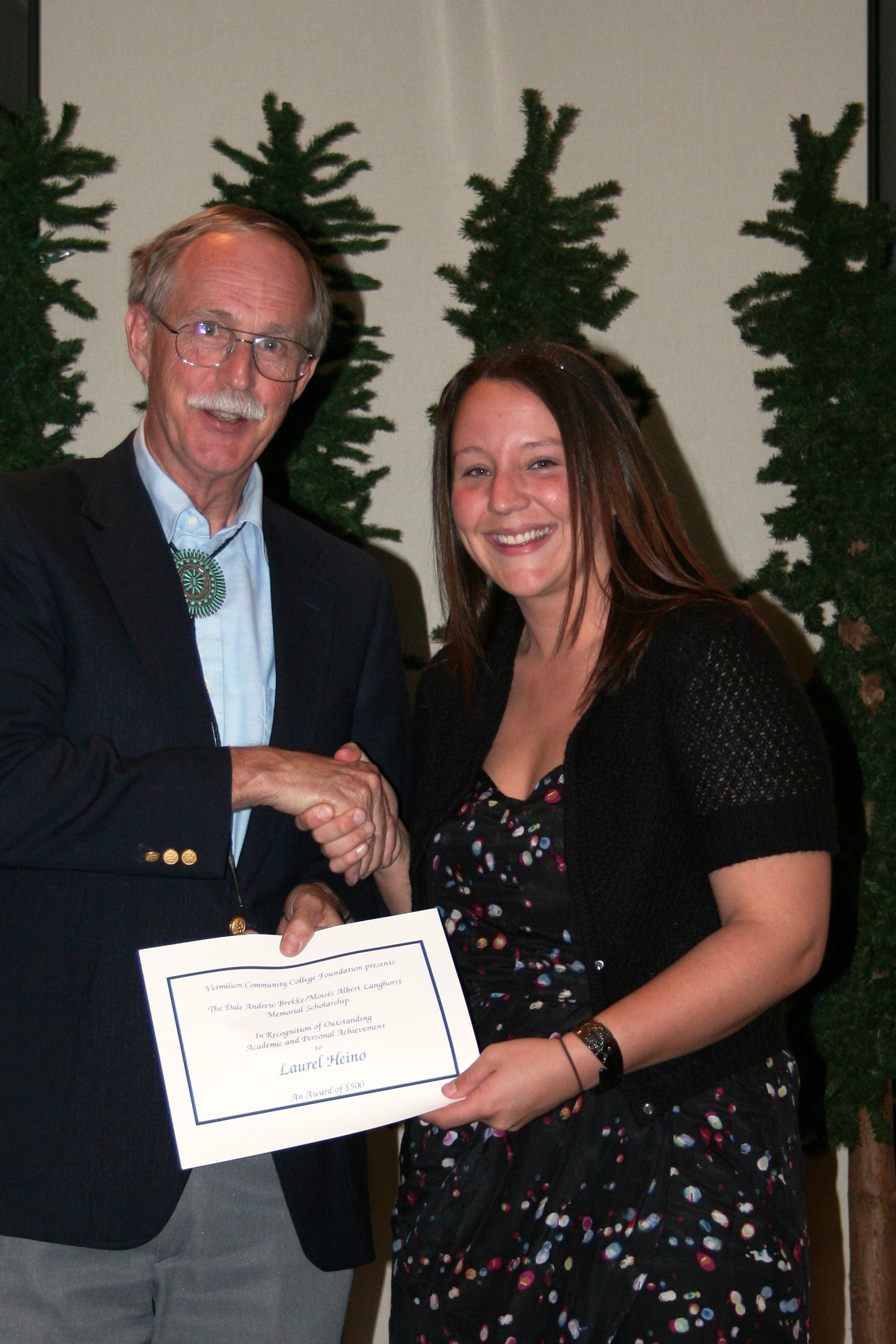
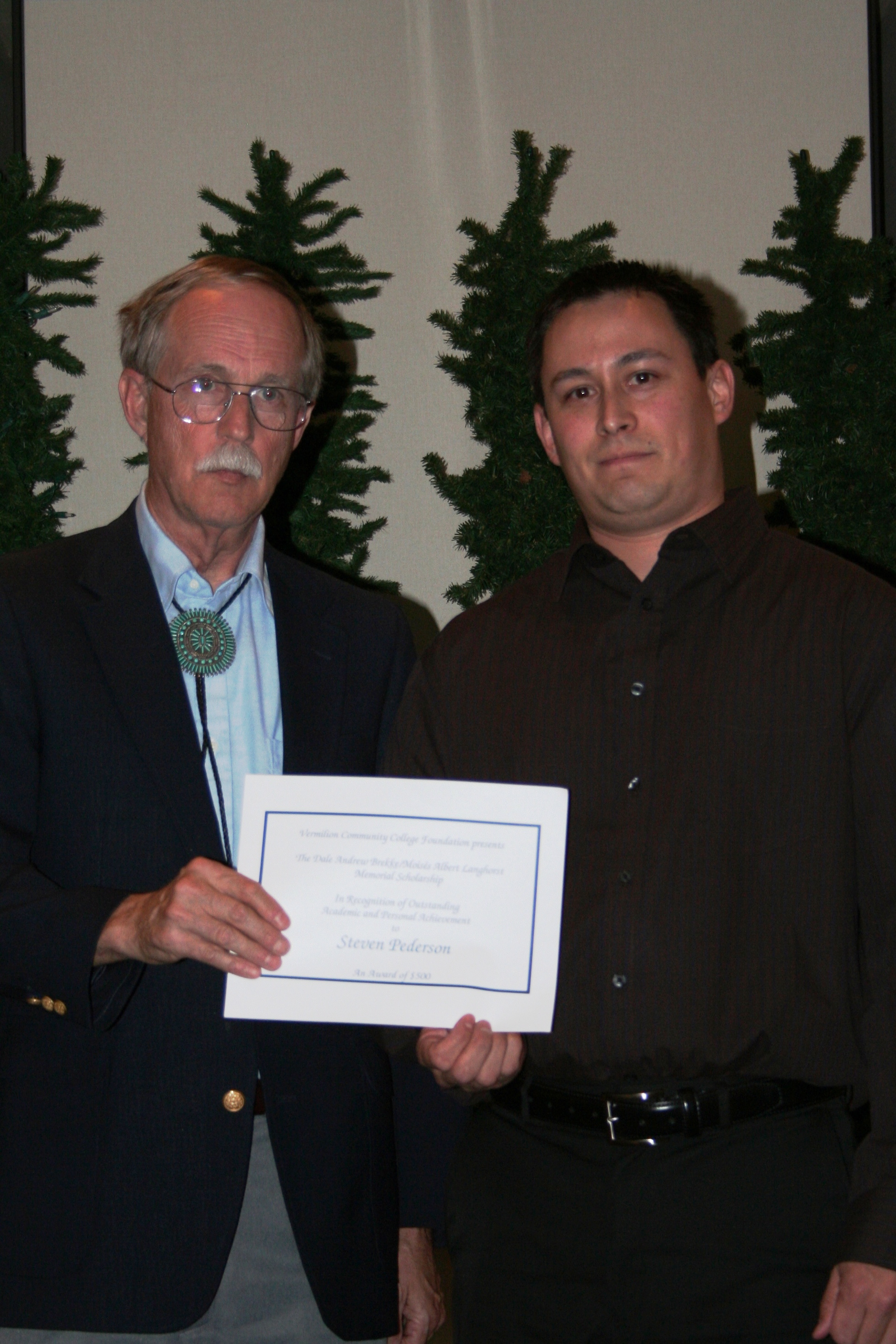
I went to Ely for the annual Vermilion Community College Foundation scholarship banquet.  For 5 years, my wife and I have sponsored a scholarship for a student selected by the College who is studying environmental or wilderness course work leading to a career in those fields.  I try to attend the banquet to present the scholarship.  It’s our legacy to a town and wilderness we deeply love.

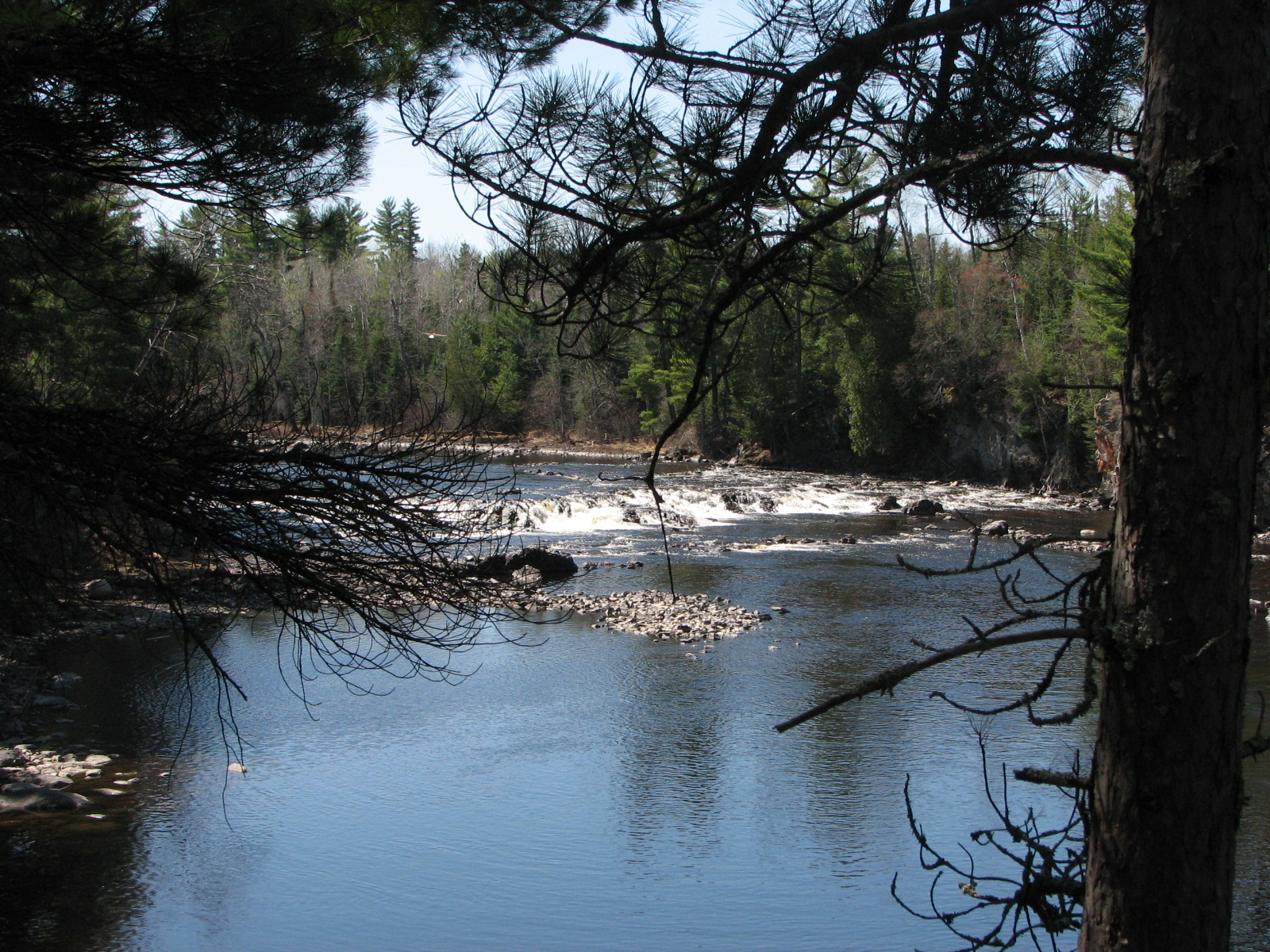
Two days before leaving I realized that if I arrived in Ely early in the day, I could rent a canoe and get on the water.  I was thrilled at the prospect (my wife said, “Why am I not surprised to hear this?”) and made arrangements.  I arrived in Ely at 9 on a perfect traveling day, got the canoe and drove out to Fall Lake.  I quickly shed every layer except for a shirt and PFD, and I could have taken the shirt off as well.  I wore neoprene gloves but really didn’t need them.  I saw nobody, except mergansers, a loon and several immature eagles at the south end of Pipestone Bay. I sat in the sun, enjoying a better view of the falls than I’ve had on the 30-plus times I have hurriedly crossed that portage.  Here’s a video of the falls and a few soaring immature eagles (they are immature because of their lack of a white head and general mottling.)

I contribute to three scholarships:  the amount of money the Foundation annually disburses has doubled since 2005.  I worked with the Friends of the Boundary Waters to create a scholarship in 2008; they and I jointly fund it.  I would also present that scholarship at the banquet, which pleased me no end–an Arizona guy who brought two fine Minnesota organizations together to create something good.

Up on Pipestone, I shot video of immature eagles soaring in a cloudless sky.  After lunch on Newton, I portaged back to Fall, paddling by the campsite where my wife and I stayed on 9/16/2001:  we started that trip on 9/11, unaware of events, heard the next day on Basswood River “the country was shut down,” but had few details and were nervous what we would learn when we exited.  On every trip since, we always note the presence of aircraft.

As a Navy veteran, a shipboard medical officer, I had long wanted to establish a scholarship for veterans, whom I feel should get free education.  Patti Zupancich of the Foundation worked with the Brekke and Langhorst families to allow me to contribute to an existing scholarship in memory of two young Moose Lake cousins who died in Iraq, 6 months apart.  Their aunt would attend the banquet but declined to present the scholarship because she knew how emotionally difficult it would be.  Patti suggested that I present the award, which was met with immediate approval.  I was grateful both families allowed me to contribute; I was deeply moved by their additionally allowing me to present it, one of the greatest honors I’ve ever received.

At 3 p.m., I came off the water, tired, sore and happy to have used muscles that had forgotten what paddling and portaging entailed.  It felt good to do J-strokes, scull, sweep, avoid rocks and portage again.  It felt right to solo in the wilderness.  But it felt odd to know in an hour, I would change from canoe clothes to coat and tie.  I had never done that before.

The banquet is always festive, which must be difficult for those who give memorial scholarships–a gold star family from Wisconsin presents one each year, too.  There is also one in memory of “Jackpine” Bob Cary, given by his daughter.

The recipient of our scholarship was there with his parents.  I enjoyed seeing how happy the three of them were.  The recipient of the Friends scholarship had taken people on tours to Listening Point.  One of the Brekke-Langhorst recipients had spent 4 years in Iraq; his father was also a veteran, and we had an interesting conversation.  The other recipient, a young woman, was ex-Navy; both of us have sailed many tens of thousands of nautical miles on the same seas in different eras.

As expected, presenting the Brekke-Langhorst scholarship was emotional, and I wanted everything to be proper.  The brave young men’s aunt thanked me, but I felt I received more than the recipients.

Every time I give, I seem to receive more.  I’m hoping the Friends get enough support to sponsor a second scholarship.  I hope some of my fellow wilderness travelers will remember those students in Ely, at the edge of the wilderness and on the edge of poverty.  If giving money is not possible, haul out a lot of trash on your next canoe trip.  Do something good for this special wilderness.

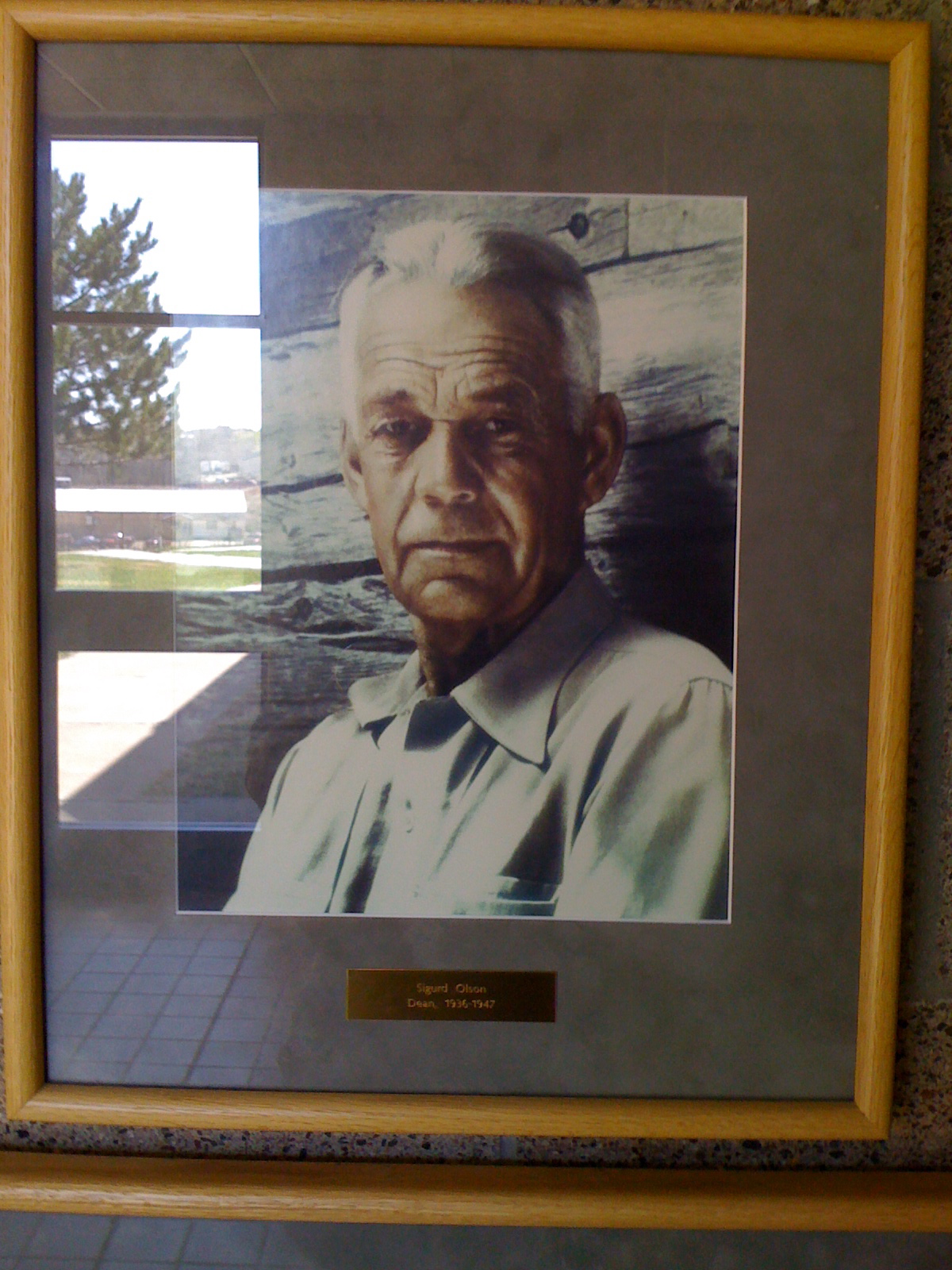
In 1938, Sig Olson, Dean of what was then called Ely Junior College, wrote “Why Wilderness?”, stating exactly how I feel on the trail:  the need for “sweat and toil, hunger and thirst, and the fierce satisfaction that comes only with hardship.”   Sig referred to hardship on the trail, not financial hardship.  There’s a scholarship in his name, too, which I want to honor by ensuring hardship stays only where it belongs.

A WEEK AT ROWE SANCTUARY

October 11, 2009

(Appeared in Tucson Audubon Society’s Vermilion Flycatcher)

6 a.m. on the Platte.  It’s dark and it’s cold. 

Upstream, I hear a sound like a jet engine warming up.  The high pitched whine gets louder and closer until it reaches me, and I begin to distinguish crane and geese calls among tens of thousands of birds simultaneously lifting off the river.  Because it was still early, and because I’m more auditory than visual, the intensity of the sound caught me by surprise. 

This was my third trip to see the crane migration and my first year as a volunteer at Rowe Sanctuary.  The Iain Nicolson Audubon Center has five permanent staff aided by many volunteers.  I’m selfish.  I wanted to see Cranes every chance I got, so I forged the following schedule:  early morning, while still dark, I snuck into a blind.  Trying not to freeze, I watched the birds gradually increase their activity, until the engine noise and the sudden explosion into the air. 

During the day I’d paint, dig holes for posts, set up rooms, take down rooms, hang things, fix what I could, try not to break what I couldn’t fix, run errands and wash dishes.  My dish washing ability seemed to be appreciated more than anything else.  If I got a chance to work outside, I could see flocks of cranes and geese overhead, with an occasional eagle and red-tailed hawk.  One day the redwing blackbirds suddenly appeared.  In the evening, I’d rush back to the house they put me up in, quickly eat dinner, and then return to one of the blinds where I would see the reverse, with the backdrop of a three or four layered colored sunset.  Once, I counted 10,000 cranes in a half hour, from only one direction. 

On the drive from the house to Rowe, I got used to seeing thousands of cranes in nearby fields, where they were eating waste corn.  Near the end of my stay, I spotted a large flock coming from the east.  High overhead they flew, spanning a quarter of the sky, sunlight reflecting off their feathers giving them a grayish-white cast.  Acting like a first time viewer, I stopped and got out to watch the flock pass, their primitive-sounding calls easily heard.  Cranes do that to me. 

Rowe takes good care of their volunteers.  Next year, after I tag along four times with certified field trip guides I will become one myself.  Am I lucky or what?  I will show people cranes and see the birds at the same time.  I was even interviewed for the Grand Island Independent:  “I love the cranes,” I was quoted.  “They’re large and they’re loud.  The first time I saw it I was in awe of the experience.  And I still am.”

The pictures not only show cranes but some of the most beautiful sunsets I’ve ever encountered.  South central Nebraska in March.  It’s a must see!