Archive for the ‘MY WRITING’ Category

FULL MENTAL AND PHYSICAL DAY IN THE WOODS

November 27, 2020

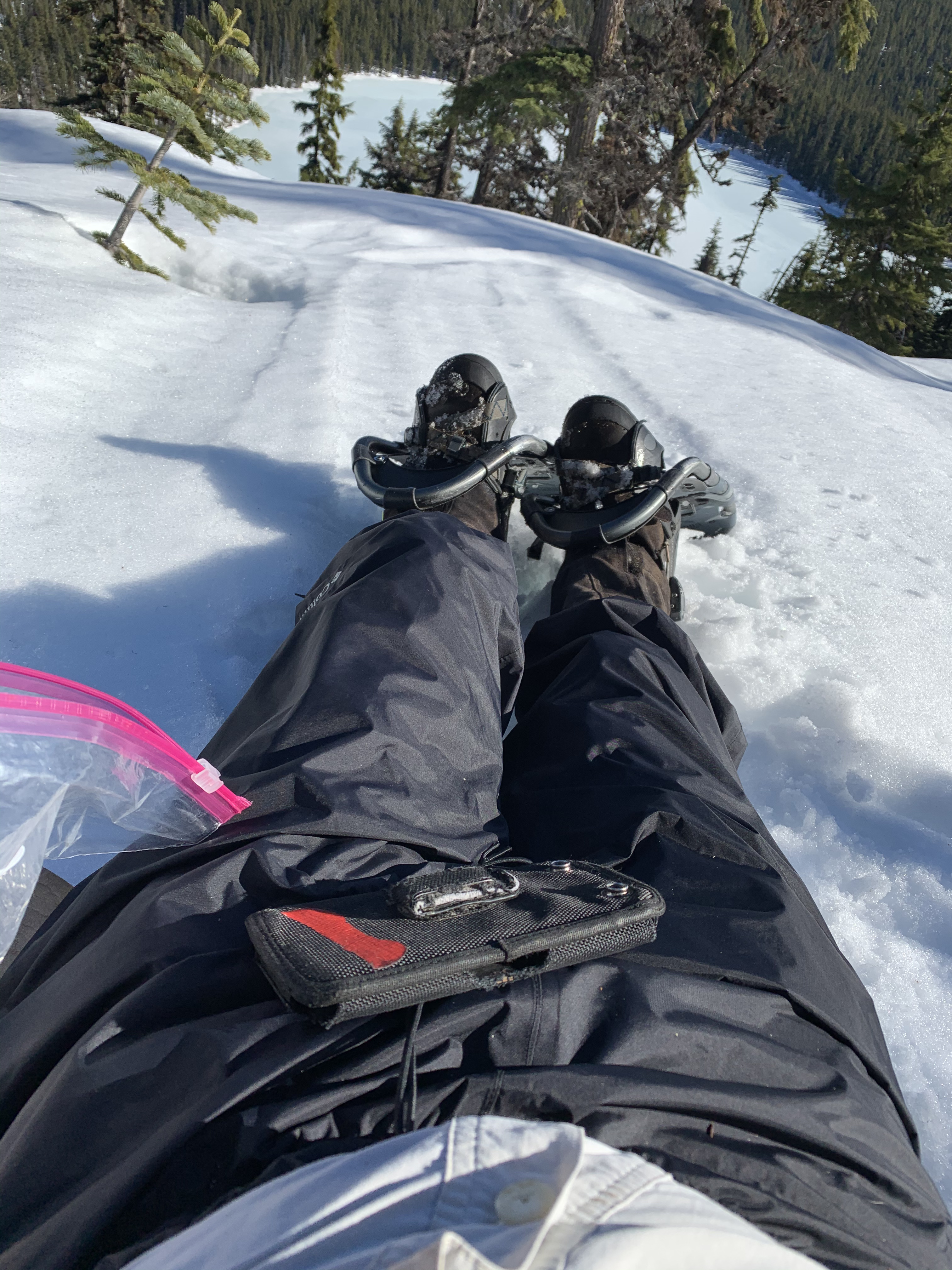
I should be colder than this, I thought, standing on the frozen dirt road with a thin coating of snow. I’ve got jeans on, 2 shirts, and a thin windbreaker.  It was 27 (or -3 C), and I had my back to a brisk wind that so far had not worked its way through my balaclava or under my hard hat.

One way to Winchester Ridge Trail was downhill to to Swan Lake then climbing out, steeply in places, to the ridge. Others had told me the bushwhack from the parking lot directly to the trail was flat and we’d get to the ridge in about a half mile.  I looked upward at the route and had my doubts, as we gathered our tools and headed east on to a trail that quickly disappeared.  

My GPS showed several contours in our direction, so I assumed the worst—that the contours were real and what I had heard wasn’t—and noted my altimeter.  I estimated at least 400 vertical feet—120 meters— of climbing. Some think that sort of knowledge is not part of the wilderness experience, but I have long used an altimeter when I hike, along with maps, which most definitely are part of the wilderness experience.  I want to know where I am, where I am going, about how far it is, and how much I have to climb or descend. Altitude on a trail can often be a surrogate for one’s location, if there are good contour maps.  The trail was gone, the trees angled up, the bushes scraped my jeans and left a coating of snow. At least hiking uphill, I was staying warm, so long as I didn’t fall.  Fortunately, Winchester Ridge Trail came earlier than what my Gaia app told me, and I didn’t have to cross two more brown contour lines. We were on the trail, heading south towards Waldo Mountain junction, about 2.5 miles away.  We didn’t know what was out there, log-wise, but we’d find out in about a half hour, when we reached the previous stopping point.

I have my watch altimeter and my Gaia contours set to metric. My GPS reads English. My car speedometer and odometer is set to metric. I didn’t think I would keep it that way, but I do. Making a meter of elevation is a lot better than a foot (nearly 3.03 times as better), and I play around with the numbers on the trail, the way I look at the rocks, trees, sky, and wildlife. To me, being in the outdoors is a full mental experience. 

I had all my essentials except for a lot less water than I carried in summer, which was a blessing.  I usually carry a Pulaski without a sheath.  Sometimes, there is one, but it tends to come off if I am going through brush, and putting the sheath on and off again several times, I finally decide it’s easier to carry it without one. If I start to slip, I am supposed to throw the tool, assuming my flailing arm in an attempt to balance me is capable to doing that on short notice.  The first time I was hiking out with the Crew, I threw it on one bounce into the calf of the guy in front of me.  Fortunately, nothing happened, but I felt stupid and apologized. That’s why one should follow well behind on the trail.

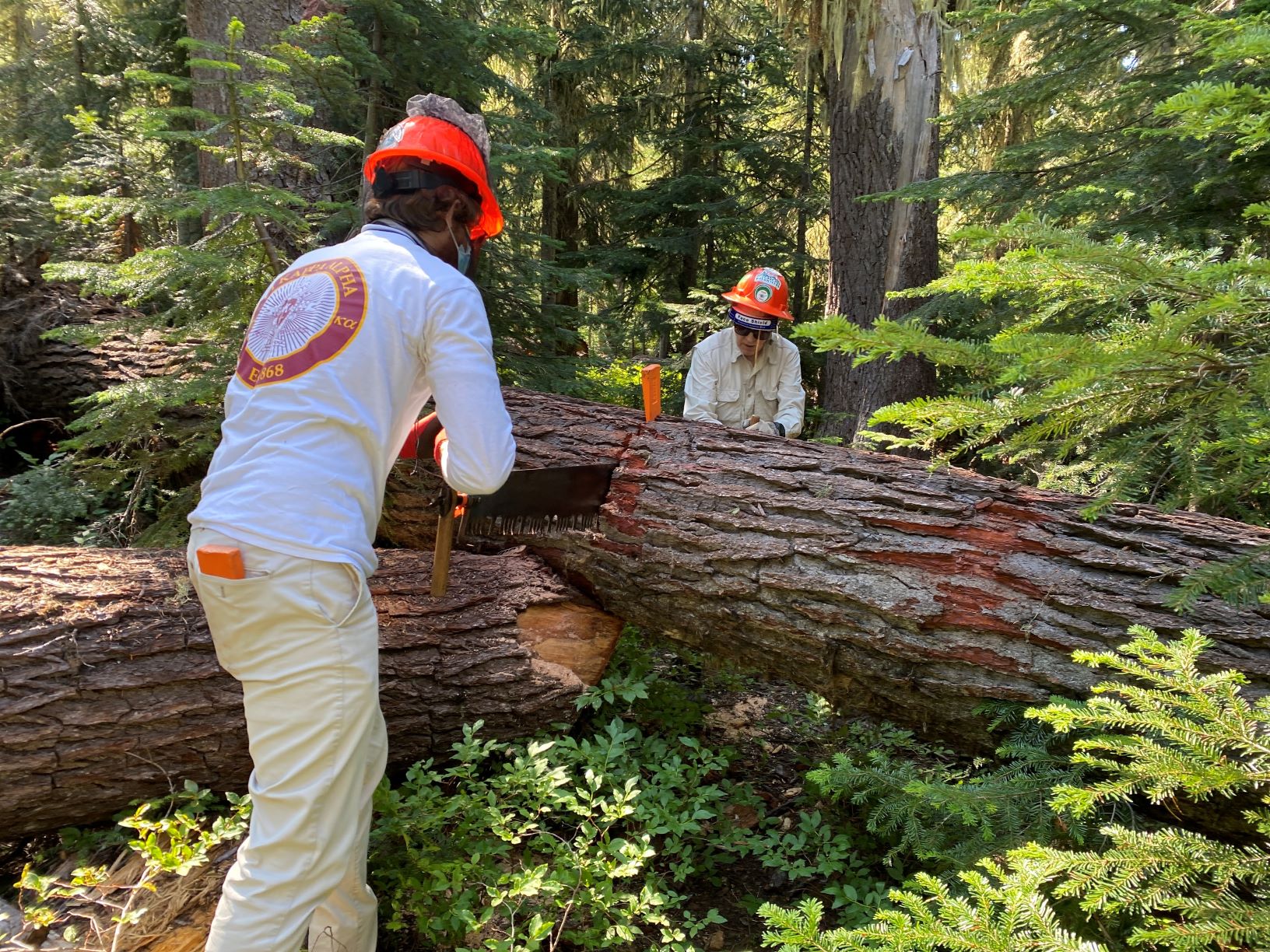
We reached the first log, and as I in the rear approached, the two working on it waved us on to the next one, 20 yards further down the trail.  As I came up to the log, I scouted the area using the acronym OHLEC—Objective-Hazards-Lean/Bind (we weren’t tree fellers, so only bind mattered)-Escape route-Cutting Plan. The first log was across the trail, 12 inches in diameter, too long to try to pull it parallel to the trail, but it had promise that with one cut, we could pull the remaining end to the side.  There were no significant hazards, the log would probably have top bind, but not severe, the escape routes weren’t an issue for a log near the ground, and we opened the cut slightly to accommodate our later pushing of the log to the desired direction.  My partner and I, both of us newly certified to do what we had already been doing all summer— the previous year as well— for that matter, bent to the task, or the saw.  

The top bind or compression wasn’t enough to catch the saw, and we cut through the log quickly. I kneel a lot on the ground, because I prefer the ground to bending over, and I think I cut better with the saw closer to eye level.  Besides, my back is happier that way.

We stopped briefly to let the first cutter crew go through on to the next log, and then finished the cut, put a strap around the log, stepped back, and pulled the remainder parallel to the trail. It was done.  I now was quite warm and took off my windbreaker.

We headed on, leapfrogging, to the next log, 20 inches in diameter, in a pile of branches. I call these things a mess. In order to figure out what to do, we had to first remove the branches, some of which had 3 inch trunks of their own and were both difficult to cut and to throw aside. Once we got the area cleared, we looked at the log and decided we probably would get away with one cut, but might need two.  

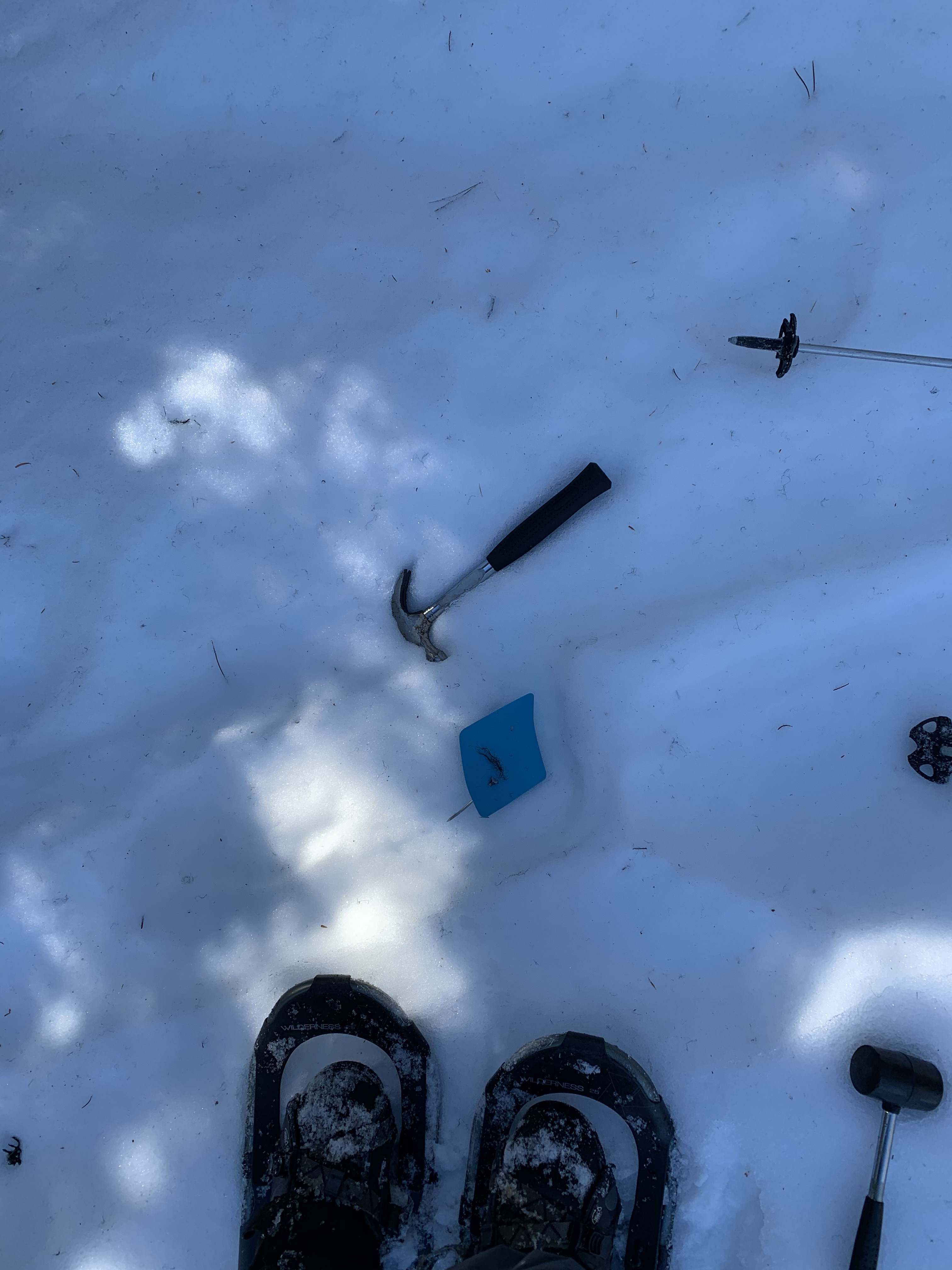
As we started cutting, the saw moved well. Sawdust was being generated, I allowed my partner to take as much of the saw as he wanted, and I pulled back as far as I could. Each stroke counted more that way. Half way through, there was a little bind. I pulled a hard plastic wedge out of my pocket, stuck it in the kerf, or the cut, and pounded it in with the back of the axe.  The stuck saw was resting against my leg, and as I pounded it, I could feel it start to move, as the bind was relieved. 

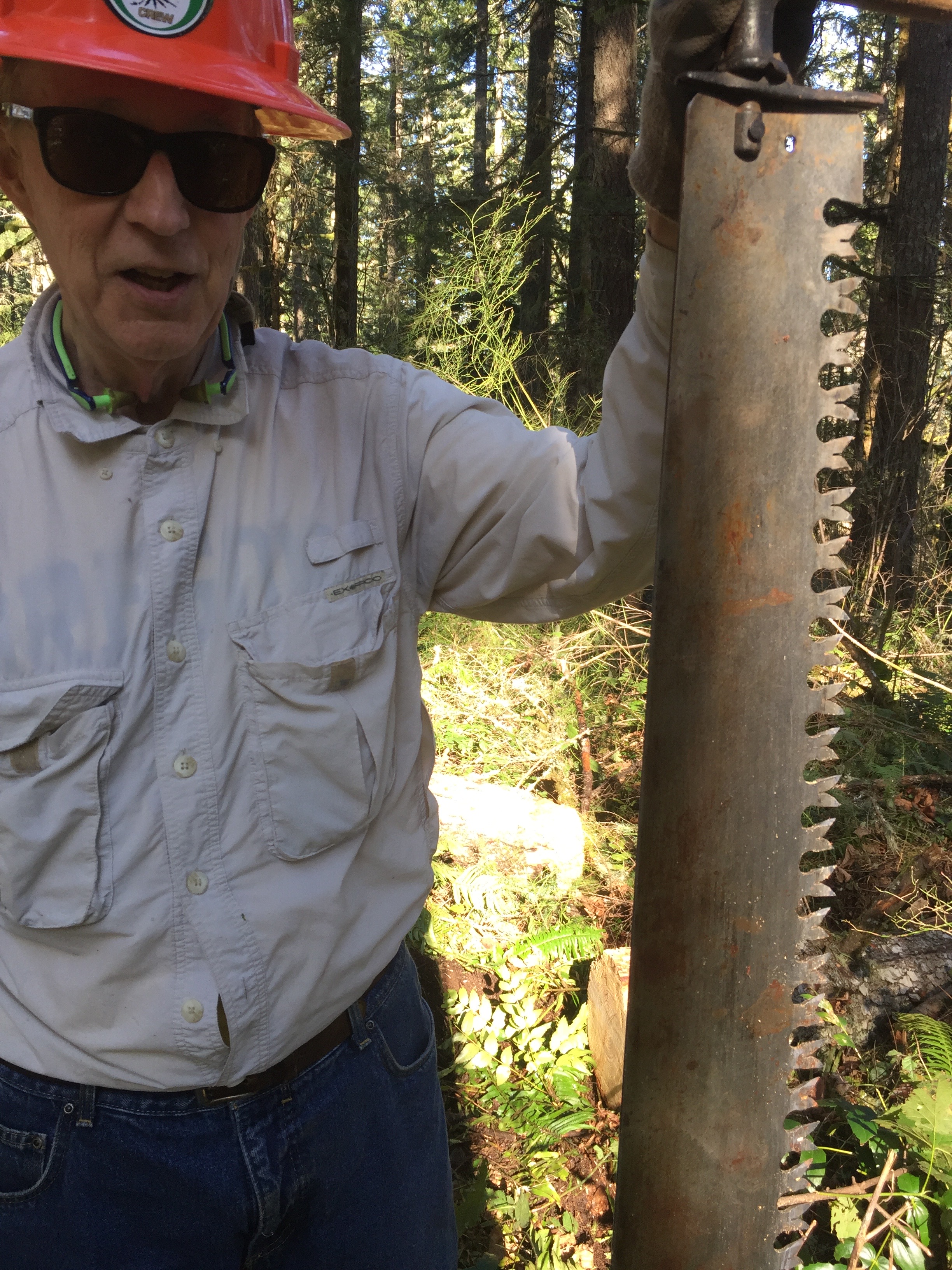
We cut further, and as we got near the end, we slowed the cutting speed and shortened the arc. The sawdust became reddish, as we entered the bark, and we stopped sawing. While we could cut through, the log might take the saw into the ground, and dirt is one of the worst enemies of a vintage cross cut saw.  I removed the handle, and my partner pulled the saw through the cut, then replacing the handle. 

I finished the cut with my KatanaBoy 500, a one man saw, and while that shouldn’t touch the ground either, it is less easily damaged than a large crosscut and also replaceable, unlike the vintage crosscuts, which were handmade with different steel that no longer exists. The log dropped slightly.  Because of the ease of the cut, we decided to make a second cut, figuring that we could do it almost as fast as trying to rig up a way to move the log. I like moving logs and saving a cut, but I have my limits.

We would later have lunch on a splendid rock overlook with Waldo Lake in the distance to our east and the Eddeeleo Lakes below us.  We would finish the trail in sunshine—although still cool—and split up the crew on the way back, some re-taking the “shortcut” back down to the cars, others, like me, taking two trails, one that descended, the second ascending to the cars. 

Our way was 4 minutes faster.  

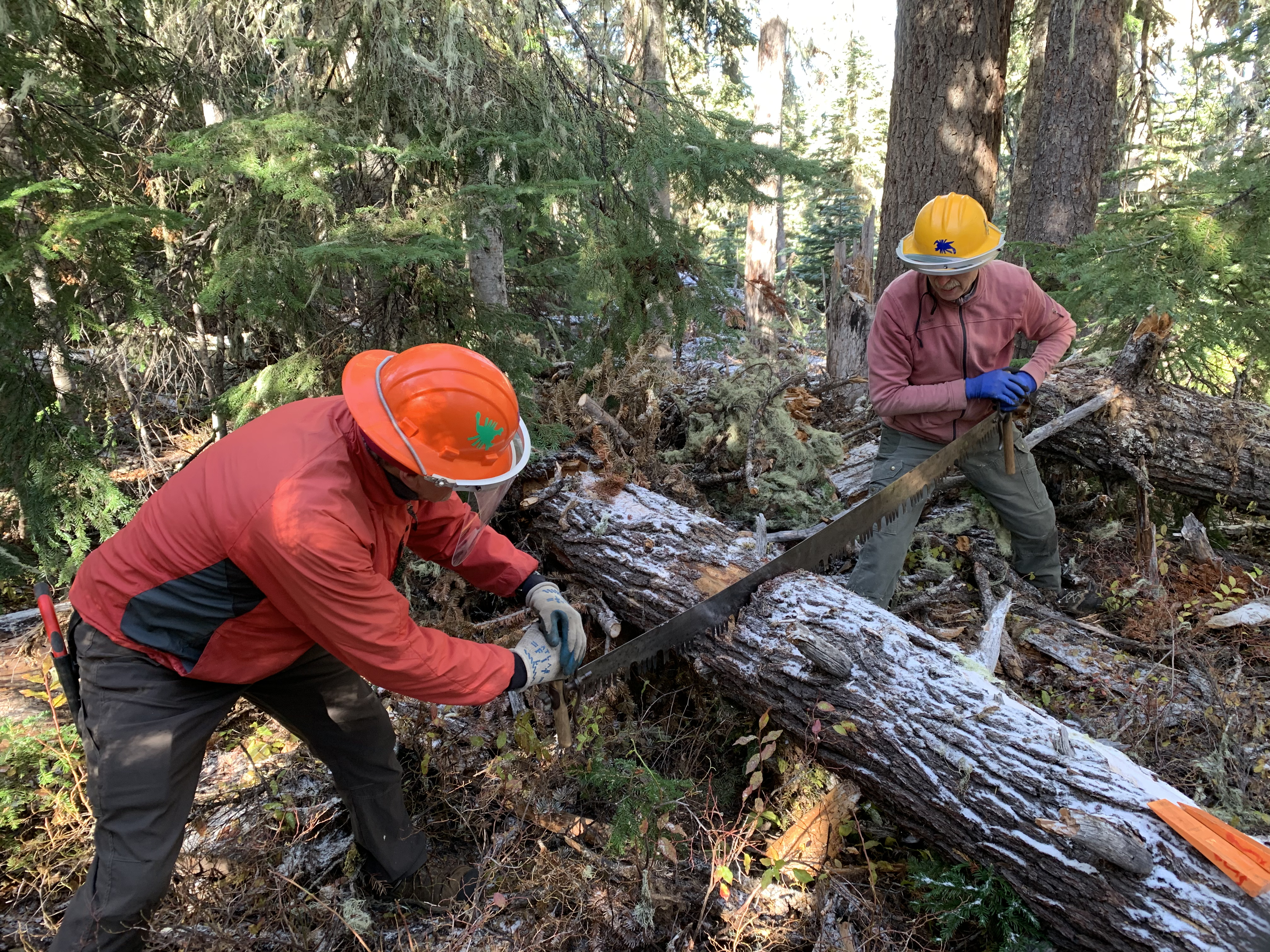
Frosty morning on the crosscut, Winchester Trail, Waldo Lake Wilderness
Three pushing. Often, we use our legs.

Waldo Mountain. The old lookout is barely visible at the top. We logged that out two months earlier.

STRANGER IN MY OWN LAND

November 11, 2020

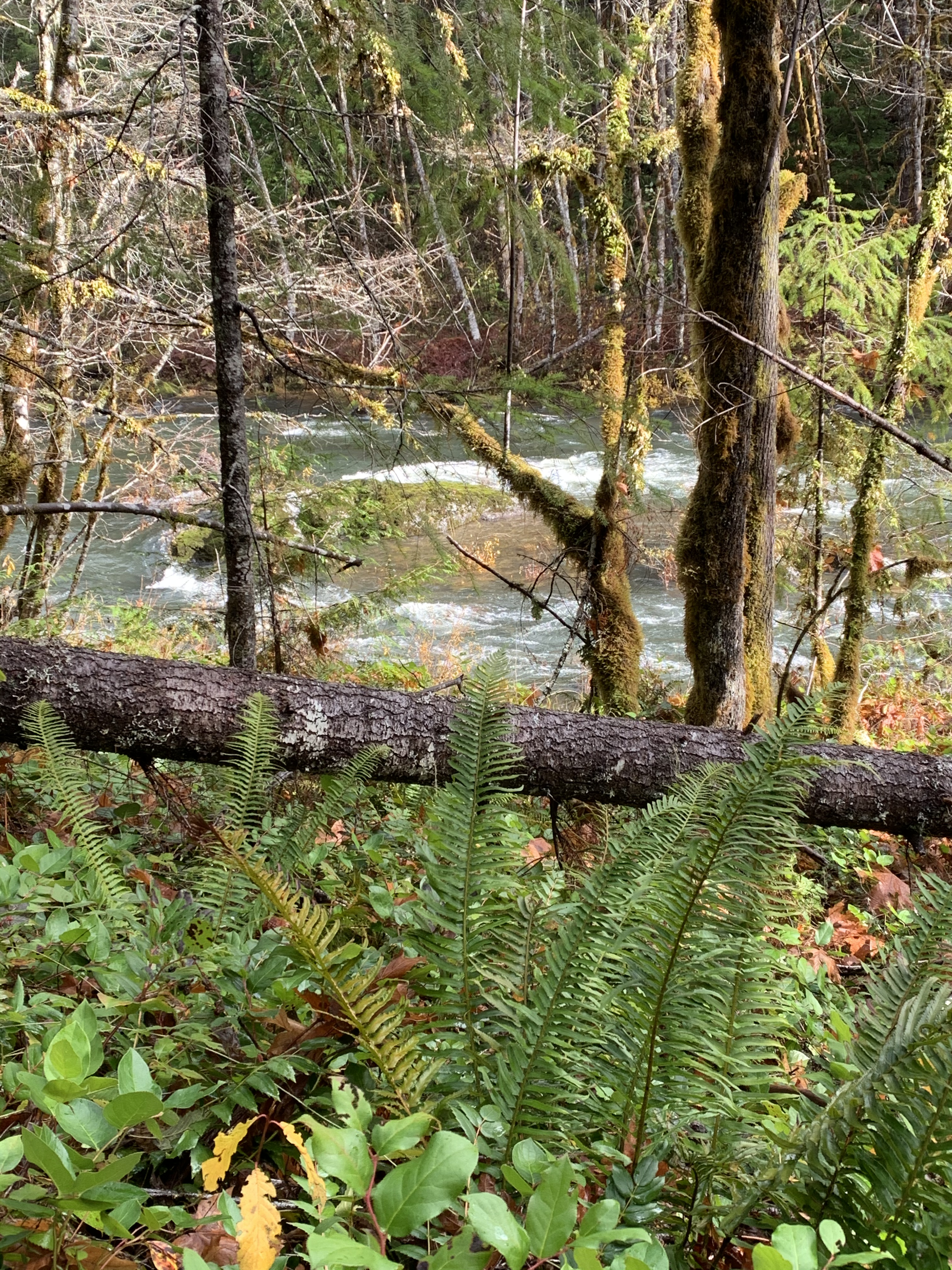
Two days after the election, the Crew had a job up on Shale Ridge on the North Fork of the Middle Fork (yes, it is called that) of the Willamette River. This was just outside of the Waldo Lake Wilderness, not far from the Three Sisters Wilderness, so chain saws were allowed.  We had four crews to deal with about five miles of trail.

I knew a guy from the Club who had recently led a hike in that area and asked him what sort of condition the trail was in.  He mentioned rotting bridges over streams and big tangles of logs and brush over the trail. I’m amazed these days that I have “connections” to learn about who has hiked where, who hadn’t put out a campfire, who is doing what in the Forest. I passed the scouting information on to the crew leader, before we all drove up separately and had our “tailgate session” at Constitution Grove. That is where we discuss the day and safety. I was with two crew leaders, one with the saw, the other, like me, a swamper helping.  We started towards the river and soon found plenty of work.  Constitution Grove has many Douglas firs, about the same age as the nation, so they are massive, and have signs on them with the name and state of someone at the Constitutional Convention in 1787. The area was named in 1987, the 200th anniversary.  I saw a John Dickinson from Delaware and wondered whether the high school in Wilmington was named for him.  It was.  I scouted a basketball game there one night, 55 years ago, my senior year in high school, when an injured player from our team spent the season as a scout and asked me to help him.  We’ve been good friends ever since.

It was nice out in the woods. Nobody spoke about the election, not a word.  The vine maples were shedding yellow leaves, when they weren’t slapping us in the face when we tried to cut them out.  Vine maples are small, but more than one guy has said his worst injuries out here were caused by them.  We had to use our arms and legs, logs as pry bars to move some of the cut logs, and I spent part of the afternoon on my knees crawling 30 feet, cleaning up enough branch debris so the sawyer could get in to cut.  As we were walking back to the vehicles at about 3, it started to rain. Perfect timing.  The drive down was almost magical in the rain, trees ablaze in color on both sides of the road, getting dark, the needed autumn rains here.

I needed that day, because I feel like I neither know nor understand America any more. I shouldn’t be surprised. I was alive during the McCarthy era, although I don’t remember, “Have you no shame?”  words that are every bit as relevant today as they were then.  We have endured the last few years with people who have no shame.  Nothing is sacred, and while political correctness has its flaws, there ought to be some verbal lines people in power simply do not cross.

I remember the Civil Rights workers (“outside agitators”) who were murdered and buried at another Philadelphia, in Mississippi.  Here in Oregon, outside agitators came in with guns and took over a wildlife refuge.  Got away with it legally, too, with only one dead, when he tried to run a police blockade and pulled a gun.  Whole thing was streamed.  I remember “activist judges” being decried by The Other Side, before the Supreme Court stopped a vote count, called corporations people, and other courts started practicing medicine.

We had Spiro Agnew, the first in a line of vice presidents so bad one wanted the president to survive: Dan Quayle, Dick Cheney, and Mike Pence, although Quayle now thinks the president should concede. Agnew was the one who coined the “Silent Majority,” which was believed to truly be in favor of the policies promulgated by the Nixon Administration.. 

No, I shouldn’t have been surprised at all by our assault on the environment by James Watt and a host of others, reaching a climax now, when there are oil leases in ANWR, and they now want to log the Tongass. This is insane, but perhaps a majority of the country doesn’t agree with me.

The flag has long been co-opted in that if one wearing it or flying it, especially in the bed of a pickup, he (yes, he) is patriotic, even if he didn’t serve in uniform, let alone overseas in unfriendly territory, doesn’t know the words of the national anthem, the Pledge of Allegiance, can’t name the thirteen colonies, the first state, or hadn’t been to even half the states.  

I didn’t like Nixon, and I was glad to see him go, that August day in 1974, before I returned to the night shift at the Denver General ER.  But Nixon signed the Clean Air Act, and back then there was bipartisan legislation. A few Supreme Court justices nominees got turned down, and stupid things said, like Sen. Roman Huruska’s famous words supporting mediocrity, but by and large the Senate was an important deliberative body. 

Now, we have a rare few senators who think the president should concede, while the majority leader feels he should take all this purported concern about the vote to court and it isn’t clear if the Secretary of State really thinks there will be a second term. The President won’t tell the GSA head that Mr. Biden should now have his own office and get morning presidential briefings, as Mr. Obama did for Mr. Trump and Mr. Bush did for Mr. Obama.  

The guys in camo have already demonstrated in Salem, probably with a few more outside agitators, but I hope they don’t really think that Biden’s nearly 400,000 vote win here should be contested or any of the now six million plus margin of victory Biden had on the west coast and the five plus million nationally,  So far.

I am trying to find humor where I can. Knowing that there is now an unofficial unofficial (not a typo) Fraud Street run (to go with Philadelphia’s Broad Street Run) from Four Seasons Landscaping to the Four Seasons Hotel, is good for a laugh.  

As is McConnell’s saying it was a good election for Republicans, even though he thinks the presidential part of it should be decided in court.

As were the protestors shouting “Stop the Count” in Detroit and Philadelphia, even as they were shouting “Count the Votes” in Phoenix.  Can’t you guys make up your mind?

Part of me is worried that the craziness will intensify, but nobody seems to be counting on Covid’s increase to up the ante.  Maybe the current leaders aren’t concerned, but the people lined up in their cars at Autzen Stadium getting tested for it are. One in 70 in North Dakota is currently infected, 1 in 16 has tested positive, and Covid positive nurses are allowed to care for patients now.  A major hospital in Idaho was recently on diversion, and we don’t yet know how many long haul Covid patients there will be in the country, let alone what exactly they have, or whether it is treatable.  Right now, the country is giving up. I’ve got to be more careful, even in the woods.

During this time, the president said that doctors were making a lot of money off Covid.  Considering that many physicians have had to stop elective surgery, change their whole practice about seeing patients, and hospitals furloughed nurses, there may be those making money off the disease, but they aren’t wearing PPE and risking their lives.

Thursday, we go back up the North Fork to do trail work.  It may rain.  We will get wet and muddy, logging out the trail and repairing tread. Bridges are out, crossings may be dicey, and there are over 200 logs to take out. It will take months to fix.   I’m looking forward to it. It’s November up here, and maybe things are starting to be what they are supposed to be.  

One can hope.

Cut through, then push this 400+kg log to the side of the trail

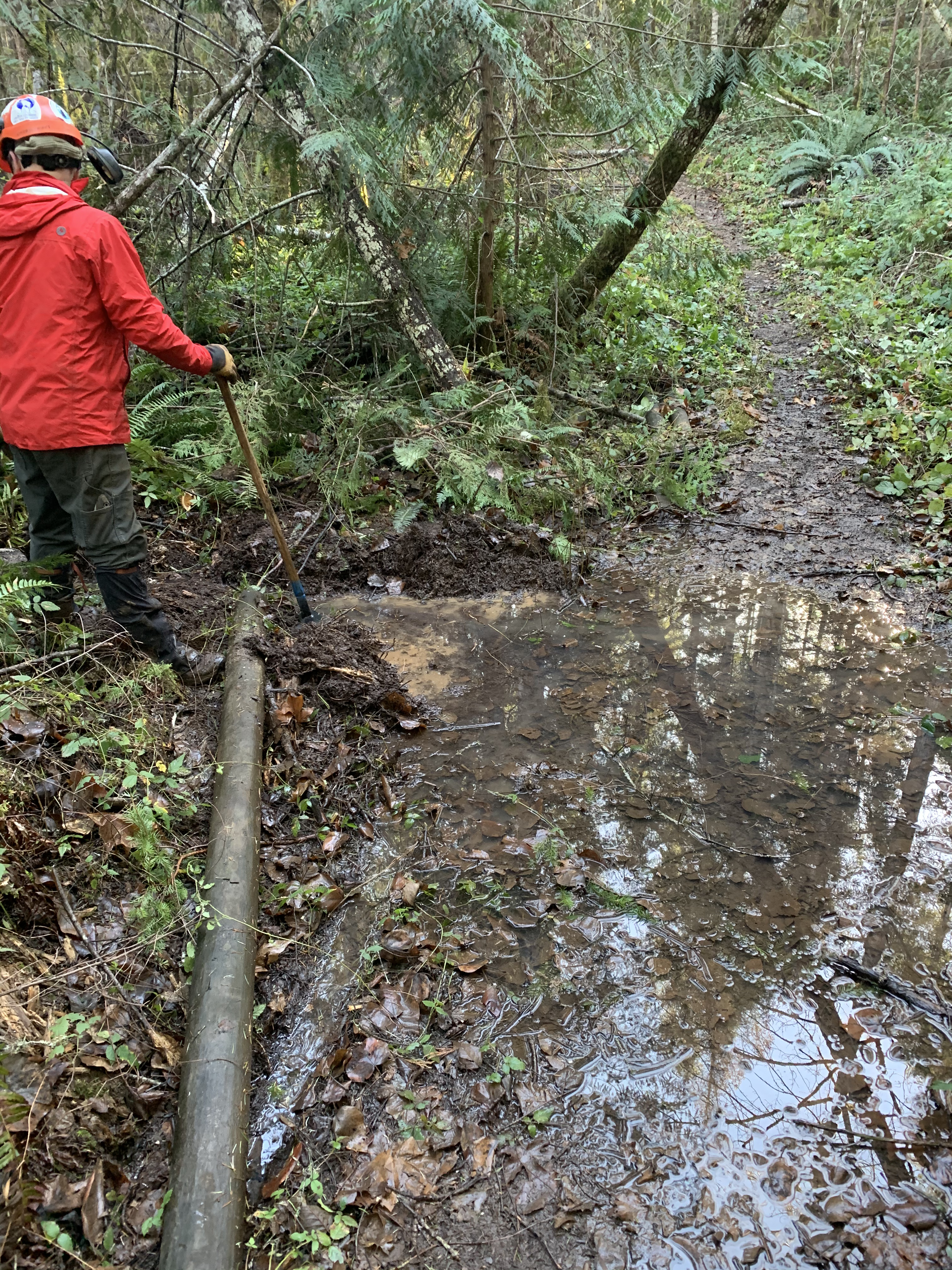
This is a several hour job to fix. Nature reclaims her land. Most of these trails need to be cleared every other year; if not cleared in a decade, they may well be lost. In some places, that may not be a bad thing.

SAW SENSES

October 15, 2020

Steve and I looked at an 18 incher blocking the trail in the Waldo Lake Wilderness.  It had been down for a while, the bark gone, which was nice, but needed to be removed. We both looked at the log, with enough space underneath to probably have a slight sag or top bind, meaning the cut from the top might start grabbing the saw as it cut through compressed fibers.  Well, that’s what wedges are for, to keep cuts or kerfs open.  He took the sheath off the 6 foot crosscut, and each of us took a handle.

We confirmed that we wanted to cut mostly straight through, and it didn’t matter which side we started from.  We both got into position, which for me was kneeling on the ground, worked the teeth a little bit into the log so they grabbed, and started sawing, pull smooth and hard, relax for partner, smooth and hard, relax, over and over again, 20, 50, 100, 200, 150, 100,….

It went well. First, I could feel how smooth the cut was. I could hear the saw sing a little, and could see the kerf, or the line of the cut, staying open, not closing, and I noted a good pile of sawdust accumulating with a few “noodles,” thin strips of wood that occur with a good saw.  Still, about half way through the log, I was thinking we could use a wedge to keep it open a little more, and Steve suggested it aloud.  I pulled an orange hard plastic wedge from my back pocket, because I like having wedges immediately available, and with a nearby axe, pounded it into the top of the kerf.

When a wedge opens up the kerf, anyone holding the handle of a saw that is in the cut can feel a decrease of compression: the saw is loose again.  We cut further, and finally got to the end, the log’s dropping part way to the ground.  The saw was wedged in the kerf, so I took off the handle, so I could pass the rest of the blade to Steve to pull it through the narrow space.  There was a time when I took a couple of minutes taking off or putting on a saw handle. Now, it is almost automatic.  Sawing with a well-known instructor, I once removed a wedge prematurely, which was met with one of those comments, “Oh, I wish you hadn’t done that,” because getting the saw out would be more difficult. Stuck saws are bad.  Sawing into the dirt is a sin. 

We started on the other side of the log, had the same experience, and that end dropped, too.  Sometimes, when both cuts are made, the log drops and if there is a downhill, immediately rolls off the trail without assistance.  That is nice. The trail was flat, and the cut log was still held in place.  I stuck a wedge between the cut part and the rest of of the log, hit it once with the axe, and the whole cut log dropped to the ground.  That was real nice.

We still weren’t able to push it, however, and weren’t sure how stuck it was.  We both sat down on the ground, put our legs against the log and pushed. This is easier on the back and allows one to use the strength of the legs.  The log shot forward about 6 feet.  That was super nice. We finished pushing it off the trail, and Steve sheathed the saw, ready for the next one. 

There are probably thirty folks on the Crew, but each work party has somewhere between 3 and 8. The first group I ever went out with had about a dozen, but this summer it has been mostly 3 or 4.  With three, one can get relief at the saw, which can’t happen with two. With four, one can have pairs leapfrogging each other.  With more, it is possible to do serious trail clearing.  The amount of sawing can still be considerable, as it was last week, when we worked solidly for about 6 hours, excepting a short lunch break.

I’ve been on the other side of a saw with many different people.  When I started, three years ago, any time someone asked me if I wanted a break, I said yes.  This year, I stopped saying yes and began offering my services. I’ve noticed a significant drop in the number of times my technique wasn’t optimal; indeed, one of the crew members told me the other day I was “so ready” for the saw certification class coming up, for which he had recommended me. 

A month ago, in the Diamond Peak Wilderness, the two of us were cutting out a log, when he was trying to give instruction to another guy in the crew.  He started pulling the saw to his left.  I can now feel when my partner’s technique isn’t quite right, and I said to him, “Hey boss, you’re pulling left.”  

“Really?”  

“Yep.”  He was.  It was the first time I had ever told anybody, although I had seen it happen often.

Along the way, I have found people with whom I would share a saw any time and a few where I would just as soon limit my exposure.  Earlier this summer, one guy, who is a lot larger and stronger than I, told me that I needed to give him more saw, meaning that I was pulling more and not letting him pull it back. That seemed odd, since once we are done pulling, we relax, keep our hands on the handle, allowing our partner to pull the saw. With the new position, my hands were slammed into the log every time he pulled back.  I said maybe it was easier for him, but not for me, thinking that this wasn’t supposed to be a competition to see who could slam the other’s hands more.  

A couple of others tend to pull the saw to one side.  The saw has some flexibility, and if it is pulled to one side, it doesn’t cut cleanly through the log, making work harder.  One can’t simply close one’s eyes and pull-relax-pull. The saw must constantly be sight aligned with the kerf, which is the best real-time information we have as to what the bind of the log is.  If there is top bind, meaning the fibers are being compressed, as the saw cuts from the top, the fibers in the log will tend to compress or grab the saw, stopping progress.  If the kerf is opening up, we are cutting through tension, the opposite, and the cut will be easier, which one probably has already noticed.

Not only do I have more endurance, I hear, feel, see, and now beginning to sense what is going on. I can feel different types of wood as we are cutting, the difficulty caused by binding, I can see the noodles of cut log when the saw is sharp and the wood the right consistency, I can monitor sawdust, and I can see the change in color that heralds the end of the wood and cutting into bark. I can hear the cracking suggesting that the log is almost cut through.  Later that day, Steve wondered what he was feeling, looking over at my kerf.  I showed him the knot that we were too close to, apologizing for guiding us there.  I should have started the cut about an inch away.

It’s clear now what I need to take in the woods and where everything is. Indeed, my day pack has changed in part from the one I have used with the Club to one I use doing trail work, which is comfortable, and in which I have a better first aid kit, marking ribbon, extra wedges, clothing, lubricant, hand sanitizer, isopropyl alcohol, emergency supplies, a lopper, and a hand saw, food and water, and my Katana Boy 500 mm strapped to the back.

The author (back), Diamond Peak Wilderness. The wedge is keeping the kerf open, which is tending to close due to top bind or compression.

The author with one type of 2-man crosscut saw, S. Willamette Trail, March 2020.

Occasionally, it is possible for two pairs to cut simultaneously. Waldo Lake Wilderness.

CAMPFIRE STORIES, FEATURING…THE FIRE

September 7, 2020

We pulled up to the empty campsite on Knife Lake, just east of the Eddy Lake portage, and I hopped  out of the canoe to check it.  Mark and I were doing a sweep of the District during a week’s time, checking permits, people, campsites, picking up litter, digging new latrines and covering old ones, but mostly taking a long canoe trip and being paid for it.  Earlier that day, we came upon a group of seven young women and an older man leading the trip.  Mark said to the guy, “I want your job.”  When the guy heard what we were doing, he said, “I want yours.”

I saw something on the site that I still vividly remember, nearly three decades later: a fire was burning well outside the fire grate, the flames high, fed by the wind, and about to reach the grassy area nearby.  Fire inside the fire grate is almost friendly.  Fire outside the grate, burning uncontrollably, is not.  

We both used our hats to get water, shovels, and Pulaski to gradually get the fire under control and then out. Had the summer been much more drier, this fire would have been off to the races. There was no Knife Lake Fire that year, and we continued our trip uneventfully towards Fraser Lake.

Later that summer, I did a trip on the Kawishiwi River and fully a third of the sites we visited had a fire area with outright active fire or warm ashes.  

I was taught that a campfire burns itself out overnight.  We left sites that way.  Finally, one time I decided to check that proposition and burned myself on hot ashes.  I learned what has been said for a lot longer than I have practiced—put the fire dead out, drown it, and don’t leave until the ashes are cold to touch. 

Five years after the Knife Lake incident, I was on a volunteer trip with the late Mike Manlove.  We came into Good Lake, and at the first site there was a tent up but nobody there and a fire burning. I still remember the leader of the trip’s coming back to the site while we were there and apologizing. As Mike wrote him a $100 fine for an unattended fire, the man was upset and embarrassed, saying he had spent over four hundred nights in the Boundary Waters and nothing like this had ever happened. I wonder how many unintended fires he had during that time.

Back then, I was pushing 200 nights and knew clearly that on day trips, one was better off not building a morning fire. Drowning it would make it harder to start that evening.  Eat a stove heated breakfast and save the fire for evening.  I’m now over 300 days, will never hit 400, and I still canoe that way.

Three years ago, I took a backpacking trip to the coast with one of the premier leaders in the Club. The area was nice, but the trip didn’t work for me. I learned that the leader’s sleep schedule and mine must be in synch.  Ours weren’t. The leader sat around the campfire drinking whisky at night and slept until 9. By 9, I have been up for 3 hours, eaten breakfast, taken a walk on the beach and was ready to go somewhere else. 

That’s not a criticism of the leader. But when we were leaving the site, he kicked some dirt over where the campfire had been and scattered the logs.  I went over and put my hand on the ground.

It was hot.  Ouch hot. That is a criticism. Shameful. That is a criticism of the leader.

It wasn’t easy getting water, since we were on a bluff over the ocean. I did work my way down to a stream for two trips and got enough water to make the area cooler.  I had to move quickly, however, because others on the trip were leaving the camp for their cars, and I didn’t want to miss my ride home. I left the site better, but worried for a full day that maybe the fire had burned under ground and would come up somewhere.

I was stunned: how could a leader leave a fire area hot?  The prior day, we left the campsite about 10, and I realized that I had not checked the campfire, perhaps because I hadn’t sat around it and assumed the leader would have put it dead out.  Wrong assumption.

I haven’t been on trips with this leader since.  I invited a Club member on a canoe trip with me in 2017; he drank Canadian Club at night and slept in the next morning.  It spoiled the trip.  We got on the water late, and the best time of day had passed.  Paddling lakes in the early morning is special.  The wind isn’t usually up, birds and other animals are more likely to be out, and there is a stillness that won’t last but a couple of hours. 

Two weeks ago, I was with the Crew doing trail work in the Diamond Peak Wilderness when a two young women backpackers came by us, having hiked up from Corrigan Lake, one of several nice lakes on the west side of that wilderness.  They commented that they had put out an abandoned campfire that morning on their way out. They knew it was there because they saw it the prior night.

“Why anyone would have a campfire in these temperatures is a mystery to me,” one said. I thought there was a campfire ban, but it was beginning the following day. Still, talks of imminent campfire bans are a good reason not to have campfires.

We thanked them for their help and continued working our way towards the lake.  I then remembered that the Club had had a backpack into Corrigan that very week.  The same leader was leading that backpack, mentoring another, and I wondered whether it had been their campfire. 

When we returned to town, it wasn’t clear to me whether they had had a campfire.  I wrote a board member with my concern, not proof, because others could have been at Corrigan, although not many, since it is a small lake.  I mentioned my concern and the issue on the coast three years prior.  I also mentioned that I had heard that one fire almost had gotten away from that same leader up in the Cascades. That was hearsay, and I admitted that.  I got a reply that the board member had seen pictures on Facebook of the group with two different campfires.  He took that information to others and the Club now bans all campfires.  If one wants to build a campfire, we can’t stop them, but it is not allowed on a Club trip.  That may not stop people, but it protects the Club.  I can think of three other violations I’ve heard about on Facebook.  Be careful what you post.

And put the fire dead out when you leave the site. Fires start fast, and it only takes seconds for a fire to be high enough in a tree that you will never reach it.

Corrigan Lake with Diamond Peak

BECOMING A TRAIL WORKER

August 15, 2020

A few mosquitoes flew around me as I left the Hemlock Butte area parking lot and started on the trail to Vivian Lake.  I was first; the other four workers were finishing getting their gear together, bug nets on, saws and Pulaskis together for the log out of the trail, clearing the path of fallen trees and branches that had accumulated over the winter.. I was going to the first blowdown, still outside the Diamond Peak Wilderness, and would wait for the chain sawyer behind me.  We would use the chain saw to clear blowdowns outside the wilderness, the first several hundred yards of trail; two man saws would be used further along, once we entered the wilderness.

We hoped to clear the main trail to the junction of the Divide Lake Trail and then clear the latter all the way to the Pacific Crest Trail.  If we had time, we wanted to clear a few miles to Vivian Lake, although that seemed like a tall order.

I got to the first blowdown, an 8 inch hemlock across the trail, and waited for the sawyer. The other three passed by on their way to the wilderness boundary, where a few big logs awaited them. We would be there soon enough.

The sawyer cleared the first obstacle and the next, and I threw the cut logs off the trail then moved on.  When I reached the third, an easy log across the trail, I kept my pack on, since I expected the cutting to be quick.  The sawyer arrived, and he looked at the log, planning the cut standing on the opposite side from me.

I looked up above the log and stopped cold.

There was a large log perpendicular to and resting right on the one we were going to cut.  I yelled over to the sawyer, telling him he might want to move to my side of the log.  He looked up at the larger log and nodded.  He moved over to my side, started up the saw and began cutting.  It didn’t take long.

As the small blowdown was cut through, two things happened in quick succession:

  1. The small log dropped on the trail.
  2. Immediately, the larger log dropped rolled down right over the trail, bounced, went airborne, and landed 15 feet below, against a tree.  

The whole sequence took maybe 5 seconds.  

“Thank you!” The sawyer called.  I nodded.  

That was the first time in nearly eighty times out in the woods with the group I can truthfully say I called a problem before it became one.  Most of the other times I had seen as others had, or there was no need for concern.  This one would have been nasty and might well have ended the day for us. 

The sawyer’s helper is called a swamper, which doesn’t exactly convey desire or respect, but it is the noun, and the verb is “to swamp (for)” someone.  Sawyers concentrate on logs, and they depend upon swampers to keep them safe from harm. It is another pair of eyes to look above for dead trees that may come down or tension loaded spring poles—small trees bent in a U-shape— that can do a lot of damage to one’s self-image if cut improperly.

A short while and two cuts later, we stashed the chain saw and entered the wilderness, dealing with two moderate size blowdowns (16 inches, 40 cm in diameter) using 2-man, 5-foot crosscuts. There were a modest number of blowdowns needing to be cut before we reached the junction of the trail to Divide Lake and the Pacific Crest Trail, and headed towards Divide Lake. Here, we had to cut out several large downed trees. We did some leapfrogging, where two would work on one blowdown and the other two worked their way up the trail. By the end of the morning, we had cleared the lower half of the trail.

We stopped for lunch.  Trail work is a special kind of hike. We don’t usually cover a lot of distance, but we see and hear much more in the woods, because we spend so much time in the same place. High in the sunlight were spider webs. There were signs of past storms, of trees leaning broken off, or cut in two.  There were shade tolerant wildflowers on the forest floor.  On wet days, there are small pools of water on low spots of the trail. Around us, we could see new growth. 

I have a special relationship with the ground, be it the forest or a floor. I often sit on it, kneel on it, lie on it.  When I saw patients and examined their legs, I knelt on the floor to do so. I had two chairs in the exam room, and often the patient and family member sat in them and I sat on the step stool.  I was closer to the ground and had eye-to-eye horizontal contact.  I didn’t try to talk down to my patients, figuratively or literally.

We do trail work because we like doing good, and we enjoy being out in the woods with a bunch of other like-minded people.  I still do “normal” hikes, but I enjoy helping make the trails accessible for everyone.  I enjoy eating my lunch without often snide comments about what I am eating, and I enjoy a day where we aren’t talking politics, only tension and compression, the latter causing saws to bind.  We approach a log, check how it lies, whether we can move it without cutting, or with a strap, or with only one cut, or needing two.  We look above, below, and around for dangerous objects. We try to anticipate what the cut log will do, where it is going to go, how to get it off the trail, and whether there is room for it somewhere else.

Only then do we saw.  The first time I did it, I lasted about 30 seconds. Half the time, one is relaxing, allowing the saw to be pulled by his or her partner.  The other half, one is pulling. Relax, pull, relax, pull, several hundred times, dealing with the bind, which pinches the saw and unless a wedge is pounded in, stops work.  

What was a first for me this day was when asked if I wanted a break, I said no, I was fine.  And I was.  I wanted to finish the cut we were doing, and then I would rest.  It was the first time working that not only did I have more endurance than someone, I had the most endurance of the small group we had, which I hadn’t realized, until somebody said they couldn’t keep up with me.  I had never heard that before. 

That sort of stuff doesn’t come easy. It requires a lot of work, good technique, pacing oneself, and time in the woods doing this.  I will not have days like this all the time.  I would suck wind sawing the following week, and I would learn that I don’t have the legs to hike, push logs, and be out in the woods 5 days out of ten, without taking a few days off.  But two weeks later, I would have my first “second wind” while sawing, and finished a 23 incher. 

I had called a hazard that otherwise would have been unseen, and I was able to hold my own sawing. I was doing my own definition of good and enjoying it.

Underbucking a log or cutting from underneath. Notice the kerf-the cut–on top. It started coming together and binding the saw (top bind). On the bottom, the kerf will open up, allowing the cut to finish.
Author (right) using a D-handle saw to cut a small log. This is too much for a handsaw and too little for a two-man saw (Crossing Way Trail, Three Sisters Wilderness 1 Aug 20)..

Author (right) sawing a large Douglas fir. The orange wedge keeps the kerf open. I carry two in my pocket, which Ian, the other person, adopted. It saves time having to find one in a pack when one knows a log will need it. One of my modifications to the work gear. Diamond Peak Tie Trail, Diamond Peak Wilderness.
This mess will be done in a few days. Notice the extreme top bind on the large Douglas fir log. This is going to spring up when cut through and is a hazard that will need some discussion before we tackle it. The lowest log can be pulled off, the middle log may need two cuts, although if it is dry enough and short enough, one will be sufficient (Diamond Peak Wilderness).

Hiking out the Hand Trail (Mt. Washington Wilderness), on the first of what would be three days clearing the 4 mile (6.5 km) trail. Three Sisters in the distance, volcanic rock from past eruptions on the left.

“Tailgate session” before work in the Covid era. Scorpomanders (Scorpions from Eugene, Salamanders from Salem) doing a joint project at Patjens Lake Trail. The loop is about 6.5 miles (10 km), half in the Mt. Washington Wilderness. We used chain sawyers outside the wilderness and crosscut saws inside. We cleared it in 5 hours (11 Aug 20).

STOP THANKING PEOPLE FOR THEIR SERVICE AND START SERVING

June 23, 2020

The day I arrived back in the US at Travis AFB, later SFO, I was carrying two arm loads of gear from my ship, which I had left about a day earlier in Subic Bay. As I half stumbled with the load along the sidewalk, people would not get out of the way.  I was still in uniform, and I would be until I could dig some civilian clothes out of my luggage, and that wouldn’t happen until after I arrived in San Diego.

That is how I left active duty in June 1977.  Nobody cared where I had been or what I had done, and there was no reason to care.  I filled a billet, I did what many young men did back then, and when my time was up, I rejoined the civilian world. The only things different would be that my hair would remain short—until the quarantine 43 years later—I lined up my shirt buttons with my zipper, and I called a lot of people “sir.”  I was 2 years older as a resident, and back then, that was considered significantly older.  November 11 came and went without my notice.  

For the next 25 years, that is about how things went regarding my past service. I had a few memorabilia on the wall in a bedroom, I drove lawyers crazy by using “sir,” because they expected a doctor to insult them, I guess. I learned a long time earlier that one could use sir in an infinite number of ways, just so the word got spoken. “Aye, aye, SIR!” I once yelled at the executive officer when I left his office having to do something I though was stupid and unnecessary.  I even let loose at an attending my first month, caught myself…and ended up with a “You are full of BULL–uhh-LONEY, SIR.”

It was 9/11 where things changed.  Suddenly, many wanted to get into the service and do something. I remember in 2003 at the AP Stat readers meeting, where a few hundred of us corrected the national AP exams, a couple of teachers were in the national guard and going to Iraq. At the meeting, they asked all veterans to stand. I was surprised.  Never heard that one before. As I stood, there were maybe 10 others in a group of about 200.  Interesting.  It is nationally about 7%.

The next time was Veterans Day that same year when I learned it was a holiday at a school where I was volunteering.  I was so surprised, I blurted out that hey, I was a veteran.  

Since then, there have been yellow ribbons on cars, flags everywhere, especially at football games, and on uniforms the players wore.  We started calling everybody who was serving a hero, which then was used for pretty much anybody who was doing what others didn’t want to do and who never before had been considered one or considered themselves one.  Heroes were also in charge of Abu Ghraib, too, or some of the more unsavory things that we did abroad. The flag got co-opted by one side, even as they did things in its name that the flag most assuredly did not stand for. 

At track meets here in Eugene, veterans and current military personnel are asked to stand before the national anthem. It is a weird and frankly kind of a neat feeling, although again, all I did was fill a billet on a ship.  If I hadn’t been there, some other guy would have had to do it. On Veterans Day, I now wear my ball cap and look for others wearing theirs, too, feeling a kinship over years, countries, and military actions.  One guy a hike with got blown up in Vietnam. He is a biologist and has had a full life. Once, one of the other vets told him that he felt guilty for staying stateside during Vietnam.  

“Don’t ever feel guilty,” the once injured man said.  He wore a hat that said “Peace.”

When Covid hit, I wanted to help.  I was willing to go to the USNS Comfort or Mercy as a medical officer—out of date to be sure, but able to help out in a military setting. It was a big pipe dream, of course, just like going elsewhere to help would have been.  I would have been  another person helping with some medical background, but I didn’t want to be one who got sick and made more work for others. I stayed home, was good, didn’t cause trouble, and did my part not to get infected. 

And so I find it strange, odd, and frankly reprehensible that when public health leaders in the country ask us to wear masks, to socially distance, to not crowd, and basically not to do stupid things, that there has been so much pushback. One of my military veteran former friends said that being worried was a result of watching too much TV.  Armed vigilantes descended on the Capitol here and demanded opening up the state. Wearing masks became a political statement, rather than a simple measure to try to limit the spread of the virus.  People complained that they weren’t being allowed “to live,” when in fact the whole idea of the restrictions was to ensure that more people did live. 

It was certainly a necessary, if unfortunate circumstance that people had to eschew normal human contact. But to don a mask—which can be decorated, like a hard hat or a helmet, or a car—to avoid infecting others and at the same time protecting oneself from infection, seems a tiny price to pay for the ability to again be outside, in public, able to do many things that for a couple of months we couldn’t do.  In Dallas, an increase of 12% absolutely for wearing a mask and social distancing—from 57 to 69%—would cause an outbreak to go from exponential growth to dying out.   A friend of mine went shopping where he counted 8 in 79 wearing a mask. I was surprised it was that high.

A couple of months of being limited in where we could go.  Anne Frank spent 25 months hidden where she was far more restricted than many of us were.  And she ended up dying.  

In Union County, Oregon, a few hundred had to attend church to sing and hold each other, ensuring that in a week 263 would get the virus in a county of about 15,000:  “Science is Real.”

“Thank you for your service” is now said to first responders, medical workers and essential workers. We need to stop saying it and realize all of us have a role in serving right now. We have a role not to get ill, not to enhance the spread of the virus, not to be jerks about it, not run too close to others in parks, or crowd in public.   We had a chance to stop the virus, and right now it looks like we will lose that chance. Wearing masks has somehow become against the constitution, against liberty, the right to infect man, the right to do what one wants, even if it infringes upon someone else’s rights—especially if that someone else is a Democrat.  

We have grown soft as a people. We are so concerned about our rights, we have forgotten about our responsibilities to collectively improve society. We want everything we want now.  But we aren’t willing to compromise a bit on anything that we think infringes upon our rights to do whatever we want without regard to consequences, costs to others, or anything else smacking of collaboration or helping one’s fellow person.

Wearing a mask is serving the country.  Use a face shield if one wants, but do something positive and useful. 

Thank you for…not being a jerk.

Face shields are easy to put on, allow one’s expression to be seen, and protect one’s eyes, which a mask can’t do.

The ball cap is wearing out, but the jacket still fits. 2016.
One can serve by volunteering outdoors, clearing trails. The author (right), Waldo Lake Wilderness, June 2019.
or…one can go on sites like zooniverse and help transcribe data from outer space, biology, physics, social sciences, or here, the names of prisoners at Mauthausen and other places, so that those who died are remembered. I visited Mauthausen, saw the “Gas Kammer” and the places where prisoners either had to jump into a quarry or be shot. It is a deep honor to be allowed to be part of the project.

THE ONLY TIME IN MY LIFE I WAS A RINGER

June 12, 2020

I had forgotten about this event for a half-century.  Or I had repressed it.  Anyway, while I was doing my morning 5-mile walk through the park today, just having seen my thirtieth different wild flower species (a Golden Iris), I thought of how this would be a lost summer for the young men who were on the canoe tripping staff at Camp Pathfinder, Canada, where I learned to canoe trip, nearly 60 years ago. One only has a few years when one is strong, has time, is willing to and can work hard, get muddy, sunburned, wet, cold, bitten by bugs, and travel by pack and paddle through of the most beautiful country anywhere.  I took 25 trips all over Algonquin Park in 6 summers, paddled to South River Village one year and spent two weeks up in Temagami in 1964.

I don’t know what brought the memory deep out of my hippocampus, but this morning I thought of a canoe race I was in 54 years ago–my only canoe race, a two man one, international competition (after all, we were in Canada).  

We staff members at Pathfinder had days off, where we either had to paddle two miles to the car dock from the island camp, or if we were lucky, caught a power boat.  Once there, it was 2-3 miles to the Park Road, and then we hitchhiked into Huntsville, about 40 miles away.  We did our laundry, had ice cream, great food (although it was great at Pathfinder, too, and lots of it), then had to retrace our route back to camp. One night, I went to the local night club at Hidden Valley, a nice hangout, which was still there in 2013 when I came through.  Back then, if one went to H.V., it would be a real late night getting back to camp. Somehow, we all did.

One weekend, and my memory is obviously very flawed, considering I hadn’t thought of this event since LBJ was president, Justin W. and I were approached by I believe the mother of two boys at the camp.  She was a rich socialite.  Her name would be immediately recognized in the clothing industry if I wrote it, but she wasn’t the story.  Justin and I were.  There was to be a canoe race on a lake nearby.  It may well have been Lake Muskoka, but all I remember was a big lake with powerboats.  Justin and I were handed paddles and a canoe, and I can’t remember if we wore PFDs.  We probably didn’t, because back then we thought we were immortal, rather than teenagers.

Justin and I weren’t great friends, and that summer, he was a loose cannon, one day holding on to a rock formation along the park road, head slumped over like he had hung himself. Cars stopped and people actually got out to check on him.  He was lucky he wasn’t cited by the OPP (Ontario Provincial Police).  He was a strong guy, so he took the bow for power, and I stayed in the stern for steering.  I can’t remember the number of canoes, but there were several but probably fewer than 10.  The water was calm, and when the gun went off, we exploded into a fury of foam, power, and testosterone.  Justin was amazing. Normally, I can overcome most bow paddlers from the stern, but he was giving me everything I could handle, and I didn’t want to waste anything on steering if I didn’t have to. My arms were aching like they never had ached before or since. I think the race was about a half mile, certainly not more than a mile.  

We won comfortably, but not a blowout.  Thrilled, we headed back to shore, arms quivering from the effort, but heads held high, very proud of ourselves.

Here is the part I don’t remember.  At first, I thought the camp leaders were present on shore and we had to leave, but a day later, my memory had changed a little. It turns out that thinking about something changes it neurologically, just like observing something in nano space changes it, too.

I think Justin and I got the trophy.  I think so, because I have a vague memory of our having come back to camp with it.  
Briefly.  

Because I also remember, and this memory is fairly clear, that we were not going to keep the trophy, and I have a vague recollection of giving back the hardware.  

How I wish I could remember this, and now as an old adult, wonder what in the world had been going on with the socialite and the canoe race.  I do remember our being told that we had no business being in that race.  That was before the term “ringer,” but today someone would say that she brought in a couple of ringers to win the race.

Today, we recognize a ringer as someone who shows up for a pick up sport who played for a Division I NCAA school. In basketball, he dribbles through your legs and you wonder what happened. If you shoot, he blocks and you have a leather sandwich. 

Justin and I talked about the race only briefly afterwards.  I remember his saying that we were racing against trappers and real woodsmen, and we beat ‘em all.  Thinking back, I wonder if the competition was a bunch of middle aged guys with beer bellies who couldn’t tell a J-stroke from jaywalking, or thought the bow was something you did after a good performance.  But I like to think we beat tough competition.  Of course, today, there would be video and posting on Instagram or Facebook, but back then it was a lot better, because we could make up a better story, sort of like I am doing here.

The following year, 1967, was my last at Pathfinder, and I was head man on four canoe trips.  I thought it was only two, but years ago, Pathfinder put them all on line, and I found my name as “Mike Smith in charge” four times. I decided to check on the trip I had with Justin. I went on Pathfinder’s Web site and found the trip about a minute later. Bless the guy who did this; what a great service to past canoe trippers.  There it was, a two day 12-man trip to McIntosh and Brûlé lakes, a loop I had forgotten about, and which I had mixed up with my last trip that year. On August 7, Justin was second man to me on that trip with four staff, four canoes, 12 men, the Blackbear-Ink portage, my first time over the miler, and the 1 mile Nature Trail portage which I would carry again four days later on my last trip as a staff man, and not again for 46 years, when I carried a canoe over it on a day trip.

Without putting it down.  I texted my wife, saying something like “That mattered.”  She texted back an eyeroll icon with “if you say so.”

The trip Justin and I took was for one purpose: to get every camper still in camp out of camp for one night so the staff could have a break.  That time of year, the long trips were underway, and the camp had fewer kids present. We took the last 8, along with four trip staff.  These guys weren’t into canoeing, but we got them out and back, and Justin was superb. He made sure there was no nonsense, and he helped the third and fourth men on the trip as well.  Nobody swamped, I checked the box “No” on the return where it asked, “Was there any profanity on the trip?” (not until the first portage, anyway) and  the staff had a great night alone in camp.

I gave Justin an AAA, the top rating, for the trip.  He told me he didn’t deserve it. I assured him that his presence was valuable.  He was great. I wonder if we spoke of the canoe race. We probably didn’t.  Too bad.

I’ve got to send in a donation to the Algonquin Campership Fund for Pathfinder. And I think I will send this to the current owner.  Maybe he can give me more information on the great race. Or be glad he wasn’t around when it took place.

I’d never add that trophy to go with winning the 5-10 hp power boat race on Honeoye Lake in 1960, and a bowling trophy at Clover Lanes in 1963, which was still there, too in 2013, but closed in 2016 to make way for Whole Foods.  I got a clock for winning my age group in the 2nd Annual AAN (American Academy of Neurology) 5 km run in 1992, but that and the other two were national events.

I’m still undefeated in international canoe race competition.  

The author back again in a red canoe.. Camp Pathfinder canoe dock; August 2013. Note the red neckerchief I am wearing

Day trip to Little Island Lake (and others). Author in blue shirt in back. I camped at this site nearly a half-century earlier.

JEALOUS

June 8, 2020

I was coring strawberries yesterday, after picking 20 pounds of them at a U-Pick spot out near Mt. Pisgah.  I was glad to get out there, and while the place was jammed, I was directed to a spot where I could be away from others. Picking is the fun part.  Washing is fine, but coring is boring, and going through several hundred berries makes for a long day.

My wife came in and had on a radio show from Doctor Radio from NYU Langone. Dr. Leora Horwitz of Health Care Innovation and Delivery Science discussed work in Covid survival in those who had been admitted to the hospital. It was a long session, so as I cored, put a red berry in a second colander, I listened to a study where people got key information from patients who later were admitted, tracking them until discharge. Wow, a hospital actually tracking something in real time, something important, with a lot of variables.  I would have loved to have spent some time doing that when I practiced.  I was jealous.

I looked over to my wife, saying, “I was trying to do this stuff 20 years ago.”  I was jealous.  I was also exaggerating on the low side.  I was doing it 35 years ago in the case of carotid endarterctomy.  I kept statistics for about ten years, until I finally got tired of beating my head against a wall and started doing quality improvement in a nursing home, since I couldn’t get anywhere in a hospital on the other side of the 110th meridian, which ran down Anklam Road between the two. I’ve often wondered how the nursing home did during these past few months. I proved then that one could decrease reporting of weight changes to the state about 80% if patients were weighed on the same scale. That’s an example of saving money and improving quality. I couldn’t get that information to fly over the meridian.

They did good work at Langone.  They found fully 75% of the patients there admitted survived to discharge.  That is useful information and impressive care, which also made me jealous.  I didn’t see too much impressive care in practice, although I sure tried to steer the place towards it.  Langone looked at risk factors and found that some lung conditions surprisingly did not seem to be problematic  They studied 5300 patients.  Of course, they had a lot of throughput and nice computers, rather than the pen and paper and the work I did by myself in medical records, back in the mid-80s and later.

I listened to the whole show and shook my head, now green with enby, which went well with the red on my fingers, my jealousy giving me a Christmas appearance in June.  I never got the chance to work for a group that really was in to dealing with learning like this one.  That’s exciting, when people are engaged in something bigger than themselves and proud of their work.  I had a little of that in the Navy, but only a little.  

I finished cleaning the strawberries and put the last two trays in the freezer. It was a good start for the season.

I have followed the Covid numbers from the beginning, when US deaths were still grouped by county and state, and we were well behind China.  I’ve watched as Mississippi briefly rescinded open up orders when they had a flurry of cases. Turned out, it was a data dump from the prior weekend.  I’ve listened to people who were concerned about our death rate here in Oregon, when on the same graph as New York, there was no daylight between the line in Oregon and the x-axis.  Here, we flattened the flounder.

I’ve watched, as Britain and the US had peaks and valleys in the daily death count, which seemed to be 5 days of the former and 2 of the latter.  Yep, the weekend.  This sort of data dumping wreaks havocs on the models that we are using to deal with the epidemic.  We had a $35,000,000,000 (worth writing it out) information system a decade ago in health care, and it was shut down during the pandemic, because it was taking valuable time away from patients.  

What in the world is wrong with us?  Or with the generation behind mine, where we counted things, pen and paper, made lists on paper, tracked stuff on paper, and knew where we were very quickly?  If an information system is only used for billing, and it slows down patient care, we really have lost our way.  Now I moved to anger.

Well, we need data inputters to do this.  Fine, put out a call. I will volunteer my time. This is bunk.  The Vice President and the Coronavirus Task Force—remember them?— asked hospitals to “please” send numbers of Covid-19 cases in their intensive care units daily. You don’t say please. You say, “Do it.” Finally, we did it, and our numbers are currently at about 17,000, compared to under 1000 in many European countries, about 300 in Italy now. Italy. Brazil is stuck on 8315, where they’ve been for a month, so they aren’t updating it. We aren’t alone. We do share the same type of leadership, however, as do two other countries in the top five, Britain and Russia.

Please?  From this group?  OK, they put out a flow chart how to get Covid tests in California that had precisely three lines. Remember Dr. Birx holding that up?  Amazing.

How difficult is it for any hospital in this country to count, as of midnight every night, the number of Covid-19 cases and the number in ICU?  You don’t need a computer for this stuff. You need someone who can count, write it down, and call it to a central hot line.  Oh yes, we could use email, too, but apparently our tech savvy populace doesn’t like that.  

It’s disgusting, and if it screws up the models we have, it is going to kill people through lack of timely information.  

Because we cannot do things in real time, we need people go back and “clean” the data, and that takes more time.  Fine, clean the data, but get the preliminary out immediately. We need it for planning.  It is easy to do, cheap, certainly not $35 billion, and it is data that everybody interested in Covid-19 wants on a daily basis.  NYU figured it out, but they are good.

I know Americans really don’t like numbers and counting, preferring nice looking software, glossy paper, and lots of colorful worthless pie charts to make the data “look good” (the human brain does not distinguish angles well, so that pie charts are a sub-optimal way to present data.) I’ve had this tirade before when I learned that mortality data, like for breast cancer, was three years old.  We ought to be able to track diagnoses in nearly real time. They have to be made by a pathologist, and there are a limited numbers of pathologists.  Every week, send the appropriate numbers to a central registry.  That way, we have immediate data, and can later use the 3 year old clean data, to compare and see exactly how much error there is and why. 

This is not the first time I offered to count things. I wanted to do it with medical errors with chart reviews with a three part ordinal score of No Error, Possible Error, Significant Error.  This could have been done in every hospital in Arizona, where I once lived, and we could have had a state wide tally of possible errors.  Oh sure, someone would sue, so those who have never been sued, unlike me, wanted to shut the whole thing down or asked me what kind of software I was using.

My brain, That’s the software.

It is soft.  Gelatinous even. That good enough?

THE JOYS OF CURIOSITY AND COUNTING

April 25, 2020

I miss hiking.  I miss snowshoeing, my last one five weeks ago now, when I soloed into Arrowhead Lake in the Diamond Peak Wilderness with nobody out there.  I knew I would not be going any time soon, and I fondly remember that special day.

Snowshoe tracks on Arrowhead Lake, Diamond Peak Wilderness March 2020

I am fortunate enough to be able to go out and walk, and nearby Alton Baker Park, straddling Eugene and Springfield, has miles of trails in meadow, oak savannah, and riparian zones.  I  cross Alton Baker to get to stores by the UO, and I’ve walked the entire 16 mile river bank loop on both sides.  Occasionally, I do a loop from Knickerbocker Bridge to Autzen Bridge and back through the park coming home.  It is about 4 miles and goes along the Willamette and then the canoe canal.  For the first week, I did my usual walks that I had done before.  

Then I decided to add more distance, going further downstream to the deFazio Bridge.  Because it is spring, I started counting the number of different wildflower species I saw.  I have a good app from the brother of noted trail writer William Sullivan.  For the past two years, I have used the app and a few other books to identify well over 150 species of wildflowers on my hikes over the course of the season.  I almost hit 200 last year.  In the park, I could usually hit 20, and one memorable day got near 30.  

Mind you, many of the wildflowers are weeds, but many of them are pretty, and I’m a non-native here, too.  I started by walking through a neighborhood over to the parking lot by Autzen stadium, past Cuthbert Amphitheater, where I have seen a couple of concerts, down to the duck pond, and the center of the 1 to a billion solar system model, and then upstream along the river to Knickerbocker Bridge and back home.  It is somewhat more than 5 miles and fairly quiet.  There are interesting birds, too.  Two of us are making an analemma at local noon throughout the year near where the big “Sun” is. I get to see rushing water leave the duck pond to go to the Willamette, then the Columbia, and finally the Pacific.  Or the atmosphere.  

But I couldn’t have imagined what I was going to see in the way of flowers.

With wildflowers, like birds, or stars, observing is quite simple: you look, if you don’t know what something is, you try to find it in a book or ask somebody, and eventually, if you see it a lot you know what it is, and after a while know its habitats. What you need is curiosity more than anything else, and I was lucky enough to have a lot instilled in me when I was a kid.  It ranks up there with reading as one of the greatest gifts I’ve received.  In Tucson, I did birding on my neighborhood walks, being called the Bird Man, and 20 species in a day was great.  The Christmas Bird Count included my neighborhood, and then I would push 30 species. I found that telling the difference between a pyrrhuloxia and a female cardinal was easy, whereas earlier I thought it impossible.  Verdins had different calls, depending on the time of year; we had rock wrens in the neighborhood and I heard an occasional canyon wren, in addition to the ever-present cactus wren, the state bird. I am very auditory; I remember people by their voice rather than their face, and I do birding the same way. I may not see a spotted Towhee, but I sure can tell when I hear one.  Lately, however, I have been spotting them more easily.  It’s practice and knowing what to look for.

Two weeks ago, I saw twenty species of wildflowers on a walk for the first time this year.  As I walked through the neighborhood, I saw a non-native pale blue violet growing outside someone’s yard.  By Autzen Stadium, I saw my first California poppy, and by the Science Center I saw the first camas of the year, a lovely five blue petaled plant.  I found a stretch near Frohnmeyer bridge where within 100 yards there were over 20 different species. I saw Hooker Fairy bells and realized the past couple of years I had misidentified a Woodland buttercup.  I went nearer the river and saw a Money plant, 4-pealed pink flowers. Larkspurs and Plumed Solomon seal were everywhere, along with Trilliums and Fringe cups.  Someone picked an Iris that I needed for my count, but a week later two more sprouted.  Near them were a cluster of Fawn lilies.   I learn more each year from the mistakes I have made.  Last year, I learned about salsify flowers, this year, I realized there were three kinds of geraniums with different sizes and leaves. I am picking up on grasses, too.  A few days later, I hit thirty species and ended the day with about 35. I figured that would be the top number. 

Camas

The app is great: I open it, make sure I have the right part of Oregon, the right week, and the right elevation. That decreases the flowers to about half, or 1800.  Wildflower (vs.  conifer, other tree, grasses, etc.) color, number of petals, size of blooms, whether leaves are alternate, opposite, apical or basal, the environment (Disturbed, alpine, rocky, riparian) bring the numbers down often to a dozen, sometimes to three or four. Then I can look at a map, read the description, and see if this is the plant.  

As the weather got sunnier, the counts rose.  I hit 40, then 45, and even 48, getting a sow thistle, Persian speedwell, and yellow oxalis in the last 20 yards, when I wasn’t expecting anything. That’s the other thing about observing; you have to always hope there is something there and at the same time be happy just to be looking and seeing what is there. Sort of like fishing.  I identified a Torlinga crabapple tree, then looked at my feet where I was almost standing in a patch of Lesser Periwinkle.

Today, I was musing how the single dogwood blossom I had seen for the past week had finally gone. For whatever reason, I looked up, which apparently I had not done, being more interested in ground blooms. There above me the whole tree was abloom. Fabulous.

Dogwood

A lot of times, I need to try different colors of the petals to make sure I am not missing something else.  I don’t identify everything but close to 90%.  I write them down when I get home and count them when I am out there.  I count a lot of things, always have, every day, often without thinking and often without knowing what I will do with the counts.  I watch the birds, too.  The other day, a Canada goose landed on the duck pond. As he landed, his feet extended and briefly, he was skimming the water like a water-skier, minus tow rope.  I had never seen that before.  There is a lot of interesting stuff in nature, but one has to look, and it helps if one both knows what one is looking for and at the same time, have the joy of looking for its own sake. One memorable morning in Nebraska, dancing cranes made the whole Platte River bounce for about 2 seconds.  I saw it myself.

https://michaelspinnersmith.com/2018/04/09/the-morning-the-platte-river-danced/

Canada geese young

This past week, I topped 50, then 52, reaching 56.  Some wildflowers are starting to fade. Oregon grape will be gone soon.  Someone picked the iris and the salsify, but I found another salsify near the river and two new irises have appeared.  The Wild roses are blooming now, and one of the plants I could not seem to identify turned out to be Miner’s lettuce.  That gave me 57 for today. And it was raining.

I’m looking forward to what I hope will be a chance to go back up Spencer Butte and this summer into the high country.  Trail work also means a chance to see new wildflowers.  But I am so happy I started looking where I hadn’t looked before.  

It’s remarkable what one sees.

Ladybug on English plantain
Fawn lilies
Plumed Solomon’s seal
Hooker Fairy bells
Red Columbine

DAYSRUNTOGETHER

April 7, 2020

As I began to write this, Bill de Blasio, the mayor of New York City, asked for a nationwide draft of doctors and other health care workers.

Ah, the draft.  I was number 56 in 1969; one brother was number 139; the other was a staff sergeant in the Marines at Da Nang. I ended up going to medical school, joining the reserves there, then spending two years’ active duty aboard the ‘Lou, the USS St. Louis (LKA-116), with two deployments to the western Pacific and having seen just about every country that bordered the Pacific north of the equator.  Just about.

The draft ended in 1973, so if I had not joined, I never would have had the experience of being a medical officer in an organization where medicine was not the top priority.  It had to be that way in the military, but ultimately that was the reason I left. But I never regretted my service. Not once.

In the interim, I have often wanted a draft, and we likely would have been a lot more cautious about entering conflicts if we had one.  A lot of young men—now women—need a time in their lives when they have to follow orders.  A big reason we got out of Vietnam was that everyday America was taking part in the war. People in the military weren’t heroes then, other than the real ones who got “The Medal” or one of the Stars. When I returned home, nobody spat on me, but nobody treated me any differently, either. I was just a young man in the military.  Just about everybody had to do it, unless they had bone spurs or some other often minor condition.  

It was a couple of decades later before Veterans Day actually had meaning for me.  I realized I was a veteran, not something that had often occurred to me for at least 15 years after my service. Really.  

Now we are in a pandemic, with doubling times of deaths recently in the 3 day range, starting to lengthen now to 4-5 days, having doubled 14 times total as I write this, with only four more doublings before we hit 100,000.  You can see why 200,000 (one more doubling after that) is on the table. And NYC needs help, badly.

From what I see and hear, there are times I am tempted to pull out my old bag and go to volunteer, since I doubt there will be a doctor draft any time soon.  Even as out of date as I am, I could certainly screen, talk to families, answer calls (with my upstate New York accent), help with intubations, and probably a few other things.  

But that’s more romantic—and a lot crazier—than reality.  I would likely get in the way, probably get sick, not unlikely become a ventilator candidate, which I would refuse, and die alone, my last days becoming part of the problem I wanted to help, 3000 miles from home.  I’d rather do it here, but as of this writing, we have had our 10th doubling for cases (1024) and our doubling time is about six days. That doesn’t mean we can’t have a huge outbreak by June, but the doubling time is gradually lengthening. Our growth factor (new/prior day) is often under 1, which is good.

I’ve never been a hero, and I am not about to be a martyr, either.  We need to have a solid volunteer corps where people can immediately go to where they are needed, starting close to home. I might be good talking to families who want information.  When I practiced, I did not shy away from talking to families of dying patients.  I didn’t like it a good share of the time, I certainly didn’t get paid extra for it, but that was my job, and I made sure I did it.  I’ve been on both sides of the white coat, and I know how important it is to actually speak to a doctor about an ill family member.  But I doubt anybody will be interested. I am good at knowing when care is futile and when there is no ethical reason to continue, but many others know that just as well and are current.  

That leaves me one other spot on the left coast: the USNS Mercy. After all, I once served on a ship.  I know how to enter and leave one (if not in uniform one faces aft, where the flag is, then one faces the officer of the deck and requests permission to come aboard.) I know the numbering system on board, so if something is deck 2, frame 46, I know it is two decks below the main deck, port side and up forward to frame 46.  This is not rocket science.

I would have a place to stay, no worries about commuting, would be available for all sorts of duties.  After all, that stuff is not easily forgotten.  My hair is short, I line up my buttons with my zipper, I can say “Sir” easily, and most of all, I have this skill.

The Navy wants no COVID aboard the ship. That is impossible.  It will happen. And I recognize that.  But with hundreds of thousands of retired military in southern California, my ending up on the Mercy is not going to happen.

So, the days run together. I have lengthened my morning walk from 3 miles to 5, much along the Willamette River, which is flowing well if a bit low from another dry winter.  I wear a mask now—just a balaclava, so long as the mornings are cold—and count the number of wildflower species I have seen.  I hit 23 today, which is good for this time of year in a limited habitat. The towhees are zzzzttting, the scrub jays calling, with an occasional Steller being seen, cormorants are on one of the river islands, herons are close by, and there aren’t a lot of people out there.

It’s a good time for those few of us who dislike crowds.  I feel sorry for those who can’t be in large groups, especially because life may change after Covid.  I don’t know whether I will ever tutor again in person; I won’t be carpooling to the high country for hikes or for work parties on the trails.  But I spent my first year here not carpooling, and lately, I have been hiking alone, rather than with the Club.  Those are my best hikes, my best snowshoes.

Up in the high country, it will be quieter this year. The new requirements for trail reservations at some of the busier trailheads are not going to be rolled out as soon as planned. The trails may get a rest from the crowds this summer.  I worry about fire season, but if few are in the high country, that removes a large risk.  

Coming home after my walk, I spend time checking the numbers of the epidemic, seeing if I detect any changes. I also do some algebra problems on line and go to zooniverse and pick a couple of projects to help out,  My lap is open for a couple of the lap cats.

I would love to help, and maybe I will get a chance to, but unless things hit the fan big time here, I am best suited to take care of myself and be one less problem, one less case.

Milton’s Sonnet 19:

“…“God doth not need

” Either man’s work or his own gifts; who best 

 “Bear his mild yoke, they serve him best. His state 

” Is Kingly. Thousands at his bidding speed 

 “And post o’er Land and Ocean without rest: 

 “They also serve who only stand and wait.”

English Daisies
Following the CDC (a huge disappointment overall in these times) guidelines. Elections matter.