Archive for the ‘MY WRITING’ Category

GOBS OF MONEY

December 29, 2014

In 2002, I discovered  to my chagrin that I wasn’t going to get served a meal on a four hour flight.  That was an annoyance, but it was only a minor harbinger of the future.

A recent spate of articles in The New Yorker has alluded to the difficulties the average traveler has flying.  Those who fly frequently pay for certain conveniences: $85 for TSA pre-check, faster and friendlier, and not in stocking feet, $25 per bag check-in, so I go carry-on with a day pack crammed with everything I may need, and early boarding (Zone 2), which is a $89 annual fee on a credit card for which I can get a free flight in maybe a decade.  Zone 2 allows me to put my carry on in the overhead early, before it is full.  There are $6 “snacks” and $6 Internet, too.  I now bring a lunch.

First Class round trip from LAX to Australia is $13,000, and people pay it, either with their money, or corporate money, which is all of our money, since “corporate” got it by selling somebody something, and probably got a tax break on it, too.  Fly from Seattle to Amsterdam round-trip costs about $1200;  another $7000, you go first class.  I paid $7000 to take a course on quality in medicine that changed my life, although I never got rich from it.  I’m retired, should survive, but I can’t comprehend paying $7000 to sit in a different seat.  My wife says, “If you have gobs of money, why not?”  She’s right.  Economy seats have shrunk; the largest seats are about the same size as the smaller ones two decades ago. Why sit in the back if you can afford to sleep lying down up front, if you got the dough and you’re old?  It just seems ostentatious to me.  I know several not for profits who would be thrilled to have that $7000.  It would be life changing to seven students at a community college I support, if each of them got $1000.  I know.  I’ve read their letters.

Jet Blue finally bit the bullet, the last airline not to charge for what were once called “frills,” giving the airlines a huge profit.  What is not surprising is that fares have not recently declined, despite the fact that the single biggest cost—fuel—has become far cheaper.  But as soon as there is a rise in the price of crude, it is immediately translated into increased prices.  It was like the price of silver and film years ago.  When silver became expensive, so did film, immediately.  When silver became cheaper, well…….

The only thing that still hasn’t changed is that we economy folks get to the same place at the same time.  Now, we don’t get inside that place at the same time, but the arrival is still equal.

Gobs of money.  That’s the term.  There are people with gobs of money.  Not $3650, which puts one in the richest half of humanity, but gobs.  The richest one percent in the US own more wealth than the bottom 90%.  The top 1% make $519K, the top 1.5% make $250K.  The richest 1% pay 24% of federal income taxes, and they state that isn’t fair.  I counter with Willie Sutton’s Law:  When asked why he robbed banks, Sutton replied, “That’s where the money is.”

Wealth management pays well.  I was turned down for a trust company because my net worth hadn’t reached their minimum.  They mentioned (and they had no business saying it) that one of their clients had a net worth of $350 million. That is gobs of money.  It is incomprehensible, I don’t know who makes that kind of money, but to me that screams “charges too much,” “ought to be giving a lot to support poorer people, public education, scholarships” “ought to be taxed on it,” “drugs?” and other socialistic statements.  Really, $350 million?

High end stores survive recessions well, because there are always those with gobs of money.  Five thousand of these folks got more than $1 million in bonuses in 2009, ($20 billion total were paid in bonuses) after the economic disaster they created starting in 2005 came home to roost.  What has changed is that many have become more ostentatious with their houses, cars, and the right schools.  I’m not talking about a good college, I’m referring to the right kindergarten.   When I practiced neurology, we had to make a rule that only four times a year could somebody take their salary early, because some of those earning $400,000 a year were asking for it because of “needs”.  The day we discussed that topic, I thought I was on Mars.

“I earned my income,” I could say.  “I studied hard through high school, college, medical school, and residency.  I did it myself.”  Well, yes and no.  I lived in a country that gave me free public education, good teachers, cheap medical care, infrastructure, subsidized college education, both by alumni and by the government, paid for defense (and I had to serve), and had a progressive tax code.  That’s all gone now.  Most of these people are white, male, and have connections.  I had two out of three.  The rest often work just as hard and aren’t as lucky.  The people on the bench spend just as much time working as the starters.

There is something wrong with a country where employees need food stamps and health insurance, while their employers have $125 billion ($125,000,000,000) net worth.  There is something wrong when 20% of the homeless are veterans.  There is something wrong when people traveling with children can’t board before first class passengers, where an airline is going to proffer “economy minus” seating (stay tuned), where Germany offers tuition-free education, while our students are saddled with huge loans, and the outgoing (read: fired) president of the University of Oregon got nearly a $1 million severance package for his subpar leadership.  Personally, I would have been embarrassed to take it, slinking away quietly.

There is something wrong in a country where quarterly earnings matter more than long term thinking, where hitting financial targets are more important than public health targets: reduction of teen pregnancy, domestic violence, gun violence, obesity, smoking, and numbers of uninsured, to name a few.  There is something wrong in a country where the CEO/worker pay ratio was 20 when I was in college, 60 in 1990, now well over 200.

There is something wrong with a country where we have $1.1 trillion in student loan debt, not dischargeable through bankruptcy, has 11% default, changes what jobs people get, and is a tremendous burden.  A 0.125% tax on all stock trades ($1.25 per $1000) would generate enough money by 2026 to pay off current student loan debt.  That’s the America I’d like to see.

There is something terribly wrong in a country where the political party that brought Civil Rights (and African-American sports stars) loses almost every election in the South. There is something wrong when trying to insure a few million more people medically was met with devastating defeats in both chambers of Congress, where the other side has offered nothing.

America gave the world three gifts, all in danger:  liberty, the national parks, and public education.  There is a fourth gift, also in danger: a large middle class losing faith in the system.  Gobs of money are not trickling down, and they never have.  The direction of the trickle is upward, defying both gravity and logic.

YOU CAN’T EAT DEDICATION

December 22, 2014

As I rode the bus yesterday, I happened to hear the driver say starting pay was $17 an hour, about $34,000 a year.  This is a job where one has to drive a large vehicle in traffic, keep a schedule, load disabled people and strap them in, keep order, deal with the general public, who are not generally well off, often with mental disabilities, in a place with wet, icy roads.  In short, the pay is not commensurate with the responsibility.

We don’t pay teachers well, either, a similar starting salary here in Eugene.  Sure, experienced teachers and bus drivers get more, but they top out about double their starting salary, well below six figures.  Teachers have a lot of responsibility, too.  They are educating the next generation.  They have to deal behavior problems, be surrogate parents, deal with parents, and teach to standards.  I have been a substitute, where I got paid $75 a day to teach statistics, keep order, holding my bladder 6 hours, and wolfing down my lunch in 2 minutes.  I’m literal. It was 2 minutes.

Now I read that the Business Roundtable wants to delay full Social Security from 67 to 70. They wouldn’t have this affect those over 55, but if I were 50, and I had been counting on getting SSI, I would be upset.  Indeed, far too many elderly require SSI to survive, which was never the intent, but medical and other costs don’t go away.  The group wants to decrease COLA, the cost of living adjustment, as well.

The Business Group is a bunch of super rich CEOs, many of whom have annual bonuses greater than the lifetime earnings of the bus driver, the teacher, and me.  Certainly, this is often the case with financiers, who got huge bonuses for destroying the world’s economy in 2008.  Mr. Obama oversaw the recovery, which has been remarkable, but just not fast enough for people, which is not surprising, given the total lack of Republican support, and the party of deregulation is now back in power.  If we paid teachers better, more math majors might have gone into teaching, rather than Wall Street, where they created models using the assumption housing prices would never fall.

I’d bet many of the Roundtable folks say that the climate isn’t changing, too, despite CO2 levels we haven’t seen in 600,000 years.  Yet, they will say the stock market always goes up, with 80 years’ data.

The Roundtable says that personal savings should be increased.  I agree, but it’s difficult to save when one has student loans to pay off (to become a teacher, for example).   Granted, many don’t manage money well, which these rich folks count on, so they can sell stuff at higher cost, get higher interest rates on credit cards, the fine print of which most can’t understand, and push debt instruments that practically nobody understands.  You don’t believe me, watch Suze Orman sometime.  Oh, if you don’t know what the Rule of 72 is*, you have just proven my case.

I’d like to see Common Core deal with financial management.  A hundred billion dollars a year is borrowed by students.  The amount is unsustainable and must decrease.  Here are my ideas:  one, mandatory national service (not religious) required which discharges federal student debt.  Second, no cap on withholding SSI deductions. Third, stop giving people like me SSI.  I end up donating much of it in one way or another, but if you make six figures for 10 years, you delay taking SSI for 10 years.  That is forced saving.  I’m flexible on the amount.  What we must not do is make it more difficult for the working men and women, the ones who teach our children, drive our busses, pick up our garbage, clean our buildings, to retire with less.  We find another way. If others disagree, no problem.  But I don’t want “Damned liberal socialists are stupid” comments. I want specific ideas, written with good grammar, with dollar savings, and how it deals with the poor, needy, those with bad fortune, like leukemia, or accidents.  I have been fortunate, in large part because of America, and in lesser part because who I am and my work ethic.  The idea that  people are totally self-made goes against what American government has done.

The Roundtable had the audacity to want to raise Medicare eligibility to 70, not 65, which only shifts costs to somebody else.  If you are born after the mid-60s, you are SOL.  Looked at insurance premiums on Blue Cross for a healthy 65 year-old lately?  About $2K a month. We currently have the Affordable Care Act, but that could easily be gutted by Congress.  Medical costs increase dramatically with age; medical debts are a major cause of bankruptcy.  We increase the age groups that can get Medicare, not decrease it.  Where’s the money coming from?  Why from those who make over $2 million a year, with high marginal rates on bonuses.  Tell me, please, why a football coach should make $7 million with a low marginal tax rate?  He brings money to the school by using players who get paid nothing including no degree.

The Roundtable thinks “efficient” medical care will cut health care costs.  I heard about “seamless” care 20 years ago; we still don’t have it.  I espoused quality in medicine 35 years ago, because it was better and saved money, but we still don’t have good indicators. If we did, we’d easily know the number of annual deaths due to medical errors with a reasonable margin of error.  Yes, easily.  I understand sampling.

What need to expand Medicare to include the whole country, but I’d accept age groups as a start.  This approach won’t bankrupt the country or the people; indeed, Medicare is one of the best run programs we have.  The Roundtable think we ought to have competition, because “well-informed seniors” will make the right choices.

Have any of them read the Part D drug manual from Humana?  Medicare is fine; I have issues with the number of insurance companies who generate more paper than a Douglas Fir Forest in Lane County.  Well informed?  By whom?  Brokers?  The one I had steered me in the wrong direction.  TV ads?  By whom?  I am a college educated 66 year-old former physician.  I have trouble understanding the rules.  What about the poor black woman in Arkansas who turns 65?  Or an 85 year-old with dementia, an elderly person who can’t see well, can’t think as clearly as Paul Ryan thinks he can, and doesn’t have technical skills?  Do they really think “market forces” will work?

Oh, the Roundtable is in favor of healthy lifestyles, but they object to the EPA’s reducing ozone in the air.  That is hypocrisy. They are against regulations on food, water, or emissions.  Deal with obesity?  Five years ago, I measured the number of obese 6th graders in one school district in Tucson.  The results OF THE 1100 were astoundingly depressing.  We could have obtained data for the whole county, 32,000, FOR FREE.  Nothing happened. Why aren’t we using elderly volunteers more?

We need a strong middle class.  It’s time to deal with outrageous incomes that have produced no significant value.  The Waltons have $30 billion net worths on the backs of poor people working without adequate insurance. We need a major increase in the marginal income tax rate, we need a tax on investments, higher on capital gains, which are not earned income, and a buy-sell tax of 0.125%, which would generate $1 trillion by 2024.  We need a tougher means test for SSI and Medicare than we currently have.  We don’t take down Medicare or SSI for those who need it most.

The Roundtable wants better teachers, but they somehow think that certification requirements will do it, when increased pay will lead to better teachers. Increased pay works for better CEOs, I’m told, better coaches, better university presidents, so why should it be different for teachers?

My father, who went from a high school science teacher to superintendent of schools, once told me the argument “teachers were dedicated” was the reason their pay was so low.  That would be fine, he continued, “except you can’t eat dedication.”

The Roundtable ought to see if they can compute the area of their table.  If they can’t, then maybe they ought to stay silent on matters of numbers and how to save money, when not everything comes with a dollar sign.  That is the America I want and serve today.

*Rule of 72:  The time for doubling (year) is 72/rate of increase (measured in %).  Credit card interest at 24% doubles debt in three years (72/24 = 3)

Proof:  P=Po (exp)^rt, where P is the new principal, Po the original, exp=e or 2.71828, r the rate in decimal form, and t=time in years.  [1+(1/n)]^n = e = [1 + n}^(1/n)

(P/Po)= (exp) ^ rt; ln (P/Po)= rt.  (P/Po)=2 for doubling and ln 2=0.693.

Therefore 0.693=rt.  Change rate to per cent  and 69.3=rt.  72 is easier to work with.  so t=72/r.

Tripling time is 110/r.   This is done on aTI-83 by LN, 72/rate you choose.  It is easy.  This should be in common core.

LESSONS IN THE CUMMINS CREEK WILDERNESS

December 18, 2014

“Well,” the woman commented in an moderately annoyed voice, “that wasn’t much of a lunch.”

We were at the eastern end of the Cummins Creek Wilderness trail, an east-west out and back of about six and a quarter miles.  I led the trip with six others, all of us members of the Obsidians, a local hiking group.  There is a similar group in Salem and one in Portland.  Non-members are welcome; they pay $5; members pay $1.  We carpool; the driver gets 9 cents a mile from each rider.  I like to drive; many don’t and sleep on the way back from the trail.

After three hikes as a non-member, one may become a member.  One of the more active members, seven years my senior, pushed for me to become a leader of a hike. I wasn’t really sure I wanted to do it, but I did about 35 hikes on my own, learning the country, and led my first one 4 months ago into the Obsidian Loop, a beautiful Cascade hike.

I solo hiked the Cummins Creek Wilderness last June and saw nobody on the 12.5 mile out and back trip.  It climbs 1300 feet net, and another 400 feet of descent during the hike has to be re-climbed, so it ranks as a “moderate” hike by Obsidian standards.

It was the holiday season, so I didn’t expect many to sign up, especially since this was a hike without views of either the mountains or the coast.  Still, there were seven of us who were on the trail by 9:45, on the central Oregon Coast, just below 1000 feet elevation.

The group split up quickly.  There was only one minor trail junction, so I stopped to make sure everybody went the right direction.  I gave people “free rein,” to go at their own pace.  It soon became obvious that we were strung out over about a mile of the trail. I wasn’t too concerned, other than the fact some would wait at the turn around point, and others might have less of a break, since days are short in Oregon in December, and we wanted to drive back while still light.

The weather was cooler than expected, with a brisk east wind.  We all carry day packs with the “10 essentials”.  None of us expect to camp out, but bad things can happen.

I got to the turnaround point just before noon.  I had waited on the way about 10 minutes to see the next person behind me.  I was third to arrive; the other two had been waiting for about 10 minutes.  I knew lunch would be brief for the last pair; since we had to hike back it would be at least 2 hours’ walk.  I told the two there and the next arrival to start eating lunch if they wished.  Ten minutes later, everybody had arrived, and we started eating lunch.

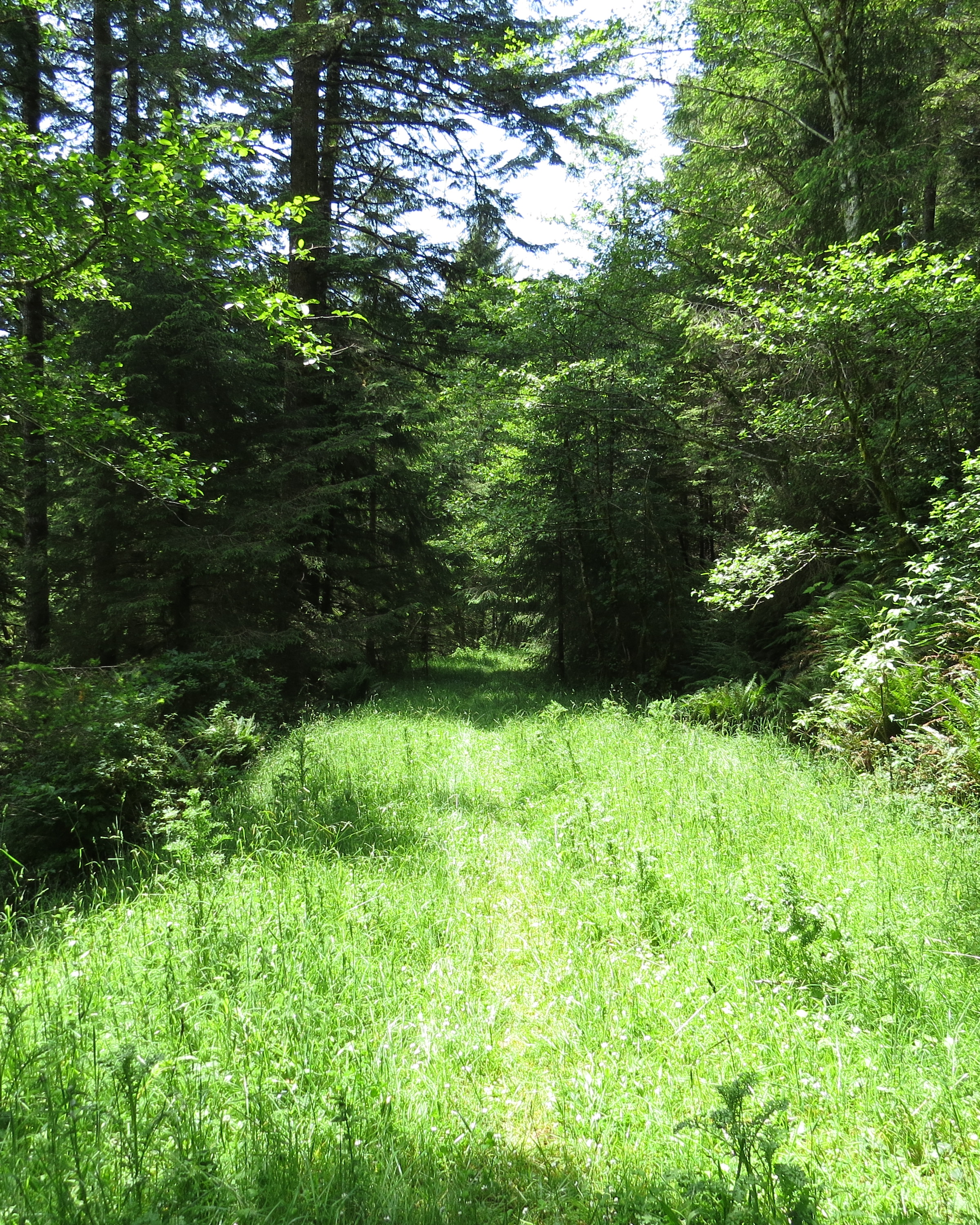
Cummins Creek Wilderness in June 2014

Cummins Creek Wilderness in June 2014

IMG_0893

Old forest service road that is being allowed to grow back. Cummins Creek Wilderness; June 2014.

Five minutes later, the person who arrived first announced that he was going to “start back.” This was fine; we are pretty informal, and I am a new leader, leading my fifth hike.  Four others, becoming cold, since the low sun had disappeared into a cloud bank, decided they would start back as well.  It was then I got the comment about the short lunch.  Reluctantly, the commenter got up and began hiking.  I waited, looked around for anything left behind, and started back.  I don’t have to be last on a hike.  If I know a person is experienced, knows the trail, I have no problem leaving them.  On this hike, however, I wanted to be “the sweep,” so if somebody had trouble, I would be available.  My GPS had read 3.2 mph underway on the way out, and I was looking to arrive at the cars about 2:30 or even 3, depending upon the person in front of me, who was disappointed about the lunch time.

IMG_4832

Field of Sword Ferns, looking down from the spine of the ridge

IMG_4838

View of the Oregon Coast from Cummins Ridge Wilderness, near the transition zone from Sitka Spruce to Douglas Firs.

Quickly, I started closing the gap.  Nearing her, I stopped, took some pictures, since I neither wanted to pass nor hike at her pace.  She disappeared from sight, but I closed the gap again, and did the same.  On a previous hike near this area last week, she had stayed with the group.  I wasn’t sure what was going on, but I wasn’t going to say anything, either.  Why was she going so slowly?

I remained silent, often sitting for 3 minutes by the clock, allowing her to get further ahead.  As I sat, I discovered that while there were no “views,” I noticed more, a a huge field of sword ferns, Oregon Ash and a few Western Cedars at 2000 foot elevation.   I continued hiking, stopping again, until we got to the half way point back.  As I stopped, I started noticing the subtle change in the forest, as we approached the coast.  There was a remarkably sharp transition zone into water loving, wind tolerant Sitka Spruce and sun loving Douglas Firs. Both were huge, but clearly there were all Sitkas at one end of the trail and all “Dougs” at the other end.  An hour into the return, I looked at my GPS.

She was making 2.9 mph good.  She wasn’t at all slow.  She wasn’t holding anybody up.  The others were walking a lot faster.  I said aloud, “I’m with a bunch of rabbits.”  Indeed, my underway speed was 3.4 mph.  This translated to a 30-plus minute difference in finishing, and the person who left early not only was ahead on that basis, he was walking fast.

I had thought for an hour that the woman was slow.  I was wrong. Facts proved me wrong.  Two miles from the end, I passed her, knowing now it was safe.  Ten minutes later, I encountered others on the hike, reaching the car 2 hours after leaving the east trailhead.  The fastest person was sitting in his vehicle.  By 2:45, we were on the road back to Eugene.  We had a partly sunny day on the coast; in Eugene, the fog never did clear.

I saw a lot more of the forest than I expected to, each time I sat down for a few minutes and let the woman go ahead.  I was alone among the trees and the wind, in one of the special areas in this country—wilderness.  I also learned something:  just because somebody lags behind doesn’t mean they are slow.  The woman had 30 more minutes in the wilderness than the man who walked back fast and sat in the car.  Hopefully, both were happy with the outcome.  Perhaps the man thought the hike was too slow; the woman felt the lunch break was too short.

What I do know is that I showed six others a part of Oregon they hadn’t seen, which I now have seen twice.  How they viewed it was their business.  How I viewed it taught me something about the Cummins Creek Wilderness, speed, and not being too quick to judge somebody who appears to be too slow.  Maybe the others are excessively fast.

It’s all about relativity.  And getting the facts.

IRINA

December 16, 2014

They just keep on a comin’, surveys about my latest purchase, its packaging, its delivery.  But enough about Amazon—for now.  Even medical and veterinary practices survey these days.

I received an automated phone call the other day, and as soon as I realized it was from a doctor’s office—a physician whom I had just seen—the ugly S-word, survey, popped into my mind.  “The survey would only take a few minutes….”  Later, the voice told me they needed “just a few moments” of my time.

Let me be clear:  a few minutes is no more than four.  A few moments is a lot less.  The two are not equivalent, and I am the most time conscious person I know. I can quickly quote my age in billions of seconds and days to the nearest 5%.  I love numbers.

Because I liked the doctor, I decided to stick around to take the survey, my eye on the second hand in the kitchen clock, which had moved a quarter a way around the dial (more than a few moments) before I heard a new voice, computer-generated, a poor sound, which turned me off.  Sure, it saves money, but it is a bit tacky.  I made a honest mistake, pressed the wrong button, and the survey disappeared.  That was good, although I missed a potential learning experience from a computer-generated phone survey, and my doctor missed hearing something, too.  Alas, I’m not paid for “a few moments” of my time these days.

It’s unfortunate, because what would have worked for me would have been a nice cheerful young woman’s calling me.  Trust me, you could find one at any Dutch Brothers kiosk in Eugene, and for $15 an hour, you would have a person making good money using her personality skills AND get a better survey.  The conversation might go like this:

“Mr. Smith (Dr. Smith would have me send her flowers), this is Irina at  xxxx’s office. We wanted to thank you for your visit and ask if all your questions were answered, or if there was anything we could have done better.”  Notice the lack of  “survey,” which has become a big red flag for many, “just a few moments,” the use of “thank you” and the emphasis on “anything,” because that gets people, otherwise reluctant to comment, to say something.

“No, everything went well.  I really liked the doctor.  He explained everything and spent a lot of time with me.”

“Oh, that is so nice to hear.  If we can be of help, please give us a call.  Thank you so much for your time.”  (She acknowledges the time using only the possessive adjective).

That took 22 seconds.  Your time may vary.

Now, the bean counters and the spreadsheet folks aren’t going to like the data, because it is not numerical.  Let me be again clear.  I am the most numerical person I know.  But, this isn’t about numbers.  It is about patient satisfaction, post-visit questions, feedback and discovering potential problems in practices.  Not only that, the doctor would have my feedback three days after I saw him.  Why, I might even tell Irina the specifics of the visit I liked.  She got a response, and I bet she would get a census—every response—if she asked the question to others the way I just posed it.

Instead, they got nothing.  Actually it was worse, because I pushed a “1” on ease of scheduling an appointment, which was the wrong number.  I figured “please press 1” was coming, and I didn’t wait.  Shameful.  The computer-generated voice didn’t know what to do.  Irina never would have done that.

I understand the need for companies to get customer’s opinions.  In the old days, we wrote letters, usually complaining about something that went wrong.  When I cleaned out my late father’s things, I discovered copies of letters I never would have sent, excoriating people. It didn’t bother him.  I have sent positive letters, like to the guy at Delta who brought out something I left on the plane and gave it to me.  Good companies know how to respond to complaints.  I still have one from 43 years ago, when my wife and I, on our honeymoon, were late getting back to Woods Hole, because the ferry turned around and returned to Nantucket to drop off a workman who forgot to disembark while docked at Nantucket.  They inconvenienced several hundred people for a jerk.  The CEO told me that.  He didn’t waffle, say “we regret the inconvenience.”  If I remember correctly, he said that he had a shouting match with the Captain, and the Captain lost.  Now, that is a good, honest response to a complaint.  Don’t get many of those today.

Waiting time?  The front desk person can easily figure that out.  They know the time of the appointment and when you are taken back to the office. You don’t need to survey to get it.

People aren’t going to pick up the phone to take a survey.  Better to have an old fashioned suggestion box at the front door, with plenty of paper and a pen.  Label it “Suggestion Box”.  If it doesn’t work, then remove it.  See what happens, first.

Personalized calling is much better business.  If you use a veterinarian, notice how they call the day after a non-routine visit, to make sure everything was fine, asking if there are any questions.  Such a call shows personal interest, especially when the pet’s name is mentioned.

Doctor’s offices can do this, too.  My doctor’s day would have been made, had he heard the things I would have said.  Everybody loves a compliment.  And if something went wrong, people need to hear it sooner, rather than later, or not at all, when the patient disappears—and tells others the bad experience.

For those who want phone surveys, hire an Irina, and skip the S-word.  Jeff Bezos has a net worth of nearly $28 billion.  I suspect if 20 people a day got a call saying, “This is Irina from Jeff Bezos’s office at Amazon.  Has our service met your standards?”  Mr. Bezos would learn a lot.  Admittedly, it’s old fashioned, unlike the e-mail bombardment one gets after a purchase.  But there is an old-fashioned term given when the front office calls an customer: “courtesy.”  Jeff ought to make a few calls himself.  Wow, that would make waves in the B-schools.

Strange thing is….such a call is not at all innovative.  It used to be the norm.


SLAMMING AND BEING SLAMMED

December 2, 2014

Sometimes on social media, one writes something and gets slammed.  Last week, I was both slammer and slamme.  When a woman likened the riots in Ferguson as having to do with liberals.  I took offense, replying that as a liberal, I believed in the rule of law.  If one does not like a law, one must work to change it.  I said the freeway near her house was paid by our taxes, a liberal concept that we need government to pay for things too big for individuals to handle themselves.  I suspected I paid more taxes than she.  I threw in my being a veteran as well, since some think that liberals don’t serve in the military.  Dick Cheney didn’t.

I didn’t know all the facts.  Sadly, her husband had been laid off.  While trying to hunt deer for meat, since they needed food, people drove by shooting off guns to scare deer away.  I don’t like hunting, but most hunters are conservationists, and we share a deep love of the land.  Subsistence hunting is different from trophy hunting.  Hunters must buy Duck Stamps, which every environmentalist should, too.  The woman apologized, and I accepted it.  She’s having a rough time, and I hope she gets back on her feet soon.  I did not levy any more cheap shots; I didn’t comment that unemployment insurance was a liberal idea.  I don’t kick people who are down.

This week, I got slammed on My Stealthy Freedom page, for a comment I thought fairly innocuous.  It bummed me out for a couple of days, and I was puzzled by the behavior of the commenter.  I eventually let it go, but I will comment far less; I don’t like being slammed.

I never, however, expected to get slammed by my older brother, who occasionally writes me, usually on my birthday.  But he weighed in the other day, when I posted that it happened to be the 140th anniversary of the birth of Sir Winston Churchill, who is my hero.

I know full well that Sir Winston was an imperfect man.  All of us are.  I am imperfect as hell, and frankly, so is my brother.  Sir Winston drank, had a streak of nastiness in him, but was one of the great writers and orators of the 20th century, and an absolute master of the English language.

I begin with my favorite quotation, because it shows both sarcasm and nastiness, two of my major flaws:

“Sir Winston, if you were my husband, I’d give you poison.”

“Lady Astor, if you were my wife, I’d drink it.”

But let’s get serious:  Churchill was prescient.  He knew war was coming, well before others, and when things went south in a hurry, he came forth with leadership, knowledge, speeches evoking the stunning beauty of the English language, and predicted closely what would happen.  “Wars are not won by evacuations,” called attention to the luck and leadership that kept Dunkirk from becoming a major disaster.  Many of his words, his incredible words, still ring in my head today.  The forward, “Their Finest Hour,” the second of six volumes about the war:  “How the English people held on, alone, until those who had hitherto been half blind, were half ready.”  If there has been a better use of the word “hitherto” in the English language, I have yet to see it.  “So if the British Empire lasts for a thousand years, men will still say ‘This….was their finest hour.’ “

On the invasion of North Africa:  “This is not the end.  This is not the beginning of the end.  It is, perhaps, the end of the beginning.”  The Italian campaign in 1943:  “The fate of this part of the world is being decided by some things called LSTs.”  I, too, was a Navy man.  Absolutely spot on.  Churchill pushed for invasion of southern Europe, which had it been done, would likely have kept much of Eastern Europe out of the Soviet sphere of influence.  It would have been a different world.

To be fair, I need to quote my brother directly:

Serious? Sure, he was a great leader in WWII, but he needed that war as much as it needed him. One definitely gets the idea that if there had been no war, he would have tried to start one, just so he could earn personal glory. That was basically what happened in Gallipoli in WWI.   My point was that Churchill would have been a historical nobody had he died before he was 65.  He lived past 65, however, when history gave him an opportunity to take the leading role on the world’s stage.

I have little doubt he would have dropped the bomb had he been in Truman’s shoes.   I never knew that my brother felt that way about the Bomb (My sarcasm comes forth here; it is “Bomb,” not “bomb.”).  I would have dropped the Bomb, too.  I’ve seen Pearl Harbor, the tunnels at Corregidor, Bataan, Kwajalein, Kagoshima, where the attack on Pearl Harbor was planned, the Memorial Cemetery at Manila, the jail there where American prisoners drowned at hide tide, the guns facing the wrong way in Singapore, and Eniwetok.  The fire bombing of Tokyo in May, 1944, killed far more people than Hiroshima, horribly so, through burning.   Estimates of casualties on the American side, had we invaded the Japanese Home Islands, would have been a million.  I respect those who disagree with me.  But my shoes have walked upon hallowed ground abroad.

He just happened to be in the right place at the right time, when his belligerent nature could be put to good use.  Exactly, dear brother.  He was in the right place at the right time; he knew what to do and how to do it.  Some of us in our lives may be fortunate enough to inhabit those two dimensions simultaneously, but we don’t achieve greatness.  Churchill was absolutely the right man for the job.   It wasn’t happenstance that he said, “We are waiting for the invasion.  So are the fishes.” That is one of the few perfect uses of the -es plural for “fish” outside of the Bible.

Churchill remains my hero, because he led through words, spoken and written, as well as deeds.  His ability to perfectly command the English language makes me proud to be part of the English speaking peoples (his wrote another four volume set, “The History of the English Speaking Peoples”).  He became great when he was older than 65.  He was imperfect and nasty, but made correct predictions far ahead of his time.  Those last three traits are part of my personality.  I am imperfect, often nasty, but have been far ahead of my time in medicine.  I am no Churchill; I can neither write nor speak English as well:  “If Hitler invaded hell, I would at least make a favorable reference to the Devil in the House of Commons.”

Churchill made exact predictions after the war, too. His final volume, “Triumph and Tragedy” had its forward: “How the great Democracies triumphed, and in doing so were able to resume the practices that so nearly cost them their existence.”

I may have been slightly inaccurate in my quotations, for I deliberately chose not to look them up.  They are burned into my mind.

CEMETERY THINKING

December 1, 2014

We could learn from Floyd, one of my cats.  Every night, when I fall asleep, Floyd lies against me, but not so hard that I am uncomfortable or have to move.  Four hours later, I awaken, shoved over to one side of the bed.  Floyd is an incrementalist.  He pushes slowly, consolidates his gains, and pushes a little more slowly.  I move.

Mr. Obama’s decision to act on immigration has angered people on both sides of the issue.  That to me is the hallmark of a good decision.   One may look at it as “we didn’t get what we wanted, so it is no good” or “we got some of what we wanted, and we will strive to get more.”  The first is perfectionist thinking, which brought us George W. Bush.  The second was incremental thinking, and it brought us Medicare, which didn’t fix medical care costs, but got us a lot closer to that goal.  Bear with me:  I won’t forget cemetery thinking.

The idea that a president can act unilaterally is not new.  Herbert Hoover blocked immigration, lasting 5 years until FDR started taking in Jews’ fleeing Nazi Germany.

On Facebook, I know people on both sides of immigration, and they are angry.  To both sides, I have two words:  GROW UP.  Two more words:  NO WAY in a country of 310 million will each of us get what we want, when and how we want it.  The President is trying to ADDRESS the issue, not make it perfect. NOBODY CAN.  Indeed, the Senate passed an immigration bill upon which the House of Representatives refused to act, because Mr. Boehner, a Republican, not some liberal like me, chose not to act on the bill.  Minority leaders: Tea Party—didn’t want it.

Mr. Boehner wants to run out the clock on Obama.  Indeed, if you are winning, and there is not a lot of time left, you want to use as much of as you can when you are in control.  Conventional wisdom called Mr. Obama a lame duck.  Instead, he acted the way I did when I was a “short timer” in the Navy.  I wasn’t going to be there much longer; when my happiness quotient (time served/time left to serve) was 3, similar to Mr. Obama’s, I started doing what I thought I should, not worrying what somebody would do to me.  Mind you, I wasn’t a jerk, but I spoke up when I thought people were wrong, and they were stuck.  I accomplished a lot; I asked for what I really wanted, another cat ploy, realizing the worst thing that could happen was somebody would say “No.”

You see, back then, the worst thing for a doctor was to be was in the military, on a ship, and deployed.  I was all three.  What could they do to me?  Take away my birthday?  And what is the House going to do to Mr. Obama?  He transformed himself from being a lame duck to a pterodactyl.  He acted, and the Republicans must respond.  Given the complexity of immigration, the suddenness and timeliness of the action (although it was predictable), before the annual 6 week shutdown of America called the “holidays,” a big lump of carbon landed in a lot of stockings.

Get real, folks.  Immigration reform won’t please everybody.  We have to have some sort of secure border, we can’t take in the world, we shouldn’t split up families, and we shouldn’t be hiring workers who are here illegally.  That is only part of the problem.  I want something DONE, see what happens, and then modify it.  The status quo isn’t working.  If both sides get something, wouldn’t that be better?  Most rational adults would say yes. Mr. Obama is governing, and this isn’t fun.  But avoiding the issue is even worse, sort of like climate change, but that is for another time.

Mr. Obama apparently decided it was time to quit playing safe, trying to please everybody, and run the country as best as he saw fit, since nobody else was willing to, and he had the power.  He issued an Executive Order, one of about 190 so far, and Washington howled.  How dare he?  Well, Mr. Reagan issued nearly 400, and the previous president, who brought divisiveness and two unnecessary wars not paid for with a war tax, the doughnut hole costing $135 billion more than predicted, and wanted to privatize Social Security, which given the recession that followed, would have been disastrous, issued 291.

Here at home, Sen. Ron Wyden’s bill to deal with increasing timber harvest, yet putting controls on it and adding wilderness areas has been hammered from both sides.  I’m a life member of the Sierra Club, but I try to be a life member of the reality club. Given my druthers, I’d ban logging, stop poisoning the land after clear cuts, since the poison is getting into the water and into the bodies of people in this state, and have a lot more wilderness.  Well, I’m not going to get my wish.  Period.  We aren’t going to stop logging in Oregon.  We can, however, add some wilderness to a state which has one of the lowest percentages in the west. Eugene has no wilderness within 40 miles.

When you have two disparate groups arguing, you have four choices: one, keep arguing and doing nothing; two, give it to one side, which creates a lot of enmity; three, compromise that gives both sides something; four, find an out of the box, creative solution that never occurred to anybody.  I’ve pretty much given up on the last, although there are a lot of creative thinkers in this country, but we need to listen to them, not ask for their money, or recycle yet another governor, senator, or general, who really ought to retire and volunteer somewhere.  America can fix problems.  When both sides dig in, both lose.  Being angrily dug in to a position usually ends up burying a lot of good ideas.  And I call that cemetery thinking.

I don’t have a problem with the Sierra Club’s wanting more.  That’s fine.  But take what you can get, people, because at some point…..hmmmm, right now for example, the next few years are not going to be very good for wilderness, politically.   Having sensible actions, even imperfect ones, to make more wilderness, even at the cost of other areas, might work.  Then you work for more.

Health care reform?  I’m an incrementalist.  Ideally, I’d expand Medicare to the whole society.  That isn’t going to happen.  Realistically, expanding it to 55 and older is one option; another is expanding it to pregnancy, labor, delivery, and the first 10 years of life.  Put in measures that would serve to show what does and does not happen, good and bad.  I believe it would cover many poor women and children, and at the same time force abortion foes to make good on what pro-life really means. I ask, how can one be against a program that helps women and children?  Easy.

By being a cemetery thinker.

RESPECTING THE OFFICE MATTERS, REGARDLESS OF THE INDIVIDUAL

November 23, 2014

I didn’t like Senator Jon Kyl, when he represented Arizona.  I might have even hated him.  When he was in office, I wanted a bill mandating a national medical safety reporting system.  This is beginning to happen now, but in 2001, when I began, nobody considered the idea.

I called Mr. Kyl’s office, requesting what I wanted, and instructed to go to their Phoenix office to meet with a staff member there.  I put on a coat and tie.  I almost never put a coat and tie on in Arizona.  I do for funerals, when many, incredibly, do not; I went years without wearing a coat and tie.  Why would I dress up to visit to a senator’s office, when I detested the man?

I had respect for the office.

There is a huge difference between respect for the office and respect for the man or woman holding that office.  The office must be honored.  I honored the office of US Senator by dressing up.  I ended up talking to a nurse, who to this doctor was insulting, since I knew more about medicine than she did.  I said nothing about the snub, presented my program, and heard nothing afterwards, which annoyed me greatly, and indeed, showed great disrespect for me.

I had respect for the office.  Don’t forget that.  When a South Carolina Congressman yelled “You lie” to Mr. Obama during a State of the Union address, it was a massive breach of protocol and courtesy.  One simply does not denigrate the office regardless of what one thinks of the man. Those who don’t know how to deal with the issue properly should either avoid the situation or remain quiet.

In what follows, my wife disagrees with me, but perhaps my military background colors my opinion.  Everybody who has served in the military knows the difference between respect for the office and respect for the man.  I was put down by enlisted people who used “Sir,” “Doctor,” or “Lieutenant,” in a tone of voice making it abundantly clear they detested me.  I did the same to senior officers.  Later on, I would do it to lawyers, a powerful technique, for arguing with somebody who keeps calling you “Sir” is difficult.

Dartmouth students recently “flamed” (a Dartmouth expression) Gov. Rick Perry of Texas, asking him many sexually explicit questions about Perry’s opposition to Gay Rights and similar issues.  Gov. Perry was asked:  “In your campaigns you have received hard-money campaign contributions of $102 million, half of which came from 204 donors. Would you have anal sex for $102 million?”

The defense in The Dartmouth, which I once served on the editorial board, was this:  “When confronting those in power who actively disrespect the rights and humanity of others, any demand to civility is ironic…”

No, I don’t agree with this.  If you become those whom you despise, what have you become?  What made Iraq so awful was that we Americans did what we criticized others for, being inhumane.  Any demand for civility is appropriate, not ironic.  You figure out how to get your point across without being disrespectful.  

Personally, I would have asked one of these questions: 

  1. “Mr. Perry,  why did you ask people to pray that Hurricane Rita turn around in the Gulf of Mexico and go backwards, when all the weather models predicted landfall near Houston?  Would you abolish NOAA, NWS, and the NHC?”  
  2. “Do you think we can pray our way out of global climate change or cure cancer?  How do you view science, Sir?”    Add the Sir.  It matters.
  3. What is your stance on prayer vs. human action, Governor?”  Frankly, that is one of the best questions I can think of to ask a religious person.

From the editor again: Respect in this context is not a paramount or meaningful concept. I’m not advocating disrespect per se — rather, that incivility can be an effective and appropriate tool for such circumstances.

I don’t agree.  Mr. Perry is a sitting governor of Texas.  I don’t like him personally, and I don’t like Texas very much either.  The latter is irrelevant, but the former calls for civility.  By being disrespectful, you have advocated disrespect.  Incivility is a shocking tool that will do exactly the opposite of what you intend.  As a Dartmouth alumnus, I was ashamed of my school; I feel if LGBT people continue on this path, it will harm their cause, not enhance it.  You mentioned the icky factor.  A lot of us support your rights without wanting to hear details.  Can you understand that?

My questions were disrespectful, but I reject the notion that I should respect a man who holds power simply because he holds it. It should matter what he does with that power, and what he does is oppress people he finds icky.

Mr. Perry holds power because he was elected, a bad, ugly, legal money driven process now, and Mr. Perry won.  I don’t like the elections process in this country; changing the election rules in Texas would also have been a good question to ask Mr. Perry, along with voting rights in general.  Nobody is asking you to respect him, but your questions should not be disrespectful.  If you treat a governor that way, would you treat an elder in society that way, too?  Yes, it matters what Mr. Perry does with his power, and you could have stated exactly those words to him.  You could have said that his stance against gay individuals was in your view an abuse of his power, and while you respected his office you could not possibly respect him as a man.  I’m not sure he is oppressing people; here, at least; people can leave Texas and stay in the country.  If you want a definition of oppression, go to My Stealthy Freedom on Facebook and see how Iranian women get arrested or have acid thrown at them for showing too much of their hair in public.  Or be sentenced to jail for a year because they saw a volleyball game.  Or be hanged for killing their rapist.  

I have been very vocal in the 300 posts I have on this blog.  I think it is time for a national reality check about politeness and respect.  We can start with the office, even if we don’t like the person.  Trust me, Mr. Perry knows you don’t like him, and Mr. Obama knows that a lot of folks don’t like him either.  Your dislike isn’t going to change either.  What would change him, if anything, would be respect for the office, stated; dislike of his policies, stated; and cogent reasons why you feel he is on the wrong side of history.

If The Dartmouth editor can’t figure out a way to say that, I would wonder how she got accepted.  I am not nearly as articulate as she, and I got accepted.  Maybe it was because my mother taught me to be polite.

OREGONIAN

November 22, 2014

A year ago, I went to my last party in Tucson, saying to myself that with the exception of two people present, I would never see anybody there again.  I said that a lot my final year in Tucson.  It was odd that the day I drove to Oregon, I never did a last walk around of the house, because I thought I would be back to help sell it.  I didn’t have to return, so I never said goodby to the saguaros, chollas, barrel cacti, prickly pear, the pyrrhuloxias, the phaniopeplas, the place where I did my astronomy for 15 years, and all the rooms.  We had a good house.

I said good-by to three people.  I hinted at it to a neighbor, but he didn’t say a word.  I arrived in Tucson quietly and I left quietly.  It was like I never existed.  I wrote an astronomy column for 20 years, and never heard a word when I was let go.  If the medical community were sad to see me go, only the Executive Director of the Medical Society said it.  I never heard a word from others.

The party was in early December, one of the few months I liked in Arizona, where one can be outside in Arizona in the evening.  I sat down, talking to a couple with whom I used to ride the bike.  Another man came up, whom I did not know, and began berating me about moving to Oregon in general and Eugene itself.  I was stunned, since the conversation hadn’t been at all about me but about the couple.

I am amazed that while I consider myself not particularly skilled in social behavior, I would never behave the way some of those influential in social circles do.  Apparently, he and his wife spent time every summer in Coeur d’Alene, Idaho, but his wife couldn’t stand the rain and couldn’t wait to get back to Tucson.  More power to them if they were happy.

He told me “it rains in Oregon,” which is kind of obvious, and I replied, “Yeah, great, isn’t it?”  I didn’t tell him I was leaving a state that had 30 years of above normal temperatures since 1984, a 20-year drought, serious water issues, and the most dysfunctional legislature in the country.  Nor did I mention I bet a major career change to statistics on helping the medical community but missed the course on marketing.  In any case, when I crossed the Colorado at Parker, I knew the car would never roll back into the state.  In the past 8 months, neither have I.  There are times when I truly wonder if I will ever return to the state.  I haven’t missed it.

So, what has been my experience to date in Oregon?  Well, yes, it rains.  From April to June, we got 6 inches, almost all at night, a lot of it brief showers, with sunshine afterwards.  From June through September, we got hardly any.  The darkness, dreary days with rain all the time I have yet to see, although I’m assured I will see them.

Last night, my wife and I walked to see the men’s basketball game at Matt Knight Arena, walked to dinner afterward, put on our rain suits, head lamps and reflectors, and walked 2 miles home in moderate rain.  It was a great day.  I often take a rain jacket but don’t expect to wear it.  We are still drier than we should be, although a 3 inch soaking sure helped the stream flow on Spencer Butte; The Sisters and Mt. Jefferson are again snow covered.  I can identify the major Cascade peaks now. I have not given up a day of running because of rain, because it rarely rains hard, and then only briefly.

Hot?  Sure.  Eugene hit 101 and had 36 days over 90, a record, but high temperature records are the new norm in America.  Unlike Tucson, Eugene cools off at night.  I didn’t use cooling the whole summer.  In Tucson, we used to open the house half the nights in summer; the last summer we closed up from May through September. One can ride a bike 12 months a year in Tucson, but they do the same in Eugene, just well lit up, wearing rain gear, although not as many wear helmets as I would like.  We have a river walk along a real river, swollen by autumn rains, not a dry river bed that once ran most of the winter.  Hiking is year round in Oregon.  The high Cascades are now closed except for snowshoes, but the coast is available, although it will be wet.  In Arizona, the hiking season is from maybe October to maybe March.  The hiking in Oregon is wonderful.

I’m useful here, a new feeling.  I volunteer 2 days a week at a community college, teaching math, and love it.  They like having me.  I volunteered 9 years in the schools in Tucson and was never busy enough.  When I left, I never heard a word. I’d go to Lane 5 days a week, but I’d miss my 6 mile weekly hike with the Obsidian Hiking Club, climbing 1500 feet to the top of Spencer Butte, trailhead 6 miles from my house.  I help read to young kids, because Oregon businesses realized that poor reading skills in their children needed to be addressed.  I’ve led 2 hikes into the Cascades, and next month will lead at least two in the Coast Range.  I’ve taken more than 60 hikes within a day’s drive of Eugene, a third with a climb of 2000 feet or more.

My recycling garbage bin is larger than my regular garbage; it was the opposite in Arizona.  Property taxes are double; there is no sales tax.  There’s a Dutch Brothers about a mile away, and I can walk to Track Town Pizza every week for German Stammtisch.  I’ve been to a bunch of track meets and walked to each one.  I ride the bus downtown, because it is free for me and easy.  I never once rode the bus in Tucson.  Shameful.

No place is perfect, and Oregon is no exception.  The rural areas are red,  crazies run for Congress, ones who have names of the nearly 32,000 scientists who deny climate change, but don’t list the degrees and don’t update the list.  Besides, last I heard, science wasn’t decided on numbers of scientists but on facts.  We have homeless and Whovilles here and graffiti, like any other place.  We debate what to do.  The newspaper has printed two of my letters, one of which may lead to my helping with the Death With Dignity Act.  There is a good chance I will help with the Oregon Patient Safety Program.  They wrote me back and followed through.  I couldn’t get past the dugout in Arizona with that.  Marijuana will be legal next July, and the Wayne Morse Free Speech Plaza downtown is just that.  There’s a Farmer’s Market every week during the spring and summer.

I run daily on Pre’s Trail, and when we walked home last night in the rain, I told my wife she was finally an Oregonian.

I’ve been one for some time.  I love it.

NATIONAL DISGRACE

November 21, 2014

At a recent Tuesday evening Stammtisch, over at Track Town Pizza, where I get my weekly chance to listen and speak German, I had just explained, in German, the story behind our having a rather large number of house cats, all former strays.

One man, nice enough, commented that the local humane society was euthanizing animals and had a “red list” for dogs that at the end of the week: if they hadn’t been adopted, they were going to be euthanized.  He used as an example that a lady friend of his turned her cat over to the organization, offering to pay for everything, then had her check bounce.  The next day, the lady returned, paid again, and saw her former cat in a truck.  She wanted to say “good by” again, and related to the man who was telling me all this that her cat was going to be taken to be euthanized.

I listened, stunned.  I wasn’t so stunned, however, to wonder why the lady turned the cat over to the organization in the first place.  One reason to relinquish a cat is one’s inability to care for it.  If the lady could drive and pay, but her check bounced, perhaps she was a little demented and her memory inaccurate.  Since the story was being retold, the chance of inaccuracy increased.  I stayed silent.

The second issue was the “Red List”; the third was the man had once wanted a husky, and the society didn’t have any.  He got one from an ad in the newspaper.

I am a strong animal lover.  I was bummed and I left the Stammtisch shortly after, deciding I  would check his story out.  There is too much of what I call Fox News behavior, where poorly unsubstantiated rumors or outright lies are treated as fact.  I am a strong supporter of two Humane Societies in two states and wanted to learn if there were substance to these allegations.

Regarding the husky, the local humane society doesn’t have control over animals that are brought in; it isn’t their fault that they didn’t have what he wanted.  Stated less politely, obtaining an animal through a newspaper ad strongly suggests (although not completely) that the man paid for the dog, which were it the case, I find reprehensible, given that we euthanize 2.7 million a year in the United States.  Yes, read that number again.  I wonder how many were healthy huskies.

I learned that the local society transported cats only if the animal needed a higher level of care or had a better chance of being adopted at another facility.  They also euthanize on site, so the man’s story was wrong.  The Red List once existed, but with a former control facility, which no longer exists.  The current society has no such list.  In addition, if you sign over an animal, the animal is no longer yours.  If the animal has kidney failure, arthritis, or is FIL positive, it won’t be adopted, and it will be euthanized.  Adult cats are not very adoptable. Fact.

To summarize, when one checks facts carefully, many rumors are found to be partially or completely unfounded.  Keep that in mind, when reading or hearing shocking things.  There are facts, and there are unsubstantiated opinions.  A lot of the latter rule the day; the former tend not to be what people want to hear.

There is a huge problem with companion animal overpopulation, entirely the fault of irresponsible people in this country, and completely within our control to solve as a people.  The 2.7 million animals I mentioned are 55% cats, 45% dogs.  This number, of course, does not count the number of homeless animals poisoned, shot, run over, drowned, starve, die of hypothermia, disease, or other causes.  I do not have those data.  I assume in my county 5000 animals are euthanized annually and another 5000 die from homelessness.

Perhaps, we ought to ban breeding.  Period.  There are far too many “designer dogs” bought, when a mutt has hybrid vigor and can be a loving animal.  Fact: a group of pit bulls recently attacked a horse, requiring the latter to be euthanized. However, some solutions cause new problems:  spaying and neutering requirements might lead to people hiding their animals to avoid what I would charge: $1000 a year for an unneutered animal. Portland, Oregon, euthanizes 30% of animals that come into their shelters.  Birmingham has more than double the rate, as do Charlotte and Memphis.  Yet, in Atlanta, some shelters went from 85% being euthanized to 20% by adoption programs and other measures.  It is no coincidence that most of our house cats came from rural Arizona, red as red can get, where litters were dumped, healthy cats were tossed out to fend for themselves, because of divorce, moving, “they don’t allow animals,” “they are too much work,” “I became allergic,” and other examples of boorish, non-thinking people who would do the same to their kids if they could.  Come to think of it, they do.  This is the God, guns, and guts group, who shame the country and their Bible, where in at least six different places speaks to the need for us to care for animals.

We ought to publicize the numbers of euthanized animals in the county each month as part of my definition of how healthy my city is and the state of society.  The government does not fund humane societies.  These organizations exist through donations and charges for animal adoption and care.  It will get worse in Tea Party America, where people should be left alone, because people do such a good job of taking care of themselves.  It’s no secret that the five worst states for health insurance, a basic need, are Texas, Nevada, New Mexico, Florida, and Georgia.  The five best are Massachusetts, Vermont, Hawaii, Washington D.C., and Connecticut.  The worst for teen pregnancy are New Mexico, Mississippi, Texas, Arkansas, and Louisiana.  The five best are New Hampshire, Vermont, Minnesota, Massachusetts, and Utah.  When people regulate themselves effectively, we won’t need government to do it.  I’m not holding my breath.

Americans need a whopping big dose of the ugliness here about our treatment of animals.  If a thin stray cat or dog that is eating garbage here doesn’t arouse something sad, then some of our humanity has been lost.  Nearly all of these stray animals will remain homeless, dying slowly by a host of conditions, none pretty.  Frankly, the lucky ones will be euthanized.  To think euthanasia of healthy cats and dogs does not happen in one’s community is to deny reality of an ugly, sad, unnecessary, completely treatable condition, a national disgrace.  Want to fix it?  Ask for monthly counts of euthanasia to be publicized, to keep the issue before the public. Donate money, work to ban breeding, and make crimes against animals severely punishable, for animal abuse correlates very strongly with human abuse.

We rank livability of cities using climate, median income and cultural opportunities, certainly not mentioning how many animals are dumped at the local shelter.  I am not surprised.  Healthier golf courses, excellent medical care and more cultured rich people rank higher than the stray animals population and euthanasias performed on animals who could give more love than one can imagine.

ERROR IS SCIENTIFIC; SO IS CONFIDENCE

November 13, 2014

“Would you like to see the Senator’s paper on the projection for Social Security for 2035?” a student asked a statistics professor friend of mine, who taught in DC.

“Is there a confidence interval mentioned?” replied my friend.

“No.”

“Then I don’t want to see it.”

Nearly every prediction we make about a parameter or phenomenon has some uncertainty.  We make the prediction based upon evidence we have gathered; the evidence we gather may not be accurate, especially predicting the future status of Social Security, which is unknown.  SSI may not even exist in 2017, for if a significant number of powerful people have their way, and enough people decide not to vote, because “it never matters,” SSI will be dumped to save money, to be used to make wealthier people wealthier, because these powerful people want no debt, believing recipients are freeloaders.  I don’t agree, but I am one person.

Even if SSI is unchanged, the funding model may, the economy will, world conditions will, and the number of people receiving it will.  Laws may modify it. All of these conditions are unknown.  They are estimated, using a variety of techniques, but these estimates have error: a word, like theory, that has a different meaning in science than it does in regular speech.

A scientific theory is a system of ideas intended to explain something.  “Your theory (thought, guess, idea) is wrong,” is in the general vernacular. Neither is wrong, except when the vernacular is used to denigrate a scientific theory.  We have a theory of gravitation, but I doubt anybody would jump off a building.

Errors in estimation occur, and they don’t mean that scientists are careless, obtain false, or don’t understand data.  Those are uses of “error” in the vernacular.  Errors in science occur because we use samples to estimate uncountable totals, like the percentage of people who plan to vote for a certain candidate, or any quantity that we may have modeled.  Let’s look at the former.  We don’t talk to every voter.  We choose people at random, and there are a variety of ways to do that.  A perfect sample is difficult to obtain; online samples, the ubiquitous surveys that B-school grads have inflicted on the country, are examples of bad sampling techniques.

If we take a second sample, we get a different result.  Same for a third and all samples we might take.  Typically, we sample only once and use the result as our point estimate, the best value we know.  Are we completely certain?  No, we aren’t, unless we take a census, measure every individual, which is not feasible.  We can quantify the error, however, depending upon the sampling approach and the sample size.  The error decreases as the sample size increases, the decrease of the error approximately proportional to the square root of the sample size.  That’s powerful stuff, done right.  A random sample of a 100 people in the nation, on a yes-no question, has an error of plus/minus 10%.

From a sample, we may construct a confidence interval, using the sample result and size.  This interval we believe to contain the exact value of what we are trying to measure.  Does it ?  We don’t know, because the true value is unknown.  Can any value be possible?  It depends upon what one considers possible.  If one considers anything possible, like the probability of winning the lottery every week for a year, then yes.  If one considers the likelihood of the sample’s being wrong at no more than 5%, typically used in science, then no, everything is not possible.

The concept of a confidence interval allows us to state a range where we think the true value lies. It is either in the interval or it is not, which is a not useful probability statement (0 or 100%).  Therefore, we call it confidence, and typically, high confidence is 95%.  It isn’t perfect, but it is considered significant evidence.

This explanation is why I was upset when the Republican candidate for the Congressional District where I live, a scientist, published the names of nearly 32,000 scientists who did not believe in global climate change.  First, scientists who matter are climate scientists (133), not people like him or me.  Second, science is not done by voting, but rather gathering evidence.  Science is not shouting at somebody, threatening them, or vilifying them in print.  One cannot discount the almost unanimity of articles that state there is manmade climate change occurring, and then use a number of disbelieving scientists to support their claim.  The database is not updated for deaths or opinion changes, which speaks to sloppiness, too, frankly.  If the database is important, it should be correct.

The publication that this candidate used to publish his list was one for which I was once a volunteer reviewer in statistics.  It is a right-wing publication, purportedly scientific, but the articles are replete with non-scientific terms and name calling.  That is fact.  I have read it; moreover, I was asked to review the statistics for articles.  If one has read this blog, one knows that I am a liberal.  I volunteered to help a right-wing journal.  I would be interested in examples where right-wing people volunteer to help a left-wing journal. I did this for free.  Truth matters.

On the basis of statistical evidence, I recommended against the publication of an article that claimed that low dose radiation was healthy (used skewing wrong), which the Congressional candidate believed in, that vaccines caused autism (regression analysis failed to check assumptions), and that the FDAs not approving drugs caused 10,000 deaths a year in the US (using correlation to conclude causation).  I stopped receiving articles for review.  I didn’t know why, suspecting that the journal didn’t like my opinion.  I cannot prove that, and I have no confidence interval.  However, I am 100% certain I stopped receiving articles to review; I later resigned.

Putting “scientist” after a name is easy; look at “creation science”.  Good science, however, is difficult.  I apply science to my life, but that is not being a scientist.  A scientist, and I will grant the candidate was once one, researches or studies something and draws conclusions, even if the conclusions are not what he hoped or expected.

Rule 2 of my approach to climate change is to look at the confidence intervals of both sides:  one side states with high confidence that their interval does not contain zero or a negative number regarding global temperature rise.  The other side does not give any such interval.  This is not scientific, and I am being polite.  If one is completely certain global climate change can’t be occurring, given the complexity of the atmosphere and oceans, such knowledge would be sought after by every climate scientist in the world.

What disturbs me is that the leadership of Congress admits they are not scientists, yet they quote both sides equally, which they are not.  They use such reasoning not to act, for acting might cost jobs, an unproven assumption.  In other words, non-scientists are deciding scientific issues in the country, and I am highly confident they threaten our future.