Archive for the ‘MY WRITING’ Category

AGE MATTERS, BUT IT DOESN’T MATTER

September 9, 2025

“you don’t go out looking for cool things to happen, but you go out knowing that cool things could happen every time…I just tell people, just go, just get out… You never know what you’re going to see, but you aren’t going to see it in the living room. You have to be there.” Sam Cook (Duluth Herald Tribune retired columnist)

“Come on in,” called Dorothy Molter, after I had paddled up to shore at Isle of Pines, her island home on Knife Lake, and knocked at the door.  Dorothy was a legend.  She left nursing and Chicago in 1930, lived on an island in Knife, a long, narrowish lake,  with a few long arms, straddling the border between Minnesota and Ontario.  Called “The loneliest woman in America,” Dorothy had hundreds of visitors every year.  She was grandmothered in and allowed to live the rest of her life there after the Wilderness Act of 1964 required resorts to be taken down, power boats removed, limited numbers of people who could go in, and even how low planes could fly. 

Dorothy gave me some of her famous root beer, and as we talked, I commented that it was a little more difficult to canoe trip when I was 32 then it had been when I was 18, guiding canoe trips in Algonquin Park, wearing the coveted red neckerchief that only guides wore.

“Yes,” Dorothy replied, completely straight-faced, “I don’t paddle and carry as well as I once did, either.”  Dorothy had 42 years on me and she would live for 5 more, her statement a lovely put down to my comment about age.  

When Ely Echo editor Bob Cary interviewed me in 1992 about my season in Ely, the fact I had met Dorothy made the article. “Jackpine Bob” wrote a book about her, The Root Beer Lady.

I first put a canoe on my head 63 years ago as an apprentice, carried wooden Old Towns, slept in canvas tents or under a canoe.  Nobody had heard of Leave No Trace.  We had can pits, cut live balsam for tent stringers every night, and washed dishes in the lake.  In my 20s, my being on the water was salt water, in the Navy, fifty thousand nautical miles and 3 Pacific crossings.

In my 30s and 40s, I explored the Quetico-Superior as much as I could.  In my office, I had a map with dots where I camped and lines where I traveled. After each trip there was new ink on the blue and green splotches. I looked at the map often, dreaming and planning the next adventure. Eventually, I realized that giving back to the wilderness was more important than having a personal proving ground, but this land would always remain a personal decompression place for me.

At 43, I volunteered in Ely for the Forest Service, a half year leave of absence from my medical practice, took 22 canoe trips and spent 100 days in the woods that summer.  I was a decade older than the guy who visited Dorothy Molter, in better shape, knowing now the lakes, portages, campsites, trees and other plants. Four years later, my wife’s and my 25th anniversary, we paddled a 110 mile 11 day loop through three ranger districts. I stopped single carrying portages, all the gear and the canoe over in one trip, in 2001, at 52.  I had nothing to prove and a lot I could hurt.  Besides, I enjoyed walking back in the woods for a second trip across the portage. Single carrying didn’t matter.

After 2002, we base camped on Lake Insula for 7 years. We enjoyed day trips exploring side bays, finding trails that led to other lakes or were a short cut. In 2005, I soloed to Kawnipi Lake one last time. Many of us who plied the canoe routes of Hunter’s Island felt Kawnipi was the most beautiful lake on either side of the border. I won’t go again, but it doesn’t matter. I was there six times, loved it, thankful for my good fortune.

Author on island “The Rock”, Lake Insula, 2005.
Last time on Kawnipi Lake, Canada May 2005

The year I turned 60, my wife and I aborted the first day’s paddle to Lake Insula, one we could do in 7 hours, because of heavy rain. We stopped, pitched the tent and stayed comfortable. Making Insula that day didn’t matter.  We made it easily the next day. 

Morning fog, Lake Insula 2010

The clock ticked louder.  On my fifth backpack trip to the Brooks Range, in my 64th year, I carried 75 pounds up a long hill west of but still in sight of the northern Dalton Highway, on the way to Summit Lake in the Gates of the Arctic NP. It was a tough trip, and I wasn’t sure I would or could do a sixth, but there was a trip offered to the Wulik Mountains in the far west Brooks, country I hadn’t seen, wonderful, wild country, and perhaps I had one more trip in me. I backpacked the Wuliks.

Wulik Mountains, Alaska, August 2014

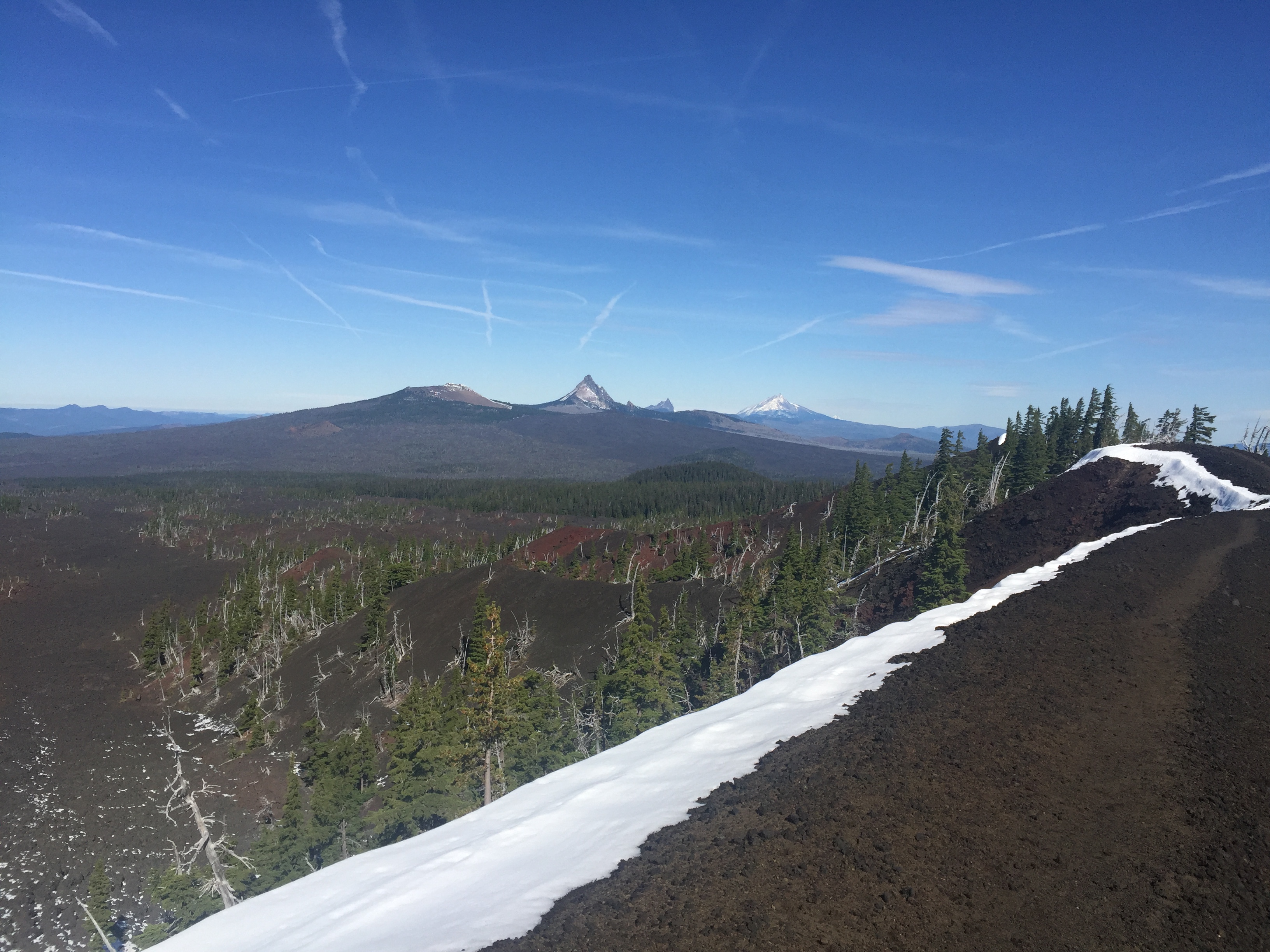
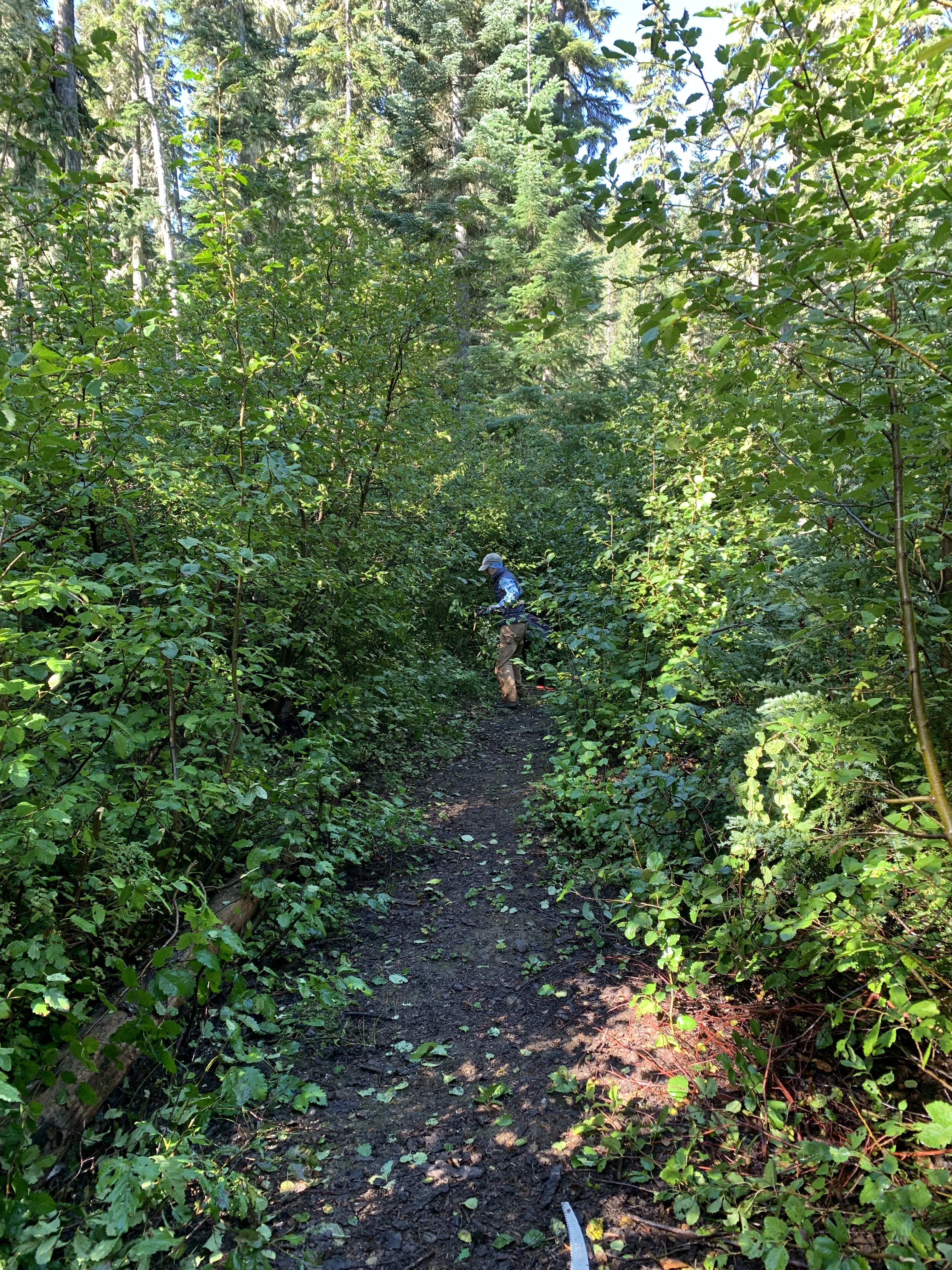
Several years later, nearly everybody  passed me on a tough hike up Oregon’s Larison Rock Trail, which I had led for years. It was a first, but it didn’t matter. When I was 76, I developed cancer and needed hormonal therapy. I changed, or perhaps was changed. I used to want to be on a saw, cutting out logs. But now, it didn’t matter. I enjoyed leading a crew twice to Lowder Mountain in the Three Sisters Wilderness to brush the meadows by hand so hikers could find the trail. What I didn’t expect was my becoming a connoisseur of smaller things, as if I had traded my hiking strength for increased ability to notice subtleties around me.  I changed my “macro” view from the open horizons of Sig Olson to a “micro” quiet magic view of Duluth writer Sam Cook, trying to follow rules of poet Mary Oliver: “Pay attention. Be astonished. Tell about it.”

That matters.

May be an image of 1 person, chipmunk and tree
Author, Black Creek, Waldo Lake Wilderness, August 2025

PAYMENT IN FULL

September 4, 2025

The day didn’t start well. Our third day working three years post-Cedar Creek Fire Black Creek trail in the Waldo Lake Wilderness since getting permission, and we had a new detour. Our drive was now 35 miles from Oakridge; 7 miles north through High Prairie plus another 8 on 1931, 4 on 1934, the latter two dirt roads through the burn and dust, just to get to paved FS 24, a few miles east of Oakridge. Then we had to go several miles through the staging area for salvage logging, by stacks of logs and heavy machinery before the final 8 miles on 2421, dirt with potholes to the trailhead. At least the final part was not in a burn.

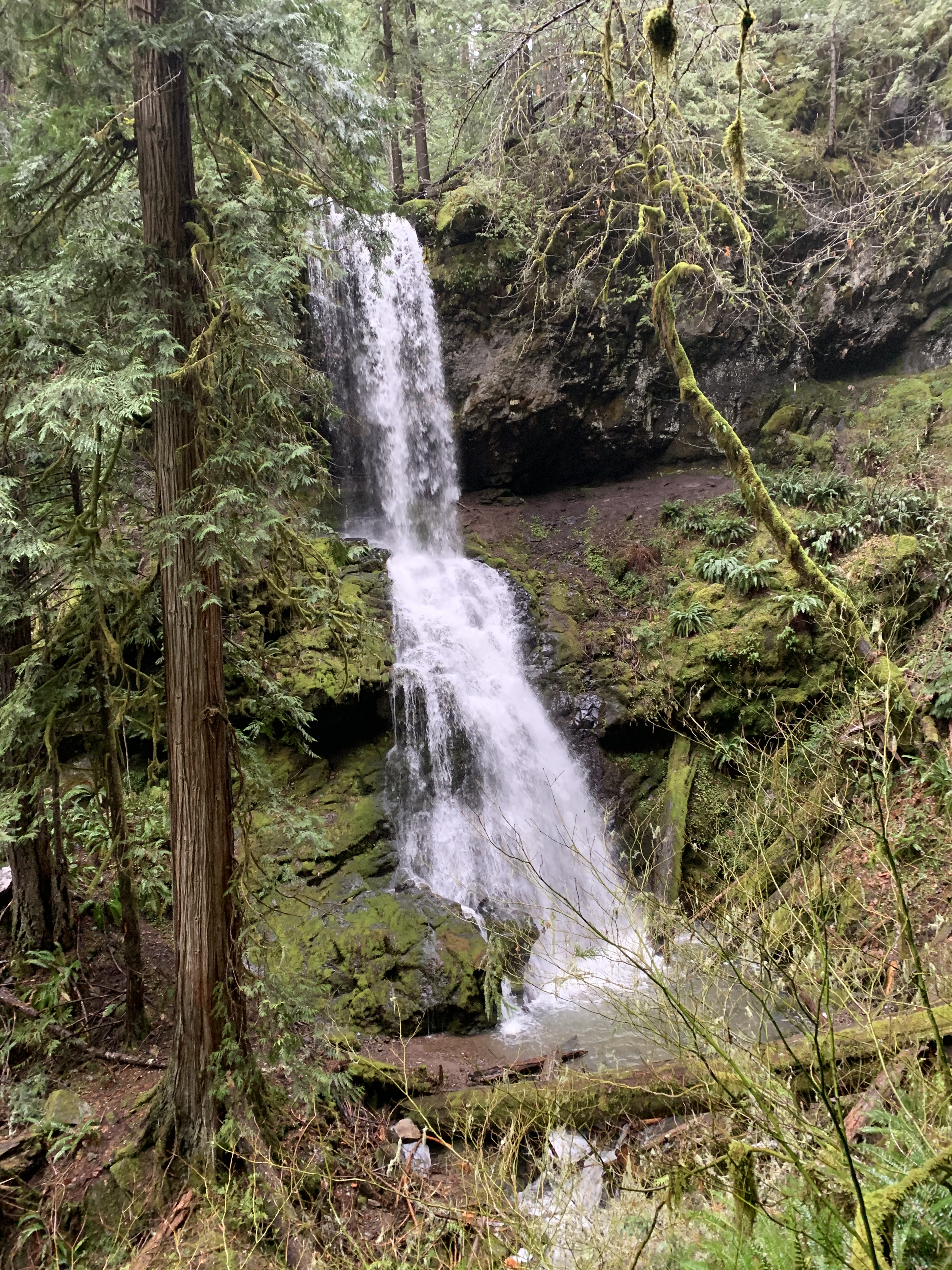
We need permission to work in the forest; we needed special permission to work at Black Creek. Burned areas are dangerous; roads may be busy with heavy equipment, there are falling trees or limbs, maybe silent; treacherous ground with hidden holes; sloughing of the trail; rock slides. During the first two outings we cleared  0.8 miles and 0.4 miles respectively. If the geometric series continued, today we would clear 0.2 miles. Black Creek Trail, 3.7 miles, goes by Lillian Falls before climbing steeply to the west shore of Waldo Lake. We hadn’t even reached the falls. I encountered an all-day-work-on-one-log here several years ago, and logs that gushed sap making saws useless. One of our saw groups had one log that did both, soaking a guy with sap. Delightful.

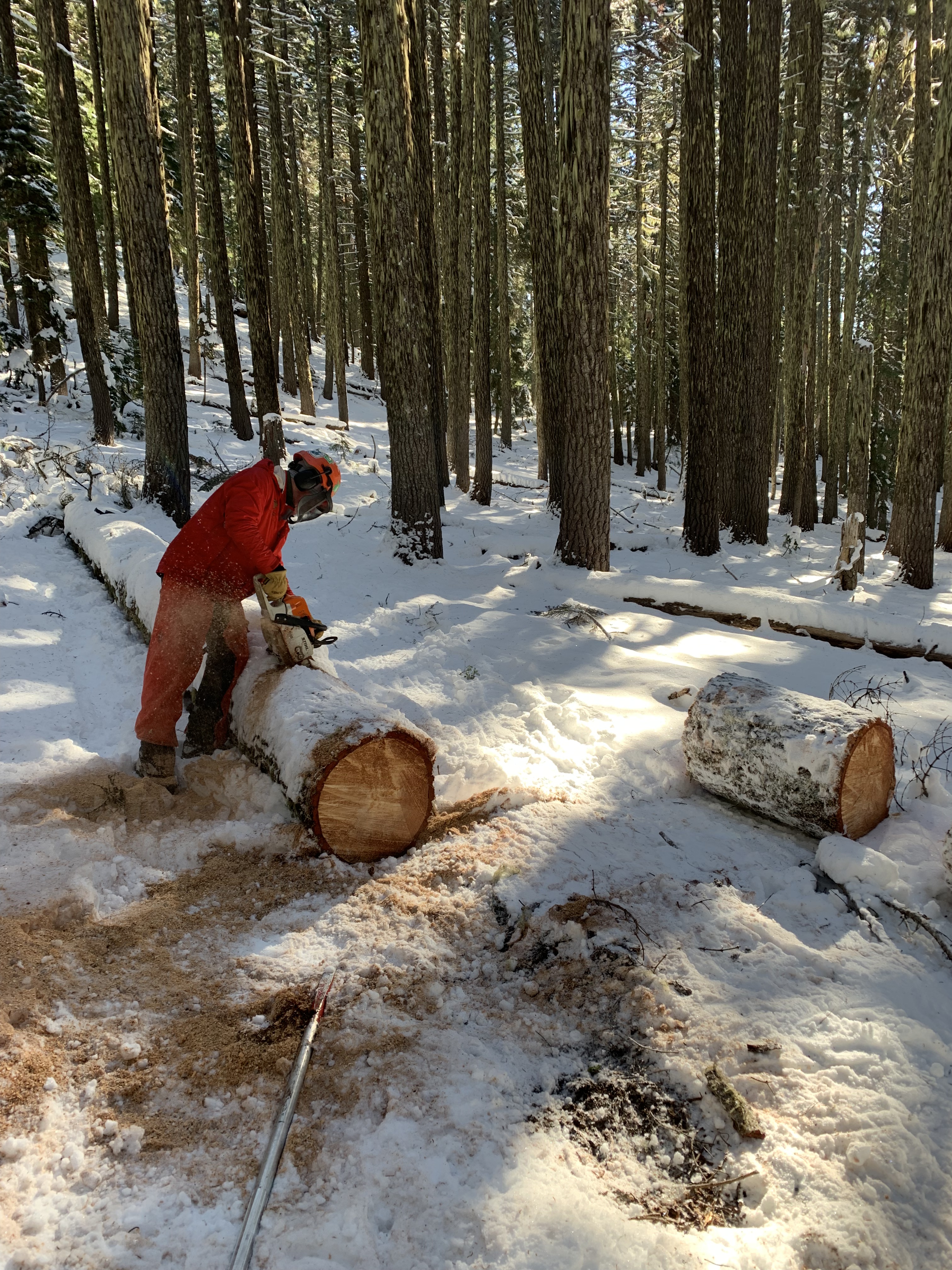
We split into three saw teams and hiked in, gaining 600 feet elevation, passing our previously cut logs, walking where we had repaired the tread. Two of us previously power brushed the quarter mille of trail outside the wilderness. I was in the middle group, where we needed to remove a 30 inch log, which had once been cut, but the remaining log had slid down and jammed two cut areas together. Much of the log lay on a steep uphill, so if we cut anything off below, there was a good chance the rest of the log might slide again. We managed to make a narrow passage through at ground level and started work to cut away the part over the trail. Between the dirt and the blackened bark, we were soon coated. The Emigrant Fire was south of us; by late morning it seemed darker than it should have been. The Sun was dimmer, smoke and white ash started to filter down from the skeletal forest high above us across the creek. We could smell smoke, and by lunch, many of us started coughing and had watery eyes. 

The group ahead of us finally got their log removed. The group behind us with sticky log syndrome still had more to do after two days work. Our log would need another day. 

By 1:15, I had had enough, enough of the heat, enough of the log, enough of the smoke, and enough of not being able to do enough. Human factors are important part of saw safety: wildfire smoke is dangerous to the lungs, especially given our activity, and coupled with heat and fatigue I felt our continuing to work was unhealthy. The Crew boss agreed and told us to pack up. On the way out, I went by the first group, still working, telling them we were knocking off. One asked me what time it was, and I answered “Time to leave.” We cleared 0.2 miles, mathematically perfect but depressing. I hope that changes, for otherwise next time we will go 0.1 miles and our mathematical limit is 1.6 miles. I really should think of other things.

While waiting for everybody to regroup at the trail head, a California Sister butterfly (Adelpha californica) landed on one of the other crew members. It looked like a white admiral but had a circular orange spot at the tip of each black wing. That was a new butterfly sighting for me.

It was a long drive home, 8 miles back on 2421, past log piles another few miles, then uphill, north, and west 12 miles on dirt to High Prairie. Far south, we saw the pyrocumulus clouds from the Emigrant Fire with a long plume of smoke to the northeast. When we reached a sign that said “Oakridge 2 Westfir 3” I looked at my map and said we could turn on McFarland and drive straight to Westfir, bypassing Oakridge. Nobody disagreed, but a quarter of mile down the road, we had to stop.

Perhaps fifteen elk, at least three young, slowly crossed the road in front of us. It was a tough day out there, dangerous dirty, dusty, hot, humid, and smoky, but seeing the elk helped, and at least for me, so did the butterfly. 

Payment in full. See you on the trail.

Author at work trying to open up more of a gap.
The haze is smoke.
The trail goes to the left of the two logs in the background.

AN INTERESTING TWIST

August 23, 2025

This wasn’t an impressive year for huckleberries at my Waldo Lake spot near Shadow Bay. I had hoped for more, but I decided to quit early and drive down to Marilyn Lakes off Waldo Lake Road, where I knew there were both blueberries and usually  a few huckleberries. It was a cool August day in the Cascades with significant mist above 4000 feet when I drove up and even on Waldo Lake itself, at 5400 feet.

Marilyn Lakes, upper and lower, are similar size, a bit over 20 acres, south of 50 acre Gold Lake, the latter’s having a campground and not allowing internal combustion motors. There is a network of trails throughout the several lakes in the area: Gold Lake Sno-Park south of 58, with Odell, Midnight, and Arrowhead Lakes; Willamette Pass Ski Area 3 miles further up, where the PCT crosses the road northbound to the Rosary Lakes, with a northern access to the PCT from Gold Lake Road as well, passing above and south of Gold Lake on the Maiden Peak Trail.

I parked on the side of the road, just south of Fuji Mountain trailhead on the other side, hiking downhill a short distance to Gold Lake. I crossed the bridge over its outflow, Salt Creek, which flows towards spectacular Salt Creek Falls, 20 miles later joining the Willamette in Oakridge.

A couple of years ago, we power saw logged out the Marilyn Lakes trail system, during which I noted a nice patch of blueberries south of Upper Marilyn Lake. Somehow, during multiple prior times on the trails, it must have been before or after blueberry season, because I didn’t notice any. There are huckleberries as well, which I thought I might sample on my three-quarters of a mile hike to the blueberries. The trail is generally flat; upper and lower lakes are separated by only three feet of elevation and 300 yards.

I hiked in from the campground and within 50 yards saw blueberry bushes, although with few berries. The trail became wet, a small seepage maybe 50 feet wide with several large skunk cabbages with individual leaves over a yard long and blooms at least a foot high. Along a small wooden puncheon were multiple, large, thick branched blueberry plants the size of cultivated ones I frequent every year to pick my own berries for morning cereal. These larger plants had berries.

For the next hour and a half, I picked. My foot was bothering me, but once I started picking, I realized I didn’t need to hike further. After obtaining what I could from the puncheon, I stepped off into the dark mud over branches that at first I didn’t even realize were blueberry plants. Wild berries are smaller than cultivated ones, so I picked to save for maybe 40 minutes, before I picked several handfuls just to eat. The branches were thick, the ground damp, with a convenient small log to sit on while I picked berries individually or in groups of two, three, or four. I could go further into the woods if I wanted for more berries, but I didn’t need to. I came here for berries and to get into the woods on a nice, cool day. I had to decide whether to wear my sunglasses for sharper vision in the dark woods or to take them off for more light, but struggle with my astigmatism and perhaps miss my target.

As I worked my way back out of the bushes, trying to protect the branches from more abuse, I placed my berry bag on the trail so I could extricate myself. As I finally stepped onto the trail and bent down to pick up the bag, I saw something red on the other side peeking out from underneath a stem of a small plant with alternate leaves resembling a false Solomon’s seal. I picked up the end of the stem and looked underneath: there were a series of red berries hanging off the underside, which I had never seen before. 

This was twisted stalk (Streptopus amplexifolius). Earlier this summer, I had heard this name (as “twisted stock”) used at Pioneer Gulch Trail, describing something larger, in a different habitat, that clearly wasn’t. That latter plant remains to me unnamed. Twisted stalk berries are not poisonous, but I didn’t plan to eat any, only to be fascinated with their color, number, and hanging. 

When I was a guide for Sandhill Cranes viewing, some were impatient if the birds were late. I told them the world was unfolding as it should. The birds always came. I went for huckleberries, ended up with wild blueberries, saw an interesting plant, and learned something about real twisted stalk, its name, location, and hanging berries. The world unfolded as it should.

See you on the trail, and may your world unfold as it should.

WIN-WIN

August 9, 2025

Years ago, when I trained in neurology, I spent time at the Tucson VA Hospital. I remember a radiologist there, a pleasant man 30 years my senior, who once tried to get rid of extra chairs in his department. I don’t know how he ended up with so many chairs, but he wanted to get them removed and had no success.

Then one day, an edict came down from the fire safety manager saying the halls were unsafe in many departments because of furniture. If anything not fixed in place was left in the hall, it would be removed.  The radiologist was thrilled. He told his secretary to start leaving chairs out in the hallway. Problem solved.

The Crew was working Rockpile Trail from the trailhead on Pioneer Gulch to Rockpile Lake junction, about two and a half miles. The trail was mostly in the 208MF fire last year and had been badly burned over. We had to hike almost a mile where we had already cleared and logged out the trail before we got to the rest needing work. We had three saw groups and I led a fourth group to work on restoring the trail, which needed to be found in some places, have holes filled with rocks and soil, and dug out in other places so people could follow it.

At the trailhead, 600 vertical feet below where we needed to start, we lay all the tools out on the ground that we would need. Everybody takes at least one tool and maybe two. Not sawing that day, I left my axe, wedges, and hand saws out of my pack and off the ground.  That was 10 pounds less right there. The last tool remaining was a Rogue Hoe/Rake, which is fine, although I prefer a Rinehart with a better hoe with no rake. I had reached a certain degree of competence in trail work and had used many different tools. An experienced crew member told me a couple years back he liked the Rinehart the most, and with time I agreed with him. But a new person to the crew took it. I could have pulled rank and taken it from him, but I can work with a Rogue Hoe. Both it and the Rinehart are light; I can use either as a walking stick, shovel, or a root cutter, especially in a burn, where roots are easy to pull out, or if not that, to cut with a hard whack. The tool is stable enough vertically that I can use it to pull myself up after kneeling.

Starting the climb, I was slow, in part because of plantar fasciitis, which had me trying different sock combinations in addition to a boot insert. I found something that worked, but it was additionally humid with a chance of thunderstorms, and that slowed me down, too. Eventually passing the new person but staying well behind another, I made it to the junction, where we regrouped. We planned to leapfrog each other up the trail. The saw groups were ahead of us. I used the rake part of the hoe to break up the soil and move it, either to fill a hole, to uncover the tread, or to make a place for flowing water to drain off in order to limit trail erosion. There had been some recent rain, so there was almost no dust; the last time we did trail work even hiking left dust in the air, quite typical in Oregon this time of year.

About a hundred yards past the junction, I caught up to the new person, who asked me whether a gully on the side of the trail could be left as is. I preferred not to do that, so I used my rake to break up some dirt to put in the gully to fill it and uncover the tread where I thought it should be.

“Wow,” the newbie said. “I should have taken your tool.”

Music to my ears.

Quietly, I replied, “Want to trade?” 

I got a look like really? You are going to let me use that?

We traded tools.

The rest of the day went well. Why not? I just traded away a tool I didn’t prefer to somebody who wanted it and had the tool I wanted. We were both happier and he might think I was really nice to work with. Or not. I had put the chairs I didn’t want in the hall. Win-win.

See you on the trail.

Jean in the foreground using a Rinehart; Dale in the background with the Rogue Hoe/Rake he “traded” for. Rockpile Trail, Diamond Peak Wilderness.

FAMILIAR SEEN IN UNFAMILIAR SURROUNDINGS

August 5, 2025

“Hey Mike,” Patrick called over, holding up a bunch of brittle brown stems. “This is yarrow. You can leave it.”

Blast it, I said to myself. I had looked at it, figured it was Queen Anne’s lace gone to seed and pulled it out. “You know, I wondered about that,” I said, “but it pulled out the way Queen Anne’s Lace did.”  

Chastened, I returned to work just below the gravel road at the Arboretum, in the brown grass, where real flowering Queen Anne’s lace needed removal. My job as one of several volunteers was to clear five or six meadows, each a few acres, of that, tansy ragwort, and Canada thistle. Queen Anne’s lace, 90% of what we were pulling out, is an invasive successful competitor, tansy ragwort is toxic to animals, and Canada thistle is also invasive. The first two are biennial; thistle perennial. We will need to do weeding next year in order to fully control the biennials.

I had just learned something about yarrow, because while I had seen plenty of the white blooms, I wasn’t familiar with yarrow that had gone to seed, a polite way to admit I had been around yarrow that had gone to seed but hadn’t noticed. The blooms had faded to brown, but the yarrow flower structures were still present. Had I looked at the flowers more carefully, I would have noticed the difference and besides, Queen Anne’s lace was still blooming. None appeared past the blooming stage. While true yarrow stems were the same size as Queen Anne’s lace and easy to remove, that was irrelevant.

We are pattern recognizers. It allows us to perform quickly and efficiently much of the time. But sometimes the familiar seen in unfamiliar surroundings can fool us. It reminded me of 24 years ago on a train trip back from a solar eclipse where that evening I saw an odd arc of stars just clearing the northern horizon over Zambia. It took me a while to realize it was the handle/spout of the Big Dipper, an asterism I knew well, the southern part of which was just visible from where I was at 16ºS., but had never seen in such circumstances. The stargazing I did south of the equator usually was focused on objects I couldn’t see from home. I stared at the handle for a long time.

I remember fields full of Queen Anne’s lace when I was a kid, but I didn’t see much of it afterwards. I was not consciously aware of its being called wild carrot because of its pale carrot-like tap root. I think I would have remembered. But perhaps not. As I worked, I developed a sense of what I had to dig up, how deep, how far around, what I could pull out just by hand, oddly using my non-dominant left hand as a decent lever that would either pull the plant out or not, whereas my dominant stronger right hand would often break the plant off above the ground and not be as helpful.

I noted the smallest Queen Anne’s lace flowers often bloomed from the same rosette of leaves. Once I discovered that relationship, I tried to remove the whole base along with its single large taproot, not each individual flower. Small free standing plants I could carefully remove with my “calibrated” left hand. Medium-sized plants I could comfortably pull out with either hand, and the larger ones I needed a shovel to clear out slightly more than 180 degrees around to pull them out. Six of us there cleared two acres, putting the removed plants in a large plastic bag, thicker than the one we used two weeks earlier, which ripped early and often, spilling seeds.

Back home the next day, Alton Baker Park was a sea of white Queen Anne’s lace. I looked at the flowers differently from the way I had before. I left these alone, more interested in picking blackberries from another invasive plant. I tried to visualize the number of tap roots out there. I like the smell, which reminds me of my childhood three thousand miles to the east.

Maybe see you on an Arboretum trail sometime. 

COOL IDEA

July 28, 2025

The small, gurgling stream nearby had my attention. Should I or shouldn’t I?

I was brushing and logging out Lowder Mountain while working with a sore foot. The affected appendage gave me three good hours, but during the fourth, I started having discomfort, and I still had to hike out. At lunch, near a barely flowing stream, I remembered a few weeks back in the Diamond Peak Wilderness, the same sore foot, but additionally a sore toenail, worsened by wearing an extra sock. During lunch, I took off the boot, hoping it wouldn’t be a mistake. It wasn’t. It felt great. I pulled off the extra sock, the one underneath, and let the foot air out. It felt even better. After 10 minutes, I put the other sock back on and then the boot. My foot still hurt, but I could finish the day. 

Remembering, I again removed my boot. Same feeling, same questions. Should I or shouldn’t I? It’s difficult to put a sweaty sock back on a wet foot. So what? I have been on my knees all morning, two of us removing brush on every foot of the trail through the large last meadow, although admittedly we spared the scarlet gilia and the western coneflowers. It’s hot. I can use the top of the sock to wipe my foot dry. We have to wait anyway for two others returning from having gone further up to check out the summit; we had time. I deserve a break, and so does my foot.

I took off boot and sock, let my bare foot get some delightful fresh air, then put the boot back on and hobbled over to the stream to where the trail crossed several flat rocks with perhaps a half inch of water flowing slowly over them. I moved carefully off the trail, under an arch of branches, found a rock I could sit on near a small pool of water maybe 6 inches deep. Perfect. I sat down on the rock, removed my foot from the boot, and stuck it in the water.

Wow. Cold and great. Within 30 seconds, I felt no cold. I should have come over a half hour earlier and eaten my lunch here. The gravel bottom was fine. I could sit here for an hour or all afternoon. I wouldn’t, of course, but I got a chance to look upstream at the steep grade with a narrow chain of rivulets. It was shady and out of the way. I had hiked by this stream at least 10 other times and never knew what was back here. But today I discovered it. Twenty minutes later, it was time to do some work, so I removed my foot which dried in two minutes. I put the sock on, then the boot, stepped back on the trail, and five minutes later the other two showed up. The hike out went fine.

I don’t swim in Oregon because the water is too cold for me, an old man with thin skin and not much insulation. Or I am a chicken. It’s great others can. Last time I swam was 2017 by a campground in the North Cascades. Several of us had just finished a hot hike. There was a lake and a boat ramp. I stripped down to shorts and ran right into the lake, the best way I can deal with cold water. I wasn’t going to swim and didn’t, immediately getting right out. But I was cooled down for the rest of the day. Swims do that.

See you on the trail but probably not in the water.

One of many meadows on Lowder Mountain.

NOT QUITE BY THE BOOK

July 20, 2025

Twenty feet ahead of my knees were many Cascade asters on the left side of the trail. I decided I would work to them—on my knees—then take a short break. I adjusted my position and continued hacking at the encroaching thimbleberry with a hand saw, occasionally using loppers for their stems at the base. I was in the middle of a brilliant green, several acres, steep sloping meadow where the forest gave way to low plants.

One of several meadows on Lowder Mountain

 I was not quite halfway up Lowder Mountain trail, which began at FS 1993, ending about 600 vertical feet above me to my right at the summit. Olallie Mountain was across the valley to my left or south, and I could see individual trees, consistent with old fire damage near the summit. We had a crew working over there logging it out. I set up a concomitant trip to Lowder because I wanted to get in the woods, my sore foot wasn’t going to tolerate hiking up Olallie, and brushing Lowder was as important as logging it out, since the couple hundred yard stretches of thick brush in each of several meadows was both difficult to follow and concealed holes of some so far undetermined rodent. I’ve hiked Lowder maybe ten times, and one specific, treacherous hole has always been there—hidden by brush.

I arrived at the asters and had to decide what to do with them. They were on the downhill side of the trail, but there was adequate room to hike by. I couldn’t see removing all with my hand saw or loppers, because frankly they were really pretty, so I removed a couple carefully and left the rest. In a couple of weeks, they will have gone to seed, their job done, part of which was giving me pleasure.

I don’t like removing flowers, but trail work requires it. I purposely avoided power brushing a few dozen trilliums last spring on the Middle Fork National Recreation Trail, although I still accidentally removed three. Trilliums take years to grow and flower, and I felt badly about my error. Three years earlier, I left a large false Solomon’s seal hang over a trail on Fall Creek, because it would have been criminal to cut that beauty out. 

A few minutes after I reached the asters, I accidentally lopped off two tiger lilies, because with so many different plants encroaching, different size, different leaf arrangement, it was difficult to sort out which plant went with what stem. A little further there were two more over the trail. I didn’t cut those; I bent the stems and moved the lilies behind thimbleberry safely away from the trail. Their flowers can still be pollinated. It’s not in the manual for trail clearing, but flowers are flowers.

Western coneflowers appeared, and I slowed to make sure they were left alone. Their stem has a whitish cast, which I had not previously noted, although I never had been in the position—hiking through a meadow on my knees—to look to avoid cutting one. The brownish cone top with the green leafy bracts is a standout. I didn’t notice the green surround when I first saw these in the wet meadows of the Waldo Lake Wilderness years ago. I haven’t been back there since the Cedar Creek fire, but this day Lowder had many. The stems could also be bent so I could move the flowering top further from the trail. If I could find a similar flower nearby, I hooked one around the other. Coneflowers need hours of sunshine, perfect for where they were.

At lunch I saw some columbines and two deep purple flowers 20 feet away and below me. When I later walked to them, I discovered the purple was really a deep red of a columbine that was past its prime and fooled my sunglasses. False alarm. The bloom had collapsed, the colors darkened. Later, I saw a blue gilia, a small puffy flower with tiny blossoms and a thin stem. It was at a switchback near a broken log I wanted to push off the trail myself but was afraid it would land in the trail below and I would have to move it again. It would have to wait for the logout the following week.

Keiko came up to me during lunch and thanked me for saving the purple flowers—the asters. She had noticed them, too.  

Western starflower.

IT’S MORE WORK THAN YOU THINK

July 17, 2025

For the tenth time that day, we stop at a log to remove it from the trail. Each of us finds a spot to drop our pack, maybe before the log, because we want to get rid of the weight and bulk before clambering over the log, or perhaps after, so we don’t have to backtrack when we finish to get the pack. Placement sometimes requires later movement to prevent the cut log, a round, from running over it. Before dropping my pack, I need to put down what else I am carrying, usually an axe or a Pulaski, sometimes a large crosscut saw or a pry bar, then take off my gloves, unbuckle the hip belt and the chest strap, the latter often closer to my neck. Then I drop the pack directly through both arms or remove one arm strap and allow the pack to swing, whereupon I grab it, remove my other arm, then more gently lower the pack.

I have a Corona hand saw and a larger 500 mm KatanaBoy saw in the back of my pack that I want available, so I put my gloves back on and pull the two saws out. These, along with a Fiskars handsaw in my pocket, are used to trim branches or finish the cut, when the big saw is close to the ground and we don’t want its teeth to have contact, which will dull them. If I am carrying a crosscut saw, there are three velcro straps or buckles that have to be undone to free the saw from the blade guard. I try to do that with my gloves on, but sometimes I can’t.

I also carry three or four hard plastic wedges in my shirt and pants pocket for the cut. Last thing I want to do when cutting is stop, go to my pack or someone else’s and hunt for them. It’s more bulk to carry, but they are nice to have ready. Wedges keep the kerf—the cut—open and lessen saw binding.

After finishing the cut, which may take a few minutes or a few hours, we sheath the big saw, which on a good day can be done with gloves on and velcro’s behaving. On a bad day, the velcro has to be pried apart, the scabbard won’t line up properly, we put the saw on in the wrong direction, and the gloves have to come off again. Then I put my Katana in the pack, then the Corona, hopefully lining it up with its scabbard inside the pack, a 50-50 chance, which shouldn’t be if I could remember the whole day which way the scabbard curves, zip up the pack, pick it up with one strap and put it on. I now have to make a decision: if I think the next log is a minute or two away, I won’t bother with the hip and chest straps, and I keep the gloves off. Or, if I know from a scouting report the next log is some distance, or I guess right, I buckle up, but that’s a good day. I have to buckle the chest strap by feel, which may take one or many more attempts. If I decide to buckle up and the next log is around the corner, I have wasted energy and time. If I don’t buckle up and the next log is more than a couple hundred yards, I am going to have to stop, because carrying the pack unbuckled becomes uncomfortable. I usually keep my gloves on, because often there is something small that might need my pocket saw, unless I accidentally drop it or leave it somewhere. When one stops ten or more times a day, it is moving a lot of weight and taking a lot of decision making time that generates more fatigue. Other than that, logging out a trail work is just a day hike, with maybe 10-15 pounds extra gear, cutting a bunch of logs, moving the rounds off the trail by pushing with hands or feet, and going to the next one.

Maybe it’s a bit more than a day hike.

SWARM

July 9, 2025

The trailhead was several miles closer than I thought and the road better than expected.  Good start to the day.

Then I opened the car door.

Immediately, mosquitoes were all over me. Alone, I had their undivided attention. I have spent time above the Arctic Circle and hundreds of days in the Boundary Waters. I know mosquitoes. Just two weeks earlier at the southern terminus of the Middle Fork trail by Timpanogos  I was the only crew member not to wear bug netting or use bug repellent; generally, that is typical. I heard, “There’s a swarm all around you.”  No problem.

Today was different. I was at another southern terminus, this time Diamond Peak Trail, planning to scout north 2 miles to Rockpile Trail and then head east. Summit Lake was nearby, and there were many ponds near the trail. Figure lots of standing water, one mammal, swatting several at a time on a hand, inhaling some, glad for once I wore hearing aids, since at least the bugs wouldn’t go in my ear.

The day didn’t improve. Two hours later, the last hour at least mosquito-free, I was off trail. I wasn’t lost, because I knew where the trail was behind me and could always get leave the woods that way if I had to. I was annoyed at myself, however, because earlier I had come through the other direction and had no difficulty. I usually need to see a trail on two separate occasions to develop a decent memory of it. 

I had hiked past ponds, streams, and snow, swatting as much as I tabulated downed trees and possible needed tread work as a result of the 208 fire. There were so many downed trees I listed them by number every hundred yards. Trail scouting in a fire zone is like route finding in winter. With no ground cover landmarks, many spots appear to have a trail. Finally reaching Rockpile Trail and turning east, I quickly lost the trail. I hunted on the north and south sides and got lucky.  I then placed my pack on the ground to scout ahead more quickly, finally making a 25 inch diameter log across the trail my turn around point. I needed my GPS to find my way back. Note to self: keep your pack on when having directional trouble or at the least be extremely certain you can find it again. The phrase “think I can” is inadequate. I returned to the 4-way junction, headed south and after 3/8 of a mile lost the trail again.

Then I saw a balloon. On the ground. In the Diamond Peak Wilderness.

At first, I thought it might be a weather balloon, for balloon soundings are sent up twice daily from Medford and Salem, and the balloons have to come down somewhere. But the gray ribbon bow was clearly not from the NWS. It was a balloon from a gathering somewhere. It still had some gas, probably helium, although I didn’t do a voice test. Someone likely to the west of me, given population centers and prevailing mid to high level winds, released it. Out of sight, out of mind. Sort of like tossing an apple core. You don’t see it again, but it still exists.

I felt like I was a little less in the wild. A balloon can do that. Once, in a remote area of Alaska, I encountered an Epi-Pen cartridge. I know that this region has not always been designated wilderness, but it has been officially wild in one form or another for 70 years and a balloon is as much out of place here as I would be in Times Square. East of nearby Summit Lake people used to drive in to what is now near the PCT. You’d never know it by how it looks now. I picked up the balloon, put it in my pack, finally figured out where I needed to go, found the trail, placed illegal but temporary ribbons for those who were going to log it out so they could find their way, and hiked downhill out of the burn area into the woods, where the mosquitoes were still waiting.’

See you on the trail. 

Unnamed pond, good mosquito source.
Turnaround point.

GREEN, IN THE LAND OF BLACK AND BROWN

June 30, 2025

I couldn’t miss seeing the green, since for the last two hours I had been in the land of black and brown,  black trees, black and brown soil, with occasional orange, which I learned was from clay having been burned. The few times I looked up from my work recovering the Pioneer Gulch trail, I could, if I stared hard enough, see some distant green across a valley through and behind the silent black trees around me. There were perhaps a dozen green plants growing in a pile of large rocks. Presumably the relative lack of fuel here plus the rocks helping to protect soil and moisture allowed the seeds to germinate. The leaves looked familiar but I couldn’t identify them. 

We were working in the post-fire zone on Pioneer Gulch Trail, in and adjoining the Diamond Peak Wilderness. The 208 fire burned 11,263 acres (about 17 square miles) between mid-July and the end of October 2024, when it was contained. Lightning caused, it was never a danger to property, but it burned wilderness in which we had worked for several years along the west side of Diamond Peak, well below the 8700 foot summit and the 1000 foot lower treeline, but high enough above the surrounding valleys, where beautiful Happy, Blue, and Corrigan Lakes were all in the burn zone. I had been on the trail several times but recognized nothing.

The official burned zone is not always a blackened moonscape. Fire footprints are a mosaic, where there can be surviving trees and ground cleared of downed brush. The Rebel Fire in 2017 cleared out the forest floor nicely. The place looks good. The 2018 Terwilliger Fire was another example of a mosaic.

Unfortunately, this part of the 208 fire had burned hot, and all the trees had burned. Pioneer Gulch climbs steeply 1100 feet in 1.3 miles and is used by climbers to access Diamond Peak. The Middle Fork Ranger District made restoring the trail a priority for us. We had finished our bridge and trail building on the Middle Fork Trail the week before and finally finished Cloverpatch work three days earlier. Those two trail jobs occupied 41 work days for me alone, although I missed out on three or four. Our job here was to cut the downed logs, remove them, find and repair the trail.

By working virtually every inch of the trail, we could make it visible for hikers. Burns kill roots, which disappear, leaving tunnels in the ground that can collapse under a hiker’s weight. They often move logs and rocks to where we don’t want them, like on the trail.

Seven months earlier, we worked on Bunchgrass Trail 30 miles north, two years after the Cedar Creek Fire. That was a moonscape with minimal regrowth and soil like powder, easy to dig in but difficult to find something solid below that would qualify as a trail. Here, there was a hard packed trail with frequent large holes, where the trail had disappeared. We filled the larger holes with rocks and then found nearby dirt to cover them, not unlike the approach to building a ramp to a bridge. Some places, the trail had eroded or would soon erode, so we moved it back into the hill a foot or more. Other places it was difficult to see the trail, but sometimes looking where a trail might be allowed us to find it. I used a Rinehart tool, a cross between a hoe and a shovel that had been bent 90 degrees. We had a Pick Mattock, a cross between a pick axe and a Pulaski, and other digging tools: Travis, McLeod, Rogue Hoe and a square shovel. I wasn’t sure what I would encounter, but the Rinehart worked fine. It could dig, acted as a small shovel, could cut many roots which were destroyed by the fire, lever moderate logs off the trail, and tamp down my fill dirt. It was light and easy to carry, doubled as a walking stick.

As we ascended, we found more trees that had survived the fire, so there was some shade. It would take us two work days to repair the trail, and we would need to do the same further south on Rockpile Trail, as well as the connector trail between Pioneer Gulch and Rockpile, and  south of that junction with an east-west Forest Service road, ending a series of trails that started at Salt Creek Falls, 20 trail miles, 65 road miles away.

A short while later about ten yards past the group of plants, I had an “of course” moment when I saw one more living plant with similar leaves as the others, but this time blooming, immediately recognizable as a Bleeding Heart.

Bleeding heart plants (Lamprocapnos spectabilis)

Diamond Peak