Archive for the ‘MY WRITING’ Category

ÄRZTEPFUSCH

November 25, 2013

A German movie made me cry.  It was the first time I had ever cried because of what I saw in the language I am teaching myself.

The movie:  Engel der Gerechtigkeit Ärztepfusch, or Justice Angel for Doctor Screw Ups, I found exceedingly moving.  The ending was beautiful. I knew music could be powerful; I had no idea the effect it could have on me. I was in tears, and I didn’t care.  I cry, and when I let go, I feel perhaps more human than at any other time.

I’ve seen the ending at least 40 times.  For the next week, it is on zdf.de (24 November).

The movie opened with a woman standing in the middle of railroad tracks, wondering whether to commit suicide.  Later, we learn why, as she comes out of the shower, learning that she had breast cancer, and the wrong breast was removed.  She had therefore a double mastecomy, brief clips being shown of ugly scars where her breasts once were. The woman had to pay for the surgery, had no recourse to justice, until she finally met the lawyer.

The hospital stonewalled, saying the doctor was Spanish, didn’t speak German, and no longer lived in Germany.  The fact that nobody else spoke up, in the OR or anywhere else may be surprising to some, but the culture of silence of medical errors in Germany may parallel that here in the US, where I saw errors hidden, denied, and blamed, in some instances, upon me, as medical director of a hospital.

Back to the movie:  at the end, the lawyer for the woman said she would go to the press before the end of the day.  The hospital administrator said that he would allow the breast reconstruction, but no blame was to be levied.  The lawyer started to think, then smiled, and the music began.  The lawyer walked to the dry cleaners, where the woman and her husband worked.  In the crowd of people waiting for clothes, the woman spotted the lawyer, who had a smile on her face.  The husband, working, looked up, surprised.  The woman said, “Enschuldigen Sie mich, bitte” (excuse me, please) and came to the lawyer.

“The operation will be next week. The papers were signed.”  The woman was stunned, the music continued, as the woman broke down and hugged the lawyer.  The smile on her husband’s face was wonderful.  It was an incredibly powerful scene.

I saw three cases of wrong side surgery during my time as Medical Director of the hospital–the wrong knee, the wrong side of the colon, and the wrong side of the brain.  The last, I had to explain to the woman’s friend, since the woman had no family.  The internist taking the case wasn’t told and was so angry, he signed off the case, without finding another physician.  This unethical practice was not uncommon where I worked, where it meant that I had to find somebody–sometimes myself–to take over.  My colleagues never sanctioned the physician.  Indeed, at a Medical Executive Committee meeting in 1998, one blamed me for taking care of a patient who had no doctor.  I left the meeting, went outside where nobody could see me and cried.  That is the medical culture I was part of.

I was told by the head of the OR that 99.9% of the cases had no problem.  No, I retorted, it was 99,99% of cases, and per cents didn’t matter, counts did.  There are certain things where the counts should be 0, not a high percentage of successes.  The hospital administrator used the same words, and the lawyer pointed out 160,000 cases of errors and 20,000 deaths in Germany every year.  Wow.  They count.

Medicine here never really changed.  We have at least 20 wrong side cases annually nationwide.  True to medicine, everybody began his or her own process for ensuring safety, which of course meant in some places the proper limb or breast was marked for surgery, or the improper one was marked.  This leads to confusion as well.

When I objected to just a letter being sent to the neurosurgeon, I was told I was no longer welcome to attend department of surgery quality assurance meetings.  At first, I was incensed, because I knew about systems, and my knowledge should have been desired, not forbidden.  I also had discovered our carotid endarterectomy complication was far too high to warrant surgery.  I literally was screamed at, when my data were presented. My patients got statistics, probability, and my recommendation; other patients were not told of these risks.

After I left medicine, my mother refused a CT scan after a fall, and we were not told of the refusal  When she later died of dementia, we discovered during her final illness that originally she had refused the scan.  I was furious and published an article about it in Medical Economics.  My father, before he died, had weeping edema, swelling so bad that it went through the skin of his legs.  The nurses called it a weak heart, when in fact low protein in his blood caused the problem–simple osmosis.  Had he been diuresed, he would have become hypovolemic and died.  He did die, but from pneumonia.  I had to tell the Nursing Home Director that I was not the enemy, but I was trying to be my father’s advocate. My oldest brother had a brain tumor missed, causing him blindness in one eye.  He was a professional photographer. I had a medical error occur in me.

Engel Gerichtigkeit was only a movie, but it was powerful and beautiful; the medicine well portrayed. 

In 2001, I developed a reporting system for medical errors. Sadly, I was naive enough to believe I could implement it.  Looking back, I didn’t have a chance against the entrenched system of hospital and medical associations.  I wrote legislation for two years for the Arizona House, with 10 co-sponsors but went nowhere.  Doctors shunned me.  One response was, “We aren’t like aviation.”

“Yes, “ I replied. “Aviation deals with their problems honestly.  You sweep them under the rug.”

ARCHAIC WORD

November 21, 2013

In order to understand what follows, one must know that within seconds, I can go to the garage and find thank you notes written to me in the past 40 years, when I practiced medicine.  These notes were handwritten, a word that has almost been extirpated from the English language, now that we have the noun/verb e-mail.

********************************************************************************

It surprised me that day in Eugene.  I headed out for a 5 k run, a daily occurrence, and 200 meters into it, I got a sharp pain in my right patella.  It wasn’t too bad, but it bothered me, for I have never had problems with my knees.  For sixty-five years, they have climbed mountains, hiked Alaska, carried 65 kg down the middle of a Canadian river, walked thousands of kilometers, skied tens of thousands, pedaled a hundred thousand, bent as I drove more than a million, and been my friends.

I finished the run, but the knee hurt.  I took some anti-inflammatories and walked 3 km to dinner and then back.  I shouldn’t have done it, but I refused to believe my knee was betraying me.  I walked, but neither my knee nor the rest of me was happy.

The next two days, I didn’t run, but I still walked to dinner.  I was a little better.  OK, I thought, this is good.  I hiked 16 km with 300 meters elevation gain with virtually no pain.  I was happy.  I drove back to Tucson and ran 5 k again.  I was fine, until I returned home after the second day’s running.  The pain was back.

I stopped running.  For a half century I have run on a regular basis.  I think perhaps 5 times I have had to stop for some time, never for knee pain.  For the next three weeks I walked and walked, took anti-inflammatories, and my knee improved.  I was going to Uganda for the eclipse, and I did not want a bad knee to hurt the trip.

Shortly before I left, I decided to test my knee by running a few steps on it.  I am capable of remarkable denial and irrational thinking.

The third day of the test, all was going so well that I ran 60 steps three times.  I did fine.  I wish I hadn’t done a fourth.  The pain was back, and I was soon on my way to Uganda with tight connections and a bad leg.  Fortunately, I did well on the trip, because I was sitting in a vehicle most of the time.  But one day, we walked in a rain forest up and down hills.  The pain was back.  When I arrived in Houston on the way home, I took an escalator rather than the stairs.  I NEVER take escalators voluntarily.

Before I went to Uganda, I did have the good sense to make an appointment for after the trip with an orthopedist whom I have known for 30 years.  I figured I would not need the appointment; I thought I would get better.  Suddenly, I was really glad I made it.  My knee was stable and not swollen, but all sorts of things went through my head.  Could I have torn something?  Do I need an MRI or surgery?  Will I ever run again? What is going on?  A former physician, these thoughts and others went through my mind.

The orthopedist entered the room and asked if I had been hiking.  Well, sort of, until recently, I replied.  He listened to me carefully, nodding like he had seen this before.  He had me lie down and put my knee into full extension.  I had done this, but I did not have long enough arms to do what he was able to do.

OUCH!  He found the spot I had been searching for.  “Patellofemoral syndrome,” he said, rather nonchalantly.  “I’ll inject it and give you some Sulindac.”  Wow, that was quick.  He injected, without saying whether it would hurt, because he knew it wouldn’t, said he was done, and told me what to do.  From start to finish, the entire procedure took 10 minutes.  Maybe.  The pain was gone.

The physician is an elder.  He has been practicing for as long as I did plus an additional 20 years since I quit.  He has seen this condition many times.  I wish we could capture his experience and use it in the medical community.  He did something simple to him, an everyday procedure, but to me his reassurance was immense.  I never felt I did much of that as a neurologist.

But then I thought about that feeling a little more.  Early one morning, a quarter century ago, the same orthopedist called me and said he thought he was having a stroke.  He had horrible dizziness and asked if I could see him soon.  I told him to come into the office right then.  I practiced in reverse order.  If I and the patient were both ready, I saw the patient, and the paperwork came later.  Patient care came before paperwork, if I had the choice.  It drove my receptionist crazy, but I wouldn’t have done it any differently.

I knew what the orthopedist had before I had hung up the phone: positional vertigo.  I confirmed it in the office, reassured him, and was fortunate in retrospect that he didn’t need vertigo exercises, which hadn’t yet been invented.  He had no stroke, didn’t need a CT scan, and MRI wasn’t around then.  I had seen this condition a lot.

He was reassured.  I doubt he remembers that day, but you know, unless I tell him thank you for what he did, he will never know how much I appreciated what he did for me.  I will remember this day, and I will make sure he will, too.  I’m not completely sure what I will do this holiday season.  But I know I will handwrite a thank you note.  No e-mail.  The verb is “to handwrite,”  archaic today, which while sad, enhances the strength of the verb.  Oh, does it enhance the strength.

If the orthopedist is like me, he will save it.  Perhaps it may make his day, as he made mine.

BUT I WORKED SOOOO HARD!!!

November 19, 2013

In late September 1966, Dr. Taylor passed back the first paper I wrote in his English 1 class.  I had worked hours on this paper, written 15 drafts, back when we used typewriters.  Each draft was poorly written.  I can still see the angle of the red “E” on the paper.  I was devastated.  

“But I worked so hard!” is what I told my stunned parents. That paper alone kept me off the Dean’s List for the only time in my college career.  I got a C minus in the course.  I got an A in English 2.  One of the reasons I like science and math is that subjectivity is less an issue.  I did not suddenly become a good writer by the spring of 1967, any more than I was such a poor writer in the autumn of 1966.

Spring 2003.  I am teaching a statistics class for business students in Nogales and give  a group a B on their presentation.  One man said: “But we worked so hard!! We deserved an A.”  I explained that while hard work is a virtue, such does not itself deserve an “A”.  Results matter.  For every Olympian, there are hundreds of others who worked just as hard or harder but didn’t have the ability or the time, got hurt, had a bad day during the trials, and didn’t make it to the top.  Hard work is necessary but not sufficient.

I worked for years to become a better writer.  It was never a goal of mine, but I discovered that I communicate better by writing than by speaking.  I have published 60 papers in 9 different fields; won two writing awards; been an astronomy columnist for the newspaper for 20 years, writing nearly 800 columns; and been a 9 year columnist for the medical society.  I have  240 posts on my blog.  I’ve written several op-eds in the newspaper, and 75% of the letters to the editor I write get published.  I am a writer.  I am not an exceptional writer, but I am good.  Last July, my letter to the editor appeared in The New Yorker, not easy to do.

I’ve heard hospital advertisements saying how hard their staff work to care for patients.   I assume people work hard.  What I do want to know is should I get operated on, and I’m a clean case (no bowel perforation or gun shot wound, for example), my likelihood of a wound infection is less than 1%, not 4%, which it was in the hospital where I was medical director. Hard working people who work in bad systems deliver hardship.  A hospital that has a 3% higher wound infection rate for 10,000 clean cases a year has 300 more wound infections.  The human cost is significant in longer hospitalizations and possibility of permanent complications, including death and lawsuits.  The cost of these 300 infections is several million dollars.  Yet we still argue that quality costs money. I said twenty years ago, in vain, that quality saved money.

I worked hard to get my Master’s in statistics, and while I obtained it my hard work didn’t substitute for my inability to become a successful statistical consultant.  I trained hard to be a platinum bike rider, to complete the 112 mile El Tour de Tucson under 5 hours, and I missed it by 7 minutes.  I worked as much as many of the riders who beat me.  I achieved my potential, and it was less than theirs.

The concept that hard work is all people need to do to escape poverty annoys me.  Mitt Romney’s son got $10 million to start his business.  Very few of us get that “seed money.”  Many connections get some kids into the top schools, where they meet other people, network, and get good jobs.  It isn’t all hard work.  Some is genetics; there are some very talented people.  A lot of it is networking.  If one is good at networking, one will do better than somebody like me, who is not good at it.

I knew David Levy nearly 30 years ago when I was an astronomy columnist for the paper and he had yet to discover his first comet.  David discovered his first comet and had the personality that led to his connection with Eugene Shoemaker.  That led to Comet Shoemaker-Levy and Mr. Levy’s becoming famous.  I was dismissed from the paper with hardly a “by your leave” in 2004, after 20 years of writing.  Networking….and luck.  No comet in 1994,  no fame.

A Nurse’s Aide who is a single mother works hard on the night shift in a nursing home.  She does things that would repel most.  I know, because I have helped these women change soiled patients, dress bed sores, try to get the patients out of bed, and dodge blows that demented patients throw at them.  She makes a little more than minimum wage, but she works hard.  She might not have been born with great intelligence, and she might not have done well in school. Many of our politicians weren’t great students.  Vice President Dan Quayle couldn’t spell “potato.”  Arizona’s governor didn’t go to college. But these NAs aren’t blue bloods.  Yes, I wish they hadn’t gotten pregnant, but the Republican Right is trying to defund Planned Parenthood, which will exacerbate the problem.  We all make bad choices.  These women are going to be poor all their lives, no matter how hard they work.

Achieving success requires many factors, in addition to hard work and intelligence.  It is being in the right place at the right time, knowing the right people, and a lot of luck, too.  A lot of luck.

A country that pays rock stars, athletes, and entertainers millions of dollars, most of which is taxed at far too low a rate, has its priorities wrong.  A country where financiers who only move money around and collect fees ought to tax their bonuses, which annually are more than I earned in my lifetime, at 80%.  Teachers provide more value than these people, and research has shown that.  I have forgotten what rock concerts I have seen; I was lied to by financial advisors about the economy in 2007, and the list of sports stars who went bankrupt is long. I can still remember the name of my kindergarten teacher, my high school math, chemistry, and physics teachers, all of whom had a profound effect on me.

No, Mitt, and Sarah, and an especial NO to Ted and Rand; most of the millions of poor people in this country are not lazy.  A lot of them have decent ideas, want to work, and want to work hard.  If you think hard work is all that is necessary, then start with yourself in Congress, by working hard for THIS country, rather than your petty party. Your behavior is shameful, and if I were a believer, I’d call you horrible sinners.  When a person fails to achieve his potential through his own behavior, that is a shame.  When another prevents him, deliberately, from achieving his potential, that is …. I don’t have the word for it.

Perhaps if I were a better writer or had the right connections I’d find that word.

NO MORE PURPLE RIBBONS

November 15, 2013

THE “10 AND 18”

Ten Standard Fire Orders

  1. Fight fire aggressively, but provide for safety first.
  2. Initiate all actions based on current and expected fire behavior.
  3. Recognize current weather conditions and obtain forecasts.
  4. Ensure instructions are given and understood.
  5. Obtain current information on fire status.
  6. Remain in communication with crew members, your supervisor, and adjoining forces.
  7. Determine safety zones and escape routes.
  8. Establish lookouts in potentially hazardous situations.
  9. Retain control at all times.
  10. Stay alert, keep calm, think clearly, act decisively.

Eighteen watch-out situations

  1. Fire not scouted and sized up.
  2. In country not seen in daylight.
  3. Safety zones and escape routes not identified.
  4. Unfamiliar with weather and local factors influencing fire behavior.
  5. Uninformed on strategy, tactics, and hazards.
  6. Instructions and assignments not clear.
  7. No communications link with crewmembers/supervisors.
  8. Constructing line without safe anchor point.
  9. Building fireline downhill with fire below.
  10. Attempting frontal assault on fire.
  11. Unburned fuel between you and the fire.
  12. Cannot see main fire, not in contact with anyone who can.
  13. On a hillside where rolling material can ignite fuel below.
  14. Weather is getting hotter and drier.
  15. Wind increases or is changing direction.
  16. Getting frequent spot fires across the line.
  17. Terrain and fuels make escape to safety zone difficult.
  18. Taking a nap near the fireline. 

1949: Mann Gulch fire.  Thirteen died when the fire blew up due to strong winds.  From the time trouble was recognized until the men were dead was 11 minutes.  Those who died did so running uphill.  They died from asphyxiation or burns.  The fire was not affecting houses or civilian lives.  We had a culture from the 1910 fire, where 87 died, that all fires were to be put out before 10 a.m. the next day.  Ironically, this has created many problems we face today.

1994: South Canyon fire, near Glenwood Springs, Colorado.  In early July, a lightning strike started it.  Because some residents complained about smoke, a decision was made to fight the fire, which was not endangering any structures or lives, and was 5 acres when a decision was made to attack it, despite its being one of the lowest priority fires in Colorado at the time, where there were at least 35 fires burning, and resources were stretched.  When the fire was initially scouted, the difficulty and the risk were noted, and recommendations were made not to fight it in that particular area.  Catastrophes occur when there are major errors, but they also occur when there is a concatenation of smaller errors.  This fire was an example of the latter.  It was attacked because a person complained of the smoke–an inadequate reason.  Had the fire grown, it might well have been clearly inaccessible to attack in the place where the people who attacked it subsequently died.  It might have been fought differently.  I do wonder whether those who complained about the smoke ever wondered whether they were culpable.

Fourteen people died, including most of the Prineville, Oregon hotshot crew, when they descended a hill, in this worrisome area, in thick growth to build fire lines. Several members thought this maneuver was dangerous, because they had unburned fuel, extremely volatile fuel,  between them and a fire they couldn’t see (Watch out #9). Nobody spoke up, except some smokejumpers elsewhere on the fire, who did not think what they were asked to do was a good idea.  Eight of the ten major rules for fire fighters, 12 of 18 Watch Out guidelines were eventually compromised or violated.

A dry cold front came through that afternoon, predicted, but the information wasn’t relayed to the firefighters.  At 1520 hours, concerns were raised, and some left the area.  At 1600 hours, all left, but sawyers were still carrying their saws, and many were walking.  Twenty minutes later, they were dead, shelters not deployed.  Not only can fire move faster than we can run (this one moved 14 mph), superheated gases and radiant heat can kill people at a great distance, and winds can knock them over.  On Mann Gulch, winds lifted a survivor up and down three times.  The idea that fire suddenly erupts and people die with no warning is not true.  Fire does suddenly erupt, but usually there are hints.  There were such hints at South Canyon.  There were draws, and there was wind, an ideal situation for fire spread, and one that had been previously noted.  Many firefighters didn’t appreciate the severity of the situation until it was too late, for the safety zones were too far away and uphill.

The recommendations after South Canyon were hoped to make fire fighting safer.  They didn’t.

Thirty Mile Fire, Washington State, 2001.  Four fire fighters died after deploying their shelters in a rock field when a small fire earlier in the day suddenly exploded, overwhelming the crew. The problem was another concatenation of errors–virtually no sleep the night before (impairs judgment equivalent to being legally drunk), going suddenly to a fire that they hadn’t planned on, faulty equipment, slow start, and pulling in the lookout.  At the lunch spot, not a safety zone, two spot fires were noted up a dead end road (which had not been previously appreciated when the group arrived at the fire), and tankers were sent to the spots.  At this point, the video given by survivors stops, and the listener is told to put himself in the position of the fireboss, rather than knowing what happened later.  The fireboss sent more help to the spot fires, had no lookout to look at what the main fire was doing, and ultimately, the whole group was cut off from escaping from the lunch site the other way.  Instead, they went up the dead end road (which also had civilians present) to what appeared to be a safe area, with a stream to the east, a rock slide with no growth (but fuel between the rocks), and the road.

Thirty minutes before the fire overwhelmed the crew, many were taking pictures of themselves, not looking for safe spots or beginning shelter deployment, not knowing this would be the last picture of them alive.

Shelter deployment means that people were in an area they should not have been in.  They were too far from the safety zone.  That happens.  Shelters are a last ditch effort to save oneself.  Had everybody deployed on the road, they would likely all have survived.  But some deployed on the rocks.  They died of asphyxiation.  Many at the time were not adequately trained to deal with shelters, which one must be able to get in either standing or lying.  Several wore fusees and backpacks into the shelter; fusees burn at 375 degrees and can ignite if in contact with the shelter itself.  Some lost gloves, which were in retrospect available and nearby, and others left backpacks too close to the shelter, where they burned, adding fuel near the shelter.  I don’t know what I would do if I were in that situation.  I haven’t been trained; all of these people were.  Many deploying shelters do so when there is a great deal of wind from the fire, sometimes ripping the shelter from a person’s hand. When I saw this haunting video, I said to myself, “When the tanker on the downwind spot fire radioed that they needed additional help, that is when I would have pulled out.  Everything is going wrong on this day, and we need to regroup.”

We get back to the basic part of fire fighting.  It is dangerous, and everybody who fights fire knows that.  My experience is nearly nil, only having driven a water tanker on a controlled burn in 1995.  The culture had been not to question orders, and there is a degree of pride in being able to handle adversity.  Nobody likes to lose a fire, nobody wants to say that they couldn’t attack it.  Nobody wants to see houses destroyed.

What I don’t remember about 1994, although I could be wrong, was that we didn’t refer to the fallen firefighters as heroes.  They were professionals, and they were sadly victims. The fire should have been allowed to burn, nobody should have been deployed in any area that was unsafe, regardless of the risk to property and especially not because somebody complained about the smoke.  And that brings me to 19 years later, a lot closer to home.

2013:  Arizona.  Nineteen firefighters die fighting the Yarnell Hill fire.  The video on the Web site was quite syrupy, and I use that word exactly as I mean to. Nothing was mentioned about the “10 and 18”.  There was a discussion about the sudden, fast fire shift, which is a known phenomenon.   I read at least one hundred comments by others, many of whom are firefighters.  A lookout was posted, and he radioed that the winds had shifted and he was leaving.  What we don’t know is critical:  why did the Hotshots leave a safe area to hike downhill, into areas where they couldn’t see the fire, into areas almost impassable on a normal day?  We have heard remarkable things about the Superintendent, who put this group together in half the time of others crews.  Did anybody of the 18 others speak up about violation of the “10 and 18?”  Or was there a culture of expertise, like we have had in medicine and aviation, where nobody speaks up to a leader who is twice their age?

We heard that the fire was moving at unbelievable speeds of 12 mph.  It was moving faster at Storm King.  Winds were expected, but the way the winds shifted was not appreciated.  There were 2 minutes to cut a place and to deploy shelters, which meant that the fire was about 600 meters away before action was taken.  Were the firefighters not aware of how close it was?  At least 5 of the 10  and 10 of the 18 were violated.  Why?  We don’t know.  More than one report is comparing the Yarnell Hill fire with the South Canyon fire.  Both were initially small, both were in difficult terrain with extreme drought, and both were handled by hotshots.  Both had a major, predictable wind event, both had unburned fuel between the firefighters and the main fire, and both led to disasters.

This was NOT an Act of God.  That statement to me is a copout, an excuse for not trying to understand circumstances that people should understand, and a way to sweep the matter under a rug.  Mistakes were made.  Thunderstorm downdrafts, erratic winds, Venturi effects, plentiful dry fuel, and a hotter than usual fire are all understandable.  Whether we can predict what they will do is another matter, and evidence is beginning to mount that our modeling of fire behavior is inadequate due to increased size of fires because of suppression, climate change allowing bark beetles to survive winters, and more houses in the wildland-urban interface.  Ability to recognize danger and to speak up is part of firefighter training.  If we cannot adequately predict the worst case scenario, and plan for it, then we have no business sending people into harm’s way, except to save lives, not property.  Worst case scenario planning is why firefighters are required to have safety zones and exits to them, both hopefully plural.

Just as Challenger repeated 17 years later with Columbia, almost to the day, with many of the same cultural problems still persisting in NASA, so did South Canyon repeat 19 years later with Yarnell Hill, almost to the day.  I suspect, like NASA, there are still cultural problems in the firefighting community.  Hopefully, the investigation will uncover these issues, and the wildland firefighting community will address exactly how we will approach fires, what we will do, and what simply will not be tolerated.   We didn’t learn from Mann Gulch in 1949; 45 and 52  years later we had South Canyon and 30 Mile fires respectively.  We didn’t learn enough from them, and 12 years after 30 Mile we had Yarnell Hill.  My prediction:  it will recur.  My hope:  It won’t.

No more purple ribbons.

LOST

October 17, 2013

This is going to be easy, I thought.  I will drive to the base of a nearby mountain, climb 1.4 miles (2.2 km), 1000 (310 m) feet and come back down 1.4 miles.  I can do this in less than an hour, and I don’t need food or water.  It was afternoon; the Sun was in the southwest.

I arrived at the base, went up in 25 minutes to the summit, and came down another trail that had appeared on the Internet map to take a longer route, 2.4 (4 km) miles to where I had begun.  No problem.  I needed the exercise.  The trailhead where I started was west of me as I started down the trail.  All went well for 15 or 20 minutes, but then I noted by watching the Sun that I was heading south, and I needed to be heading north or at the very least northwest. I should have been walking with the Sun to my left, and it was to my right.

This concerned me a little, and right then I should have stopped and turned around.  The trail was wide and good, however, so I kept going.  When it bent towards the Sun and even a little beyond, I felt better, but I generally had the Sun on my right.  When I got towards the bottom, I saw a parking lot that was clearly different from the one I started at.  I saw a sign saying “west Trailhead 3.3 (5 km) miles.”  That was where I had started.  I was down the mountain but an hour’s walk from where I had started.

I saw a nearby road and thought that maybe the road would take me to the trailhead faster.  That was my second mistake.  I had no map of the road, and my Internet connection was not helpful, either.  But the road headed north.  That was where I wanted to go, until the road headed west and then southwest.  I thought more and more about turning around, and saw a woman walking.  I asked her if this road went near a certain landmark I had passed.

“I don’t know that place, but you’ve walked over the mountain and are on the back side.”

That is not what the Internet maps had shown.  I knew immediately what to do:  turn back. It’s a shame an hour earlier I didn’t do what I knew I needed to have done, for I would now be approaching where I wanted to be. When I reached the trailhead, I had two options:  completely retrace my steps, which was not a bad idea, but I would have to walk up to the summit again, 4.1 miles (6 km) in all, and why didn’t I bring water?  That way had a 100% probability of returning me to where I wanted to go.  Or, I could start on the signed trail that led north 3.3 miles.  The trail had a couple of forks that were not marked.  One led to the summit, which I considered, because that was familiar, but I stayed on the flat trail I had found–the Sun remained on my left, and within forty minutes was back at the car.

I was thirsty when I got back, and I thought what I had done is how people get into trouble.  Step 1, you have a sense of uncertainty., but you ignore it.  Step 2, you start fitting things into place so that you convince yourself you are going in the right direction.  Step 3, things aren’t right, and retracing your route seems too long.  Step 4, you try what turns out to be a shortcut, and it isn’t.  Step 5, you run out of daylight, you injure yourself, you panic, start burning energy and consuming water by running, get more lost, and you are stuck in the woods all night, with no food, water, or shelter.  I’m not young; my reserves are less, and while the young are often the ones who die of hypothermia, I am far from immune.

*************************

Seven years ago, on Isle Royale, I hiked in the dark after a wolf had visited my camp.  My flashlight was good, so I could see the trail, until there was a big blowdown in front of me.  I walked around the blowdown, and it took some time, but soon I was back on the trail.  Something nagged at me, however.  For whatever reason, I wondered if I had turned around. It happened to me once in broad daylight on the Appalachian Trail in 1998.  I stopped.  That was smart.  I took out a compass, which I had never used in the woods before, but always brought with me.  I needed to be going generally northeast, and my direction was southwest.  I had been turned around on the blowdown.  I thought I would come to it again, if I were correct, and I did just that.  I saw what I had done wrong and continued, northeast.  I listened to myself.

**************************

Twenty-one years ago, with nearly 90 days in the woods that summer behind me, I headed out on Burntside Lake for the Crab Lake portage several miles away.  I didn’t have a map for the particular part of Burntside I was on, but I had maps for the rest of the the lake.  My plan was to go due north and eventually reach the part of the lake that I had maps for.

About a mile from shore, I hadn’t arrived at the points listed on the map I had. I tried to “fit” some islands ahead of me into the map I had, and I kept going.  After a second and a third mile, the less certain I was whether I was on the map, or where the Crab Lake portage was.  I could still see the shore behind me, where I had launched.  I stopped paddling.

“You are lost,” I said aloud, to the waves.  “You have no idea where you are.  You don’t want to admit defeat and turn around, but do so.  Nothing good is going to happen if you try to keep going.”  I turned around, quite embarrassed, and two hours later was back in Ely.  The first place I went to was an outfitting store to see where I had been.

I never would have made the portage that night.  The next morning, I launched from a different point and had a good trip into the Burntside Unit of the Boundary Waters.  I didn’t get lost once, and I was comfortable the whole time.

Failure to prepare properly sets the stage for getting lost in the woods.  Take proper gear, even if it is a short hike.  I didn’t on the mountain.  A sprained ankle, a minor issue,  becomes a big issue on a remote trail. Check directions.  I had a compass, but the Sun was more than adequate.  If you can’t tell yourself, “I know where I am, how far it is to a certain point, and how I am going to get to the end,” you should be concerned.  Listen to your concerns.  Sure, it is fine to walk a few more minutes, but start considering turning around and going to the last point where you knew exactly where you are.  Don’t ever look for shortcuts through the woods.  Unless you have a clear line of sight to a distant trail, stay exactly on the trail you are on.

Don’t be afraid to tell yourself you are on the wrong trail.   Don’t be afraid to turn back to familiar surroundings.  Don’t be afraid of saying you don’t know exactly where you are. Don’t be afraid of later having people laugh at your getting lost or having taken the wrong trail.  Later being laughed at means later you are alive.

Be very afraid of being lost, in trouble, alone, and saying, “I can’t believe this is happening to me.”

CREAM PIES, BAD SERVICE, AND OCCASIONAL RECOVERY…WHAT’LL IT BE?

October 13, 2013

On the highway from Anchorage to Wrangell-St.Elias National Park, there is a small restaurant half way to the Richardson Highway, right near the view of the Matanuska Glacier.  If you are lucky enough to have the owner serve you lunch, you will have the choice of getting the dessert first.  I was at first taken aback, but the lady was an Alaskan, and I figured she knew what she was talking about.  Alaskans often do.

It was a fantastic lunch, with the best cream pie I ever had, followed by a grilled cheese sandwich.  On the way back from the Park to Anchorage, I had a late lunch, because I wasn’t going to eat anywhere else. I ordered the pie first and the grilled cheese second.  Granted, my lunch was not a big ticket item, but I was one customer who came back, because of how I was served.  I saw four national parks on that trip, and they were beautiful, as I expected they would be.  What I didn’t expect was to ever eat dessert first….and enjoy it.

*************************

“I’m sorry I didn’t get back to you.  I just got back from vacation, and I had a meeting that was dumped on me this morning.”

I heard that after I answered my phone to hear, “Mr. Smith, how are you?”

My answer was terse:  “That depends upon what you have to say.”

Normally, I don’t partake in pleasantries, which I have been trying to change for years.  In this instance, however, “How are you?” was ludicrous.  It ranks with a customer service person not helping you, and then ending the conversation with “Have a nice day.”  Do people realize what they are saying? The previous day, the same individual, from the cable company, had failed to show for an appointment to look at the wiring at my house and tell me what I needed to do to get service.  This was electrical science, not rocket science.

One hundred five minutes after the agreed upon appointment, a voicemail was left on my phone.  At the time, I had long since given up and did not have my phone with me.  Apparently, this individual didn’t have his phone either, at the time of the appointment, or he could have used it to call me earlier in the afternoon to cancel or to change the time, something in my era that required a land line and knowledge of where all the pay phones in one’s city were located.  I thought it ironic that a man from the communication industry couldn’t make a simple call.

We agreed to meet the next day at 1.  At 2, still waiting, I called him, with the above exchange.  He eventually appeared, told me about his vacation (to watch a football game) and eventually set up the service, although he didn’t stay around long enough to make sure it worked.  It didn’t, although I was eventually able to fix the problem myself.

Here are some lessons for people in the service industry:

  1. If you can’t keep an appointment, tell the customer immediately, apologize, don’t offer excuses, especially that you were on vacation (many people these days can’t afford them or are taking an unplanned, unpaid one), and had extra work.  Your family is interested in excuses; your customers are not.  We are interested in an apology and a new, early, convenient appointment.
  2. If you miss a second appointment, you are in trouble.  You begin the conversation with “I am so embarrassed, and if I can still convince you I will show up, I will give you a month’s of service free.”  That is an apology and use of a term called “recovery,” which was shown to me by the motel clerk in Anchorage, after I slept on the floor in the airport because they had given my reservation to another Michael Smith.  I got two nights in a large suite at half price.  Unfortunately, the night “sleeping” on the floor was not refundable.
  3. You are so in trouble, that you need to drop everything and serve that customer.  That means you don’t call ten minutes later and check where the customer lives, especially since you have a computer-phone which can give you that information as well as even substitute for a pay phone.
  4. You make it certain that you have your phone with you at all times, especially if you are in the–uhhh  communications industry, so if your boss calls you unexpectedly, you make sure that your customers are aware if there will be a delay.  If your boss objects to that, find a new line of work or a new boss.

I read body language well, and it was clear the cable guy either wanted to leave or needed to use my toilet. I’m not sure I ever did it right, but I have had doctors who were incredibly busy but made me feel they had all the time in the world for me.  Those people are worth a great deal.  Find them.

*************************

In this city, to which my wife and I travel frequently, we eat almost exclusively at a certain restaurant.  After a while, not only did they give us “a little extra” or “try this and see what you think,” great business practice, the owner, a woman, remembered us, despite our sometimes having been absent for months.  That is impressive; if you have that skill, you need to tell any potential employer you have it.  People like to be remembered.  Why would we eat anywhere else?

I was recently at this restaurant, this time alone.  Unfortunately, the owner was away on vacation, and there was a fill in staff.  The food was great, but the place wasn’t the same. I still left a large tip, because these days tips matter a great deal to people.

The next night, however, was different, maybe even a disaster.  As I entered, I noted many cars parked outside.  There was a large group in one room.  I sat down and immediately ordered, not because I knew there would be a wait, but because I knew what I wanted.  Fifteen minutes later, the woman across from me asked if anybody was going to serve her.  This was a bad sign.  Ten minutes later, I was told by one waitress there was a group of 14, and the kitchen was getting “slammed.”  There was an apology, but the lady still not had her order taken.

Fifteen minutes later, and fifteen minutes before I was going to leave, my food came, slid to me by the server, without one of the side dishes I particularly like.  I had to go up front to request that side dish, and when it arrived, it was again slid about a meter across the table to me by a hurried waiter.  Simultaneously, a table of 5 was getting special treatment by one server.  It was an elderly lady’s birthday, but I wished that they could have just ordered the dessert a little faster.  The lady across from me was now saying people who had come in behind her were getting served.  I finished as fast as I could and left.  I did leave a tip, less than I normally do, and left.

This restaurant was too busy that night.  The lady across from me will never go there again, UNLESS  there is recovery and her meal is free.  That would likely bring her back at least for another try.   Is a free meal worth it?  I think so.

The next night I returned.  Within 30 seconds of sitting down, I had my order taken and the side dish was at the table.  I had a good meal and left a good tip.  On the way out, I did talk to one server I knew.  I told her that had the restaurant told people there would be a 15 minute wait, they likely would not have had so much difficulty.  People are willing to wait to be seated, so long as the wait time is reasonable.  What people don’t like is be put at a table and forgotten.  Once a customer is seated, the process has to begin.  The server thought I had a good idea.  This isn’t even electrical science.

*************************

The following night, at a different restaurant, I got prompt service, but the menu was  stained with food, and I received an “is everything OK?” called to me from about 10 meters.  To be fair, I was the only one in the restaurant, so maybe that was fine.  It seemed a little tacky, however.  The bill came with a feature that costs the restaurant industry millions in lost revenue every year:  Nobody asked me, “Would you be interested in looking at our dessert menu?  We have some interesting choices.”  I’m thin for my age, and on this particular day, I was hungry.  I paid the bill, left a better tip than deserved, and left.

You can bet the lady running the restaurant in the Alaskan hinterland wouldn’t have forgotten the dessert.

IMG_1526

DR. NONEG

October 11, 2013

When I was medical director of a hospital, I dealt with a Dr. Noneg, a prominent member of the medical staff.  Noneg entered practice near the time as I was changing my role to hospital medical director from neurologist.  Because of personality clashes, he soon left the practice that hired him.  He wouldn’t budge on his demands, but he was new to the practice, so there were choices, but not very good ones.  He could lessen his demands, or he could leave.  He left and began his own practice.  He was against insurance companies, as many were, and for some time got a great deal of press because of his outspokenness.

Noneg occasionally practiced outside his field.  When we were both in practice, he handled carotid artery disease cases, something I believed then and now only a neurologist should do.  Since 1984, I had tracked outcomes and referred my patients to only one surgeon, whose outcomes were slightly better than untreated disease.  I made my data available, but the local surgical community slammed me for my data and approach.  I was the only one to deal with this issue using outcomes at my local hospital.  Dr. Noneg did not.  He handled MS cases, which an internist can, but really a neurologist should.  For me, it was a matter of doing what is best for the patient; I wasn’t protecting my turf. Indeed, I wanted less work, not more.

Noneg and I clashed when it came to coverage of the emergency department at night.  Many patients who come to the emergency department don’t have physicians.  If it were a particular specialty, that patient would be assigned to the physician on call for that speciality.  Each physician was on call in a rotation that lasted a month, and several of us had several months a year we had to take new patients.  When one was building a practice, this was a way to do it, unless, of course, the patient couldn’t pay for the services.  I wrote off $30,000 a year in unpaid bills for over a decade.  It was considered normal, but I made good money in spite of it.

Noneg didn’t like this coverage arrangement, and he convinced many of his colleagues that the hospital should pay for such, $500 a night per specialty.  Needless to say, this would have been a great expense for the hospital, since there were at least ten specialties a night that would need payment.  Noneg wouldn’t negotiate.  Not a bit.  In many ways, he reminded me of the Republican Party.  There was no give or take.  If you did what he wanted, he was a nice guy.  If you didn’t, he was an enemy.  Had the hospital capitulated, I certainly would have been laid off, which I could have dealt with, but then the physicians would have had to deal with their issues (yelling at nurses, turf wars) themselves, which physicians, for all their power, are loath to do.  By the way, physician behavioral issues were the single biggest problem I faced as medical director.  I counted.  “Administration is the problem,” was said, until there was a thorny issue, and then “administration needs to fix it.”  Substitute “government” for administration, and you have a common national refrain.   We hate government, until a Cat 5 or an EF4 devastates our town, and then we can’t have enough of it.

Back then, we had nurses from managed care companies review patient charts to see if continued care was necessary in the hospital.  On the one hand, it was a physician’s decision whether or not to discharge a patient, not an insurance company’s.  On the other hand, many physicians would write “Doing well” for days, without any indication of why if the patient were doing so well why they needed hospitalization.  Hospital resources were consumed, not the physician’s worry.  But if somebody is paying the bills, that somebody usually wants to have some control over the costs involved.

An additional issue with utilization occurred in winter, because the city had an influx of visitors, and hospital beds were in short supply.  Getting patients discharged was necessary to allow new admissions, otherwise having to go on “divert,” which was not good for the city.  It was not uncommon for patients to stay in the Emergency Department 24 hours, no bed being available.  This was not good care.  When we didn’t have a bed, because a physician hadn’t visited that day, the physician said the patient wasn’t ready to go, without any documentation in the chart, or because the person covering for a physician refused to make a decision, we had one less bed we could fill.  Dr. Noneg responded to the notes from managed care nurses, polite as they were, with a simple “Drop Dead.”

In a hospital, that is not particularly funny.  Nor was it helpful.

Dr. Noneg persuaded his colleagues that the care of emergency department patients was the hospital’s problem, and the physicians stopped accepting them.  Accordingly, the hospital hired people willing to practice in the hospital full-time, called hospitalists.  They took care of these patients, and during their stay, found a physician willing to care for them after discharge.  I would have liked that job: regular hours, taking care of sick patients, then not having to manage their problems in the office afterwards.

Soon, hospitalists started caring for more and more inpatients.  For some physicians, who were very busy in their office, this was a good idea.  For others, who found that they were no longer going to be able to take care of their patients in the hospital, this was resisted.  The state medical association tried to intervene, but when physicians give up control of taking care of emergency patients, sometimes there are consequences.

Not negotiating has consequences outside of medicine.  It has tied Congress in knots over a host of issues, all of which could be dealt with given some creative thinking and a little willingness to let the other side have something.  But if you are Dr. Noneg, or a member of the Tea Party, you simply don’t negotiate.  Maybe the other guy caves, maybe not.  I learned early in life that the world isn’t going to do what I demand it do.  I had a lot of temper tantrums.  Some apparently do not learn that.

Eventually, Dr. Noneg set up a boutique practice, where he would be available 24/7 for his patients, each of whom paid him $1500 a year.  It wasn’t for the money that Dr. No did this, of course, except whenever somebody says it isn’t for the money, it is always for the money.  Dr. Noneg tried to have his patients jump the queue in Emergency Departments, but one soon learns in medicine that ED physicians and nurses are extremely strong-willed individuals who work in a high stress environment and deal with it well.  They don’t negotiate, either.  Dr. Noneg lost, and his patients had to wait.  The $1500 didn’t cover hospital or consultant costs, although I suspect–but cannot prove–many patients thought it would.

A while back, I got a call at home from Noneg’s office, wanting “my staff” to pull a chart of a patient I had once treated.  I haven’t practiced in over 20 years, and my charts, if still intact, would have remained with my group.  I was surprised that Noneg didn’t know that.

I was also surprised he didn’t demand I produce the charts. That would have been an interesting negotiation.  I would have enjoyed it.  But the world doesn’t always work the way I want it to.

PRIORITIES

October 8, 2013

Vermilion Community College in northeastern Minnesota had to cut its budget 8.5%, or $750,000.  Concomitantly, there is a tuition freeze.  The latter is good for students, but further budget cuts are required, and they can come only from curtailing services, like laying off faculty members. Gee, that’s a great way to help unemployment, cutting college budgets so that fewer students can get an education that helps them get a better job, or to create jobs, through innovation.

Big government has often been the enemy, until 2005, when most of the country asked “Where’s FEMA?” and heard “Heck of a job, Brownie.”  That was the answer to gutting FEMA.  Fast forward to 2012 or 2013, where FEMA was positioned before Sandy hit and Moore was devastated.  Watch Coast Guard Alaska sometime and see how many lives are saved by government people–military personnel–who fly choppers into harm’s way to save people.  Does anybody in their right mind think we could do this privately with less cost?  Many feel each of us should take care of ourself.  That’s fine, until a family member is T-boned at an intersection with major trauma, a spouse says “I have cancer,” or a child needs something common–an appendectomy–and you don’t have insurance.

Vermilion is uniquely located in a town of 3400 at the edge of the largest roadless area in the Lower 49.  North and east of Vermilion, one travels only by canoe.  Vermilion offers courses in wilderness studies, including management, biology, and law enforcement.  Ten per cent of their students are minorities, and the student body comes from 250 different high schools.  Ask your local community college how many high schools their student body comes from.  Or whether they offer studies in Park Service Law Enforcement.

There are scholarships awarded to VCC students.  I am involved in three.  In the past seven years, the monies have doubled, from $20,000 to $45,000.  That’s a long way from $750,000.  I am trying to get the Friends of the Boundary Waters to create more scholarships than the one I initiated and mostly fund.  I want 3, 4, or 5 scholarships.  The Friends couldn’t stop the cell phone tower that is visible for 20 miles in the wilderness, and they probably can’t stop the sulfide mine, either.  But the Friends could fund several scholarships, sending a strong message to the Conservationists with Common Sense and those who think mining is the answer to joblessness that no, it is education that matters in Ely, and education is what will save the town, not mines.  My letter to the membership will be sent soon.  But even 100 scholarships would barely make a dent in the deficit.

There is a vocal group in this nation that says we should all pay our own way.  They are against government funding for education, immunizations, family planning, health care, food safety, milk pasteurization, science in all forms, weather forecasting, and early reading programs, all of which pay huge dividends.  This vocal group does not consider long term issues, like what happens should you get disabled, demented, ill, hurt, or suffer from consequences of a hurricane, tornado, flooding or drought.  To these people, government is bad, the private sector is good.  Stated differently: Republicans in government are public servants; Democrats are bureaucrats.

The congressman from Colorado, whose district was devastated by the recent flood, voted against Hurricane Sandy aid.  Many in Congress whose districts have been  beneficiaries of FEMA voted against aid to Sandy victims.  That’s real Christian.  Perhaps the churches can fix the roads in Lefthand Canyon, where I once lived, with a few collection plates.  Without federal aid, these people are SOL, because they lived in the wrong place, like Moore, Oklahoma, or Joplin, Missouri.  Should we pray more, like Governor Perry suggested?  Or do we fund the National Weather Service? I sometimes wonder what century I live in, whether I need to reset my watch back 75 years.

This vocal group is dangerous.  They will destroy the country as we know it.  They want to remove SSI and Medicare, devastating the elderly, destroy public education, and send us into default that will destroy our leadership and the world’s economy.. They want troops to go everywhere, so long as troops aren’t them or their children.  Only 7% of us are veterans.  I don’t think this group will ultimately win, but  Mr. Obama inherited a huge mess in 2009: 2 wars, the credit markets nearly frozen, and bad unemployment.  The wars had been kept off budget, so it wouldn’t look so bad. He couldn’t fix the mess in 2 years, and those with insurance were so vociferous about the Affordable Health Care Act that the American public voted in a bunch of crazies, who will do whatever it takes to bring down the government to get their own way.  They are also impolite, shouting “lie” at the State of the Union Speech, and shouting down a CIB Congressman (Combat Infantry Badge) who was against the Iraq War.

We could, of course, fund education and basic research better.  We could restore public education to the extent that the US educated its citizens to read books, write a coherent sentence, understand enough math to deal with debt and calculate interest (the Rule of 72 for doubling time of money–P/Po=exp(rt); P/Po=2, and take ln–the natural log– of both sides, so that the doubling time is 72 divided by the interest rate in per cent).  They  ought to know where, say, Azerbaijan is and why it is important (Caspian Sea, oil, proximity to Dagestan and Iran) and speak 2 or maybe 3 languages.  We could do this.  Then perhaps we wouldn’t complain about outsourcing of jobs to countries who believe education is important.

I find it annoying and hypocritical that Rand Paul’s state of Kentucky gets more in federal aid than it pays the government.  I think Kentucky should get funding for one thing:  Mammoth Cave National Park. New York State in the past two decades has paid more than a trillion dollars (that is 1E12, Rand, in case you didn’t know) than it has received.

Back to Vermilion, which could, of course, raise tuition and force students to get loans.  That would balance their budget but create students leaving with large debt.  Well, then, let’s open a sulfide mine.  Except mining jobs don’t last.  Only the tailings do.  Unemployment on the Iron Range, is the highest in the state, triple that of other parts.  Ask the people in Morenci, Arizona, how well things are going now.  Ask people who work in the mines what they want their kids to do.  Hint: it is not work in the mines.  The world has changed; the days of high school to the mines to having lots of money with ever increasing benefits are gone.  That was a past world.  The present is much leaner.  The future will be even more so.

With both age and illness stalking my life, I’m more interested in next year and the next decade, too, hoping that good science will be there when I need it, not prayers and collection plates, because I don’t believe in the first, and the second denies the reality of medical costs.  We could start with a tax rate of 39.5% for AGI over $250,000 and 50% for AGI over $2 million, because nobody in my view is worth $2 million a year.  In addition, deny them SSI, and tax 80% for bonuses of any sort.  Oh yeah, charge a buck for every $1000 trade in the stock market.  Stop policing the world, and fix the infrastructure that our “strange weather” (that really is no longer so strange) destroys every year.

Yes, raise taxes.  It’s an investment.  Fixing infrastructure will create jobs and long lasting value.  Fixing education will allow young and older people get out of the rut to go places their families never have gone before.  Health insurance will improve lives.  This has been proven in Oregon.  Hire more teachers at Vermilion and have a scholarship fund that allows deserving kids to have impacts in many areas. We need mines: we need them to be more productive of materials, safer, using less energy, with  far less impact on the environment.  Those new mines exist; we need only the right people to create them.  They will appear, if we educate them.

SOLO

September 30, 2013

For well over a decade, my wife and I have taken an annual canoe trip into the Boundary Waters.  We have everything planned.  Day 1, we stay north of  Minneapolis, where we have drinks at a country bar, dinner, and ice cream afterward.  The next day, we hit the shopping center in Cloquet, get our food, and drive up to Ely.  We pack that night, and the third morning, go across the street to a coffee shop that opens early and serves good scones, too. We drive out to the jumping off point and head in to the woods for a week.

My wife wants a picture of me in that coffee shop this year.  She won’t be there with me.

I knew at some point, circumstances would prevent our going up there.  I just hoped it wouldn’t be “this year”, but “this year” always comes.  Always.  I was under orders to go.  My wife knows the clock in my head.  In 2004, on the river into LaCroix, we saw an old guy paddling and floating downstream, mostly floating.  Mind you, he was about 75, but he was in the woods.  I don’t see many 75 year-olds in the woods.  My wife said, “That’s you in 20 years.”

Nine have now passed.

In 2005, I soloed into Kawnipi Lake for one more look.  I have thought about going back to it, perhaps the most beautiful lake in the Quetico-Superior.  I’ve seen Kawnipi six times, however, I am turning 65 in 9 weeks, and seeing Kawnipi again with high mile days is no longer as important to me as it once was.  Damn, I loved those high mile days.  I can still see myself powering into a nasty headwind on the west side of Agnes, trying to make it to the Silence Lake inlet.  Oh yeah, it was raining like stink, too.

We used to go into Lake Insula, but in 2011, the Pagami Creek Fire burned the whole route in. We could have done it last year, because with decent weather, we can paddle the 7 portage route in as many hours, get to our favorite campsite, not burned, for a late lunch.  Neither of us, however, wanted to see the fire scars.  We both know fire is necessary, and that the area will heal, but we want to remember Insula the way it was, not the way it is now.

We started camping on Basswood Lake, looking for the ideal spot.  The first two years, we found good sites, but they weren’t what we wanted.  Last year, on a day trip, we found one, a little further in.  This was going to be our destination this year.

Except illness and bad crap happen.

I’m going to try to go there solo. I say try, because the intervening nine years at my age is a lot different from intervening nine years thirty years ago.  Last April, I solo hiked into the BW.  I couldn’t make it safely to Angleworm Lake because of deep snow, and the concern that I would get too fatigued or hurt.  I turned back and found a place to camp.  It wasn’t ideal, but it was nice enough.  I was in the woods, alone, and winter camped, which I had not done in 30 years.  Not only was it a good trip, it was the smartest I had camped.  Oh, I got cold at night, and I didn’t do everything right.  But the big decisions were sound–I turned around, I found a good spot, I stayed warm enough, and I ate well.

I’m going in solo again, by canoe.  It will be familiar….  I have soloed more than 20 times.  I talk to myself.  I give myself pep talks, the most important one at the jumping off point, where I tell myself not only to be careful, but to go with the flow.  “It’s just physics,” is one phrase I use, so when I drop food or trip over a root I don’t complain.  I don’t run.  I never deviate from my route that both my wife and outfitter know.  If I am late, I want people to know where I am….and where I am NOT.

I once published an article in a magazine about solo trips.  It was accepted, but the editor added a picture of a waterfall with the caption, “While solo tripping can be good, these sights can’t be shared with one you love.”  That annoyed me.  I wrote that solo trips aren’t for everyone; indeed, only a few of us seek out this solitude.  We do it because we have to.  Maybe we’re selfish, but there are times we want to see things alone and be by ourself.  In society today, that may be strange; I find it nearly sacred.

I won’t go in solo to think about the course of my life, the state of the world, or the next article I will write.  Nope, I will say that, but in the end, I will spend a few hours contemplating a campfire, trying to find that loon that is calling, walking along the shore and see what’s growing on land or in the water, follow a path from the site until it deadends, wondering why it deadends.  I will watch caterpillars, ants, mergansers, not analyzing anything.  If it is nice, I’ll lie on my back and look up at the sky.  I’ll usually watch an eagle soaring and wonder what he’s seeing.

I will return in 4 days to the same place I started.  The canoe, paddles, and PFD will be the same.  The person, however, will be different.  Oh, he will look the same, other than being cut up in a few places, a little stiffer, blisters on his hands, sunburn where he should have been more careful.  But the real difference lies deeper.  He’s been out in the woods and saw whatever it was he needed to see.   He won’t be able to explain it, but those who seek out wilderness and make it part of their life understand.  So will his wife, who will see him and immediately know he went where he needed to.

FISHIN’ STORY

September 29, 2013

I never forgot that summer day at Crow Lake, nearly six decades ago, when I landed my first smallie, 13 inches and a pound.  Over the years, I’d catch perch, sunnies, rock bass, pike, largemouth and other smallies (smallmouth bass), always happy, but of course never quite recapturing the thrill that I had with the first one.  I can still see the rock under water where I caught him, the tug on the rod,  bending almost in two.  One has to understand this thrill to fully understand what’s coming next.  I’m writing about fishin’, no “g”, because every fisherman knows that.  You go fishin’.  I guess a few folks from the Cities go fishing, but the rest of us go fishin’.  We use leeches and crawlers, the latter being nightcrawlers, or earthworms that come out at night, after we water the lawn during the day.  These are “live bait,” which a segment of the fishin’ population considers the only way to fish.  It’s a bit religious, although we’ll use lures like Raps, spinners, jitterbugs, and spoons, ‘cause some places don’t allow live bait, because of contamination concerns.

Oh, we don’t use the metric system, either.  My bass was not 33 cm long and 0.45 kg.  Give me a break.  My heavens, nobody here would know what the hell you were talking about if you said that.  I’m vegetarian now, but I eat fish, because I’m willing to catch, kill, clean and cook them.  While I don’t fish any more, there will always be a soft spot in my heart for fishin’.

I hadn’t planned on soloing into the Boundary Waters this September, because my wife and I usually go together.  Illness entered our house this year, however, and while she was doing well, canoeing was out of the question. Stuff happens.  She told me to go.  I felt a bit guilty, but I get over it quickly.  I think she’s glad to have me gone for a while.  I come back better for the trip.
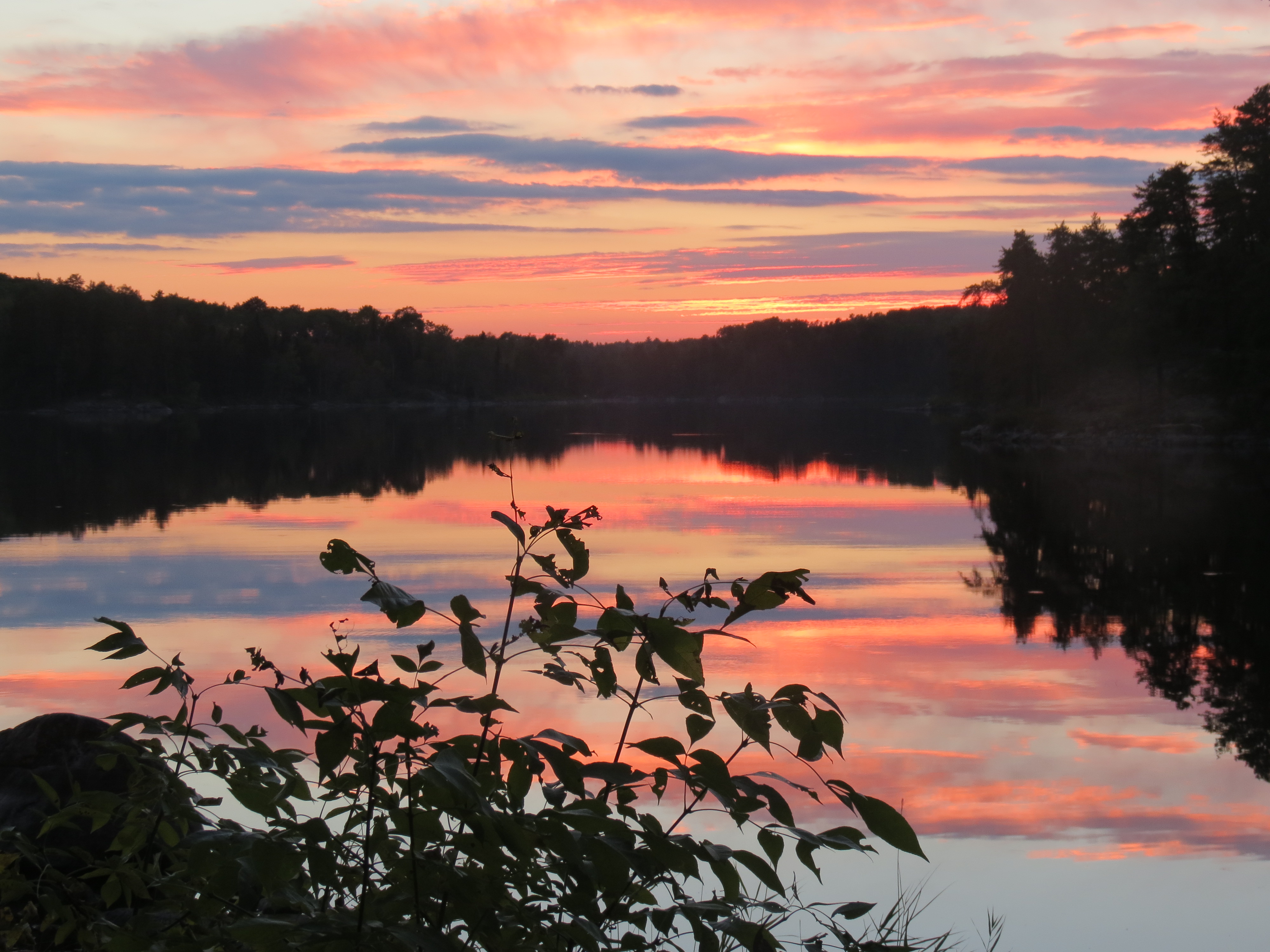
Sunset, Basswood Lake, top of Pipestone and Jackfish Bays.

Red Maple leaf.

I’ve soloed into the Boundary Waters on the good side of twenty times.  I usually go with the plan that I will think a lot about my life, family, place in the world, all the heady stuff people believe is important.  Usually, though, I end up fascinated with what most would call trivialities.  I round the corner of an island, and an immature Bald Eagle takes off in front of me. Or I’m lazing under a few jack pines on a cliff and see a dozen mergies diving in unison. Or, if I’m lucky, I see a Pileated Woodpecker fly back and forth across the bay out front, a real treat.  The world’s problems, my own, tend to wait.  A red tree leaf on the trail  is highly significant,  as is morning mist on the lake, an incredible sunset  or a rising last quarter Moon, with a loon calling, when I take my midnight break.

I process what I see and hear slowly, so it might take hours or days to discover what is truly meaningful.  Readers of my post “Dreams”, should know that I left that men’s room without the slightest thought of writing about what had just transpired.  By the time I got home, 12 hours later, the story wrote itself.

My first night out, I was on a campsite my wife and I had discovered last year.  We were camped in the motor zone on Basswood and found this one out of the zone.  We should have moved, but we didn’t.  There are many lovely tent sites, quiet bays, and lots of room.  She couldn’t see it this year; I decided if my 64 year old arms could do it, I’d go in 14 miles for a couple of nights.  I got there in 4 hours, which I thought decent.  And so the first night, I sat on a fallen Norway and started to write about the day.

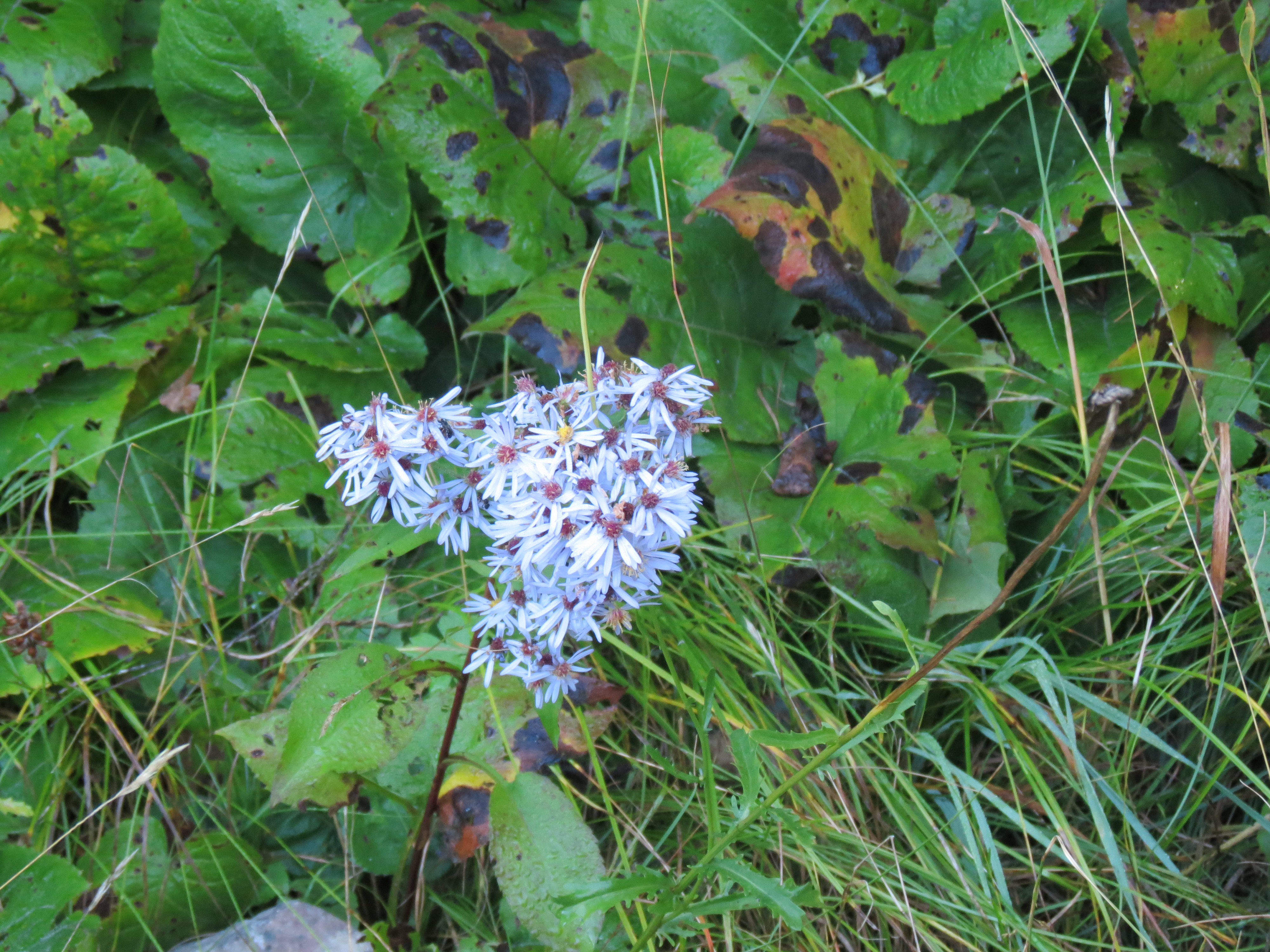
What surprised me was that my thoughts were not of the eagle perched by Newton Falls, nor the Aster

Aster plant, end of portage from Newton to Pipestone Bay.

Aster plant, end of portage from Newton to Pipestone Bay.

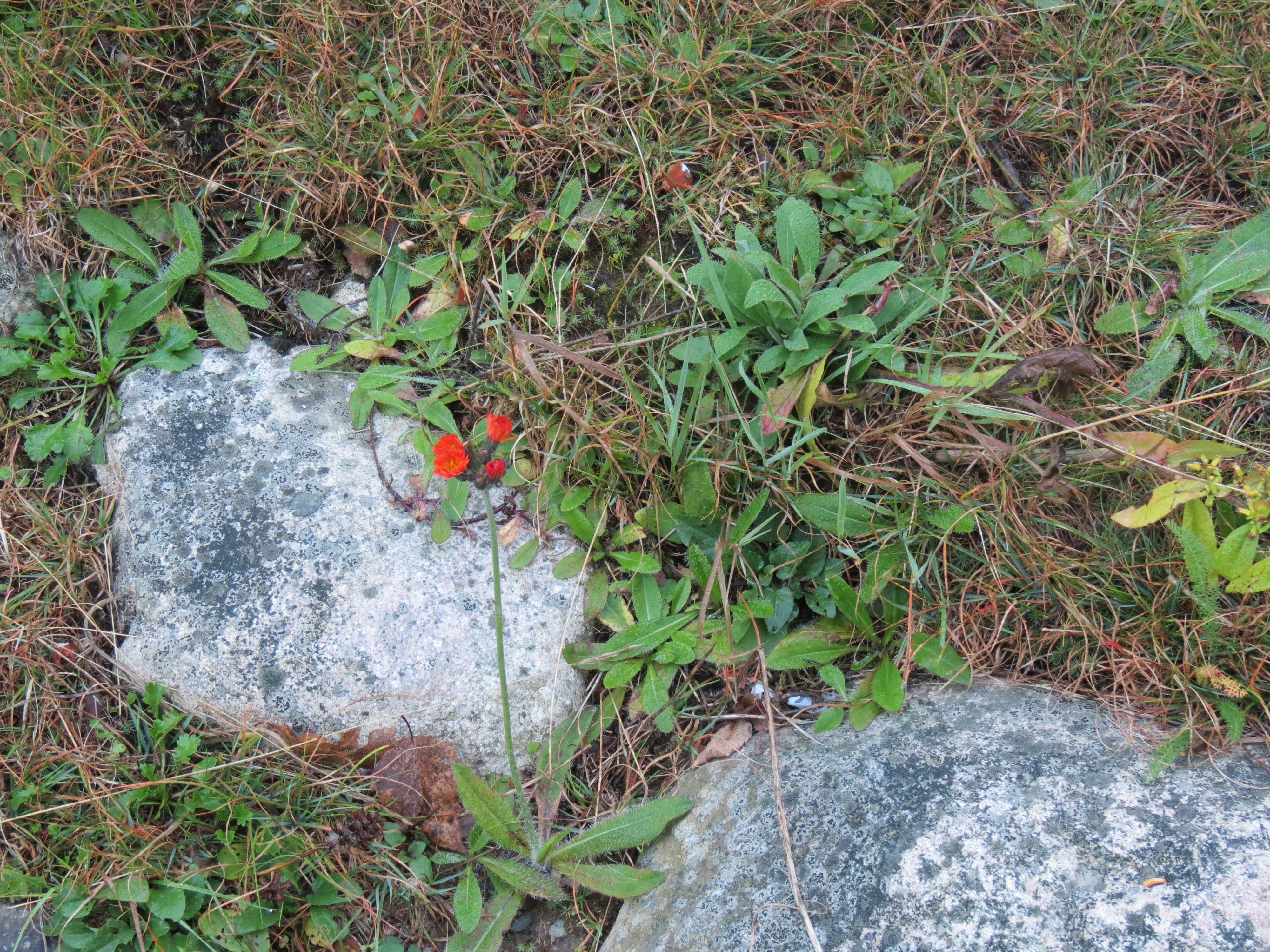
and Hawkweed blooms

Orange hawkweed.  This is worth kneeling down to smell.

Orange hawkweed. This is worth kneeling down to smell.

by Pipestone Bay, near the end of the portage.  It wasn’t even the site itself, which was better than I remembered.

Nope, it was a fishin’ story I heard that morning, back in Ely.  Yep, fishin’.

I heard the fishin’ story because I went to a bakery the morning of my departure into the woods.  My wife asked me to go to that bakery, because we always had gone there together before heading out.  We got coffee and a scone, one of her fondest memories of the trip.  We remember these things every year with hopes next year will be the same.  Except at some point, next year won’t work out.  Always.  It is the way of the world.  Not working out happened to be 2013, a bummer.  But I still went to the bakery, got my coffee and scone from the same woman, who was helped by a man I hadn’t seen before.  I don’t know their relationship, and it doesn’t particularly matter.  I was there for scones and coffee; I was about to get a lot, lot more than I paid for, and fishin’ stories ought to be told in the present tense.

A second customer comes in, and the man who is helping the woman starts talking about a fishin’ trip he guided the prior week.  OK, now I understand the relationship.  They have a bakery, and he works as a guide.  Oh yeah, he works holding ducts, too.  That came up in the conversation:  “It’s about 30 hours of work, and while I know nothing about ducts, I can hold them.”  This is Ely, where they measure jobs by hours they will last, not salary, bonuses, or bennies, which are non-existent.  But that’s for another time.  I’m telling a fishin’ story now.

The man is guiding out on a lake that I know well, but will remain unnamed, because guides do not tell ordinary people where good fishing is, and as a listener, it is completely unethical for me to mention the name.  Guides do a lot of “water time” to find the honey holes that help them live.  When you put in a lot of “water time,” you don’t give it away.  The guide talks about a day trip that he and his charges took. Wow.  I’ve done that day trip, and it’s a haul.  I’m starting to listen closely, for while I’ve been in 300 lakes up here, camped out as many nights, this guy knows fishin’ and this country a lot better than I.  If you haven’t figured that out, I’ve just paid him a hell of a compliment.

I’m still sitting at the window looking out on Sheridan Street but turn around when the guide says, “I caught the biggest walleye in my life last week–32 1/2 inches.”  I look at him as he continues, “took a picture and let her go.  She was old, had a big head, and I could see the unusual coloration on her.”  Big walleyes are breeders, and they should all be thrown back after a quick picture. If a good guide sees you keeping one of these for dinner, he will quietly direct the fishin’ elsewhere to make sure you don’t catch anything more. I heard that from an expert. Good sportsmen practice catch and release. Good sportsmen, however, often don’t do what this guide does next.

“She comes belly up about 100 yards away.  I went over, because the gulls were circling.  She was alive, so I worked her gills for a few minutes, made sure they were going, and let her go.  She dived deep and was gone.”  Working the gills means move the fish back and forth, so the dissolved oxygen can fix to the hemoglobin on the gills.

My story that first night was right before my eyes. I wanted to write something profound, and here it was: I spread my hands about 32 1/2 inches apart and dreamt of having that on my line.  Wow.  Best fishin’ story I’ve heard in a long time.  Nothing trivial about this.  Not when you know fishin’.

That guy is a real sportsman, too, and it’s a helluva fishin’ story.  I respect him.  He gets it.  He knows how to take people fishin’.  I like the bakery.  I left a decent tip when I got my order; I decided I would stop in and grab another one of those scones when I came back before the long drive to the Cities.  I doubt I will hear another fishin’ story, because maybe the guy is holding ducts.  Still, maybe it will be my lucky day.  I will leave a lot bigger tip for the woman, not just for the scone but for the fishin’ story.  I bet she knows a lot of fishin’ stories.  My wife doesn’t believe half of mine.  Bet she believes his.  He’s a guide.  He knows fishin’.

Well, I’m in the woods for a few days, cover some miles, see some sunsets, eagles, fall colors, and spend 30 minutes watching an ant move a pine needle.  Yes, trivial stuff.  Unless one is an ant.  Did you ever watch an ant carry something 10 times longer than he is?  I was fascinated.  Anyway, I finally came out of the woods 3 hours before a big boomer pounded the land.  Temperature dropped like a stone, but I had a September trip where I never wore my rain clothes and slept without a hat on.  That’s a great trip.

It got better.

I had breakfast at the Moose (The Chocolate Moose) at the corner of Sheridan and Central in Ely, and I’m ready to leave town, when I go by the bakery for the blueberry scone and coffee.  The scone is to die for.  I’m normally pretty shy, but four days alone in the woods makes me talkative, so I just ask the woman how big the walleye was, ‘cause I like to have my facts right.  She immediately asks the man to come out.  It really is my lucky day–dry trip, blueberry scone, and I’m going to talk to the man himself, a guy who knows fishin’.

He is a guide.  Name is Don Beans, and he runs  Jasper Creek Guide Service in Ely.  He’s on Facebook.  I got the brochure.  I started with a real dumb question:  “Where did you catch it?”  Completely nonplussed, Don answered, “Not saying.”  I was embarrassed as hell with my faux pas, forgetting that no guide ever divulges his secrets, but hey, I haven’t been fishin’ for a while.  I replied saying the lake began with one of two letters, and named the letters.  The first one was correct.  I told him I was familiar with that lake, having spent time with the Forest Service.  He must have thought I was for real, so we both talked about a secret lake that we both knew well.  I ain’t telling you the name of the lake.  No way.  You want to know, take a trip with Don.

Then I told him about back in ’92 when Steve Cochran and  I were out working, when we spent an evening jiggin’ for walleyes on Pipestone Bay, where I had just been.  Cochran, a Forest Service worker, guided on his days off.  Don is a guide who probably does bakery and duct work on his days off.  Probably does any other work he can, too.  Bet he’s good at it.  Doesn’t ask dumb questions, the way I do.

“Lot of water time to find that hole,” Don said, when I told him about the school of walleyes we were jigging into.  I had never caught a walleye before and pulled in 8 that night.  Threw them all back.  I told Don that I was impressed with his throwing the fish back and then going out to rescue it from the gulls.  I liked his response:

“What else could I do?”

Not “it was the right thing to do,” which implies that one has a choice, but the implication was clear: the right thing is one’s only action.  This is a good guide. Come to think of it, this is a good person, too.  I’m writing a 2100 word fishin’ story, and Don Beans has summarized the jist of it in 5 words.  He’d probably be a good editor, too.  His next 5 words were even better.

“Want to see a picture?”  he asked.  That was like asking me if I wanted a lifetime supply of blueberry scones.  Oh man, did I strike gold today.  First the scone, then the story in depth, and now a picture.

I saw Don with the fish.  I don’t have to spread my arms 32 1/2 inches.  I’ve seen what it looks like.  That walleye is a treasure in American waters, thanks to Don.  She won’t be around much longer, but she has done her job in nature.  Wow, what a fishin’ story.

And the whole thing is true.  Makes me want to take up fishin’ again.

If I do, I know who will guide me,  where that secret lake is, and what I’m having for breakfast that first morning.  I may ask dumb questions, but I ain’t stupid.