Archive for the ‘MY WRITING’ Category

IN THE ZONE

February 29, 2024

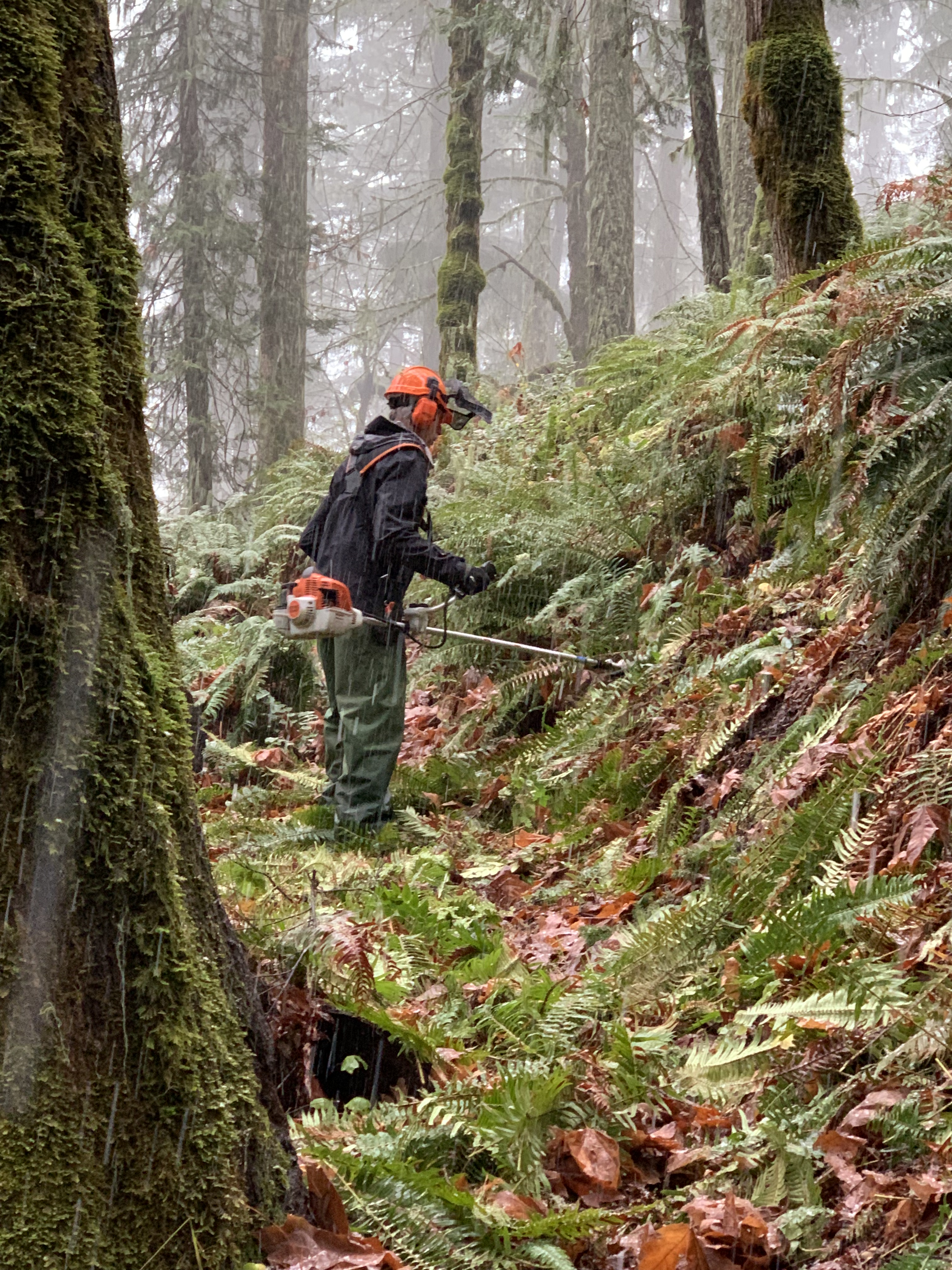
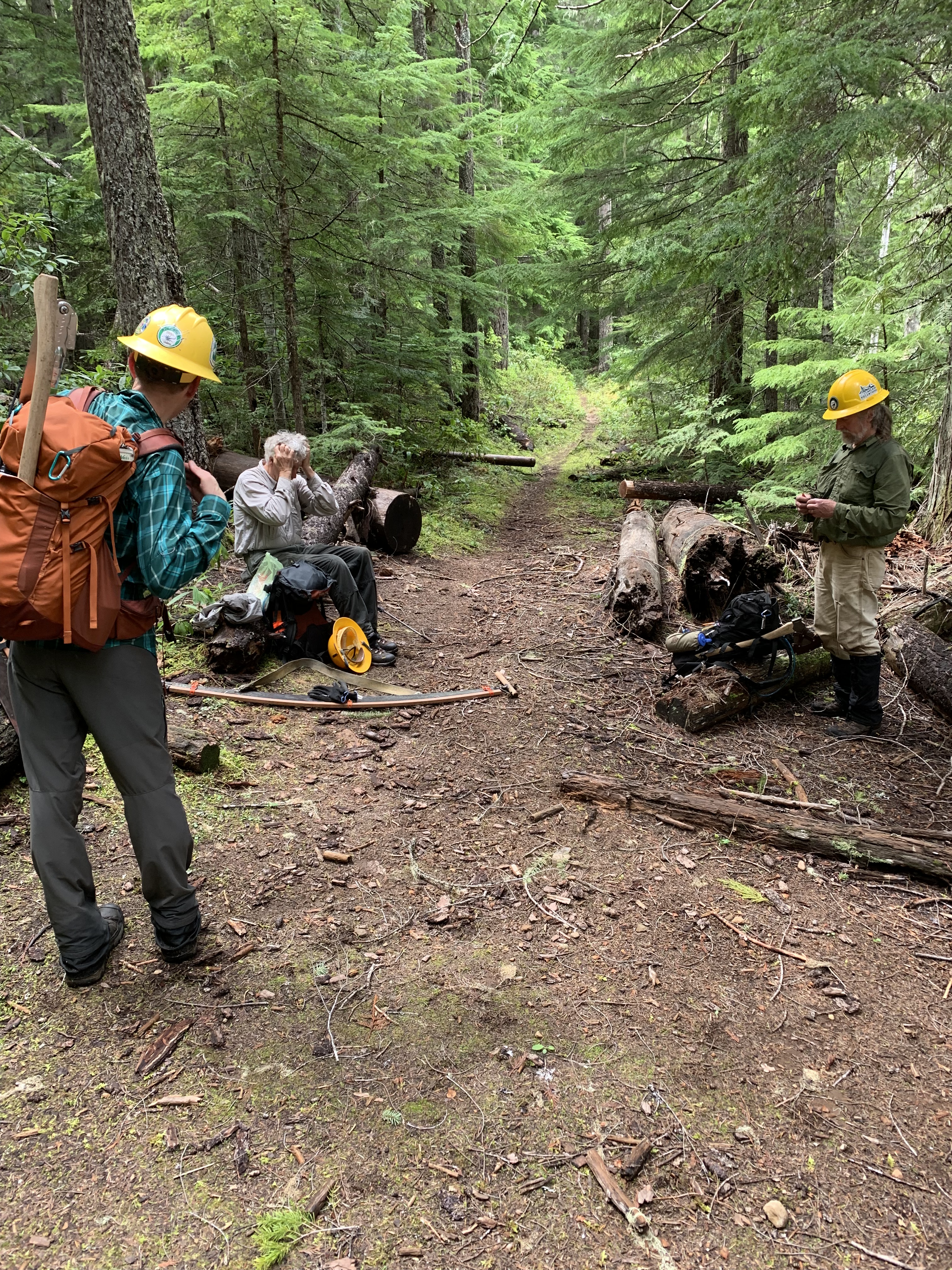
The day was going well. I was in the zone, strapped to a Stihl power brusher, felt fine, and was swinging it back and forth across the trail comfortably, clearing the Salal, ferns, and Oregon grape encroachment. My goal was to reach Harper Creek, which looked like a sure thing; if we could work up the other side, that would be icing on the cake. I had added cotton to my ears and they and the hardhat ear muffs dulled the sound well. The brushers can be fussy; I have the touch to start them, knowing how much to choke (1 pull) and can have been known to fix them, unless a blade has sheared off, in the field. The crew boss was cleaning the filter one time and said it would be better if he could burn the gunk off but he didn’t have any matches. I said that I had a lighter in my pack, and he couldn’t believe it. Hey, it is one of the essentials. 

We were clearing the South Willamette Trail, a 5.1 mile path paralleling route 58 from Eula Ridge trailhead west to Hardesty Trail. It completes a 14 mile loop that starts at Hardesty trailhead, goes to the top of Hardesty Mountain and down Eula Ridge, gaining 3200 feet net vertical plus another thousand feet plus up and down on the South Willamette. Mountain bikers love the trail. There is additionally a trail running race on this route that one has to complete in four hours to be considered a finisher. I hiked it once in four and a half, in full hiking gear, and while I thought I could knock thirty minutes off my time by going light, I wondered why I would want to do that, so I never did. 

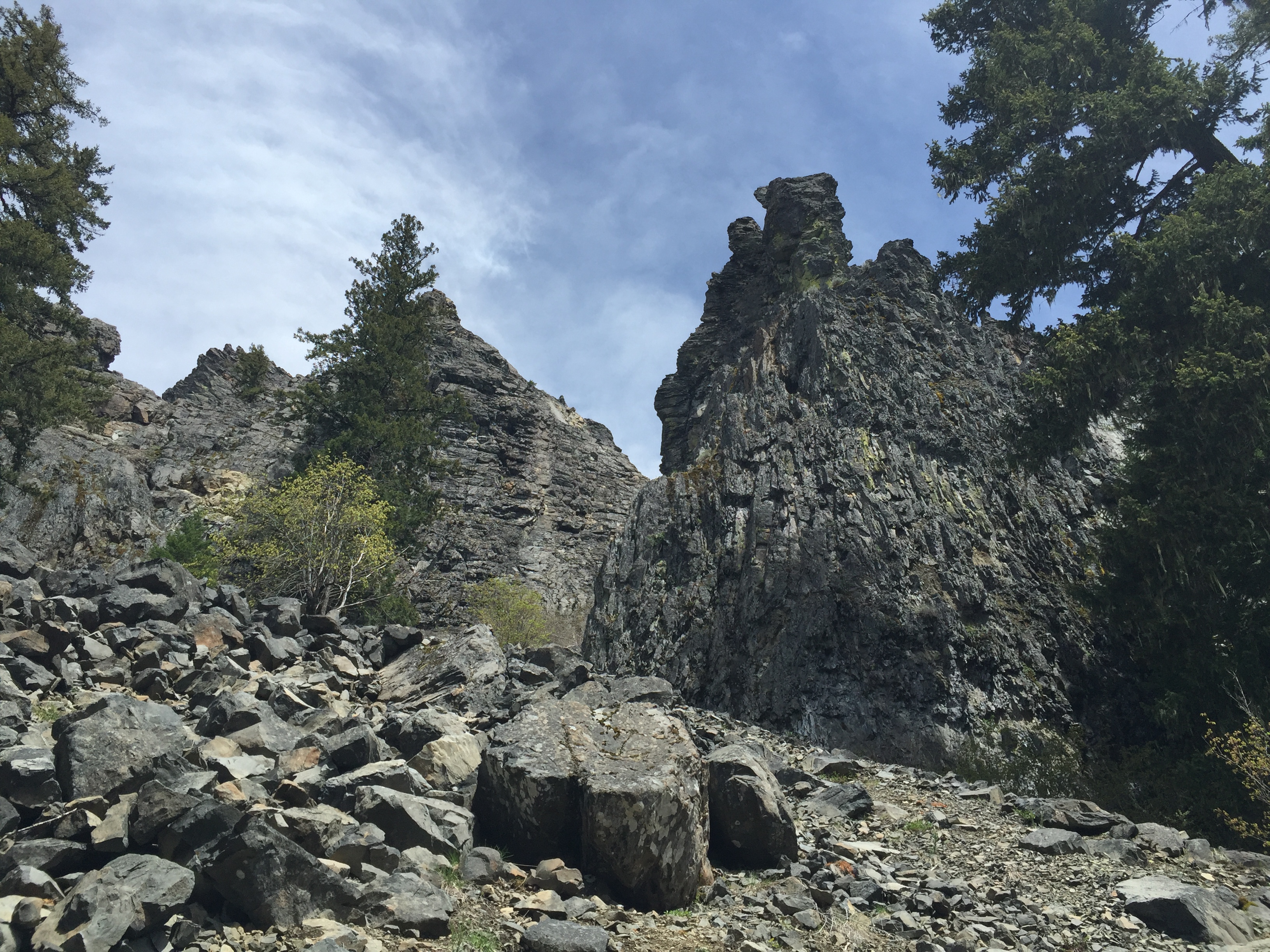
The trail has an entry at Crale Creek Road, about a third of the way from Hardesty to Eula, and we had worked both directions from there. The next step was to hike in from Crale and continue east, but I had checked a map and did some scouting to discover that I might be able to join the trail further along where the road and trail were close. I look at maps a lot and see possibilities for shortcuts. I should do a post sometime on the ones we do as trail workers. After I had scouted the trail, I hiked out to Crale, bushwhacking 100 yards, then having a decent track to the road. This track wasn’t the closest way to the road, but the elevation change was minimal, the path good, and the hike was much shorter and flatter. Short distance and many contour lines equal hills or worse.

I took the crew to the new spot I had found, and we parked near an RV that was there for the winter. I held the usual Tailgate Session reminding people to call out, whistle or touch a person ahead of them if they wished to pass.  It is unsafe to try to sneak by somebody working with a brusher or a saw, and going off trail to pass can lead to tripping. I spoke about controlling bleeding, since that is one of the few emergencies out here where quick action can save a life.  As a former neurologist, I can attest to many cardiac arrest “saves” who became vegetative, and I was the one who had to deal with telling the family the person wasn’t going to wake up.  Bleeding can’t wait, as a tragic death on the Dutch Creek Incident showed in 2008, where a tree that was cut down hit another which broke off, fell, and shattered the femur of a young man on his first fire. He bled to death. We deal with many sharp objects, and bleeding is a major worry of mine in the woods. A heart attack or a stroke out there is going to do what it will, and we can’t do much about it. Bleeding, however, we can and must control. I carry an Israeli bandage in my pack and I told everybody where it was. I also mentioned optimal places where we would try to get an injured person to.

I also was the only one who knew the route in, which gave me some credibility. I had organized the work party and chose the trail, brought the brushers, fuel, rake, and Pulaski. I knew where I was, the distances, the creek, the elevation, everything necessary. On the way in, I discovered another marking ribbon different from mine, and without missing a beat, moved towards that ribbon that showed an opening in the woods that turned out to be a user trail I had missed when I was trying to find a way from the other direction. I went straight to the main trail, no bushwhack necessary.  One of the other workers asked me—the only one who did—where the bushwhack was that we were supposed to do, and I told him that I saw the new ribbon and on the fly I took it.  The others either didn’t notice or were happy enough just to get to the trail, saving a few hundred feet of climbing and a three-quarters of a mile hiking. I love finding these shortcuts and can think of many instances where they have helped. New parking area, significant shortcut, favorable weather, everybody working well, yes, I was in the zone.

At lunch, we stopped just above Harper Creek, trail visible on the other side. I knew the area well; I have hiked the SWT many times, having cleared the trail in parts in fifteen to twenty different outings. After we finished, well above the creek on the other side, a few days later I would scout the far end and then lead a crew there the following week, either brushers only or having a sawyer along, too, depending upon what the scouting showed.

We don’t clear each trail every year; every other is usually sufficient. And necessary. 

LIFE CHANGE

December 25, 2023

I had snowshoed to the upper part of Willamette Pass Ski Area from the west side, puffing, tired, having gained a thousand feet elevation in 3 miles, but the novice trail, not steep,had only light snow accumulation. I was surprised at my fatigue.  I still had to climb higher in deeper snow to reach Maiden Saddle so I could go down the back side to the Pacific Crest Trail to check it for diamond marker placement on the trees. I trudged back and forth, switchbacking up the hill, sometimes on the marked trail, usually not. At the top, I was puffing even more, and after it quieted, I worked my way down. I was beat, and while the altitude of 6400’ (1900m) was significant, this day was taking more out of me than I planned.

Tie trail coming off the Pacific Crest Trail about 400 m south of Lower Rosary Lake.

I have adopted a snowshoe trail that I visit every fall before snow to see if there are logs that will impact winter skiing and replace any diamond markers that have fallen off the trees or have been on trees that have fallen. I try to get someone to remove the logs, and I replace missing diamonds.  In winter, I return to the trail, move diamond markers further up the trees, in case there may be so much snow that the markers could be buried.

On the way down, I left the winding, barely tracked trail, and went straight down the fall line to Upper Rosary lake, snowshoeing directly to and on the lake to the isthmus between it and Middle Rosary, where I had lunch.  Cutting switchbacks in heavy snow is not harmful to the trail, unlike when there is no snow.  That saved me at least a half mile’s trudging. I still had 4 miles to go to get out. I divvied up the distance into finishing the Rosary Lakes; the area between Lower Rosary, the largest of the three, and the tie trail junction that went back up the mountain; to the junction where the trail started to head west, rather than south.  In that way, I broke up the distance in my mind and eventually made it back to the parking lot. I have been snowshoeing for several years, and while this trip had some deep snow, much was not.

Spring came, the snow melted, and I was fine, until I got tendonitis, which slowed me down, so  I rested my leg in June and did fine until August, when the Crew worked the lower part of Olallie Mountain.  I wasn’t the only one that day tired when the heat, humidity and the activity called an end to our work on the logs on the lower two miles. But it took me a full day to recover, not a half day, and that was new. Still, we worked the same area a few weeks later, when it was cooler, and I didn’t feel as tired as I had the first time.

The Crew then worked Crossing Way, a trail that goes into the Three Sisters Wilderness, a few weeks later. I had worked it in 2021 and found it long, uphill, and hot.  It was the same this year, and I found myself fading after lunch; I didn’t bother stopping for a log loose in the middle of the trail and had to go back to deal with it. I was getting sloppy, being in plodding hiking mode rather than clearing trail mode. Thirty minutes later, we worked on several logs, and when we finished those, I was done. It is an uncomfortable feeling to know there is a 4 mile hike ahead to get back, carrying gear, when one is tired. I was still within myself, but I didn’t like the sensation I had. Others felt the same way, and we hiked out a very long hour and a half.

This log was cut so that it balanced, and we could move it with a finger. We pushed it off the log below.

The last log out of the year, as it turned out, was Olallie Mountain again, this time the summit trail, 2 miles climbing about 1000 feet, after first hiking in the 2 miles we had done two other times that summer. We had three crews working, and there were single logs, multiple logs, logs with branches, one after another. We thought it would be cooler in October, and some of us took less water to lighten our load. I was tired by lunch. After lunch, I had what was becoming the all too familiar sensation of climbing slowly. The logs seemed more difficult, the Sun hot, my water starting to dwindle. I reached a plateau with the summit still nearly a mile and 70 logs away, impossible to complete this day. I took a break and lay down in the shade in the woods. Someone came by and I told them I would be getting up in a couple of minutes, but I felt comfortable but tired, and didn’t want to get up.  

I had been thinking as I had climbed how much more further I had to return, and I needed the ability to return. I heard a person behind me on the trail who was starting down, and I finally got up and joined him. More than an hour later, with a half mile to go, I was out of water. I filled my water bottle in a stream, planning to purify it when I got to the vehicles. Fortunately, when I arrived, one of the vehicles was open and I got the water I had left behind. I realized then that I could no longer do a full day of climbing and working at altitude beyond certain distances.

I’ve seen many changes in myself in my mid seventies. I am more cold sensitive now, whereas I used to hike in shorts and short sleeved shirts. Even in summer, I often will use long pants in the morning. I also notice other hikers on the trail, other walkers in town, are faster than I am, not that I am racing—I’m not—but I am slower. The Club has fast hikers, and shortly before the winter episode on Willamette Pass, I found myself at the back of a hike and never seeing the leader except at the mandatory stops at trail junctions.  That was new.

Every year I can hike, snowshoe, and do trail work is a gift. It has been the last  few years. Many are denied that gift. I’m looking forward to snowshoeing this winter, but with a wary eye on distance. I’m a volunteer, not the paid help. Protect the brain, and then let the brain take care of the body.

The author on Olallie Mountain, July 2023

TIDES

November 7, 2023

“There is a tide in the affairs of men.” (Shakespeare; Julius Caesar)

Eclipse Day on Green Island, off the coast of Cairns, Australia, and by morning twilight I was on the beach, ready. We had arisen at 1 am, were aboard the boat from Cairns at 2 and were on the island by 3. I had plenty of room on the beach, which should have been a warning.

The eclipse began shortly after sunrise, and so did morning high tide, a true spring tide, a king tide.  With a total eclipse, by definition the Sun, Moon, and Earth were lined up and the Moon was near perigee, its closest point to us. I had to rather unceremoniously move inland, apologizing to the locals that I lived in a desert and didn’t appreciate how quickly water levels change with tides. The beach where I had stood was soon several feet under water. The eclipse was stunning; so were the tides.

King tides, a non-scientific term, are high tides when the Earth is closest to the Sun in its orbit (perihelion), which happens to be early January, the Moon is new or full and is close (perigee) to the Earth. The lineup doesn’t have to be perfect. There is one new and one full Moon a month, and for each of about three days for three consecutive months there will be such tides.

Spring tides are when the Sun, Moon and Earth are in alignment (sygyzy), when the Moon is new or full. For a day or two on either side of that alignment, there isn’t much difference.  Both the Sun and Moon pull on the Earth; the Sun has half the tidal effect of the Moon on the Earth. I experienced king tides in Australia for the November 2012 eclipse. A month later, at new Moon, the tides were still higher. The Moon wasn’t in exact alignment with the Earth, but it was closer than it was in November, the Earth closer to the Sun, and proximity overcame the loss of perfect alignment.

Why do tides occur later each day here? Suppose the Moon is culminating (due south) at 9 p.m. and there is a high tide. A day later, at 9 p.m., the Moon, which is constantly moving eastward among the stars, another way of saying it rises later each day, is not quite due south at 9 p.m. It will be some time later, and that average time is about 50 minutes. This is split up into two high tides a day, so each one is about 25 minutes later. Two important disclaimers; first, 50 minutes is not exact; it varies with the season and the Moon’s orbit; second, the configuration of the ocean bottom near the shore affects the time as well.

Every object exerts a gravitational attraction with any other object—your phone with you; two people with each other; Saturn with a car, proportional to the product of the two masses (think of mass* as “stuff”) divided by the square of their distance. We know gravity is universal, but we didn’t always know that until the observed changes in the double star Porrima (in Virgo) over several years showed that gravity worked in deep space as well as on Earth. Richard Feynman once said about a globular cluster of stars, “if you can’t see gravity operating here, you’ve got no soul.”

If the Sun is so large, why is its tidal interaction with the Earth only half that of the Moon, when its gravitational effect is so much more, which is why we orbit around it?  The answer is because tidal forces are inversely dependent not on the square of the distance but the cube, the third power.

Centripetal force directed into a circle is inversely proportional to the distance from the center, or radius; gravitational force is inversely proportional to the distance between two bodies squared; tidal forces are inversely proportional to the distance between two bodies cubed. For those with a calculus background, the rate of change of gravity is the tidal force the same way the rate of change of velocity is acceleration. The derivative of an inverse square, (1/x^2) is (-2/x^3). I find the derivation as beautiful as seeing a king tide right up to the rock wall in Newport.

The Sun, 330,000 times more massive than the Earth, is also nearly 400 times further away than the Moon, so the tidal force exerted by the Moon on the Earth is almost double that of the Sun. We are held in place by the Sun’s gravity; our tides are more a function of the Moon. When it all lines up in early January, all bodies closest to each other, we have a king tide!

If you go to Anchorage, look up the time of the tidal bore in Turnagain Arm. If you are lucky, you may be able to see it and hear it moving southward as a long wave across the arm.

*“If you want to lose weight, go into space. If you want to lose mass, diet.”

OUTSIDE CONTROL LIMITS

October 2, 2023

That night, on Crooked Lake, 19 years ago, rain that had begun 24 hours earlier continued with the addition of a howling wind, the likes of which I had never heard before. It would start as a low whine and increase to a loud scream. 

We had been tent bound most of the day, and a measuring cup had 3 inches of water in it, so it  had been a good day not to move. The wind, however, scared me. It was a known danger, with tree limbs and whole trees possibly coming down. I had seen such places in the canoe country, once in Gabbro, far to our southeast, where there were downed trees all over the campsite. These trees weren’t dead to begin with. They had been very much alive but unable to bend sufficiently in the wind to keep them from breaking apart, shattering, 20-30 feet above the ground.

I lay awake, waiting for the sound of a branch cracking, which would be my signal to leave the tent. In case I didn’t, I had a hand saw next to me, not that it would help much if a 14 inch trunk landed on me.  I finally fell asleep, and the next day we would have a northwest wind behind us on the long paddle back to Basswood Lake.

That event was a powerful storm, but it was not unusual.  Lately, I have concerns about unknown weather, the new weather. I think many felt global climate change just meant slightly warmer days. It doesn’t work that way.  When a system starts to become less controlled, the first thing that changes is the variability.  Now, the average has also changed, the variability increase obvious.  We are discovering that systems stall and either produce long droughts, floods, or major blizzards, called by climatologist Daniel Swain as “precipitation whiplash.”  I do a decent job of weather predicting in the outdoors and in town, I check the European and American models daily. I ought to be far more comfortable, but the other day, I realized I am not, and that is disturbing.

Two years ago, the models predicted remarkably  high temperatures for the Northwest, so high that they were discounted. But while the temperatures didn’t reach the low 120s, (49-50 C.) except in Canada, they came close enough for three days, far closer to the models than anyone had forecasted. Heat of this nature was so far off the graph of the daily temperatures for the last 100 years that a discreet 3 dots may be seen well above the curve of the other 36,525 temperatures.

Heat is silent, but I am old, and my physiological ability to deal with high temperatures is less. I still work in hot weather, but I drink often, and after a morning’s hard work, I am tired. By the end of the day, I am very tired, and it takes me half the next day to recover. I used to hike Spencer Butte on Wednesday after having worked Tuesday. I don’t anymore.  One day this summer, despite drinking over 3 liters of fluid while working, it took me a full day to recover.

Storms concern me now. I have always had a slight sense of worry mixed with excitement when awakening in the woods to the low rumble of an incoming thunderstorm. I’ve dealt with them. I stay on my pad, inside, and hope a tree nearby doesn’t fall on me. But now there seems to be a difference in these storms. They are more energetic than formerly. They carry more water, and I am not sure our models will capture their strength the way they did with the high temperatures.  Or maybe the models will be correct, but humans reading them will say no, that can’t be right, when it is. Now, I will be asking the questions:  is this a storm type I have dealt with or is this a new type I have never experienced? Or is the categorization something I haven’t yet considered?

New York’s recent flooding had very little warning. The storm was more compact and wetter than expected, and the concern was raised by meteorologists that the large effect, smaller scale events will be much more difficult to forecast, especially for major metropolitan areas, where a few miles one way or the other makes a huge difference.

In the changing climate, we will have to learn new rules and keep learning them, since equilibration is centuries away, barring ways to decarbonize the atmosphere. Storms may form faster than we have seen before, catching seasoned weather watchers off guard. What bothers me is we will encounter changes we can’t even imagine. If temperatures can reach 118 in the PNW, can we go a half year with no rain?  Can we have a dozen wet atmospheric rivers in 3 months like hit  California?  Streams have evolved in the face of past rain events may not be able to deal with new rain events—there may be flooding or dangerous currents that have never been seen before, and these may be significant issues not only in the backcountry but even on the highways, major or minor, that lead to these areas.

Not only may streams not be properly configured, neither may be trees. What happens when so much precipitation falls that the soil gives way, as it already has? Will this make trees unstable, promote root rotting, early death?  We don’t know. What plant can survive flooding rains and months of drought? While they can evolve. but will they if frequency and severity quickly double?  Evolution is slower.

I am leaving the Earth’s stage at the very dawn of these new changes.  I will see them and expect to be significantly affected by some.  But I won’t be here for the main show, which is going to show changes never imagined, be tragic, and expensive beyond belief.

CLOPETY SPLASH

September 10, 2023

A gray October morning, third day out without seeing anybody, and I was trying to make up time because of my staying put in the tent the prior day because of a pouring rain. I needed to make decent miles before the early sunset and hoped the weather would hold, although cloudy skies showed little promise. I had paddled perhaps five of the eighteen miles I needed to go and was moving up Spoon Creek, when I suddenly sensed something ahead.

Right around the corner were a moose and calf.  Right there. Fortunately, unlike four months earlier, when I passed a moose and newborn calf on a lake, needing to out paddle a swimming angry cow, this calf was larger and the cow just stared at me. I had my paddle in the water, using it to brake, but I couldn’t back up or move to the side if she charged me. She didn’t, and the two quietly left. I was on schedule later that afternoon. That night, geese awoke me as they flew south towards a Hunter’s Moon. The following day, I paddled in dense fog, the day after in a blizzard, and before I finished would see three more moose and no people.

On the canoe trips my wife and I took, we had a joke that I was ”expected” to find a moose, and nature often delivered. Still, I never go into the wild expecting to see something. I try to put myself in the right place and hope I will get lucky. I certainly have been. Showing up in the wilderness and showing up in life are important parts of success.

On one trip, our moose sighting was a bull seen on a back road on our way to the jumping off point to Lac La Croix in the western Quetico. We encountered one on a portage coming into Basswood Lake, where I kept the canoe on my head a lot longer than planned so my wife could join me and see it 10 yards away. There was the last day out on a trip, previously moose-less, when I went down to the lake to get water, looked down the shore, and saw a cow standing in the lake 50 yards away.  I got my wife’s attention and motioned her to come down. The country had delivered its annual moose sighting. 

We saw our ’96 moose at the end of the first of what would be 15 portages on a day we took the Frost River to Cherokee Lake.  Eight years later, we saw one swimming across a lake towards us, initially impossible to identify because there were so many branches stuck in his antlers that he looked like a motorized floating tree.  

In 2010, we were at our favorite campsite on Lake Insula, what would be our last time there, a year before the Pagami Creek fire. The site was at the head of a quiet bay, and few ever left the main travel channel through the lake to go there. It was serene, views in all directions, lovely ledge rock of Canadian Shield.  After dinner, I walked over to look out on the bay and the sunset. I always carry binoculars just in case I see something; If I stayed past dark, I could check out the Double Cluster in Perseus or Andromeda Galaxy.

It was calm and well into nautical twilight, where the light is too dim to read by, and the first stars are visible, when I heard a distant, odd sound with two components.  I looked with my binoculars then quickly ran to get my wife. There was a bull moose on the far shore, walking right at the water’s edge, clopety, splash, clopety, splash. Water carries sound well. I didn’t realize it at the time, but the noise was in phase with the sight from our viewpoint, because the moose was walking at precisely the speed so that we heard the prior splash when he was making the next step into water. 

We listened to the distant clop, splash for two minutes in deepening darkness until he turned into the woods and both he and the sound disappeared. 

See you on the trail. Any wildlife sighting is a gift.

ON THE INJURED LIST

August 11, 2023

Seven miles into the hike, just over half way, and we were climbing out of Separation Creek watershed to the Horse Creek Trail 600 feet vertically above us. There were no switchbacks, and I periodically stopped and wondered how the two guys in front of me got so far above me. Or ahead of me, since above and ahead distances were not much different.

We had done a car shuttle to log out the middle portion of the Separation Lake Trail in the Three Sisters Wilderness. We hiked down and in 5.6 miles through an area we had logged out the week before and then crossed the creek itself on a narrow bridge that I didn’t want to cross again, to do the next part. Now we were on the up and not quite out part. Once I got to the top, assuming I was still alive, there was a 5 mile hike back out to where a car had been left. We would get in the car and drive back to the Separation Creek trailhead, 20 miles by road, to get everybody back into the vehicles for the long drive home. We carpool.

Crossing Separation Creek

Somehow, I made it to the top and back out, all 13.2 miles, and I seemed to be fine, except for some heel pain that I thought was due to the boot’s rubbing on me. It wasn’t.

Separation Lake

I had tendonitis, supposedly a middle-aged problem, but overuse at any age can cause it. I knew where the overuse occurred. For the next year I dealt with it by using ice, care in how I walked, and getting by. My problem improved enough so I could still hike, some days bothered by the tendon, other days by my left knee. At my age, these things are not uncommon, although two years prior I had neither. But two years in one’s youth and mid-life are very different from two years when one over 70. They are more like dog or cat years. Trail work isn’t body friendly.

One day this year, hiking familiar Spencer Butte, I had more pain, enough so that I couldn’t walk well after one hike, which was new.  I rested 2 days and felt better enough that I went back and scouted Horse Creek for this year’s log out. I did fine for hiking 5 miles up. Coming back, I had pain in my sole for the last 3 miles, which was new and probably plantar fasciitis.

That latter pain improved quickly, and I even worked a few days later running the power brusher with little difficulty. That weekend, even wearing the same boot, I had more trouble and wondered how I would work Horse Creek again, this time with equipment.

I gave up. I was tired of hurting, so I canceled on the log out, and for the next three weeks did only short walks with open back shoes, a lap around the neighborhood, nothing more.  With such a regimen, I improved greatly and was able to be out on the trail with a group who wanted an experience being a trail volunteer with us. I did fine.

I still do fine, although my Achilles is sore at the end of a hike. By the following morning, it is better, and a day after that I can hike again.  I had to give up the Wednesday hikes because I was working both Tuesday and Thursday on the trails, and I couldn’t do three days in a row.

I had hoped to help out up later this summer in the North Cascades region of Washington State, where fires, winters, and minimal staff have left a huge backlog of trail work needing to be done. They have a few hundred logs per mile, and they need crosscut sawyers up there.  I qualify, and I’d do it, but it’s a day’s drive each way, and while I can work, it is difficult putting back to back days together. It would be a great deal of time spent for not much help delivered.  On the other hand, with some of the pictures I’ve seen, one might not be hiking far at all, spending the day cleaning up huge tangles of brush and logs. Need to think about it. 

On top; 5 miles to go. The trail in front heads further into the Three Sisters Wilderness.

NORTH

June 18, 2023

 NORTH

I stumbled out of the tent on to the grass for my middle of the night nature break. We were camped next to the Aichilik River, a beautiful, wild, braided flow that emptied into the Arctic Ocean, 30 miles to the north.  Above the river was the full disk of the sun, a finger breadth or so, about two degrees, above the northern horizon, its light’s shimmering on the water. Two weeks from the solstice, and the midnight Sun was right where it should be at 69 N.: two degrees north of the Arctic Circle, two degrees above the northern horizon. Above the Arctic Circle in June, it’s daylight all night, and the Sun circles the sky.

I’m Up North. For me, north is my favorite direction, along with upstream, uphill, beyond the wilderness boundary.  There is north, and there is Up North, a special construct in my world, sometimes referred to as “God’s country.”  Minnesota outdoor writer Sam Cook wrote, “Up North is a map on the wall, a dream in the making, a tugging at one’s soul.” Sig Olson referred to it as “beyond steel, and roads and towns, where they will find release.” “They” is defined below.

My Up North is coming around a corner of Obsidian Trail in the volcanic area and seeing Middle Sister suddenly fill my vision. It is big water of Agnes Lake in the Quetico, stretching as far as I can see, open horizons that Olson wrote about, remembering head winds, rain, snow and the beautiful campsites on the Canadian Shield. Up North is seeing Mt. Adams from Timberline Trail; behind Upper Trestle Falls; the tors, granite poking through the ground, in Serpentine Hot Springs on the Seward Peninsula. It’s standing hanging to a tree at the top of Lowder Mountain, looking down at Karl and Ruth Lakes. It’s the vastness of Drain Creek Valley in the Refuge; the incredible view of the forests below Diamond Peak, seen from Hemlock Butte. It’s a hermit thrush in camp or being so high one can look down upon a golden eagle in flight. It’s autumn where the trees have more colors than just yellow, seeing the lake ahead when the portage is almost over, the primal feeling when you hear rumbling of thunder at night when camped in the wilderness. It’s Virginia Falls on the Nahanni.

All was well. It was normal nighttime cold, which always struck me odd with the sun out. We would hike on aufeis later that morning, frozen water that expanded out of the riverbed, providing a decent highway for hiking on the North Slope in June. We’d likely cross the river a few times. Wet feet are a given up here. If you were lucky, that’s all that got wet. That’s part of Up North. Wetness. It’s difficult, but it wouldn’t be Up North without it.

Up North is paddling the Yukon River into the vastness of Lake Laberge that Robert Service memorialized in “The Cremation of Sam McGee.” It’s understanding that “sweat and toil, hunger and thirst, and the fierce satisfaction that comes only with hardship” are why some of us —“they”—go.Olson didn’t add soaking wet, which I would be in 2 days, when we hiked in pouring rain, seven of us piling into a small cook tent for lunch where we had hot soup and briefly forgot how wet we were. The sun came out that afternoon. Up North is the feel of the warm sun on your soaking wet body, watching everything dry while you drink something hot. Up North is a solitary, haunting loon call down the lake.

See you on the trail. May you find your own Up North.

“Up North is a map on the wall, a dream in the making, a tugging at one’s soul. For those who feel the tug, make the dream happen, put the map in the packsack and go, the world is never quite the same.  We have been Up North. And part of us always will be.”  (Sam Cook)

Middle Sister from Obsidian Loop Trail

Open Horizons from Agnes Lake, 2005, my last time there.

Tors, granite poking through the ground, Serpentine Hot Springs, Alaska, 2016

Karl and Ruth Lake, Three Sisters Wilderness, Oregon, 2014

Caribou on aufeis, Aichilik River, Arctic National Wildlife Refuge, 2009.

REFLECTION

April 18, 2023

Maybe it was the silence that woke us at our campsite on Horse Lake. The wilderness is seldom totally quiet, but we caught a moment when air, plants, and animals were simultaneously still. I had experienced such quiet only two other times, once in the Grand Canyon, the other in the Boundary Waters. In any case, I was awake, quietly unzipped the netting, and crawled outside, barefoot.

Before me was a phenomenon few witness: a clear, dark night sky with no light pollution. We were in the largest roadless area in the contiguous states, and it was a long way—2 days’ travel by canoe—to the nearest road and a good deal further to any sort of town. The Moon was almost new and wouldn’t rise for two hours. Below me, I felt the cold, wet, dewy grass of the campsite. It might yet become foggy for the morning travel south through two lakes and a river to Jackfish Bay on Basswood. 

Looking over at the calm lake, I saw Orion’s reflection in the water before I even looked up at the sky itself; Betelgeuse, Saiph, Bellatrix, Rigel, with the three stars in the belt, Alnitak, Alnilam, and Mintaka, all clearly visible. I’ve seen good reflections in the daytime; this reflection was the best I had ever seen at night. Up in the sky was the actual Orion, Jupiter a little to the north, among the stars in Gemini, so bright that I first thought I was seeing Venus, although that was clearly impossible at 1:30 am. 

When I view Orion, I often follow the belt to the right or west two fists at arm’s length to Aldebaran, in Taurus, in the Hyades Cluster and then another fist length to the Pleiades, nearly high overhead, through the white pines on the campsite.  I didn’t have my glasses on, but the sky was transparent, perfectly calm, but if a touch of a breeze came up, fog would form. 

For the first and only time in my life, with the naked eye I could make out the seven bright stars in the Pleiades using averted vision. If one views in low light, looking slightly to the side of a desired object focuses the image on the dim light sensitive rods of the retina, not the bright light sensitive cones of the macula, where sharp, colorful images are discerned, but at the cost of sensitivity in low light. That’s why we see colors poorly at night. In any event, I saw Alcyone, the brightest Pleiad; then Electra, Maia, Celaeno, Sterope, Merope, and…yes, there it really was, Taygate, near Maia.

I’ve noted when it is quiet, I talk in a whisper. There are few places in the modern world where one is immersed in wilderness, dark skies, and silence, my “Outdoor Triad.”  On the September trips, we had either darkness like this or saw the post-Harvest Moon rise almost at the same time for the next two to three nights. If the weather were clear, we could watch the Moon rise through the trees, or, by changing our perspective to the correct one, realized we weren’t seeing the Moon rise, we were watching the Earth rotate. 

Try to watch the Earth rotate sometime. You don’t even need to leave town, although it’s a lot better in the woods. Changing one’s perspective is good for the soul. 

See you on the trail.

Obsidian Journal (obsidians.org) April 2023

INVITATION

March 28, 2023

Four years ago, the Crew worked on the Wren Nature Trail by the Middle Fork Ranger Station.  The trail itself was short, flat, but had been subjected to “Snowmageddon” with trees down in so many places we could barely find the trail. That afternoon, we all met as a group in one area to clear brush.  Many of us were new, and it appeared that several wanted to make a good impression by hacking away vigorously at the brush, so close together that I left the scene and worked elsewhere so I wouldn’t get struck by a blade.

I came back later when the power saws were going to be used on a log. I made the bad mistake—I knew as soon as I did it—and slipped behind the sawyer as soon as he pulled the starter cord. I knew it was wrong. Nothing happened to me, however, and we finished the job.

I can still remember afterwards, nine of us out by the ranger station when one of the senior crew members—been around forever—talked to us and pointed to me and basically dressed me down for my unsafe maneuver. It stung. I still remember the direction I was facing (west) and how I felt (like crap).

I worked with that same person a few times and always seemed to be in the wrong place whenever a power saw was going.  The individual loves the Fall Creek National Recreation Area, a beautiful place with soft soil and prone to landslides, fires, and other trail wrecking catastrophes.  It is the Sisyphus for the Crew: we work the area, and then it all falls apart again. He worked in areas with one or two other crew members he chose, mentoring them, and the rest of us worked elsewhere in the forest. I would have loved to have had a mentor, but as it has been for most of my life, I ended up learning the material on my own with practice and correction; most people are not good teachers. And in my defense, nobody ever told me that the Forest Service limited the number of people’s working in Fall Creek due to conditions.

Two years ago, the individual put out a call for volunteers to help him in Fall Creek. I decided to go and worked with him and a few others. It went fine. The second time, he had me do independent work a half mile further down the trail from the others. I did that, although I did not tell him afterwards that while I was downhill from them, several rounds, or cut logs, came crashing down in the woods to my level, a hundred yards from me. The others were cutting logs high above me and did not appear to know I was below them. When I came back up the trail, I saw new logs that hadn’t been there when I came down. I said nothing, told the individual I had finished the job, and he nodded approval. 

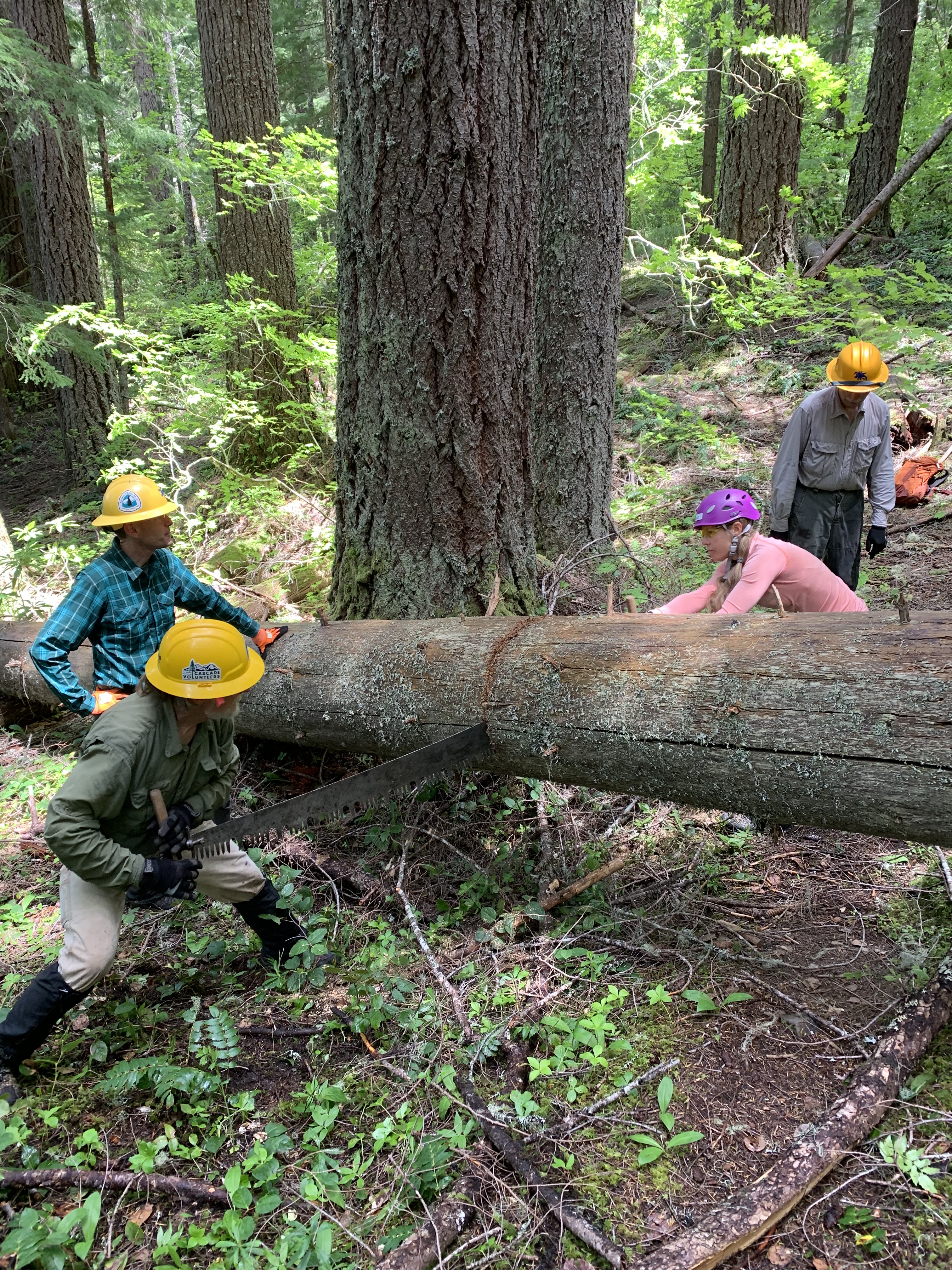
Last year, the individual was one of two others who went out with me on a log out at Olallie Mountain in the Three Sisters Wilderness. I was the crew leader, which made me not only nervous to begin with, since it was my first time as a crew leader for a log out, but a newly certified B level crosscut sawyer. The work went well. With one difficult log, I saw a way to slide it off trail along the smooth inner cambium layer of a recent cut log nearby. We were able to do it slick, figuratively and literally.

A few people still went to Fall Creek, and I usually wasn’t among them, until this year, when we worked the Andrews trail, doing brushing. This was my forte, and I was comfortable with the work. I should have been. I have been out with the Crew more than two hundred times in 5 years, and I am the go to person with power brushers, even though this is only my third season using them. 

This winter, the Forest Service allowed a few members of the crew to clear the east end of the Fall Creek trail. This area, damaged by fire, had dozens of trees felled to try to make a fire break during the conflagration. It was a mess. The rules were simple: stay in sight, look uphill a lot for falling debris, and be extraordinarily careful.  One of the individuals was giving steady suggestions as we went along. This did not go over well with the sawyers. I’ve had that happen on crosscut logouts, too. I don’t need extroverts firing away all sorts of suggestions when I just want to process things for myself, quietly. I knew how to conduct myself on this particular trail that day, and I did.

At Mt. Pisgah two weeks later, I was asked by the individual if I would be willing to help out in Fall Creek. I was a known quantity. I knew my way around in the woods, and I knew what needed to be done and how to stay out of trouble.  Not stated but understood was that I stayed quiet unless I had something to say. I accepted.

Ten days later, I was called and asked if I could go that week. I was told I would be doing a lot of standing around and if I didn’t want to do that, it was OK not to come. Are you kidding? Start work in a burn area with incredibly complex and interesting issues? I jumped at the chance and went out. There were only three of us, the other an A level power sawyer, still new to sawing.  We spent the day working on three logs.  A week later, I was asked again, and I went back out again. 

It took four years to go from dressed down in public to being asked to be out there because I knew my way around. 

I have since been out there two additional times. It is dangerous work. I am seeing 2-3 ton logs under enough tension that when released, can fly upward 10-15 feet and a distance of 60 to 70. Clearing aa few of them can take a full day.  We have to watch for logs above us which can roll down. Trying to walk through the mess on the trail is in some places impossible.

The senior sawyer opened up to me on the drive out one afternoon. He wasn’t sure if he still was able to go in, not because of his cutting skills but because of the work needed to get in there. I told him he didn’t have to carry everything. Others could do that. I am no longer the fastest hiker in the Club, either. I can still hike well, hike uphill and do it with a load, and frankly that’s all I want now in my life. I’ve carried power saws uphill for a mile, steadily.

So when we went into the danger zone last week, I carried his saw and a pry bar in addition to my pack and its gear. I wasn’t going to be holding the saw most of the day cutting logs.  It was something I could do, and when the time came to leave, I didn’t ask, didn’t say a word. I picked up his saw and carried it back out. Then I went back and carried the other saw out that we had.

When I was asked this week if I can go out Friday, I replied,“Yes. I’ll be there.” 

BIRD

March 7, 2023

As I hiked down from the top of Spencer’s Butte on cruise control, nice pace on the Tie Trail, suddenly a bird, all white underneath, flew across the trail.  That was unusual. I stopped, heard the bird call nearby and remained still. The bird called again.

I had trouble localizing exactly where the bird was, wondering if my worsening hearing was also affecting my ability to localize sounds. Out of the corner of my eye, however, I saw movement, and the bird appeared behind a few sword ferns on the side of a downed Douglas fir. It looked at first like a nuthatch, but I’ve only seen nuthatches on standing trees, and this bird was too big. Then, as if to give me a hint, it turned and I saw a small patch of red on the back of its head. Continuing, as if to show me all the right places, the bird moved so I could see the large white patch on its back. It was a Hairy woodpecker.

No big deal, really. The bird is common, but it got me to stop and identify it, not call it a Downy, Three-toed, Pileated, a Flicker, or something “interesting.”  Seeing and identifying this bird made this one hike memorable. That’s special.  There is some evidence to suggest that being fully focused on something enhances one’s recollection of it. Why wouldn’t it?

Indeed, I have a fond recollection of an autumn day several years ago when there was a flock of golden-crowned kinglets at the top of the butte. I counted myself lucky in Arizona if I saw one. These guys were everywhere. That day.  Maybe only that day. But I was there when they were, and that mattered. It’s remarkable how a single event may be burnt into one’s memory, perhaps not completely accurately, but often good enough.

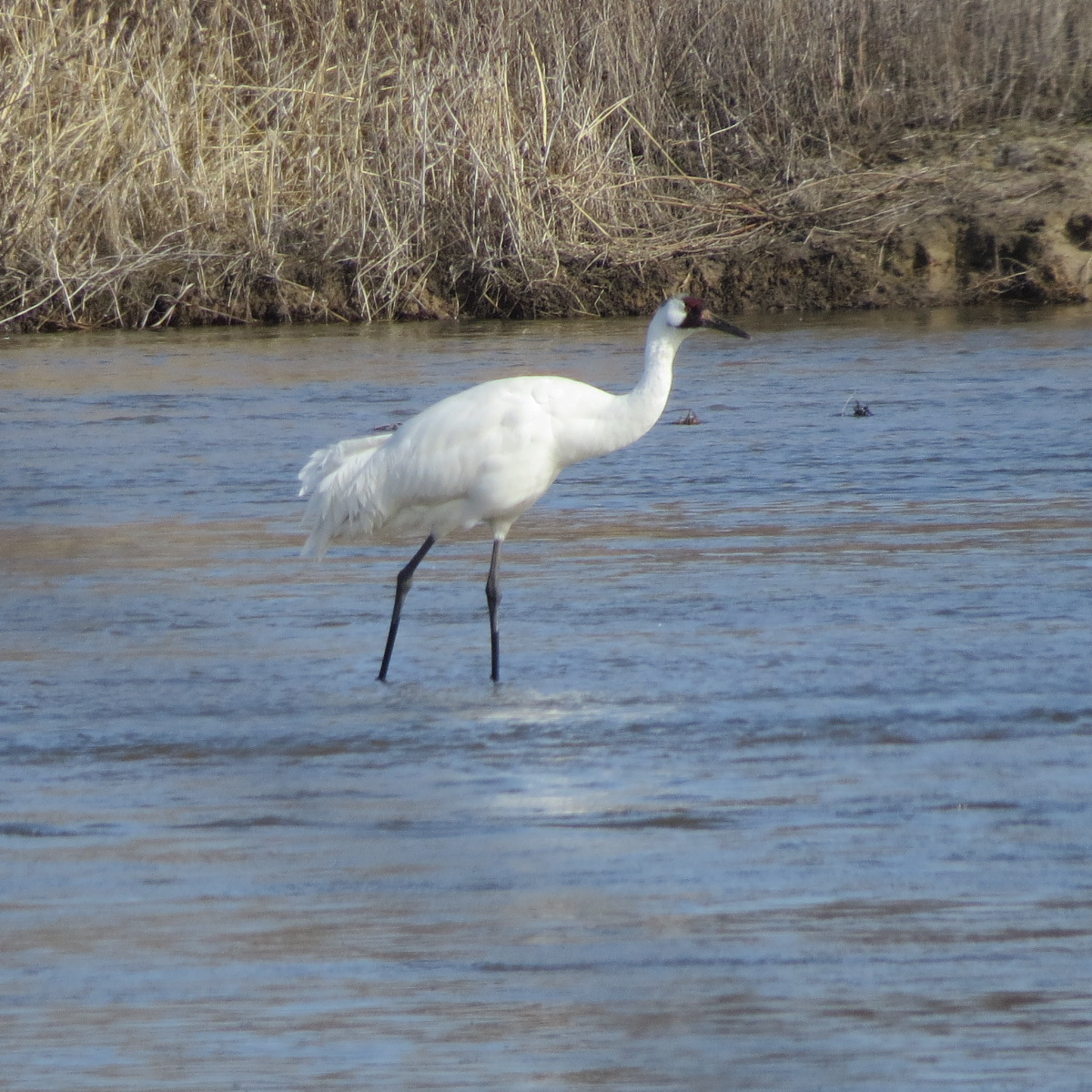
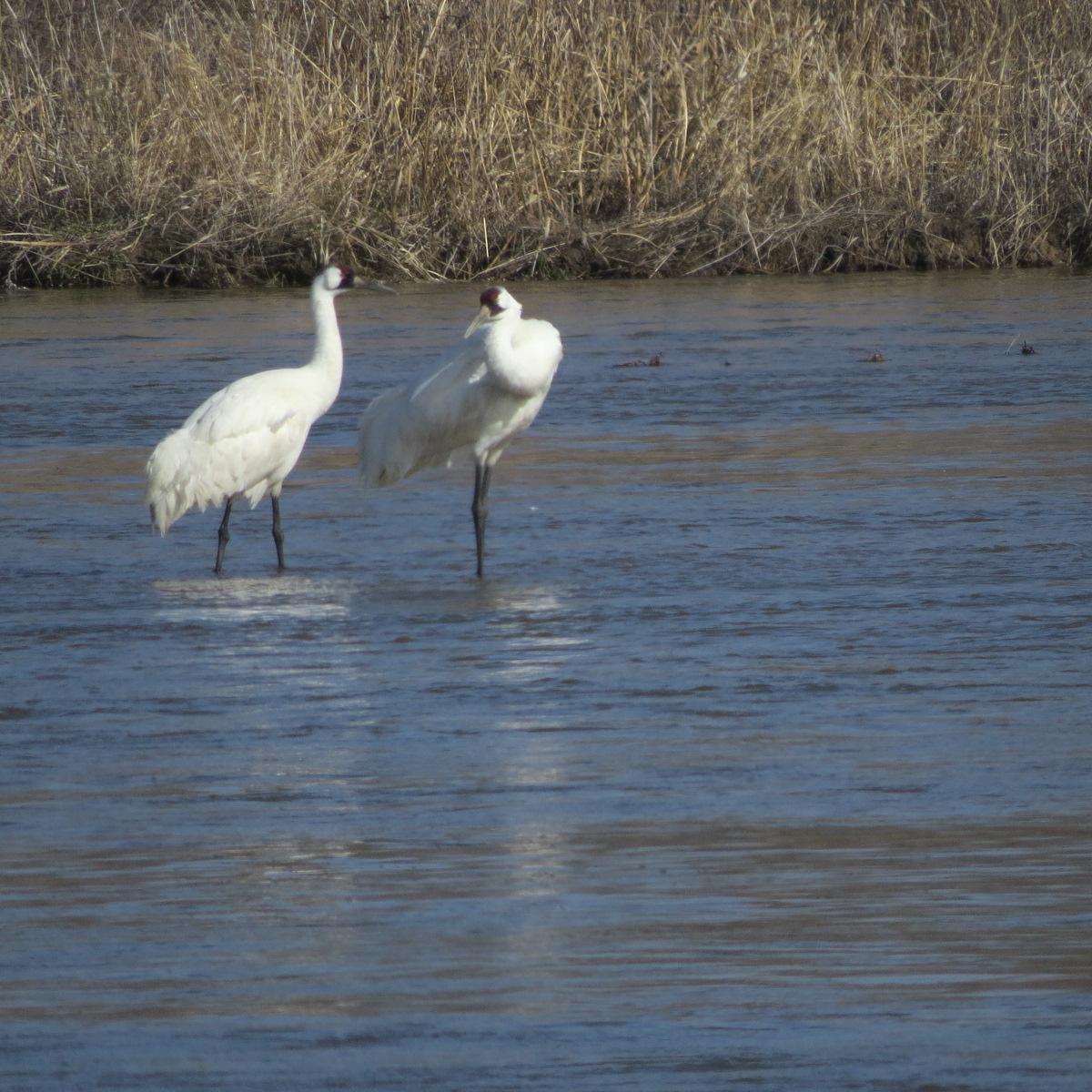
I’m not more than a novice birder, and while I keep a life list, I haven’t updated it since before the pandemic. I have trouble with teals, struggle with sparrows, wonder about warblers, ask about accipiters, and blank out with buteos. More than half of the seven hundred birds on my list I saw overseas as part of a solar eclipse trip. One hundred alone were on a single memorable day in Kruger in 2002. The eclipse was clouded out, but the birding almost made up for it. Almost. I took exactly one formal birding trip in Nebraska in 2007 and saw 98 different species, but the most important lesson I learned that week was that such trips weren’t for me, much as I understand why people take them. After all, I volunteered for a week in late winter for ten years at Rowe Sanctuary in Nebraska in spring, doing everything from cleaning toilets to running the cash register, just so I could be in the viewing blinds twice a day with visitors answering questions about the Sandhill Crane migration in weather ranging from a blizzard to 85 degrees.

I am not disappointed if I don’t see wildlife in the woods. They have their schedule, and I’m only a visitor, probably an unwelcome one at that. But every animal I see is a gift, and this woodpecker made my day. Do I have low standards? Perhaps. But if  I’m easily pleased, that’s a gift, too.

See you on the trail. 

From the Obsidian Bulletin, March 2023