Archive for the ‘UNPUBLISHED OUTDOOR WRITING’ Category

EATING THE ELEPHANT

August 10, 2021

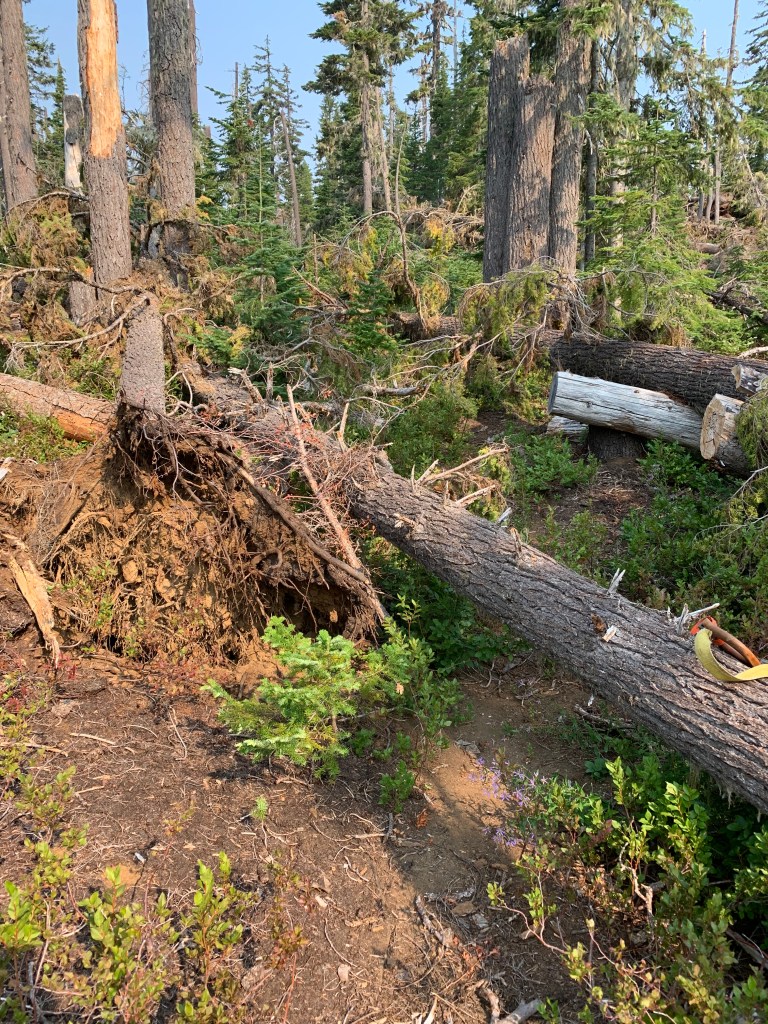
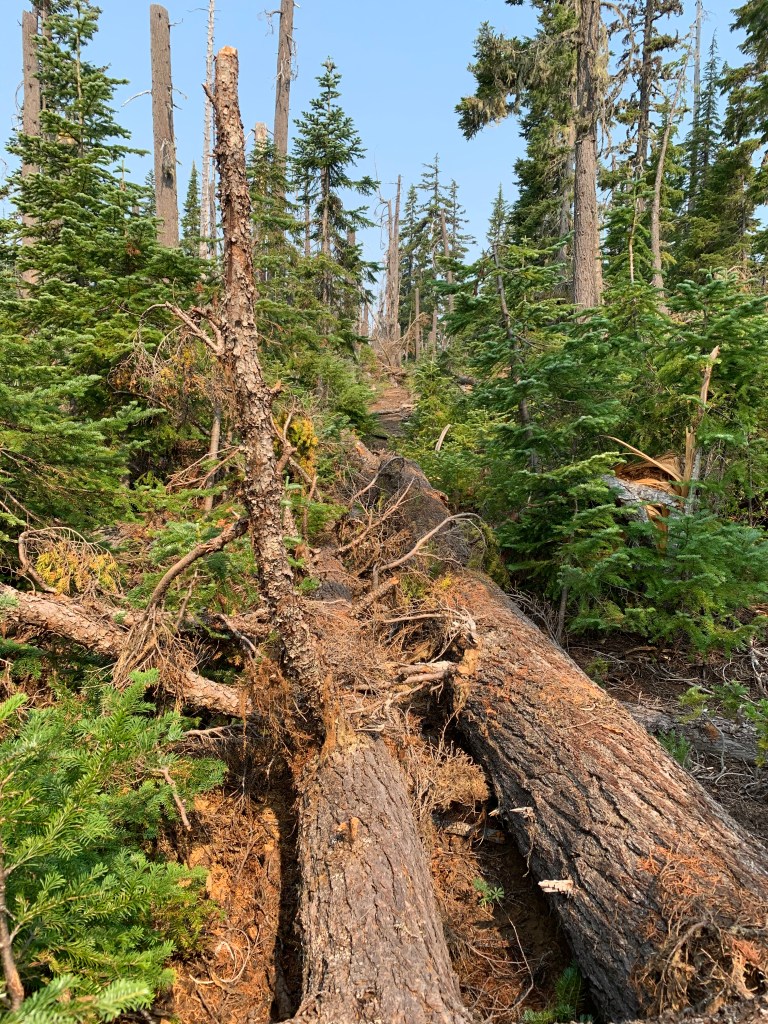
I was the first one there. Oh man, What a mess.  There were three large logs on and over the trail, having fallen in just the right way (or wrong way from our viewpoint) to land directly on the trail, not across it, where we could make two cuts and be done with the log. Nope, one was chest high and over the east side of the trail, there were two on the ground in the middle, and at the south end were two more broken off logs, 15 feet long each. Most call this jumble a jackstraw; when scouting a trail, I referred to it as a “mess,” as I did above.

Several of the logs had branches that in themselves were significant work to remove with a hand saw. While I was waiting for the others to join me, I removed about ten of them.  Nothing could be done without their removal, in order to increase visibility of the log, and get a better idea of how it will behave when cut, and it is something that the first person there can do. Like vacuuming at home, or doing the dishes, one doesn’t announce to the others the completion of the job.  It is assumed someone will do it, and this time the job fell to me.

Working on this area is dangerous in at least two different ways: first, removal of the smaller branches is not major cutting, which means it may be done with less preparation and more unpleasant surprises as results. The second is with all the sharp protrusions, falling can be really nasty. Seeing these on a hike is potentially a hike ender.

Looking at the mess, we all just wanted to bypass it, for this area on the trail has had bad blowdowns for the last three years I know of, and the year before that the Crew spent 8 weeks on the trail and probably some right at this spot.  Last year, I spent three long days clearing the 6 mile trail. 

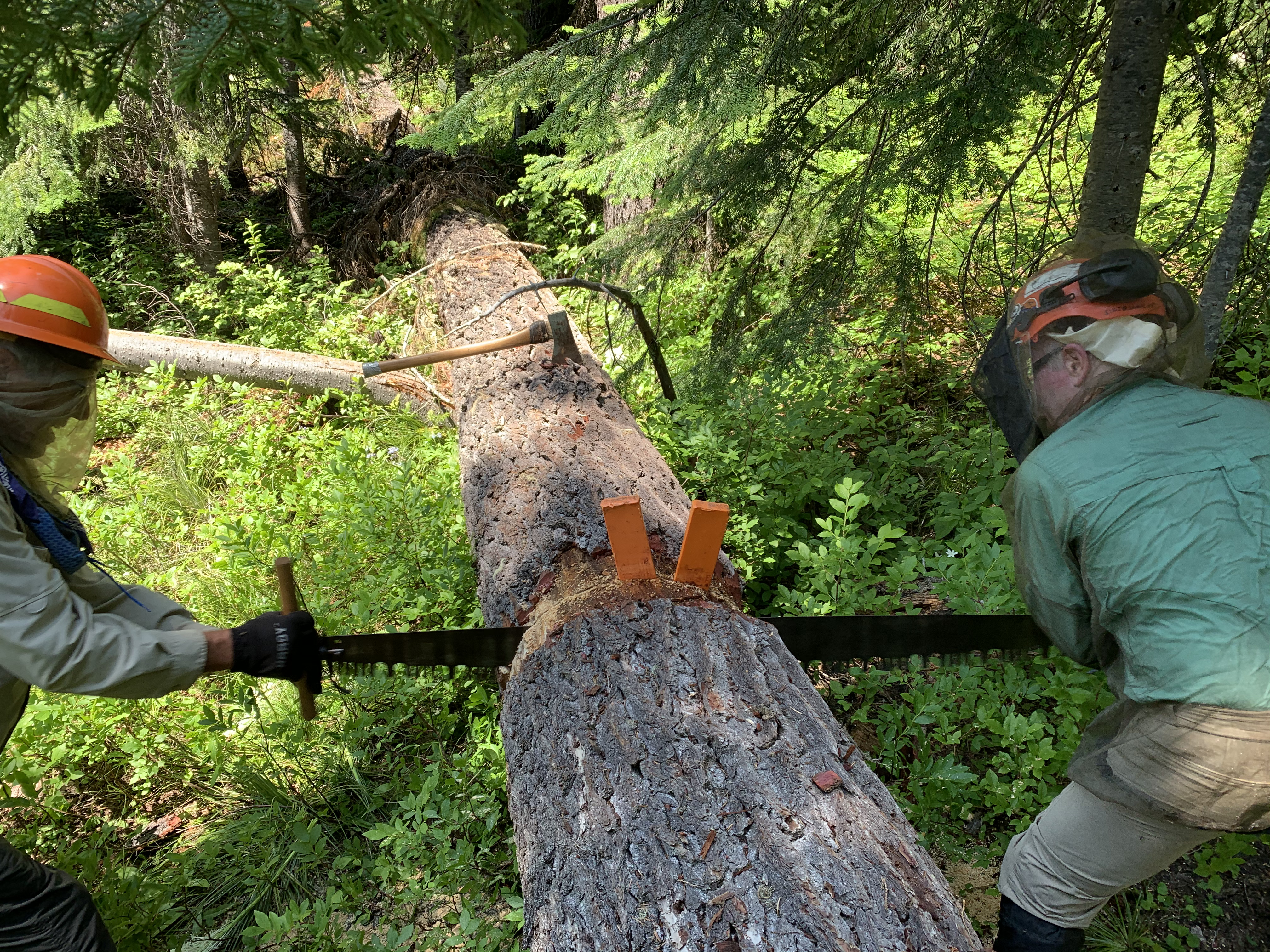
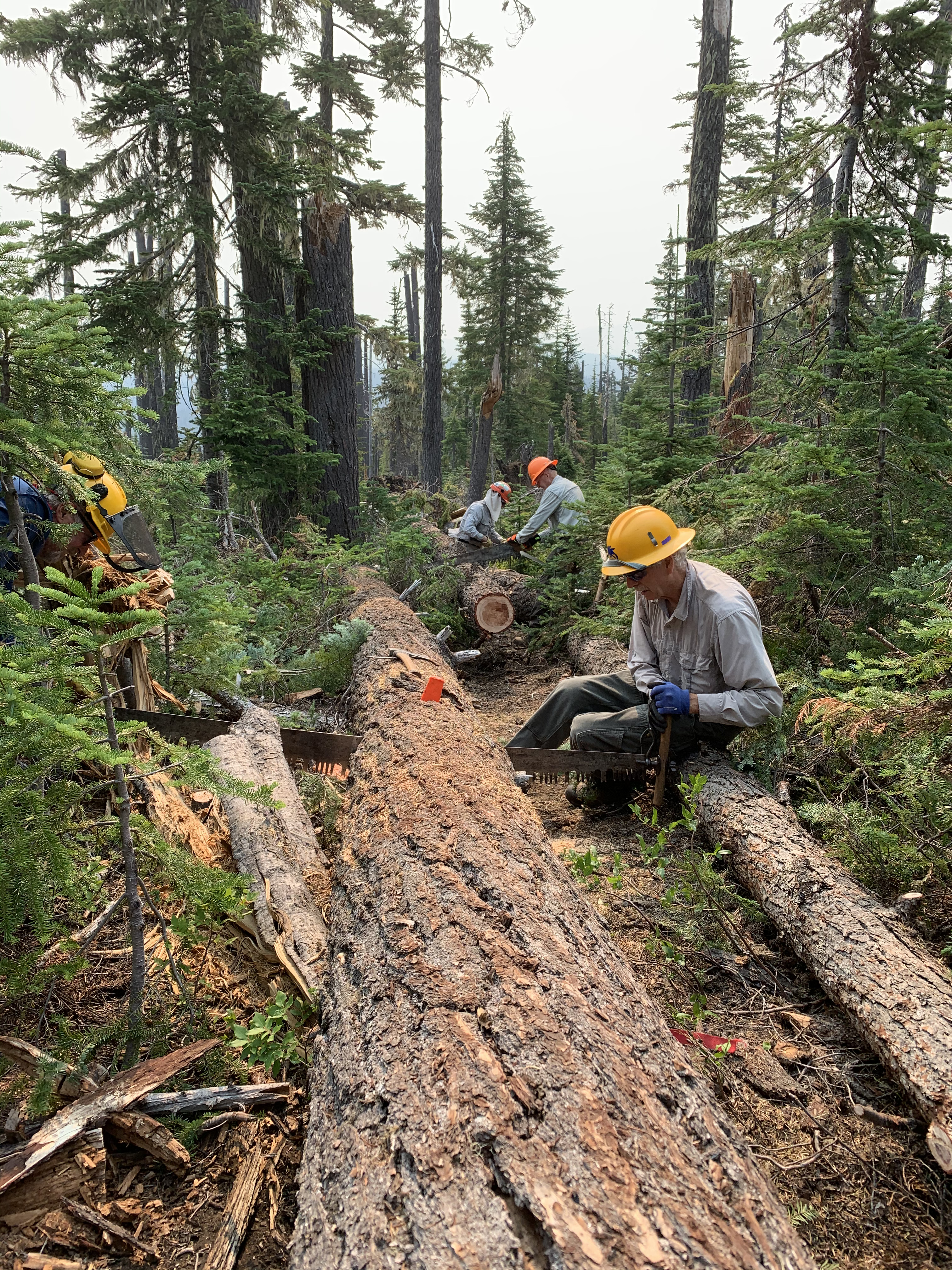
We were 5 and tackled the logs with a plan by splitting the crew in two and working from each end. This increased our production and kept us out of each other’s radius of danger.   Then, it was a matter of starting, focusing on the task ahead, not worrying about how long it was going to take. It would take a while. The day was going to be warm and smoke already present from fires south of us would give over to thunderstorms in the afternoon, but it was hazy already and humid. After hiking in nearly three miles in with full gear, we were plenty warm.  

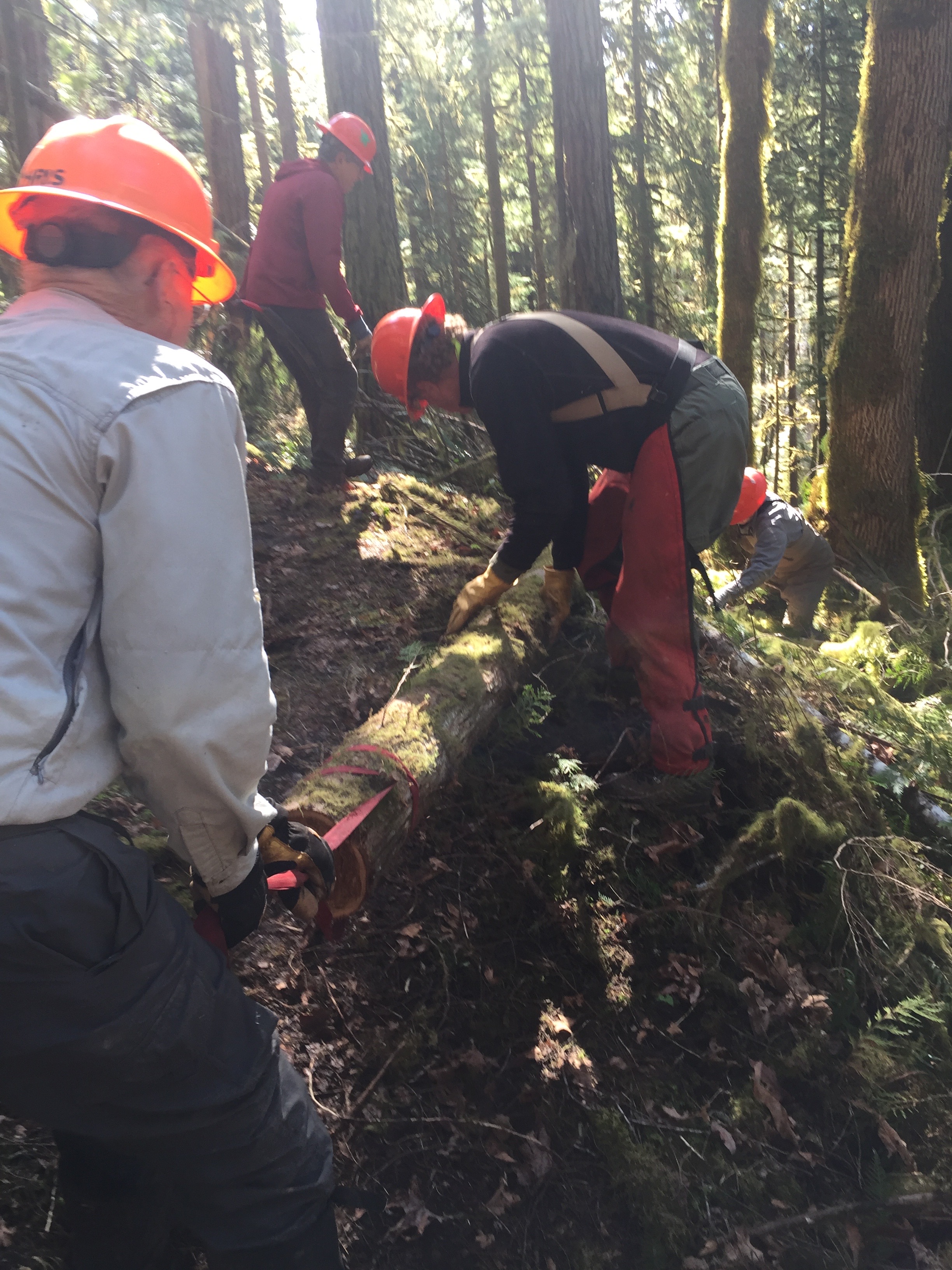
Two other logs were across the trail about ten yards to the south, and they were dealt with by two cuts each. The larger logs parallel to the trail were cut in about 12 foot intervals, enough to be useful and still be manageable to move off the trail, where there was limited room due to thick brush and small trees adjacent.  We used my strap, a cut tree for a pry bar, and three pairs of hands or legs to move everything we cut.  There was a lot of discussion about where we wanted the log to go, what needed to be removed or done, and who would do what.

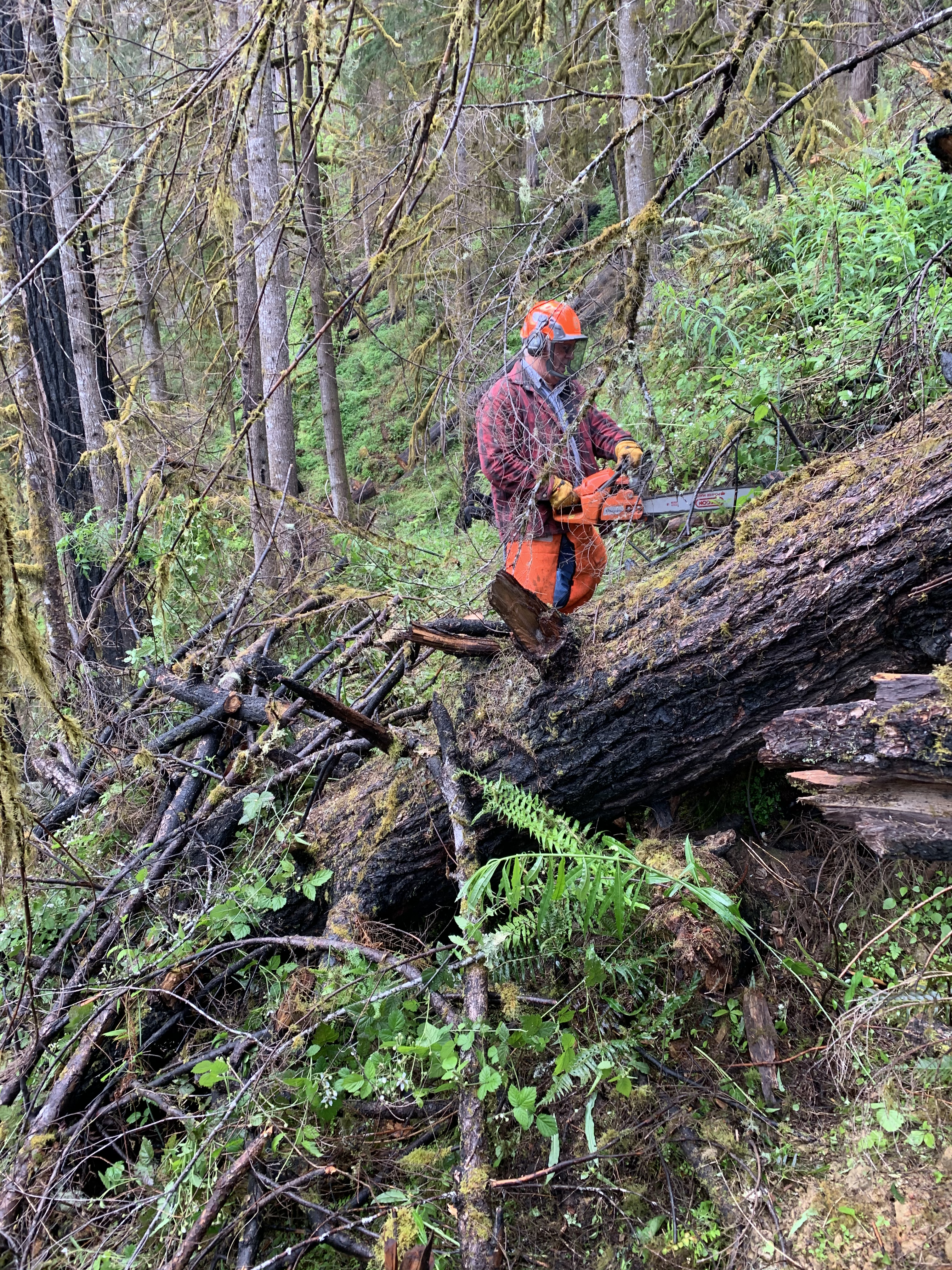
Plenty of work for everybody except the cameraman, who was taking a break. Note the haze.

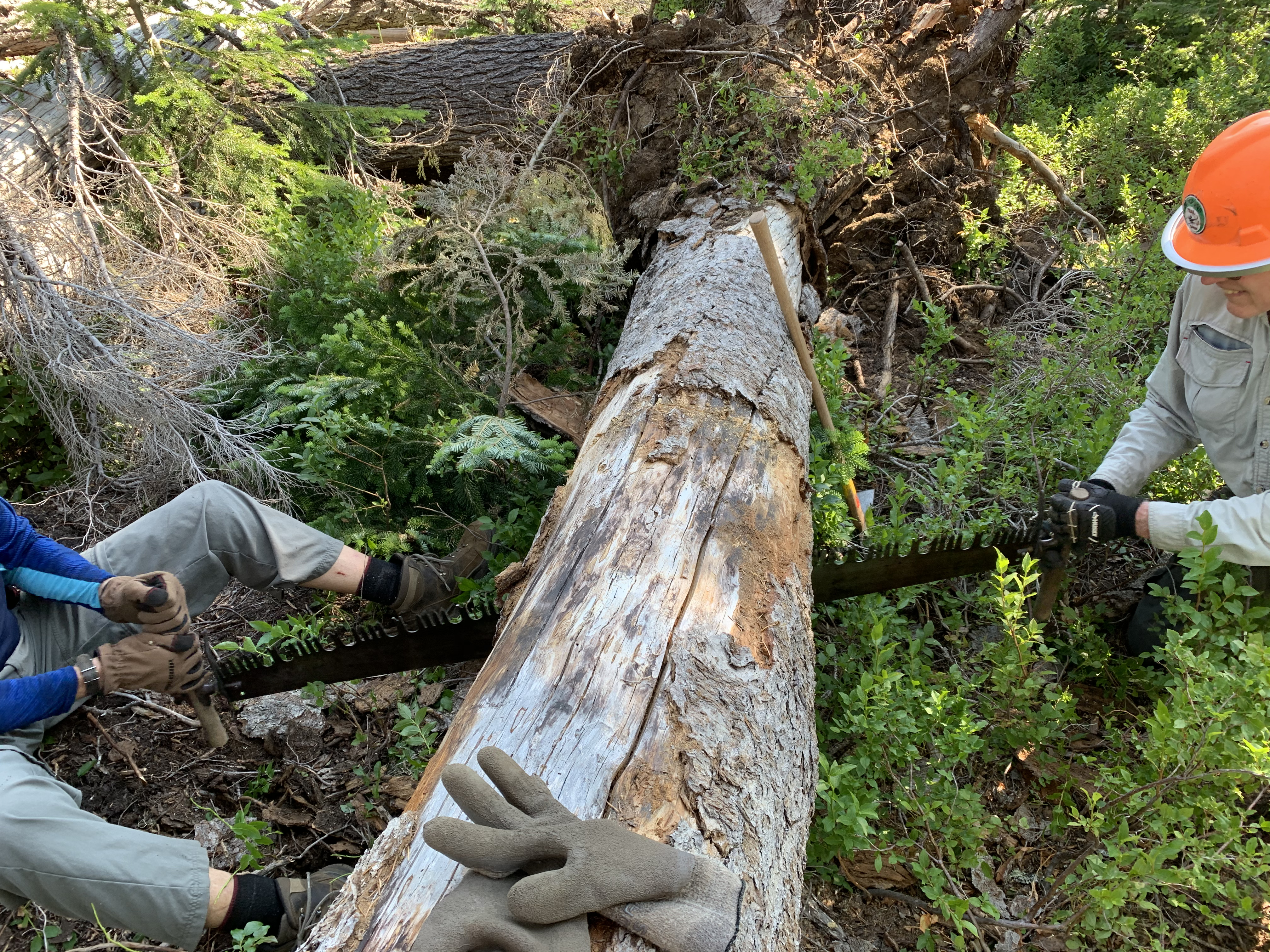
Little by little we had more room, the trail began to be recovered, and we could start to see what needed to go and what could stay.  Fortunately, the logs were green enough to cut easily, and the only problem we had was a log that had cracked. Normally, one would think dealing with a cracked log would be less work, cutting through the crack, but that is a bad idea.  We tried to break the log apart with a Pulaski and ended up with the mass of wood fibers going in several directions, making a cut almost impossible and prying out the wood difficult enough.

Two 12 foot logs that were at the north end of the mess were pushed off rather unceremoniously.  Any way that worked we used, along with several methods that didn’t work.

After a morning’s work, we were left with two more cuts, one to make the trail a little wider, and as that occurred, we decided the second cut, which would do the same, was not necessary.  

Clearing the trail itself required the same philosophy.  There were hundreds of logs down, and each one needed to be evaluated, the cut planned and completed, and the log moved.  The only way to do that was one stroke of the saw at a time, one cut at a time, one log at a time, one bite of the elephant at a time.  Hand Lake Trail is famous for downed logs, because most of it had been burned over in 2010 in the Scott Mountain fire, and after several years, dead trees start falling over with the wind—or without it, for that matter. Every dead tree was a candidate for falling in addition to the live ones that had blown over. We would return here, but we weren’t sure when. Thunderstorms rolled in about 2, so we left, and lightning struck north of us in the Mt. Washington wilderness, starting yet another fire, leading to the closure of the trail the next day.

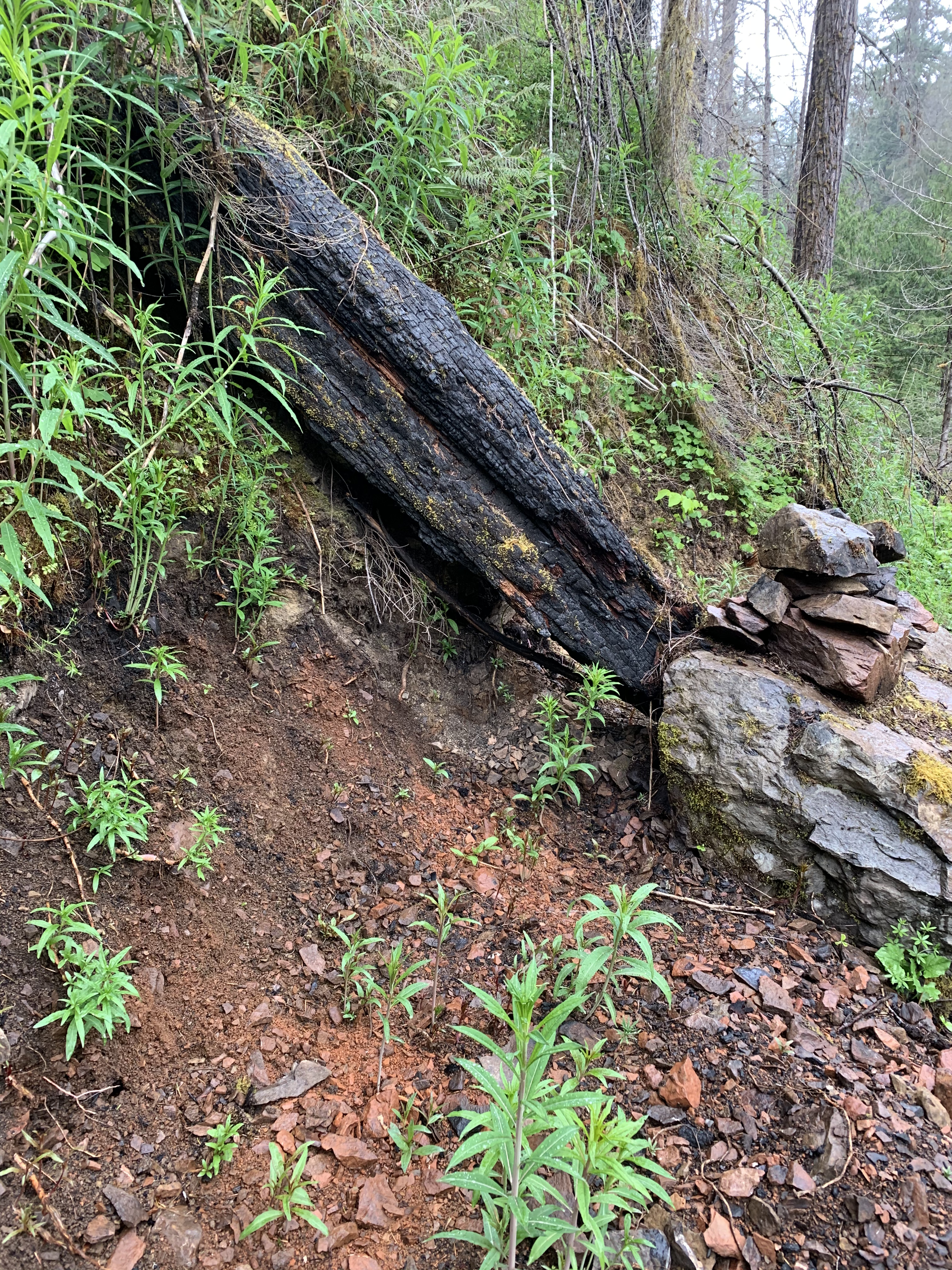
Hand Lake Trail in the burned area, 2020.

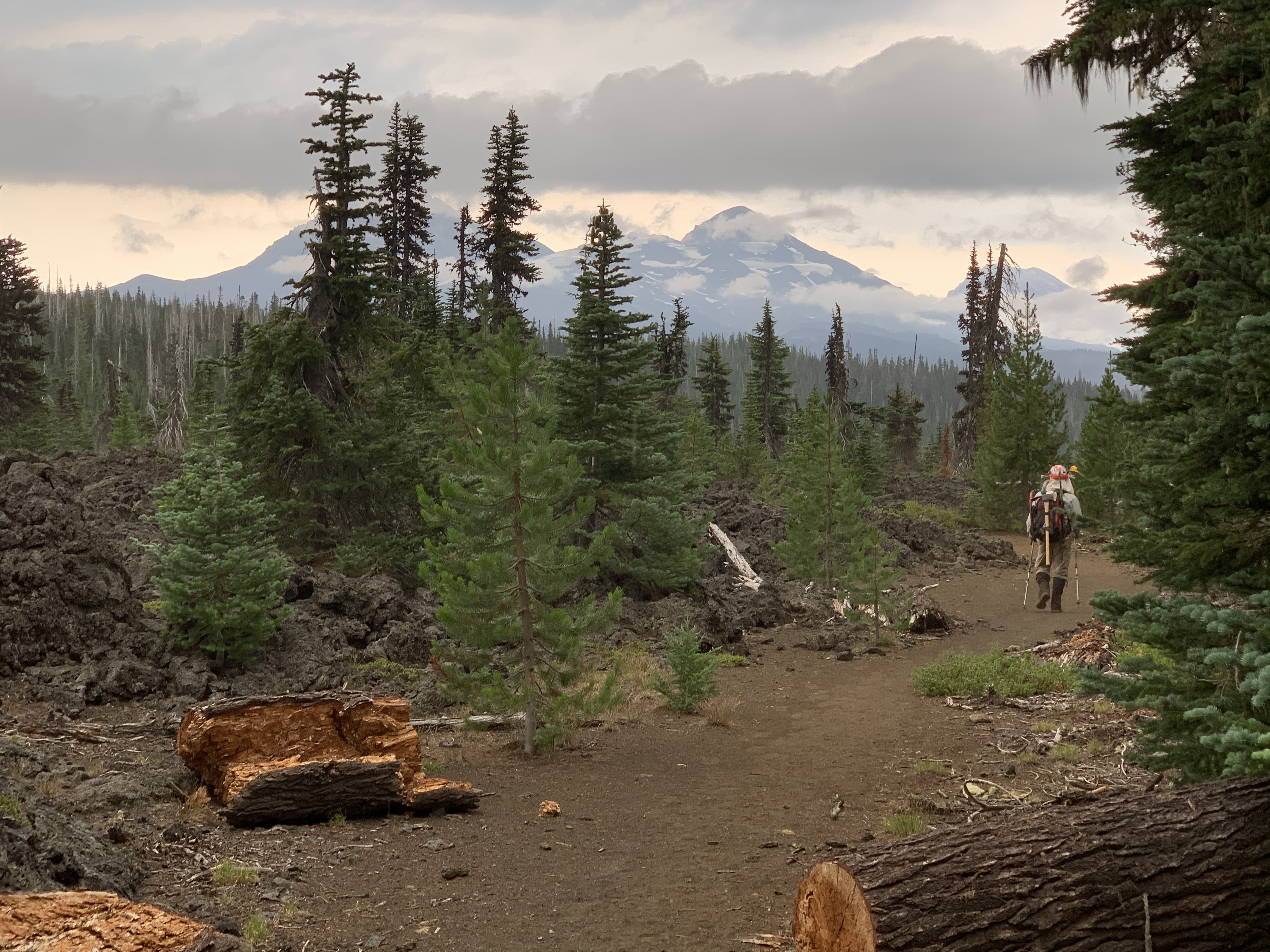
Hiking out of the Mount Washington wilderness. The Three Sisters are in the background, the volcanic debris from 1800 years ago is to the left.

NOT REALLY HELPFUL

July 6, 2021

We encountered the first log, a 300+ year-old tree that had fallen and rotted partly away. It was difficult to go over or around, but someone had cut a notch in the top and two holes on the side for foot placement. We used them to go over the log, deciding we would remove it on the way back.

The Crew leader and I were on a section of the Winberry Divide Trail, not far from Lookout Point  Reservoir, the trail neither long enough nor high enough to attract a lot of use, but it clearly had had some love in years past, judging by the “turnpike” structures where still intact logs denoted an edge of the trail.  Most of the tread was becoming overgrown by Thimbleberry and other big-leafed plants, and we were trying to recover the path that could connect Fall Creek to the north with the reservoir to the south.  

We had split our crew in half; the leader and I were to log out part 3 of the trail, having logged out part 1 a month ago.  We would then retrace and log out part 2 from the top, on which the other two members of the Crew coming up from below using the power brusher.  I hadn’t been sure when I signed up with which group I would be working.  I like swamping or helping for log cutting with power saws, so I can look at the binds and predict what I think the log will do. On the other hand, the Stihl one cylinder 26 cc displacement power brusher with a starter cord can be fun to cut with.  The leader put me with him, and we started up the trail. The recent heat wave had ended, but humid warm air surrounded us.  I was glad I wore a thin shirt.

As we continued, I cleared encroaching brush at eye level, not trying to deal with the mass of thimbleberry that flowed over the trail, since that was better suited for the power brusher.  We soon encountered a second log that had been recently cut. 

Again, not by us.

A little further up were two more cut logs.  Sort of. In between them were two on the ground that were tripping hazards, especially in the thick growth, and the logs that were cut had ends that still extended out over the trail.  It was passable but not adequately logged out. The leader cut out the first log in one place, and I was able to lift and toss it into the blackberry patch near the trail. He trimmed back a second log so it was not over the trail, while with my Corona hand saw I cut out a small 3-inch log, also a hazard, but which had been left behind.  

The leader decided to turn around, figuring most everything would have been cut, if not ideally, and we would head in the opposite direction back to the start, head down Trail 2 from the other end, logging it out and joining up with the power brusher duo.  I suggested we cut out the first log we encountered, which we did over the next half hour with multiple cuts from above, so we could remove smaller chunks before the last remaining large piece.  The rotten wood gave way easily, and we had the trail cleared quickly.

Returning towards the starting point, we removed a pile of overhanging branches near the start of the trail, continuing downhill to link up with the others.

The trail is passable, unless one is tall or on a horse. It’s a lot of work to clear this and more dangerous that one thinks, for branches intertwined with each other often have a lot of force if the tension is suddenly released by a cut. I’ve seen a small branch knock off a hard hat and send a person’s glasses ten yards into the woods. Winberry Divide Trail.

This isn’t the first time we have encountered “rogue cutters,” who often are those who want to go further into the woods and bring their own saws to clear obstructions.  Earlier this year, three crosscut sawyers wanted to log out Gold Point Trail and found it had been already logged out. That’s unfortunate, because the log out was probably with a chain saw, and the top in early season is off limits to chain saws, not because it is in wilderness—it is not— but because of Peregrine Falcon’s nesting on nearby cliffs.

It also meant that a crew carried all their equipment up a couple of thousand vertical feet for naught.  I know that feeling: the year before, I had carried a chain saw to the top of Trestle Falls trail to log out about a dozen downed logs.  I had scouted the trail myself a few weeks earlier. Someone had logged out the trail, and it would have been nice, saved a lot of time and effort—the saw was a heavy load to carry up 700 vertical feet—if they had notified someone what they had done.

Someone like me, who maintains the trail page for the Cascade Volunteers Web site, and would like to have an updated list of trail conditions from competent people, so we don’t scout trails that have previously been scouted, and we don’t send crews to clear trails that have been previously cleared.  We also should not have to finish work that should have been finished, like the clearing of brush at the beginning of the trail, or work that had been started, but not finished.

In 2018, the upper part of Ollallie Mountain Trail was partly logged out and I was with the crew that had not been informed.  We have a problem where some do log-outs in areas where chain saws may not be allowed, where the Forest Service is not aware of work being done, where Workmen’s Comp Laws will not apply, in the name of “Have Saw, will Cut.” Often, the minimum distance to pass is cut, and logs may be left in the middle of the trail, so the work has to be redone—or at least finished.

The leader and I worked our way to a pile of several 16” diameter logs, one of which had been removed, and two others, each of which had two cuts half to two-thirds the way through the log, and no further. Perhaps the saw broke, perhaps they ran out of gas, or perhaps they couldn’t cut further. Ten yards further a log was left in the middle of the trail.  The problem with rogue cutting is people’s leaving logs that also need to be cut, like those at ground level that can be tripped over. Or, as just described and I have seen this earlier in the year, where a log was cut and the round (piece) left, not even pushed off the trail.

We haven’t cut anything yet. This is how we found the logs

This is amateur hour.  Three years ago with a hand saw, I started to cut out a long 4-inch log up on Hardesty Mountain, but just as I began, I suddenly realized the log had some side bind and I hadn’t a clue what might occur when I cut.  I quit, shook my head at my ignorance, walked away and never did that again. Six score days out on the trail with experienced people, I am beginning to approach competence.

The sawyer made the first cut outside the perimeter of the other two cuts, and 15 minutes later, we pushed the last round off the trail and went to deal with the log in the middle of the trail.  He cut it once into two parts, then we sat on the ground and used our combined four legs to push each section into the brush on the side, off the trail.

Log found in the middle of the trail. Sitting down and putting legs on it is far easier than pushing with arms. I have learned, however, that such effort is akin to hiking perhaps a quarter of a half mile, and one does pay for it when hiking out.

For those who want to help: join a crew, and if some logs are beyond one’s ability, leave them—uncut.  But once you start cutting, finish.  Don’t forget to push the round off the trail. That’s part of the job, too.

LUNCH TIME WITH…OR WITHOUT THE CREW

June 28, 2021

A couple of years ago, in winter, I worked widening a trail near Upper Trestle Falls, above Brice Creek in the Umpqua National Forest.  I had significant job constraints: a rock cliff on one side and a 50 foot drop off down the other on the other side, with maybe 4 feet of usable space between.  

Cold day at Upper Trestle Falls

The work was safe enough; I had room to maneuver, could work a little with the Pulaski while standing just below the trail, digging into mud, clearing branches, moving rocks, establishing drainage—all the things that one does with trail work.  I had about 60 feet of trail to work on, and at 11:30, I took a break for lunch.  

Nobody else from the Crew was nearby; they were filling in root wads a half mile back down the trail, trying at least to re-establish the trail, an honorable job I have done as well, but I didn’t see any point in hiking back there for lunch.  A few weeks earlier, on the other side of the ravine, I was again working solo at lunch time, decided to hike back to the Crew to eat, arriving as they were just finishing lunch, and then had to rush mine to rejoin the group. I look forward to lunch all morning; I am a morning person and do my best hiking and trail work early, and lunch in the woods if I am camped out is my favorite meal.  I usually have a protein bar sometime between 9 and 10, a holdover from 30 years ago in the Canoe Country, when doing trail work, I needed extra calories, so I downed a large Hershey bar in mid-morning.  It may not have been healthy, but it really perked me up.  Three decades later, doing trail work, or hiking, I have a mid-morning snack. It’s a little healthier but tastes just as good, and I look forward to it just as much.

At lunch, I get to sit down, take off my hard hat, lie down against my pack if I wish, and relax while I eat my sandwich.  Some of the crew have their lunches made by their spouses. Mine would laugh if I asked her to.  I’ve been making my lunch since I was a latchkey kid, some 65 years ago, and I know exactly what I want, adding a few more calories when I am doing trail work. I do not like being hungry on the job. 

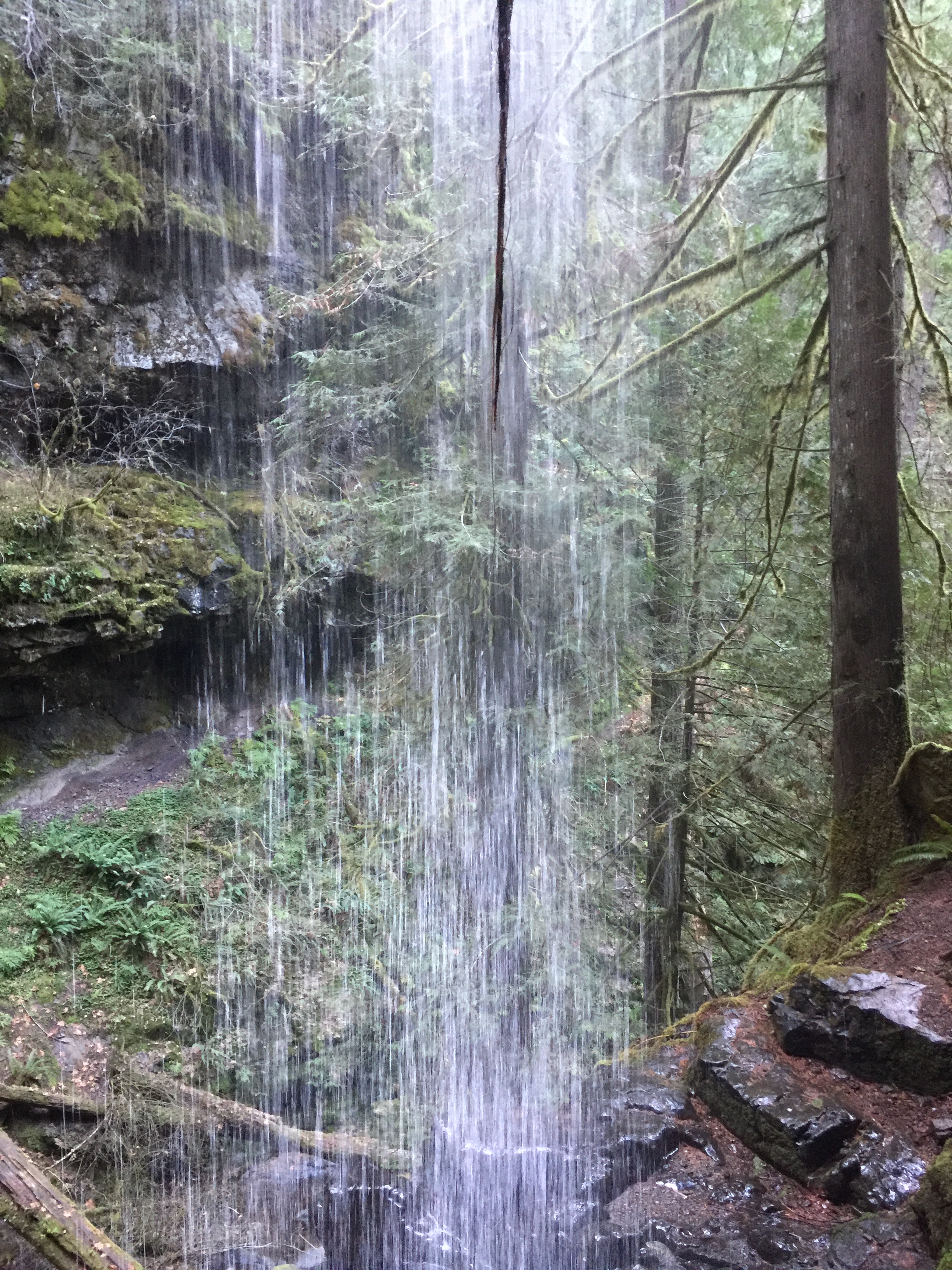
This lunch spot was special. I had a bird’s eye seat at Upper Trestle Falls, and I can stare at water for hours.  I watched the water hit the creek far below and drop towards Brice Creek, then the Coast Fork, the main Willamette, and finally the Columbia before entering the Pacific Ocean. I wasn’t too concerned about the distance the water was going to travel. I was savoring my food, relaxing for the thirty minutes I allotted myself to finish raisins, chocolate, and apple, get a good drink, and steel myself for finishing this part of the trail before going back down and working on a root wad.

Behind the falls, on the trail

Sometimes, I have lunches at overlooks near the trail, other times, it’s just on a nearby log, with a place to put my foam pad and weary body, and stare at the woods across the way.  On Gold Point Trail, I relaxed against the steep backrest of the cliff behind me, staring at a tree that I suddenly noted had at least nine holes drilled in it for various nests, a woodpecker apartment building. You see a lot more in the woods when you can stop and just stare, without specifically looking for something. Trail work gives one plenty of chances to do that. Last week, lunch was near Lillian Falls below us, in lovely shade before we headed off to a remove a series of large logs that would be in bright sunshine, although when I played my cards right, I was able to wrangle the side in the shade to do my cutting. Lunch marks the half way point of the work day, it is the end of the best work I am going to be doing, and I need to pace myself carefully for the rest of the day, both working and for the hike back out of there.  I’ve still got an extra protein bar in the lunch bag; somewhere in the backpack are more calories. They need to be swapped out for something with a more recent expiration date, and I am not sure where they are, other than I know they are in there, along with a small bottle of water that is always good to see when it’s a hot day, and I have been vigorously hydrating.  

I usually don’t talk much during lunch. It’s sort of “Let your victuals close your mouth,” I learned as a kid.  Of course, if I am alone when I eat, that’s easy, but I usually don’t have much to say, so I listen and get a close look at the woods around me.  The nice thing about the Crew is we don’t talk politics.  I’m frankly hard pressed to remember what we talked about at the last lunch.  Maybe nothing. The other guys are just as hungry and tired as I am.  

A month back, on a rainy day at Erma Bell Lakes, I sat down in the woods in a relatively dry spot. I took off my hard hat and put on a wool hat that I had fortunately remembered to bring along. It was chilly, about 50, but I was fine until about 15 minutes into lunch, when I began feeling cold.  I cut the time short, got up, changed my gloves to dry ones, shivered a little it, and followed the rest of the guys down the trail to the next log. Lunch was necessary, but movement was more so, and I wouldn’t be warm again for an hour and three more logs cut out. 

Right after lunch on the Erma Bell Lakes trail

Half hour passed, time to get up, get the stiffness out of me, and get back to work.  Want people to have a good experience on this trail.

Working on a root wad in the rain in December, an honorable way to spend the day.
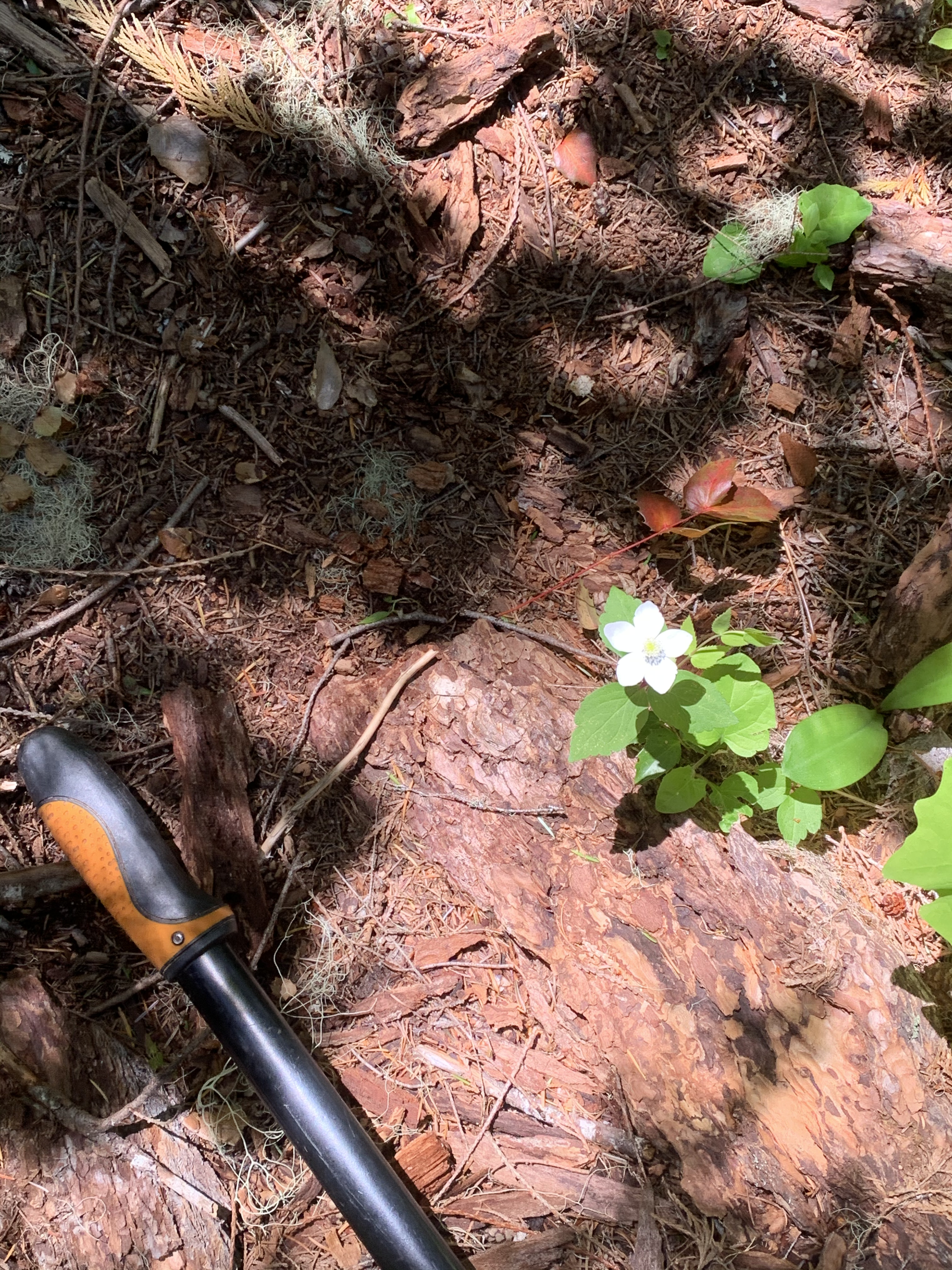
Oregon Anemone near Lillian Falls
Lunch spot at Vivian Lake, Diamond Peak Wilderness

TURNING AROUND IS UNDERRATED

May 30, 2021

I realized at 1:30 pm that we were over 3 miles from the trailhead with all our work gear and still going further away. We had to hike out at some point and drive home, making for a long day, and I was beginning to think I needed to say something to the crew leader.  Some leaders have a good sense of time on trail; others seem to be able to work non-stop all day. I ran into both kinds in medicine, too, and the group with whom I practiced was full of the latter, which is one reason why I ultimately left. I’ll admit it; I get tired, I get hungry, and I can’t go-go-go for 12 hours.

The four of us had done good work, cutting out two dozen blowdowns on the trail to the west side of the Erma Bell Lakes, a trio of lakes in a beautiful forest due north of Waldo Lake. But it had been rainy, temperature in the upper 40s, and at lunch I had cooled down. My wet gloves did not help.  I was saving the dry ones for later.  I at least brought a wool hat to use during lunch, but I had the hard hat back on, and cutting out two small logs had only slightly warmed me up.

We ascended another 100 vertical feet into snow patches and at a trail junction held a powwow. It was obvious the loop the leader wanted to do was out of the question, but he wanted to go on to a second junction with the trail up the east side of the Erma Bells.  I committed to the 0.8 miles to the junction and hoped to arrive no later than 2.  

Logs like this that fall along the trail often require multiple cuts. Between Middle and Lower Erma Bell Lakes, Three Sisters Wilderness,
May 2021. Once the second cut was made, the four of us pushed the log (600-800 pounds) to one side of the trail using our legs.

Within 200 yards, we had encountered more snow and another blowdown. This section was going to take longer than 30 minutes.  One of the others, Sig, and I cut out the obstruction and pushed it with our legs off the trail into the snow. He commented to me that walking in snow was going to slow us down.  I thought that it would also cool our feet, which isn’t what I wanted, especially since they were finally warm.

About an eighth of a mile from the junction, I started walking on snow the whole time. The other two members of the crew stopped and said they wanted to go on to the junction and up the east side back to the vehicles.  I didn’t want to do that. I didn’t know the trail, there would be snow for at least the next half mile or even more (I would later learn the trail would remain at the snow level for about a mile and a half), and unknown numbers of blowdowns would be an issue.  They would scout the trail, but that would slow them down even more. This was a long day, I was tired, and warmth required me to keep moving–preferably towards the trailhead.

I was concerned when the leader said his GPS had us at 6 miles in. Mine said 3.8, and a sign I had read at the beginning said our hoped destination was 4.5 miles. My GPS, map, and sense all confirmed each other. He was operating with a faulty GPS.  Since we wouldn’t finish the trail, I suggested we come back another day and log out the eastern side of the trail and the far southern end of the loop.  That was thought to be reasonable, but we ended up going our separate ways, Sig and I back the way we came; the other two’s continuing on around.

They were experienced and good hikers, but it was late in the day and they were tired, too, whether or not they appreciated it.  I was back at the car in an hour and a half, Sig a few minutes later. We knew the trail, we knew it was clear.  He was going to wait for them; as assistant crew leader, he let me leave.  By then, I was warm, mostly dry, and just tired, but not unduly so.

My decision was right and smart.  The other two, who knew the trail, were in good shape and did not have any problems. We each made our choices.  They did encounter deep snow and at least 40 various sized blowdowns. I would not have enjoyed dealing with that.

I’m not afraid of turning around. I did it on the hike to Young’s Rock a few years ago when I encountered a huge blowdown with drop-offs on one side and a cliff on the other, all snow-covered. I looked at all options to go over it and finally decided to turn around and head back.  It was a good decision. One day this past winter on snowshoes, I turned around and retraced my steps, not finishing a loop. That was the right decision, too. Only twice can I remember stopping and checking the situation before deciding to continue. Once was my first hike on Obsidian Loop, when I was in a snow field and actually took a few steps back before turning around and going on. I had a GPS for the first time and realized I could have my track traced rather than turn on the instrument and see where I was. I had a tough hike, six consecutive miles off (but near) the trail, but I completed the loop—without snowshoes. It was a great hike but not the smartest thing I have done.

Blowdowns blocking the route, Young’s Rock Willamette NF, April 2016. My walking stick is about 1.3 m in length. The log was cut out about a month later.
Small Lake on Obsidian Loop (7000′ or 2100 m.), where I was probably the first to see it that season. Getting away with something doesn’t mean it was safe. Obsidian Loop, July 3, 2014.

The second was doing Duffy Loop, which the map said was 19 miles but was actually 23.1.  At 8 miles, I realized the GPS was either over-reading the mileage or the map was wrong. I sat and decided what to do and decided to continue. It was a long day. I had lunch at the 13 mile mark in a nice woods and watched my water carefully.  The problem with that approach is that water needs to be drunk, not conserved, on a hot day.  The west side of the loop back to the main trail was in an old burn and had blowdowns and no shade. I got back to the car where fortunately I had water and drank heavily.

I should have turned around.  The other mistake I made was not to stop and drink out of a stream. I risked giardia, but it would not have been dumb.  Now I add a water purifier to my pack along with chlorine tablets.  

I don’t regret the times I turned around. Either I didn’t have the legs that day, I had a bad map, or trail conditions were worse than expected.  Trail not yet walked is seldom flat with no obstructions. There are instances where feeling like one has to do the distance is akin to summit fever of mountaineers. I have endurance, but I am old and have nothing to prove and a lot to hurt.

I’ve been accused of being too analytical and neither enjoying the hike nor the view.  When I am in the woods, I do monitor myself, the GPS, the map, the sky, and the conditions. I can’t exclude the possibility of an unexpected medical problem, but that’s what InReach is for.  I can exclude as much as possible getting lost or in over my head.  I know many in Search and Rescue. I don’t want to have them go out there to rescue me from my own sins.

For the record, I identify wildflowers, birds, and can describe the trail a year later. I also know whether I want to do the hike again. Obsidian Loop I’ve hiked 11 times; Duffy Loop I will never hike again.

THE ROCK AND THE FLOWERS

May 22, 2021

So THAT was the rock Jim was talking about, around which he wanted me to dig out, because the trail would be safer behind the rock than the foot wide passage on the creek side, where a misstep would lead to a nasty fall.  There was a 10 foot formerly burned log on the adjacent hill that dived into the soil by the rock. What was I going to dig out?  The log was in the way, and nobody could go under it. 

The Rock

I had a Rogue hoe with me, not quite as good as a Pulaski for serious digging, but good enough in the soft soil of Fall Creek. I easily dug out what I could then stopped to think about the whole matter.

The Crew was restoring Fall Creek Trail, a national historic trail supported financially by some retired Forest Service employees and volunteers like us, who drove there on our own dime, with our own tools, and worked on our own time. On a somewhat drizzly morning, six of us crossed Fall Creek on a wet log well above the water.  I had been over this log a week before under dry conditions; this time I crossed crawling.  It didn’t help the previous night I awoke with a premonition I was going to fall off the log. I didn’t feel safe standing, and besides, I had knee pads. I crossed without incident.

Crossing the creek.

We hiked uphill a quarter mile, where we had logged out the week before, repaired several hundred feet of tread and began work from where we had left off.  I was sent to “swamp” (help) a crew member with a chain saw, so he could log out everything beyond to where the trail reached its highest point.  Once we did that, my job was then to descend to the creek and take care of rerouting around the rock and to repair a small piece of the trail that I had left several weeks earlier. I had been upset with myself about not having done more than place a small log with some rocks at the edge. The trail was not quite a foot wide, twice that or a bit more would be much more safe.   

The sawyer trimming before cutting the log. This would take three cuts plus a lot of smaller brush removal.

It was an easy hike down, I found the spot that needed widening, and a few yards later saw the rock and the log.  If I could deal with the rock, I could have lunch and then deal with the easier matter of widening the trail. But how?  I pushed on the log, and it at least gave a slight bit of motion.  I climbed up the steep, soft slope, grabbed some grass and put my legs into the log.  Not much happened, but I felt a little give.  

I returned to my pack and took all three saws I had, a small hand saw, a 14” hand saw, and my Katana Boy 500 mm saw.  I also took the thick cloth tape I had out of my pack, a wedge, and took another look at the bottom of the log.  I couldn’t cut out too far above it, because the whole log would come down on me.  But I could cut near the rock, so I began with the Katana Boy, finding it good for a while before it bound up.  I then switched to the 14” saw, finding some of the log rotten and easily flaked off. I stuck the wedge in and pried, removing more material.  I finally cut through, and the log shifted downward a couple of inches. 

That was encouraging, and I went up the bank and pushed some more.  The log moved a little, but not much.  I cut more off the bottom, tried pushing, and did it again.  Each time, the log shifted a little. I finally went up the bank and pushed, this time actually moving the log out of the depression it had formed. There was another burned out branch from a log that was holding up progress, so I removed that, too.  I pushed some more, and the log shifted about ten degrees. Now it had to be removed or marked as a hazard with colored tape, announcing to the world the person who had caused this was a rookie.  Couldn’t have that happen.

So, I pushed hard, and the log finally paid the gravity bill, slowly rolling off the hill to the trail, then bouncing off the trail, rolling down almost 100 feet to the creek.  All that remained was to clean up the soil that came down.  The bypass would be fine, and I was pleased with my result.  

Rock without the log with a bit more cleanup to do.

I ate lunch, listening occasionally to the chain sawyer working on logs back up the hill.  I don’t set out to eat lunch alone on trail crews, but frequently I end up in places where I do.  The creek was beautiful, the light rain more than welcome, and I had a big part of my job finished.

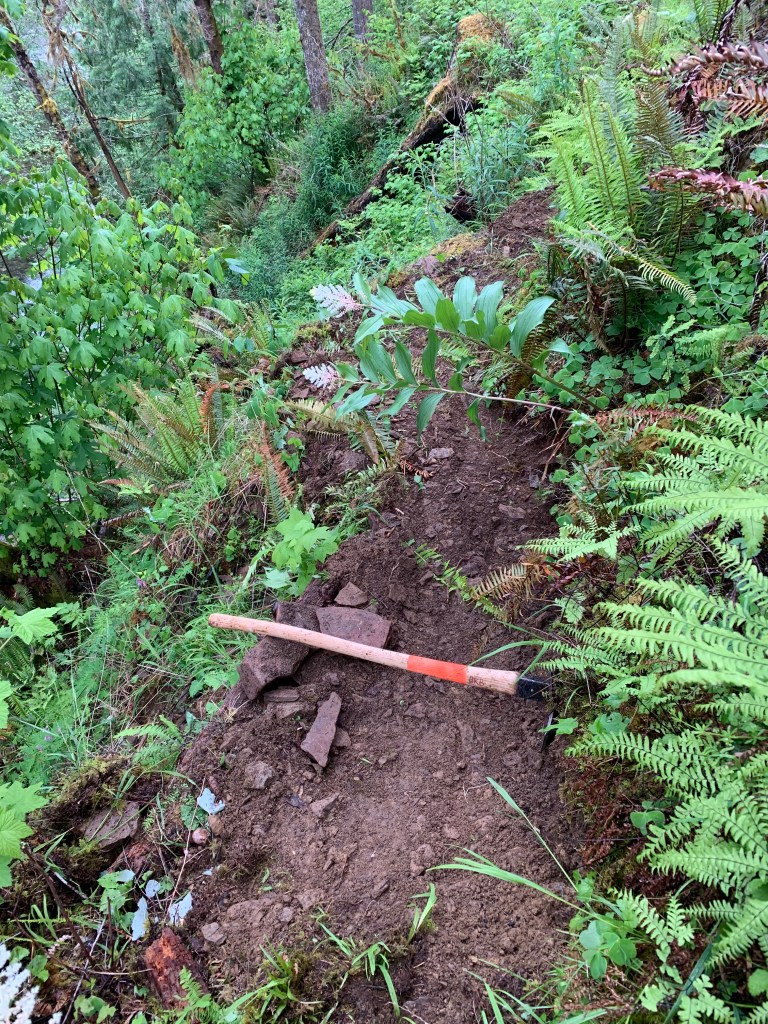
I then started widening the trail, working below the edge of the trail standing on loose soil, my knees anchored at the edge. With the hoe, I pulled plant material off the inner or “strong” side of the trail, easily getting into subsoil or mineral soil, which we wanted to have on the trail. The width was just over a foot, with places where erosion could easily destroy the whole trail.  I dug up small and large rocks, placing some at the “weak” or outer edge, piling the dirt at the edge and some of the grassy clumps as well, which retained their soil and I hoped would transplant. 

I was limited by large rocks on the inner aspect of the trail, which I couldn’t remove.  I also noted two lovely False Solomon’s seal plants in full bloom, right above the narrowest part of the trail.  Normally, we cut out plants; the ubiquitous Sword ferns were cut off along with Maiden Hair ferns with their black stems. They grow back quickly enough. There was a carpet of moss, too, which I hated to pull up, but I did and tried to place it on wet soil.

But I wouldn’t cut out the False Solomon’s seals.  They were the nicest I have ever seen.  So I let them hang over the trail, after photographing them and smelling the gentle, sweet smell they have. In a few weeks, they will have gone to seed and hopefully have spread their genes elsewhere.  Some time next year, we can come by with a power brusher and remove the dead stems and maybe see several big new plants.

I was finished here. The trail was wider, the bypass around the rock more than adequate, and the False Solomon’s seals saved.  When I told Jim that I had moved the log out of the way, neither embellishing my actions nor discussing the flowers, he just looked at me, nodded, and said, “Good.”

THIRD BRIDGE

March 31, 2021

We had a short hike to the third failed bridge on the North Fork of the Middle Fork of the Willamette River, a Wild and Scenic River that runs from Waldo Lake to Westfir, Oregon, where it empties into the Middle Fork of the Willamette. It had rained on the way to the trailhead, but the rain had stopped, and the five of us were ready to deal with what we thought would be the easiest of the three failed bridges we were tasked to totally decommission.  I had looked forward to the day, remembering a short hike, a smaller bridge, spending a short time there, and then we would have removed all the failed bridges.

The hike was not as easy or as short as I remembered, uphill from the start, trail muddy and slick, my pack, including an electric reciprocating DeWalt saw and a battery, a Pulaski in my right hand, meant I was carrying 30-40 pounds going uphill.  I had hiked to the top of Spencer Butte in Eugene the day before, and my legs reminded me that every step.

We arrived at the bridge, which looked the way I had remembered it two months earlier. It was angled down to the stream in a V, a good 20 degree angle going down and 30 degrees going up the other side. A big log lay on the far side. 

The bridge. Notice what happens to the green on the right side, across the stream.

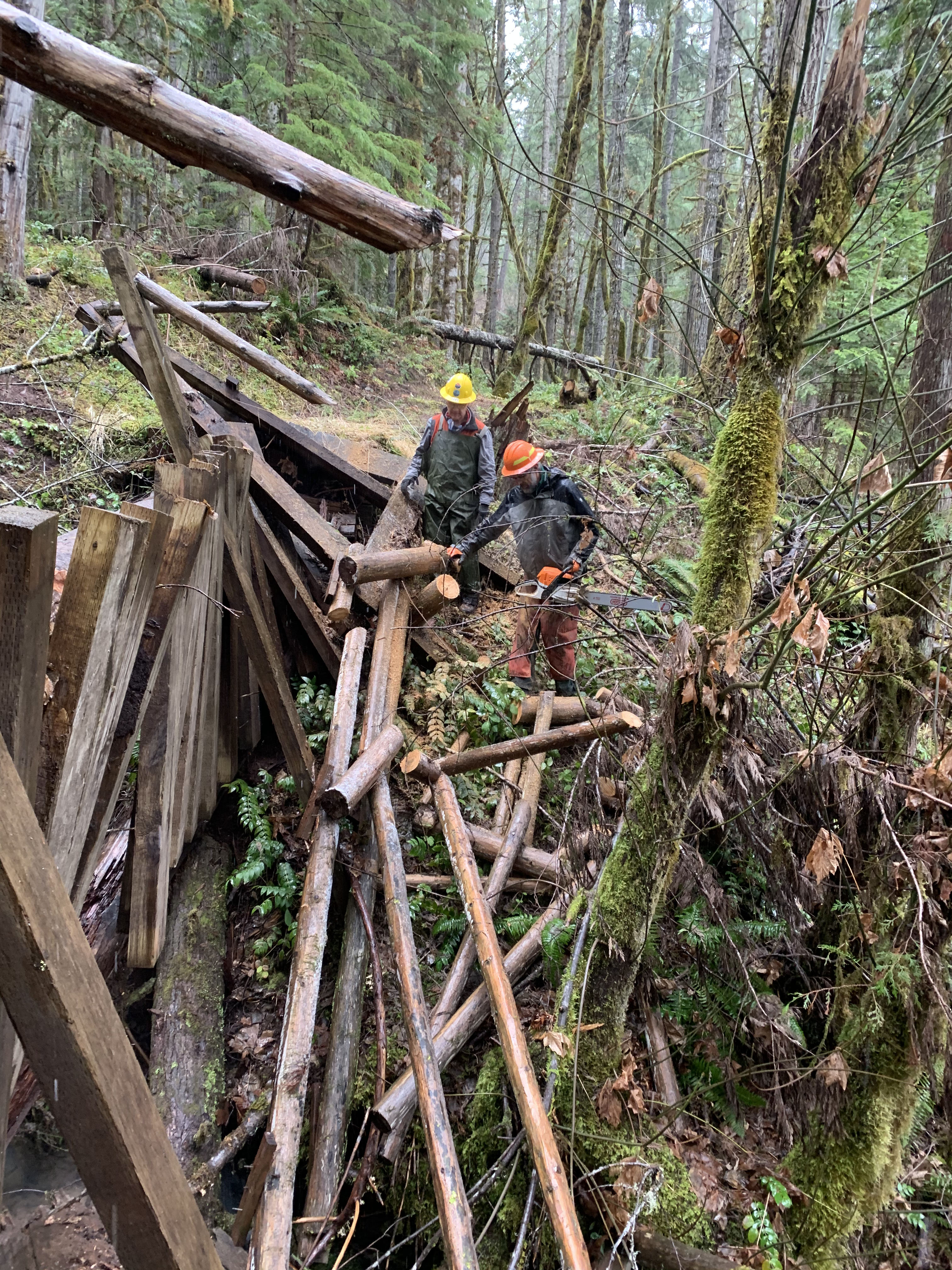
Having decided to work on the far side, I crossed the bridge, holding the wooden rail that we would soon cut off, being careful not to slip. The rails were then removed with a chain saw, falling into the creek. The log on the far side was removed and slid into the creek. There were about 70 planks remaining that needed to be removed.  These were chemically treated and we wanted to keep them out of the river. Each was nailed into large 24-30 inch diameter stringer logs below using 8 inch helical nails, meant for staying.  That meant also that they would resist being removed. 

By us.  Five to six nails per plank.  Do the math.

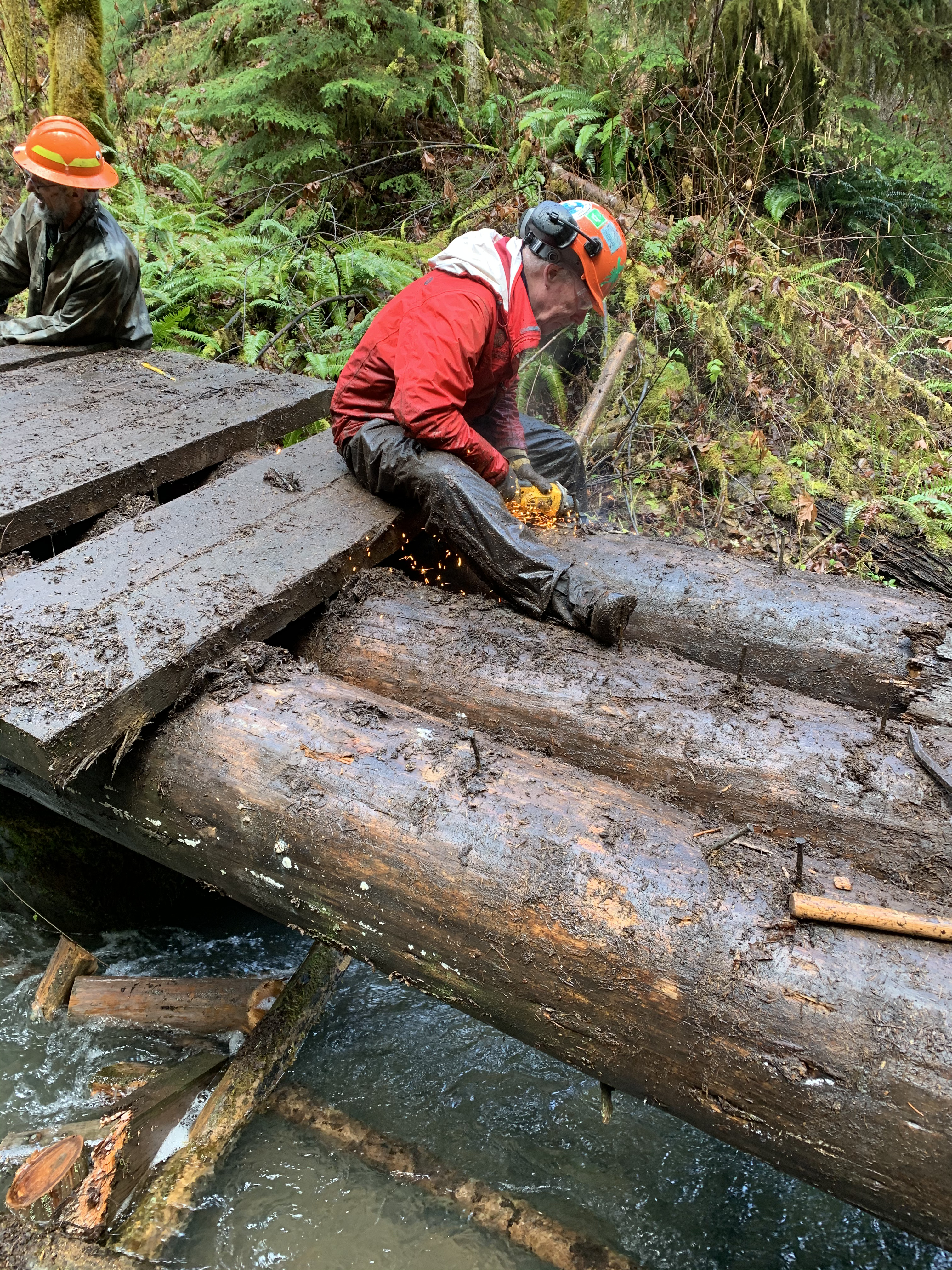
The crew leader told us to pace ourselves, and I took that to heart.  The rain had started again, although I only noticed it by seeing drops splashing into puddles. Wearing a hard hat has advantages.  The planks were attacked by the other four with pry bars and crow bars to try to loosen the nails.  The first few planks were removed easily with the nails in them. My job was to cut the nails out with a grinder, rather than trying to knock them out with a small sledge hammer.  The grinder worked well, the nails smoked, then bent, so I could then remove the molten end and stack it on a nearby log, where we would later collect and remove them.

Crew member grinding off the visible nail on a stringer, stream below.

For the first few planks, I just had to move them a few yards on level ground to where I was stacking them, using the long nails as handles.  When I had the plank in the stack, I cut off the nails, then went to the next plank, which began to become further downhill from me, as the crew continued working.  The ground was getting progressively muddier.

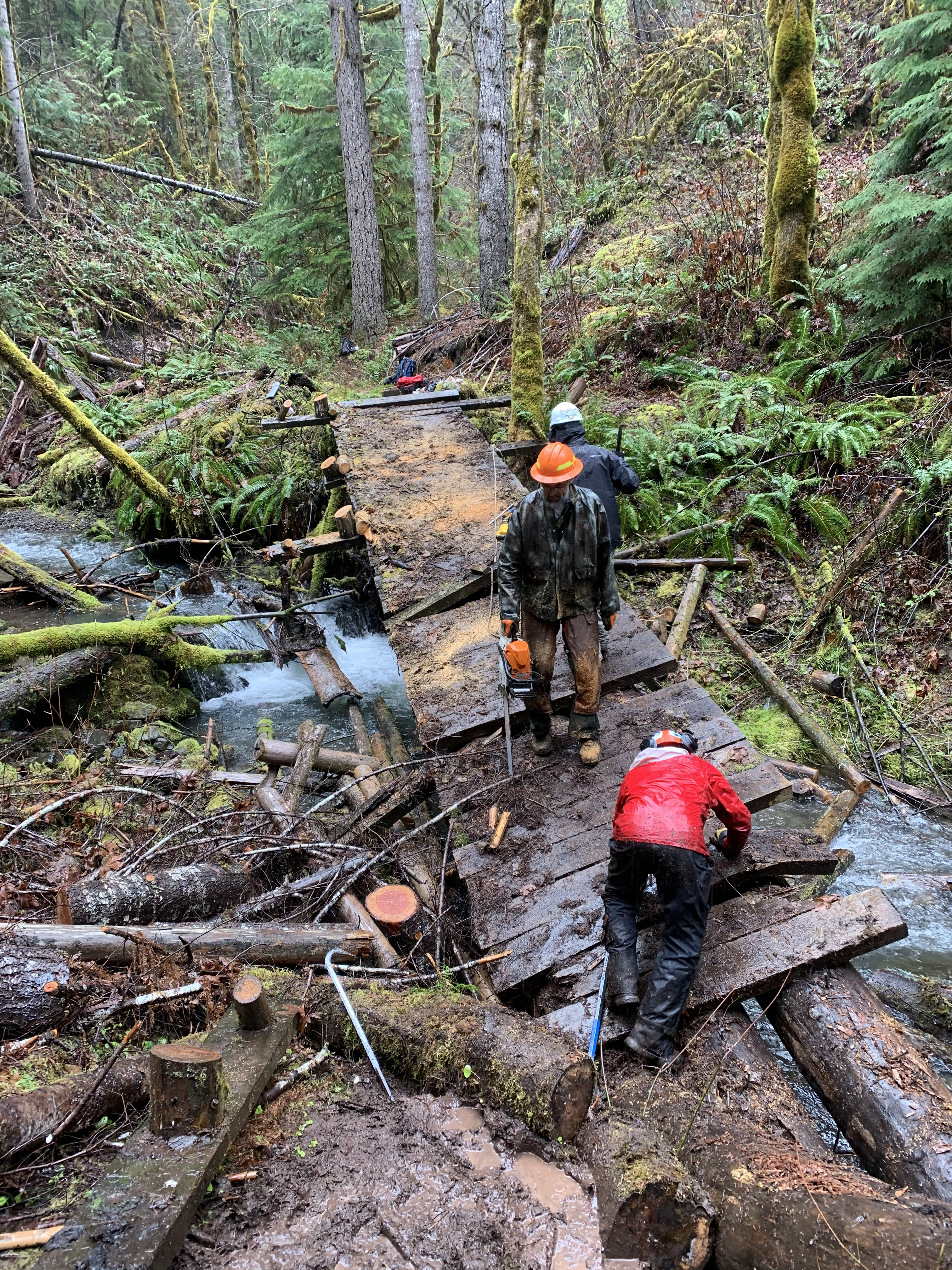
About forty planks remaining.

While some of the guys could pick up a plank and actually throw it, it was all I could do to pick one up; throwing was impossible.  I would raise the end, try to pull it a couple of steps uphill, rest it on the muddy ground, then rinse and repeat.  There was a lot of rinsing from above.  

It was also a bad day for tools.  he grinder suddenly stopped grinding a nail, and after hearing noise but not seeing any motion, I discovered that the disk had had a catastrophic failure, disappearing into the woods somewhere at 120,000 rpm, leaving behind a small arc of a piece near the center.  There was no telling where it went. I was glad to have a plastic shield on my hardhat, and not just for Covid protection.

We had about half the bridge apart by noon, at which time it had been raining significantly for 2 hours, so we ate standing, after we had crawled up the bridge with now every other plank removed. 

In the afternoon, we worked up from the bottom of the V, where the planks were harder to remove. We started using the grinder on those nails that the disk could reach, the reciprocating saw on the other nails. We left behind nails in the log stringers, which needed to be removed with the grinder.  The thin cawsall blades lost their bright yellow paint within seconds of being used. After about the fourth or fifth nail, they broke.  Two other disks broke on the grinder, too, although that was not with my use.

I was now taking each plank, sliding it to the bottom of the V, then lifting and tipping it towards the far end. I slid it up a wet, slippery stringer, keeping myself between the plank and the creek, until I could push it off on to semi-solid swampy ground.  I then crawled over the stringer, pulled the plank up to the pile, put it in place, catching my breath, and then going down to help on the next one.

We are all volunteers.

At one point, where I had a decent look at the bottom of a plank, so I could use a crow bar on a nail, my foot slipped off a small log, and I fell into the stream.  I moved back, realizing that (1) my gaiters were doing a good job keeping water out, and (2) they could only do that for a few seconds, before I got my feet wet.  I flopped a bit, like a blue fish out of water, as I tried to get out myself, and finally recovered my footing.  We cut the nail out with our remaining saw blade before it broke.  That was the end of that remaining blade, and even if it hadn’t broken, the batteries were all dead.

I was beat. I wasn’t doing the work the others were, but the lifting of each of the thirty-five planks under my jurisdiction was plenty.  I counted the number of planks left—15, then eventually 14, and finally down to 3.  At this point, we were all told to come across the stringers, since they were going to be the next thing cut, and crossing the stream at stream level appeared dicey, not something any of us wanted to do. 

I crossed to the north side of the stream where we had arrived. The crew leader used the chain saw to cut out the last two planks that we were unable to salvage.  He then cut the large stringers, which dropped into the stream.  We were done. The sun came out, and we dragged our weary selves and tools back to the vehicles.  This was by far the toughest bridge. We were all experienced with the work, but everything about this bridge was more difficult.  

Next year, the hope is that three replacement bridges will be built there.  I’m still trying to decide whether I want to be in on that job. 

Maybe in low water.

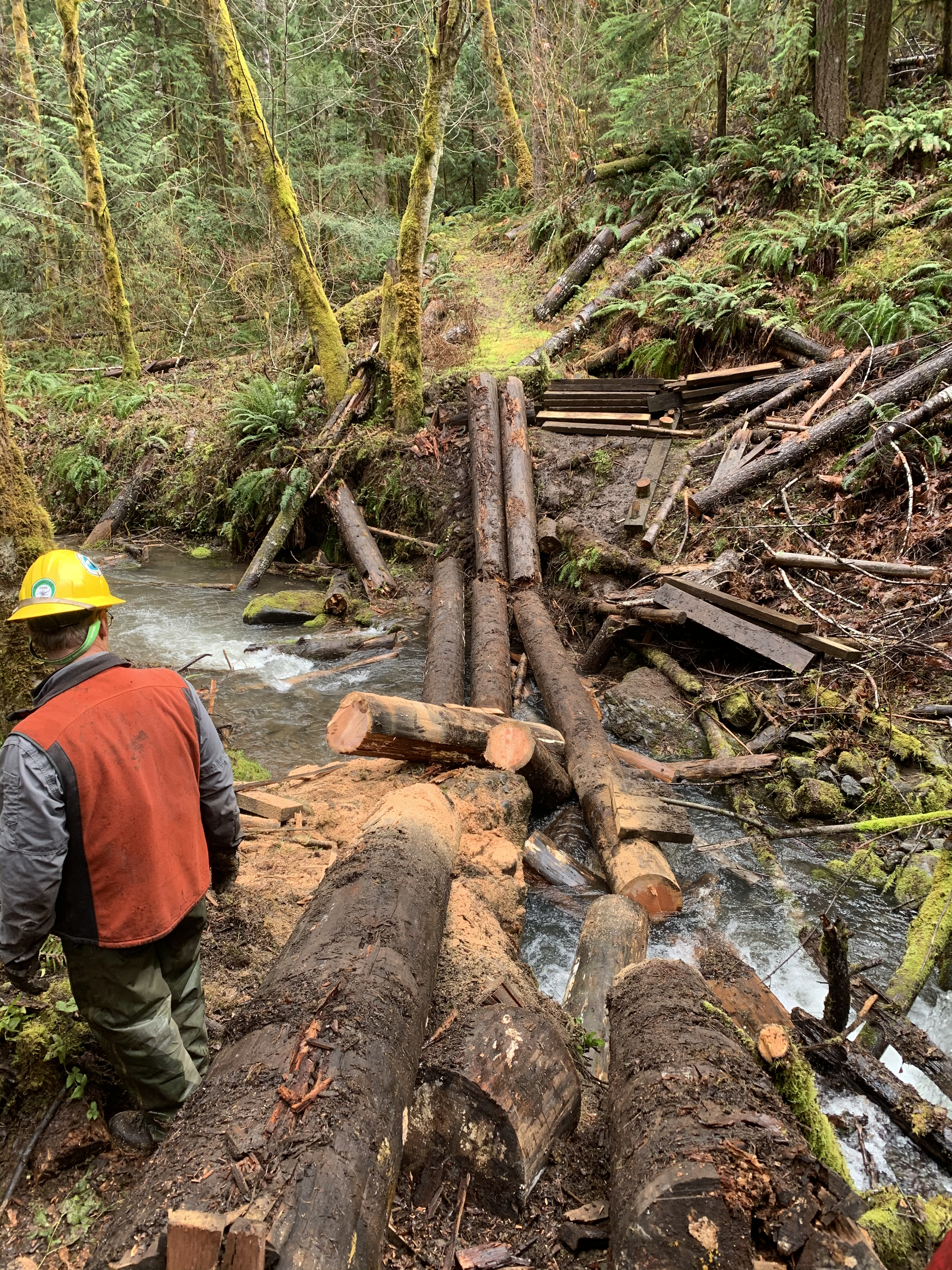
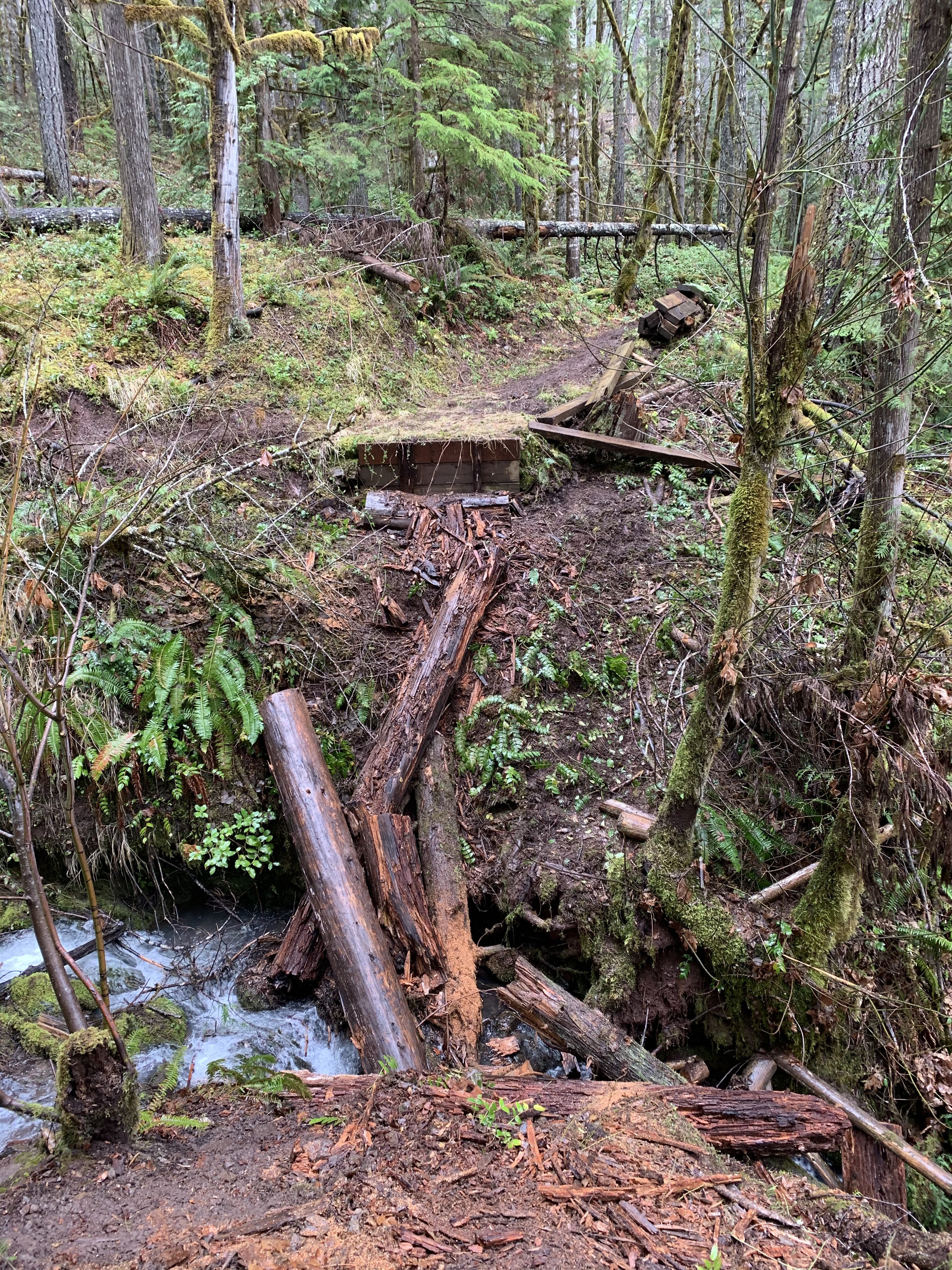
The bridge has been decommissioned and the stringers will eventually be carried away. My stack was on the far side, right of center, and the green patch is just a memory.

Notice the nails that need to be trimmed. All the tools are carried in and out. The North Fork is about 200 yards downstream

ROCK WORK

March 15, 2021

I wished I hadn’t hiked Spencer Butte the day before, I said to myself arriving at a nasty climb on the North Fork trail, 2 miles into our work day, where we had already done along the way considerable sawing and moving mud to clean up a trail damaged by numerous uprooted trees with associated root balls, AKA “rootwads.” I was I crew leader to boot, mostly because I was willing to organize the group when the usual leader was taking a well-deserved week off.  Three others signed up to go out with me, each of whom had decades of experience more than I dealing with trails. 

I trudged up the climb I had done a couple of months before, one that seemed to go on and on, when I saw an orange hardhat ahead, where Chris was trying to dig out a rock. Half the trail tread was gone, sloughed into a pile of rocks and mud below.  Tom joined me, and we started filling the hole with rocks.  The good news was that there were a lot of them available. The bad news was…well, it was Rock Work, and if I start handling rocks, my arms are going to be toast before long.  

Tom and Chris working. I’m resting, taking pictures. Somebody needs to document the work.
The completed job…at least until the next season maybe.

Tom was stronger. He went and got rocks, putting them in. I sat among the rocks, picking them up and shot putting them into the hole. Chris gave up on the trail rock, as it was a lot bigger than thought and deep into the ground.  After we had enough rocks, we made the pile even with the usable tread, then covered it with dirt, tamping it down, making it look like undisturbed trail.  Then we continued uphill further, until we reached a ridge about 300 feet above the river.  It was another half mile to the next rootwad, and Chris and Tom would keep on going.  I stayed to fix it, which I did with Steve, doing additional trail repair nearby where the trail was starting to erode.  At least there was no rock work with this one.  I went yet another half mile to a bridge across Leapfrog Creek, a normal intact bridge, where I had lunch and checked on the radio with Tom, who was waiting for Chris, who as usual had gone even further ahead.  

When it became time to hike out, I was beat with 3 miles to the cars.  The hill we climbed, we could descend but all I seemed to notice were the uphill sections on the way back. After a mile, I was able to leave my tools under a log that we would work on the following week. That at least freed my arms to complain only about gravity, rather than holding something against gravity. Climbing the nasty hill at the end, muddy steps, branches and logs to negotiate, required two rest breaks for all of 75 yards gain.  

Pass the jelly. My arms were toast that night.  Rock work.

I know a couple of guys whose first day with the Crew was carrying rocks. They never returned.  I was luckier.  I had my first experience my twelfth time out,  I looked it up in my trip diary. I remember having to fill buckets with small ones and carry them to where rocks were being placed in the middle of a muddy trail at Terwilliger Hot Springs.  The further afield I had to go, the more difficult the carrying became.  It was work to dig the rocks out, put them in the bucket, then carry the bucket, eventually 100 yards, then empty it one rock at at time. That was one trip. Eventually, I decreased the load in the bucket, preferring to walk more than to carry more.

That winter, I did more rock work at Fall Creek, building a rock wall along a trail. I again had a bucket and had to find rocks. When one does trail work, there is a quick appreciation for places where there are a lot of convenient rocks or a lot of good soil. The finished rock wall looked nice, but within a year, a storm destroyed most of the trail, including the part we worked on, and a Sisyphus crew is now working on it. No good deed goes unpunished.

Rock work in the pouring rain, Fall Creek, February 2019

Two years ago, we did rock work on Brice Creek in the Umpqua National Forest, a popular ten mile trail along the Creek of the same name, where the crew leader one day asked us to dig rocks out of the trail and out of walls along the trail. I was more experienced by then and didn’t say anything, but I had noticed walking to the start of the job that there were many soft holes in the trail where rocks had been removed. I think the idea was to have the trail wheelchair accessible, but the holes just made it more difficult to walk on, let alone push a wheelchair.  I don’t mind rocks on a trail. I use them to push off when hiking. If wet, I am careful walking on them.  That day, we used pry bars and a 9 pound hammer that we swung at a rocks sticking out of a wall as well as out of the ground. At that point, Lacy J. Dalton’s song “The Boys of 16th Avenue” came to mind, and I did wonder why we were doing this. I wasn’t alone, either. That was about as tired as I’ve ever been after a day.

Areas needing work on Brice Creek Trail. The clear spots had already been done.

We use rocks for stabilization, we use them for steps,  and we pull some out so we can get at decent soil underneath to help rebuild a trail. More than once, after carrying a large one, I’ve dropped it on the trail, only to have it land wrong and roll off, crashing down below. That’s a bummer.  Other times, like yesterday I was carrying one, dropped it by mistake, and it ended up being a perfect step where it landed.  Rock karma.

Fall Creek Trail, November 2019

Occasionally, I see a few on the dirt road coming or going. Then I have to decide first whether I can get the car over it without hearing a horrid “Clang,” or whether I should get out of the car and move it, so that I and nobody else has to think about it.  That’s where I try to use my feet.

Because I think if I so much as touch a rock, I am going to be really tired at the end of the day.

Last day working before the lockdown, Fall Creek, 12 March 2020

IN THE WOODS, IN THE ELEMENTS

March 5, 2021

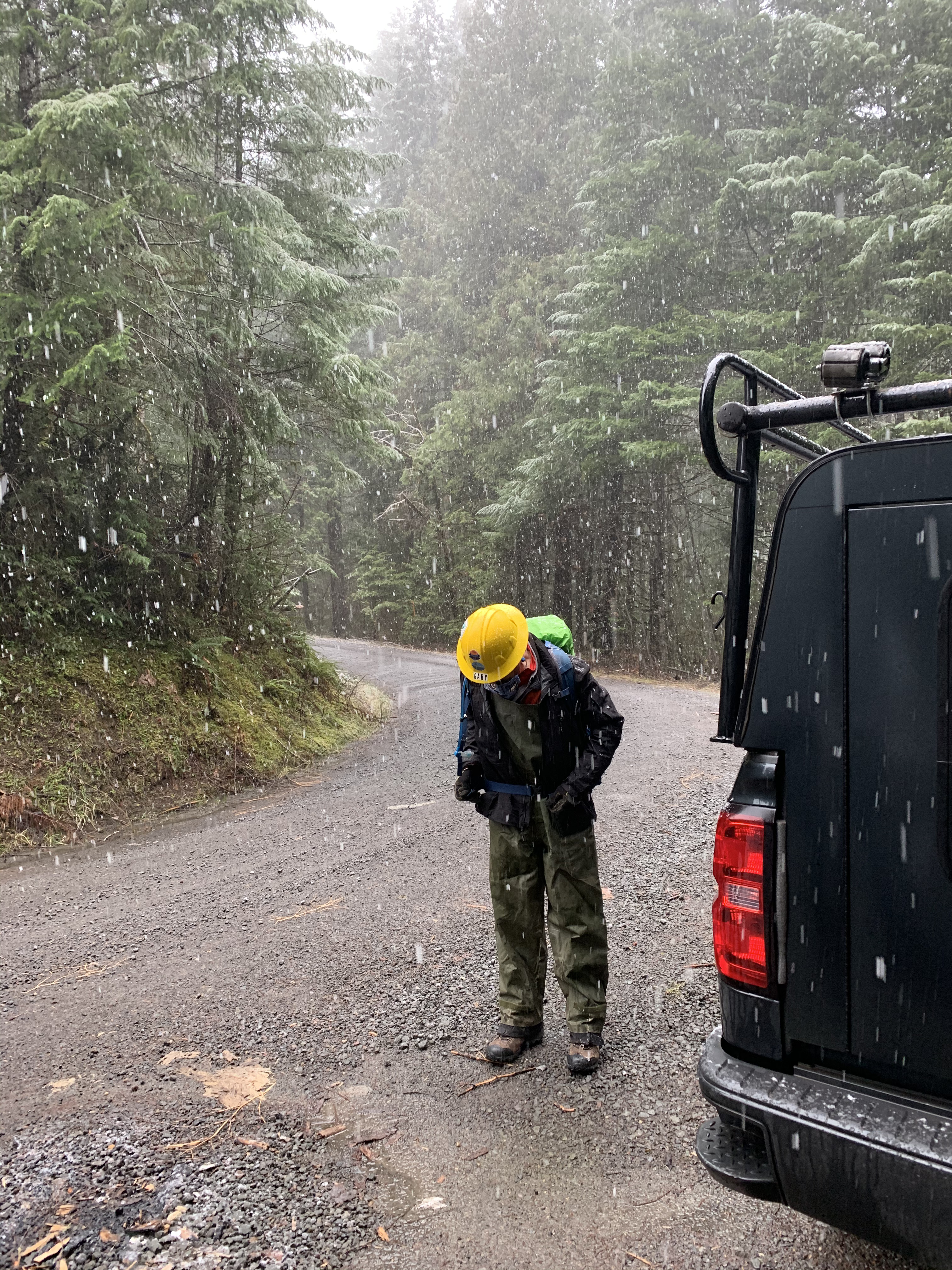
Last time out with the Crew, we met as usual at the Middle Fork Ranger Station near Oakridge.  On the drive out there, it rained hard, a cold rain, clouds backed up along the Cascades, meaning heavy snow up there, and when I reached the meeting point, light snow was falling.  

We caravanned 7 miles up to the trailhead, off Route 1919, where it was both snowing and raining harder.  We were right at water’s melting point as was the case the prior weekend, when I hiked the Middle Fork Trail. It’s interesting at the junction—the snow is prettier, and most of us in the woods would rather have it continue to snow than rain, for it takes more of it to make us wet.

Snowy morning at the trailhead; February 2021.

The Crew goes out rain or shine. We had a run of favorable weather until this past week, until  our job was to take apart another failed bridge.  I picked up a Pulaski and started down the steep muddy user trail we had made, knowing that precipitation would soon change to rain as I descended. It did, and the faint trail changed to mud as I discovered when I slid down the last 10 feet to the main trail below. We immediately crossed one passable but damaged bridge, hiked past a creek where we had removed the first failed bridge and continued a half-mile to the next bridge.

I guess it was raining while we worked. It was hard to notice, with the chain saw working, my pulling 100 pound planks up the hill and stacking them, grinding off the spikes with a grinder, sparks flying a foot or two in front of me.  But when I looked, my rain jacket and pants were soaked. Sometimes out there, I look down, and water pours off the hardhat, my first realization it is raining.  We stayed warm while we worked, took the bridge down by noon and in the rain hiked back out to the vehicles, up the tough, muddy, steep hill.  We packed out all the tools, and after everybody left, I had lunch up there, rain pouring on the car roof. No more snow.  I ate quickly, because I was rapidly cooling off, which on cold days is actually the most difficult part, because one is cooling off rapidly and becoming uncomfortable, even while one is resting. I then started the car, set the heat on high, and when I reached the main road, the Crew Leader was waiting for me, making sure I was OK. I apologized for not telling him I was eating.  Nice to know someone would look for me if anything happened. By that time, the heater was going full blast. I may not have noted the wetness while working, but I sure did notice it then.

I thought of some of the many times I have dealt with rain in the woods. When I was young at the Camp, I dreaded it, but in summer I never remember being too cold from rain, just wet, and I dried soon enough. The joys of youth.  Or the poor memory of old age.

It wasn’t until I spent 6 months in the Boundary Waters that I learned to deal with rain in the woods, the single best lesson I learned up there. I watched what others wore and did, and I copied them. I had good rain gear. No, it didn’t color match (nobody’s did), but it kept me dry.  I went out in early July to west Basswood, where we patrolled in the motorized zone with a small boat powered by an 8 hp Yamaha. Heading east on Fall Lake in 50 degree temperatures, pouring rain, sitting in the bow, my outer layers were soaked but I was fine. That whole 4-day trip was with on and off showers, and it was an effort to keep a pair of dry socks, but it worked. Dry socks for night are a must. Eventually I had to put on wet, cold socks in the morning. At least they were wool—it only felt awful for a few minutes– until they warmed up. 

I had about 40 days of rainy travel that summer, and I never remembered being miserable in rain as I had once been. I realized I could travel no matter what was falling, the only exceptions being wind, which made it impossible, and thunderstorms, outright dangerous.  There was favorable and unfavorable weather for doing things, not good and bad days. From then on, I was in good shape, with many memorable days of travel where I stayed warm, if not completely dry. I would never look at rainy weather the same way again. 

A few years later, my wife and I headed out on Lake One, knowing a big line of storms was heading our way, but our permit was for entering that day, and we needed to go.  We got a few miles in when it started to rain, and when I looked at the situation, I decided it was easier to set up camp early and wait out the rain while we still had dry gear.  The campsite wasn’t the most scenic, but I have fond memories of being dry in the tent while it rained hard outside. 

Tent bound with my journal, Lake Insula, 2007.

Just because one can travel in rain doesn’t mean one has to seek it out, either. 

The next year, same area, when we were reviewing campsites for an article in the Boundary Waters Journal, we had unfavorable weather on Lake Insula. We got hailed and sleeted on, and it looked like we wouldn’t be able to review all 47 campsites on the lake. The last full day was mostly sunny, however, so we paddled a slug of miles, checked out twenty different sites, discovering some shortcuts on the lake across peninsulas.  We got the information we needed.  The south end of Insula burned in 2011 due to the Pagami Creek Fire, so much of the information is now longer relevant.  Still, we have fond memories of the campsite trip and later stayed on a super 5-star site on the lake, hidden in a lovely bay.  Saw a moose there one night.

Lake Insula, September 2007.
Optimal late season gear. Looks like it even matched,
but that would be coincidental.

I’ve done plenty of memorable rainy hikes here in Oregon.  I led one up Heckletooth Mountain near Oakridge October 2017 the day an atmospheric river gave us a significant dumping.  It was wet, but we were going uphill and stayed warm, and the yellow leaves of the big leaf maples were so bright they appeared like sunshine.  None of us on the hike had any idea of what the colors up there would be like. I’ve been up Spencer Butte in snow and in freezing rain.  It got a bit dicey on top, but my wetness was more from sweating than rain. The snow on top was beautiful, even nicer when few were crazy enough to go up there.

Spencer Butte, 2019.

One of the ways I fall asleep at night is thinking of paddling out or back from Basswood Lake, just beating a storm to the campsite, where in the rain, or snow, or just before it rained, I pitch the tent, get everything under cover, put up the cook tent, where I have dinner with the weather roaring above me.  Then I wait for a lull and wash everything.  I may or may not fall asleep quickly thinking about it or out there, but in either case, I am in a good place. 

Mountain Kittentails, February 2021

IT DOESN’T HAVE TEETH; IT’S A GRINDER

February 22, 2021

The North Fork Trail parallels the river of the same name (well, the North Fork of the Middle Fork of the Willamette River), an Oregon Wild and Scenic River, for about 11 miles upstream from Westfir/Oakridge and Highway 58. The river itself flows from Waldo Lake to the Middle Fork of the Willamette near Oakridge. The Aufderheide, Highway 19, one of the original 50 of national scenic byways, is across the river on the east side and connects in 60 miles to Highway 126 heading to Santiam and McKenzie Pass. The trail is for hiking and mountain biking at low elevation but hadn’t been fully assessed or addressed after the Snowmageddon event three years ago, and it looked it.  The Crew had hiked in the first time from FS Road 1919 at the north end with power brushers to clear encroaching plants and Pulaskis for the root wads—made by falling trees whose roots pulled out of the trail, but soon realized what we needed to do was log the whole thing out–over 400 trees in 5 miles needed removal– in addition to taking apart three failed bridges, or maybe four, I can’t remember. There were other bridges considered passable, but many might not choose to cross them.  I can understand their concerns. 

Map of upper Willamette River. Lookout Point, Fall Creek and Hills Creek are actually reservoirs.
Four wheel drive doesn’t do well here without some help.

Anyway, after the logging was completed, a brief phrase describing 175 man hours, long days driving in on roads that we sometimes had to log out to drive on, hiking to the trail, then cutting out and moving the rounds (cut logs), we tackled the spectacularly failed bridge north of FS 1912. 

Not usable.

Getting there was interesting.  We could hike in a mile from lower elevation, climbing a little then descending to a creek where the bridge was.  But since 1912 paralleled the trail, above it, we drove in about 3/4 of a mile, parked, where it was about 200 yards to the trail, 60 of those yards vertically down, on somewhat muddy ground, over a few logs, to reach the trail.  Once there, we crossed a serviceable bridge— “passable” although I wouldn’t lead a hike with the Club over—that canted about 5 degrees to the downstream side and was slick on even a dry day.  Then it was a quarter mile downhill to the worksite. Downhill sounds nice, but downhill on mud is dicey.

We first had to cut down bridge parts that were hanging in the breeze, then pry up the thick planks that were once tread from the large logs in which they were all pounded into with long spikes. I’m sure there is better terminology, but one gets the gist.  We wanted to save the planks for reuse, piling them nearby, but we first needed to get the spikes out.  They were about 8-10 inches long, and pounding them out, using the claws on the hammer or chisels was a difficult undertaking, because the claws weren’t deep enough to grab the spikes.  It would take us 10-15 minutes to remove a plank and then someone would spend 30 minutes or more on some of the spikes. We then used cawsalls, battery powered metal cutting saws. They would cut, and I learned once the nail started to smoke, and then smelled like boiled metal, although boiled metal isn’t in our smell repertoire, one could then stop and break the nail off. The cawsalls chewed up batteries like a dog a toy.

The stream was pretty, about 50-100 feet vertical above the river, but of course the nearby rocks were mossy and slippery, the far side muddy and steep, making any river crossing an undertaking in itself. The first day, we managed to cut out about two-thirds of the planks and stack them, each of the thirty to forty weighing well over 100 pounds, requiring two or more people to move on terrain that was, shall we say, friction impaired. We finally quit, stashing the pry rod, hammers, spikes removed, and a few other tools in a bucket on the other side of the creek.  We hiked out, across the 5 degree canted bridge, back up the awful hill to the cars, each puff of breath telling ourselves it was better than hiking a mile back to the bottom of the 1912 road.  

We planned one more day on the bridge the following week, this time bringing in more Lithium 18V batteries and a grinder, which I had never seen before. Most of the Crew have their own Home Office for hardware at home.  I have a hammer and at least now a voltmeter to check the car battery, not much else.  We split up in two groups, one on each side of the creek to remove the remaining planks, cut out some of the logs underneath, continuing to stack everything salvageable on the near side, and leave the cut big stuff by the creek. I watched one of the guys use the grinder to cut a spike out, and then he handed me the grinder. It seemed easy to use, the disk whirred around fast, and I cut the next spike with the usual smoke-stink-bend and break, before the battery died.  OK.  I picked up another battery, sure didn’t want to have to ask how to put it in, but fortunately figured out how.  I pushed the start button, things started to rotate, and went through the smoke-stink-break off spike process again.  With the machine stopped, I looked at the disk, which resembles a CD, and while cutting through metal, plays 100+ db screechy music that isn’t much different from some of the stuff my OK Boomer ears listen to today.  Heavy metal, indeed.

No teeth.  Uh oh, I thought, I ground those things right off.  Damn.

“Hey,” I called. “The teeth are gone.”  

The crew leader came over. “It doesn’t have teeth.  It’s a grinder.”

Oh. I could have sworn I saw teeth when I started.  Nope. I guess I have OK Boomer eyes, too.

We got the fifty odd heavy planks out and stacked, spikes removed or pounded into the center of the plank, finished cleaning up what we could and the leader called the job complete.  Wow, lot of big logs on both sides, many cut ones down in between, and this is done. Well, I don’t want to move those.  Better to walk out of there, back uphill where each week the steps were becoming progressively more muddy.

This week, it’s another mile to the next bridge. The planks hang down vertically and it is even more slippery.  If it is too wet, we will deal with root wads.  That’s safer, but one spends the day walking on boots that have 3 inches of mud caked on them.

The North Fork below.

Next up.

IN THE ZONE

January 31, 2021

We waited 35 minutes at the 12 mile mark for the rest of the group to catch up. By then, the two of us had had lunch, stiffened up, I had hiked back a quarter mile looking for the others, and we still had to finish the last 14 miles of the McKenzie River National Scenic Trail.  We waited earlier 15 minutes at the 3 mile mark. Unless we got permission from the hike leader, it was going to be a long day with more waiting to hike the 26+ mile trail. I had been told we would be hiking at 3 mph, but the leader invited a friend who was still recovering from a leg injury, and there were others that were not hiking anywhere near that speed.

I convinced my partner to ask if we could go on ahead, and we got permission.  There was a climb out from where we ate lunch, and at first, I was slow, but then I got warmed up, and before long, I was in cruise mode.  I’m not a sprinter. I like endurance activities, and once I find my zone, I can hold my speed for a long time.  We started cranking out a mile every 17 minutes, and at the 18 mile mark, took a break for 5 minutes by the clock. I emptied my boots of some dirt, drank some water, had something to eat, and put my boots back on. Off we went, along the beautiful free running McKenzie River to our left.  

McKenzie River
Blue Pool. The water goes underground and comes out here, but in heavy snow years, the water floods the woods about a mile away and comes over the part at 11 o’clock like a waterfall. This is a third of the way.

I wasn’t stiff, and we continued making good time.  We hit that special moment when the odometer reads “20.00,” and took another break at 22 miles, doing the same routine we did earlier. Seventeen minutes later, I knew the end was coming, an hour more, maybe, then a half hour, a quarter hour. There was the highway nearby, the trail left the river and paralleled the highway at the end. I was there, along the road, and I was done. I felt fine. I could have done 30 miles that day. Five minutes later, my partner finished.

Lighter than a GPS, and every gram carried matters.
End of the trail.

That’s being in the zone.  I would do the hike a year later with a faster group, but one person took videos to post on his Facebook page, costing us 20 minutes of prime hiking time when it was still cool, on a day which we knew would be much hotter.  One woman had diarrhea, another developed a blister, and I hiked four miles in atrial fibrillation, which was an interesting experience.  I converted to normal rhythm at lunch. It took us almost nine hours.

                        * * *

I was at an elementary school in Oro Valley, Arizona, 30 years ago, shooting free throws. I was by myself and had to fetch the ball, so I reset each time I shot. I hit two in a row, then 5.  OK, not bad.  I dribbled once, held the ball, flexed my legs, then shot. Six.  A short while later, 10.  Hmmm.  Swish, swish, swish, swish, swish, and I was at 15, finally ending my streak at 20 in a row.  It was amazing. I felt like I couldn’t miss, and I wasn’t getting any gifts, like bouncing off the back iron 5 feet in the air and dropping straight through.  Normally, I was a 65% free throw shooter. Assuming that, a streak of 20 in a row had an expected value of 1 in 5000 tries. If I shot 20 five times every day, which I didn’t, maybe once in 3 years I could do this.

Mind you, I know there is a considerable body of evidence to say the hot hand really doesn’t exist, but the evidence isn’t conclusive. There are days where difficult tasks don’t seem difficult, where everything comes easy. That day, I was beyond any performance limits I knew of. I was in the zone. Everything clicked, and I shot like I never had before…or ever would do again. 

* * *

Nearly 30 years before that, I swam the 400 free in a high school meet—that would be 400 yards—and I was ahead. Way ahead. I felt like I could swim forever.  I won the race by 35 yards with the best time I ever had—5:19.3. The fact that I remember that race, never forgot my time, slow as it is today, among all the races I did, and even the ones I won, is testimony to the power of the feeling. I was in the zone. A team member told me it looked like I wasn’t even working.  But let’s be real: the national record for 500 yds, 25 yd length pool, is 1 minute 12 seconds faster than I swam 400 yds. 

* * *

I ran only one marathon, with three goals—to finish, to finish without stopping, and to finish without stopping or walking.  I did all three. My time was not particularly stellar—3:25.48—but again, I remember it exactly.  What else I remembered about the race was that 5 miles into it, I actually felt I was sitting in a car watching the scenery go by.  I was detached from all the effort my body was going through.  At 5 miles, I was just getting started, for whatever my athletic skills are, and they don’t amount to a lot, I do well at distance.  Indeed, my time for the second 10 miles—77 minutes—was exactly the same as it was for the first 10.

* * *

In 2002, I rode the 160 mile Tour of Cochise County, the second longest of the four rides the Perimeter Bicycle Association of America sponsors (the longest was 252 miles) that day. I was with a group of five, and we had to have our own Sag support. For the first 70-80 miles, much was flat with some downhill, and I stayed in the back drafting off the sprinters.  I remember going through Tombstone upwards of 25 mph, drafting, and I was barely turning the pedals. 

After lunch, at about 100 miles, I was doing fine, “just warmed up,” I told others. There was almost no wind, a gift in Cochise County. One of the sprinters went to the front, seemed to be tired, so I said, “pull over if you wish.”  He immediately pulled over.  Two of us took over at the front, the sprinters drafted, and I did two-thirds of the pulling. I stomped out the cadence, over and over again, two miles at a crack, 540 strokes, then sat in the pack for a mile, before going back out to pull.  I was in the zone, and it took us 8 hours to do the ride, the best single ride I ever did or will do.

* * *

On skis, some days I could hit a mogul field and pound myself down one after another—air, turn, hit, compress; stand suddenly, air, turn, hit, compress; stand suddenly,…down the bumps, until I finished or stopped because of exhaustion, and shook my fist in the air.  That’s being in the zone. It’s a dopamine high, receptors reacting, a sense of everything working.

I was in the zone once on a portage, when I was 100 yards on the trail and didn’t remember putting the canoe on my head.  I knew it the other day, when I took over the power brusher duties, wanting to finish the trail, and didn’t stop until I did. I know it on hikes, when I say to myself, “this is a special day out here,” when I am covering ground and thoroughly enjoying myself. 

I can’t predict when I will be in the zone:  the day before and the day after, nothing is special. But for a short time or a day, a glorious day, everything is in sync, in tune, and alive.

These guys are for real. They have the right genes, eat right, train right, but only two of them will go to the Olympics, Men’s 3000 m steeplechase, US Olympic Trials, Eugene, Oregon, June 2012. I’ve seen performances here that for one day a specific individual was in the zone, smashing his personal best, and sometimes going to the Olympics. It’s exciting.