Archive for the ‘UNPUBLISHED OUTDOOR WRITING’ Category

FAMILIAR SEEN IN UNFAMILIAR SURROUNDINGS

August 5, 2025

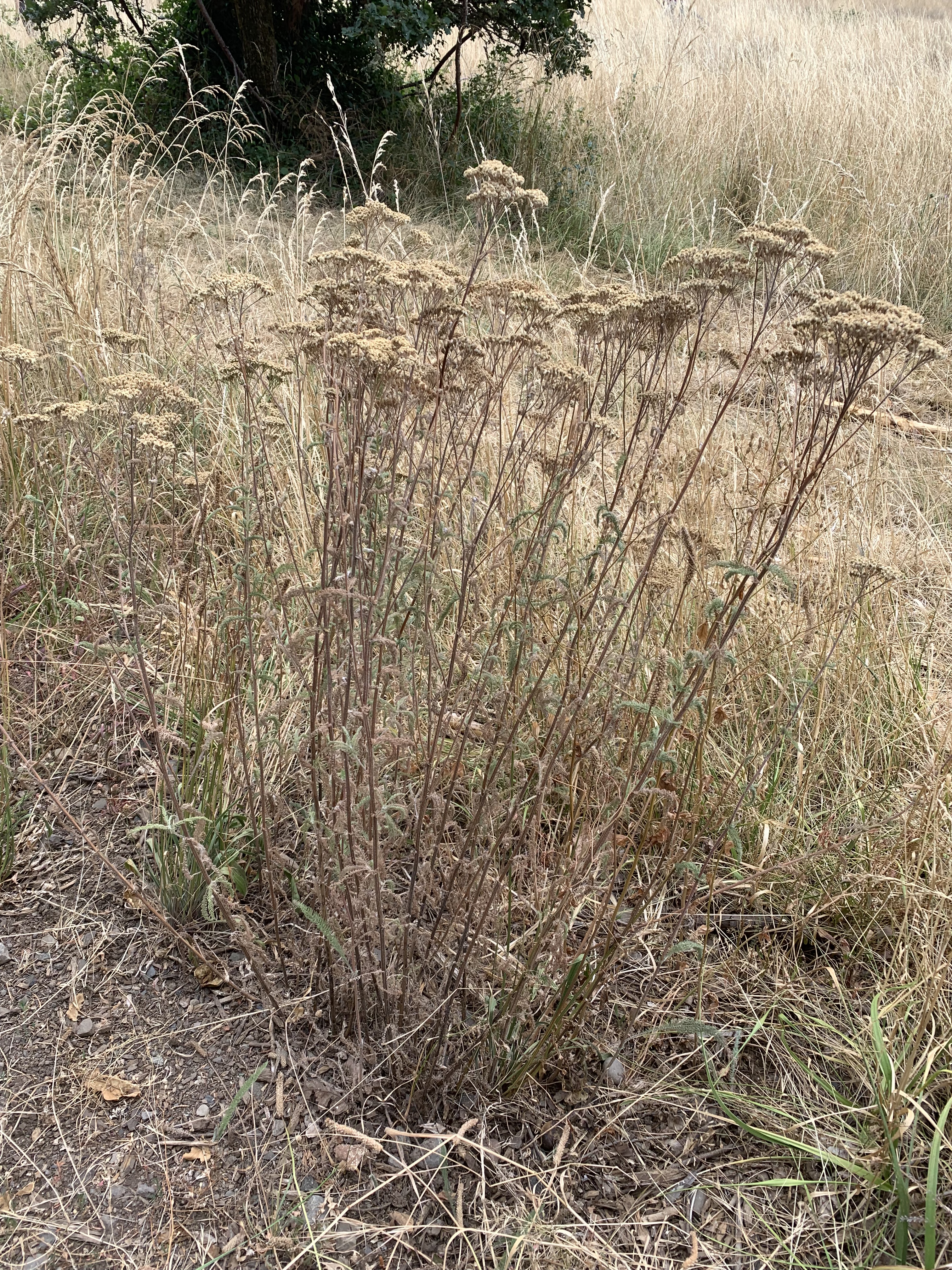
“Hey Mike,” Patrick called over, holding up a bunch of brittle brown stems. “This is yarrow. You can leave it.”

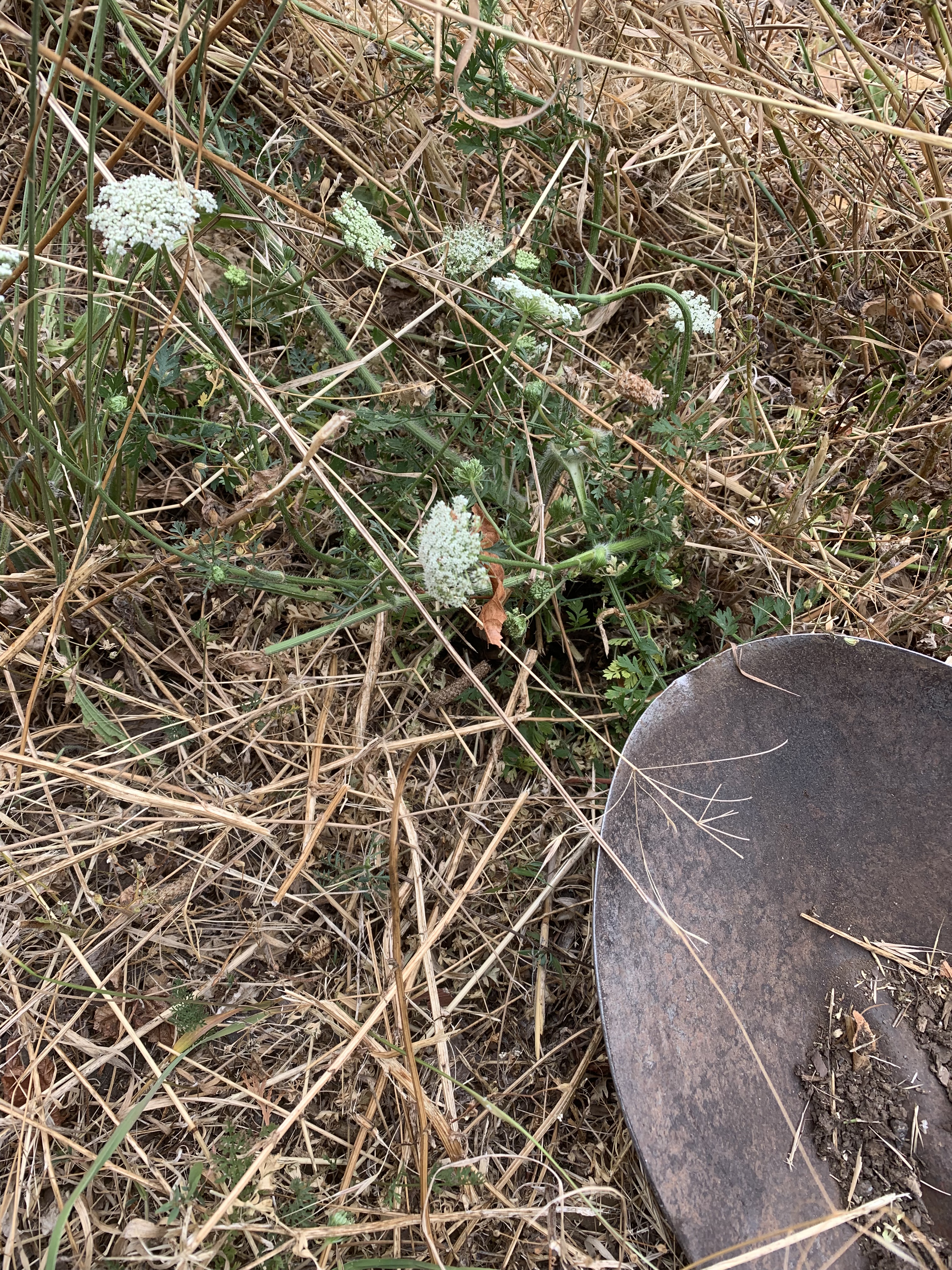
Blast it, I said to myself. I had looked at it, figured it was Queen Anne’s lace gone to seed and pulled it out. “You know, I wondered about that,” I said, “but it pulled out the way Queen Anne’s Lace did.”  

Chastened, I returned to work just below the gravel road at the Arboretum, in the brown grass, where real flowering Queen Anne’s lace needed removal. My job as one of several volunteers was to clear five or six meadows, each a few acres, of that, tansy ragwort, and Canada thistle. Queen Anne’s lace, 90% of what we were pulling out, is an invasive successful competitor, tansy ragwort is toxic to animals, and Canada thistle is also invasive. The first two are biennial; thistle perennial. We will need to do weeding next year in order to fully control the biennials.

I had just learned something about yarrow, because while I had seen plenty of the white blooms, I wasn’t familiar with yarrow that had gone to seed, a polite way to admit I had been around yarrow that had gone to seed but hadn’t noticed. The blooms had faded to brown, but the yarrow flower structures were still present. Had I looked at the flowers more carefully, I would have noticed the difference and besides, Queen Anne’s lace was still blooming. None appeared past the blooming stage. While true yarrow stems were the same size as Queen Anne’s lace and easy to remove, that was irrelevant.

We are pattern recognizers. It allows us to perform quickly and efficiently much of the time. But sometimes the familiar seen in unfamiliar surroundings can fool us. It reminded me of 24 years ago on a train trip back from a solar eclipse where that evening I saw an odd arc of stars just clearing the northern horizon over Zambia. It took me a while to realize it was the handle/spout of the Big Dipper, an asterism I knew well, the southern part of which was just visible from where I was at 16ºS., but had never seen in such circumstances. The stargazing I did south of the equator usually was focused on objects I couldn’t see from home. I stared at the handle for a long time.

I remember fields full of Queen Anne’s lace when I was a kid, but I didn’t see much of it afterwards. I was not consciously aware of its being called wild carrot because of its pale carrot-like tap root. I think I would have remembered. But perhaps not. As I worked, I developed a sense of what I had to dig up, how deep, how far around, what I could pull out just by hand, oddly using my non-dominant left hand as a decent lever that would either pull the plant out or not, whereas my dominant stronger right hand would often break the plant off above the ground and not be as helpful.

I noted the smallest Queen Anne’s lace flowers often bloomed from the same rosette of leaves. Once I discovered that relationship, I tried to remove the whole base along with its single large taproot, not each individual flower. Small free standing plants I could carefully remove with my “calibrated” left hand. Medium-sized plants I could comfortably pull out with either hand, and the larger ones I needed a shovel to clear out slightly more than 180 degrees around to pull them out. Six of us there cleared two acres, putting the removed plants in a large plastic bag, thicker than the one we used two weeks earlier, which ripped early and often, spilling seeds.

Back home the next day, Alton Baker Park was a sea of white Queen Anne’s lace. I looked at the flowers differently from the way I had before. I left these alone, more interested in picking blackberries from another invasive plant. I tried to visualize the number of tap roots out there. I like the smell, which reminds me of my childhood three thousand miles to the east.

Maybe see you on an Arboretum trail sometime. 

COOL IDEA

July 28, 2025

The small, gurgling stream nearby had my attention. Should I or shouldn’t I?

I was brushing and logging out Lowder Mountain while working with a sore foot. The affected appendage gave me three good hours, but during the fourth, I started having discomfort, and I still had to hike out. At lunch, near a barely flowing stream, I remembered a few weeks back in the Diamond Peak Wilderness, the same sore foot, but additionally a sore toenail, worsened by wearing an extra sock. During lunch, I took off the boot, hoping it wouldn’t be a mistake. It wasn’t. It felt great. I pulled off the extra sock, the one underneath, and let the foot air out. It felt even better. After 10 minutes, I put the other sock back on and then the boot. My foot still hurt, but I could finish the day. 

Remembering, I again removed my boot. Same feeling, same questions. Should I or shouldn’t I? It’s difficult to put a sweaty sock back on a wet foot. So what? I have been on my knees all morning, two of us removing brush on every foot of the trail through the large last meadow, although admittedly we spared the scarlet gilia and the western coneflowers. It’s hot. I can use the top of the sock to wipe my foot dry. We have to wait anyway for two others returning from having gone further up to check out the summit; we had time. I deserve a break, and so does my foot.

I took off boot and sock, let my bare foot get some delightful fresh air, then put the boot back on and hobbled over to the stream to where the trail crossed several flat rocks with perhaps a half inch of water flowing slowly over them. I moved carefully off the trail, under an arch of branches, found a rock I could sit on near a small pool of water maybe 6 inches deep. Perfect. I sat down on the rock, removed my foot from the boot, and stuck it in the water.

Wow. Cold and great. Within 30 seconds, I felt no cold. I should have come over a half hour earlier and eaten my lunch here. The gravel bottom was fine. I could sit here for an hour or all afternoon. I wouldn’t, of course, but I got a chance to look upstream at the steep grade with a narrow chain of rivulets. It was shady and out of the way. I had hiked by this stream at least 10 other times and never knew what was back here. But today I discovered it. Twenty minutes later, it was time to do some work, so I removed my foot which dried in two minutes. I put the sock on, then the boot, stepped back on the trail, and five minutes later the other two showed up. The hike out went fine.

I don’t swim in Oregon because the water is too cold for me, an old man with thin skin and not much insulation. Or I am a chicken. It’s great others can. Last time I swam was 2017 by a campground in the North Cascades. Several of us had just finished a hot hike. There was a lake and a boat ramp. I stripped down to shorts and ran right into the lake, the best way I can deal with cold water. I wasn’t going to swim and didn’t, immediately getting right out. But I was cooled down for the rest of the day. Swims do that.

See you on the trail but probably not in the water.

One of many meadows on Lowder Mountain.

NOT QUITE BY THE BOOK

July 20, 2025

Twenty feet ahead of my knees were many Cascade asters on the left side of the trail. I decided I would work to them—on my knees—then take a short break. I adjusted my position and continued hacking at the encroaching thimbleberry with a hand saw, occasionally using loppers for their stems at the base. I was in the middle of a brilliant green, several acres, steep sloping meadow where the forest gave way to low plants.

One of several meadows on Lowder Mountain

 I was not quite halfway up Lowder Mountain trail, which began at FS 1993, ending about 600 vertical feet above me to my right at the summit. Olallie Mountain was across the valley to my left or south, and I could see individual trees, consistent with old fire damage near the summit. We had a crew working over there logging it out. I set up a concomitant trip to Lowder because I wanted to get in the woods, my sore foot wasn’t going to tolerate hiking up Olallie, and brushing Lowder was as important as logging it out, since the couple hundred yard stretches of thick brush in each of several meadows was both difficult to follow and concealed holes of some so far undetermined rodent. I’ve hiked Lowder maybe ten times, and one specific, treacherous hole has always been there—hidden by brush.

I arrived at the asters and had to decide what to do with them. They were on the downhill side of the trail, but there was adequate room to hike by. I couldn’t see removing all with my hand saw or loppers, because frankly they were really pretty, so I removed a couple carefully and left the rest. In a couple of weeks, they will have gone to seed, their job done, part of which was giving me pleasure.

I don’t like removing flowers, but trail work requires it. I purposely avoided power brushing a few dozen trilliums last spring on the Middle Fork National Recreation Trail, although I still accidentally removed three. Trilliums take years to grow and flower, and I felt badly about my error. Three years earlier, I left a large false Solomon’s seal hang over a trail on Fall Creek, because it would have been criminal to cut that beauty out. 

A few minutes after I reached the asters, I accidentally lopped off two tiger lilies, because with so many different plants encroaching, different size, different leaf arrangement, it was difficult to sort out which plant went with what stem. A little further there were two more over the trail. I didn’t cut those; I bent the stems and moved the lilies behind thimbleberry safely away from the trail. Their flowers can still be pollinated. It’s not in the manual for trail clearing, but flowers are flowers.

Western coneflowers appeared, and I slowed to make sure they were left alone. Their stem has a whitish cast, which I had not previously noted, although I never had been in the position—hiking through a meadow on my knees—to look to avoid cutting one. The brownish cone top with the green leafy bracts is a standout. I didn’t notice the green surround when I first saw these in the wet meadows of the Waldo Lake Wilderness years ago. I haven’t been back there since the Cedar Creek fire, but this day Lowder had many. The stems could also be bent so I could move the flowering top further from the trail. If I could find a similar flower nearby, I hooked one around the other. Coneflowers need hours of sunshine, perfect for where they were.

At lunch I saw some columbines and two deep purple flowers 20 feet away and below me. When I later walked to them, I discovered the purple was really a deep red of a columbine that was past its prime and fooled my sunglasses. False alarm. The bloom had collapsed, the colors darkened. Later, I saw a blue gilia, a small puffy flower with tiny blossoms and a thin stem. It was at a switchback near a broken log I wanted to push off the trail myself but was afraid it would land in the trail below and I would have to move it again. It would have to wait for the logout the following week.

Keiko came up to me during lunch and thanked me for saving the purple flowers—the asters. She had noticed them, too.  

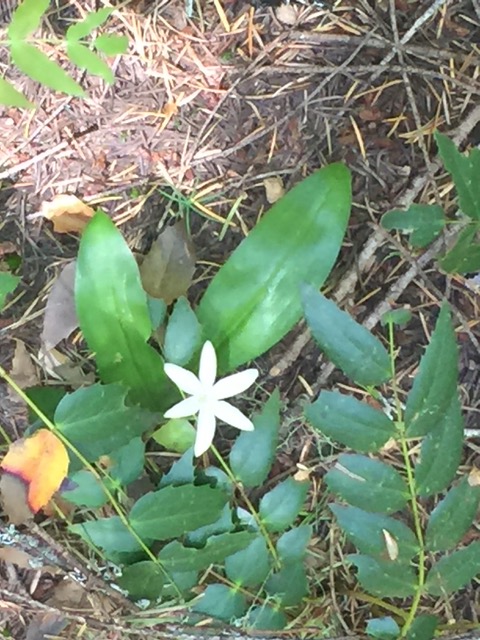
Western starflower.

IT’S MORE WORK THAN YOU THINK

July 17, 2025

For the tenth time that day, we stop at a log to remove it from the trail. Each of us finds a spot to drop our pack, maybe before the log, because we want to get rid of the weight and bulk before clambering over the log, or perhaps after, so we don’t have to backtrack when we finish to get the pack. Placement sometimes requires later movement to prevent the cut log, a round, from running over it. Before dropping my pack, I need to put down what else I am carrying, usually an axe or a Pulaski, sometimes a large crosscut saw or a pry bar, then take off my gloves, unbuckle the hip belt and the chest strap, the latter often closer to my neck. Then I drop the pack directly through both arms or remove one arm strap and allow the pack to swing, whereupon I grab it, remove my other arm, then more gently lower the pack.

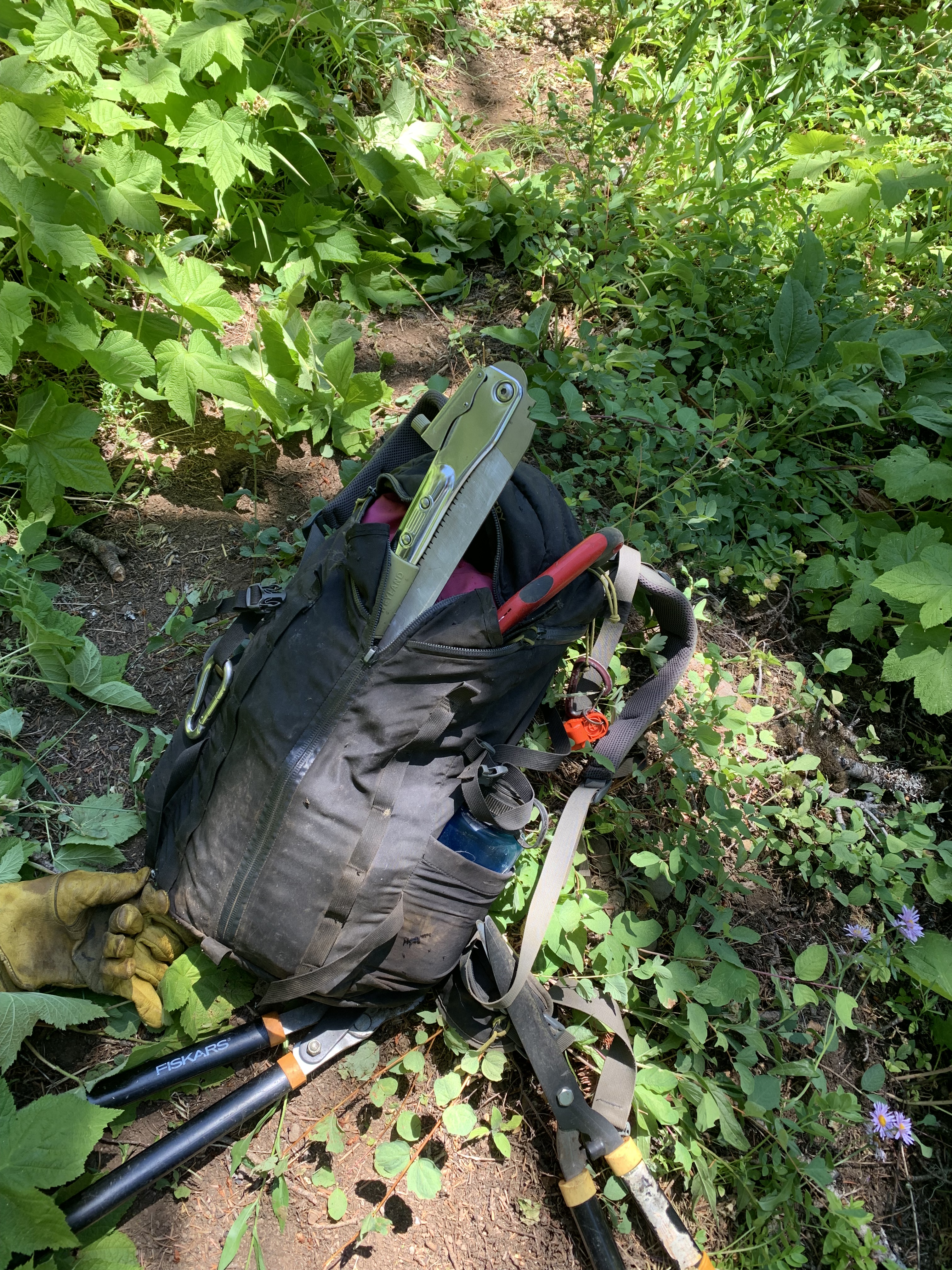
I have a Corona hand saw and a larger 500 mm KatanaBoy saw in the back of my pack that I want available, so I put my gloves back on and pull the two saws out. These, along with a Fiskars handsaw in my pocket, are used to trim branches or finish the cut, when the big saw is close to the ground and we don’t want its teeth to have contact, which will dull them. If I am carrying a crosscut saw, there are three velcro straps or buckles that have to be undone to free the saw from the blade guard. I try to do that with my gloves on, but sometimes I can’t.

I also carry three or four hard plastic wedges in my shirt and pants pocket for the cut. Last thing I want to do when cutting is stop, go to my pack or someone else’s and hunt for them. It’s more bulk to carry, but they are nice to have ready. Wedges keep the kerf—the cut—open and lessen saw binding.

After finishing the cut, which may take a few minutes or a few hours, we sheath the big saw, which on a good day can be done with gloves on and velcro’s behaving. On a bad day, the velcro has to be pried apart, the scabbard won’t line up properly, we put the saw on in the wrong direction, and the gloves have to come off again. Then I put my Katana in the pack, then the Corona, hopefully lining it up with its scabbard inside the pack, a 50-50 chance, which shouldn’t be if I could remember the whole day which way the scabbard curves, zip up the pack, pick it up with one strap and put it on. I now have to make a decision: if I think the next log is a minute or two away, I won’t bother with the hip and chest straps, and I keep the gloves off. Or, if I know from a scouting report the next log is some distance, or I guess right, I buckle up, but that’s a good day. I have to buckle the chest strap by feel, which may take one or many more attempts. If I decide to buckle up and the next log is around the corner, I have wasted energy and time. If I don’t buckle up and the next log is more than a couple hundred yards, I am going to have to stop, because carrying the pack unbuckled becomes uncomfortable. I usually keep my gloves on, because often there is something small that might need my pocket saw, unless I accidentally drop it or leave it somewhere. When one stops ten or more times a day, it is moving a lot of weight and taking a lot of decision making time that generates more fatigue. Other than that, logging out a trail work is just a day hike, with maybe 10-15 pounds extra gear, cutting a bunch of logs, moving the rounds off the trail by pushing with hands or feet, and going to the next one.

Maybe it’s a bit more than a day hike.

SWARM

July 9, 2025

The trailhead was several miles closer than I thought and the road better than expected.  Good start to the day.

Then I opened the car door.

Immediately, mosquitoes were all over me. Alone, I had their undivided attention. I have spent time above the Arctic Circle and hundreds of days in the Boundary Waters. I know mosquitoes. Just two weeks earlier at the southern terminus of the Middle Fork trail by Timpanogos  I was the only crew member not to wear bug netting or use bug repellent; generally, that is typical. I heard, “There’s a swarm all around you.”  No problem.

Today was different. I was at another southern terminus, this time Diamond Peak Trail, planning to scout north 2 miles to Rockpile Trail and then head east. Summit Lake was nearby, and there were many ponds near the trail. Figure lots of standing water, one mammal, swatting several at a time on a hand, inhaling some, glad for once I wore hearing aids, since at least the bugs wouldn’t go in my ear.

The day didn’t improve. Two hours later, the last hour at least mosquito-free, I was off trail. I wasn’t lost, because I knew where the trail was behind me and could always get leave the woods that way if I had to. I was annoyed at myself, however, because earlier I had come through the other direction and had no difficulty. I usually need to see a trail on two separate occasions to develop a decent memory of it. 

I had hiked past ponds, streams, and snow, swatting as much as I tabulated downed trees and possible needed tread work as a result of the 208 fire. There were so many downed trees I listed them by number every hundred yards. Trail scouting in a fire zone is like route finding in winter. With no ground cover landmarks, many spots appear to have a trail. Finally reaching Rockpile Trail and turning east, I quickly lost the trail. I hunted on the north and south sides and got lucky.  I then placed my pack on the ground to scout ahead more quickly, finally making a 25 inch diameter log across the trail my turn around point. I needed my GPS to find my way back. Note to self: keep your pack on when having directional trouble or at the least be extremely certain you can find it again. The phrase “think I can” is inadequate. I returned to the 4-way junction, headed south and after 3/8 of a mile lost the trail again.

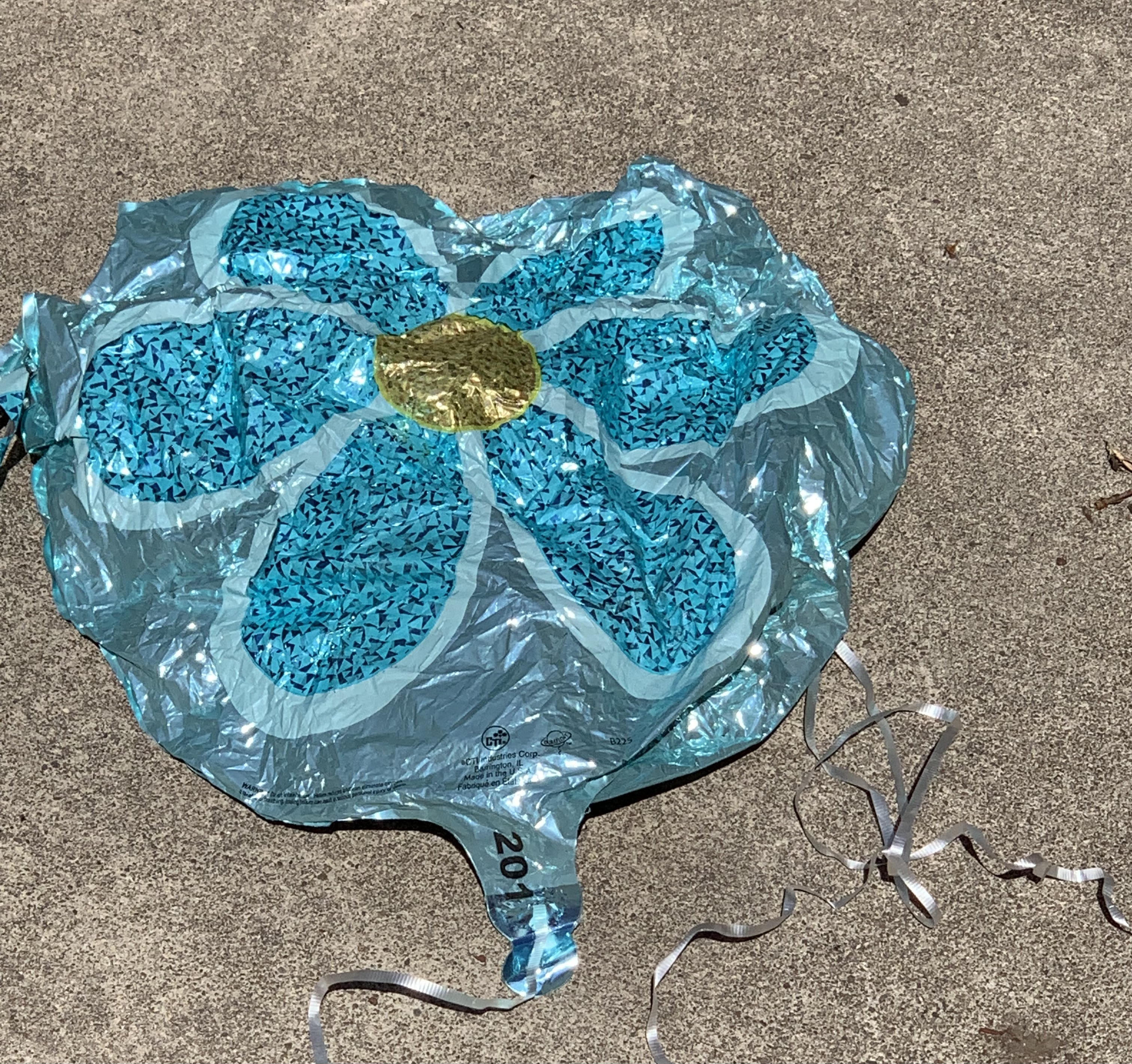
Then I saw a balloon. On the ground. In the Diamond Peak Wilderness.

At first, I thought it might be a weather balloon, for balloon soundings are sent up twice daily from Medford and Salem, and the balloons have to come down somewhere. But the gray ribbon bow was clearly not from the NWS. It was a balloon from a gathering somewhere. It still had some gas, probably helium, although I didn’t do a voice test. Someone likely to the west of me, given population centers and prevailing mid to high level winds, released it. Out of sight, out of mind. Sort of like tossing an apple core. You don’t see it again, but it still exists.

I felt like I was a little less in the wild. A balloon can do that. Once, in a remote area of Alaska, I encountered an Epi-Pen cartridge. I know that this region has not always been designated wilderness, but it has been officially wild in one form or another for 70 years and a balloon is as much out of place here as I would be in Times Square. East of nearby Summit Lake people used to drive in to what is now near the PCT. You’d never know it by how it looks now. I picked up the balloon, put it in my pack, finally figured out where I needed to go, found the trail, placed illegal but temporary ribbons for those who were going to log it out so they could find their way, and hiked downhill out of the burn area into the woods, where the mosquitoes were still waiting.’

See you on the trail. 

Unnamed pond, good mosquito source.
Turnaround point.

GREEN, IN THE LAND OF BLACK AND BROWN

June 30, 2025

I couldn’t miss seeing the green, since for the last two hours I had been in the land of black and brown,  black trees, black and brown soil, with occasional orange, which I learned was from clay having been burned. The few times I looked up from my work recovering the Pioneer Gulch trail, I could, if I stared hard enough, see some distant green across a valley through and behind the silent black trees around me. There were perhaps a dozen green plants growing in a pile of large rocks. Presumably the relative lack of fuel here plus the rocks helping to protect soil and moisture allowed the seeds to germinate. The leaves looked familiar but I couldn’t identify them. 

We were working in the post-fire zone on Pioneer Gulch Trail, in and adjoining the Diamond Peak Wilderness. The 208 fire burned 11,263 acres (about 17 square miles) between mid-July and the end of October 2024, when it was contained. Lightning caused, it was never a danger to property, but it burned wilderness in which we had worked for several years along the west side of Diamond Peak, well below the 8700 foot summit and the 1000 foot lower treeline, but high enough above the surrounding valleys, where beautiful Happy, Blue, and Corrigan Lakes were all in the burn zone. I had been on the trail several times but recognized nothing.

The official burned zone is not always a blackened moonscape. Fire footprints are a mosaic, where there can be surviving trees and ground cleared of downed brush. The Rebel Fire in 2017 cleared out the forest floor nicely. The place looks good. The 2018 Terwilliger Fire was another example of a mosaic.

Unfortunately, this part of the 208 fire had burned hot, and all the trees had burned. Pioneer Gulch climbs steeply 1100 feet in 1.3 miles and is used by climbers to access Diamond Peak. The Middle Fork Ranger District made restoring the trail a priority for us. We had finished our bridge and trail building on the Middle Fork Trail the week before and finally finished Cloverpatch work three days earlier. Those two trail jobs occupied 41 work days for me alone, although I missed out on three or four. Our job here was to cut the downed logs, remove them, find and repair the trail.

By working virtually every inch of the trail, we could make it visible for hikers. Burns kill roots, which disappear, leaving tunnels in the ground that can collapse under a hiker’s weight. They often move logs and rocks to where we don’t want them, like on the trail.

Seven months earlier, we worked on Bunchgrass Trail 30 miles north, two years after the Cedar Creek Fire. That was a moonscape with minimal regrowth and soil like powder, easy to dig in but difficult to find something solid below that would qualify as a trail. Here, there was a hard packed trail with frequent large holes, where the trail had disappeared. We filled the larger holes with rocks and then found nearby dirt to cover them, not unlike the approach to building a ramp to a bridge. Some places, the trail had eroded or would soon erode, so we moved it back into the hill a foot or more. Other places it was difficult to see the trail, but sometimes looking where a trail might be allowed us to find it. I used a Rinehart tool, a cross between a hoe and a shovel that had been bent 90 degrees. We had a Pick Mattock, a cross between a pick axe and a Pulaski, and other digging tools: Travis, McLeod, Rogue Hoe and a square shovel. I wasn’t sure what I would encounter, but the Rinehart worked fine. It could dig, acted as a small shovel, could cut many roots which were destroyed by the fire, lever moderate logs off the trail, and tamp down my fill dirt. It was light and easy to carry, doubled as a walking stick.

As we ascended, we found more trees that had survived the fire, so there was some shade. It would take us two work days to repair the trail, and we would need to do the same further south on Rockpile Trail, as well as the connector trail between Pioneer Gulch and Rockpile, and  south of that junction with an east-west Forest Service road, ending a series of trails that started at Salt Creek Falls, 20 trail miles, 65 road miles away.

A short while later about ten yards past the group of plants, I had an “of course” moment when I saw one more living plant with similar leaves as the others, but this time blooming, immediately recognizable as a Bleeding Heart.

Bleeding heart plants (Lamprocapnos spectabilis)

Diamond Peak

WHITE FLOWERS AND UNDERBUCKING

June 8, 2025

I love queen cup flowers. Six separate white petals, not tall, they bloom in the sixth month of the year, following the five petal Oregon anemones, which bloom in the fifth month of the year. I noted them along with a few five petal wild blackberry flowers on the half mile Frissell Crossing Trail from the South Fork Trail in the Three Sisters Wilderness to the campground, effectively unusable because of blowdowns. At least 20 logs were over, on, and blocking the trail.

The Crew had split into two groups this Saturday, an unusual day to be out, but we had several interested who could come out only weekends. I came along fully expecting to clear brush at the far end of the wilderness trail, but I was assigned to a group cutting out logs outside of the wilderness. That was fine by me. My foot bothered me a bit, and I wouldn’t be hiking as far.

The first log was a teaching moment for another Mike, retired Forest Service, a crosscut saw expert with a wealth of information. He sharpens saws, a job that he says takes about ten years before a person does it properly. The classic saws we use are about a century old, with as many teeth as years, along with terms like rakers, gullets, guards, and made of high carbon steel, not requiring sharpening often but very brittle. The saw teeth should never touch dirt, and woe unto anybody who lets that happen. The handles may be removed or rotated 90 degrees. Once while bucking in a different crew where nobody knew me, I fastened a saw handle about as quickly as possible with gloves on. That doesn’t usually happen, and it meant something that day to have someone see it.

We soon had a couple pair of logs that had to be dealt with, plenty of work for everybody. I had done one logout earlier this year, so my arms were ready for another day’s handling of a saw. Along the trail the trilliums were now gone at our elevation about 3000 feet. It was about 60, comfortable, some stream noise in the distance from the South Fork of the McKenzie River and no bugs. Good day to be out.

I misjudged what one log was going to do and didn’t recognize a couple of things we could do on one that the other Mike pointed out. I wasn’t feeling good about myself thinking after more than 7 years out here and 120 plus days logging out, I wasn’t progressing, just getting old.

After lunch, we worked on a series of three logs that required six cuts, opening another section of trail. We encountered the last log about 12 inches in diameter, high over the trail, caught in the V of two trees on one side. My turn to say what to do. Nobody else was talking. 

I have visualized this sort of problem at night and tried to figure out how to deal with it.

I said we should go to the far end away from the V where the log was closer to the ground and cut it there. It had bottom bind, meaning it was bowed upward; a cut will have tend to have the log go upward and maybe come apart (like explode), with a great deal of force. Such logs are under a lot of tension on top with compression below. We started with a top cut, a small mistake but maybe not having been seen by others. The log started talking to us by cracking, and I told my partner to stop sawing and to move the saw underneath to underbuck, cutting from below. I like to do this anyway, but I should have done this right away.  If we cut into compression, the tendency of the log to explode when the tension is cut will be minimized so it won’t slab off, carry the saw into the air, or throw a Pulaski 30 feet, all of which I’ve seen. Earlier that day, I had underbucked  twice with the right offset so when the cut round fell, the saw stayed in the fixed part, completely protected.  That’s pretty cool if one is interested in this sort of stuff.

We underbucked maybe an inch into the log and then went back to the top. There was more noise, and I had us again underbuck about three inches away from the first time. We returned to the top and this time cut all the way through. The log dropped.

Perfectly. It didn’t slab, and it was now just below waist height. Wonderful. The V it had been hanging in was pulled apart just enough to keep the log off the ground. We cut through it and were done.

On the way back, I thought I saw a trillium, but the three sepals were white along with the rest of the flower. Trilliums have green sepals. When we got back to the vehicles, there was a whole group of these flowers growing nearby, and I took a closer look. They were Oregon Iris. It can be—and here it was—white.

Queen’s cup

Oregon anemone

WILD GINGER

May 26, 2025

As soon as I discovered Ken would be riding with us to the work site, I realized I wasn’t going to be—or shouldn’t be— sitting in the front seat of Brad’s truck. Ken was a newbie to the crew. He was big, like 6’2 and 230 at least. But his clothes and gear were appropriate, and he lived in a small town up the McKenzie River, meaning he had probably been in the woods a lot more than I had.

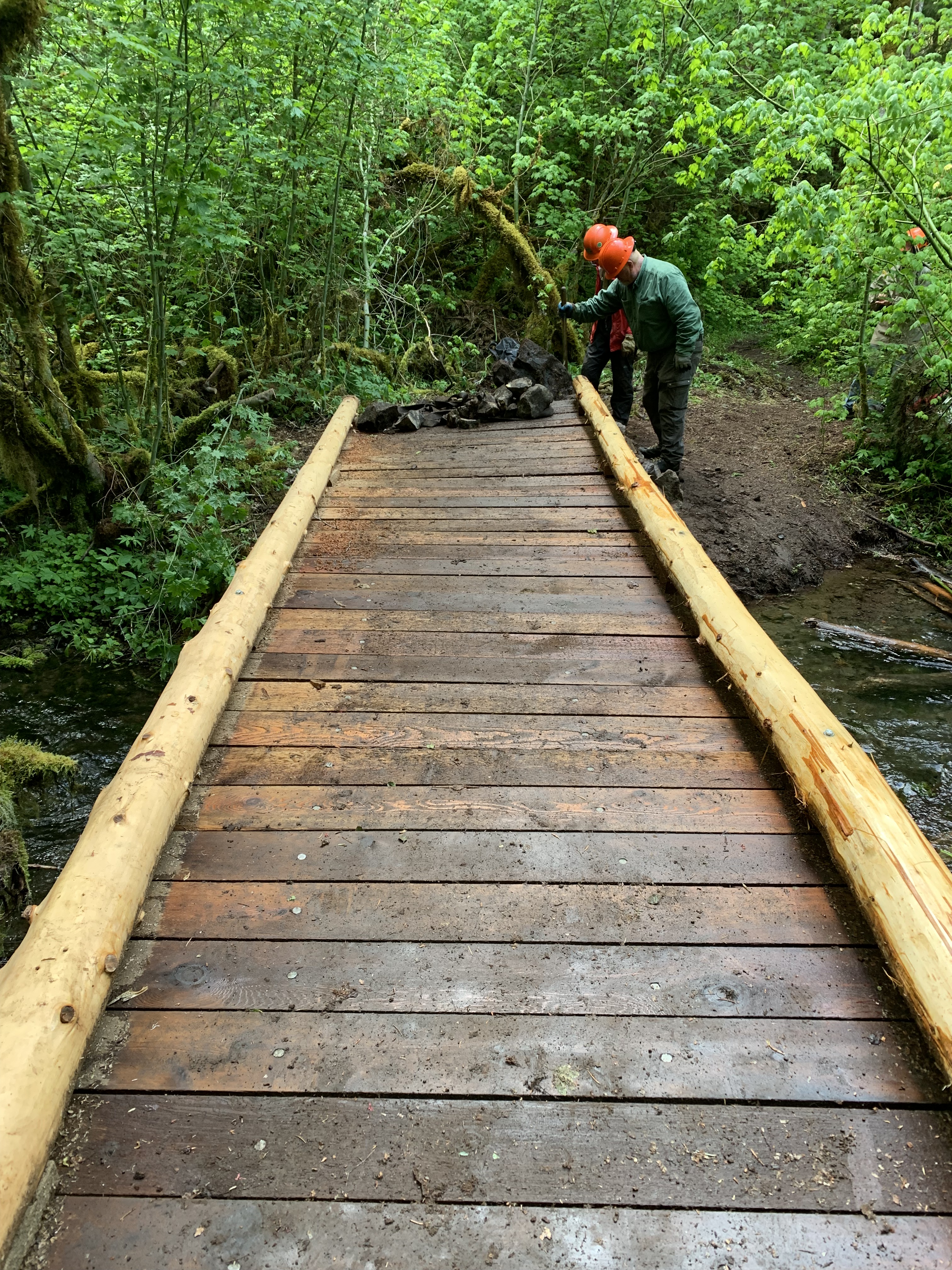
We got to the worksite 60 miles later, parking along FS 21. Lot of interesting places out here upriver on the Willamette: Indigo Springs, Chuckle Springs, often called the source instead of a source of the Willamette’s Middle Fork here (there is a North Fork and a Coast Fork); Pioneer Gulch leading to Diamond Peak, and Lake Timponagos. The Middle Fork Trail runs 32 miles from the last, by our work site, to Hills Creek Reservoir. I had hiked and worked much of the trail. The Crew was making a bridge and two puncheons, which were like an elevated bridge. These involved cutting Western Red Cedar, stripping the bark, moving the 1 ton stringer logs by straps, a rope puller, and people to the bridge site, then placing them on smaller logs or sills, perpendicular to the crossing site, leveling everything, pounding large nails through the stringers into the sills, nailing decking, the planks between them, which we had carried in, and finally making ramps at each end.

I have done bridge assembly, but others do it better than I, so I self select and am involved in getting rocks and appropriate mineral soil, moving them to the bridge site and helping build the ramps. The more rocks, the less soil needed, and some of the ramps require a cubic yard of fill. It is exceedingly difficult work. I also help make new trail, and we had a few hundred yards of re-routing to do, because rivers move and can erode existing trail.

In one memorable day, I carried planks a quarter mile down a slippery hill to the worksite and then went back up the hill to get the next—8 times. Then I stripped a 30 foot cedar of bark, followed by rock gathering and hauling. Three of us used a rock sling to haul big rocks, which Ken, by himself, would move into place as a support. We called him when we needed a fourth on the sling. After lunch, I shoveled gravel into buckets and carried them to the ramps. We finally finished the project and removed the dicey log crossing we had used for 3 weeks to cross the stream. I pulled out the larger logs and sent small ones down the stream away from the bridge. We were done with this segment.

But not quite. Before I left, I saw Ken down by the water’s edge. He motioned me to come over. There, I saw two plants by the water, each with an odd-shaped flower, which he told me were wild ginger. I had never seen it, and in eight prior days I had worked here, crossing the stream a couple of dozen times, wading in it with boots once, never studied the growth along the bank. I was focused on other matters. Maybe too focused.

All I had to do was look. It was right there, quiet magic, maybe hoping we would finally leave.

VOLUNTEERS HELPING VOLUNTEERS

May 1, 2025

We had Arc-Lin employees help us out on the Middle Fork project the other day for their thrice annual volunteer stint with us. We are making three trail re-routes to deal with erosion by the Middle Fork of the Willamette River and need to build a bridge and two puncheons, the latter low bridges, over perennial wet areas on the trail.

We arrived at the “user trail” on FS road 21, the 28 mile marker visible, well south of Oakridge. This is an unmaintained path about 200 yards to the Middle Fork Trail, with a significant drop, and we needed to carry a few dozen pieces of decking in, each a 6 by 6 cedar log 6 feet long, carried on a shoulder. I went first to show the second level volunteers where the destination was.

No problem. I knew the trail and got to the dumping off point for the planks with two behind me but back a little ways.  I noted one had two planks on his shoulder.  These guys are young and strong.

We divvied up the work among the group; two groups would do bridge work, I was doing the bypass, the most physical part of the job. Four of us worked on the new trail. It had a small but definitely not to be ignored stream in the middle of its 50 yard length, and there were multiple large rocks which needed to be moved. I did some drainage work then returned to the other end of the bypass to do some more digging. I was under an 8 inch log that was about 40 feet long that needed to cut out with a power saw later. Chase, the strong guy who carried two deck planks, came by a little later and rotated the log maybe 20 degrees. I told him to wait for the saw. He agreed.

The morning passed by quickly, and we had lunch, courtesy of our visitors, who bring it for us as payment for their being abused. While eating, I kept thinking about the log and wondered if we could move it. I process slowly, and Chase had likely forgotten about it, but I had an idea.  The bridge work was going well with the others, who were in the water and using various power tools along with some rebar to hold the stringers to the perpendicular sills. 

After lunch, we returned to our spots, and I called Chase over. He lifted one end of the log, which was wedged between two trees, but it wasn’t going anywhere easily. I went down the hill under the log, took the Pulaski and hacked once at the log. Interesting. It seemed breakable.

“Give me ten whacks,” Chase said. I nodded.

I count things.

The log eventually broke in half, and each of us was able to move one piece. Mine was easier, since it was already off the trail. Chase pushed his into the woods.  The other guys were working on moving several multi-hundred pound rocks, using a pry bar and muscles. I keep forgetting when young people work with us, we need to view the workload differently. Movements we think impossible suddenly become possible.

Chase was wrong about his chopping ability. He needed 25 whacks.

See you on the trail. Hope you enjoy the bypass.

THE CABLE

April 6, 2025

Amazingly, it wasn’t raining, despite the forecast. It sure was wet in the woods, though, and the two streams that we had put bridges across in the past 16 months were really flowing. The Crew was back at Cloverpatch working on the third bridge. 

I had already done some work here, having carried in my share of tools, planks, and one memorable day figured out how to use a small log as a runner for a 1-2 ton stringer to get it to the bridge site. But the last few times out, I was either relegated to, or had the honor of, being the lead for the work party building the trail to the next and last bridge site, a half mile further. After three days with tread tools there we were now within about 50 feet of the end, maybe a bit more given some rerouting that I thought might be necessary.

But on this wet day, I stayed with the rest of the eight person crew, hiking in, debarking cedar logs that would be used for stringers, posts, supports, and rails, a couple hundred linear feet required. Counting the posts, that comprised about 1000 square feet of bark that needing removal, although I was the only one crazy enough to calculate that.

Additionally, we had rock “cribs” needing filling so stringers and sills, the latter large diameter shorter length logs perpendicular to the crossing stringers, would rest minimizing wetness and rotting. We needed to make a ramp at each end for smooth travel at both ends of the 21 foot long bridge. This entailed more rocks, soil to fill in the spaces, and repeating until we had a smooth ramp.

I used a straight draw knife, sharp 10 inch blade, couple inches wide, beveled, handle at each end. Grabbing each handle, one straddled the log, leaned forward, put the blade under the bark, and pulled towards oneself,  strips of bark peeling off. In the right season, strips could be several feet long, but this time of year two feet was good. We cut down to the cambium, worked our way down the log, and rotated it, continuing. I debarked a 12 and a 25 footer and then took a break collecting rocks, which were plentiful in the Tire Creek area. I had filled the lower two feet of the crib several weeks ago mostly by myself. Now, the rocks needed to go above the sills to support the ramp, to take up volume, each rock removing the need for the equivalent volume of mineral soil.

I was not the strongest. Jeff was carrying rocks I would roll, and in some instances he stopped to talk while carrying. Wow. My legs were good, so I could still do my part by carrying smaller rocks with more trips, taking time from that task to knock some rocks out of a root wad with a shovel. Before I knew it, time for lunch. I was beat. Rock work does that.

After eating, I rolled left and gradually stood, now needing to move rocks to the crib on the other side of the bridge. There were no rock shortages there, the distance shorter, but the weight the same. Most of the crew was about a decade younger than I, although Chris was only a year younger. He may be a little slower the past two years, but so am I; there is nothing wrong with his arm strength.

We didn’t finish, which would require more visits, and hiked out a mile and a half with plenty of uphill. For the first part, in addition to my pack, I carried only a light strap. Easy enough. I caught up with Hal, who had stopped, putting down 20 yards of coiled cable for a no longer needed come-a-long. I was polite, asking if he wanted to trade the cable for my light strap. I expected—and hoped—he would say he was fine.

“Would you? To the top of the next hill?” Crap. He’s serious.

I picked up the cable, coiled, 35 pounds plus. I let my right arm take the weight, and I started up the hill. My hiking speed dropped like a stone, and I went uphill about the same rate I could push one.  But I was going to carry it up the hill, and once I got there, I wasn’t going to relinquish it. I would carry it to the trailhead. 

I did make it. I finally felt useful; perhaps this will be another good year.

Constructing the bridge.
Debarking a stringer.